Extended Detection and Response (XDR) Market (2026-2036)
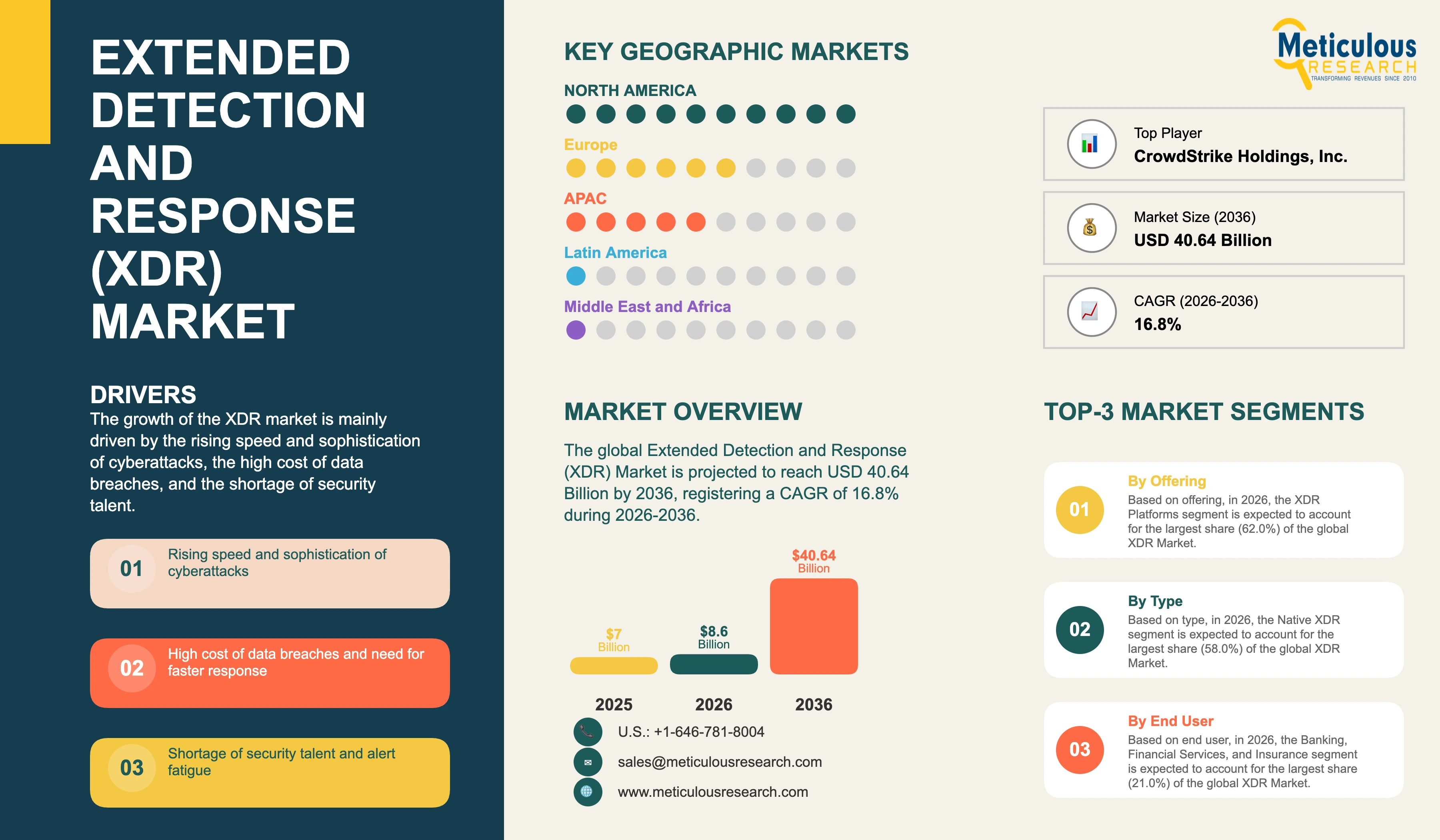
The global extended detection and response (XDR) market was valued at USD 7.00 billion in 2025. This market is expected to reach USD 40.64 billion by 2036 from an estimated USD 8.60 billion in 2026, registering a CAGR of 16.8% during the forecast period (2026-2036).
- Published
- Nov 2026
- Pages
- 269
- Format
- PDF + Excel
- Report ID
- MRICT - 1042542
- Base year
- 2025
- 2025 · BASELINE
- $7.00B
- 2036
- $40.64B
- CAGR 2026–2036
- 16.8%
2025 baseline · 2026–2036 forecast at 16.8% CAGR · hover a bar for the value
Key highlights
CrowdStrike's 2026 Global Threat Report found that the average eCrime breakout time, the time an attacker takes to move from initial access to other systems, fell to 29 minutes in 2025, with the fastest observed breakout taking only 27 seconds, while 82% of detections were malware-free and attacks by AI-enabled adversaries rose by 89%.
IBM's Cost of a Data Breach Report 2025 found that the global average cost of a data breach was USD 4.44 million and the average cost in the U.S. reached a record USD 10.22 million, while organizations that made extensive use of security AI and automation saved an average of USD 1.9 million per breach and shortened the breach lifecycle by about 80 days.
The IBM report also found that the average time to identify and contain a breach fell to 241 days, a nine-year low, with 181 days to identify and 60 days to contain, which shows that faster detection and response remain a major opportunity for organizations.
Palo Alto Networks reported that its Cortex XSIAM security operations platform reached about 400 customers by the end of its fiscal 2025, with average annual recurring revenue per customer above USD 1 million, which shows the strong demand for AI-driven, unified detection and response platforms.
Regulations such as the EU NIS2 Directive, the EU Digital Operational Resilience Act, which has applied to financial entities since January 2025, and the U.S. SEC's cybersecurity disclosure rules require organizations to detect, manage, and report significant incidents quickly, which supports investment in detection and response capabilities.
Leading security vendors are adding generative and agentic AI to their XDR platforms, including AI assistants that summarize incidents and autonomous agents that triage alerts and carry out investigation steps, while the industry continues to consolidate, as shown by Sophos' acquisition of Secureworks and its Taegis XDR platform, completed in 2025.
By offering, XDR platforms account for the largest share of 62.0% in 2026, while managed XDR services register the highest CAGR.
By type, native XDR accounts for the largest share in 2026, while open and hybrid XDR registers the highest CAGR.
By end user, banking, financial services, and insurance account for the largest share of 21.0% in 2026, while manufacturing registers the highest CAGR.
By geography, North America accounts for the largest share of 44.0% in 2026, while Asia-Pacific registers the highest CAGR of 20.1%.
Report summary
| Particulars | Details |
|---|---|
| Base Year | 2025 |
| Estimated Year | 2026 |
| Forecast Period | 2026-2036 |
| Market Size in 2025 | USD 7.00 billion |
| Market Size in 2026 | USD 8.60 billion |
| Market Size by 2036 | USD 40.64 billion |
| CAGR (2026-2036) | 16.8% |
| Format | PDF, Excel & Cloud Portal · 269 pages |
| Largest Segment by Offering (2026) | XDR Platforms (62.0%) |
| Largest Segment by End User (2026) | Banking, Financial Services, and Insurance (21.0%) |
| Largest Region (2026) | North America (44.0%) |
| Fastest-Growing Region | Asia-Pacific (CAGR 20.1%) |
| Segments Covered | Offering, Type, Deployment Mode, Organization Size, End User, and Geography |
| Geographic Scope | North America, Europe, Asia-Pacific, Latin America, and Middle East and Africa |
| Key Companies Profiled | CrowdStrike, Microsoft, Palo Alto Networks, SentinelOne, Trend Micro, Cisco, Sophos, Trellix, Fortinet, Check Point, Bitdefender, ESET, Stellar Cyber, Arctic Wolf, and WithSecure |
Report overview
Segments covered: offering, type, deployment mode, organization size, end user.
The growth of this market is mainly driven by the rising speed and sophistication of cyberattacks, including identity-based and malware-free intrusions that siloed security tools struggle to detect, the high cost of data breaches, the shortage of skilled security analysts, which pushes organizations toward platforms that correlate alerts and automate response, the consolidation of security tools onto unified platforms, the use of artificial intelligence in security operations, and stricter cybersecurity regulations and incident reporting rules, such as the EU NIS2 Directive, the Digital Operational Resilience Act, and the U.S. Securities and Exchange Commission's cybersecurity disclosure rules. However, factors such as high implementation costs and complexity, integration challenges with existing security tools, concerns about vendor lock-in, and the risk of concentrating security operations on a single platform are expected to restrain the growth of this market to some extent.
Extended detection and response (XDR) is a security approach that collects and correlates data from multiple security layers, such as endpoints, identities, email, networks, cloud workloads, and applications, to detect threats more accurately and respond to them faster than separate tools can. XDR evolved from endpoint detection and response (EDR), which focuses on endpoints, by extending visibility and response across the wider IT environment. XDR platforms use analytics, machine learning, and increasingly generative and agentic artificial intelligence to detect suspicious activity, group related alerts into incidents, investigate root causes, and automate response actions, such as isolating devices, disabling accounts, or blocking network traffic.
This market covers the global revenue from XDR platforms, managed XDR services, and related professional services, measured in value. It includes native XDR, in which a single vendor provides the security controls and the XDR platform, and open and hybrid XDR, which integrate data from third-party security tools. It is segmented by offering, type, deployment mode, organization size, end user, and geography. Standalone endpoint protection platforms, standalone EDR products not sold as part of an XDR offering, standalone security information and event management (SIEM) systems, and general managed security services that do not include XDR are not included.
Security teams face growing challenges that make it harder to detect and stop attacks in time. Organizations use many separate security tools, each producing its own alerts, which leads to alert fatigue, missed threats, and slow investigations. Attackers increasingly use stolen credentials, legitimate administration tools, and cloud services rather than traditional malware, which makes their activity harder to detect with any single tool. According to CrowdStrike's 2026 Global Threat Report, 82% of detections in 2025 were malware-free and the average breakout time fell to 29 minutes, which means that defenders must detect and stop attackers within minutes. At the same time, there is a global shortage of skilled security analysts, which makes it difficult for many organizations to run effective security operations centers.
XDR addresses these challenges by combining data from multiple sources on a single platform, correlating alerts into a smaller number of high-confidence incidents, and providing automated investigation and response. This improves detection accuracy, reduces the workload on analysts, and shortens response times. XDR also supports the consolidation of security tools, which can reduce costs and complexity. Many vendors are now combining XDR with SIEM, security orchestration, automation, and response (SOAR), and AI assistants into unified security operations platforms, sometimes called AI-driven security operations centers.
The value of XDR is measured mainly in outcomes, such as the mean time to detect and respond to threats, the number of alerts analysts must handle, and the number of tools an organization needs to operate. Organizations that adopt XDR typically aim to reduce response times from hours or days to minutes, reduce the number of alerts that reach analysts, and retire overlapping tools.
The market includes several types of vendors with different starting points and strengths. Endpoint security leaders, such as CrowdStrike, SentinelOne, Microsoft, Trend Micro, Sophos, Bitdefender, and ESET, have extended their EDR products into XDR platforms. Network and platform security vendors, such as Palo Alto Networks, Cisco, Fortinet, Check Point, and Trellix, offer XDR as part of broader security platforms. Open XDR specialists, such as Stellar Cyber, integrate data from many third-party tools, and managed detection and response providers, such as Arctic Wolf, WithSecure, and Sophos, which acquired Secureworks in 2025, offer XDR as a managed service.
Managed XDR services are growing rapidly because many organizations, particularly small and mid-sized businesses, lack the staff and expertise to operate XDR platforms around the clock. Managed XDR providers monitor customers' environments, investigate alerts, and respond to threats on their behalf, often using the vendor's own platform. Cyber insurance requirements, which increasingly ask for EDR or XDR and 24x7 monitoring, are also driving demand.
Over the forecast period, the XDR market is expected to grow strongly, supported by the growing speed and complexity of attacks, platform consolidation, the use of AI in security operations, and regulatory requirements. North America is expected to remain the largest market, while Asia-Pacific is expected to grow fastest as digital transformation, cyber regulations, and threat activity increase across the region.
Native XDR is expected to account for the largest share of the market in 2026, while open and hybrid XDR is projected to register the highest CAGR as organizations integrate existing security tools.
CrowdStrike's 2026 Global Threat Report found that the average eCrime breakout time fell to 29 minutes in 2025, with the fastest breakout taking 27 seconds, and that 82% of detections were malware-free. This means that organizations must detect and respond to attacks across endpoints, identities, and cloud within minutes, which is the core purpose of XDR.
Managed XDR is a service in which a vendor or service provider operates an XDR platform on behalf of a customer, providing round-the-clock monitoring, threat hunting, investigation, and response. It is popular with organizations that lack in-house security staff.
AI is used to detect threats, correlate alerts, summarize incidents, and automate investigation and response. IBM found that organizations using security AI and automation extensively saved an average of USD 1.9 million per breach, and XDR vendors are adding AI assistants and agents to their platforms.
Report infographic
Market dynamics
16 factors across 5 forcesRising speed and sophistication of cyberattacks
Cyberattacks are becoming faster, more targeted, and harder to detect with traditional security tools. Attackers use stolen credentials, phishing, social engineering, and legitimate remote management and cloud tools to move through networks without triggering traditional malware defenses. According to CrowdStrike's 2026 Global Threat Report, the average eCrime breakout time fell to 29 minutes in 2025, a 65% increase in speed compared with 2024, and the fastest observed breakout took just 27 seconds. The report also found a 37% increase in cloud-conscious intrusions and an 89% increase in attacks by adversaries using AI. Ransomware groups continue to target organizations of all sizes and in all sectors, and nation-state actors target governments, critical infrastructure, and technology companies.
Detecting these attacks requires correlating signals across endpoints, identities, email, cloud, and networks, because each signal on its own may look harmless. XDR platforms are designed to do this, and they can automatically contain threats before attackers can cause major damage. The growing speed and sophistication of attacks is therefore a key driver of XDR adoption across all industries.
Attackers are also targeting the tools and services that organizations rely on, such as remote access software, cloud identity providers, software supply chains, and, increasingly, AI systems and development platforms. Each new attack surface adds to the volume of security data that must be analyzed, which strengthens the case for platforms that bring this data together and apply consistent detection logic and automated response.
High cost of data breaches and need for faster response
Data breaches remain very expensive for organizations of every size and in every industry. IBM's Cost of a Data Breach Report 2025 found that the global average cost of a data breach was USD 4.44 million and the average cost in the U.S. reached a record USD 10.22 million. The report also found that breaches took an average of 241 days to identify and contain, and that breaches with longer lifecycles cost significantly more than those resolved quickly. Organizations that made extensive use of security AI and automation saved an average of USD 1.9 million per breach and shortened the breach lifecycle by about 80 days.
These findings show the financial value of faster detection and response, which is the core benefit of XDR. Boards and executives increasingly view cybersecurity as a business risk, and they are willing to invest in platforms that reduce the likelihood and impact of breaches. XDR platforms account for the largest share of the market by offering, reflecting this demand.
Shortage of security talent and alert fatigue
Organizations around the world struggle to recruit and retain skilled security analysts, and security operations teams are overwhelmed by large volumes of alerts from many tools, many of which are false positives. This leads to burnout, missed threats, and slow investigations. XDR platforms reduce this burden by correlating alerts into incidents, prioritizing the most serious threats, providing context for investigations, and automating routine response actions.
AI assistants and agentic AI capabilities, which can summarize incidents, answer analysts' questions, and carry out investigation steps, are further improving analyst productivity. For organizations that lack in-house expertise, managed XDR services provide round-the-clock monitoring and response by experienced analysts. Managed XDR services form the fastest-growing offering in this market.
Security tool consolidation and platform strategies
Many organizations use dozens of security tools from different vendors, which increases costs, complexity, and integration challenges. Chief information security officers are increasingly consolidating tools onto integrated platforms to improve visibility, simplify operations, and reduce costs. Major security vendors, such as Palo Alto Networks, CrowdStrike, Microsoft, and Cisco, have pursued platform strategies, offering XDR alongside endpoint, identity, cloud, and network security, and some offer incentives for customers to consolidate.
XDR is at the center of these platform strategies, because it brings data from multiple security controls together for detection and response. Palo Alto Networks reported that its Cortex XSIAM platform reached about 400 customers by the end of its fiscal 2025, with average annual recurring revenue per customer above USD 1 million, which shows strong demand for consolidated security operations platforms.
Consolidation also helps organizations manage security budgets, which are under pressure despite rising threats. By replacing several point products with a single platform, organizations can reduce license, integration, and staffing costs, while improving detection through better data correlation.
Table of contents
13 chapters · 128 sections · 269 pages · click to expandSegmental analysis
| Segment | Largest share (2026) | Fastest growth (2026–2036) |
|---|---|---|
| By Offering | XDR platforms | Managed XDR services |
| By Type | Native XDR | Open and hybrid XDR |
| By Deployment Mode | Cloud-based | — |
| By Organization Size | Large enterprises | — |
| By End User | Banking, financial services, and insurance | Manufacturing |
By Offering
- The XDR platforms segment is expected to account for the largest share of 62.0% of the market.
- The large share of this segment is mainly due to the wide adoption of XDR platforms by large enterprises and government organizations, the strong platform strategies of leading security vendors, and the replacement of separate EDR, network detection, and SIEM tools with integrated platforms.
- XDR platforms are sold mainly as cloud-delivered subscriptions, often priced by endpoint, user, or data volume, and they are frequently bundled with endpoint protection, identity protection, and cloud security.
- Leading vendors, such as CrowdStrike, Microsoft, Palo Alto Networks, SentinelOne, and Trend Micro, are adding AI capabilities and expanding data sources, which increases the value of their platforms.
- XDR platforms are expected to remain the largest offering over the forecast period.
- Platform vendors are investing heavily in AI capabilities, such as natural language search, incident summaries, automated investigations, and AI agents, which increase the value of their platforms and help customers with limited staff.
- They are also expanding data sources to include cloud workloads, identity systems, SaaS applications, and operational technology, and they are adding SIEM capabilities to compete for log management and compliance spending.
- These investments strengthen the position of XDR platforms as the central system for security operations.
- Large enterprises, which account for the largest share by organization size, use XDR platforms to replace or supplement separate EDR, network detection and response, email security analytics, and SIEM tools, and they often deploy XDR across tens or hundreds of thousands of endpoints and identities.
- The value of platforms increases as more data sources are added, which encourages customers to expand their use over time, and vendors use platform pricing and bundles to encourage adoption of additional modules.
- Government organizations are also major buyers, particularly in the U.S., where federal agencies are deploying EDR and XDR under cybersecurity directives.
- However, the managed XDR services segment is projected to register the highest CAGR during the forecast period.
- The rapid growth of this segment is driven by the shortage of security staff and demand from small and mid-sized businesses.
- Professional services make up the rest of the market.
- Managed XDR services include round-the-clock monitoring, threat hunting, investigation, and response delivered by vendors or service providers using XDR platforms.
- Professional services include implementation, integration, detection tuning, training, and incident response support, which are often bought during initial deployment or after a major incident.
By Type
- The native XDR segment is expected to account for the largest share of the market, due to the strong positions of vendors that offer integrated endpoint, identity, cloud, and network security.
- However, the open and hybrid XDR segment is projected to register the highest CAGR during the forecast period, driven by organizations that want to integrate existing tools from several vendors into a single detection and response workflow.
- Native XDR is offered by vendors such as Microsoft, CrowdStrike, Palo Alto Networks, Trend Micro, and SentinelOne, which provide their own endpoint, identity, cloud, and email security controls along with the XDR platform, allowing deep integration and automated response.
- Open and hybrid XDR, offered by vendors such as Stellar Cyber and increasingly by platform vendors that support third-party data, allows organizations to keep existing tools and integrate them into a single detection and response platform.
By Deployment Mode
- The cloud-based segment is expected to account for the largest share of the market and is also projected to register the higher CAGR, driven by the scalability and ease of cloud-delivered platforms.
- On-premises and hybrid deployments remain important for government and regulated organizations.
- Cloud-based XDR platforms can scale easily, receive continuous updates, and use cloud-based analytics and AI, which makes them the preferred choice for most organizations, including many government agencies that now accept cloud services with appropriate security authorizations.
- On-premises and hybrid deployments are used by organizations with strict data residency, classified networks, or air-gapped environments.
By Organization Size
- The large enterprises segment is expected to account for the largest share of the market, while the small and medium-sized enterprises segment is projected to register the higher CAGR, driven by managed XDR services, cyber insurance requirements, and simplified platforms designed for small IT teams.
By End User
- The banking, financial services, and insurance segment is expected to account for the largest share of 21.0% of the market.
- The large share of this segment is mainly due to the high value of financial data and assets, frequent targeting by cybercriminals and nation-state actors, and strict regulations, such as the EU Digital Operational Resilience Act and financial regulators' cybersecurity requirements.
- Financial institutions typically have mature security operations and large security budgets, and they are early adopters of advanced detection and response platforms.
- Banking, financial services, and insurance is expected to remain the largest end user over the forecast period.
- Banks, insurers, and payment companies face constant attacks, including ransomware, business email compromise, fraud, and nation-state espionage, and they must comply with strict regulations on operational resilience and incident reporting.
- The EU Digital Operational Resilience Act, which has applied since January 2025, requires financial entities to detect, manage, and report major ICT-related incidents, and financial regulators in the U.S., the U.K., Singapore, and other countries have similar requirements.
- Financial institutions also use XDR to consolidate tools and reduce the complexity of their security operations.
- However, the manufacturing segment is projected to register the highest CAGR during the forecast period.
- The rapid growth of this segment is driven by ransomware attacks on manufacturers and the convergence of IT and OT.
- IT and telecommunications, government and defense, healthcare and life sciences, retail and e-commerce, energy and utilities, and other end users make up the rest of the market.
- IT and telecommunications companies are major buyers because they manage large and complex networks and are frequent targets of nation-state actors.
- Government and defense agencies deploy XDR to protect sensitive systems and comply with cybersecurity directives.
- Healthcare and life sciences organizations face frequent ransomware attacks that can disrupt patient care, and they hold sensitive data.
- Retail and e-commerce companies protect payment and customer data, while energy and utilities protect critical infrastructure and operational technology from increasingly frequent attacks.
Geographic analysis
North America
Largest shareIn 2026, North America is expected to account for the largest share of 44.0% of the global XDR market. The large share of this region is mainly due to high cybersecurity spending, the presence of leading XDR vendors, frequent targeting by cybercriminals and nation-state actors, high data breach costs, and regulations such as the SEC's cybersecurity disclosure rules. The U.S. is the largest market in the world for XDR, with strong adoption across financial services, government, healthcare, technology, and retail. The IBM report found that the average cost of a breach in the U.S. reached a record USD 10.22 million in 2025, which encourages investment in detection and response. North America is expected to remain the largest region throughout the forecast period. Most leading XDR vendors, including CrowdStrike, Microsoft, Palo Alto Networks, SentinelOne, Cisco, Fortinet, and Arctic Wolf, are based in the U.S., and the region has a large ecosystem of managed security service providers. U.S. federal agencies have deployed EDR and XDR capabilities under cybersecurity executive orders and directives, and the SEC's cybersecurity disclosure rules require public companies to disclose material cybersecurity incidents within four business days, which increases board-level attention to detection and response. Canada is also investing in cybersecurity, supported by national cyber strategies and growing adoption of managed security services.
Asia-Pacific
Fastest growthAsia-Pacific is projected to register the highest CAGR of 20.1% during the forecast period. Growth is driven by rapid digital transformation, rising cyberattacks, and new cybersecurity laws in Japan, India, Australia, Singapore, and other countries. Japan has strengthened its cybersecurity laws, including active cyber defense legislation, India's Digital Personal Data Protection Act and CERT-In incident reporting rules increase requirements for organizations, and Australia has introduced mandatory ransomware payment reporting under its Cyber Security Act. Singapore, South Korea, and other countries are also tightening cybersecurity requirements, and the region has seen many high-profile attacks on financial institutions, telecommunications companies, and manufacturers.
Europe
Europe holds a significant share, supported by NIS2 and DORA, while Latin America and the Middle East and Africa are growing markets. The EU NIS2 Directive expands cybersecurity requirements to many more sectors and organizations, and DORA sets strict requirements for financial entities. European organizations also value data sovereignty, which supports demand for European vendors and local data hosting.
Latin America
In Latin America, Brazil and Mexico are the largest markets, while in the Middle East, the GCC countries and Israel are investing heavily in cybersecurity.
Competitive landscape
The XDR market is moderately concentrated, with a few large security platform vendors holding significant shares and many specialists. Leading companies include CrowdStrike, Microsoft, Palo Alto Networks, SentinelOne, Trend Micro, Cisco, Sophos, Trellix, Fortinet, Check Point, Bitdefender, ESET, Stellar Cyber, Arctic Wolf, and WithSecure.
Companies compete on detection efficacy, breadth of data sources, AI capabilities, ease of use, integration, managed services, and price.
CrowdStrike, Microsoft, and Palo Alto Networks are the leading platform vendors in this market, each with a large installed base and broad portfolio. CrowdStrike's Falcon platform extends from endpoint protection to identity, cloud, and next-generation SIEM, and the company offers managed services through Falcon Complete. Microsoft Defender XDR benefits from integration with Windows, Microsoft 365, Entra ID, and Sentinel, and is widely used by organizations with Microsoft enterprise agreements. Palo Alto Networks offers Cortex XDR and XSIAM, which combine XDR, SIEM, and automation. SentinelOne offers the Singularity platform with AI-driven detection and Purple AI, while Trend Micro offers Vision One. Cisco, Fortinet, Check Point, and Trellix offer XDR as part of broader security platforms, while Sophos, Arctic Wolf, and WithSecure focus on managed detection and response. Stellar Cyber specializes in open XDR for managed service providers and enterprises.
The top five players are estimated to account for 52.0% of the XDR market in 2025.
Players use several strategies to grow in this market, including platform consolidation, acquisitions, AI investment, and managed services.
For example, vendors are offering platform bundles and incentives that allow customers to consolidate tools, acquiring companies in identity, cloud, and AI security, launching AI agents for autonomous investigation, and expanding managed services and partner programs for managed service providers. Vendors are also investing in partnerships with cloud providers and marketplaces to simplify purchasing.
Competition is expected to center on AI and platform breadth.
Vendors that can combine broad data coverage, effective AI, and strong managed services are expected to gain share, while smaller vendors may focus on specific niches, such as open XDR, small business, or operational technology. Consolidation is expected to continue as large platforms acquire specialists, and pricing pressure may increase as platform vendors bundle XDR with other security products.
Some of the key players operating in the XDR market are CrowdStrike Holdings, Inc., Microsoft Corporation, Palo Alto Networks, Inc., SentinelOne, Inc., Trend Micro Incorporated, Cisco Systems, Inc., Sophos Ltd., Trellix, Fortinet, Inc., Check Point Software Technologies Ltd., Bitdefender, ESET, spol. s r.o., Stellar Cyber, Inc., Arctic Wolf Networks, Inc., and WithSecure Corporation.
- —
Sophos completed its acquisition of Secureworks in 2025, Palo Alto Networks' XSIAM reached about 400 customers, and vendors are adding agentic AI to their XDR platforms.
- CrowdStrike
- Microsoft
- Palo Alto Networks
- SentinelOne
- Trend Micro
- Cisco
- Sophos
- Trellix
- Fortinet
- Check Point
- Bitdefender
- ESET
- Stellar Cyber
- Arctic Wolf
- WithSecure
Expert perspectives
XDR has become a core part of modern security operations, as organizations seek to detect and stop fast-moving attacks across endpoints, identities, cloud, and networks.
The market is shaped above all by the speed and stealth of modern attacks, which leave defenders very little time to act. With average breakout times now measured in minutes and most intrusions malware-free, organizations need detection and response capabilities that correlate signals across many sources and act automatically. XDR provides this capability and is increasingly at the center of security operations, often combined with SIEM and AI-driven automation.
Over the forecast period, the market is expected to grow at about 16.8% per year, supported by AI, platform consolidation, managed services, and regulation.
AI is expected to be the most important factor shaping the market. AI assistants and agents can greatly increase the productivity of security teams, and vendors with large, high-quality security data sets are best placed to build effective AI. At the same time, organizations will need to build trust in AI-driven decisions and keep human oversight of critical actions.
XDR platforms are the largest offering, while managed XDR grows fastest. BFSI is the largest end user, while manufacturing grows fastest.
Managed XDR is expected to grow fastest because of the shortage of security staff and growing demand from small and mid-sized businesses, while open and hybrid XDR is expected to grow faster than native XDR as organizations seek to integrate existing tools. Manufacturing, healthcare, and energy are expected to see strong growth as threats to operational technology and critical services increase.
North America remains the largest region, while Asia-Pacific is the fastest-growing region at a CAGR of 20.1%.
North America benefits from high security spending, high breach costs, and the presence of leading vendors, while Europe is supported by NIS2, DORA, and demand for data sovereignty. Asia-Pacific offers the fastest growth because of digital transformation, rising attacks, and new cybersecurity laws, while Latin America and the Middle East and Africa offer growing opportunities.
For vendors, the key priorities are AI, data breadth, and managed services.
For security leaders, the key priorities are to consolidate tools where it improves detection and reduces costs, to adopt AI carefully with clear oversight, to maintain resilience against vendor failures, and to consider managed services where in-house capacity is limited. Overall, XDR is expected to remain one of the fastest-growing segments of the cybersecurity market over the forecast period, as it becomes the main system through which organizations detect, investigate, and respond to threats.
Customer perspectives
Chief Information Security Officer - Regional bank, U.S.
We consolidated EDR, identity protection, and our SIEM onto one platform. Our analysts now see one incident instead of fifty alerts.
This explains why XDR platforms account for 62.0% of the market and banking, financial services, and insurance account for 21.0%.
For financial institutions, consolidation improves both detection and the ability to meet regulatory incident reporting deadlines, which is why they are among the earliest and largest buyers of XDR platforms.
This explains why managed XDR and manufacturing are growing fastest.
For mid-sized manufacturers, ransomware that stops production is the main risk, and managed XDR gives them round-the-clock protection without hiring a full security team.
This explains why AI-driven security operations are a key opportunity and why Asia-Pacific is the fastest-growing region in this market.
Chief Information Officer - Hospital group, U.K.
After the outage in 2024, we reviewed our dependence on a single vendor, but we still see a unified platform as the best way to protect patient services.
This shows that resilience and vendor concentration are important considerations for buyers, even as they continue to consolidate on XDR platforms, and why healthcare is among the faster-growing end users.
“We do not have a security team that works around the clock, so managed XDR was the only realistic option for us.”
“Attackers move in minutes now. We use AI-driven triage and automated containment so that our analysts can focus on the incidents that really matter.”
Frequently asked questions
The market was valued at USD 7.00 billion in 2025 and USD 5.60 billion in 2024, and is estimated at USD 8.60 billion in 2026.
Cite this report
Meticulous Research. (2026). Extended Detection and Response (XDR) Market - Global Opportunity Analysis and Industry Forecast (2026-2036) (Report No. MRICT - 1042542). Meticulous Market Research Pvt. Ltd. https://www.meticulousresearch.com/product/extended-detection-and-response-xdr-market-7225