Data Security Posture Management (DSPM) Market (2026-2036)
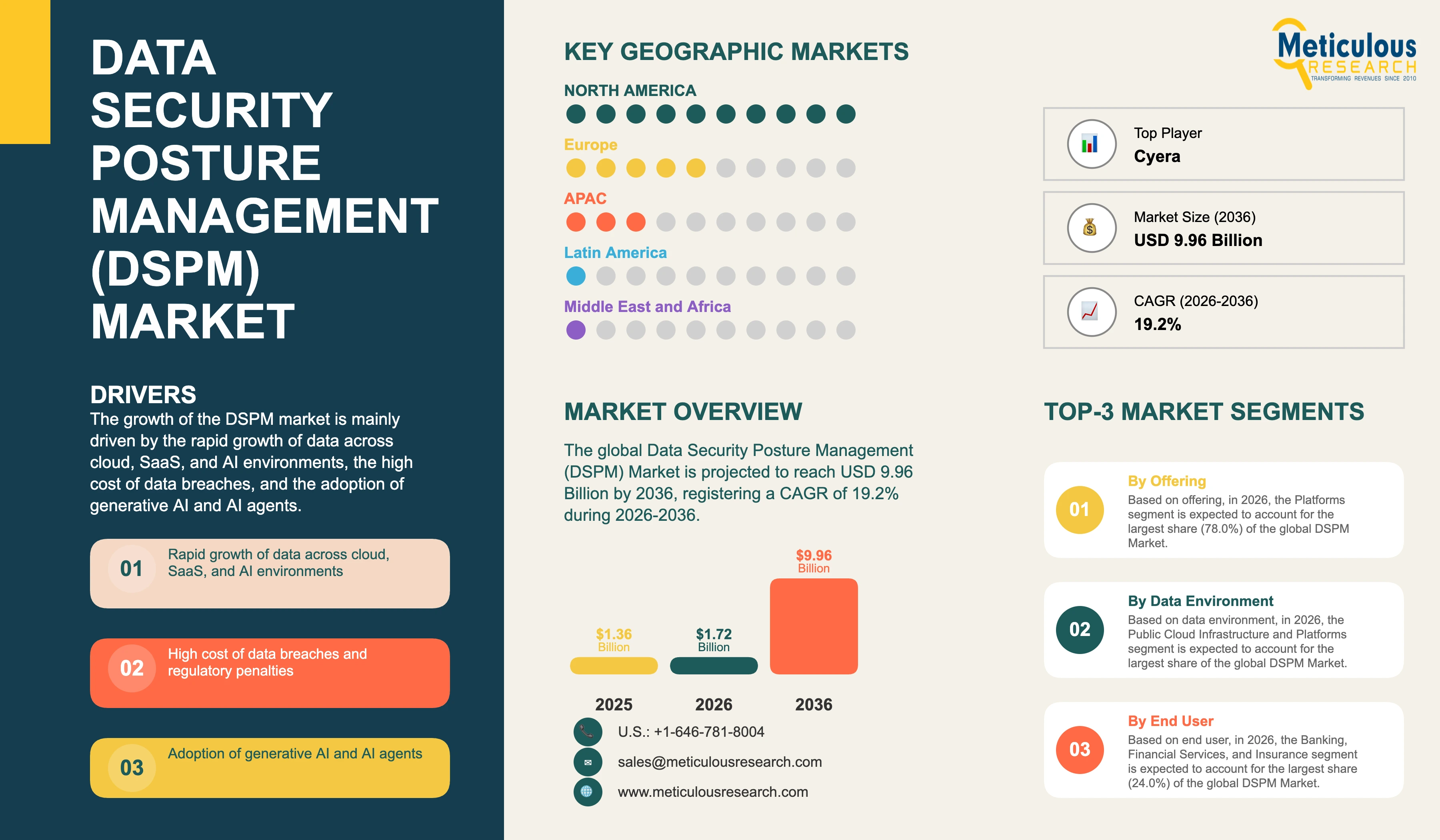
The global data security posture management (DSPM) market was valued at USD 1.36 billion in 2025. This market is expected to reach USD 9.96 billion by 2036 from an estimated USD 1.72 billion in 2026, registering a CAGR of 19.2% during the forecast period (2026-2036).
- Published
- Nov 2026
- Pages
- 256
- Format
- PDF + Excel
- Report ID
- MRICT - 1042522
- Base year
- 2025
- 2025 · BASELINE
- $1.36B
- 2036
- $9.96B
- CAGR 2026–2036
- 19.2%
2025 baseline · 2026–2036 forecast at 19.2% CAGR · hover a bar for the value
Key highlights
IBM's Cost of a Data Breach Report 2025 found that the global average cost of a data breach was USD 4.44 million and the U.S. average reached a record USD 10.22 million, while 13% of organizations reported breaches of AI models or applications and 97% of those organizations lacked proper AI access controls.
Cyera, one of the leading specialist DSPM vendors, raised USD 400 million at a USD 9 billion valuation in January 2026 and a further USD 600 million at a USD 12 billion valuation in June 2026, which shows the strong investor confidence in data security platforms built around DSPM and the rapid growth of leading specialist vendors.
Veeam completed its USD 1.725 billion acquisition of Securiti AI, a DSPM, privacy, and AI governance vendor, in December 2025, following earlier acquisitions of DSPM start-ups by Palo Alto Networks (Dig Security), Rubrik (Laminar), CrowdStrike (Flow Security), Netskope (Dasera), and Proofpoint (Normalyze), which shows that DSPM is becoming a core capability of broader security and data resilience platforms.
Google completed its USD 32 billion acquisition of Wiz in March 2026, bringing a cloud security platform that includes data security posture capabilities into Google Cloud, which highlights the convergence of DSPM with cloud-native application protection platforms.
DSPM vendors are rapidly adding AI security posture management, data loss prevention, and data detection and response capabilities, positioning their platforms as the data trust layer for enterprise AI, while cloud providers and large security vendors are building DSPM into their native security services.
Regulations such as the EU AI Act, the Digital Operational Resilience Act, which has applied to financial entities since January 2025, PCI DSS 4.0, whose future-dated requirements became mandatory in March 2025, and India's Digital Personal Data Protection Rules require organizations to know where sensitive data is stored and to protect it, which supports demand for DSPM.
By offering, platforms account for the largest share of 78.0% in 2026, while services register the higher CAGR.
By data environment, public cloud infrastructure and platforms account for the largest share in 2026, while AI and LLM data pipelines register the highest CAGR.
By end user, banking, financial services, and insurance account for the largest share of 24.0% in 2026, while healthcare and life sciences register the highest CAGR.
By geography, North America accounts for the largest share of 52.0% in 2026, while Asia-Pacific registers the highest CAGR of 23.5%.
Report summary
| Particulars | Details |
|---|---|
| Forecast Period | 2026-2036 |
| Base Year | 2025 |
| Estimated Year | 2026 |
| CAGR (Value) | 19.2% |
| Format | PDF, Excel & Cloud Portal · 256 pages |
| Market Size (Value) in 2025 | USD 1.36 billion |
| Market Size (Value) in 2026 | USD 1.72 billion |
| Market Size (Value) in 2036 | USD 9.96 billion |
| Segments Covered | Offering, Deployment Mode, Data Environment, Organization Size, End User, and Geography |
| Countries Covered | North America, Europe, Asia-Pacific, Latin America, and Middle East and Africa |
| Key Companies | Cyera, Microsoft, Varonis, Securiti (Veeam), BigID, Palo Alto Networks, Wiz (Google), CrowdStrike, Rubrik, Zscaler, Netskope, Proofpoint, Sentra, Concentric AI, and Thales |
| Largest Segment by Offering (2026) | Platforms (78.0%) |
| Largest Segment by End User (2026) | Banking, Financial Services, and Insurance (24.0%) |
| Largest Region (2026) | North America (52.0%) |
| Fastest-Growing Region | Asia-Pacific (CAGR 23.5%) |
Report overview
Segments covered: offering, deployment mode, data environment, organization size, end user.
The growth of this market is mainly driven by the rapid growth of sensitive data spread across multiple clouds, SaaS applications, data warehouses, and on-premises systems, the rise of shadow data that security teams cannot see, the high cost of data breaches, the fast adoption of generative AI and AI agents that need access to enterprise data, and tighter data protection and cybersecurity regulations, such as the EU General Data Protection Regulation, the Digital Operational Resilience Act, the NIS2 Directive, the EU AI Act, U.S. state privacy laws, PCI DSS 4.0, and India's Digital Personal Data Protection Rules. However, factors such as overlap with existing cloud security, data loss prevention, and data governance tools, the cost and complexity of scanning very large data estates, the shortage of skilled staff, and concerns about granting scanning tools access to sensitive data are expected to restrain the growth of this market to some extent.
Data security posture management (DSPM) is a category of security software that automatically discovers where an organization's data is stored, classifies sensitive data such as personal information, financial records, health data, intellectual property, and credentials, maps who and what can access it, and identifies risks such as misconfigured storage, excessive access, unencrypted data, stale copies, and data flowing to places it should not. DSPM tools then prioritize these risks, recommend or automate remediation, and monitor data continuously as it moves across environments. Unlike traditional data security tools that focus on network or endpoint controls, DSPM takes a data-first view, starting from the data itself and working outward to the identities, applications, and infrastructure that can reach it.
This market covers the global revenue from DSPM platforms and related services, measured in value. It includes stand-alone DSPM platforms, DSPM modules sold as part of broader data security, cloud security, and data resilience platforms where they can be separately identified, and professional and managed services for DSPM deployment and operation. It is segmented by offering, deployment mode, data environment, organization size, end user, and geography. General cloud security posture management, data loss prevention, backup, and data governance products that do not include data discovery, classification, and risk analysis for security purposes are not included.
The need for DSPM has grown as data has spread across many environments. Organizations now store data in multiple public clouds, hundreds of SaaS applications, data warehouses and data lakes such as Snowflake and Databricks, development and test environments, backups, and on-premises file shares and databases. Developers and data teams create copies of data for analytics, testing, and AI projects, often without the knowledge of security teams, which leads to large volumes of shadow data that is unmonitored and poorly protected. Traditional data security tools were designed for on-premises environments and cannot keep up with the speed and scale of cloud data, which has created a gap that DSPM fills.
Generative AI has added new urgency to the problem of data visibility and control. Organizations are connecting large language models, copilots, and AI agents to enterprise data through retrieval-augmented generation, training, and fine-tuning, which can expose sensitive data to users or systems that should not see it if access permissions are too broad. IBM's Cost of a Data Breach Report 2025 found that 13% of organizations reported breaches of AI models or applications and that 97% of those organizations lacked proper AI access controls. DSPM tools help organizations understand what data AI systems can reach, label sensitive data, and enforce controls before AI is deployed, which has made DSPM a key part of AI security and governance programs.
The market includes several types of vendors that approach data security posture from different starting points. Specialist DSPM and data security platform vendors, such as Cyera, BigID, Sentra, Concentric AI, and Varonis, focus on data discovery, classification, and risk analysis. Cloud security and platform vendors, such as Palo Alto Networks, Wiz (now part of Google Cloud), CrowdStrike, Zscaler, Netskope, and Microsoft, offer DSPM as part of broader cloud, network, or endpoint security platforms. Data resilience vendors, such as Veeam through Securiti and Rubrik through Laminar, combine DSPM with backup and recovery. Email and data protection vendors, such as Proofpoint, and data security vendors such as Thales through Imperva, add DSPM to their data protection portfolios.
DSPM is rapidly converging with adjacent data security, identity, and AI security categories. Many vendors now combine DSPM with data loss prevention, data detection and response, identity and access governance, and AI security posture management into unified data security platforms. This convergence reflects customer demand for fewer tools and for a single view of data risk across all environments, and it has led to a wave of acquisitions and large funding rounds in the market.
Over the forecast period, the DSPM market is expected to grow strongly, supported by data growth, cloud and AI adoption, regulation, and platform consolidation. North America is expected to remain the largest market, while Asia-Pacific is expected to grow fastest as cloud adoption and data protection laws expand across the region.
Our developers copy production data into test and analytics environments all the time. We needed a tool that finds those copies automatically and tells the right team to clean them up.
This explains why public cloud infrastructure and platforms account for the largest share by data environment and why automated remediation workflows are a key buying criterion.
The new data protection rules mean we must know exactly where customer data sits and who can see it. DSPM gives us that map across our clouds and SaaS tools.
This explains why Asia-Pacific is the fastest-growing region and why regulation is a major driver of DSPM adoption in emerging markets.
Public cloud infrastructure and platforms are expected to account for the largest share of the market in 2026, while AI and LLM data pipelines are projected to register the highest CAGR as organizations connect generative AI and AI agents to enterprise data.
DSPM starts from the data, discovering and classifying sensitive data and mapping who can access it. Data loss prevention focuses on blocking sensitive data from leaving the organization, while cloud security posture management focuses on misconfigurations in cloud infrastructure. Many vendors now combine these capabilities in unified platforms.
AI copilots and agents need access to enterprise data, and if permissions are too broad they can expose sensitive information. DSPM helps organizations find sensitive data, fix excessive access, and monitor what AI systems can reach. IBM found that 97% of organizations that reported AI-related breaches lacked proper AI access controls.
Key regulations include GDPR, DORA, NIS2, and the EU AI Act in Europe, U.S. state privacy laws, HIPAA, and the SEC's cybersecurity disclosure rules, PCI DSS 4.0, India's Digital Personal Data Protection Rules, and data protection laws across Asia-Pacific, Latin America, and the Middle East.
Report infographic
Market dynamics
16 factors across 5 forcesRapid growth of data across cloud, SaaS, and AI environments
Organizations are generating and storing more data than ever, and this data is increasingly spread across multiple public clouds, SaaS applications, data warehouses, data lakes, development environments, and on-premises systems. Data is copied, moved, and transformed constantly by applications, analytics pipelines, and AI workloads, and much of it contains sensitive information. Security teams often do not know where all their sensitive data is, who can access it, or how it is protected, which makes it difficult to prevent breaches and comply with regulations.
DSPM addresses this visibility gap by automatically discovering and classifying data across environments, including shadow data that security teams did not know existed, and by mapping access and exposure. As data volumes and the number of data stores continue to grow, demand for automated discovery and posture management is expected to increase. Public cloud infrastructure and platforms account for the largest share of the market by data environment, reflecting the large volume of sensitive data stored in cloud object storage, databases, and analytics services.
Data sprawl also increases costs, since organizations pay to store redundant, obsolete, and trivial data that they no longer need. DSPM tools help identify such data so that it can be deleted or archived, which reduces both risk and storage costs and gives security teams an additional business case when seeking budget for DSPM programs.
High cost of data breaches and regulatory penalties
Data breaches remain expensive and damaging for organizations in every industry and region. IBM's Cost of a Data Breach Report 2025 found that the global average cost of a data breach was USD 4.44 million and that the average cost in the U.S. reached a record USD 10.22 million. Breaches involving data stored across multiple environments and shadow data are often harder to detect and contain, which increases costs. In addition to direct costs, breaches can lead to regulatory fines, lawsuits, loss of customer trust, and damage to brand reputation.
Regulators around the world are increasing the enforcement of data protection and privacy laws. Fines under the EU General Data Protection Regulation have reached hundreds of millions of euros for some companies, and U.S. state privacy laws, sector regulations, and the SEC's cybersecurity disclosure rules add further obligations. Reducing the exposure of sensitive data is one of the most effective ways to reduce breach costs and regulatory risk, which drives investment in DSPM.
Adoption of generative AI and AI agents
The rapid adoption of generative AI, copilots, and AI agents is one of the most important drivers of the DSPM market. AI systems need access to large amounts of enterprise data to be useful, and organizations are connecting them to file shares, SaaS applications, databases, and knowledge bases. If permissions are too broad or sensitive data is not labeled, AI tools can surface confidential information to employees, customers, or attackers, and sensitive data can be used in training or fine-tuning without proper controls.
DSPM tools help organizations prepare their data for AI by identifying sensitive data, cleaning up excessive permissions, labeling data, and monitoring what AI systems can access. Many vendors have added AI security posture management capabilities that discover AI models, data pipelines, and agents and assess their data risks. AI and LLM data pipelines form the fastest-growing data environment in this market, reflecting the speed of AI adoption.
Tighter data protection and cybersecurity regulations
Data protection and cybersecurity regulations are expanding to more countries and sectors and becoming stricter. The EU General Data Protection Regulation requires organizations to know what personal data they hold and to protect it, while the Digital Operational Resilience Act, NIS2 Directive, and EU AI Act add requirements for financial entities, critical sectors, and AI systems. In the U.S., about 20 states have comprehensive privacy laws, and sector rules such as HIPAA and the SEC's cybersecurity disclosure rules apply. PCI DSS 4.0, whose future-dated requirements became mandatory in March 2025, requires organizations to identify and protect cardholder data. India's Digital Personal Data Protection Rules, China's data security and personal information laws, and new laws in other countries are also increasing requirements.
DSPM helps organizations meet these requirements by providing an up-to-date inventory of sensitive data, showing where regulated data is stored and who can access it, and producing evidence for audits. Compliance is therefore a major reason for DSPM adoption, particularly in regulated industries such as financial services and healthcare.
Cross-border data transfer rules and data localization requirements in countries such as China, India, Indonesia, Saudi Arabia, and Vietnam also require organizations to know where data is stored and how it flows, which DSPM helps to document and monitor.
Table of contents
13 chapters · 131 sections · 256 pages · click to expandSegmental analysis
| Segment | Largest share (2026) | Fastest growth (2026–2036) |
|---|---|---|
| By Offering | Platforms | Rapid growth of this |
| By Deployment Mode | Cloud-based (SaaS) | — |
| By Data Environment | Public cloud infrastructure and platforms | AI and LLM data pipelines |
| By Organization Size | Large enterprises | — |
| By End User | Banking, financial services, and insurance | Healthcare and life sciences |
By Offering
- The platforms segment is expected to account for the largest share of 78.0% of the market.
- The large share of this segment is mainly due to the subscription-based delivery of DSPM software, the growing number of large enterprises deploying DSPM across multiple clouds and SaaS applications, and the expansion of DSPM platforms into data loss prevention, data detection and response, and AI security, which increases the value of each deployment.
- DSPM platforms are typically sold as annual subscriptions priced by data volume, data stores, cloud accounts, or users, and many customers expand their usage over time as they add environments and capabilities.
- Leading platforms provide automated discovery and classification, access mapping, risk prioritization, compliance reporting, and integration with cloud providers, identity systems, ticketing tools, and security operations platforms.
- Specialist vendors such as Cyera, BigID, Varonis, and Sentra compete with DSPM capabilities embedded in broader platforms from Microsoft, Palo Alto Networks, Wiz, CrowdStrike, Zscaler, Netskope, Veeam, and Rubrik.
- Platforms are expected to remain the largest offering over the forecast period, supported by data growth, AI adoption, and platform consolidation.
- Platform adoption usually begins with discovery and classification in one environment, such as AWS or Microsoft 365, and then expands to additional clouds, SaaS applications, data platforms, and on-premises systems, as well as to additional use cases such as compliance reporting, access governance, data loss prevention, and AI security.
- This land-and-expand pattern supports strong net revenue retention for leading vendors.
- Large enterprises are also standardizing on a single data security platform across business units, which increases contract sizes and favors vendors with broad coverage and strong integrations with cloud providers, identity systems, and security operations tools.
- However, the services segment is projected to register the higher CAGR during the forecast period.
- The rapid growth of this segment is driven by demand for help with deployment, data classification policy design, remediation programs, and managed DSPM, particularly among organizations with limited security staff.
- Services include consulting, implementation, integration, training, and managed services delivered by vendors, systems integrators, and managed security service providers.
By Deployment Mode
- The cloud-based (SaaS) segment is expected to account for the largest share of the market and is also projected to register the higher CAGR during the forecast period, driven by the ease of deployment, scalability, and continuous updates of SaaS platforms and by agentless architectures that scan data within customers' cloud accounts.
- The hybrid and on-premises segment remains important for government agencies, financial institutions, and other organizations with strict data residency requirements or large on-premises data estates.
- Most DSPM vendors offer SaaS management consoles with scanning performed either by the vendor or within the customer's own cloud accounts, which combines ease of use with control over data.
- Hybrid deployments use on-premises scanners or connectors for file shares, databases, and mainframes, with results sent to a cloud console.
By Data Environment
- The public cloud infrastructure and platforms segment is expected to account for the largest share of the market, due to the large volume of sensitive data stored in cloud object storage, managed databases, and other cloud services on AWS, Microsoft Azure, Google Cloud, and Oracle Cloud.
- However, the AI and LLM data pipelines segment is projected to register the highest CAGR during the forecast period, driven by the rapid adoption of generative AI, retrieval-augmented generation, and AI agents.
- SaaS applications, data warehouses and data lakes, and on-premises data stores make up the rest of the market, with SaaS and data platforms growing quickly as organizations move more data into Microsoft 365, Salesforce, Snowflake, Databricks, and similar services.
- Public cloud infrastructure and platforms include object storage, managed databases, file systems, and container and serverless environments, where misconfigured storage and excessive access are common causes of breaches.
- SaaS applications include collaboration, CRM, HR, and productivity platforms, where sharing links and broad permissions can expose sensitive data.
- Data warehouses and data lakes hold large volumes of analytics data, often including copies of production data.
- On-premises data stores include file servers, databases, and legacy systems that remain important in many industries.
- AI and LLM data pipelines include training data, vector databases, retrieval-augmented generation sources, and AI agent access paths.
By Organization Size
- The large enterprises segment is expected to account for the largest share of the market, due to their large and complex data estates, regulatory exposure, and security budgets.
- However, the small and medium-sized enterprises segment is projected to register the higher CAGR during the forecast period, driven by simplified offerings, managed services, and growing regulatory requirements for smaller organizations.
- Large enterprises typically deploy DSPM across multiple clouds and business units and integrate it with security operations, identity governance, and privacy programs, while smaller organizations often begin with a single cloud or SaaS environment.
By End User
- The banking, financial services, and insurance segment is expected to account for the largest share of 24.0% of the market.
- The large share of this segment is mainly due to the large volume of sensitive financial and personal data held by banks, insurers, and payment companies, frequent targeting by cybercriminals, and strict regulations, such as the Digital Operational Resilience Act, PCI DSS 4.0, and financial regulators' data protection requirements.
- Financial institutions are moving large amounts of data to cloud platforms and SaaS applications for analytics, customer service, and AI, which increases the need for visibility and control over sensitive data.
- They also have mature security programs and budgets that allow early adoption of new categories such as DSPM.
- Banking, financial services, and insurance is expected to remain the largest end user over the forecast period.
- Banks and insurers use DSPM to locate customer data, card data, and transaction records across cloud and SaaS environments, to reduce the number of employees and systems with access to sensitive data, and to produce evidence for regulators and auditors.
- Many are also using DSPM to prepare data for AI use cases, such as customer service copilots and fraud analytics, where sensitive data must be protected.
- Payment companies use DSPM to meet PCI DSS 4.0 requirements for identifying and protecting cardholder data.
- However, the healthcare and life sciences segment is projected to register the highest CAGR during the forecast period.
- The rapid growth of this segment is driven by large volumes of protected health information, frequent ransomware attacks, and the use of clinical and research data in AI.
- IT and telecommunications, government and public sector, retail and e-commerce, manufacturing, energy and utilities, and other end users make up the rest of the market.
- IT and telecommunications companies hold large volumes of customer and network data and are early adopters of cloud and AI.
- Government agencies use DSPM to protect citizen data and classified information and to meet zero trust requirements.
- Retail and e-commerce companies protect customer and payment data, while manufacturing and energy companies protect intellectual property and operational data.
Geographic analysis
North America
Largest shareIn 2026, North America is expected to account for the largest share of 52.0% of the global DSPM market. The large share of this region is mainly due to early cloud and AI adoption, high data breach costs, the presence of most leading DSPM and cloud security vendors, strong venture capital investment, and regulations such as U.S. state privacy laws, HIPAA, and the SEC's cybersecurity disclosure rules. The U.S. is the largest market in the world for DSPM, with strong adoption across financial services, technology, healthcare, retail, and government. The IBM report found that the average cost of a data breach in the U.S. reached a record USD 10.22 million in 2025, which encourages investment in reducing data exposure. North America is expected to remain the largest region throughout the forecast period. Most leading DSPM vendors, including Cyera, Varonis, BigID, Securiti, Palo Alto Networks, Wiz, CrowdStrike, Rubrik, Zscaler, Netskope, Proofpoint, and Concentric AI, have their headquarters or major operations in the U.S., and the region has seen the largest venture capital investment in data security. U.S. federal agencies are adopting data-centric security as part of zero trust strategies, and about 20 states have comprehensive privacy laws that require organizations to protect personal data. Canada is also strengthening privacy laws and cybersecurity requirements for critical sectors.
Asia-Pacific
Fastest growthAsia-Pacific is projected to register the highest CAGR of 23.5% during the forecast period. Growth is driven by rapid cloud and AI adoption and new data protection laws, such as India's Digital Personal Data Protection Rules, Australia's privacy reforms, and data laws in China, Japan, and Southeast Asia. India's Digital Personal Data Protection Rules, notified in 2025, set out obligations for data fiduciaries that are being phased in, while Australia has strengthened privacy penalties following major data breaches at telecommunications and health insurance companies. Japan, Singapore, South Korea, and other countries are expanding data protection requirements and AI governance frameworks, and hyperscale cloud providers are opening new regions across the area.
Europe
Europe holds a significant share, supported by GDPR, DORA, NIS2, and the EU AI Act, while Latin America and the Middle East and Africa are smaller but growing markets. European organizations place high importance on data sovereignty, which supports demand for in-account scanning and local data hosting. The U.K., Germany, France, and the Netherlands are the largest European markets.
Middle East & Africa
In the Middle East, Israel is a major center of DSPM innovation, home to the founders and research teams of several leading vendors, while the GCC countries are investing in data protection as part of digital transformation programs.
Competitive landscape
The DSPM market is moderately fragmented and consolidating rapidly, with specialist vendors, large security platform vendors, and data resilience vendors. Leading companies include Cyera, Microsoft, Varonis, Securiti (Veeam), BigID, Palo Alto Networks, Wiz (Google), CrowdStrike, Rubrik, Zscaler, Netskope, Proofpoint, Sentra, Concentric AI, and Thales.
Companies compete on discovery coverage, classification accuracy, AI security capabilities, remediation and enforcement, ease of deployment, integration, and price.
Cyera has emerged as the leading specialist, combining DSPM, data loss prevention, identity, and AI security, and it has raised more than USD 2 billion in funding. Microsoft offers DSPM capabilities within Microsoft Purview, which benefit from deep integration with Microsoft 365 and Copilot. Varonis has a long history in data security for file systems and SaaS and has moved to a SaaS platform. Securiti, now part of Veeam, combines DSPM with privacy, governance, and AI trust, while BigID focuses on data discovery, privacy, and AI data governance. Palo Alto Networks, Wiz, CrowdStrike, Zscaler, and Netskope offer DSPM within broader cloud and network security platforms, while Rubrik and Veeam combine DSPM with data resilience. Sentra and Concentric AI are fast-growing specialists, and Thales offers DSPM through Imperva's data security portfolio.
The top five players are estimated to account for 45.0% of the DSPM market in 2025.
Players use several strategies to grow in this market, including acquisitions, platform expansion, AI capabilities, and partnerships with cloud providers.
For example, vendors are acquiring start-ups in data loss prevention and AI security, launching AI security posture management modules, integrating with Microsoft Copilot and other AI platforms, offering their products through cloud marketplaces, and building partner programs with systems integrators and managed security service providers. Specialist vendors are also raising large funding rounds to invest in research and development and global expansion, which supports rapid product innovation.
Competition is expected to center on AI data security and platform breadth.
Vendors that can protect data across all environments, including AI pipelines and agents, and move from visibility to automated protection are expected to gain share. Consolidation is expected to continue, with large security, cloud, and data resilience vendors acquiring specialists, while a few leading specialists grow into broad data security platforms. Price competition may increase as DSPM capabilities are bundled into larger platforms.
Some of the key players operating in the DSPM market are Cyera, Microsoft Corporation, Varonis Systems, Inc., Veeam Software (Securiti), BigID, Inc., Palo Alto Networks, Inc., Wiz, Inc. (Google LLC), CrowdStrike Holdings, Inc., Rubrik, Inc., Zscaler, Inc., Netskope, Inc., Proofpoint, Inc., Sentra, Concentric AI, and Thales Group.
- —
Veeam completed its acquisition of Securiti AI in December 2025, Google completed its acquisition of Wiz in March 2026, and Cyera raised USD 600 million at a USD 12 billion valuation in June 2026.
- Cyera
- Microsoft
- Varonis
- Securiti · Veeam
- BigID
- Palo Alto Networks
- Wiz · Google
- CrowdStrike
- Rubrik
- Zscaler
- Netskope
- Proofpoint
- Sentra
- Concentric AI
- Thales
Expert perspectives
DSPM has moved quickly from a new category to a core part of enterprise data security, driven by cloud data sprawl, AI adoption, and regulation.
The market is driven by a simple problem: most organizations do not know where all their sensitive data is or who can access it, and this problem is getting worse as data spreads across clouds, SaaS applications, and AI systems. DSPM solves this problem with automated discovery and classification, and the rapid growth and large valuations of leading vendors show that buyers see it as a priority. Generative AI has turned data security posture from a compliance concern into a prerequisite for AI adoption, since organizations cannot safely deploy copilots and agents without understanding what data they can access.
Over the forecast period, the market is expected to grow at about 19.2% per year, supported by AI security, platform consolidation, and regulation.
Growth is expected to be strongest in AI and LLM data pipelines, healthcare, small and mid-sized enterprises, and Asia-Pacific. At the same time, DSPM is expected to become a standard feature of broader data security platforms, which means that the boundaries of the market will continue to shift as vendors combine posture management with protection, governance, and resilience.
Platforms are the largest offering, while services grow faster. BFSI is the largest end user, while healthcare grows fastest.
Financial services will remain the largest end user because of the volume of sensitive data and strict regulation, while healthcare is expected to grow fastest as hospitals, insurers, and life sciences companies adopt cloud and AI. Services are expected to grow faster than platforms as organizations seek help with remediation and managed DSPM.
North America remains the largest region, while Asia-Pacific is the fastest-growing region at a CAGR of 23.5%.
North America benefits from early cloud and AI adoption and the presence of leading vendors, while Europe is supported by strict regulation and demand for data sovereignty. Asia-Pacific is expected to grow fastest as new data protection laws take effect and cloud adoption accelerates.
For vendors, the key priorities are AI security, remediation, and platform breadth.
For security leaders, the key priorities are to build a complete and continuously updated inventory of sensitive data, reduce excessive access, prepare data for AI, and assign clear ownership for remediation. Overall, DSPM is expected to become a foundation of enterprise data security and AI governance over the forecast period, as organizations recognize that they cannot protect, govern, or use data safely without first knowing where it is and who can reach it.
Customer perspectives
Chief Information Security Officer - global bank, U.K.
We found millions of sensitive records in cloud storage that no one was tracking. DSPM gave us that visibility and the evidence we need for DORA.
This explains why platforms account for 78.0% of the market and BFSI 24.0%.
For banks, the value of DSPM lies in both reducing breach risk and providing evidence to regulators, which is why financial institutions are among the earliest and largest buyers of DSPM platforms.
Director of Data Protection - hospital network, U.S.
Before we let clinicians use AI copilots, we had to know what patient data they could reach. DSPM showed us where permissions were far too broad.
This explains why AI pipelines and healthcare are growing fastest.
For healthcare organizations, AI adoption and strict privacy rules make it essential to control which systems can reach patient data, which supports rapid growth in this segment.
Frequently asked questions
The market was valued at USD 1.36 billion in 2025 and USD 1.02 billion in 2024, and is estimated at USD 1.72 billion in 2026.
Cite this report
Meticulous Research. (2026). Data Security Posture Management (DSPM) Market - Global Opportunity Analysis and Industry Forecast (2026-2036) (Report No. MRICT - 1042522). Meticulous Market Research Pvt. Ltd. https://www.meticulousresearch.com/product/data-security-posture-management-dspm-market-7205