Digital Lending Platforms Market (2026-2036)
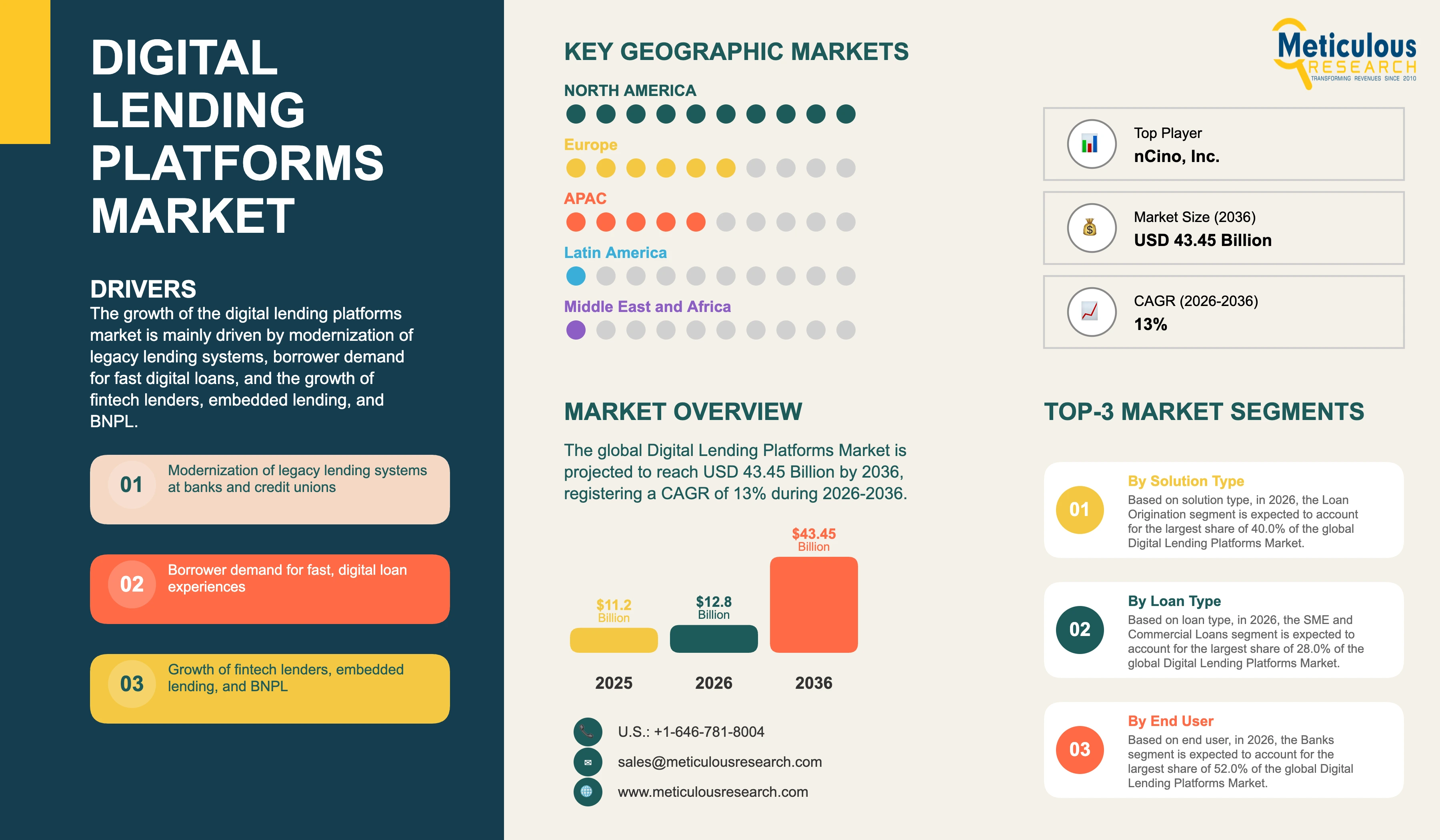
The global digital lending platforms market was valued at USD 11.20 billion in 2025. This market is expected to reach USD 43.45 billion by 2036 from an estimated USD 12.80 billion in 2026, registering a CAGR of 13.0% during the forecast period (2026-2036).
- Published
- Nov 2026
- Pages
- 267
- Format
- PDF + Excel
- Report ID
- MRICT - 1042520
- Base year
- 2025
- 2025 · BASELINE
- $11.20B
- 2036
- $43.45B
- CAGR 2026–2036
- 13.0%
2025 baseline · 2026–2036 forecast at 13.0% CAGR · hover a bar for the value
Key highlights
nCino, a leading provider of cloud-based lending and banking software with more than 2,700 customers worldwide, raised its fiscal 2027 outlook in August 2026 to total revenues of USD 644 million to USD 647 million, while noting that elevated interest rates continued to weigh on demand from U.S. independent mortgage banks, showing both the strength of commercial and consumer lending technology demand and the cyclical pressure on mortgage technology.
The revised EU Consumer Credit Directive, Directive (EU) 2023/2225, which member states had to transpose by November 2025 and which applies from November 2026, extends consumer credit rules to buy now pay later and other small loans, strengthens creditworthiness assessment requirements, and gives consumers rights related to automated credit decisions, which requires lenders across Europe to upgrade their lending platforms, disclosures, and decisioning processes.
The EU Artificial Intelligence Act classifies AI systems used to evaluate the creditworthiness of individuals as high-risk, with requirements for risk management, data quality, documentation, transparency, and human oversight being phased in, which increases demand for explainable, well-governed credit decisioning software.
The Reserve Bank of India consolidated its rules for digital lending in the Reserve Bank of India (Digital Lending) Directions, 2025, which set requirements on disclosures, data handling, loan service providers, and lending apps, as India's digital lending sector continues to grow on the back of its digital public infrastructure, including UPI and the Account Aggregator framework.
Banks and credit unions are consolidating commercial, small business, consumer, and mortgage lending onto unified cloud platforms and adding AI tools for document processing, spreading, credit memo drafting, and portfolio monitoring, with vendors such as nCino reporting that large customers are expanding commitments to AI capabilities.
Open banking and open finance frameworks continue to expand, including the U.K.'s open banking ecosystem, the EU's proposed Financial Data Access regulation, Brazil's open finance system, Australia's Consumer Data Right, and India's Account Aggregator framework, which give lenders consent-based access to bank account and other financial data that can be used for faster and more accurate credit decisions.
By solution type, loan origination accounts for the largest share of 40.0% in 2026, while credit decisioning and risk analytics register the highest CAGR.
By loan type, SME and commercial loans account for the largest share in 2026, while buy now pay later and point-of-sale loans register the highest CAGR.
By end user, banks account for the largest share of 52.0% in 2026, while fintech lenders and NBFCs register the highest CAGR.
By geography, North America accounts for the largest share of 42.0% in 2026, while Asia-Pacific registers the highest CAGR of 16.1%.
Report summary
| Particulars | Details |
|---|---|
| Base Year | 2025 |
| Estimated Year | 2026 |
| Forecast Period | 2026-2036 |
| Market Size in 2025 | USD 11.20 billion |
| Market Size in 2026 | USD 12.80 billion |
| Market Size by 2036 | USD 43.45 billion |
| CAGR (2026-2036) | 13.0% |
| Format | PDF, Excel & Cloud Portal · 267 pages |
| Largest Segment by Solution Type (2026) | Loan Origination (40.0%) |
| Largest Segment by End User (2026) | Banks (52.0%) |
| Largest Region (2026) | North America (42.0%) |
| Fastest-Growing Region | Asia-Pacific (CAGR 16.1%) |
| Segments Covered | Solution Type, Deployment Mode, Loan Type, End User, and Geography |
| Geographic Scope | North America, Europe, Asia-Pacific, Latin America, and Middle East and Africa |
| Key Companies Profiled | nCino, Fiserv, FIS, Temenos, Finastra, ICE Mortgage Technology, Q2 Holdings, Blend Labs, MeridianLink, Abrigo, Pegasystems, Newgen Software, Mambu, Infosys Finacle, and Experian |
Report overview
Segments covered: solution type, deployment mode, loan type, end user.
The growth of this market is mainly driven by the replacement of legacy, paper-based lending processes at banks and credit unions with cloud-based platforms, borrower demand for fast, mobile, and fully digital loan experiences, the rapid growth of fintech lenders and non-bank financial companies, the use of artificial intelligence and alternative data in credit decisioning, open banking and data-sharing frameworks that make borrower data easier to access, embedded lending and buy now pay later at the point of sale, and the expansion of digital credit in emerging markets in Asia-Pacific, Latin America, and Africa. However, factors such as the cost and complexity of replacing core banking and lending systems, data security and privacy risks, regulatory scrutiny of AI-based credit decisions and fintech lending practices, high interest rates that have reduced mortgage volumes, and integration challenges with legacy systems are expected to restrain the growth of this market to some extent.
Digital lending platforms are software solutions that allow banks, credit unions, fintech lenders, non-bank financial companies, and other lenders to manage the lending process digitally, from application and onboarding through credit decisioning, approval, documentation, funding, servicing, collections, and portfolio management. These platforms replace manual, paper-based processes with automated workflows, online and mobile applications, electronic documents and signatures, and integrations with credit bureaus, bank account data, identity verification, and core banking systems. They support many types of loans, including commercial and small business loans, consumer and personal loans, mortgages, auto loans, and buy now pay later and point-of-sale financing.
This market covers the global revenue from digital lending platform software and related services, including loan origination systems, loan servicing and collections software, credit decisioning and risk analytics, lending portfolio management and analytics, and other lending solutions such as digital onboarding and document management for lending, delivered through cloud-based or on-premises deployment, along with implementation, integration, and support services. It is segmented by solution type, deployment mode, loan type, end user, and geography. The value of loans issued, interest income earned by lenders, credit bureau data fees, and general core banking systems that are not specific to lending are not included.
Lending has historically been one of the most manual and paper-heavy processes in banking. Commercial loans often required weeks of document collection, financial spreading, credit analysis, and committee approvals, while consumer loans and mortgages involved many forms, document uploads, and manual checks. Digital lending platforms automate much of this work, allowing lenders to approve simple consumer loans in minutes and to reduce the time needed for complex commercial and mortgage loans. This improves the borrower experience, reduces costs, and helps lenders compete with fintech companies that offer fast, fully digital loans.
Fintech lenders and digital banks have changed borrower expectations across consumer, small business, and point-of-sale lending. Companies such as online personal loan providers, small business lenders, and buy now pay later providers offer simple mobile applications and fast decisions, often using alternative data and machine learning models. Traditional banks and credit unions have responded by investing in digital lending platforms, often provided by specialist vendors such as nCino, MeridianLink, Blend, Q2, and Abrigo, or by large banking technology providers such as Fiserv, FIS, Temenos, Finastra, and Infosys Finacle. In emerging markets, digital lending has grown rapidly through mobile apps and partnerships between banks, NBFCs, and fintech platforms.
Artificial intelligence is becoming central to digital lending, from credit risk assessment to document processing and customer service. Lenders use machine learning models to assess credit risk, detect fraud, and personalize offers, and generative AI tools are being used to extract data from documents, analyze financial statements, draft credit memos, and support loan officers. At the same time, regulators are increasing scrutiny of automated credit decisions. The EU AI Act classifies creditworthiness assessment as a high-risk use of AI, and the revised EU Consumer Credit Directive gives consumers rights related to automated decisions, while U.S. regulators require lenders to explain the reasons for adverse credit decisions. These requirements increase demand for explainable, well-documented decisioning software.
Macroeconomic conditions also affect the market, particularly for loan types that are sensitive to interest rates. Higher interest rates since 2022 have reduced mortgage origination volumes and slowed demand for mortgage technology, particularly among independent mortgage banks in the U.S., while commercial and consumer lending technology has continued to grow. Credit quality concerns have increased demand for portfolio monitoring, early warning, and collections software. Over the longer term, lenders continue to invest in digital lending because it reduces costs and improves competitiveness regardless of the rate cycle.
The market includes specialist lending software vendors, core banking and financial technology providers, credit decisioning and analytics companies, and business process management platforms. Leading companies operating in this market include nCino, Fiserv, FIS, Temenos, Finastra, ICE Mortgage Technology, Q2 Holdings, Blend Labs, MeridianLink, Abrigo, Pegasystems, Newgen Software, Mambu, Infosys Finacle, and Experian.
Over the forecast period, the digital lending platforms market is expected to grow strongly, driven by continued modernization at banks and credit unions, the growth of fintech and embedded lending, AI-based decisioning, and rapid adoption in emerging markets. North America is expected to remain the largest market, while Asia-Pacific is expected to grow fastest at a CAGR of 16.1%.
Report infographic
Market dynamics
16 factors across 5 forcesModernization of legacy lending systems at banks and credit unions
Many banks and credit unions still rely on legacy lending systems, spreadsheets, and paper-based processes that are slow, costly, and difficult to change. These systems make it hard to offer digital applications, integrate with new data sources, or meet changing regulatory requirements. As a result, financial institutions are replacing them with modern digital lending platforms that cover the full loan life cycle and can be updated regularly. Cloud-based platforms are especially attractive because they reduce infrastructure costs, allow faster deployment of new features, and support remote work by loan officers and credit teams.
Banks are also consolidating lending for different products onto unified platforms, so that commercial, small business, consumer, and mortgage lending share common data, workflows, and customer views. nCino, for example, reported in 2026 that many of its largest customers were consolidating more of their critical operations onto its platform and expanding their commitments to its AI capabilities. Banks account for the largest share of the market by end user, and loan origination accounts for the largest share by solution type. Regulatory pressure to improve operational resilience and data quality also encourages banks to replace fragmented legacy systems.
Borrower demand for fast, digital loan experiences
Consumers and small business owners increasingly expect to apply for loans online or on mobile devices, upload documents digitally, receive decisions quickly, and sign loan documents electronically. Fintech lenders and digital banks have set high standards for speed and convenience, and borrowers who face slow or complicated processes may choose other lenders. Digital lending platforms allow traditional lenders to offer pre-filled applications, instant decisions for simpler loans, real-time status updates, and electronic closing, which improves conversion rates and customer satisfaction.
Small businesses in particular have often struggled to obtain credit quickly from traditional banks, and digital platforms that use bank account data, accounting software data, and automated financial analysis can greatly reduce the time and cost of small business lending. SME and commercial loans account for the largest share of the market by loan type, reflecting the high value of commercial lending platforms and the importance of small business credit for banks.
Growth of fintech lenders, embedded lending, and BNPL
Fintech lenders, non-bank financial companies, and digital banks have grown rapidly in consumer lending, small business lending, and point-of-sale financing. These companies are built on digital lending platforms and often license software from specialist vendors or build their own platforms on cloud-native lending cores. Embedded lending, in which credit is offered within non-financial platforms such as e-commerce sites, accounting software, and marketplaces, and buy now pay later at the point of sale are growing quickly and require fast, automated origination and decisioning.
In emerging markets, digital lenders and NBFCs are extending credit to consumers and small businesses that previously had limited access to formal credit, using mobile data, digital payments, and alternative data. Fintech lenders and NBFCs form the fastest-growing end user segment in this market, and buy now pay later and point-of-sale loans form the fastest-growing loan type.
AI, alternative data, and open banking
Advances in artificial intelligence and access to new data sources are transforming credit decisioning. Machine learning models can use bank transaction data, cash flow information, utility and rent payments, and other alternative data to assess borrowers more accurately, including those with limited credit histories. Open banking and data-sharing frameworks, such as those in the U.K., the EU, Brazil, India, and Australia, make it easier for lenders to access borrower data with consent. Generative AI tools automate document processing, financial spreading, and credit memo preparation, which reduces the workload of loan officers and credit analysts.
These capabilities help lenders approve more borrowers, reduce losses, detect fraud, and lower costs, which increases demand for advanced decisioning and analytics software. Credit decisioning and risk analytics form the fastest-growing solution type in this market.
Regulators in several countries are also encouraging the responsible use of alternative data and cash flow information to expand access to credit for underserved borrowers, provided lenders can explain their decisions and manage bias. This combination of new data, better models, and regulatory support is expected to keep demand for advanced decisioning software strong throughout the forecast period, particularly among fintech lenders and banks serving small businesses and thin-file consumers.
Table of contents
12 chapters · 121 sections · 267 pages · click to expandGeographic analysis
North America
Largest shareIn 2026, North America is expected to account for the largest share of 42.0% of the global digital lending platforms market. The large share of this region is mainly due to the large number of banks, credit unions, and mortgage lenders in the U.S. and Canada, high spending on banking technology, the presence of leading lending software vendors such as nCino, Fiserv, FIS, MeridianLink, Blend, Q2, Abrigo, and ICE Mortgage Technology, the large fintech lending sector, and the early adoption of cloud-based lending platforms. The U.S. is the largest national market, with thousands of community banks and credit unions that rely on specialist vendors for digital lending, a large commercial lending market, and the world's largest mortgage market. Although higher interest rates have reduced mortgage technology spending, investment in commercial, small business, and consumer lending platforms has remained strong, and AI adoption is accelerating. North America is expected to remain the largest region throughout the forecast period. Canada also contributes, with banks and credit unions modernizing their lending platforms and preparing for the country's consumer-driven banking framework.
Asia-Pacific
Fastest growthAsia-Pacific is projected to register the highest CAGR of 16.1% during the forecast period. The rapid growth of this region is mainly driven by the rapid expansion of digital lending in India, supported by UPI, the Account Aggregator framework, and the RBI's digital lending rules, the growth of digital banks and fintech lenders in Southeast Asia, Australia's open banking system, the modernization of lending at banks in Japan, and strong demand for consumer and small business credit across the region. In India, banks and NBFCs process very large volumes of small digital loans, and vendors such as Newgen Software and Infosys Finacle serve many regional banks. China has a large digital lending sector led by technology platforms and banks, while Indonesia, Vietnam, and the Philippines are seeing rapid growth in digital consumer credit.
Europe
Europe is the second-largest region, supported by bank modernization programs in the U.K., Germany, France, the Netherlands, and the Nordic countries, mature open banking, the growth of digital banks such as challenger banks in the U.K., and new requirements under the EU Consumer Credit Directive and AI Act, which push lenders to upgrade their platforms.
Latin America
Latin America is growing quickly because of digital lending in Brazil and Mexico, and the Middle East and Africa is supported by digital banks in the Gulf and mobile lending in Africa.
Competitive landscape
The digital lending platforms market is fragmented, with specialist lending software vendors, large banking technology providers, credit decisioning and analytics companies, and business process management platforms. Leading companies operating in this market include nCino, Fiserv, FIS, Temenos, Finastra, ICE Mortgage Technology, Q2 Holdings, Blend Labs, MeridianLink, Abrigo, Pegasystems, Newgen Software, Mambu, Infosys Finacle, and Experian.
Companies compete on product breadth across loan types, ease of use, configuration flexibility, AI capabilities, integration with core banking and data providers, regulatory compliance features, cloud delivery, implementation speed, and customer support. Specialist vendors often lead in particular segments, such as commercial lending, mortgage, or consumer lending for credit unions, while large banking technology providers offer lending as part of broader core banking suites. Cloud-native vendors such as Mambu compete for fintech lenders and digital banks that need flexible lending cores, while business process management vendors such as Pegasystems and Newgen serve banks that want highly configurable workflows.
The top five players are estimated to account for 22.0% of the digital lending platforms market in 2025. This low concentration reflects the many vendors focused on different loan types, institution sizes, and regions, as well as the large number of in-house and regional solutions used by lenders in emerging markets.
Players use several strategies to grow in this market, including adding AI and generative AI features, expanding into new loan types and adjacent solutions such as onboarding and account opening, international expansion, partnerships with cloud providers and fintech companies, and acquisitions. Private equity investment has also been active in the sector, including the agreement to take MeridianLink private in 2025, which reflects investor interest in recurring lending software revenue.
Competition is expected to focus increasingly on AI capabilities, platform breadth, speed of implementation, and the ability to support embedded lending and fintech partners, and consolidation is expected to continue as vendors seek scale and broader product portfolios. Large cloud providers and system integrators also play an important role as partners, helping lenders implement and run lending platforms, and partnerships with data providers, credit bureaus, and identity verification firms are increasingly important for delivering complete solutions.
Some of the key players operating in the digital lending platforms market are nCino, Inc., Fiserv, Inc., Fidelity National Information Services, Inc. (FIS), Temenos AG, Finastra, ICE Mortgage Technology (Intercontinental Exchange, Inc.), Q2 Holdings, Inc., Blend Labs, Inc., MeridianLink, Inc., Abrigo, Pegasystems Inc., Newgen Software Technologies Limited, Mambu GmbH, Infosys Finacle (Infosys Limited), and Experian plc.
- —
The revised EU Consumer Credit Directive began to apply in November 2026, the RBI consolidated its digital lending rules in 2025, MeridianLink agreed to be taken private, and vendors such as nCino expanded AI capabilities as banks consolidated lending onto unified platforms.
- nCino
- Fiserv
- FIS
- Temenos
- Finastra
- ICE Mortgage Technology
- Q2 Holdings
- Blend Labs
- MeridianLink
- Abrigo
- Pegasystems
- Newgen Software
- Mambu
- Infosys Finacle
- Experian
Expert perspectives
Digital lending has become a core priority for banks, credit unions, and fintech lenders, because lending is a major source of revenue and customer relationships and because borrower expectations have changed permanently. Lenders that cannot offer fast, simple, and digital loan experiences risk losing customers, while those that automate lending can reduce costs, improve risk management, and grow loan portfolios profitably. This makes lending technology one of the most resilient areas of banking technology spending, even when overall IT budgets are under pressure.
Over the forecast period, the digital lending platforms market is expected to grow at a CAGR of 13.0%, driven by continued replacement of legacy systems, cloud migration, AI adoption, and rapid growth in emerging markets and fintech lending. Interest rate cycles will continue to affect demand in mortgage technology, but we expect commercial, consumer, and small business lending platforms to grow steadily, and AI to become a major source of new revenue for vendors.
Loan origination remains the largest solution type because every loan begins with an application and decision process, while credit decisioning and risk analytics grow fastest as lenders invest in AI and alternative data. SME and commercial loans remain the largest loan type, while BNPL and point-of-sale loans grow fastest. Banks remain the largest end user, while fintech lenders and NBFCs grow fastest.
North America remains the largest region because of its large banking sector and vendor base, while Asia-Pacific is the fastest-growing region at a CAGR of 16.1%, led by India and Southeast Asia.
For lending software vendors, the key priorities are to build secure, explainable AI into lending workflows, offer unified platforms across loan types, support open banking and embedded lending, and help customers comply with changing regulations. For lenders, the priority is to modernize in phases, starting with the products and processes that offer the greatest returns, such as small business lending and consumer loans, while building strong data foundations and AI governance. We believe that vendors with deep lending expertise, strong AI capabilities, and broad platforms will gain the most as the market grows.
We also expect the boundary between lending platforms and broader banking platforms to blur, as vendors expand into onboarding, account opening, deposits, and treasury management, and as core banking providers strengthen their lending modules. This will intensify competition but also increase the value of each customer relationship. In emerging markets, we expect strong growth from banks and NBFCs that are digitizing lending for the first time, often skipping legacy systems entirely and adopting cloud-native platforms from the start.
Customer perspectives
Chief Lending Officer - Regional bank, U.S.
Over the past two years, we moved commercial, small business, and consumer lending onto one cloud platform, which cut our approval times and gave our bankers a single view of each customer. Now we are adding AI to spread financials and draft credit memos.
Vice President of Lending - Credit union, U.S.
Our members expect to apply for auto and personal loans on their phones and get an answer quickly, so we invested in a digital lending platform that connects to our core system and credit bureaus.
“We use bank statement data and machine learning to approve small loans in minutes, but we must also meet strict RBI rules on disclosures, data handling, and lending app practices, so our platform must support compliance as well as speed.”
Frequently asked questions
The market was valued at USD 11.20 billion in 2025 and USD 9.80 billion in 2024, and is estimated at USD 12.80 billion in 2026. These values cover lending software and related implementation and support services, not the value of loans issued.
Cite this report
Meticulous Research. (2026). Digital Lending Platforms Market - Global Opportunity Analysis and Industry Forecast (2026-2036) (Report No. MRICT - 1042520). Meticulous Market Research Pvt. Ltd. https://www.meticulousresearch.com/product/digital-lending-platforms-market-7203