Europe E-Invoicing Market (2026-2036)
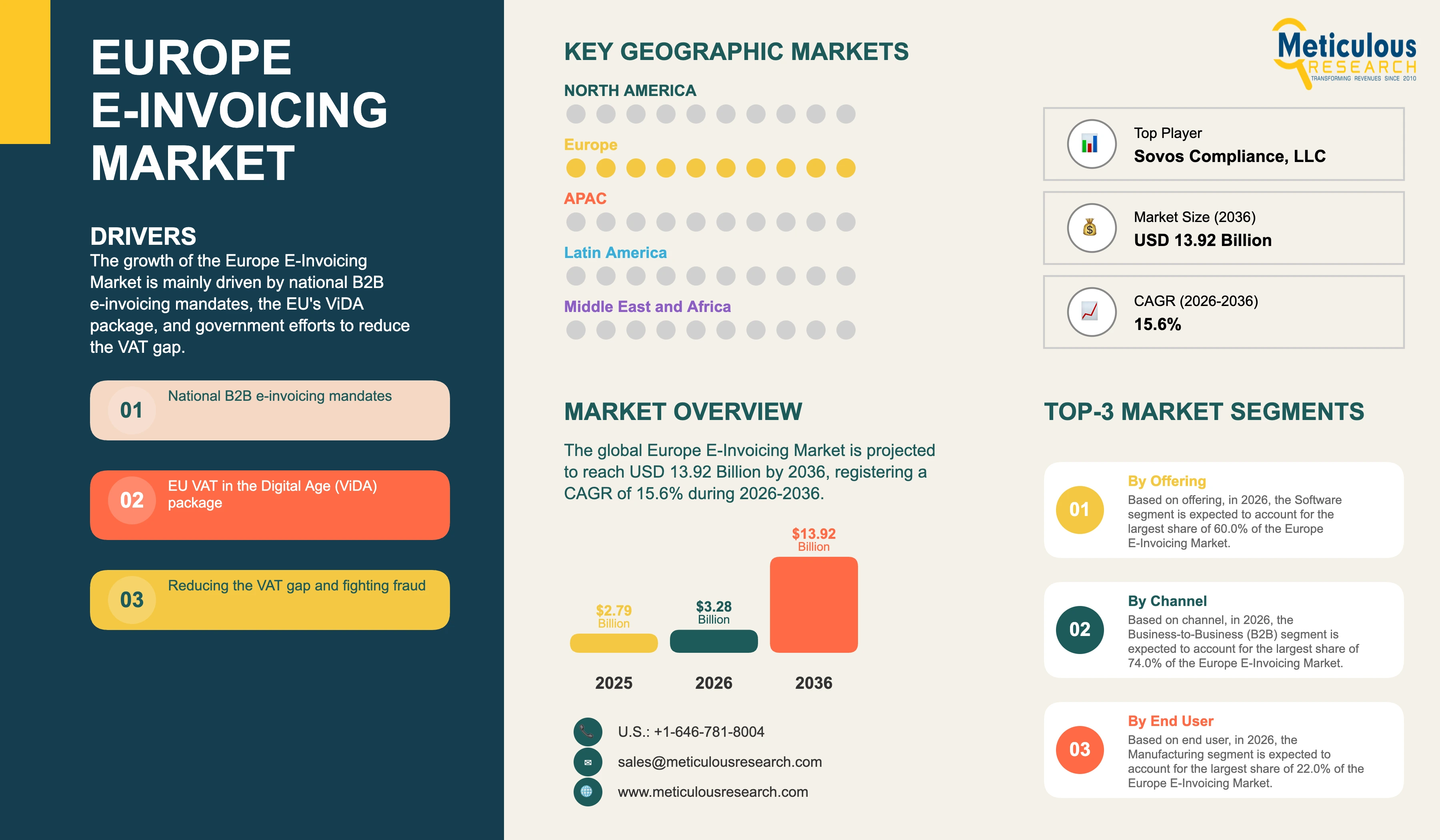
Europe E-Invoicing Market Size The Europe e-invoicing market was valued at USD 2.79 billion in 2025. This market is expected to reach USD 13.92 billion by 2036 from an estimated USD 3.28 billion in 2026, registering a CAGR of 15.6% during the forecast period (2026-2036). The growth of this market is
- Published
- Nov 2026
- Pages
- 207
- Format
- PDF + Excel
- Report ID
- MRICT - 1042543
- Base year
- 2025
- 2025 · BASELINE
- $2.79B
- 2036
- $13.92B
- CAGR 2026–2036
- 15.6%
2025 baseline · 2026–2036 forecast at 15.6% CAGR · hover a bar for the value
Key highlights
2026 is one of the busiest years for e-invoicing in Europe, with mandatory B2B e-invoicing taking effect in Belgium and Croatia in January, Poland's national KSeF system going live for large taxpayers on 1 February and for most other businesses on 1 April, and Greece phasing in mandatory e-invoicing during the year, which together bring several million additional businesses into e-invoicing.
France began its e-invoicing mandate on 1 September 2026, when large and medium-sized businesses started issuing e-invoices and all businesses became required to receive them, with small and micro businesses required to issue e-invoices from September 2027.
Spain approved Royal Decree 238/2026 implementing mandatory B2B e-invoicing under the Crea y Crece law in March 2026, and the ministerial order that took effect in October 2026 set compliance dates starting in October 2027 for large businesses and one year later for other businesses.
The U.K. government confirmed in its November 2025 Budget that all VAT invoices for B2B and B2G transactions must be issued as e-invoices from April 2029, and it published an implementation roadmap at its October 2026 Budget.
Poland's Ministry of Finance announced in September 2026 that penalties for KSeF errors will remain suspended until the end of 2027 to give businesses time to adapt, while France has registered dozens of certified private platforms (plateformes agréées) to exchange invoices and report data to the tax authority.
Germany has required all businesses to be able to receive structured e-invoices since January 2025, with mandatory issuance phased in for larger businesses from January 2027 and for all businesses from January 2028, while the EU's ViDA package, adopted in 2025, will require e-invoicing and digital reporting for intra-EU B2B transactions from July 2030.
Thomson Reuters completed its acquisition of Pagero, a global e-invoicing and tax compliance network headquartered in Sweden, in 2024, which illustrates the consolidation of the European e-invoicing market around providers with broad country coverage and strong tax compliance capabilities.
By offering, software accounts for the largest share of 60.0% in 2026, while also registering the higher CAGR.
By channel, business-to-business (B2B) accounts for the largest share in 2026 and registers the highest CAGR.
By end user, manufacturing accounts for the largest share of 22.0% in 2026, while retail and consumer goods register the highest CAGR.
By country, Italy accounts for the largest share of 17.0% in 2026, while France registers the highest CAGR of 19.4%.
Report summary
| Particulars | Details |
|---|---|
| Forecast Period | 2026-2036 |
| Base Year | 2025 |
| Estimated Year | 2026 |
| CAGR (Value) | 15.6% |
| Format | PDF, Excel & Cloud Portal · 207 pages |
| Market Size (Value) in 2025 | USD 2.79 billion |
| Market Size (Value) in 2026 | USD 3.28 billion |
| Market Size (Value) by 2036 | USD 13.92 billion |
| Segments Covered | Offering, Channel, Deployment Mode, Organization Size, End User, and Country |
| Countries Covered | Italy, Germany, France, Poland, Spain, U.K., Belgium, Netherlands, Nordic Countries, and Rest of Europe |
| Key Companies | Sovos, Thomson Reuters (Pagero), SAP, Avalara, Basware, Edicom, Comarch, Esker, Unifiedpost Group, Coupa, OpenText, Tradeshift, Generix Group, TeamSystem, and Zucchetti |
| Largest Segment by Offering (2026) | Software (60.0%) |
| Largest Segment by End User (2026) | Manufacturing (22.0%) |
| Largest Country (2026) | Italy (17.0%) |
| Fastest-Growing Country | France (CAGR 19.4%) |
Report overview
Segments covered: offering, channel, deployment mode, organization size, end user. Regions: Europe.
Electronic invoicing, or e-invoicing, is the issuing, exchange, and processing of invoices in a structured digital format that can be read and processed automatically by computer systems, rather than as paper documents or unstructured PDF files sent by email. In Europe, e-invoices are typically based on the European standard EN 16931 and exchanged through national platforms, the Peppol network, or certified service providers. E-invoicing solutions convert invoices from ERP and accounting systems into the required formats, validate them, transmit them to buyers and, in some countries, to tax authorities, receive incoming e-invoices, and archive them in line with legal requirements.
This market covers the revenue from e-invoicing software and services in Europe, measured in value, including e-invoicing platforms, compliance connectors, Peppol access point services, archiving, and related professional and managed services. It is segmented by offering, channel, deployment mode, organization size, end user, and country, covering Italy, Germany, France, Poland, Spain, the U.K., Belgium, the Netherlands, the Nordic countries, and the rest of Europe. Broader accounts payable automation, procure-to-pay suites, and tax determination software are included only to the extent of their e-invoicing modules.
Governments have been the main force behind e-invoicing adoption in Europe for more than a decade. E-invoicing for public procurement has been required across the EU since Directive 2014/55/EU, which obliges public bodies to receive e-invoices that comply with EN 16931. Italy introduced mandatory B2B e-invoicing through its central exchange system, the Sistema di Interscambio, in 2019, and today its system handles billions of invoices each year. Other countries followed with their own mandates, including Romania in 2024 and Belgium, Croatia, Poland, Greece, and France in 2026, while Germany, Spain, Slovakia, and the U.K. have set timelines for the coming years. The main reasons are to reduce the VAT gap, which the European Commission estimates at tens of billions of euros a year, to fight VAT fraud, and to modernize tax administration.
European countries use different technical and legal models for e-invoicing, which shapes how businesses must comply. In clearance models, such as those in Italy and Poland, invoices must pass through a government platform for validation before they reach the buyer. In decentralized models, such as Belgium's Peppol-based approach, invoices are exchanged between accredited service providers. France uses a hybrid model in which certified private platforms exchange invoices and report invoice and payment data to the tax authority, while Spain allows businesses to use approved private platforms or a free public solution and requires invoice status reporting. Germany requires businesses to exchange EN 16931-compliant e-invoices without a central platform, at least until reporting is added. These differences mean that companies operating in several European countries need solutions that support many formats, networks, and government platforms.
The EU's ViDA package, adopted in 2025, will bring greater harmonization to these national approaches over time. It will require e-invoicing and digital reporting for intra-EU B2B transactions from July 2030, based on EN 16931, and it allows member states to introduce domestic e-invoicing mandates without seeking a derogation from the European Commission. As a result, more EU countries are planning domestic mandates aligned with ViDA, and businesses across Europe are preparing for e-invoicing to become the norm.
The market includes a wide range of providers with different strengths and customer focus. Global e-invoicing and tax compliance providers, such as Sovos, Thomson Reuters through Pagero, and Avalara, offer coverage of many countries. ERP and procurement software vendors, such as SAP and Coupa, provide e-invoicing integrated with their platforms. European specialists, such as Basware, Edicom, Comarch, Esker, Unifiedpost Group, Tradeshift, and Generix Group, offer e-invoicing networks and accounts payable and receivable automation, while local accounting software providers, such as TeamSystem and Zucchetti in Italy, serve small and medium-sized businesses.
Over the forecast period, the Europe e-invoicing market is expected to grow strongly, as new mandates take effect, as ViDA approaches, and as businesses use e-invoicing data to improve cash flow and automate finance processes. Italy is expected to remain one of the largest markets because of its mature system, while France, Germany, and Spain are expected to grow fastest as their mandates take effect.
Business-to-business (B2B) e-invoicing is expected to account for the largest share of the market in 2026 and to register the highest CAGR, driven by national B2B mandates and ViDA.
Belgium and Croatia introduced mandates in January 2026, Poland's KSeF went live in February and April 2026, Greece phased in its mandate during the year, and France began its mandate in September 2026.
ViDA (VAT in the Digital Age) is an EU package adopted in 2025 that will require e-invoicing and digital reporting for intra-EU B2B transactions from July 2030 and allows member states to introduce domestic e-invoicing mandates without EU approval.
Germany will require issuance from January 2027 for larger businesses and from January 2028 for all businesses, Spain from October 2027 for large businesses and about a year later for others, and the U.K. from April 2029 for all VAT invoices in B2B and B2G transactions.
Peppol is an international network and set of standards that allows businesses and governments to exchange e-invoices through certified access points, and it is used in Belgium, the Netherlands, Norway, Denmark, Sweden, Croatia, and other European countries, as well as in many countries outside Europe.
Report infographic
Market dynamics
16 factors across 5 forcesNational B2B e-invoicing mandates
National mandates are the most important driver of the Europe e-invoicing market. In 2026, mandatory B2B e-invoicing took effect in Belgium and Croatia in January, Poland's KSeF went live for large taxpayers on 1 February and for most other businesses on 1 April, Greece phased in mandatory e-invoicing, and France began its mandate on 1 September, requiring all businesses to receive e-invoices and large and medium-sized businesses to issue them. Germany will require larger businesses to issue e-invoices from January 2027 and all businesses from January 2028, Spain will require large businesses to comply from October 2027 and others from 2028, Slovakia plans to introduce its mandate in 2027, and the U.K. will require e-invoicing for all VAT invoices from April 2029.
Each mandate requires millions of businesses to adopt e-invoicing solutions, often within short timeframes, and many need help from service providers to connect their ERP or accounting systems to national platforms or networks. Multinational companies operating in several European countries face multiple mandates with different requirements, which drives demand for providers with broad coverage. B2B is the largest and fastest-growing channel in this market.
The scale of these national programs is very large in terms of the number of businesses affected. France alone has several million VAT-registered businesses that must be able to receive e-invoices from September 2026, and Germany has a similarly large business population that must issue e-invoices by 2028. Poland's KSeF covers millions of taxpayers, and Spain's mandate will extend to all companies and self-employed professionals. Each wave of adoption brings new customers to e-invoicing providers, and many businesses that start with basic compliance later expand into accounts payable automation and other services.
EU VAT in the Digital Age (ViDA) package
The EU's ViDA package, adopted in 2025, is the most significant change to the EU VAT system in decades. From July 2030, it will require e-invoicing and near real-time digital reporting for intra-EU B2B transactions, replacing current recapitulative statements, and it allows member states to introduce domestic mandates without EU approval. By 2035, national reporting systems will need to align with the EU model.
ViDA gives businesses across Europe a clear reason to invest in e-invoicing, even in countries without domestic mandates, and it encourages governments to introduce mandates that align with the EU framework. The European Commission expects ViDA to help reduce the VAT gap significantly and to lower compliance costs for businesses over time.
ViDA will also change the way invoices are issued for cross-border transactions, requiring e-invoices to be issued within ten days of the transaction and data to be reported to tax authorities shortly afterward. Companies with significant intra-EU trade, such as manufacturers, distributors, and logistics providers, will need to update their systems and processes well before 2030.
Reducing the VAT gap and fighting fraud
VAT is a major source of revenue for European governments, and the gap between expected and actual VAT revenues, caused by fraud, evasion, errors, and insolvency, amounts to tens of billions of euros each year across the EU. Countries that have introduced e-invoicing and real-time reporting, such as Italy and Poland, have reported improvements in VAT collection, which encourages other governments to follow.
E-invoicing gives tax authorities timely and detailed data on business transactions, which helps them detect fraud, such as missing trader fraud, and pre-fill VAT returns. These benefits make e-invoicing a policy priority for finance ministries across Europe.
Poland and other countries have also linked e-invoicing to wider tax digitalization programs, such as standard audit files and real-time VAT reporting, which increases the value of e-invoicing data for tax authorities and strengthens their commitment to mandates.
Efficiency, cost savings, and Peppol adoption
E-invoicing allows businesses to automate invoice processing, reduce errors, speed up approvals and payments, and lower the cost of handling invoices compared with paper or PDF invoices. The Peppol network, which allows businesses to exchange e-invoices through certified access points, is widely used in Belgium, the Netherlands, Norway, Denmark, Sweden, and other countries, and it is expected to play a growing role as more countries adopt decentralized models.
The European standard EN 16931 and Peppol make it easier for businesses to exchange e-invoices across systems and borders, which reduces the cost of adoption and supports the growth of the market.
E-invoicing also shortens payment cycles, which improves cash flow, particularly for small suppliers, and Spain has explicitly linked its mandate to reducing late payments between businesses. Electronic invoices also reduce paper use and support companies' sustainability goals.
Table of contents
13 chapters · 111 sections · 207 pages · click to expandSegmental analysis
| Segment | Largest share (2026) | Fastest growth (2026–2036) |
|---|---|---|
| By Offering | Software | — |
| By Channel | Business-to-business (B2B) | Business-to-business (B2B) |
| By Deployment Mode | Cloud-based | — |
| By Organization Size | Large enterprises | — |
| By End User | Manufacturing | Retail and consumer goods |
By Offering
- The software segment is expected to account for the largest share of 60.0% of the market.
- The large share of this segment is mainly due to the wide adoption of cloud-based e-invoicing platforms, compliance connectors, and e-invoicing modules within ERP and accounting software, and the need for businesses to connect to national platforms and networks such as Italy's SdI, Poland's KSeF, France's certified platforms, and Peppol.
- E-invoicing software is typically sold as subscriptions priced by invoice volume, number of countries, or users, and many providers offer platforms that cover multiple European countries through a single integration with the customer's ERP system.
- Software for small businesses is often embedded in accounting packages, while large enterprises use dedicated compliance platforms.
- Software is expected to remain the largest offering and also to register the higher CAGR during the forecast period, supported by new mandates, ViDA, and the shift of small businesses to cloud-based accounting and invoicing tools.
- Services, including implementation, integration, managed services, and archiving, make up the rest of the market.
- Large enterprises typically use global compliance platforms, such as those from Sovos, Pagero, SAP, and Avalara, that connect to their ERP systems and handle e-invoicing and reporting in many countries.
- Mid-sized businesses often use e-invoicing networks, such as those from Basware, Edicom, Comarch, Esker, and Unifiedpost, that also offer accounts payable and receivable automation.
- Small businesses increasingly receive e-invoicing as part of accounting software, such as TeamSystem and Zucchetti in Italy.
- Software providers must continuously update their products to keep up with changing regulations and certifications in each country.
- Services are also important, particularly for large enterprises that need help with ERP integration, data mapping, testing, and change management across many countries, and for businesses that outsource e-invoicing operations to managed service providers.
- Archiving services, which store e-invoices for the legally required period, often ten years, are another source of recurring revenue.
By Channel
- The business-to-business (B2B) segment is expected to account for the largest share of the market and is also projected to register the highest CAGR during the forecast period, driven by national B2B mandates and ViDA, which together will make structured e-invoicing the norm for business transactions across Europe.
- Business-to-government (B2G) e-invoicing, which has been required for public procurement across the EU since the 2010s, and business-to-consumer (B2C) e-invoicing and e-reporting, such as France's e-reporting requirements, make up the rest of the market.
- B2B invoices account for most invoice volumes in Europe, and B2B e-invoicing offers the greatest efficiency benefits because invoices can flow directly between suppliers' and buyers' systems.
- B2G e-invoicing is mature in many countries and is growing more slowly, while B2C e-reporting requirements are expanding in France and some other countries.
- ViDA will add intra-EU B2B transactions to the scope of mandatory e-invoicing from July 2030, which will further increase B2B volumes and require changes to cross-border invoicing processes.
By Deployment Mode
- E-Invoicing Market Analysis by Deployment Mode
- The cloud-based segment is expected to account for the largest share of the market and is also projected to register the higher CAGR during the forecast period, driven by the ease of connecting to national platforms and networks and the need for continuous compliance updates.
- On-premises solutions remain in use among large enterprises with legacy ERP systems.
- Cloud-based solutions also make it easier for small businesses to adopt e-invoicing without investing in IT infrastructure, and providers can update them centrally when regulations change, which is essential in a market where rules change frequently.
By Organization Size
- E-Invoicing Market Analysis by Organization Size
- The large enterprises segment is expected to account for the largest share of the market, because mandates often apply to large businesses first and they handle large volumes of invoices across many countries.
- However, the small and medium-sized enterprises segment is projected to register the higher CAGR during the forecast period, driven by the extension of mandates to all businesses.
- Mandates in Poland, France, Spain, and Germany extend to small businesses in 2026 to 2028, and millions of small companies are adopting e-invoicing for the first time, often through accounting software or free government tools.
- Large enterprises also tend to buy additional services, such as accounts payable automation, supplier portals, and managed compliance, which increases their spending per company compared with small businesses.
By End User
- The manufacturing segment is expected to account for the largest share of 22.0% of the market.
- The large share of this segment is mainly due to the large volume of B2B invoices exchanged between manufacturers and their suppliers and customers, complex supply chains across many European countries, and the early adoption of e-invoicing and EDI by large manufacturers.
- Manufacturers in Germany, Italy, France, Poland, and Spain are among the largest users of e-invoicing, and many are integrating e-invoicing with procurement, order management, and accounts payable automation.
- Manufacturing is expected to remain the largest end user over the forecast period.
- Manufacturers often receive thousands of supplier invoices each month and issue large volumes of invoices to distributors and customers across Europe, which makes automation especially valuable.
- Many also use EDI for orders and delivery notes and are integrating these processes with e-invoicing to achieve end-to-end automation of procure-to-pay and order-to-cash processes.
- ViDA will affect manufacturers with intra-EU trade in particular, since they will need to issue e-invoices for cross-border sales.
- However, the retail and consumer goods segment is projected to register the highest CAGR during the forecast period.
- The rapid growth of this segment is driven by large supplier networks and e-reporting requirements for B2C transactions.
- Banking, financial services, and insurance, IT and telecommunications, government and public sector, healthcare and life sciences, energy and utilities, transportation and logistics, and other end users make up the rest of the market.
- Banks and insurers use e-invoicing for procurement and some customer billing, IT and telecommunications companies issue large volumes of invoices to business customers, and government agencies use e-invoicing for public procurement.
- Healthcare, energy and utilities, and transportation and logistics companies are also adopting e-invoicing as mandates extend across sectors.
- Retail and consumer goods companies have large supplier networks, often with thousands of small suppliers, and, in France, must also comply with e-reporting for B2C transactions, which drives strong demand for e-invoicing and reporting solutions.
Geographic analysis
Europe
Largest shareThe Europe e-invoicing market was valued at USD 2.79 billion in 2025. This market is expected to reach USD 13.92 billion by 2036 from an estimated USD 3.28 billion in 2026, registering a CAGR of 15.6% during the forecast period (2026-2036). The growth of this market is mainly driven by the wave of national business-to-business e-invoicing mandates being introduced across Europe, including in Belgium, Croatia, Poland, Greece, and France in 2026 and in Germany, Spain, Slovakia, and the U.K. in the following years, the EU's VAT in the Digital Age (ViDA) package, which will require e-invoicing for intra-EU business transactions from July 2030, the efforts of governments to close VAT gaps and reduce fraud, the adoption of the Peppol network and the European e-invoicing standard EN 16931, and the cost savings that businesses gain from automating invoice processing. However, factors such as the complexity of complying with different national models and formats, integration challenges with legacy ERP and accounting systems, low digital readiness among small businesses, and frequent changes and delays in mandate timelines are expected to restrain the growth of this market to some extent. In 2026, Italy is expected to account for the largest share of 17.0% of the Europe e-invoicing market. The large share of this country is mainly due to its mature mandatory B2B e-invoicing system, in place since 2019, which covers almost all businesses and processes billions of invoices each year through the Sistema di Interscambio, and its large base of e-invoicing and accounting software providers. Italy's system has become a model for other countries, and Italian businesses use e-invoicing data for automated VAT returns and other processes. However, growth in Italy is expected to be slower than in other countries because the market is already mature. Growth in Italy will come mainly from value-added services, such as automated accounting, payments, and financing, and from ViDA-related changes for cross-border transactions. Italian providers, such as TeamSystem and Zucchetti, serve large numbers of small businesses and accountants. France is projected to register the highest CAGR of 19.4% during the forecast period. Growth is driven by the e-invoicing and e-reporting mandate that began in September 2026 and extends to small businesses in 2027, which affects millions of companies. France's model relies on certified private platforms, which exchange invoices between businesses and transmit invoice and payment data to the tax authority, and dozens of platforms have been registered. The reform also requires e-reporting for B2C and cross-border transactions, which adds to demand. Germany, Spain, Poland, and the U.K. are also expected to grow rapidly as their mandates take effect, while Belgium, the Netherlands, and the Nordic countries are mature Peppol markets. Germany has required businesses to receive e-invoices since January 2025, with mandatory issuance for businesses with turnover above EUR 800,000 from January 2027 and for all businesses from January 2028, using formats such as XRechnung and ZUGFeRD. Spain's Royal Decree 238/2026 and its ministerial order set compliance dates from October 2027 for large businesses. Poland's KSeF went live in 2026, with penalties suspended until the end of 2027. The U.K. will require e-invoicing for all VAT invoices from April 2029 using a decentralized model. Belgium introduced its Peppol-based mandate in January 2026, while the Netherlands and the Nordic countries have long used e-invoicing widely, particularly for public procurement. The rest of Europe includes Croatia, Greece, Romania, Slovakia, Portugal, and other countries with mandates in place or planned, which together form a significant and growing part of the market. Europe E-Invoicing Market Size Geographic Analysis
Competitive landscape
The Europe e-invoicing market is fragmented, with global providers, ERP vendors, European specialists, and local accounting software providers. Leading companies include Sovos, Thomson Reuters (Pagero), SAP, Avalara, Basware, Edicom, Comarch, Esker, Unifiedpost Group, Coupa, OpenText, Tradeshift, Generix Group, TeamSystem, and Zucchetti.
Companies compete on country coverage, compliance expertise, certifications, ERP integration, ease of use, value-added services, and price.
Sovos and Thomson Reuters, through Pagero, offer global compliance networks covering e-invoicing and tax reporting in many countries. SAP offers e-invoicing through its Document and Reporting Compliance solution, integrated with its ERP systems, while Avalara offers e-invoicing alongside tax determination. Basware, Esker, Coupa, Tradeshift, and OpenText combine e-invoicing with accounts payable automation, procurement, and B2B networks. Edicom, Comarch, Generix Group, and Unifiedpost Group are European specialists with strong positions in Spain, Poland, France, and Belgium, respectively, while TeamSystem and Zucchetti lead in the Italian SME market.
Providers differ in their focus, customer base, and geographic strengths across the European market. Global compliance providers serve multinational companies with complex requirements, ERP vendors serve their installed base, procurement and accounts payable vendors focus on finance process automation, and local providers and accounting software companies focus on small and mid-sized businesses in their home markets. Competition is intense in countries with new mandates, where many providers compete for first-time customers.
The top five players are estimated to account for 30.0% of the Europe e-invoicing market in 2025.
Players use several strategies to grow in this market, including acquisitions, certifications, partnerships, and SME offerings.
For example, providers have obtained certification as French platforms and Peppol access points, acquired local providers to expand coverage, and formed partnerships with ERP vendors, accounting software providers, and banks to reach small businesses. Many are also investing in AI and automation to add value beyond compliance and to differentiate their offerings as basic e-invoicing becomes standardized.
Competition is expected to center on coverage, price, and value-added services.
Large enterprises are expected to consolidate their spending with providers that offer broad European coverage and ViDA readiness, while small businesses will choose low-cost solutions embedded in accounting software or offered by banks. Consolidation among providers is expected to continue.
Some of the key players operating in the Europe e-invoicing market are Sovos Compliance, LLC, Thomson Reuters Corporation (Pagero), SAP SE, Avalara, Inc., Basware Corporation, Edicom, Comarch SA, Esker SA, Unifiedpost Group SA, Coupa Software Inc., OpenText Corporation, Tradeshift, Generix Group, TeamSystem S.p.A., and Zucchetti S.p.A.
- —
Belgium, Croatia, Poland, Greece, and France introduced mandates in 2026, Spain approved its B2B e-invoicing decree, and the U.K. published its implementation roadmap for April 2029.
- Sovos
- Thomson Reuters · Pagero
- SAP
- Avalara
- Basware
- Edicom
- Comarch
- Esker
- Unifiedpost Group
- Coupa
- OpenText
- Tradeshift
- Generix Group
- TeamSystem
- Zucchetti
Expert perspectives
Europe is in the middle of a major transition to mandatory e-invoicing, driven by national mandates and ViDA.
The market is driven mainly by regulation rather than by voluntary adoption, which gives it unusual visibility. Within a few years, most European businesses will be required to issue and receive structured e-invoices, and ViDA will extend e-invoicing to intra-EU transactions from 2030. This transition is creating one of the fastest-growing segments of the European finance software market, with millions of businesses adopting e-invoicing for the first time.
At the same time, the fragmented nature of national models means that compliance remains complex for companies operating across Europe, which supports demand for providers with broad coverage and deep regulatory expertise.
Over the forecast period, the market is expected to grow at about 15.6% per year, supported by mandates, ViDA, and value-added services.
Growth is expected to be strongest in countries with new mandates, such as France, Germany, Spain, Poland, and the U.K., while Italy and the Nordic countries are mature markets. Value-added services, such as accounts payable automation, payments, and financing, are expected to become increasingly important as basic compliance becomes standardized.
Software is the largest offering, B2B is the largest channel, and manufacturing is the largest end user, while retail and consumer goods grow fastest.
Small and medium-sized enterprises are expected to be the fastest-growing customer group, as mandates extend to all businesses and low-cost cloud solutions become widely available.
Cloud-based deployment is expected to dominate, as providers update their platforms centrally to keep up with changing regulations, and B2B e-invoicing will continue to account for most of the market.
Italy remains the largest country market, while France is the fastest-growing country at a CAGR of 19.4%.
Germany is expected to become one of the largest country markets by the end of the forecast period, as its large business population adopts e-invoicing in 2027 and 2028. The main swing factors are the timing of mandates, the implementation of ViDA, the role of free government tools, and the readiness of small businesses.
For providers, the key priorities are country coverage, compliance expertise, ViDA readiness, and SME offerings.
For businesses, the key priorities are to prepare early for national mandates and ViDA, choose providers with broad coverage and strong ERP integration, and use e-invoicing data to automate finance processes. Overall, e-invoicing is expected to become a standard part of business operations across Europe by the early 2030s, with providers competing increasingly on the value they add beyond compliance.
Customer perspectives
Head of Indirect Tax - industrial manufacturer, Germany
In two years we have had to comply with new systems in Poland, Belgium, and France, and Germany is next. One provider connected to our ERP is the only practical way to manage this.
This explains why software accounts for 60.0% of the market and manufacturing 22.0%.
For multinational manufacturers, the number of overlapping mandates makes a single compliance platform essential, and ViDA will add cross-border requirements from 2030.
This explains why large enterprises still account for the largest share of the market by organization size, even as small businesses grow faster, and why global compliance providers win many large contracts.
Chief Financial Officer - retail chain, France
The French reform covers our suppliers and our e-reporting. We chose a certified platform that handles both.
This explains why France and retail are growing fastest.
For French retailers, the reform affects both their large supplier base and their customer transactions, which drives investment in certified platforms.
Owner - small engineering firm, Poland
We started using KSeF through our accounting software in April. It was simpler than we expected, and our customers now receive invoices immediately.
This explains why small and medium-sized enterprises are the faster-growing organization size segment and why accounting software providers are key channels.
Finance Director - logistics company, Spain
With Crea y Crece starting in 2027 and ViDA in 2030, we are moving to one platform now so we are not caught out later.
This explains why Spain is among the fastest-growing countries and why ViDA readiness drives multi-country platform decisions.
Frequently asked questions
The market was valued at USD 2.79 billion in 2025 and USD 2.38 billion in 2024, and is estimated at USD 3.28 billion in 2026.
Cite this report
Meticulous Research. (2026). Europe E-Invoicing Market - Global Opportunity Analysis and Industry Forecast (2026-2036) (Report No. MRICT - 1042543). Meticulous Market Research Pvt. Ltd. https://www.meticulousresearch.com/product/europe-e-invoicing-market-7226