Selective Catalytic Reduction Systems Market (2026-2036)
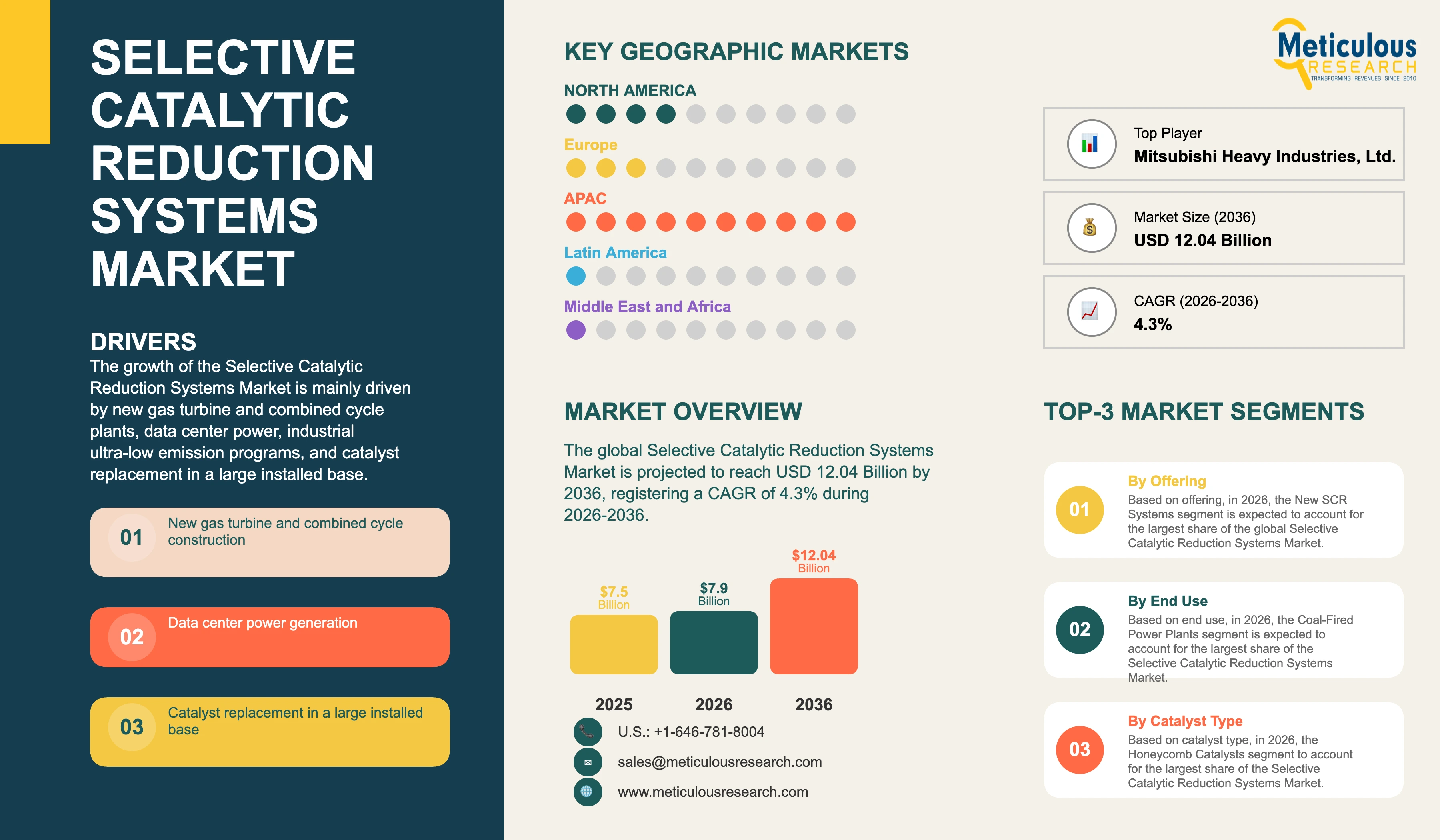
The global selective catalytic reduction systems market was valued at USD 7.50 billion in 2025. This market is expected to reach USD 12.04 billion by 2036 from an estimated USD 7.90 billion in 2026, registering a CAGR of 4.3% during the forecast period (2026-2036).
- Published
- Nov 2026
- Pages
- 259
- Format
- PDF + Excel
- Report ID
- MREP - 1042734
- Base year
- 2025
- 2025 · BASELINE
- $7.50B
- 2036
- $12.04B
- CAGR 2026–2036
- 4.3%
2025 baseline · 2026–2036 forecast at 4.3% CAGR · hover a bar for the value
Key highlights
GE Vernova reported a gas turbine backlog of 83 GW at the end of 2025 and expects about 100 GW by the end of 2026, while Siemens Energy and Mitsubishi Heavy Industries also report record gas turbine orders. In the U.S. and many other markets, new gas turbines in combined cycle and simple cycle plants must be equipped with SCR systems to meet nitrogen oxide permit limits, which creates a large pipeline of SCR demand.
POWER Magazine reported in 2026 that EnergyLink International had received orders for 56 SCR units and stacks for data center power projects, with many more pending, as data center developers turn to on-site gas turbines and engines that need SCR to meet air permit limits.
In July 2026, Johnson Matthey completed its acquisition of Cormetech, a leading U.S. manufacturer of SCR catalysts with more than 400 customers and strong intellectual property in gas turbine catalysts, which shows the strategic value of the stationary SCR catalyst business.
China commissioned 78 GW of new coal power capacity in 2025, according to the Centre for Research on Energy and Clean Air (CREA) and Global Energy Monitor (GEM), and new Chinese coal units must meet ultra-low nitrogen oxide limits that require high-efficiency SCR systems. China also called for half of clinker capacity in key air pollution control regions to complete ultra-low emission retrofits by the end of 2025.
According to the China Association of Environmental Protection Industry, revenue from China's flue gas and ultra-low emission retrofit segment fell by about 4.1% in 2025 to around RMB 120 billion as coal-fired power retrofits neared completion, which shows that growth in China is shifting from power plants to industrial sectors, operation and maintenance, and catalyst replacement.
Fuel Tech announced several SCR contracts in 2026 for new natural gas turbines at municipal utilities and industrial sites in the U.S., including a project to add 100 MW at a Midwest utility to serve manufacturing and data center growth, and it reported a sales pipeline of USD 75 million to USD 100 million for data center SCR opportunities.
By offering, new SCR systems account for the largest share of 60.0% in 2026, while services register the highest CAGR.
By catalyst type, honeycomb catalysts account for the largest share in 2026, while corrugated catalysts register the highest CAGR.
By reagent, urea accounts for the largest share in 2026, while aqueous ammonia registers the highest CAGR.
By end use, coal-fired power plants account for the largest share of 38.0% in 2026, while reciprocating engines and generator sets register the highest CAGR.
By geography, Asia-Pacific accounts for the largest share of 52.0% in 2026, while North America registers the highest CAGR of 5.9%.
Report summary
| Particulars | Details |
|---|---|
| Base Year | 2025 |
| Estimated Year | 2026 |
| Forecast Period | 2026-2036 |
| Market Size in 2025 | USD 7.50 billion |
| Market Size in 2026 | USD 7.90 billion |
| Market Size by 2036 | USD 12.04 billion |
| CAGR (2026-2036) | 4.3% |
| Format | PDF, Excel & Cloud Portal · 259 pages |
| Largest Segment by Offering (2026) | New SCR Systems (60.0%) |
| Largest Segment by End Use (2026) | Coal-Fired Power Plants (38.0%) |
| Largest Region (2026) | Asia-Pacific (52.0%) |
| Fastest-Growing Region | North America (CAGR 5.9%) |
| Companies Profiled | 18 companies and other companies |
| Segments Covered | Offering, Catalyst Type, Reagent, End Use, Geography |
| Countries Covered | U.S., Canada, Germany, U.K., Italy, France, Netherlands, Poland, Nordic Countries, Spain, Rest of Europe, China, Japan, South Korea, India, Taiwan, Indonesia, Vietnam, Thailand, Australia, Rest of Asia-Pacific, Mexico, Brazil, Chile, Argentina, Rest of Latin America, Saudi Arabia, U.A.E., Qatar, Turkey, South Africa, Rest of Middle East & Africa |
Report overview
Segments covered: offering, catalyst type, reagent, end use.
The growth of this market is mainly driven by the wave of new gas turbine and combined cycle plants in the U.S., the Middle East, and Asia that require SCR systems to meet nitrogen oxide permit limits, the rapid growth of on-site gas turbine and reciprocating engine power for data centers, the continued construction of coal-fired units in China and India, ultra-low emission programs for cement, steel, coking, and glass plants in China, the International Maritime Organization's Tier III limits for ships operating in nitrogen oxide emission control areas, and the regular replacement of catalysts in a very large installed base of SCR systems. However, factors such as coal phase-out policies in Europe and North America, the completion of China's coal power retrofit programs, regulatory uncertainty in some markets, and the high capital and operating costs of SCR systems are expected to restrain the growth of this market to some extent.
Selective catalytic reduction (SCR) systems reduce emissions of nitrogen oxides (NOx) from the exhaust gases of power plants, industrial facilities, ships, and engines by injecting ammonia or urea into the gas stream and passing it through a catalyst, where the nitrogen oxides are converted into nitrogen and water. SCR is the most effective commercial technology for NOx control, with removal efficiencies of 80% to more than 95%, and it is required by regulators for many large combustion sources. This report covers global revenue from new stationary and marine SCR systems, replacement catalysts, and related services, including catalyst regeneration, testing, tuning, and maintenance. SCR systems for on-road and off-road diesel vehicles are excluded from the scope of this report.
A stationary SCR system includes a reactor housing with catalyst layers, a reagent storage and preparation system, an ammonia injection grid or urea injection system, static mixers, flow straightening devices, and controls and analyzers. Catalysts are made from titanium dioxide with vanadium and tungsten or molybdenum oxides and are supplied in honeycomb, plate, or corrugated forms, while zeolite catalysts are used in some high-temperature and engine applications. Catalysts lose activity over time and must be replaced, added, or regenerated every few years, which creates a recurring market. The design of an SCR system depends on the fuel, gas temperature, dust load, and required NOx removal, so each installation is engineered for its application.
SCR systems were first widely used at coal-fired power plants in Japan and Germany in the 1980s and then in the U.S. and China. China installed SCR on almost its entire coal fleet during its ultra-low emission program in the 2010s, and new coal units in China and India are built with SCR. Gas turbines in combined cycle and simple cycle plants in the U.S., Europe, Japan, South Korea, and other markets also use SCR, usually integrated into the HRSG or in a standalone system for simple cycle units. Japan, South Korea, and Taiwan also have large fleets of SCR-equipped coal and gas plants, and their catalyst manufacturers were among the pioneers of the technology.
The market has expanded beyond power plants into cement kilns, steel sintering and pelletizing plants, coke ovens, glass furnaces, refineries, petrochemical plants, chemical plants, waste incinerators, and biomass plants, especially in China, Europe, and the U.S. Marine SCR systems are used to meet the International Maritime Organization's Tier III NOx limits for ships operating in emission control areas, and reciprocating engines and generator sets used for distributed power, combined heat and power, and data centers increasingly use compact SCR systems with urea injection.
Business models include supply of complete SCR systems under engineering, procurement, and construction contracts, supply of SCR systems as part of HRSG or engine packages, sale of catalysts for new systems and replacements, catalyst regeneration, and services such as catalyst testing, ammonia injection tuning, flow modeling, and maintenance. Catalyst suppliers often have long-term relationships with plant operators because catalysts need regular replacement. Many system suppliers also offer performance guarantees for NOx removal and ammonia slip, which makes engineering quality and catalyst selection important competitive factors.
The market includes system integrators, catalyst manufacturers, HRSG and boiler suppliers, engine and gas turbine package suppliers, and marine equipment suppliers. Leading companies include Mitsubishi Heavy Industries, Babcock & Wilcox, Kanadevia, Topsoe, Johnson Matthey (Cormetech), BASF, Umicore, JGC Catalysts and Chemicals, Nippon Shokubai, Datang Environmental Industry Group, Chengdu Dongfang KWH, Fujian Longking, CECO Environmental (Peerless), Fuel Tech, Zeeco, Andritz, Doosan Enerbility, Wärtsilä, Yara Marine Technologies, and Hug Engineering.
Over the forecast period, the SCR market is expected to grow steadily, driven by gas-fired power plants, data center power, industrial applications, marine, and catalyst replacement, while demand from new coal plants declines after the current Chinese and Indian pipelines are completed. The market is expected to shift from coal power toward gas turbines, engines, industrial plants, and recurring catalyst and service revenue, which together provide more stable long-term demand. The growing focus on local air quality in fast-growing cities in Asia, the Middle East, and Africa is also expected to support stricter NOx limits for both new and existing sources.
All of our units already have SCR, so our main work now is managing catalysts and replacing layers every few years. We look for catalysts that last longer and suppliers who can help us optimize ammonia use as our units run more flexibly.
Our NOx limit is getting tighter, and SCR is the only way to meet it reliably. We chose a catalyst that can handle the dust and alkali in our kiln gas, because a poor choice would mean frequent cleaning and replacement.
Report infographic
Market dynamics
16 factors across 5 forcesNew gas turbine and combined cycle construction
The strongest driver of the SCR market today is the global revival of gas-fired power plant construction. Large gas turbine manufacturers report record backlogs, with GE Vernova targeting about 100 GW by the end of 2026 and delivery slots stretching into 2029 and 2030, and most of these turbines will be installed in plants that need SCR systems to meet NOx permit limits. In the U.S., new gas turbines in nonattainment areas and most combined cycle plants must meet NOx limits of about 2 to 2.5 parts per million, which can only be achieved with SCR.
Combined cycle plants usually integrate the SCR catalyst inside the HRSG, while simple cycle peaking plants use standalone hot SCR systems that operate at higher temperatures and are often combined with carbon monoxide oxidation catalysts. Utilities, independent power producers, and data center developers in the U.S., Saudi Arabia, the U.A.E., Japan, South Korea, Taiwan, and other markets are building both types of plants, which creates demand for SCR systems, catalysts, and reagent systems. Fuel Tech, CECO Environmental, Zeeco, and other U.S. suppliers have reported growing orders for SCR systems behind new gas turbines in 2026.
Data center power generation
The rapid growth of data centers for cloud computing and artificial intelligence has created a shortage of grid power in key U.S. markets, and many developers are installing on-site generation using aeroderivative and industrial gas turbines, reciprocating engines, and large diesel and gas generator sets. These units often must meet strict NOx limits in their air permits, especially when they run continuously rather than only for backup, which requires SCR systems.
POWER Magazine reported in 2026 that EnergyLink International had received orders for 56 SCR units and stacks for data center projects, and Fuel Tech has described a data center sales pipeline of USD 75 million to USD 100 million. Catalyst suppliers such as Umicore and Johnson Matthey are developing compact catalysts for data center engines and generators. This demand is still small compared with utility power plants, but it is growing very quickly across the major U.S. data center markets. Developers often need SCR systems on fast-track schedules, which favors suppliers with standardized modular designs and available manufacturing capacity.
Industrial ultra-low emission programs
China has extended ultra-low emission requirements from coal power plants to cement, steel, coking, glass, and other industries, and these programs require plants to reduce NOx emissions to levels that usually need SCR. China called for half of clinker capacity in key air pollution control regions to complete ultra-low emission retrofits by the end of 2025, and provincial governments, such as Ningxia, continue to set new deadlines for cement plants. Steel sintering plants, coke ovens, and glass furnaces are also installing SCR systems, often with low-temperature catalysts that work after desulfurization and dust removal.
India, Southeast Asian countries, Turkey, and other emerging economies are also tightening NOx limits for cement, steel, and other industries, while the European Union's Industrial Emissions Directive and best available techniques reference documents continue to lower NOx limits for large combustion plants and industrial facilities. These programs create a large and growing market for SCR in industrial applications, where gas conditions are often more challenging than in power plants.
Catalyst replacement in a large installed base
The global installed base of SCR systems is very large, covering most coal-fired capacity in China, the U.S., Europe, Japan, South Korea, and Taiwan, a large share of gas-fired capacity, and many industrial and marine installations. SCR catalysts lose activity over time because of poisoning, fouling, and erosion, and they typically need replacement or regeneration every three to six years in coal plants and somewhat longer in gas plants.
This creates a recurring market for replacement catalysts, catalyst regeneration, catalyst testing, and services such as ammonia injection tuning and flow optimization. As plants operate more flexibly, with more start-ups and lower loads, catalyst management becomes more complex, which increases demand for engineering services and monitoring. Catalyst replacement demand is less cyclical than new system demand, which makes it an important source of stable revenue for catalyst suppliers. In China alone, the catalyst volume installed during the ultra-low emission program creates a very large replacement cycle that will continue for many years.
Table of contents
12 chapters · 157 sections · 259 pages · click to expandSegmental analysis
| Segment | Largest share (2026) | Fastest growth (2026–2036) |
|---|---|---|
| By Offering | New SCR systems | Services |
| By Catalyst Type | Honeycomb catalysts | Corrugated catalysts |
| By Reagent | Urea | Aqueous ammonia |
| By End Use | Coal-fired power plants | Reciprocating engines and generator sets |
By Offering
- The new SCR systems segment is expected to account for the largest share of 60.0% of the global selective catalytic reduction systems market.
- The large share of this segment is mainly attributed to the large number of new gas turbines being installed in combined cycle and simple cycle plants in the U.S., the Middle East, and Asia, the construction of new coal-fired units with SCR in China and India, industrial SCR projects under China's ultra-low emission programs, and the growing use of SCR in data center power, marine vessels, and reciprocating engines.
- New systems include the initial catalyst load, reactor, reagent system, injection and mixing equipment, and controls, which makes them more valuable than replacement catalyst orders.
- Gas turbine and engine SCR systems are expected to provide most of the growth in this segment, while new coal SCR systems are expected to decline after the current pipelines in China and India are completed.
- However, the services segment is projected to register the highest CAGR during the forecast period.
- The rapid growth of this segment is primarily driven by the very large installed base of SCR systems, the growing complexity of catalyst management as plants operate more flexibly, the expansion of catalyst regeneration as a lower-cost alternative to new catalysts, and demand for testing, tuning, flow modeling, and maintenance services.
- Catalyst management services help plant owners plan replacements, extend catalyst life, and maintain compliance as operating conditions change.
- Meanwhile, the replacement catalysts segment is expected to witness steady growth, supported by regular catalyst changes in coal, gas, industrial, and marine installations, and the growing installed base of SCR systems worldwide.
- The urea segment is expected to account for the largest share of the selective catalytic reduction systems market, while the aqueous ammonia segment is projected to register the highest CAGR during the forecast period.
By Catalyst Type
- The honeycomb catalysts segment is expected to account for the largest share of the global selective catalytic reduction systems market.
- The large share of this segment is mainly attributed to the widespread use of honeycomb catalysts in coal-fired power plants in China and other markets, their high surface area and activity per unit volume, their suitability for a wide range of applications, and the large production capacity of honeycomb catalyst manufacturers, especially in China.
- Honeycomb catalysts are extruded ceramic blocks with many parallel channels, and they are available in different pitches for high-dust and low-dust applications.
- They are used in coal, gas, industrial, and marine applications, and they account for most catalyst replacement demand in China's very large coal fleet.
- Chinese manufacturers have built very large honeycomb production capacity, which keeps prices highly competitive in this segment worldwide.
- However, the corrugated catalysts segment is projected to register the highest CAGR during the forecast period.
- The rapid growth of this segment is primarily driven by the use of corrugated catalysts in gas turbine applications, where their low weight, low pressure drop, and high geometric surface area are valuable, the strong growth of gas-fired power plants and data center gas turbines, and their use in some industrial and engine applications.
- Meanwhile, the plate catalysts segment is expected to witness steady growth, supported by its resistance to plugging and erosion, which keeps it in demand for high-dust coal and industrial applications.
By Reagent
- The urea segment is expected to account for the largest share of the global selective catalytic reduction systems market.
- The large share of this segment is mainly attributed to the safety advantages of urea, which is non-toxic and easy to store, the switch from liquid ammonia to urea at large power plants in China, the use of urea in marine and engine SCR systems, and the growing use of urea-to-ammonia conversion systems at power plants and industrial sites near populated areas.
- Urea-based systems either convert urea into ammonia in a separate reactor before injection or inject urea solution directly into the exhaust gas, where it decomposes.
- Urea is also the standard reagent for marine and engine SCR, where safety and ease of handling are essential.
- However, the aqueous ammonia segment is projected to register the highest CAGR during the forecast period.
- The rapid growth of this segment is primarily driven by its widespread use in gas turbine SCR systems in the U.S. and other markets, where it offers a good balance between safety and simplicity, the strong growth of new combined cycle and simple cycle plants, and its use in industrial applications where anhydrous ammonia is not permitted.
- Meanwhile, the anhydrous ammonia segment is expected to witness steady growth, supported by its continued use at existing coal plants and large industrial installations, although safety concerns are gradually shifting new projects toward urea and aqueous ammonia.
By End Use
- The coal-fired power plants segment is expected to account for the largest share of 38.0% of the global selective catalytic reduction systems market.
- The large share of this segment is mainly attributed to the very large installed base of SCR systems at coal-fired plants in China, the U.S., Europe, Japan, South Korea, and Taiwan, which creates large and regular demand for replacement catalysts and services, the construction of new coal units with SCR in China and India, and the large size of coal SCR systems, which require much more catalyst than gas turbine systems.
- Demand from coal-fired plants is expected to remain significant but to grow slowly, as new coal construction declines after 2030, coal plants close in Europe and North America, and Chinese coal plants operate fewer hours.
- Catalyst replacement and services will remain the main sources of revenue in this segment over the long term.
- However, the reciprocating engines and generator sets segment is projected to register the highest CAGR during the forecast period.
- The rapid growth of this segment is primarily driven by the use of gas and diesel engines and generator sets for on-site data center power, stricter NOx limits for engines that run continuously, the use of engines for grid balancing and distributed generation, and the development of compact, modular SCR systems with integrated urea injection.
- Meanwhile, the gas-fired power plants, cement, iron and steel, refining and petrochemicals, marine, waste incineration and biomass, and other industries segments are expected to witness steady growth, supported by the gas power boom, industrial emission programs in China and other countries, and IMO Tier III requirements for ships.
Geographic analysis
Asia-Pacific
Largest shareIn 2026, Asia-Pacific is expected to account for the largest share of 52.0% of the global selective catalytic reduction systems market. The large share of this region is mainly due to the very large installed base of SCR systems at coal-fired power plants in China, Japan, South Korea, and Taiwan, the construction of new coal units with SCR in China and India, China's ultra-low emission programs for cement, steel, coking, and glass plants, the large shipbuilding industries in China, South Korea, and Japan that install marine SCR systems, and the large catalyst manufacturing industry in China and Japan. New gas-fired plants in Japan, South Korea, Taiwan, and Southeast Asia also add demand for gas turbine SCR systems.
North America
North America is the second-largest market and is projected to register the highest CAGR of 5.9% during the forecast period. The rapid growth of this region is mainly driven by the strong revival of combined cycle and simple cycle gas plant construction in the U.S., the rapid growth of on-site gas turbine and engine power for data centers, strict NOx limits for new gas turbines and engines in many states, and steady catalyst replacement demand from the large installed base at coal and gas plants. Suppliers such as Fuel Tech, CECO Environmental, Zeeco, EnergyLink, and Johnson Matthey (Cormetech) have reported growing demand from these segments.
Europe
Europe is a mature but stable market, supported by strict NOx limits under the Industrial Emissions Directive, SCR use in waste incineration, biomass, cement, and glass plants, marine SCR for ships operating in the Baltic and North Sea emission control areas, and catalyst replacement at existing coal and gas plants, although coal plant closures are reducing demand in power generation. Germany, the Nordic countries, the Netherlands, Italy, and Poland are among the most important markets, and European suppliers such as Topsoe, BASF, Umicore, Andritz, Wärtsilä, Yara Marine Technologies, and Hug Engineering are leaders in specific segments.
Middle East & Africa
The Middle East & Africa is expected to grow quickly, supported by the large combined cycle construction program in Saudi Arabia and other Gulf countries, where new plants increasingly include SCR, and by industrial projects in refining, petrochemicals, and aluminum.
Latin America
Latin America accounts for a smaller share of the market, with demand from gas-fired plants in Mexico, Brazil, Argentina, and Chile and from cement and industrial plants, as several countries tighten NOx standards for large combustion sources.
Competitive landscape
The global selective catalytic reduction systems market is fragmented, with the top five players estimated to account for about 35% of the market in 2025. The market includes catalyst manufacturers, SCR system integrators, boiler and HRSG suppliers, environmental engineering companies, engine and marine equipment suppliers, and specialized service providers.
Topsoe, Johnson Matthey (Cormetech), BASF, Umicore, JGC Catalysts and Chemicals, Nippon Shokubai, and Kanadevia are leading catalyst suppliers outside China, while Datang Environmental Industry Group, Chengdu Dongfang KWH, and other Chinese producers dominate the Chinese catalyst market and are expanding exports. Mitsubishi Heavy Industries, Babcock & Wilcox, Doosan Enerbility, Andritz, and Fujian Longking supply SCR systems for coal-fired power plants and industrial applications.
In gas turbine and engine applications, CECO Environmental (Peerless), Fuel Tech, Zeeco, and other system integrators work with gas turbine and engine manufacturers and HRSG suppliers to supply standalone and integrated SCR systems, while Wärtsilä, Yara Marine Technologies, and Hug Engineering are leading suppliers of marine and engine SCR systems. Shipyards in China, South Korea, and Japan are important customers for marine SCR suppliers.
Companies compete on catalyst activity and durability, NOx removal efficiency, ammonia slip, pressure drop, system reliability, price, delivery time, engineering capability, and service support. Key strategies include acquisitions to gain technology and capacity, development of low-temperature, multi-function, and compact catalysts, partnerships with gas turbine, engine, and HRSG manufacturers, expansion of catalyst regeneration and management services, and growth in data center and marine markets.
The competitive landscape is changing as the market shifts from coal to gas, engines, and industry. Catalyst suppliers with strong positions in gas turbine and engine catalysts and system integrators with experience in fast-track gas projects are gaining share, while companies focused mainly on coal SCR face slower growth and stronger competition from Chinese producers. Consolidation, such as Johnson Matthey's purchase of Cormetech, is expected to continue. Smaller regional integrators are also expected to partner with larger catalyst suppliers to access technology and financing.
Some of the key players operating in the selective catalytic reduction systems market are Mitsubishi Heavy Industries, Ltd., Babcock & Wilcox Enterprises, Inc., Kanadevia Corporation, Topsoe A/S, Johnson Matthey Plc (Cormetech), BASF SE, Umicore SA, JGC Catalysts and Chemicals Ltd., Nippon Shokubai Co., Ltd., Datang Environmental Industry Group Co., Ltd., Chengdu Dongfang KWH Environmental Protection Catalysts Co., Ltd., Fujian Longking Co., Ltd., CECO Environmental Corp., Fuel Tech, Inc., Andritz AG, Wärtsilä Corporation, Yara Marine Technologies AS, and Hug Engineering AG, among others.
- —
Johnson Matthey completed its acquisition of Cormetech in July 2026, EnergyLink International received orders for 56 SCR units for data center projects, Fuel Tech won several SCR contracts for new gas turbines in 2026, and China's ultra-low emission programs continued to drive SCR projects in cement and steel.
- Mitsubishi Heavy Industries, Ltd.
- Babcock & Wilcox Enterprises, Inc.
- Kanadevia Corporation
- Topsoe A/S
- Johnson Matthey Plc · Cormetech
- BASF SE
- Umicore SA
- JGC Catalysts and Chemicals Ltd.
- Nippon Shokubai Co., Ltd.
- Datang Environmental Industry Group Co., Ltd.
- Fujian Longking Co., Ltd.
- CECO Environmental Corp.
- Fuel Tech, Inc.
- Andritz AG
- Wärtsilä Corporation
- Yara Marine Technologies AS
- Hug Engineering AG
Expert perspectives
The selective catalytic reduction systems market is moving away from its traditional dependence on coal power and toward gas turbines, engines, industrial plants, and ships. We see the current gas power boom, driven by data centers and electricity demand growth, as the most important near-term driver, while catalyst replacement and services provide a stable base of recurring revenue across all segments.
Over the forecast period, the market is expected to grow at a CAGR of 4.3%, from USD 7.90 billion in 2026 to USD 12.04 billion in 2036. Growth will be supported by gas-fired power plants, data center engines and turbines, industrial ultra-low emission programs, marine SCR, and catalyst replacement, while the decline of coal power outside Asia and the completion of China's coal retrofit program will limit growth in the largest traditional segment.
In terms of segments, new SCR systems remain the largest offering, while services grow fastest. Honeycomb catalysts remain the largest catalyst type, while corrugated catalysts grow fastest. Coal-fired power plants remain the largest end use, while reciprocating engines and generator sets grow fastest. Asia-Pacific remains the largest region, and North America is the fastest-growing region at a CAGR of 5.9%.
For suppliers, the key priorities are to build capacity and partnerships to serve the gas turbine and data center boom, to develop compact and low-temperature catalysts for engines and industry, to grow catalyst management and regeneration services, and to compete effectively against Chinese catalyst producers through technology and service rather than price alone.
We expect gas turbines, engines, and industrial applications to account for a growing share of market value over time. In our view, the acquisition of Cormetech by Johnson Matthey signals that major catalyst companies see the stationary emissions business as an attractive long-term market, and we expect further investment and consolidation in this space. Suppliers that offer both catalysts and engineering services will have an advantage in winning long-term relationships with operators. Data center power could become one of the most dynamic segments of the market if on-site generation continues to grow as expected.
Regulation will remain a key factor, since SCR systems are installed mainly to meet emission limits. Clear and consistently enforced NOx rules for gas turbines, engines, and industrial facilities, and the possible designation of new marine emission control areas, would strengthen demand, while rollbacks or weak enforcement would slow it in some regions. In our view, the overall direction of NOx regulation to remain toward tighter limits, especially for industrial facilities and engines.
Customer perspectives
Director of Power Infrastructure - data center developer, U.S.
Our on-site turbines and engines will run around the clock, so our air permits require very low NOx emissions. We need SCR systems that can be delivered quickly and fit into a compact site, and suppliers who can keep up with our schedule.
Frequently asked questions
The global selective catalytic reduction systems market was valued at USD 7.50 billion in 2025, up from USD 7.10 billion in 2024, and is estimated at USD 7.90 billion in 2026. The market includes new stationary and marine SCR systems, replacement catalysts, and services, and excludes SCR systems for on-road and off-road diesel vehicles.
The global selective catalytic reduction systems market is expected to reach USD 12.04 billion by 2036, supported by gas-fired power plants, data center power, industrial emission programs, marine SCR, and catalyst replacement.
The market is expected to register a CAGR of 4.3% from 2026 to 2036, as growth in gas turbines, engines, industry, and services offsets slower demand from coal-fired power plants.
New gas turbines and engines in many U.S. states and other markets must meet very low NOx permit limits, which usually can only be achieved with SCR. Data centers that run on-site generation continuously face the same requirements.
Market growth is mainly driven by new gas turbine and combined cycle construction, data center power generation, industrial ultra-low emission programs, and catalyst replacement in a large installed base.
Coal phase-out, the completion of China's power retrofits, and high costs restrain growth, while price competition from Chinese catalyst producers and regulatory uncertainty are key challenges.
Key opportunities include low-temperature and multi-pollutant catalysts, compact SCR for engines and distributed generation, marine SCR and new emission control areas, and SCR for hydrogen and ammonia combustion.
New SCR systems are expected to account for the largest share of 60.0% of the market in 2026, while services are projected to register the highest CAGR.
Coal-fired power plants are expected to account for the largest share of 38.0% of the market in 2026, while reciprocating engines and generator sets are projected to register the highest CAGR.
Corrugated catalysts are projected to register the highest CAGR during the forecast period, driven by their use in gas turbine SCR systems.
Asia-Pacific is expected to account for the largest share of 52.0% of the market in 2026, mainly due to the large installed base at coal plants in China, Japan, South Korea, and Taiwan and China's industrial emission programs.
North America is projected to register the highest CAGR of 5.9% during the forecast period, driven by new gas-fired plants, data center power, and strict NOx limits.
The report profiles 18 companies, including Mitsubishi Heavy Industries, Ltd., Babcock & Wilcox Enterprises, Inc., Kanadevia Corporation, Topsoe A/S, Johnson Matthey Plc (Cormetech), BASF SE, Umicore SA, and others such as Fuel Tech, Inc., Andritz AG, Wärtsilä Corporation, Yara Marine Technologies AS, and Hug Engineering AG.
Johnson Matthey completed its acquisition of Cormetech in July 2026, EnergyLink International received orders for 56 SCR units for data center projects, Fuel Tech won several SCR contracts for new gas turbines in 2026, and China's ultra-low emission programs continued to drive SCR projects in cement and steel.
In 2026, the urea segment is expected to account for the largest share of the selective catalytic reduction systems market, while the aqueous ammonia segment is projected to register the highest CAGR during the forecast period.
Cite this report
Meticulous Research. (2026). Selective Catalytic Reduction Systems Market - Global Opportunity Analysis and Industry Forecast (2026-2036) (Report No. MREP - 1042734). Meticulous Market Research Pvt. Ltd. https://www.meticulousresearch.com/product/selective-catalytic-reduction-systems-market-7417