District Heating Networks Market (2026-2036)
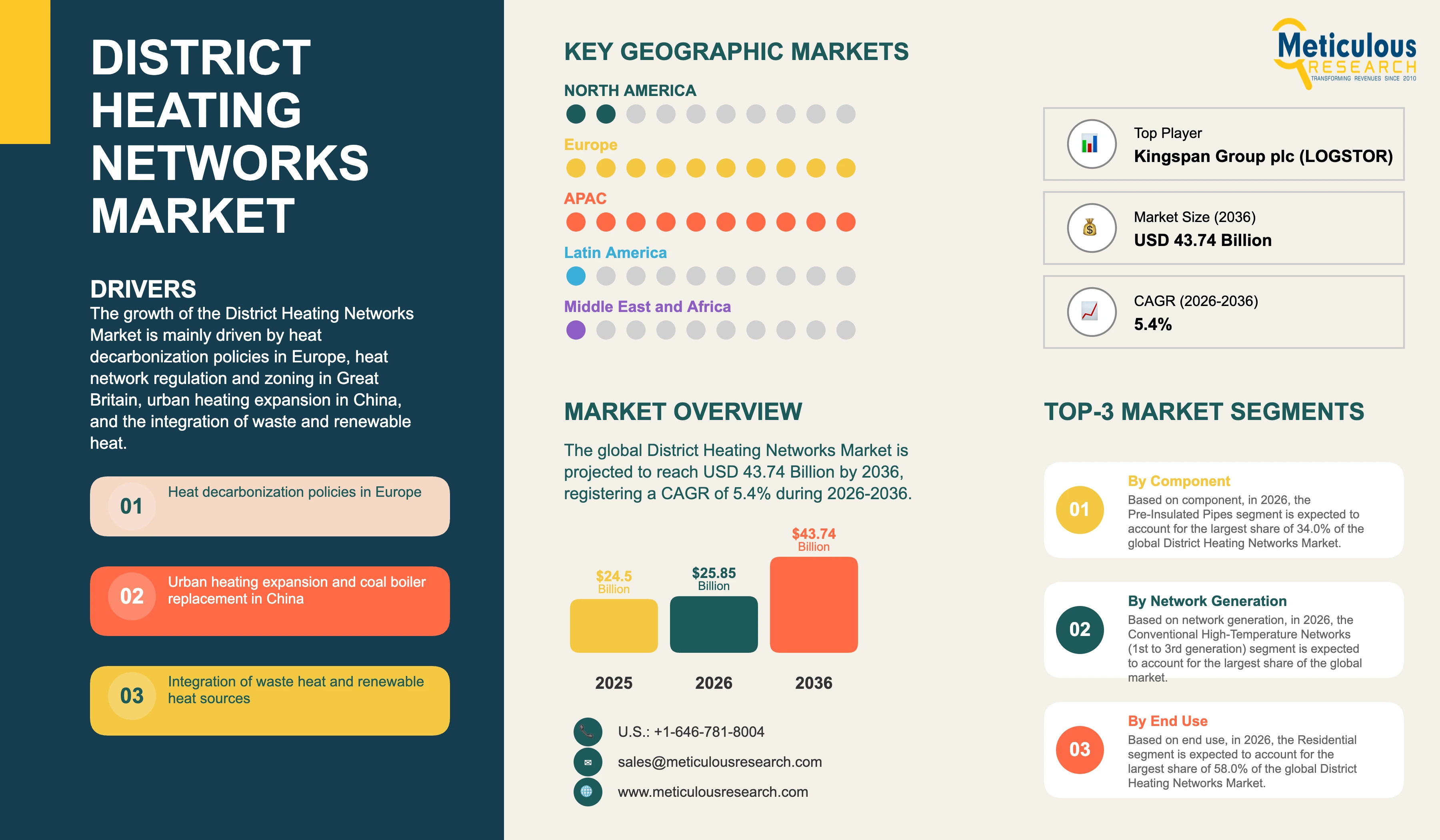
The global district heating networks market was valued at USD 24.50 billion in 2025. This market is expected to reach USD 43.74 billion by 2036 from an estimated USD 25.85 billion in 2026, registering a CAGR of 5.4% during the forecast period (2026-2036).
- Published
- Nov 2026
- Pages
- 265
- Format
- PDF + Excel
- Report ID
- MREP - 1042702
- Base year
- 2025
- 2025 · BASELINE
- $24.50B
- 2036
- $43.74B
- CAGR 2026–2036
- 5.4%
2025 baseline · 2026–2036 forecast at 5.4% CAGR · hover a bar for the value
Key highlights
Germany's economy and buildings ministries set a target of connecting 100, 000 buildings to district heating every year, and a study by Prognos for the German heating industry estimated that about EUR 43.5 billion of investment in district heating would be needed by 2030 to meet climate targets.
Under Germany's Heat Planning Act, municipalities with more than 100,000 inhabitants had to complete their heat plans by June 30, 2026, which is expected to move many cities from planning to network construction. The federal budget raised funding for efficient heat networks under the BEW program to about EUR 1.4 billion for 2026 and about EUR 1.9 billion for 2027, and the government's 2026 climate program foresees EUR 2.7 billion in 2030.
Germany's Federal Office for Economic Affairs and Export Control received 5, 760 applications under the BEW heat network funding program between its launch in 2022 and early June 2026, showing strong demand from municipal utilities and other heat network operators.
Ofgem became the statutory regulator for heat networks in Great Britain on January 27, 2026, under the Energy Act 2023 and the Heat Networks (Market Framework) Regulations. The U.K. government has targets for heat networks to meet 7% of heat demand in England by 2035 and about 20% of U.K. heat by 2050, up from about 3% today, supported by heat network zoning.
China completed the northern line of the Liaocheng-to-Jinan long-distance heating pipeline in October 2025, a 110-kilometer, 1.6-meter diameter pipeline that is the country's longest and largest, bringing industrial waste heat from power plants to Jinan. Once both lines operate, the 150-kilometer network will heat about 100 million square meters and allow the city to shut down 54 coal-fired heating boilers.
In June 2026, KfW IPEX-Bank provided long-term financing to BEW Berliner Energie und Wärme, operator of the largest district heating network in Western Europe, which supplies about 700,000 homes in Berlin, to support investment in new generation assets and network expansion under its plan for climate-neutral heat by 2045.
By component, pre-insulated pipes account for the largest share of 34.0% in 2026, while thermal energy storage registers the highest CAGR.
By network generation, conventional high-temperature networks (1st to 3rd generation) accounts for the largest share in 2026, while ultra-low-temperature and ambient networks (5th generation) registers the highest CAGR.
By project type, new network construction accounts for the largest share in 2026 and also registers the highest CAGR.
By end use, residential accounts for the largest share of 58.0% in 2026, while industrial registers the highest CAGR.
By geography, Europe accounts for the largest share of 46.0% in 2026 and also registers the highest CAGR of 6.1%.
Report summary
| Particulars | Details |
|---|---|
| Base Year | 2025 |
| Estimated Year | 2026 |
| Forecast Period | 2026-2036 |
| Market Size in 2025 | USD 24.50 billion |
| Market Size in 2026 | USD 25.85 billion |
| Market Size by 2036 | USD 43.74 billion |
| CAGR (2026-2036) | 5.4% |
| Format | PDF, Excel & Cloud Portal · 265 pages |
| Largest Segment by Component (2026) | Pre-Insulated Pipes (34.0%) |
| Largest Segment by End Use (2026) | Residential (58.0%) |
| Largest Region (2026) | Europe (46.0%) |
| Fastest-Growing Region | Europe (CAGR 6.1%) |
| Companies Profiled | 16 companies and other companies |
| Segments Covered | Component, Network Generation, Project Type, End Use, Geography |
| Countries Covered | Germany, Denmark, Sweden, Finland, Poland, Netherlands, Austria, Czech Republic, U.K., France, Russia, Rest of Europe, China, South Korea, Japan, Mongolia, Rest of Asia-Pacific, U.S., Canada, Turkey, Rest of Middle East & Africa, Chile, Rest of Latin America |
Report overview
Segments covered: component, network generation, project type, end use.
The growth of this market is mainly driven by national heat decarbonization strategies in Europe that rely heavily on heat networks, including Germany's municipal heat planning law and its target of connecting 100,000 buildings a year, the new heat network regulation and zoning framework in Great Britain, the continued expansion of urban central heating and long-distance heat transmission pipelines in northern China, the integration of industrial waste heat, large heat pumps, geothermal, and solar thermal into networks, the modernization of aging networks to reduce heat losses and lower supply temperatures, and growing interest in low-temperature and ambient networks for new urban districts. However, factors such as the very high upfront capital cost of networks, gaps in public funding, long planning and permitting times, disruption from street works, and competition from individual heat pumps in less dense areas are expected to restrain the growth of this market to some extent.
District heating networks are systems of insulated pipes that distribute hot water or steam from central heat sources to many buildings for space heating and hot water. Heat can come from combined heat and power plants, waste incinerators, industrial waste heat, large heat pumps, geothermal wells, solar thermal fields, electric boilers, and conventional boilers, and it is delivered to buildings through substations or heat interface units that transfer heat into building systems. This report covers global revenue from district heating network infrastructure, including pre-insulated pipes, substations and heat interface units, pumping systems, heat meters, sensors, and network controls, thermal energy storage connected to networks, and civil works, installation, and engineering. Heat generation plants, such as CHP units, heat pumps, and boilers, are excluded from the scope of this report, as they are covered in separate studies.
District heating is widely used in Northern, Central, and Eastern Europe, Russia, China, South Korea, and Japan, and to a smaller extent in North America, where networks serve many university campuses, hospitals, and city centers. In Denmark, Finland, Sweden, and the Baltic countries, district heating supplies a majority of buildings, while in Germany about 14% of households are connected. Northern China has one of the world's largest district heating systems, with urban central heating covering billions of square meters of floor area and many thousands of kilometers of pipelines.
District heating networks are increasingly seen as a key tool for decarbonizing heat in dense urban areas, because they allow cities to switch heat sources centrally and to use heat that would otherwise be wasted. Germany's heat transition strategy relies heavily on heat networks, the U.K. has introduced regulation and zoning to expand them, and China is using long-distance pipelines to deliver waste heat from power plants and industry to cities, replacing coal-fired boilers.
District heating technology is evolving steadily toward lower supply temperatures and more diverse heat sources. Older networks often operate at temperatures above 90 degrees Celsius and sometimes use steam, which leads to high heat losses. Fourth-generation networks operate at about 50 to 70 degrees Celsius, which reduces losses and allows the use of heat pumps, waste heat, and solar thermal, while fifth-generation networks distribute water at near-ambient temperatures and use heat pumps in each building, allowing both heating and cooling and the exchange of heat between buildings. Each generation requires different pipe materials, substation designs, and control strategies, which shapes demand for network equipment.
District heating network construction is capital-intensive, and the assets are very long-lived once installed. Pipes are typically buried under streets and last 30 to 50 years or more, and installation, civil works, and connection to buildings account for a large share of total cost. Business models include municipal utilities that own and operate networks, private concession and joint venture arrangements, energy service companies, and, in the U.K., regulated heat network operators within zoned areas. In China, most networks are owned by state-owned heating companies and municipal utilities, often linked to power generation groups. Infrastructure funds and pension investors are increasingly interested in heat networks as long-term regulated or contracted assets.
The market includes manufacturers of pre-insulated pipes, substations, heat exchangers, pumps, meters, and controls, engineering firms, construction contractors, and heat network developers and operators. Leading companies include Kingspan (LOGSTOR), isoplus, BRUGG Group, REHAU, Georg Fischer (Uponor), Danfoss, Alfa Laval, Kelvion, Grundfos, Wilo, Kamstrup, Landis+Gyr, Veolia, ENGIE, Vital Energi, and Ramboll.
Over the forecast period, the district heating networks market is expected to grow steadily, supported by heat planning and funding programs in Europe, regulation and zoning in the U.K., continued expansion and modernization in China, integration of renewable and waste heat, and the shift to low-temperature networks. Digital monitoring and control systems, thermal storage, and new network generations are expected to account for a growing share of investment. The integration of data center waste heat and large heat pumps is also expected to change the design of networks in many European cities.
Report infographic
Market dynamics
16 factors across 5 forcesHeat decarbonization policies in Europe
European countries are relying on district heating as a central part of their strategies to decarbonize heating in buildings. Germany's Heat Planning Act requires municipalities to prepare heat plans that identify areas suitable for heat networks, with larger cities required to complete their plans by June 30, 2026, and the government aims to connect 100,000 buildings a year to district heating. A Prognos study for the industry estimated that about EUR 43.5 billion of investment would be needed by 2030 to expand and decarbonize German networks.
Several other European countries are also expanding and modernizing their heat networks as part of national heat strategies. The Netherlands is developing collective heat systems under its heat transition program, Poland is modernizing and decarbonizing its very large network base, Austria, the Czech Republic, and the Baltic and Nordic countries are investing in network expansion and new heat sources, and Denmark continues to extend its networks into smaller towns, and the European Union's Energy Efficiency Directive and Renewable Energy Directive promote efficient district heating and the use of renewable and waste heat. These policies create a long-term pipeline of network construction and modernization projects.
National and European funding programs are an essential support for this investment, given the long payback periods of networks. Germany's BEW program received 5,760 applications between 2022 and early June 2026, and its budget is planned to rise to EUR 2.7 billion in 2030, although industry associations argue that even this is not sufficient to meet national targets.
Regulation and zoning of heat networks in great britain
Great Britain has introduced a new regulatory framework for heat networks, with Ofgem becoming the statutory regulator on January 27, 2026, under the Energy Act 2023. The new rules introduce consumer protections, technical standards through the Heat Network Technical Assurance Scheme, and authorization requirements for operators, which are designed to build consumer confidence and attract investment.
The government is also developing heat network zoning, under which areas where heat networks are the lowest-cost low-carbon heating solution will be designated, and certain buildings in these zones may be required to connect. The U.K. aims for heat networks to meet about 7% of heat demand in England by 2035 and about 20% of U.K. heat by 2050, up from about 3% today, and industry studies have identified tens of billions of pounds of investment potential. Pilot zones are already in procurement or commercialization in several cities, and the Green Heat Network Fund and other programs provide capital support for new low-carbon networks in England.
Urban heating expansion and coal boiler replacement in China
China has one of the largest district heating systems in the world, serving billions of square meters of floor area in northern cities, and it continues to expand and modernize its networks as cities grow and replace small coal-fired boilers. Clean heating policies in northern China encourage the use of waste heat from power plants and industry, gas-fired and electric heat sources, and long-distance heat transmission to replace scattered coal boilers and reduce air pollution.
Large projects such as the Liaocheng-to-Jinan pipeline, which will deliver waste heat from power plants more than 100 kilometers away to about 100 million square meters of floor area in Jinan, show the scale of investment in Chinese networks. Chinese energy companies such as CHN Energy are also expanding heating coverage from their power plants, and many cities are investing in network upgrades to reduce leaks and heat losses. The scale of China's networks means that even modest annual expansion and replacement rates create very large demand for pipes, valves, and substations.
Integration of waste heat and renewable heat sources
District heating networks allow the use of heat sources that cannot easily serve individual buildings, including industrial waste heat, heat from data centers, wastewater, rivers, lakes, and the sea through large heat pumps, deep geothermal energy, and large solar thermal fields. As countries seek to replace fossil fuels in heating, these sources are becoming more important, and they require networks to collect and distribute the heat.
Data center waste heat is an emerging source in Europe, where the Energy Efficiency Directive encourages large data centers to use their waste heat, and Nordic, German, and Dutch cities have connected data centers to their networks. Integrating these sources often requires network extensions, lower supply temperatures, and new substations and controls, which supports investment in network infrastructure. Sewage heat recovery and river or sea water heat pumps are also being connected to networks in cities such as Vienna, Helsinki, and Stockholm.
Table of contents
12 chapters · 139 sections · 265 pages · click to expandSegmental analysis
| Segment | Largest share (2026) | Fastest growth (2026–2036) |
|---|---|---|
| By Component | New network construction | Thermal energy storage |
By Component
- The new network construction segment is expected to account for the largest share of the district heating networks market, and it is also projected to register the highest CAGR during the forecast period.
Geographic analysis
Europe
Largest shareIn 2026, Europe is expected to account for the largest share of 46.0% of the global district heating networks market and is also projected to register the highest CAGR of 6.1% during the forecast period. The large share and rapid growth of this region are mainly due to heat decarbonization strategies that rely on heat networks in Germany, the Netherlands, the U.K., Poland, Austria, and the Nordic countries, Germany's municipal heat planning law and BEW funding program, the new heat network regulation and zoning framework in Great Britain, large networks in Russia and Eastern Europe that need modernization, and the strong presence of European network equipment suppliers such as Kingspan (LOGSTOR), isoplus, BRUGG, REHAU, Danfoss, Alfa Laval, Grundfos, Wilo, and Kamstrup. In Russia and Eastern Europe, very large networks built in the Soviet era need extensive modernization, although investment levels vary widely between countries. The Nordic countries continue to lead in network efficiency and the integration of waste heat, heat pumps, and thermal storage. Turkey and parts of North Africa have some interest in geothermal district heating, while district cooling is much more important in the Gulf countries. Some data center and industrial projects in these regions may create small heat networks for specific users.
Asia-Pacific
Asia-Pacific is the second-largest market, supported mainly by China's very large urban central heating system in northern regions, the continued expansion of networks as cities grow, the replacement of small coal boilers with waste heat and long-distance heat transmission, and network modernization to reduce losses. South Korea and Japan also operate significant district heating and cooling networks, and Mongolia and other Central Asian countries are modernizing their systems with international support. Chinese cities are also beginning to use large heat pumps and industrial waste heat in networks, which requires new connections and equipment. The region's growth rate is expected to be lower than Europe's because China's networks are already extensive and expansion is slowing in some cities.
North America
North America accounts for a smaller share of the market, with demand coming from university and hospital campuses, city center networks in the U.S., and neighborhood energy systems in Canadian cities such as Vancouver and Toronto. Many campuses are converting old steam networks to hot water and adding heat pumps as part of decarbonization plans. Building performance standards in cities such as New York and Boston are also encouraging district energy solutions for large buildings.
Latin America
The Middle East & Africa and Latin America account for very small shares of the district heating market, as heating demand is limited in most of these regions.
Competitive landscape
The global district heating networks market is fragmented, with the top five players estimated to account for about 25% of the market in 2025. The market includes manufacturers of pre-insulated pipes, substations and heat interface units, heat exchangers, pumps, heat meters, and controls, engineering firms, construction contractors, and network developers and operators.
Kingspan (LOGSTOR), isoplus, BRUGG Group, REHAU, and Georg Fischer (Uponor) are leading suppliers of pre-insulated pipe systems, with strong positions in Europe and growing activity in other regions. Danfoss and Alfa Laval are leading suppliers of substations, heat exchangers, and controls, while Kelvion supplies heat exchangers, Grundfos and Wilo supply pumps, and Kamstrup and Landis+Gyr supply heat meters and data systems.
Veolia and ENGIE develop, build, and operate district heating networks in many countries, Vital Energi is a leading heat network contractor in the U.K., and Ramboll is a leading engineering firm for district heating design and planning. Many municipal utilities and local construction companies also play important roles in their markets, and Chinese pipe and equipment manufacturers serve the domestic Chinese market. Large utilities such as Vattenfall, Fortum, and E.ON also develop and operate major networks in Northern and Central Europe.
Companies in this market compete on product quality and durability, heat loss performance, installation speed, digital capabilities, price, and the ability to deliver complete solutions and long-term service. Key strategies include expansion of pipe and substation manufacturing capacity in Europe, development of plastic and flexible pipes for low-temperature networks, smart substations and digital network management tools, partnerships with municipal utilities and developers, and acquisitions of regional suppliers and contractors.
The competitive landscape is expected to evolve as heat planning in Germany and zoning in the U.K. create a large pipeline of projects. Suppliers with strong manufacturing capacity, broad product portfolios, and the ability to support customers with design, digital tools, and financing will be best positioned, while regulation in the U.K. is expected to favor larger, well-capitalized network developers and operators. Consolidation among pipe manufacturers, substation suppliers, and network contractors is also possible as companies seek scale.
Some of the key players operating in the district heating networks market are Kingspan Group plc (LOGSTOR), isoplus Fernwärmetechnik GmbH, BRUGG Group AG, REHAU Group, Georg Fischer AG (Uponor), Danfoss A/S, Alfa Laval AB, Kelvion Holding GmbH, Grundfos Holding A/S, Wilo SE, Kamstrup A/S, Landis+Gyr Group AG, Veolia Environnement S.A., ENGIE SA, Vital Energi Utilities Limited, and Ramboll Group A/S, among others.
- —
Ofgem began regulating heat networks in Great Britain in January 2026, German cities with more than 100,000 inhabitants completed heat plans by June 2026, Germany increased BEW funding for 2026 and 2027, KfW IPEX-Bank financed Berlin's district heating expansion, and China completed the 110-kilometer Liaocheng-to-Jinan heating pipeline.
- Vattenfall
- Fortum
- E.ON also develop and
Expert perspectives
The district heating networks market is entering a period of strong investment in Europe, as heat networks move to the center of national strategies to decarbonize buildings. We see Germany's municipal heat planning, the U.K.'s new regulation and zoning framework, and continued expansion in China as the main forces that will shape the market over the next decade.
Over the forecast period, the market is expected to grow at a CAGR of 5.4%, from USD 25.85 billion in 2026 to USD 43.74 billion in 2036. Growth will be supported by new networks and expansions in Europe, modernization and long-distance transmission in China, integration of waste and renewable heat, digitalization, and thermal storage, while high capital costs, funding gaps, construction constraints, and competition from individual heat pumps will moderate growth.
In terms of segments, pre-insulated pipes remain the largest component, while thermal energy storage grows fastest. Conventional high-temperature networks remain the largest network generation, while fifth-generation networks grow fastest. Residential customers remain the largest end use, while industrial customers grow fastest. Europe remains the largest region and is also the fastest-growing region at a CAGR of 6.1%.
For network equipment suppliers and contractors, the key priorities over the forecast period are to expand manufacturing and installation capacity to meet the expected surge in European projects, to develop products for low-temperature and fifth-generation networks, to offer digital monitoring and control tools that reduce heat losses and integrate new heat sources, and to work with municipal utilities on project development and financing.
We expect the pace of growth in Europe to depend heavily on public funding, heat prices, and regulatory frameworks in each country. In our view, the completion of German heat plans and the implementation of U.K. zoning will be the most important milestones for the market, and stable, adequate funding will be essential to turn plans into construction. Suppliers that can help reduce network costs and installation times will play a key role in making these plans affordable. We also expect thermal storage, heat pumps, and digital control to become standard parts of new and modernized networks.
Policy and funding decisions will remain the key factors for this market. Adequate funding for programs such as Germany's BEW, clear zoning rules in the U.K., and continued clean heating policies in China would support strong growth, while funding cuts or policy changes that favor individual heat pumps could slow it in some areas. Interest rates and construction costs will also strongly affect the affordability of new networks.
Customer perspectives
Head of Heat Networks - municipal utility, Germany
Our heat plan shows that large parts of the city should be supplied by the network, so we are preparing to build new lines and connect thousands of buildings. Funding and construction capacity are our biggest concerns, and we need suppliers who can deliver reliably.
Director of Development - heat network developer, U.K.
Regulation and zoning give investors and customers more confidence in heat networks. We are designing new low-temperature networks with heat pumps and smart controls so that we can offer competitive and reliable heat.
Chief Engineer - heating company, northern China
We are replacing small coal boilers with waste heat from power plants delivered through long-distance pipelines. Reducing leaks and heat losses in our older networks is also a major priority.
Frequently asked questions
The global district heating networks market was valued at USD 24.50 billion in 2025, up from USD 23.30 billion in 2024, and is estimated at USD 25.85 billion in 2026. The market includes pre-insulated pipes, substations and heat interface units, pumping systems, heat meters and controls, thermal storage, and civil works, installation, and engineering, and excludes heat generation plants.
Cite this report
Meticulous Research. (2026). District Heating Networks Market - Global Opportunity Analysis and Industry Forecast (2026-2036) (Report No. MREP - 1042702). Meticulous Market Research Pvt. Ltd. https://www.meticulousresearch.com/product/district-heating-networks-market-7385