Renewable Diesel Market (2026-2036)
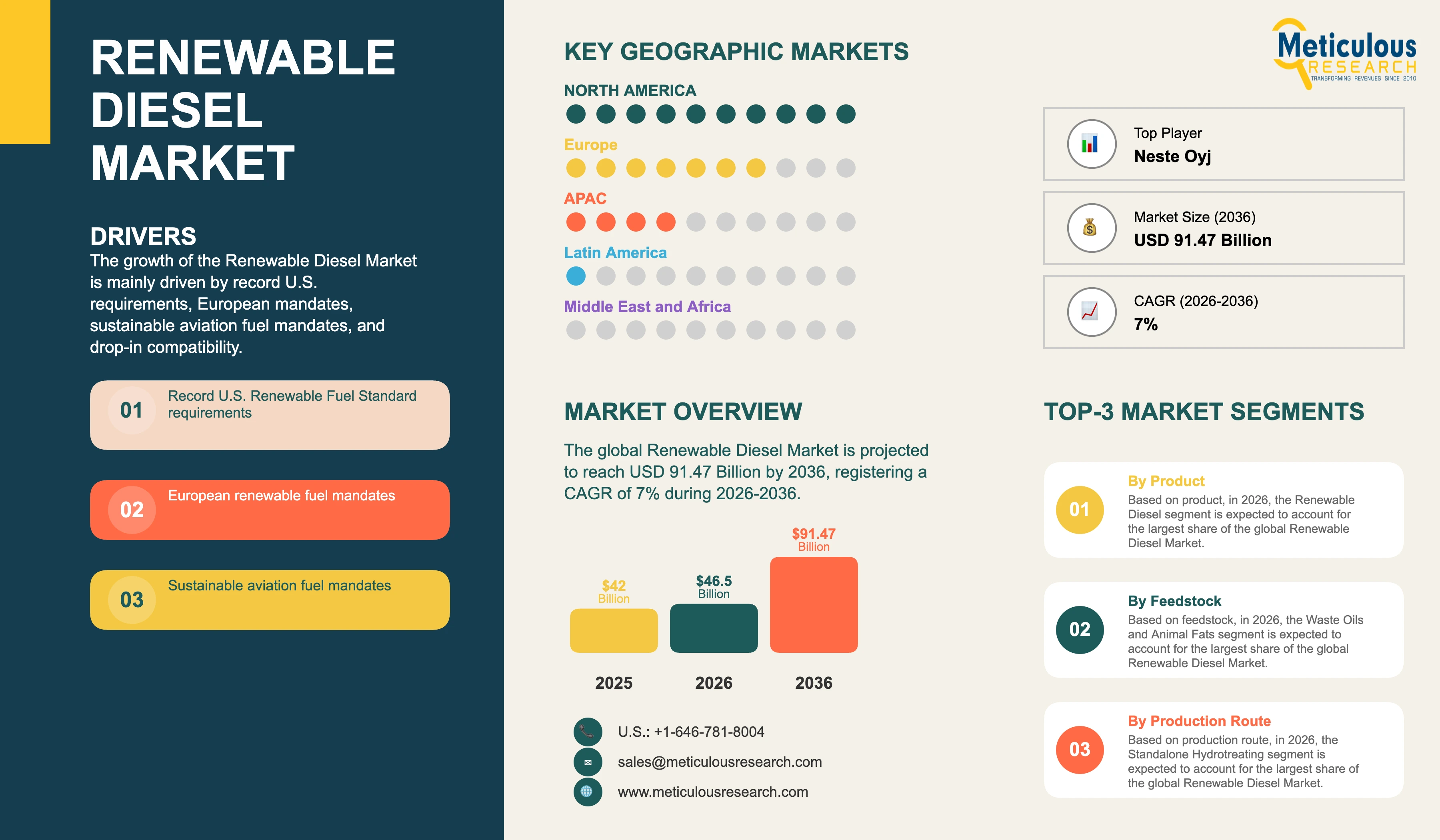
The global renewable diesel market was valued at USD 42.00 billion in 2025. This market is expected to reach USD 91.47 billion by 2036 from an estimated USD 46.50 billion in 2026, registering a CAGR of 7.0% during the forecast period (2026-2036).
- Published
- Nov 2026
- Pages
- 270
- Format
- PDF + Excel
- Report ID
- MREP - 1042733
- Base year
- 2025
- 2025 · BASELINE
- $42.00B
- 2036
- $91.47B
- CAGR 2026–2036
- 7.0%
2025 baseline · 2026–2036 forecast at 7.0% CAGR · hover a bar for the value
Key highlights
Neste, the world's leading producer of renewable diesel and sustainable aviation fuel, reported 2025 Renewable Products sales of 4.1 million tonnes, up from 3.7 million tonnes in 2024, with a full-year comparable sales margin of USD 411 per tonne and comparable EBITDA of EUR 764 million, and it expects its renewables production capacity to reach 6.8 million tonnes annually in 2027.
Neste reported fourth-quarter 2025 sales of 832, 000 tonnes of renewable diesel and a record 253,000 tonnes of sustainable aviation fuel, and it said that the renewable diesel market improved toward the end of 2025, with favorable regulatory developments and increasing demand for renewable fuels in Europe.
For 2026, the U.S. Environmental Protection Agency set a requirement for refiners to generate or purchase 8.86 billion RINs, equivalent to blending a record 5.4 billion gallons of biodiesel and renewable diesel, a target more than 60% higher than 2025 levels.
U.S. renewable diesel production averaged about 170, 000 barrels per day in the first quarter of 2025, down 12% from the first quarter of 2024, as producers adjusted to the transition from the blenders tax credit to the Section 45Z clean fuel production credit, although U.S. renewable diesel production capacity had increased by nearly 20% since the first quarter of 2024.
The U.S. exported nearly 50, 000 barrels per day of renewable diesel and other biofuels, including sustainable aviation fuel, in the second half of 2025, about 20% of combined production, according to the Energy Information Administration, and export prices strengthened in 2026 because of supply disruptions related to the conflict in the Gulf.
Global sustainable aviation fuel production was expected to reach about 2.4 million tonnes in 2025, accounting for about 0.8% of total aviation fuel use, according to the International Air Transport Association, with most current production coming from hydroprocessed esters and fatty acids plants that also produce renewable diesel.
By product, renewable diesel accounts for the largest share of 82.0% in 2026, while hydroprocessed sustainable aviation fuel registers the highest CAGR.
By feedstock, waste oils and animal fats account for the largest share of 48.0% in 2026, while other feedstocks register the highest CAGR.
By production route, standalone hydrotreating accounts for the larger share in 2026, while co-processing in petroleum refineries register the higher CAGR.
By geography, North America accounts for the largest share of 44.0% in 2026, while Asia-Pacific registers the highest CAGR of 9.7%.
Report summary
| Particulars | Details |
|---|---|
| Base Year | 2025 |
| Estimated Year | 2026 |
| Forecast Period | 2026-2036 |
| Market Size in 2025 | USD 42.00 billion |
| Market Size in 2026 | USD 46.50 billion |
| Market Size by 2036 | USD 91.47 billion |
| CAGR (2026-2036) | 7.0% |
| Format | PDF, Excel & Cloud Portal · 270 pages |
| Largest Segment by Product (2026) | Renewable Diesel (82.0%) |
| Largest Segment by Feedstock (2026) | Waste Oils and Animal Fats (48.0%) |
| Largest Region (2026) | North America (44.0%) |
| Fastest-Growing Region | Asia-Pacific (CAGR 9.7%) |
| Companies Profiled | 12 companies and other companies |
| Segments Covered | Product, Feedstock, Production Route, Geography |
| Countries Covered | U.S., Canada, Finland, Netherlands, Germany, Sweden, Italy, France, Rest of Europe, Singapore, China, South Korea, Japan, Rest of Asia-Pacific, Brazil, Rest of Latin America, UAE, Rest of Middle East & Africa |
Report overview
Segments covered: product, feedstock, production route.
The growth of this market is mainly driven by record biomass-based diesel requirements under the U.S. Renewable Fuel Standard, low-carbon fuel standards in California, other U.S. states, and Canada, the U.S. clean fuel production tax credit, renewable fuel and greenhouse gas reduction mandates in the European Union, the rapid growth of sustainable aviation fuel mandates, which are driving investment in hydroprocessed esters and fatty acids capacity that also produces renewable diesel, the drop-in nature of renewable diesel, which can be used in existing engines and infrastructure without blending limits, and new production capacity in Asia-Pacific. However, factors such as the limited availability and rising cost of waste oils and vegetable oil feedstocks, dependence on policy credits and incentives, overcapacity and margin volatility, and competition from electrification in road transport are expected to restrain the growth of this market to some extent.
Renewable diesel, also known as hydrotreated vegetable oil, is a paraffinic diesel fuel produced by hydrotreating vegetable oils, animal fats, used cooking oil, and other lipid feedstocks. Unlike biodiesel, which is a fatty acid methyl ester produced by transesterification, renewable diesel is chemically similar to petroleum diesel and meets the same fuel specifications, which allows it to be used at any blend level, including as a 100% replacement for petroleum diesel, in existing engines, pipelines, and fueling infrastructure. Renewable diesel can reduce lifecycle greenhouse gas emissions significantly compared with petroleum diesel, depending on the feedstock used.
This report covers global revenue from the sale of renewable diesel and co-products from hydrotreated renewable fuel plants, including hydroprocessed esters and fatty acids sustainable aviation fuel, renewable naphtha, and renewable propane, produced from waste oils and animal fats, vegetable oils, and other feedstocks through standalone hydrotreating and co-processing in petroleum refineries. Revenue is measured at the value of fuel sold, excluding the separate value of policy credits such as RINs, low-carbon fuel standard credits, and tax credits. Biodiesel produced by transesterification, ethanol, synthetic fuels produced by Fischer-Tropsch, alcohol-to-jet, and power-to-liquid processes, and biogas are excluded from the scope of this report, as they are covered in separate studies.
Renewable diesel is produced in two main ways, through standalone plants and through co-processing. Standalone renewable diesel plants, which include new plants and petroleum refineries converted to renewable fuel production, use dedicated hydrotreating and isomerization units to process 100% renewable feedstocks. Co-processing involves processing a small share of renewable feedstocks together with petroleum feedstocks in existing refinery hydrotreaters or fluid catalytic cracking units. Many standalone plants can also produce sustainable aviation fuel by adding a fractionation step and adjusting operating conditions, which allows producers to switch between renewable diesel and sustainable aviation fuel depending on market conditions.
The U.S. is the largest renewable diesel market, driven by the Renewable Fuel Standard, California's Low Carbon Fuel Standard, similar programs in Oregon and Washington, and federal tax credits. Several major U.S. refineries have been converted to renewable diesel production, and new plants have been built, which has significantly increased U.S. production capacity. Europe is the second-largest market, driven by the Renewable Energy Directive and national mandates, and Neste's plants in Finland, the Netherlands, and Singapore supply large volumes to Europe and North America. Asia-Pacific is a growing production region, with plants in Singapore, China, South Korea, and other countries supplying both domestic and export markets.
The renewable diesel market has been highly volatile in recent years, with sharp swings in margins. Rapid capacity additions in the U.S. and elsewhere led to overcapacity and lower margins in 2024 and early 2025, and the transition from the U.S. blenders tax credit to the Section 45Z clean fuel production credit on January 1, 2025, caused production disruptions and a sharp fall in imports. Margins improved toward the end of 2025, supported by stronger demand in Europe, record U.S. biomass-based diesel requirements for 2026, and higher export prices related to supply disruptions in 2026.
Sustainable aviation fuel is becoming increasingly important for renewable diesel producers in every major region of the world. The European Union's aviation fuel mandate requires fuel suppliers to blend increasing shares of sustainable aviation fuel into jet fuel, starting at 2% in 2025 and rising over time, and the U.K. and other countries have similar mandates. Most current sustainable aviation fuel is produced by hydroprocessed esters and fatty acids plants, which also produce renewable diesel, and many producers are increasing the share of sustainable aviation fuel in their output.
Over the forecast period, the market is expected to grow strongly, supported by mandates, low-carbon fuel programs, and sustainable aviation fuel demand. Renewable diesel is expected to remain the largest product, while hydroprocessed sustainable aviation fuel grows fastest. Waste oils and animal fats are expected to remain the largest feedstock, while other feedstocks grow fastest. Standalone hydrotreating is expected to remain the largest production route, while co-processing grows fastest. North America is expected to remain the largest region, while Asia-Pacific is expected to grow fastest.
We switched our trucks to renewable diesel because it works in our existing engines and helps us meet our emissions targets.
This comment explains why North America is the largest region.
We need increasing volumes of sustainable aviation fuel to meet the European mandate.
This comment explains why sustainable aviation fuel is growing fastest.
Demand for renewable fuels in Asia is growing as governments set new targets.
This comment explains why Asia-Pacific is the fastest-growing region. Across all customer groups, carbon intensity and compliance value are increasingly important, as buyers use renewable diesel and sustainable aviation fuel to meet regulatory obligations and corporate emissions targets. Buyers also value reliable supply, consistent fuel quality, and transparent certification of feedstocks and sustainability. Fleet operators often prefer long-term supply agreements that guarantee availability and price, while airlines focus on securing sustainable aviation fuel volumes to meet mandates and voluntary targets.
Shipping companies and rail operators are also beginning to use renewable diesel, focusing on compatibility with existing engines and on the emissions reductions it provides. Buyers in all segments expect clear documentation of carbon intensity. Price remains decisive for many fleet operators, especially where credits do not fully cover the premium over petroleum diesel.
Report infographic
Market dynamics
16 factors across 5 forcesRecord U.S. renewable fuel standard requirements
The U.S. Environmental Protection Agency set record Renewable Fuel Standard requirements for 2026, requiring refiners to generate or purchase 8.86 billion RINs, equivalent to blending 5.4 billion gallons of biodiesel and renewable diesel, more than 60% above 2025 levels. These requirements create strong demand for renewable diesel, which is the largest source of biomass-based diesel in the U.S. Production in the first months of 2026 lagged the required levels, which supported RIN prices and producer margins.
The Renewable Fuel Standard is complemented by low-carbon fuel standards in California, Oregon, and Washington, and by Canada's Clean Fuel Regulations, which reward fuels with lower carbon intensity. Renewable diesel produced from waste feedstocks has a low carbon intensity and earns significant credits under these programs. California is the largest consumer of renewable diesel in the world, and renewable diesel accounts for a large share of the diesel used in the state. The Section 45Z clean fuel production credit, which replaced the blenders tax credit in 2025, rewards domestic production based on carbon intensity, which favors U.S. producers using low-carbon feedstocks.
Because the Section 45Z credit is tied to carbon intensity and the origin of feedstocks, it has strengthened the competitiveness of U.S. domestic production and production using North American feedstocks, which contributed to a sharp decline in U.S. imports of renewable diesel in 2025. These policy changes are reshaping trade flows and investment decisions across North America.
European renewable fuel and greenhouse gas mandates
The European Union's Renewable Energy Directive requires member states to increase the share of renewable energy in transport, with specific targets for advanced biofuels, and many countries have greenhouse gas reduction requirements for fuel suppliers. Renewable diesel is widely used to meet these requirements because it can be blended at high levels without technical limits. Countries such as Sweden, Finland, Germany, and the Netherlands have high renewable fuel requirements, and HVO100 is sold at fuel stations in several countries. Neste reported favorable regulatory developments and increasing demand for renewable fuels in Europe toward the end of 2025, which supported improved margins. Germany's increase in its greenhouse gas reduction quota and other national measures are expected to support demand over the forecast period.
The European Union has also introduced strict sustainability and traceability requirements for feedstocks, which favor producers with robust supply chain verification, and it has limited the use of high indirect land use change risk feedstocks. These requirements support demand for renewable diesel made from certified waste and residue feedstocks.
Rapid growth of sustainable aviation fuel mandates
Sustainable aviation fuel mandates in the European Union and the U.K., together with incentives in the U.S. and commitments by airlines, are driving rapid growth in demand for sustainable aviation fuel. Most current production comes from hydroprocessed esters and fatty acids plants, which also produce renewable diesel, and producers are investing to increase their sustainable aviation fuel output. Neste sold a record 253,000 tonnes of sustainable aviation fuel in the fourth quarter of 2025.
Global sustainable aviation fuel production was expected to reach about 2.4 million tonnes in 2025, accounting for about 0.8% of aviation fuel use, and mandates require this share to increase significantly by 2030 and beyond. This growth is expected to drive investment in new hydrotreating capacity and conversions, which will also increase renewable diesel production capacity.
The ability of hydroprocessed esters and fatty acids plants to produce both renewable diesel and sustainable aviation fuel gives producers flexibility to shift output toward the more valuable product, and the growth of sustainable aviation fuel is expected to make the overall renewable fuels business more resilient.
Drop-in compatibility and decarbonization of heavy transport
Renewable diesel can be used in existing diesel engines, trucks, buses, ships, trains, and off-road equipment without modification, and it can be distributed through existing pipelines and fueling infrastructure. This drop-in compatibility makes it one of the most practical options for reducing emissions in heavy transport, where electrification is more challenging. Fleet operators, municipalities, and logistics companies are using renewable diesel to meet emissions targets. Renewable diesel also offers performance benefits, such as a high cetane number and lower emissions of particulates and nitrogen oxides, which supports its use in urban fleets and sensitive environments. Marine and rail operators are also beginning to use renewable diesel to reduce emissions, and the International Maritime Organization's efforts to reduce shipping emissions could create additional demand for renewable diesel and other renewable fuels in marine applications over the forecast period.
Table of contents
11 chapters · 121 sections · 270 pages · click to expandSegmental analysis
| Segment | Largest share (2026) | Fastest growth (2026–2036) |
|---|---|---|
| By Product | Renewable diesel | Hydroprocessed sustainable aviation fuel |
By Product
- The standalone hydrotreating segment is expected to account for the larger share of the renewable diesel market, while the co-processing in petroleum refineries segment is projected to register the higher CAGR during the forecast period.
Geographic analysis
North America
Largest shareIn 2026, North America is expected to account for the largest share of 44.0% of the global renewable diesel market. The large share of this region is mainly due to the U.S. Renewable Fuel Standard, California's Low Carbon Fuel Standard, and large production capacity in the U.S. Within North America, the U.S. is the largest country market, with large production capacity in California, Louisiana, Texas, and other states, and the world's largest consumption of renewable diesel in California. Canada is a growing market, supported by its Clean Fuel Regulations and new production capacity. U.S. exports of renewable diesel and other biofuels reached nearly 50,000 barrels per day in the second half of 2025, which shows the growing role of the U.S. as an exporter.
Europe
Europe is the second-largest market, supported by renewable fuel and aviation fuel mandates and national greenhouse gas reduction requirements. In Europe, Finland, the Netherlands, Sweden, Germany, Italy, and France are important markets and producers, and Neste's Rotterdam expansion is expected to add significant capacity.
Asia-Pacific
Fastest growthAsia-Pacific is projected to register the highest CAGR of 9.7% during the forecast period. The rapid growth of this region is mainly due to new plants in Singapore, China, South Korea, and Southeast Asia and new sustainable aviation fuel targets. In Asia-Pacific, Singapore hosts one of the world's largest renewable fuel plants, and China, South Korea, and Japan are adding capacity. Singapore will remain the region's main export hub, supported by its large production capacity and strategic location on major shipping routes. Asia-Pacific production is also increasingly linked to export demand in Europe and North America, which means that trade policies in importing regions will affect its growth.
Latin America
In Latin America, Brazil is developing renewable diesel and sustainable aviation fuel production under its Fuel of the Future program. Latin America is expected to grow rapidly from a small base, supported by Brazil's policies and its large feedstock base.
Middle East & Africa
The Middle East & Africa is a small market, but projects to produce sustainable aviation fuel and renewable diesel are being planned in the UAE and other countries, supported by aviation hubs and national decarbonization targets.
Competitive landscape
The global renewable diesel market is consolidated, with the top five players estimated to account for about 55% of the market in 2025. The market includes dedicated renewable fuel producers, petroleum refiners, and joint ventures between refiners and feedstock suppliers.
Neste is the world's leading producer, with 2025 Renewable Products sales of 4.1 million tonnes. Diamond Green Diesel, a joint venture between Valero and Darling Ingredients, is the largest U.S. producer, and Marathon Petroleum, Phillips 66, and Chevron through Renewable Energy Group are other major U.S. producers. Enilive, TotalEnergies, Repsol, UPM, Preem, and Moeve are leading European producers, and Montana Renewables is a growing U.S. producer of sustainable aviation fuel. Companies compete on feedstock access, carbon intensity, production costs, scale, and product flexibility. Key strategies include sustainable aviation fuel expansion, feedstock integration, refinery conversions, and long-term offtake agreements.
Feedstock access is a key competitive advantage, as shown by the Diamond Green Diesel joint venture between Valero and Darling Ingredients, which combines refining expertise with one of the world's largest collectors and processors of waste fats and oils. Neste has built a global network for sourcing waste and residue feedstocks, and several producers have invested in feedstock pretreatment to process lower-quality feedstocks. Recent developments include Neste's record sustainable aviation fuel sales and capacity expansion, record U.S. biomass-based diesel requirements for 2026, and the growth of U.S. renewable diesel exports. We expect producers to continue shifting output toward sustainable aviation fuel and to pursue partnerships that secure feedstock supply. Competition is expected to intensify in sustainable aviation fuel, as many refiners and renewable fuel producers announce projects, while some smaller renewable diesel producers may face pressure during periods of weak margins.
Barriers to entry are significant because of the high capital cost of plants, the need for feedstock supply chains and pretreatment capability, and the technical expertise required to operate hydrotreating units, but refinery conversions have allowed several refiners to enter the market relatively quickly. Partnerships between refiners, feedstock suppliers, and airlines are increasingly common. These partnerships help secure feedstock supply and offtake, reduce risk for new projects, and give airlines access to sustainable aviation fuel volumes over long periods.
Some of the key players operating in the renewable diesel market are Neste Oyj, Diamond Green Diesel (Valero Energy and Darling Ingredients), Marathon Petroleum Corporation, Phillips 66, Chevron Renewable Energy Group, Enilive S.p.A., TotalEnergies SE, Repsol S.A., UPM-Kymmene Corporation, Preem AB, Moeve, and Montana Renewables (Calumet, Inc.), among others.
- —
The U.S. set record 2026 biomass-based diesel requirements, Neste reported record sustainable aviation fuel sales, and U.S. renewable diesel exports increased in the second half of 2025.
- TotalEnergies
- Repsol
- UPM
- Preem
- Moeve
Expert perspectives
The renewable diesel market is entering a new phase of growth after a period of overcapacity and margin pressure. We expect strong growth over the forecast period, supported by record U.S. requirements, European mandates, and sustainable aviation fuel demand.
Over the forecast period, the market is expected to grow at a CAGR of 7.0%, from USD 46.50 billion in 2026 to USD 91.47 billion in 2036. Growth will be supported by mandates, low-carbon fuel programs, sustainable aviation fuel, and drop-in compatibility, while feedstock constraints, policy dependence, overcapacity, and electrification will moderate growth.
In terms of segments, renewable diesel remains the largest product, while hydroprocessed sustainable aviation fuel grows fastest. Waste oils and animal fats remain the largest feedstock, while other feedstocks grow fastest. Standalone hydrotreating remains the largest production route, while co-processing grows fastest. North America remains the largest region, while Asia-Pacific grows fastest at a CAGR of 9.7%.
For producers, the key priorities are to secure low-carbon feedstocks, increase sustainable aviation fuel capability, and manage costs. We believe that feedstock access will be the most important competitive factor over the forecast period.
We expect market value to recover in 2026, supported by record U.S. requirements, improving European demand, and higher export prices, followed by strong growth as sustainable aviation fuel mandates increase and new capacity comes online in Asia-Pacific and Europe. Our forecast assumes that the U.S. Renewable Fuel Standard, low-carbon fuel programs, and European mandates remain in place and gradually increase, and that feedstock supply grows through new collection systems and new crops. A weakening of policies or a sharp rise in feedstock costs could slow growth, while faster adoption of sustainable aviation fuel could add upside. In our view, producers with secure low-carbon feedstocks, flexible product slates, and strong positions in sustainable aviation fuel will be best positioned over the forecast period.
We also expect the market to become more global, with growing trade in renewable diesel and sustainable aviation fuel between North America, Europe, and Asia, and with feedstocks sourced from many regions. Policies that favor domestic production, such as the Section 45Z credit, may limit some trade, but overall trade is expected to grow.
We see sustainable aviation fuel as the most important long-term growth driver for the market, with renewable diesel providing a large and steady base of demand from road transport, marine, and off-road applications. Feedstock constraints will shape the pace of growth. We expect steady consolidation over time, as larger producers acquire smaller plants.
Customer perspectives
Buyers of renewable diesel include fuel distributors, refiners with blending obligations, fleet operators, municipalities, airlines, and shipping companies. Their decisions depend mainly on price, carbon intensity, compliance value, and supply reliability.
Frequently asked questions
The global renewable diesel market was valued at USD 42.00 billion in 2025, down from USD 43.50 billion in 2024 because of lower U.S. production and margins during the tax credit transition, and is estimated at USD 46.50 billion in 2026.
The global renewable diesel market is expected to reach USD 91.47 billion by 2036, supported by mandates, low-carbon fuel programs, and sustainable aviation fuel demand.
The market is expected to register a CAGR of 7.0% from 2026 to 2036, with the fastest growth in hydroprocessed sustainable aviation fuel, other feedstocks, co-processing, and Asia-Pacific.
The U.S. Environmental Protection Agency requires refiners to generate or purchase 8.86 billion RINs in 2026, equivalent to blending a record 5.4 billion gallons of biodiesel and renewable diesel, more than 60% above 2025 levels.
Market growth is mainly driven by record U.S. Renewable Fuel Standard requirements, European renewable fuel and greenhouse gas mandates, sustainable aviation fuel mandates, and the drop-in compatibility of renewable diesel.
Limited feedstock availability, rising feedstock costs, and dependence on policy credits restrain growth, while overcapacity, competition, electrification, and policy uncertainty are key challenges.
Key opportunities include expansion of sustainable aviation fuel production, new feedstocks, expansion in Asia-Pacific, and co-processing in existing refineries.
Renewable diesel is expected to account for the largest share of 82.0% of the market in 2026, while hydroprocessed sustainable aviation fuel is projected to register the highest CAGR.
Other feedstocks, such as cover crop oils and tall oil, are projected to register the highest CAGR, while waste oils and animal fats account for the largest share of 48.0%.
North America is expected to account for the largest share of 44.0% of the market in 2026, mainly due to the U.S. Renewable Fuel Standard and California's Low Carbon Fuel Standard.
Asia-Pacific is projected to register the highest CAGR of 9.7% during the forecast period, driven by new plants and sustainable aviation fuel targets.
Neste reported 2025 Renewable Products sales of 4.1 million tonnes, up from 3.7 million tonnes, a comparable sales margin of USD 411 per tonne, and comparable EBITDA of EUR 764 million, and it expects its renewables capacity to reach 6.8 million tonnes in 2027.
The report profiles 12 companies, including Neste Oyj, Diamond Green Diesel (Valero Energy and Darling Ingredients), Marathon Petroleum Corporation, Phillips 66, Chevron Renewable Energy Group, Enilive S.p.A., TotalEnergies SE, Repsol S.A., UPM-Kymmene Corporation, Preem AB, Moeve, and Montana Renewables (Calumet, Inc.).
The U.S. set record 2026 biomass-based diesel requirements, Neste reported record sustainable aviation fuel sales, and U.S. renewable diesel exports increased in the second half of 2025.
In 2026, the standalone hydrotreating segment is expected to account for the larger share of the renewable diesel market, while the co-processing in petroleum refineries segment is projected to register the higher CAGR during the forecast period.
Cite this report
Meticulous Research. (2026). Renewable Diesel Market - Global Opportunity Analysis and Industry Forecast (2026-2036) (Report No. MREP - 1042733). Meticulous Market Research Pvt. Ltd. https://www.meticulousresearch.com/product/renewable-diesel-market-7416