Sugar Reduction Ingredients Market (2026-2036)
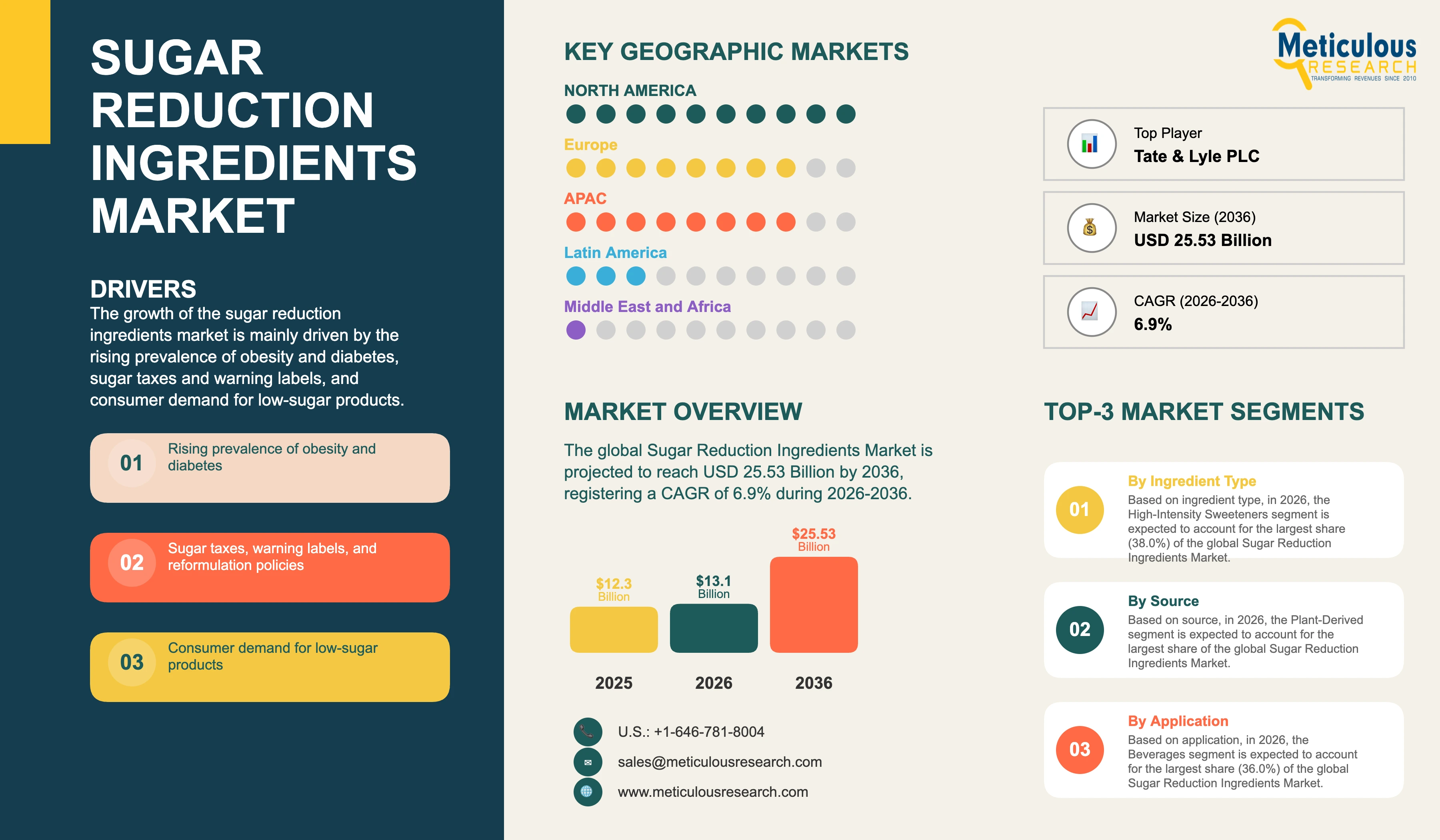
The global sugar reduction ingredients market was valued at USD 12.30 billion in 2025. This market is expected to reach USD 25.53 billion by 2036 from an estimated USD 13.10 billion in 2026, registering a CAGR of 6.9% during the forecast period (2026-2036).
- Published
- Nov 2026
- Pages
- 255
- Format
- PDF + Excel
- Report ID
- MRFB - 1042516
- Base year
- 2025
- 2025 · BASELINE
- $12.30B
- 2036
- $25.53B
- CAGR 2026–2036
- 6.9%
2025 baseline · 2026–2036 forecast at 6.9% CAGR · hover a bar for the value
Key highlights
The World Health Organization's Global Report on the Use of Sugar-Sweetened Beverage Taxes, 2025, published in January 2026, found that at least 116 countries had introduced national excise taxes on at least one type of sugar-sweetened beverage as of July 2024, and WHO has called on governments to raise these taxes further under its 3 by 35 initiative.
The UK government reported that the Soft Drinks Industry Levy led to an average 47% reduction in sugar in soft drinks within its scope between 2015 and 2024, and it confirmed that from 1 January 2028 the levy will be extended to milk-based and milk-substitute drinks and the lower sugar threshold will be cut from 5 grams to 4.5 grams per 100 milliliters.
Front-of-pack warning labels for high sugar content are now mandatory in several Latin American countries, including Mexico, Chile, Peru, Colombia, Argentina, and Brazil, which has led many food and beverage companies in the region to reformulate their products with less sugar.
Ingredient suppliers continue to invest in new production technology and capacity, including bioconversion and fermentation for stevia components such as Reb M, enzymatic production of allulose, and new application centers that help food and beverage manufacturers reformulate products with less sugar while keeping the taste consumers expect.
The U.S. Food and Drug Administration updated the definition of the healthy nutrient content claim in December 2024, adding limits on added sugars for foods that carry the claim, and it has proposed a front-of-package nutrition information box that would show added sugar levels.
In June 2025, the European Food Safety Authority concluded that the safety of D-allulose could not be established in one novel food application because the applicant did not supply requested data, which shows that the approval of rare sugars in the European Union remains slow, while allulose is already permitted in the U.S., Japan, South Korea, and several other countries.
By ingredient type, high-intensity sweeteners account for the largest share of 38.0% in 2026, while rare sugars register the highest CAGR.
By source, plant-derived ingredients account for the largest share in 2026 and register the highest CAGR.
By application, beverages account for the largest share of 36.0% in 2026, while nutrition and dietary supplements register the highest CAGR.
By geography, North America accounts for the largest share of 33.0% in 2026, while Latin America registers the highest CAGR of 9.1%.
Report summary
| Particulars | Details |
|---|---|
| Base Year | 2025 |
| Estimated Year | 2026 |
| Forecast Period | 2026-2036 |
| Market Size in 2025 | USD 12.30 billion |
| Market Size in 2026 | USD 13.10 billion |
| Market Size by 2036 | USD 25.53 billion |
| CAGR (2026-2036) | 6.9% |
| Format | PDF, Excel & Cloud Portal · 255 pages |
| Largest Segment by Ingredient Type (2026) | High-Intensity Sweeteners (38.0%) |
| Largest Segment by Application (2026) | Beverages (36.0%) |
| Largest Region (2026) | North America (33.0%) |
| Fastest-Growing Region | Latin America (CAGR 9.1%) |
| Segments Covered | Ingredient Type, Source, Application, and Geography |
| Geographic Scope | North America, Europe, Asia-Pacific, Latin America, and Middle East and Africa |
| Key Companies Profiled | Tate & Lyle, Ingredion, Cargill, ADM, dsm-firmenich, Roquette, BENEO, Kerry, Givaudan, Celanese, JK Sucralose, Samyang, CJ CheilJedang, SweeGen, and Layn Natural Ingredients |
Report overview
Segments covered: ingredient type, source, application.
The growth of this market is mainly driven by the rising prevalence of obesity and type 2 diabetes, the spread of sugar-sweetened beverage taxes and front-of-pack warning labels that push manufacturers to reformulate, growing consumer demand for low-sugar and no-added-sugar products, and steady improvements in the taste and cost of natural sweeteners such as stevia and monk fruit and of new ingredients such as allulose and sweetness modulators. However, taste and texture gaps compared with sugar, regulatory scrutiny of some non-sugar sweeteners, the slow and uneven approval of novel ingredients such as allulose in Europe, and volatile raw material and production costs are expected to restrain the growth of this market to some extent.
Sugar reduction ingredients are ingredients that food and beverage manufacturers use to lower the sugar content of their products while keeping an acceptable taste, texture, and mouthfeel. They include high-intensity sweeteners, which are many times sweeter than sugar and are used in very small amounts, such as stevia leaf extracts, monk fruit extracts, sucralose, aspartame, acesulfame potassium, and saccharin; polyols, also known as sugar alcohols, such as erythritol, xylitol, sorbitol, maltitol, and isomalt, which provide bulk and some sweetness with fewer calories; soluble fibers and bulking agents, such as soluble corn fiber, polydextrose, inulin, and oligosaccharides, which replace the bulk and texture of sugar; rare sugars, such as allulose and tagatose, which taste and behave like sugar but provide very few calories; and sweetness enhancers and flavor modifiers, which boost the perception of sweetness or mask off-notes so that less sugar or sweetener is needed.
This market covers the global sales of sugar reduction ingredients to food, beverage, nutrition, pharmaceutical, and oral care manufacturers, as well as tabletop sweetener products, measured in value. It is segmented by ingredient type, source, application, and geography. Sugar itself, high-fructose corn syrup, honey, and other caloric sweeteners are not included, nor are finished low-sugar consumer products. Polyols used for non-food purposes, such as sorbitol used in industrial applications, are also excluded.
Sugar reduction has become one of the most important reformulation priorities for the global food and beverage industry over the past decade. Health authorities around the world recommend that people limit their intake of free sugars, and the World Health Organization recommends that free sugars make up less than 10% of total energy intake, with a further reduction to below 5% for additional health benefits. Excess sugar intake is linked to obesity, type 2 diabetes, tooth decay, and other health problems, which place a heavy burden on health systems. In response, governments have introduced sugar taxes, warning labels, marketing restrictions, and voluntary or mandatory reformulation targets, while consumers are increasingly choosing products with less sugar.
No single ingredient can fully replace sugar, because sugar provides not only sweetness but also bulk, texture, browning, preservation, and mouthfeel. Manufacturers therefore use combinations of ingredients, such as a high-intensity sweetener for sweetness, a polyol or fiber for bulk and texture, and a flavor modifier to round out the taste and mask off-notes. This has led ingredient suppliers to offer sugar reduction systems and technical support rather than single ingredients, and it has made application expertise a key source of competitive advantage in the market.
The market includes a range of companies, from global ingredient groups to specialists. Large ingredient companies, such as Tate & Lyle, Ingredion through its PureCircle stevia business, Cargill, ADM, dsm-firmenich, Kerry, Roquette, and BENEO, offer broad portfolios of sweeteners, polyols, fibers, and texturants. Flavor companies, such as Givaudan, offer sweetness modulation and taste solutions. Specialists, such as Celanese with acesulfame potassium, JK Sucralose, Samyang and CJ CheilJedang with allulose, SweeGen with fermentation-derived stevia, and Layn Natural Ingredients with monk fruit and stevia extracts, focus on specific ingredients.
The market is shifting toward natural and plant-derived ingredients, as many consumers prefer sweeteners they perceive as natural over synthetic sweeteners. Stevia and monk fruit extracts have grown strongly over the past decade, and new production methods, such as bioconversion and precision fermentation, are making the best-tasting stevia components, such as Reb M and Reb D, available at lower cost and larger scale. Rare sugars such as allulose, which can replace sugar more closely in many applications, are also growing rapidly in markets where they are approved.
Over the forecast period, the sugar reduction ingredients market is expected to grow steadily, supported by public health policies, consumer demand, and continued innovation in taste and cost. North America is expected to remain the largest market, while Latin America is expected to grow fastest as front-of-pack warning labels and sugar taxes drive reformulation across the region.
Plant-derived ingredients are expected to account for the largest share of the market in 2026 and to register the highest CAGR, driven by demand for stevia, monk fruit, and plant-based fibers.
At least 116 countries tax sugar-sweetened beverages, and several Latin American countries require front-of-pack warning labels. These policies encourage manufacturers to reformulate their products with less sugar, which increases demand for sugar reduction ingredients. The UK levy reduced sugar in soft drinks within its scope by an average of 47% between 2015 and 2024.
Allulose is a rare sugar that tastes and behaves much like sugar but provides very few calories. It is approved in the U.S., Japan, South Korea, and several other markets, and in the U.S. it can be excluded from added sugar counts on nutrition labels, but it has not yet been authorized as a novel food in the European Union.
Sugar provides sweetness, bulk, texture, browning, and preservation, so replacing it usually requires a combination of sweeteners, fibers, polyols, and flavor modifiers, along with careful reformulation and testing.
Report infographic
Market dynamics
16 factors across 5 forcesRising prevalence of obesity and diabetes and public health concern about sugar
Obesity and type 2 diabetes have risen sharply around the world over the past decades, and excess sugar intake is widely recognized as one of the contributing factors. Health authorities, including the World Health Organization and national dietary guideline committees, recommend limiting the intake of free and added sugars, and doctors, dietitians, and public health campaigns encourage people to cut back on sugary drinks and foods. People with diabetes or prediabetes, as well as those trying to manage their weight, are particularly likely to choose products with less sugar.
This growing health concern creates steady demand for products with less sugar and therefore for the ingredients used to make them. Food and beverage companies have responded by launching reduced-sugar, no-added-sugar, and zero-sugar versions of their products and by reformulating existing products to lower their sugar content, which supports demand for sweeteners, polyols, fibers, and flavor modifiers across all major food and beverage categories.
Sugar taxes, warning labels, and reformulation policies
Governments around the world are using a mix of fiscal and regulatory tools to reduce the amount of sugar people consume. According to the World Health Organization's Global Report on the Use of Sugar-Sweetened Beverage Taxes, 2025, at least 116 countries had introduced national excise taxes on at least one type of sugar-sweetened beverage by July 2024. Taxes that are tiered by sugar content, such as the UK Soft Drinks Industry Levy, give manufacturers a strong incentive to reformulate, and the UK government reported that the levy led to an average 47% reduction in sugar in soft drinks within its scope between 2015 and 2024. The UK will extend the levy to milk-based and milk-substitute drinks and lower its threshold to 4.5 grams of sugar per 100 milliliters from January 2028, which is expected to drive another wave of reformulation.
Front-of-pack warning labels are another powerful driver of reformulation, especially in Latin America. Chile introduced black octagonal warning labels for products high in sugar, salt, saturated fat, and calories in 2016, and similar labels are now mandatory in Mexico, Peru, Colombia, Argentina, Brazil, and other countries. Products with warning labels face restrictions on marketing and sales in schools in some countries, so many companies reformulate to avoid them. In the U.S., the FDA has updated its healthy claim to include added sugar limits and has proposed a front-of-package nutrition box. These policies are expected to continue to drive demand for sugar reduction ingredients over the forecast period.
Consumer demand for low-sugar products
Many consumers are actively trying to reduce their sugar intake, and products labeled as zero sugar, no added sugar, or reduced sugar have grown strongly in categories such as soft drinks, dairy, confectionery, bakery, and snacks. Zero-sugar versions of major soft drink brands have become some of the fastest-growing products in the beverage industry, and many brands now position low sugar as a core part of their offer. Younger consumers in particular expect low-sugar options across categories.
At the same time, consumers are not willing to compromise on taste, which means that sugar reduction ingredients must deliver a sugar-like taste with no bitterness or aftertaste. This combination of demand for low sugar and high expectations for taste is driving demand for better-tasting ingredients, such as advanced stevia components, allulose, and sweetness modulators, as well as for blended solutions that combine several ingredients.
Improvements in taste, cost, and production technology
The taste and cost of natural sweeteners have improved greatly over the past decade. Early stevia extracts were dominated by Reb A, which has a bitter and licorice-like aftertaste, while newer components such as Reb M and Reb D taste much closer to sugar but are present in only small amounts in the stevia leaf. Bioconversion and fermentation technologies, used by companies such as Cargill and dsm-firmenich through their Avansya joint venture, SweeGen, and Ingredion, now produce these components at commercial scale and lower cost. Similar advances are improving the production of allulose and other rare sugars through enzymatic conversion.
Flavor companies have also developed sweetness enhancers and modulators that reduce off-notes and boost sweetness perception, which allows manufacturers to achieve greater sugar reduction with good taste. These technological advances are expanding the range of products in which sugar can be reduced and are supporting the growth of plant-derived and fermentation-derived ingredients.
Table of contents
11 chapters · 141 sections · 255 pages · click to expandGeographic analysis
North America
Largest shareIn 2026, North America is expected to account for the largest share of 33.0% of the global sugar reduction ingredients market. The large share of this region is mainly due to high consumption of packaged foods and beverages, strong consumer demand for low-sugar and zero-sugar products, the presence of major ingredient and food companies, and the approval of a wide range of sweeteners, including allulose. The U.S. is the largest market in the region, with strong demand for zero-sugar beverages, low-sugar snacks, and nutrition products, and the FDA's updated healthy claim and proposed front-of-package labeling are expected to support further sugar reduction. North America is expected to remain the largest region throughout the forecast period. Allulose, which can be excluded from added sugar counts on U.S. nutrition labels, is widely used in North American products, and many brands use stevia, monk fruit, and erythritol in keto, low-carb, and diabetic-friendly products. Several U.S. cities, such as Philadelphia, Seattle, and Berkeley, have local taxes on sugar-sweetened beverages, and some states are considering restrictions on sugary drinks in nutrition programs. Canada has introduced front-of-package labeling for foods high in sugars, saturated fat, and sodium, with compliance required by 2026, which is expected to encourage reformulation. Major ingredient companies such as Tate & Lyle, Ingredion, Cargill, and ADM have large operations and application centers in the region. Mexico has had a tax on sugar-sweetened beverages since 2014 and introduced warning labels in 2020, and Chile, Peru, Colombia, Argentina, Brazil, and Uruguay also require front-of-pack warnings. Many large food and beverage companies in the region have reformulated their products to avoid warning labels, which has increased demand for sweeteners, fibers, and polyols.
Latin America
Fastest growthLatin America is projected to register the highest CAGR of 9.1% during the forecast period. Growth is driven by mandatory front-of-pack warning labels and sugar taxes in Mexico, Chile, Brazil, Colombia, and other countries. Brazil, Mexico, and Colombia are the largest markets in the region.
Europe
Europe and Asia-Pacific hold large shares, while the Middle East and Africa is a smaller but growing market. In Europe, sugar taxes in the U.K., France, Ireland, Portugal, and other countries, Nutri-Score labeling in several countries, and voluntary reformulation programs support demand, although the slow approval of novel ingredients such as allulose limits options for manufacturers.
Asia-Pacific
In Asia-Pacific, China is the largest producer of stevia, monk fruit, sucralose, and erythritol and a growing consumer market, while Japan and South Korea have long used rare sugars and sweeteners, and India and Southeast Asia are growing quickly as sugar taxes spread.
Middle East & Africa
In the Middle East and Africa, sugar taxes in Saudi Arabia, the United Arab Emirates, South Africa, and other countries are supporting reformulation.
Competitive landscape
The sugar reduction ingredients market is moderately fragmented, with large global ingredient companies and many specialist producers. Leading companies include Tate & Lyle, Ingredion, Cargill, ADM, dsm-firmenich, Roquette, BENEO, Kerry, Givaudan, Celanese, JK Sucralose, Samyang, CJ CheilJedang, SweeGen, and Layn Natural Ingredients.
Companies compete on taste, functionality, cost, regulatory approvals, natural positioning, supply security, and application support.
Tate & Lyle, Ingredion, Cargill, and ADM offer broad portfolios of sweeteners, fibers, starches, and texturants and provide extensive application support to food and beverage companies. Tate & Lyle strengthened its texturant and stabilizer portfolio with the acquisition of CP Kelco in 2024, and Ingredion owns PureCircle, one of the largest stevia producers. dsm-firmenich and Cargill produce fermentation-derived Reb M through their Avansya joint venture, while Givaudan and Kerry focus on taste and sweetness modulation. Roquette and BENEO are major producers of polyols and specialty carbohydrates. Celanese, which markets acesulfame potassium under the Sunett brand, and JK Sucralose are leading producers of synthetic sweeteners, Samyang and CJ CheilJedang are major allulose producers, and SweeGen and Layn focus on stevia and monk fruit.
The top five players are estimated to account for 31.0% of the sugar reduction ingredients market in 2025.
Players use several strategies to grow in this market, including acquisitions, investment in fermentation and bioconversion capacity, new product launches, and application centers.
For example, ingredient companies are acquiring specialists to broaden their sugar reduction portfolios, investing in fermentation and enzymatic production capacity for Reb M and allulose, and launching blends and systems for specific applications. Companies are also seeking regulatory approvals for new ingredients in Europe and other markets and building application centers close to customers in Latin America and Asia.
Competition is expected to center on taste and cost.
Suppliers that can offer sugar-like taste at competitive cost, secure supply, broad regulatory approvals, and strong application support are expected to gain share over the forecast period. Price pressure is expected in commodity sweeteners such as sucralose and erythritol, while premium natural and fermentation-derived ingredients and rare sugars offer higher margins, which is why most leading suppliers are shifting their investment toward these products.
Some of the key players operating in the sugar reduction ingredients market are Tate & Lyle PLC, Ingredion Incorporated, Cargill, Incorporated, Archer Daniels Midland Company, dsm-firmenich AG, Roquette Frères, BENEO GmbH, Kerry Group plc, Givaudan SA, Celanese Corporation, JK Sucralose Inc., Samyang Corporation, CJ CheilJedang Corporation, SweeGen, Inc., and Layn Natural Ingredients Corp.
- —
The UK confirmed the extension of its soft drinks levy to milk-based drinks from 2028, WHO published its 2025 global report on sugar-sweetened beverage taxes, and EFSA issued an opinion on allulose in 2025.
- Tate & Lyle
- Ingredion
- Cargill
- ADM
- Roquette
- BENEO
- Kerry
- Givaudan
- Celanese
- JK Sucralose
- Samyang
- CJ CheilJedang
- SweeGen
- Layn Natural Ingredients
Expert perspectives
Sugar reduction has become a permanent part of the food and beverage industry's agenda, driven by public health policy, consumer demand, and continued innovation in ingredients.
The market is shaped by policy as much as by consumer demand. Sugar taxes, warning labels, healthy claim rules, and reformulation targets create clear incentives for manufacturers to reduce sugar, and these policies are spreading to more countries and more product categories. The UK levy extension to milk-based drinks and the spread of warning labels in Latin America are examples of how policy can drive new waves of reformulation across entire categories.
Over the forecast period, the market is expected to grow at about 6.9% per year, supported by sugar taxes, labeling rules, and better-tasting ingredients.
Growth is expected to be strongest in natural and fermentation-derived ingredients and rare sugars, which offer better taste and cleaner labels, while synthetic sweeteners are expected to grow more slowly. Value growth will also come from blends, systems, and sweetness modulators, which command higher prices than single commodity sweeteners.
High-intensity sweeteners are the largest ingredient type, while rare sugars grow fastest. Beverages are the largest application, while nutrition grows fastest.
Beverages are expected to remain the core of the market, but dairy, bakery, confectionery, and nutrition products are expected to see increasing reformulation activity as policies extend beyond soft drinks and as ingredient technology makes deeper sugar reduction possible in solid foods.
North America remains the largest region, while Latin America is the fastest-growing region at a CAGR of 9.1%.
In North America, approval of allulose and strong consumer demand for zero-sugar and low-carb products support steady growth. In Latin America, warning labels and taxes are driving rapid reformulation. In Europe, demand is supported by sugar taxes and labeling, but slow novel food approvals limit innovation. Asia-Pacific offers large long-term potential as sugar taxes spread and packaged food consumption grows.
For ingredient suppliers, the key priorities are taste, cost, regulatory approvals, and application support, together with secure and diversified supply chains for stevia, monk fruit, and rare sugars.
For food and beverage manufacturers, the key priorities are to plan for tighter sugar policies, build flexible formulations that can use different sweeteners as regulations and consumer preferences change, and work closely with ingredient suppliers to achieve sugar reduction without losing consumers. Overall, the market is expected to keep growing as sugar reduction moves from beverages into every major food category, and suppliers that combine broad portfolios with strong application expertise are best placed to benefit from this shift.
Customer perspectives
R&D Director - soft drinks company, Mexico
Warning labels changed everything. We reformulated most of our portfolio with stevia blends to stay below the thresholds.
This explains why Latin America is the fastest-growing region and beverages account for 36.0% of the market.
For beverage companies in markets with warning labels, reformulation is often a commercial necessity, because labeled products face restrictions on marketing, school sales, and sometimes promotion.
Head of Product Development - dairy company, U.K.
The levy extension to milk drinks means we need sugar reduction systems that keep the creamy taste. Fibers and new sweeteners are key.
This explains why dairy and frozen desserts are expected to see strong reformulation activity over the forecast period, and why suppliers are developing systems that combine sweeteners with fibers and texturants for milk-based products.
Category Manager - nutrition bar brand, U.S.
Our consumers want low sugar and high protein. Allulose and soluble fibers let us cut sugar without losing the chewy texture.
This explains why rare sugars and fibers are growing quickly and why nutrition and dietary supplements form the fastest-growing application, as brands in protein bars, shakes, and sports nutrition look for ingredients that cut sugar while keeping texture, taste, and clean labels.
Procurement Director - global food company, Switzerland
We are moving from synthetic sweeteners to stevia and monk fruit across our portfolio, but cost and supply security are critical for us.
This explains why plant-derived ingredients account for the largest share by source and why suppliers are investing in fermentation and bioconversion to secure supply at lower cost.
Frequently asked questions
The market was valued at USD 12.30 billion in 2025 and USD 11.55 billion in 2024, and is estimated at USD 13.10 billion in 2026.
Cite this report
Meticulous Research. (2026). Sugar Reduction Ingredients Market - Global Opportunity Analysis and Industry Forecast (2026-2036) (Report No. MRFB - 1042516). Meticulous Market Research Pvt. Ltd. https://www.meticulousresearch.com/product/sugar-reduction-ingredients-market-7199