District Cooling Market (2026-2036)
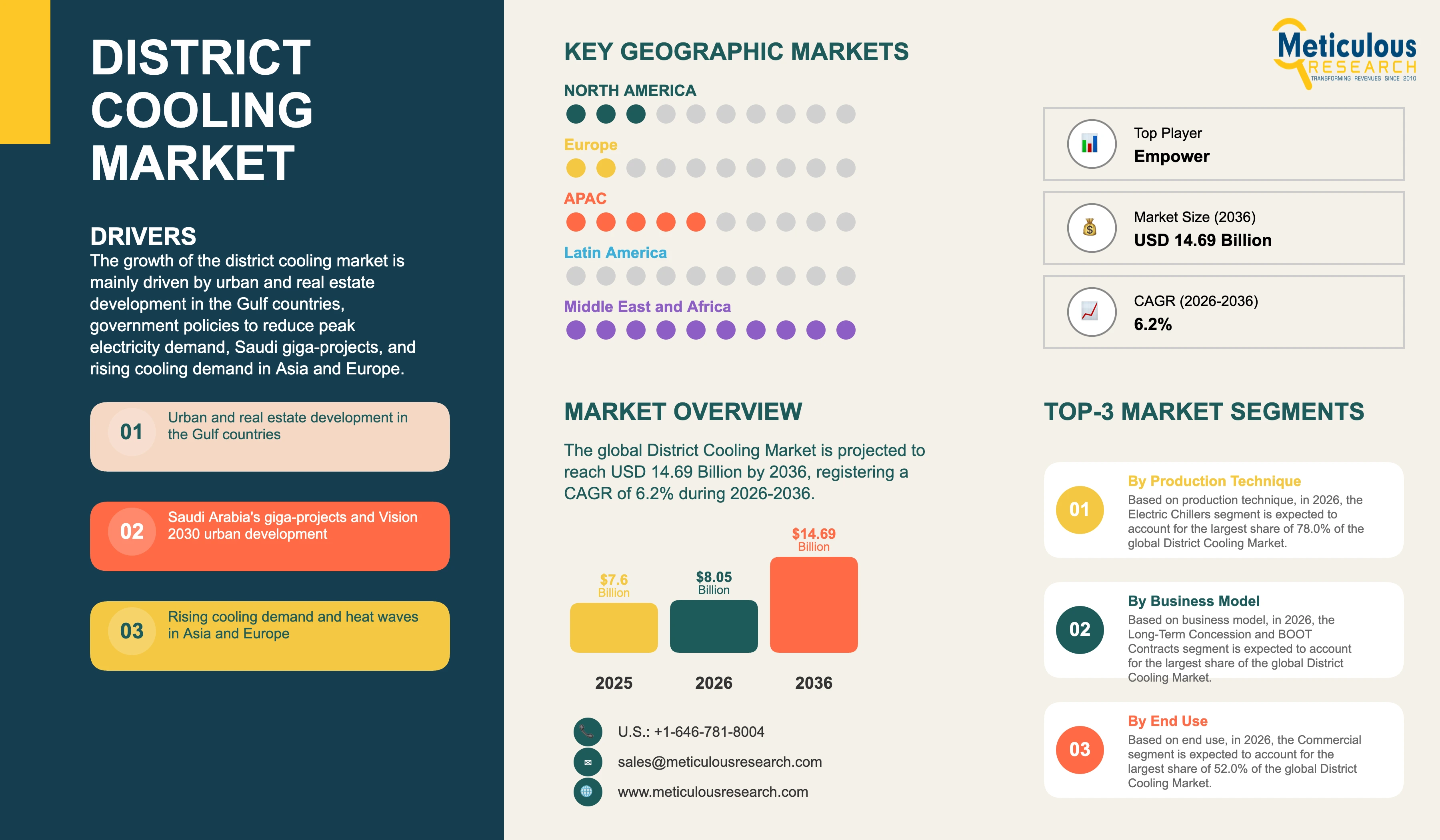
The global district cooling market was valued at USD 7.60 billion in 2025. This market is expected to reach USD 14.69 billion by 2036 from an estimated USD 8.05 billion in 2026, registering a CAGR of 6.2% during the forecast period (2026-2036).
- Published
- Nov 2026
- Pages
- 249
- Format
- PDF + Excel
- Report ID
- MREP - 1042701
- Base year
- 2025
- 2025 · BASELINE
- $7.60B
- 2036
- $14.69B
- CAGR 2026–2036
- 6.2%
2025 baseline · 2026–2036 forecast at 6.2% CAGR · hover a bar for the value
Key highlights
Emirates Central Cooling Systems Corporation (Empower), the world's largest district cooling provider, reported record 2025 revenue of AED 3.419 billion, up 4.9% from 2024. Its connected capacity reached about 1.7 million refrigeration tons (RT), and contracted capacity rose 11% to nearly 2 million RT after it signed 186 new contracts during the year.
Empower's distribution pipeline network across Dubai exceeded 430 kilometers in 2025, and its number of district cooling plants reached 90. The company reported that district cooling consumption in Dubai increased by about 69% between 2020 and 2024.
National Central Cooling Company (Tabreed) reported 2025 revenue of AED 2.46 billion and an EBITDA margin of 51.6%. Its total connected capacity increased 19% year-on-year to 1.57 million RT, driven by organic growth and acquisitions, with organic growth of 4.4%.
In October 2025, Tabreed and CVC DIF completed the acquisition of PAL Cooling Holding from Multiply Group at an equity value of AED 3.87 billion. The deal covers eight long-term concessions on Abu Dhabi's main island and Al Reem Island with potential of about 600,000 RT of connected capacity, and Tabreed also signed a concession to cool Palm Jebel Ali in Dubai.
Qatar has about 70 district cooling plants with a combined installed capacity of about 1.15 million RT, according to Qatar's utility Kahramaa, which equals about 20% of the country's total cooling capacity. In Saudi Arabia, the Diriyah Company awarded City Cool a SAR 700 million contract to build a district cooling plant and network with a capacity of about 72,500 RT for the first phase of the Diriyah giga-project.
The Paris district cooling network, operated by Fraîcheur de Paris, a company owned by ENGIE and RATP, is the largest in Europe and is planned to grow to about 250 kilometers by 2042. In Singapore, SP Group's district cooling operations have reached a combined capacity of about 209,450 RT, and its Marina Bay network is described as the world's largest underground district cooling network.
By production technique, electric chillers account for the largest share of 78.0% in 2026, while heat recovery and hybrid systems register the highest CAGR.
By business model, long-term concession and BOOT contracts account for the largest share in 2026 and also register the highest CAGR.
By end use, commercial accounts for the largest share of 52.0% in 2026, while industrial and data centers register the highest CAGR.
By geography, Middle East & Africa accounts for the largest share of 50.0% in 2026, while Europe registers the highest CAGR of 8.9%.
Report summary
| Particulars | Details |
|---|---|
| Forecast Period | 2026-2036 |
| Base Year | 2025 |
| Estimated Year | 2026 |
| CAGR (Value) | 6.2% |
| Format | PDF, Excel & Cloud Portal · 249 pages |
| Market Size (Value) in 2025 | USD 7.60 billion |
| Market Size (Value) in 2026 | USD 8.05 billion |
| Market Size (Value) in 2036 | USD 14.69 billion |
| Largest Segment by Production Technique (2026) | Electric Chillers (78.0%) |
| Largest Segment by End Use (2026) | Commercial (52.0%) |
| Largest Region (2026) | Middle East & Africa (50.0%) |
| Fastest-Growing Region | Europe (CAGR 8.9%) |
| Segments Covered | Production Technique, Business Model, End Use, Geography |
| Countries Covered | UAE, Saudi Arabia, Qatar, Kuwait, Bahrain, Oman, Egypt, Rest of Middle East & Africa, Japan, China, South Korea, Singapore, Malaysia, India, Hong Kong, Rest of Asia-Pacific, U.S., Canada, France, Sweden, Finland, Spain, Netherlands, Austria, Italy, Germany, Rest of Europe, Brazil, Colombia, Rest of Latin America |
| Key Companies | 16 companies and other companies |
Report overview
Segments covered: production technique, business model, end use.
The growth of this market is mainly driven by rapid urban and real estate development in the Gulf countries, especially in Dubai, Abu Dhabi, Riyadh, and Doha, government policies that promote district cooling to reduce peak electricity demand and emissions, Saudi Arabia's giga-projects and new urban districts developed under Vision 2030, rising cooling demand in Asia due to urbanization and higher temperatures, the expansion of large networks in Europe such as the Paris district cooling network in response to more frequent heat waves, the growing use of free cooling from seas, lakes, and rivers, and the growth of cooling-as-a-service and long-term concession models. However, factors such as high upfront investment, long payback periods, dependence on real estate development and occupancy, and difficulties in connecting existing buildings are expected to restrain the growth of this market to some extent.
District cooling is a system that produces chilled water in central plants and distributes it through insulated underground pipes to many buildings for air conditioning. Each connected building receives chilled water through an energy transfer station, which replaces the need for individual chillers and cooling towers in each building. Central plants can use large electric chillers, absorption chillers driven by waste heat or gas, free cooling from seawater, lakes, rivers, or deep water, and thermal energy storage to shift production to off-peak hours. This report covers global revenue from district cooling services, including capacity and connection charges and consumption charges collected by district cooling providers, as well as the operation and maintenance of captive district cooling systems under service contracts. Revenue from the sale of standalone building air conditioning equipment is excluded from the scope of this report.
District cooling is most widely used in the Gulf countries, where cooling can account for a very large share of peak electricity demand in summer. The United Arab Emirates is the world's largest district cooling market, with major providers such as Empower, Tabreed, and Emicool serving large real estate developments in Dubai and Abu Dhabi. Qatar, Saudi Arabia, Kuwait, Bahrain, and Oman also have significant district cooling capacity, and the technology is used in many airports, financial districts, malls, and residential communities across the region. In Qatar, district cooling accounts for about 20% of total cooling capacity, and Gulf governments see it as a way to reduce the need for new power generation capacity.
Outside the Middle East, district cooling is used in commercial districts and campuses in Asia, North America, and Europe. Japan and South Korea operate district heating and cooling systems in many urban centers, Singapore has district cooling in Marina Bay, Punggol, Tengah, and other areas, and Malaysia, China, Hong Kong, and India have growing numbers of systems. In North America, Toronto's deep lake water cooling system and district energy systems in many U.S. cities and university campuses provide cooling, while in Europe Paris, Stockholm, Helsinki, Vienna, Barcelona, and Amsterdam operate significant district cooling networks.
District cooling offers several important advantages over conventional cooling systems installed in individual buildings. Large central plants are more efficient, typically consuming much less electricity per unit of cooling than conventional building systems, and they can use thermal storage, free cooling, and treated sewage effluent or seawater for cooling towers. District cooling also reduces refrigerant leaks, frees space in buildings, lowers maintenance needs for building owners, and reduces peak electricity demand, which helps utilities avoid building new power plants. Because plants are operated by specialist providers, they can be maintained to higher standards and upgraded with new technology more easily than thousands of individual building systems.
The district cooling business model is typically based on long-term contracts that run for 20 to 30 years or more. In the Gulf countries, district cooling providers often hold exclusive concessions or long-term agreements with master developers, and they charge customers a fixed capacity charge based on contracted cooling load and a variable consumption charge based on actual use. This structure gives providers stable, utility-like revenue, which has attracted infrastructure investors and supported acquisitions, such as the purchase of PAL Cooling by Tabreed and CVC DIF. In Europe, North America, and Asia, district cooling is often provided by municipal or regulated utilities or under city concessions, as in Paris, Singapore, and Toronto.
The market includes district cooling utilities and service providers, energy companies with district energy businesses, and suppliers of chillers, energy transfer stations, pipes, pumps, and controls. Leading companies include Empower, Tabreed, Emicool, Qatar Cool, ENGIE, Enwave, Vicinity Energy, SP Group, Keppel, Gas District Cooling, Stockholm Exergi, and Veolia, while Johnson Controls, Trane Technologies, Daikin, and Danfoss supply key equipment.
Over the forecast period, the district cooling market is expected to grow steadily, supported by continued real estate development and new giga-projects in the Gulf, expansion in Asia, network growth in Europe, and the shift to more efficient and lower-carbon cooling. New business models, thermal storage, digital optimization, and the use of free cooling and waste heat are expected to shape the development of the market.
Report infographic
Market dynamics
16 factors across 5 forcesUrban and real estate development in the Gulf countries
Rapid urban development in the Gulf countries is the most important driver of the district cooling market. Dubai and Abu Dhabi continue to launch large residential, commercial, and mixed-use developments, and district cooling is often the standard cooling solution for master-planned communities, business districts, and islands. Empower's contracted capacity grew 11% in 2025 to nearly 2 million RT, and the company signed 186 new contracts during the year, including agreements for The Island by Wasl and Palm Gateway in Dubai.
In Abu Dhabi, Tabreed's acquisition of PAL Cooling gives it eight long-term concessions on the main island and Al Reem Island, where further development is expected to raise connected capacity toward about 600,000 RT. Tabreed has also signed a concession for Palm Jebel Ali, one of Dubai's largest new developments. Population growth, strong real estate demand, and tourism projects across the UAE are expected to keep demand for district cooling high throughout the forecast period.
Developers prefer district cooling because it reduces the capital cost and space needed for building cooling systems, and many master developers require new buildings in their communities to connect to district cooling networks. Long-term contracts with developers and building owners give providers a clear pipeline of future capacity. The gap between contracted and connected capacity at Empower, of roughly 300,000 RT at the end of 2025, illustrates the volume of capacity that will be connected as new buildings are completed.
Government policies to reduce peak electricity demand and emissions
Governments in the Gulf countries promote district cooling to reduce peak electricity demand, save fuel, and lower carbon emissions. Cooling accounts for a very large share of electricity use during summer, and district cooling systems can use significantly less electricity than individual air conditioning systems. Qatar's utility Kahramaa reports that about 70 district cooling plants with about 1.15 million RT of capacity operate in the country, and it promotes district cooling as part of the country's sustainability goals.
Dubai and Abu Dhabi have established regulatory frameworks for district cooling, including licensing, pricing rules, and efficiency requirements, and Saudi Arabia's Electricity Regulatory Authority licenses district cooling providers. Regulations that require new developments in certain areas to use district cooling, together with green building codes and national net-zero targets, support the growth of the market. Kuwait, Bahrain, and Oman are also developing district cooling regulations and projects as part of their energy efficiency programs.
Saudi arabia's giga-projects and vision 2030 urban development
Saudi Arabia is one of the most important growth markets for district cooling, driven by giga-projects and new urban districts under Vision 2030. Projects such as Diriyah, King Salman Park, the King Abdullah Financial District, the Red Sea developments, and NEOM's Oxagon have selected district cooling. The Diriyah Company awarded City Cool a SAR 700 million contract for a district cooling plant and network with a capacity of about 72,500 RT, and Saudi Tabreed operates large systems including the 100,000 RT system at the King Abdullah Financial District.
Many of these projects use build-own-operate-transfer models, which allow developers to avoid upfront investment and give providers long-term revenue. As more giga-projects move from planning to construction and occupancy, demand for district cooling in Saudi Arabia is expected to grow faster than in more mature Gulf markets, although some projects have been delayed or scaled back.
Rising cooling demand and heat waves in Asia and Europe
Rising temperatures, more frequent heat waves, urbanization, and higher incomes are increasing cooling demand in Asia and Europe. The International Energy Agency has reported that cooling accounted for almost one-third of India's total electricity consumption at some points in mid-May 2026, and cities in Southeast Asia, China, and India are exploring district cooling to reduce electricity demand and urban heat. Singapore has introduced district cooling in public housing estates in Tengah and Punggol and continues to expand its Marina Bay network.
In Europe, heat waves in recent summers have increased demand for cooling in cities where air conditioning was traditionally uncommon. Paris experienced severe heat waves in June 2026, and the city sees district cooling as an important tool for protecting vulnerable people in hospitals, schools, and care homes. The Paris network is planned to grow to about 250 kilometers by 2042, and other European cities are expanding their networks.
Table of contents
11 chapters · 143 sections · 249 pages · click to expandSegmental analysis
| Segment | Largest share (2026) | Fastest growth (2026–2036) |
|---|---|---|
| By Production Technique | Electric chillers | Heat recovery and hybrid systems |
| By Business Model | Long-term concession and BOOT contracts | Long-term concession and BOOT contracts |
| By End Use | Commercial | Industrial and data centers |
By Production Technique
- District Cooling Analysis by Production Technique
- The electric chillers segment is expected to account for the largest share of 78.0% of the global district cooling market.
- The large share of this segment is mainly attributed to the widespread use of large electric centrifugal chillers in district cooling plants in the Gulf countries, Asia, and North America, their high efficiency and reliability, the availability of low-cost electricity in many Gulf markets, and the ability to combine electric chillers with thermal energy storage to reduce peak demand.
- Nearly all the large plants operated by Empower, Tabreed, Qatar Cool, and other Gulf providers use electric chillers.
- Leading chiller manufacturers such as Johnson Controls (YORK), Trane Technologies, Carrier, and Daikin supply large chillers for district cooling plants, and efficiency improvements in chillers, variable-speed drives, and plant controls continue to reduce electricity use.
- Electric chillers are also well suited to thermal energy storage, which allows plants to produce chilled water or ice at night and reduce peak electricity demand.
- However, the heat recovery and hybrid systems segment is projected to register the highest CAGR during the forecast period.
- The rapid growth of this segment is primarily driven by the integration of district heating and cooling in Europe and North America, the use of heat pumps to recover heat from cooling systems, and the use of waste heat from data centers and industry.
- Heat recovery chillers and large heat pumps allow district energy providers to supply heating and cooling from the same plant, which improves overall efficiency and reduces emissions.
- Meanwhile, free cooling from seawater, lakes, rivers, and deep water is expected to witness steady growth, supported by projects in Toronto, Paris, Stockholm, and Helsinki, while absorption chillers remain a small niche used mainly where low-cost heat is available.
By Business Model
- District Cooling Analysis by Business Model
- The long-term concession and BOOT contracts segment is expected to account for the largest share of the global district cooling market.
- The large share of this segment is mainly attributed to the common use of exclusive concessions and build-own-operate-transfer agreements in the Gulf countries, where providers sign long-term contracts with master developers and governments to develop and operate district cooling systems for entire communities or districts.
- These contracts provide stable revenue from fixed capacity charges and variable consumption charges.
- Examples include Tabreed's concessions in Abu Dhabi and Palm Jebel Ali, the Diriyah district cooling project awarded to City Cool, and the Paris concession operated by Fraîcheur de Paris.
- Concession contracts typically run for 20 to 30 years or more and give providers exclusive rights to serve a defined area, which supports investment in large central plants and networks.
- The long-term concession and BOOT contracts segment is also projected to register the highest CAGR during the forecast period, driven by Saudi giga-projects, new developments in the UAE, and the introduction of cooling-as-a-service and concession models in India, Southeast Asia, and Africa.
- Infrastructure investors value these contracts because of their predictable, long-term cash flows and the essential nature of the service.
- Meanwhile, the utility tariff-based service and captive systems under O&M contracts segments are expected to witness steady growth, supported by regulated district energy utilities in Japan, Singapore, Toronto, and European cities, and airports, universities, hospitals, and government complexes that operate their own systems.
- The long-term concession and BOOT contracts segment is expected to account for the largest share of the district cooling market, and it is also projected to register the highest CAGR during the forecast period.
By End Use
- The commercial segment is expected to account for the largest share of 52.0% of the global district cooling market.
- The large share of this segment is mainly attributed to the high cooling demand of office towers, shopping malls, hotels, and mixed-use developments, the concentration of commercial buildings in business districts where district cooling is most economic, and the long history of district cooling in commercial districts such as Dubai's financial and business districts, Doha's West Bay, Singapore's Marina Bay, and the commercial centers of Paris and Toronto.
- Commercial customers value the reliability, space savings, lower maintenance costs, and green building benefits of district cooling, and many large commercial developments are designed with district cooling from the start.
- Hotels, hospitals, and large shopping malls are among the largest individual customers in many district cooling networks.
- In the Gulf countries, commercial towers in business districts and waterfront developments make up a large part of contracted capacity, while in Europe and Asia, commercial buildings in city centers are the main customers for district cooling networks.
- However, the industrial and data centers segment is projected to register the highest CAGR during the forecast period.
- The rapid growth of this segment is primarily driven by the rapid expansion of hyperscale and colocation data centers in the Gulf, Asia, and Europe, the need for efficient and reliable cooling for semiconductor plants and other industrial facilities, and the development of industrial parks with shared utilities.
- Meanwhile, the residential and institutional and government segments are expected to witness steady growth, supported by large residential developments in the Gulf, public housing projects in Singapore, and airports, hospitals, universities, and government complexes that serve as anchor customers.
Geographic analysis
Middle East & Africa
Largest shareIn 2026, the Middle East & Africa is expected to account for the largest share of 50.0% of the global district cooling market. The large share of this region is mainly due to the very high cooling demand in the Gulf countries, where cooling can account for a large share of peak electricity demand, the strong presence of district cooling in the UAE, Qatar, Saudi Arabia, Kuwait, Bahrain, and Oman, government policies that promote district cooling, and the continued development of large real estate projects and giga-projects. The UAE is the world's largest district cooling market, with Empower alone connecting about 1.7 million RT, while Qatar has about 1.15 million RT of district cooling capacity.
Asia-Pacific
Asia-Pacific is the second-largest market, supported by district heating and cooling systems in Japan and South Korea, district cooling in Singapore, Malaysia, Hong Kong, and China, and emerging projects in India. Singapore's SP Group operates about 209,450 RT of district cooling capacity, and India has district cooling in GIFT City and projects in Amaravati and Gurugram. Japan remains one of the largest district heating and cooling markets in the region, with systems serving many large urban redevelopment areas in Tokyo, Osaka, and other cities. The region is expected to grow quickly as urbanization and heat increase cooling demand.
Europe
Fastest growthEurope is projected to register the highest CAGR of 8.9% during the forecast period. The rapid growth of this region is mainly due to rising cooling demand caused by more frequent heat waves, the expansion of large networks such as the Paris network, which is planned to reach about 250 kilometers by 2042, the use of free cooling and heat recovery in Nordic cities, EU policies that promote efficient heating and cooling, and the growth of district cooling in Spain, Italy, Austria, the Netherlands, and Germany. Europe's growth starts from a relatively small base, as district cooling still serves only a small share of cooling demand in most European cities.
North America
North America accounts for a significant share of the market, with district cooling provided by Enwave in Toronto, Vicinity Energy and other district energy providers in U.S. cities, and many university and hospital campuses.
Latin America
Latin America accounts for a small share of the market, with projects in Brazil, Colombia, Panama, and other countries, including systems in business districts and airports supported by energy efficiency programs.
Competitive landscape
The global district cooling market is moderately concentrated, with the top five players estimated to account for about 35% of the market in 2025. The market includes district cooling utilities and service providers, energy companies with district energy businesses, and suppliers of chillers, energy transfer stations, pipes, and controls.
Empower is the world's largest district cooling provider by connected capacity, with about 1.7 million RT in Dubai, while Tabreed is the most geographically diversified provider, with operations in the UAE, Saudi Arabia, Oman, Bahrain, Egypt, and India. Emicool serves Dubai developments, and Qatar Cool is the leading commercial provider in Qatar. ENGIE operates district cooling networks in Paris and other cities and is a major shareholder in Tabreed.
Enwave operates Toronto's deep lake water cooling system, Vicinity Energy operates district energy systems in several U.S. cities, SP Group and Keppel operate district cooling systems in Singapore, Gas District Cooling operates systems in Malaysia, and Stockholm Exergi operates one of Europe's largest district cooling networks. Johnson Controls, Trane Technologies, and Daikin supply large chillers, and Danfoss supplies energy transfer stations and controls.
Companies in this market compete on reliability, efficiency, pricing, the ability to secure long-term concessions and contracts with developers, access to low-cost capital, and technical capabilities. Key strategies include securing new concessions in growing markets, acquiring existing systems, expanding into new countries, investing in thermal storage, free cooling, and digital optimization, and partnering with developers, governments, and infrastructure investors.
The competitive landscape is expected to evolve as consolidation continues in the Gulf and infrastructure investors increase their participation in the market. Providers with large portfolios, strong relationships with developers and governments, and access to capital will be best positioned, while equipment suppliers that offer high-efficiency chillers, heat pumps, and digital controls will benefit from the expansion of district cooling. Local contractors and engineering firms also play important roles in building plants and networks, especially in Saudi Arabia and India.
Some of the key players operating in the district cooling market are Emirates Central Cooling Systems Corporation PJSC (Empower), National Central Cooling Company PJSC (Tabreed), Emirates District Cooling LLC (Emicool), Qatar District Cooling Company Q.C.S.C. (Qatar Cool), ENGIE SA, Enwave Energy Corporation, Vicinity Energy, SP Group, Keppel Ltd., Gas District Cooling (M) Sdn Bhd, Stockholm Exergi AB, Veolia Environnement S.A., Johnson Controls International plc, Trane Technologies plc, Daikin Industries, Ltd., and Danfoss A/S, among others.
- —
Empower reported record 2025 revenue and nearly 2 million RT of contracted capacity, Tabreed and CVC DIF completed the acquisition of PAL Cooling, Tabreed signed the Palm Jebel Ali concession, SP Group announced further Marina Bay expansion in 2026, and Paris continued expanding its network after severe heat waves in June 2026.
- Emirates Central Cooling Systems Corporation PJSC · Empower
- National Central Cooling Company PJSC · Tabreed
- Emirates District Cooling LLC · Emicool
- Qatar District Cooling Company Q.C.S.C · Qatar Cool
- ENGIE SA
- Enwave Energy Corporation
- Vicinity Energy
- SP Group
- Keppel Ltd.
- Gas District Cooling (M) Sdn Bhd
- Stockholm Exergi AB
- Veolia Environnement S.A.
- Johnson Controls International plc
- Trane Technologies plc
- Daikin Industries, Ltd.
- Danfoss A/S
Expert perspectives
The district cooling market is a stable, infrastructure-like market with steady growth, driven mainly by urban development in the Gulf countries and rising cooling demand worldwide. We see real estate development in the UAE, Saudi Arabia's giga-projects, and the expansion of networks in Asia and Europe as the main forces shaping the market over the next decade.
Over the forecast period, the market is expected to grow at a CAGR of 6.2%, from USD 8.05 billion in 2026 to USD 14.69 billion in 2036. Growth will be supported by new developments and concessions in the Gulf, expansion in Asia and Europe, free cooling, thermal storage, and the growth of cooling-as-a-service models, while high upfront investment, dependence on real estate development, and the difficulty of connecting existing buildings will moderate growth.
In terms of segments, electric chillers remain the dominant production technique, while heat recovery and hybrid systems grow fastest. Long-term concession and BOOT contracts remain the largest and fastest-growing business model. Commercial customers remain the largest end use, while industrial and data center customers grow fastest. The Middle East & Africa remains the largest region, while Europe grows fastest at a CAGR of 8.9%.
For district cooling providers, the key priorities over the forecast period are to secure long-term concessions and contracts in growing markets, to manage the timing risk of real estate development, to improve efficiency and reduce water use, and to offer flexible service models for existing buildings, data centers, and industrial customers. Access to low-cost capital will remain an important competitive advantage. Providers should also prepare for stricter efficiency and water use rules in Gulf markets.
We expect the Gulf countries to remain the core of the market, with the UAE and Saudi Arabia accounting for most new capacity. In our view, Saudi Arabia offers the largest growth potential, but the pace of giga-project development will determine how quickly this potential is realized. Consolidation in the UAE is likely to continue as infrastructure investors seek stable assets. Qatar and other Gulf markets are expected to grow more slowly but steadily.
In Europe and Asia, we expect district cooling to become an increasingly important part of urban climate adaptation strategies. Heat waves in European cities and rising cooling demand in Asian cities will create new opportunities, especially for providers that can integrate district heating and cooling and use free cooling and waste heat. We also see data centers and industrial campuses as a growing source of demand in all regions over the forecast period.
Customer perspectives
Buyers of district cooling services include master developers, building owners, government entities, hotels, malls, office tower owners, residential communities, hospitals, universities, airports, data center operators, and industrial companies. Their decisions depend mainly on reliability, total cost of cooling, contract terms, capacity charges, service quality, and sustainability benefits.
This comment explains why the Middle East & Africa accounts for 50.0% of the market and why long-term concession and BOOT contracts are the largest business model.
This comment explains why the commercial segment accounts for 52.0% of the market and why electric chillers with thermal storage, which account for 78.0% of the market, remain the main production technique.
This comment shows why Europe is the fastest-growing region and why free cooling and heat recovery and hybrid systems are growing quickly. It also shows the growing role of public buildings.
“For our new master-planned communities, district cooling is now the standard choice for every building. It saves space and capital in our buildings, and a long-term concession with an experienced provider gives us reliable cooling for decades.”
“Connecting our buildings to the district cooling network lets us remove our own chillers and cooling towers, saving energy and maintenance costs. Reliability and transparent pricing are our main concerns.”
“Heat waves are becoming more frequent, and we need to protect hospitals, schools, and care homes. District cooling using river water and heat recovery is an efficient way to provide cooling without adding thousands of individual air conditioners.”
Frequently asked questions
The global district cooling market was valued at USD 7.60 billion in 2025, up from USD 7.20 billion in 2024, and is estimated at USD 8.05 billion in 2026. The market includes revenue from district cooling services, including capacity and consumption charges, and the operation and maintenance of captive systems under service contracts.
Cite this report
Meticulous Research. (2026). District Cooling Market - Global Opportunity Analysis and Industry Forecast (2026-2036) (Report No. MREP - 1042701). Meticulous Market Research Pvt. Ltd. https://www.meticulousresearch.com/product/district-cooling-market-7384