Low-Carbon Aluminum Market (2026-2036)
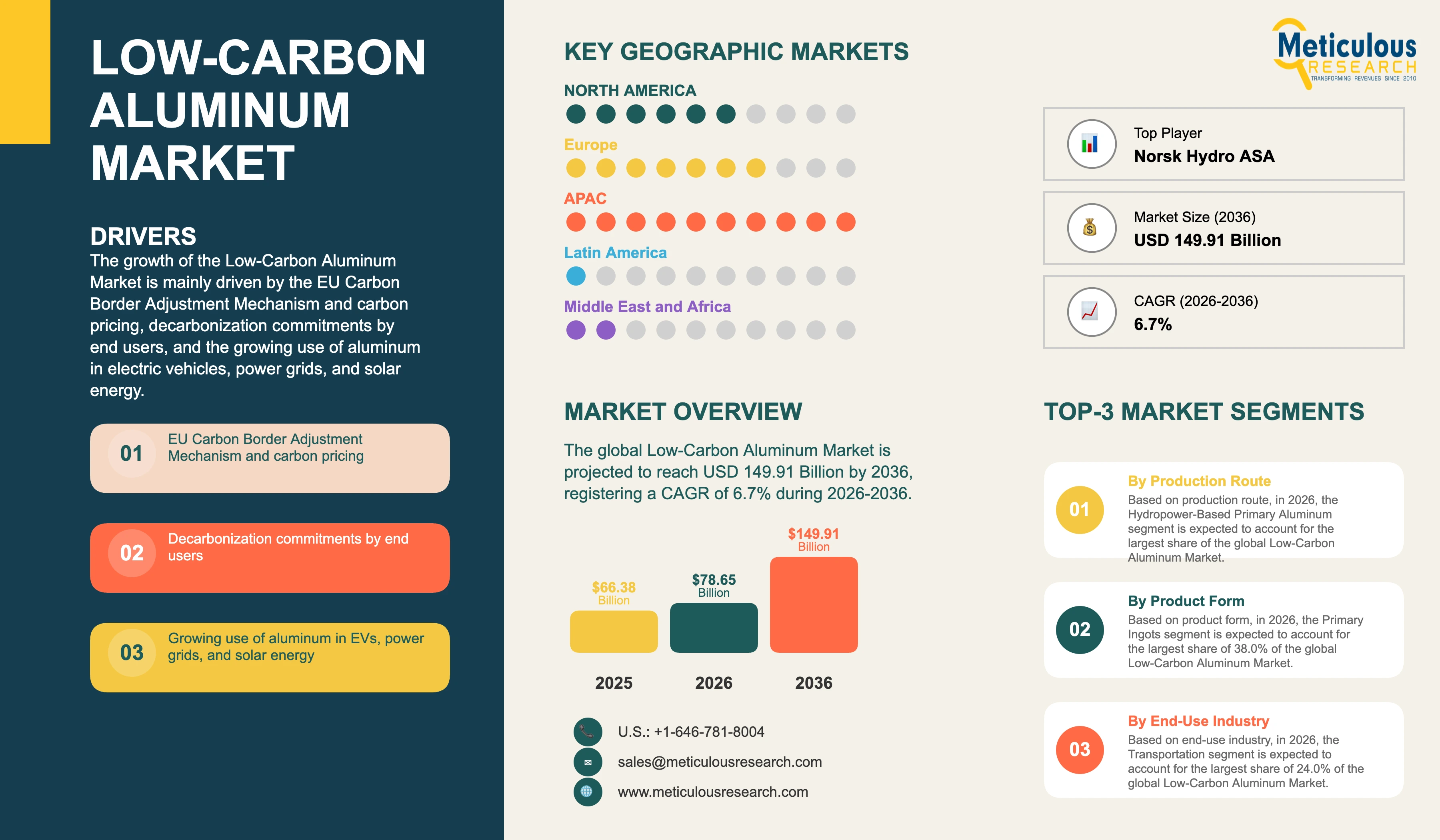
The global low-carbon aluminum market was valued at USD 66.38 billion in 2025. This market is expected to reach USD 149.91 billion by 2036 from an estimated USD 78.65 billion in 2026, registering a CAGR of 6.7% during the forecast period (2026-2036). In terms of volume, this market is expected to reach 45.43 million tons by 2036 from an estimated 24.20 million tons in 2026, registering a CAGR of 6.5% during the forecast period.
- Published
- Nov 2026
- Pages
- 270
- Format
- PDF + Excel
- Report ID
- MRCHM - 1042483
- Base year
- 2025
- 2025 · BASELINE
- $66.38B
- 2036
- $149.9B
- CAGR 2026–2036
- 6.7%
2025 baseline · 2026–2036 forecast at 6.7% CAGR · hover a bar for the value
Key highlights
According to the International Aluminium Institute (IAI), the global average greenhouse gas emissions intensity of primary aluminum production was about 15.1 tons of CO2 equivalent per ton in 2022, on a cradle-to-gate basis, while low-carbon primary aluminum is commonly defined as metal produced with smelter emissions of 4 tons of CO2 equivalent per ton or less.
The EU Carbon Border Adjustment Mechanism entered its definitive phase on 1 January 2026, requiring importers of aluminum and other covered products into the EU to pay for the embedded emissions of their imports, which increases the value of low-carbon aluminum for buyers in Europe.
Norsk Hydro supplies low-carbon aluminum to Mercedes-Benz for its new electric CLA, produced with renewable energy and recycled content, and has signed a letter of intent with automotive supplier Nemak to develop low-carbon aluminum casting products.
Leading producers have launched low-carbon aluminum brands, including Hydro REDUXA and Hydro CIRCAL, Alcoa's Sustana line, Rusal's ALLOW, Rio Tinto's RenewAl, Emirates Global Aluminium's CelestiAL, and Century Aluminum's Natur-Al.
ELYSIS, a joint venture of Alcoa and Rio Tinto supported by the governments of Canada and Quebec, is developing an inert anode technology that eliminates direct greenhouse gas emissions from the smelting process, and Audi has piloted the use of ELYSIS metal.
Recycled aluminum requires only about 5% of the energy needed to produce primary aluminum, which makes recycled and high recycled-content aluminum one of the most important sources of low-carbon supply.
China, which produces about 60% of the world's primary aluminum, has moved a significant amount of smelting capacity to hydro-powered Yunnan province, making it a major source of low-carbon primary aluminum, although droughts have periodically forced smelters there to cut output.
Emirates Global Aluminium and Century Aluminum have announced plans to build new smelters in the U.S., which would use lower-carbon power and add domestic supply in a market that depends heavily on imports from hydro-powered smelters in Canada.
By production route, hydropower-based primary aluminum accounts for the largest share in 2026, while inert anode and other near-zero carbon aluminum registers the highest CAGR.
By product form, primary ingots account for the largest share of 38.0% in 2026, while foundry alloys register the highest CAGR.
By end-use industry, transportation accounts for the largest share of 24.0% in 2026, while electrical and power registers the highest CAGR.
By geography, Asia-Pacific accounts for the largest share of 38.0% in 2026, while Europe registers the highest CAGR of 8.2%.
Report summary
| Particulars | Details |
|---|---|
| Base Year | 2025 |
| Estimated Year | 2026 |
| Forecast Period | 2026-2036 |
| Market Size in 2025 | USD 66.38 billion |
| Market Size in 2026 | USD 78.65 billion |
| Market Size by 2036 | USD 149.91 billion |
| CAGR (2026-2036), Value | 6.7% |
| Format | PDF, Excel & Cloud Portal · 270 pages |
| Market Volume (2026 to 2036) | 24.20 million tons to 45.43 million tons (CAGR 6.5%) |
| Largest Segment by Product Form (2026) | Primary Ingots (38.0%) |
| Largest Segment by End-Use Industry (2026) | Transportation (24.0%) |
| Largest Region (2026) | Asia-Pacific (38.0%) |
| Fastest-Growing Region | Europe (CAGR 8.2%) |
| Segments Covered | Production Route, Product Form, End-Use Industry, and Geography |
| Geographic Scope | Asia-Pacific, Europe, North America, Middle East and Africa, and Latin America |
| Key Companies Profiled | Norsk Hydro, Alcoa, Rio Tinto, Rusal, Emirates Global Aluminium, Century Aluminum, Yunnan Aluminium, Press Metal, Aluar, Novelis, Constellium, and Speira |
Report overview
Segments covered: production route, product form, end-use industry.
The growth of this market is mainly driven by the start of the financial phase of the EU Carbon Border Adjustment Mechanism (CBAM) in 2026, decarbonization commitments by automakers, packaging companies, construction firms, and electronics makers, the growing use of aluminum in electric vehicles, power grids, and solar energy, and investment by producers in renewable-powered smelting, recycling, and inert anode technology. However, factors such as the limited supply of renewable power for smelting, the dominance of coal-based production in China, India, and other countries, small and uncertain green premiums, and the lack of a single global standard for low-carbon aluminum are expected to restrain the growth of this market to some extent.
Aluminum is one of the most widely used metals in the world, used in vehicles, buildings, packaging, power cables, electronics, and machinery because it is light, strong, corrosion-resistant, and easy to recycle. However, primary aluminum production is very energy-intensive, because smelting alumina into aluminum requires large amounts of electricity, typically around 14,000 to 15,000 kilowatt-hours per ton, and the aluminum industry accounts for about 2% of global greenhouse gas emissions. The carbon footprint of aluminum depends mainly on the source of electricity used for smelting, ranging from around 4 tons of CO2 equivalent per ton or less for hydro-powered smelters to more than 20 tons for smelters powered by coal.
This market covers the global sales of low-carbon aluminum by producers and recyclers, measured in value and in million tons, including primary aluminum produced at smelters with emissions of 4 tons of CO2 equivalent per ton or less (Scope 1 and 2) and recycled and high recycled-content aluminum products sold with a verified low carbon footprint. It includes metal sold as primary ingots, extrusion billets, sheet ingots and slabs, foundry alloys, and wire rod, and is segmented by production route, product form, end-use industry, and geography. Semi-fabricated and finished aluminum products are not included.
Low-carbon primary aluminum is produced mainly at large smelters powered by hydroelectricity in Canada, Norway, Iceland, Russia, Brazil, Argentina, Malaysia, and the Yunnan province of China, as well as at smelters using solar, wind, or nuclear power. Recycled aluminum, which requires only about 5% of the energy of primary production, has a much lower carbon footprint and is increasingly sold as a branded low-carbon product, such as Hydro CIRCAL, which contains at least 75% post-consumer scrap. Producers verify and certify the carbon footprint of their products through third-party audits and standards, such as those of the Aluminium Stewardship Initiative. Buyers increasingly ask for product-level data rather than company averages.
For many years, low-carbon aluminum was sold at little or no premium over standard aluminum, because supply was plentiful and few buyers were willing to pay more. This has started to change as automakers, packaging companies, construction firms, and electronics makers set targets to reduce the emissions in their supply chains, and as regulations, such as the EU CBAM, put a price on the carbon content of imported aluminum. Price assessments for low-carbon aluminum differentials in Europe and other regions have improved transparency, although premiums remain small and vary by market.
China, which produces about 60% of the world's primary aluminum, relies mainly on coal-fired power, but it has moved a significant amount of smelting capacity to Yunnan province, where hydropower is available, and its government has set a cap on total primary aluminum capacity. In the Middle East, Emirates Global Aluminium has produced solar-powered aluminum, and producers in India, which rely heavily on coal, are exploring renewable power. These changes are increasing the supply of low-carbon aluminum, although hydropower supply can be affected by droughts, as seen in Yunnan in recent years. Producers in the Gulf countries, which rely mainly on natural gas, are also investing in solar power and carbon capture to reduce emissions.
Over the forecast period, demand for low-carbon aluminum is expected to grow much faster than demand for aluminum overall, supported by regulations, customer commitments, and the growing use of aluminum in electric vehicles, power grids, and solar energy. Supply is expected to grow through new renewable power agreements, recycling, smelter conversions, and new technologies, such as inert anodes, although limited renewable power and high investment costs will constrain the pace of growth. Demand is also expected to become more differentiated, with buyers paying different premiums for metal with different carbon footprints, recycled content, and certifications. The share of low-carbon aluminum in total aluminum supply is expected to rise steadily, as more producers decarbonize and as buyers in Europe, North America, and Asia set stricter requirements for the materials they purchase.
Report infographic
Market dynamics
15 factors across 5 forcesEU Carbon Border Adjustment Mechanism and carbon pricing
The EU Carbon Border Adjustment Mechanism, which covers aluminum, steel, cement, fertilizers, electricity, and hydrogen, entered its definitive phase on 1 January 2026, after a transitional reporting period that began in 2023. Importers of aluminum into the EU must now account for the embedded emissions of their imports and buy CBAM certificates priced in line with the EU Emissions Trading System, which increases the cost of high-carbon aluminum and makes low-carbon aluminum more attractive for buyers in Europe. Because CBAM is calculated on the actual emissions of each product where verified data are available, producers that can document a low carbon footprint can reduce the CBAM cost for their customers, which gives them a competitive advantage.
Producers with low-carbon smelters, such as Hydro, Alcoa, Rio Tinto, and Century Aluminum, are expected to benefit, as their products face lower CBAM costs, and some industry executives expect CBAM to support regional aluminum premiums in Europe. Other countries, such as the U.K., are developing similar carbon border mechanisms, and carbon pricing is being introduced or expanded in China, Canada, and other countries. Europe is the fastest-growing region in this market, supported by CBAM and strong demand from European automakers and packaging companies. The EU is also considering extending CBAM to downstream products that contain aluminum, which could further increase its impact.
Decarbonization commitments by end users
Automakers, beverage can makers, construction firms, and electronics companies have set targets to reduce the emissions in their supply chains, and aluminum is often one of the largest sources of these emissions. Automakers, such as Mercedes-Benz, BMW, Volvo Cars, Audi, and Polestar, have signed agreements to buy low-carbon aluminum, and many have set targets for the use of low-carbon and recycled aluminum in their vehicles by 2030.
Packaging companies, such as Ball and Crown, beverage brands, and electronics makers, such as Apple, are also buying low-carbon aluminum to meet their climate targets. Construction firms and building developers are using low-carbon aluminum to reduce the embodied carbon of buildings, supported by green building standards and public procurement rules. Transportation accounts for the largest share of the market by end-use industry. Many of these companies report their supply chain emissions under the Science Based Targets initiative and other frameworks, which creates pressure to reduce emissions from purchased materials. Apple, for example, has used aluminum made with the ELYSIS process in some of its products.
Growing use of aluminum in electric vehicles, power grids, and solar energy
Electric vehicles use more aluminum than conventional vehicles, in battery enclosures, body structures, and motor housings, to offset the weight of their batteries, and automakers are using large aluminum castings to simplify vehicle structures. Power grids use aluminum in overhead transmission lines and cables, and solar power plants use aluminum in panel frames and mounting structures.
The growth of electric vehicles, grid investment, and solar installations is increasing demand for aluminum, and many customers in these sectors want low-carbon material to reduce the emissions associated with clean energy products. Electrical and power is the fastest-growing end-use industry in this market, and foundry alloys, which are used in vehicle castings, are the fastest-growing product form. Data centers also use aluminum in racks, cooling systems, and electrical equipment, and some data center operators have set targets to reduce the embodied carbon of their buildings and equipment.
Investment in renewable-powered smelting, recycling, and new technologies
Aluminum producers are investing in renewable power agreements, smelter upgrades, recycling plants, and new technologies to reduce their emissions. Hydro is expanding its recycling capacity and developing its HalZero technology for zero-emission alumina-to-aluminum production, Alcoa and Rio Tinto are developing the ELYSIS inert anode technology, and Emirates Global Aluminium has produced aluminum using solar power. Rusal has expanded its use of recycled metal at its Irkutsk smelter to produce low-carbon ALLOW foundry alloys.
Recycling companies, such as Novelis, Constellium, and Speira, are expanding their capacity to recycle post-consumer scrap into high recycled-content products. These investments are increasing the supply of low-carbon aluminum and lowering its carbon footprint further. Recycled and high recycled-content aluminum and inert anode and other near-zero carbon aluminum are among the fastest-growing production routes in this market. Governments are supporting some of these investments, such as the U.S. Department of Energy's support for new low-carbon smelters and the Canadian and Quebec governments' support for ELYSIS.
Table of contents
11 chapters · 124 sections · 270 pages · click to expandGeographic analysis
Asia-Pacific
Largest shareIn 2026, Asia-Pacific is expected to account for the largest share of 38.0% of the global low-carbon aluminum market. The large share of this region is mainly due to the large volume of low-carbon aluminum produced and consumed in China, particularly from hydro-powered smelters in Yunnan, along with production in Malaysia and demand from Japan, South Korea, and other Asian countries. China is the world's largest aluminum producer and consumer, and its shift of capacity to hydro-powered Yunnan and its investment in recycling have made it a major source of low-carbon aluminum. Malaysia's Press Metal operates hydro-powered smelters in Sarawak, and Japan and South Korea are major buyers of low-carbon aluminum for automotive, electronics, and packaging industries. India is developing renewable power for smelting and expanding recycling. Asia-Pacific is expected to remain the largest region throughout the forecast period. Australia is also working to convert its coal-dependent smelters to renewable power, supported by government programs. Japan and South Korea have very limited primary aluminum production and rely on imports, which makes them important buyers of low-carbon metal from Australia, Malaysia, the Middle East, and Canada. Indian producers, such as Hindalco and Vedanta, rely mainly on coal power but are investing in renewable energy to reduce emissions.
Europe
Fastest growthEurope is projected to register the highest CAGR of 8.2% during the forecast period. Growth is driven by the EU CBAM, the climate commitments of European automakers, packaging companies, and construction firms, and the large production of low-carbon aluminum by Hydro and others in Norway and Iceland, as well as recycling by Hydro, Novelis, Constellium, and Speira. European aluminum producers and buyers are also among the most active in developing standards and certification for low-carbon aluminum. Germany, France, Italy, and Spain are major consumers of low-carbon aluminum for automotive, packaging, and construction applications, while Norway and Iceland are major producers.
North America
North America holds a significant share of the market, supported by hydro-powered production in Canada and demand from automakers, packaging companies, and construction firms. The U.S. is expected to see new low-carbon supply from planned smelters and recycling plants, and Canada remains the largest source of low-carbon primary aluminum in the region.
Latin America
The Middle East and Africa and Latin America hold smaller shares, supported by solar-powered production in the UAE and hydro-powered production in Brazil and Argentina. Brazil and Argentina have hydro-powered smelters operated by Albras, Alumar, and Aluar, which supply low-carbon metal to domestic and export markets.
Competitive landscape
The low-carbon aluminum market is moderately concentrated, with a small number of large producers with hydro-powered smelters accounting for a large share of supply. Leading companies in the market include Norsk Hydro, Alcoa, Rio Tinto, Rusal, Emirates Global Aluminium, Century Aluminum, Yunnan Aluminium, and Press Metal, along with recycling companies, such as Novelis, Constellium, and Speira.
Producers in this market compete mainly on the verified carbon footprint of their products, certification and traceability, product range, recycling capabilities, and relationships with automotive, packaging, and construction customers. Many producers have developed low-carbon brands and offer products with different carbon footprint levels to meet customer requirements. Recyclers compete mainly by securing scrap supply, investing in sorting and processing technology, and offering high recycled-content products. Several producers also operate their own downstream businesses, such as extrusion, rolling, and casting, which allows them to offer low-carbon finished products and work closely with customers on product development.
The top five players are estimated to account for 40.0% of the low-carbon aluminum market in 2025, reflecting the strong positions of Hydro, Rio Tinto, Alcoa, Rusal, and Yunnan Aluminium in hydro-powered production. Concentration is lower in recycled aluminum, where many regional recyclers and remelters operate alongside large producers.
Players use several strategies to grow and strengthen their positions in this market, including signing renewable power agreements, converting smelters to renewable power, building new low-carbon smelters, expanding recycling capacity, developing inert anode and zero-emission technologies, and signing long-term supply agreements with automakers and other customers. Hydro, Alcoa, and Rio Tinto are investing in recycling and new technologies, while Emirates Global Aluminium and Century Aluminum are planning new smelters in the U.S.
Competition is expected to center on carbon footprint, cost, certification, recycling, and the ability to supply customers in different regions. Producers with low-carbon power, strong recycling capabilities, and advanced technologies are expected to capture most of the value growth. Producers that rely on coal power are expected to face growing pressure from customers and regulators. Partnerships, joint ventures, and acquisitions, particularly in recycling and new technologies, are expected to reshape the competitive landscape over the forecast period.
Some of the key players operating in the low-carbon aluminum market are Norsk Hydro ASA, Alcoa Corporation, Rio Tinto Group, United Company RUSAL International PJSC, Emirates Global Aluminium PJSC, Century Aluminum Company, Yunnan Aluminium Co., Ltd., Press Metal Aluminium Holdings Berhad, Aluar Aluminio Argentino S.A.I.C., Novelis Inc., Constellium SE, and Speira GmbH.
- —
The EU CBAM entered its definitive phase in January 2026, Hydro began supplying low-carbon aluminum for the Mercedes-Benz CLA and signed a letter of intent with Nemak, and producers continued to invest in recycling and inert anode technology.
- Norsk Hydro
- Alcoa
- Rio Tinto
- Rusal
- Emirates Global Aluminium
- Century Aluminum
- Yunnan Aluminium
- Press Metal
- Aluar
- Novelis
- Constellium
- Speira
Expert perspectives
The low-carbon aluminum market is entering a new phase, as regulations, such as the EU CBAM, and customer commitments create stronger demand for verified low-carbon metal. Hydro-powered producers and recyclers are best positioned, while producers that rely on coal power face growing pressure to decarbonize.
Over the forecast period, low-carbon aluminum volume is expected to grow at about 6.5% per year, much faster than aluminum demand overall, and value at about 6.7% per year. Premiums for low-carbon aluminum are expected to increase gradually as CBAM and customer demand strengthen, although they will vary by region and product. The value of the market is also sensitive to aluminum prices, which are expected to remain volatile because of energy costs, trade policies, and supply constraints in China. China's cap on primary aluminum capacity is expected to limit global supply growth, which could support aluminum prices and increase the importance of recycling.
Inert anode and other near-zero carbon aluminum is the fastest-growing production route, foundry alloys are the fastest-growing product form, and electrical and power is the fastest-growing end-use industry, reflecting new technologies, electric vehicles, and grid investment. Hydropower-based primary aluminum, primary ingots, and transportation remain the largest segments.
Asia-Pacific remains the largest region, while Europe is the fastest-growing region at a CAGR of 8.2%, supported by CBAM and strong customer demand. The main swing factors that could change this outlook are carbon prices, the implementation of CBAM and similar policies, the availability of renewable power, the speed of technology deployment, and aluminum prices.
For aluminum buyers, such as automakers, packaging companies, and construction firms, the key decisions are which carbon footprint levels to require, how to verify supply, and how much to pay for low-carbon metal. For producers, success depends on securing long-term low-carbon power, expanding recycling, investing in new technologies, and building long-term relationships with customers. Producers that can provide reliable data, certification, and traceability will have an advantage as buyers and regulators demand greater transparency. Buyers that secure long-term low-carbon supply early are likely to benefit as competition for verified low-carbon metal increases.
Overall, low-carbon aluminum is expected to become a mainstream segment of the aluminum market, with its growth driven by regulation, customer demand, and technology. The pace of growth will depend on how quickly carbon prices rise and how widely customers are willing to pay for verified low-carbon metal. New smelters in the U.S. and the commercial deployment of inert anode technology could become important sources of new supply later in the forecast period.
Customer perspectives
Head of Sustainable Procurement - premium automaker, Germany
Aluminum is one of the largest sources of emissions in our vehicles, so we have signed long-term agreements for low-carbon and recycled aluminum. CBAM and our own climate targets make verified low-carbon metal essential for every new model.
Automakers are also asking suppliers to report carbon footprints at the product level, which increases demand for certified low-carbon aluminum.
Strong automotive demand is why transportation accounts for 24.0% of the market and Europe is the fastest-growing region.
Procurement Director - aluminum extruder, U.S.
Our building and solar customers increasingly ask for the carbon footprint of every profile we supply, and some will not accept bids without it. We buy most of our billet from hydro-powered smelters in Canada and are adding more recycled content.
Construction and solar customers are increasingly asking for environmental product declarations, which supports demand for certified low-carbon billet.
Demand for verified low-carbon billet from construction and solar customers supports growth in extrusion billets and electrical and power applications.
Supply Chain Manager - consumer electronics manufacturer, Japan
Our climate targets cover our suppliers as well as our own factories, and aluminum casings are a major part of our footprint. We are working with smelters in Asia, the Middle East, and Canada, as well as recyclers, to secure low-carbon supply for our products.
Electronics makers with supplier emissions targets are expected to increase their purchases of low-carbon and recycled aluminum over the forecast period.
Demand from Asian manufacturers contributes to Asia-Pacific's 38.0% share of the market.
Frequently asked questions
The market was valued at USD 66.38 billion in 2025 and USD 56.70 billion in 2024, and is estimated at USD 78.65 billion in 2026.
Cite this report
Meticulous Research. (2026). Low-Carbon Aluminum Market - Global Opportunity Analysis and Industry Forecast (2026-2036) (Report No. MRCHM - 1042483). Meticulous Market Research Pvt. Ltd. https://www.meticulousresearch.com/product/low-carbon-aluminum-market-7166