Mono-Material Packaging Market (2026-2036)
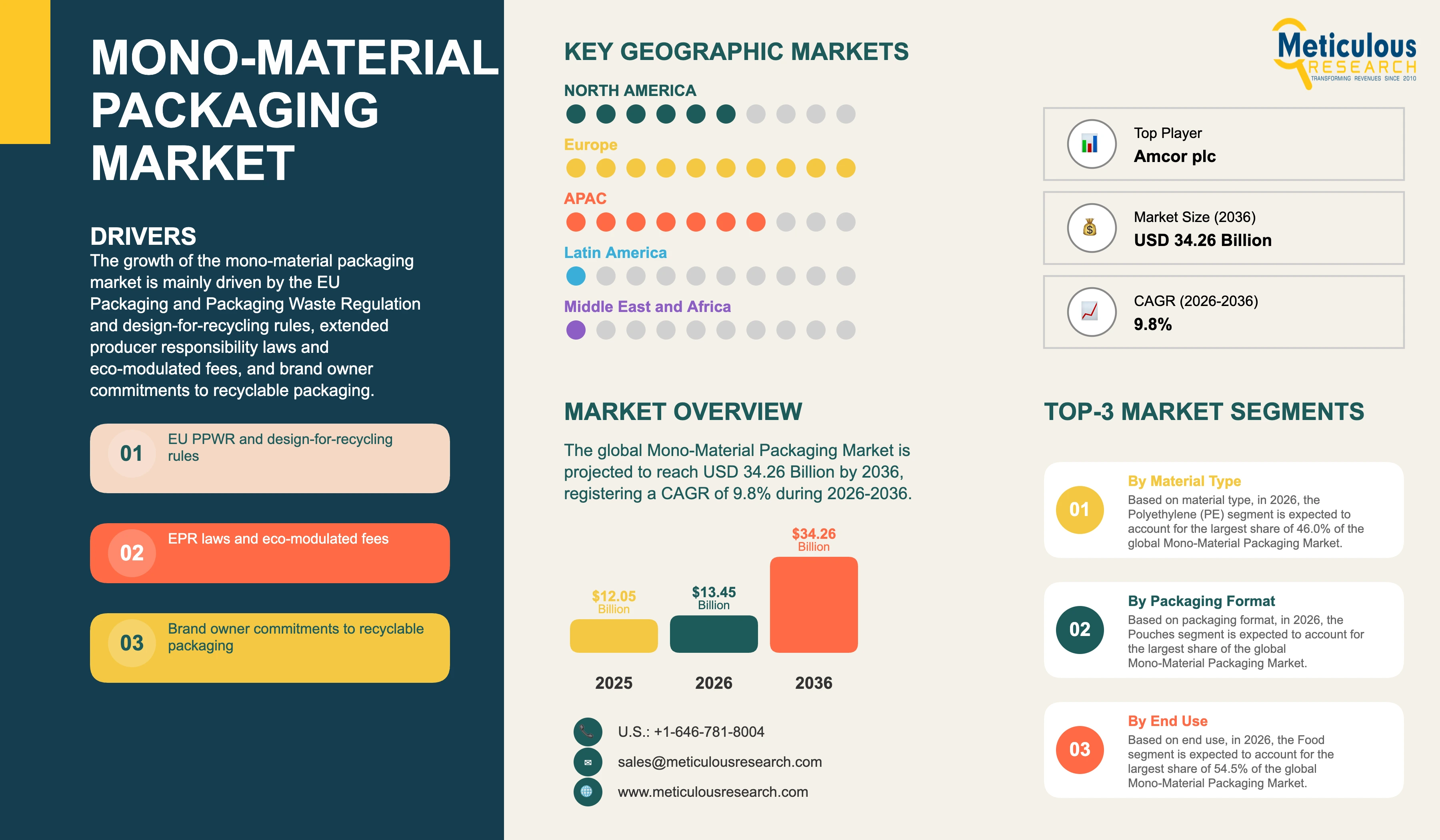
The global mono-material packaging market was valued at USD 12.05 billion in 2025. This market is expected to reach USD 34.26 billion by 2036 from an estimated USD 13.45 billion in 2026, registering a CAGR of 9.8% during the forecast period (2026-2036). In terms of volume, this market is expected to reach 6.37 million tons by 2036 from an estimated 2.79 million tons in 2026, registering a CAGR of 8.6% during the forecast period.
- Published
- Nov 2026
- Pages
- 268
- Format
- PDF + Excel
- Report ID
- MRCHM - 1042479
- Base year
- 2025
- 2025 · BASELINE
- $12.05B
- 2036
- $34.26B
- CAGR 2026–2036
- 9.8%
2025 baseline · 2026–2036 forecast at 9.8% CAGR · hover a bar for the value
Key highlights
The EU Packaging and Packaging Waste Regulation generally applies from 12 August 2026, and from 1 January 2030 all packaging placed on the EU market must be designed for material recycling and meet design-for-recycling criteria, with recyclability performance grades of A to C.
Under the PPWR timeline, packaging must be recycled at scale from 2035, and only packaging in the higher recyclability grades is expected to remain permitted from 2038, which is pushing converters to redesign multi-material laminates as mono-PE, mono-PP, or fiber-based structures.
Amcor has developed recycle-ready options for 96% of its flexible packaging portfolio, while 49% of its flexible packaging production by weight was designed for recyclability at the end of fiscal 2025, showing the large conversion opportunity that remains.
Amcor won two WorldStar Global Packaging Awards 2026 for its AmPrima mono-PE recycle-ready packaging for shredded cheese, which Fonterra is rolling out across its shredded cheese portfolio in Oceania, removing about 270 tonnes of non-recyclable material from the Australian market each year.
The CEFLEX Designing for a Circular Economy guidance places strong emphasis on mono-PE and mono-PP structures, and new barrier coatings and inks, such as Siegwerk's Cirkit Oxybar White, are being developed specifically for mono-material flexible packaging.
Amcor completed its combination with Berry Global in 2025, creating the largest global supplier of consumer packaging with a broad range of recycle-ready flexible and rigid solutions, and it launched the AmSky recycle-ready blister pack for pharmaceuticals and new formats of AmPrima, AmLite, and HeatFlex.
California's SB 54 requires all covered single-use packaging to be recyclable or compostable by 2032, and EPR laws for packaging are now in place in several U.S. states, including Oregon, Colorado, Maine, Minnesota, Maryland, and Washington.
PP is the fastest-growing material type, trays and containers are the fastest-growing packaging format, and high barrier packaging is the fastest-growing barrier level.
By material type, polyethylene (PE) accounts for the largest share of 46.0% in 2026, while polypropylene (PP) registers the highest CAGR.
By packaging format, pouches account for the largest share in 2026, while trays and containers register the highest CAGR.
By barrier level, standard barrier packaging accounts for the largest share in 2026, while high barrier packaging registers the highest CAGR.
By end use, food accounts for the largest share of 54.5% in 2026, while pharmaceuticals and healthcare registers the highest CAGR.
By geography, Europe accounts for the largest share of 41.0% in 2026, while Asia-Pacific registers the highest CAGR of 11.8%.
Report summary
| Particulars | Details |
|---|---|
| Base Year | 2025 |
| Estimated Year | 2026 |
| Forecast Period | 2026-2036 |
| Market Size in 2025 | USD 12.05 billion |
| Market Size in 2026 | USD 13.45 billion |
| Market Size by 2036 | USD 34.26 billion |
| CAGR (2026-2036), Value | 9.8% |
| Format | PDF, Excel & Cloud Portal · 268 pages |
| Market Volume (2026 to 2036) | 2.79 million tons to 6.37 million tons (CAGR 8.6%) |
| Largest Segment by Material Type (2026) | Polyethylene (PE) (46.0%) |
| Largest Segment by End Use (2026) | Food (54.5%) |
| Largest Region (2026) | Europe (41.0%) |
| Fastest-Growing Region | Asia-Pacific (CAGR 11.8%) |
| Segments Covered | Material Type, Packaging Format, Barrier Level, End Use, and Geography |
| Geographic Scope | Europe, North America, Asia-Pacific, Latin America, and Middle East and Africa |
| Key Companies Profiled | Amcor, Mondi, Huhtamaki, Constantia Flexibles, Sealed Air, Coveris, ProAmpac, TOPPAN, UFlex, Südpack, Cosmo First, Taghleef Industries, Printpack, and Klöckner Pentaplast |
Report overview
Segments covered: material type, packaging format, barrier level, end use.
The growth of this market is mainly driven by the EU Packaging and Packaging Waste Regulation (PPWR), which requires all packaging placed on the EU market to be recyclable by design from 2030, extended producer responsibility (EPR) laws with fees linked to recyclability in Europe, the U.S., and Asia, brand owners' commitments to make their packaging recyclable and to use more recycled content, and advances in film and coating technologies that allow mono-material structures to match the performance of multi-material laminates. However, factors such as the higher cost and technical difficulty of achieving high barrier performance with mono-material structures and gaps in collection and recycling infrastructure for flexible packaging are expected to restrain the growth of this market to some extent.
Mono-material packaging is packaging made predominantly from a single material family, such as polyethylene (PE), polypropylene (PP), polyethylene terephthalate (PET), or paper, so that it can be sorted and recycled in existing recycling streams. Mono-material does not mean single-layer, because a mono-PE or mono-PP pouch can contain several functional layers, such as a print layer, a barrier layer, and a sealant layer, as long as the overall structure remains compatible with recycling of that material. This market covers engineered mono-material packaging designed for recyclability, including flexible films, pouches, bags, lidding films, and redesigned rigid formats such as all-PP or all-PET trays and mono-material tubes. Conventional single-material commodity containers, such as PET beverage bottles, are not included, as they have always been made from a single material.
Traditional flexible packaging often combines different materials, such as PET, aluminum foil, nylon, and PE, in laminates that give excellent barrier and strength but cannot be separated and recycled. These multi-material laminates are widely used for snacks, coffee, cheese, meat, pet food, and many other products, and they make up a large share of the flexible packaging that ends up in landfill or incineration. Industry groups estimate that flexible packaging is one of the fastest-growing packaging types in the world, which makes its recyclability one of the most important issues for the packaging sector. Replacing them with mono-material structures is one of the main ways the packaging industry is responding to new recyclability rules and brand owner commitments.
Regulation is the main driver of change in this market, as the EU Packaging and Packaging Waste Regulation entered into force in February 2025 and generally applies from 12 August 2026, and from 1 January 2030 all packaging must be recyclable by design and meet recyclability performance grades, with packaging required to be recycled at scale from 2035. EPR laws with fees linked to recyclability are also being introduced or expanded in Europe, the U.S. states such as California, Oregon, and Colorado, and countries such as India, which raises the cost of non-recyclable packaging.
Technology developments have made mono-material packaging much more practical in recent years. Machine-direction oriented PE (MDO-PE) and biaxially oriented PE (BOPE) films give PE structures the stiffness and printability once provided by PET, while high-barrier BOPP films and thin coatings of EVOH, aluminum oxide, or silicon oxide allow mono-PE and mono-PP structures to protect oxygen- and moisture-sensitive products. Converters such as Amcor, Mondi, Huhtamaki, Constantia Flexibles, and ProAmpac have launched mono-material product families for coffee, cheese, snacks, pet food, and other applications. Ink, adhesive, and coating suppliers have also launched products designed to be compatible with recycling, which removes some of the last barriers to recyclable designs.
Brand owners are a key source of demand, as many large food, beverage, personal care, and home care companies have committed to making their packaging recyclable, reusable, or compostable and to using more recycled content. Many of these companies have found that flexible packaging is the hardest part of their portfolios to convert, and they are working with converters to redesign packs while keeping shelf life, machine speeds, and appearance. Amcor, for example, has developed recycle-ready options for 96% of its flexible packaging portfolio, but less than half of its flexible packaging production by weight was designed for recyclability at the end of fiscal 2025, which shows how much conversion work remains.
The market still faces important limits, as high barrier applications, such as retort foods, coffee, and some pharmaceuticals, are still difficult to convert to mono-material structures without some loss of performance or higher cost, and mono-material packs can require changes to filling and sealing lines. In addition, being mono-material does not automatically make a pack recyclable in practice, because collection and sorting systems for flexible packaging are still limited in many countries. Nevertheless, regulation, brand commitments, and technology progress are expected to make mono-material packaging the default for many flexible packaging applications over the forecast period. Value growth is expected to be slightly faster than volume growth, as the mix shifts toward higher barrier and higher value structures.
Polyethylene (PE) is expected to account for the largest share of 46.0% of the market in 2026, while polypropylene (PP) is projected to register the highest CAGR.
Trays and containers are projected to register the highest CAGR among packaging formats, and high barrier packaging is projected to register the highest CAGR among barrier levels.
Food is expected to account for the largest share of 54.5% of the market in 2026, while pharmaceuticals and healthcare is projected to register the highest CAGR.
Europe is expected to account for the largest share of 41.0% of the market in 2026.
Asia-Pacific is projected to register the highest CAGR of 11.8% during the forecast period.
The report profiles 14 companies, including Amcor, Mondi, Huhtamaki, Constantia Flexibles, Sealed Air, and Coveris. The top five players account for an estimated 38.5% of the market in 2025.
Report infographic
Market dynamics
15 factors across 5 forcesEU Packaging and Packaging Waste Regulation and design-for-recycling rules
The EU Packaging and Packaging Waste Regulation (PPWR) is the most important driver of mono-material packaging. It generally applies from 12 August 2026, and from 1 January 2030 all packaging placed on the EU market must be designed for material recycling and meet design-for-recycling criteria, with recyclability performance grades from A to C. Packaging must be recycled at scale from 2035, and the regulation also sets minimum recycled content targets for plastic packaging from 2030, increasing toward 2040.
Because many multi-material laminates cannot meet these criteria, converters and brand owners must redesign large parts of their flexible packaging portfolios before 2030. Mono-PE, mono-PP, and fiber-based structures are the main routes to compliance, and the PPWR's link between recyclability grades and EPR fees creates a financial incentive to move early. Europe accounts for the largest share of the market. Because the PPWR applies to all packaging sold in the EU, it also affects exporters from other regions, which spreads its impact globally. Many brand owners have also chosen to apply EU-compliant designs across all their markets to avoid managing separate packaging for each region, which further extends the PPWR's influence.
Extended producer responsibility laws and eco-modulated fees
Extended producer responsibility (EPR) laws make brand owners and retailers responsible for the cost of collecting and recycling their packaging, and many of these laws set higher fees for packaging that is difficult to recycle. EPR schemes are well established in Europe and are being introduced in U.S. states such as California, Oregon, Colorado, Maine, Minnesota, Maryland, and Washington, as well as in India, Canada, and other countries.
California's SB 54 requires all covered packaging to be recyclable or compostable by 2032, and other states have similar goals. Eco-modulated fees give brand owners a direct financial reason to switch from multi-material laminates to recyclable mono-material structures. As these schemes expand and fees rise, demand for mono-material packaging is expected to grow in North America and Asia-Pacific as well as Europe. North America is a key growth market, and Asia-Pacific is the fastest-growing region in this market. In Europe, several countries already charge much higher fees for non-recyclable packaging than for recyclable packaging, which has made the business case for conversion clear.
Brand owner commitments to recyclable packaging
Many large consumer goods companies, including food, beverage, personal care, and home care brands, have committed to making their packaging recyclable, reusable, or compostable and to increasing recycled content. Flexible packaging is often the hardest part of their portfolios to convert, and these companies are working closely with converters to redesign packs for products such as snacks, confectionery, coffee, cheese, frozen foods, and pet food.
Large brand owners can drive rapid change because they buy very large volumes of packaging and can require their suppliers to offer recyclable options. Recent examples include Fonterra's move to Amcor's AmPrima mono-PE film for shredded cheese in Oceania and the adoption of mono-material coffee pouches by roasters in Europe. Food accounts for the largest share of the market. Retailers are also setting packaging requirements for their private-label products, which adds further demand. Brand owners also see recyclable packaging as a way to meet consumer expectations, as many consumers say they prefer products in packaging that can be recycled.
Advances in mono-material films, coatings, and converting
Technology improvements have made it possible to produce mono-material packaging that performs close to multi-material laminates. MDO-PE and BOPE films provide stiffness, clarity, and printability for mono-PE structures, while high-barrier BOPP, metallized PP, and thin barrier coatings based on EVOH, aluminum oxide, silicon oxide, and water-based polymers provide oxygen and moisture protection. Heat-resistant PE and PP grades also allow mono-material packs to run on existing filling lines.
Resin producers such as Dow, ExxonMobil, Borealis, and SABIC have developed grades specifically for mono-material packaging, and ink and adhesive suppliers have developed products that are compatible with recycling. These advances are allowing mono-material packaging to move from low-barrier applications into medium- and high-barrier applications. High barrier packaging is the fastest-growing barrier level in this market. Continuous improvements in film orientation and coating equipment are also reducing the cost gap with conventional laminates. Down-gauging, which reduces film thickness while maintaining strength, is also helping mono-material packs use less plastic overall.
Table of contents
12 chapters · 133 sections · 268 pages · click to expandSegmental analysis
| Segment | Largest share (2026) | Fastest growth (2026–2036) |
|---|---|---|
| By Material Type | Polyethylene (PE) | Polypropylene (PP) |
By Material Type
- PP offers higher heat resistance and stiffness than PE, which makes mono-PP suitable for snacks, confectionery, ready meals, and microwaveable and retort packs, and high-barrier BOPP and metallized PP films allow it to replace PET and foil laminates in many demanding applications.
Geographic analysis
Europe
Largest shareIn 2026, Europe is expected to account for the largest share of 41.0% of the global mono-material packaging market. The large share of this region is mainly due to the EU Packaging and Packaging Waste Regulation, well-established EPR schemes with eco-modulated fees, strong sustainability commitments by European brand owners and retailers, and the presence of leading converters and industry initiatives such as CEFLEX. Europe has led the development of mono-material packaging, with the CEFLEX design guidelines, recyclability certification bodies such as cyclos-HTP and RecyClass, and strong demand from brand owners and retailers in Germany, France, the U.K., the Netherlands, Italy, and the Nordic countries. The PPWR's requirement that all packaging be recyclable by design from 2030 has turned mono-material conversion into a regulatory necessity for much of the flexible packaging sold in the region. Leading converters such as Amcor, Mondi, Huhtamaki, Constantia Flexibles, Coveris, and Südpack have major operations in Europe and have launched broad mono-material portfolios. Germany's packaging law and France's anti-waste law have also pushed brand owners toward recyclable designs ahead of the PPWR. Europe's share is expected to decline slightly over the forecast period as other regions adopt similar rules. Retailers such as major European supermarket chains have also set their own deadlines for recyclable own-label packaging, which adds pressure on suppliers.
Asia-Pacific
Fastest growthAsia-Pacific is projected to register the highest CAGR of 11.8% during the forecast period. Growth is driven by the very large flexible packaging market in China, India, Japan, and Southeast Asia, India's EPR obligations under its Plastic Waste Management Rules, Japan's plastic resource circulation law, the adoption of global brands' packaging standards, and the growth of converters and film producers in the region. Large populations, rising consumption of packaged foods, and the growth of modern retail and e-commerce are also increasing demand for flexible packaging in the region.
North America
North America holds a significant share of the market, supported by new EPR laws in U.S. states such as California, Oregon, and Colorado, California's SB 54 requirement for all covered packaging to be recyclable or compostable by 2032, and brand owner commitments. Canada is also advancing EPR programs in several provinces, which supports demand for recyclable packaging in the region.
Latin America
Latin America and the Middle East and Africa are smaller markets, where adoption is driven by multinational brands and new EPR rules in countries such as Chile and Colombia.
Competitive landscape
The mono-material packaging market is moderately fragmented, with large global flexible packaging converters, regional converters, film producers, and rigid packaging specialists competing across different formats and applications. Amcor, following its combination with Berry Global in 2025, is the largest player, with a broad portfolio of mono-material solutions under its AmPrima and other brands. Mondi, Huhtamaki, Constantia Flexibles, and Sealed Air are also major players, each with dedicated recyclable mono-material product families.
Other important players include Coveris, ProAmpac, Südpack, and Printpack in flexible packaging, TOPPAN in barrier films and packaging, UFlex and Cosmo First in films and packaging in India, Taghleef Industries in BOPP films, and Klöckner Pentaplast in mono-material rigid trays and films. Resin producers, film producers, ink and adhesive suppliers, and equipment makers also play key roles in developing mono-material solutions, often through partnerships with converters and brand owners. Dow, ExxonMobil, Borealis, LyondellBasell, and SABIC supply resins designed for mono-material structures, while Siegwerk, Henkel, and other suppliers provide compatible inks and adhesives.
The top five players are estimated to account for 38.5% of the market in 2025, reflecting the strong positions of Amcor, Mondi, Huhtamaki, Constantia Flexibles, and Sealed Air. Smaller converters often compete by focusing on specific applications, regions, or customers, and many are investing in new film and coating capacity to meet growing demand. Consolidation is also reshaping the market, as shown by Amcor's combination with Berry Global and other acquisitions of specialist converters. Mondi and Huhtamaki have also expanded their recyclable flexible packaging capacity in Europe and Asia.
Players use several strategies to grow in this market, including launching new mono-material product families, investing in MDO-PE, BOPE, and high-barrier BOPP film capacity, partnering with resin producers and brand owners on joint development, obtaining recyclability certifications, and acquiring specialist converters. Many converters are also offering design-for-recycling consulting and recyclability assessments to help brand owners prepare for the PPWR. Competition is expected to center on barrier performance, machinability, cost, certified recyclability, and the ability to support global brand owners in several regions. Converters that also offer recycled content and digital traceability are expected to have an advantage as PPWR labeling and recycled content requirements take effect.
Some of the key players operating in the mono-material packaging market are Amcor plc, Mondi plc, Huhtamaki Oyj, Constantia Flexibles GmbH, Sealed Air Corporation, Coveris Management GmbH, ProAmpac LLC, TOPPAN Holdings Inc., UFlex Limited, Südpack Verpackungen GmbH & Co. KG, Cosmo First Limited, Taghleef Industries, Printpack, Inc., and Klöckner Pentaplast Group.
- —
The PPWR began to apply on 12 August 2026, Amcor won two WorldStar 2026 awards for its AmPrima mono-PE cheese packaging and reported recycle-ready options for 96% of its flexible packaging portfolio, and Siegwerk launched Cirkit Oxybar White for mono-material flexible packaging. These launches show continued innovation.
- Amcor
- Mondi
- Huhtamaki
- Constantia Flexibles
- Sealed Air
- Coveris
- ProAmpac
- TOPPAN
- UFlex
- Südpack
- Cosmo First
- Taghleef Industries
- Printpack
- Klöckner Pentaplast
Expert perspectives
The mono-material packaging market is moving from a sustainability initiative to a regulatory requirement, driven mainly by the EU Packaging and Packaging Waste Regulation, which requires all packaging to be recyclable by design from 2030. EPR laws with fees linked to recyclability in Europe, the U.S., and Asia, and brand owner commitments, are reinforcing this shift, and converters are racing to redesign large parts of their flexible packaging portfolios before the 2030 deadline.
The main technical challenge is to match the performance of multi-material laminates, especially in high barrier applications such as coffee, meat, cheese, and retort foods. Advances in MDO-PE and BOPE films, high-barrier BOPP, and thin barrier coatings have made mono-material packaging viable for many of these applications, but cost and machinability remain concerns. At the same time, recyclable design only delivers real environmental benefits if collection and recycling systems for flexible packaging improve, which requires investment beyond the packaging industry.
PP is the fastest-growing material type, trays and containers are the fastest-growing packaging format, high barrier packaging is the fastest-growing barrier level, and pharmaceuticals and healthcare is the fastest-growing end use, reflecting the move of mono-material designs into more demanding applications. PE and food remain the largest segments.
Europe remains the largest market, while Asia-Pacific is the fastest-growing region at a CAGR of 11.8%. The main swing factors are the final PPWR design-for-recycling criteria and recyclability grades, the pace of EPR adoption in the U.S. and Asia, progress in flexible packaging collection and recycling, and the cost of mono-material films and coatings compared with conventional laminates. Developments in chemical recycling could also influence how strictly mono-material designs are required for some applications. The cost of recycled resins and the success of new sorting technologies, such as digital watermarks, will also shape the market.
For brand owners, the key decision is when and how to convert their packaging portfolios, given long development and testing timelines and the 2030 PPWR deadline. Starting early allows time for shelf-life testing, line trials, and supplier qualification. For converters, success depends on offering certified recyclable solutions that match the performance and cost of existing packs and on supporting brand owners across regions. Converters with strong barrier technology and design-for-recycling expertise are expected to gain share. Collaboration across the value chain, from resin producers to recyclers, will be essential to make mono-material packaging work in practice.
Overall, growth in this market rests on regulation, brand commitments, and continued technology progress, and mono-material designs are expected to become the default for much of the world's flexible packaging over the forecast period.
Customer perspectives
Head of Packaging Development - global food company, Europe
We have about three years to make every pack we sell in Europe recyclable, and most of our flexible packaging is still laminate. We are moving pack by pack to mono-PE and mono-PP, and the hardest part is keeping shelf life without slowing our lines.
The urgency created by the PPWR and the size of food packaging portfolios are why food accounts for 54.5% of the market and why Europe holds the largest share at 41.0%. Shelf life and line speed are the main criteria food companies use when choosing mono-material solutions.
Procurement Director - coffee roaster, Europe
Coffee was the pack we thought we could never convert, because it needs a very high barrier. The mono-PE pouches we use now keep the aroma just as well, and they run on our existing lines.
The success of high barrier mono-material solutions in demanding applications such as coffee is driving the fast growth of the high barrier segment. Brand owners are increasingly confident that mono-material packs can meet their performance needs.
Sustainability Manager - personal care brand, India
EPR rules in India are making us account for every gram of plastic we put on the market. Moving to mono-material laminates makes it easier for recyclers to take our packaging, and it helps us meet our targets.
EPR rules and global brand standards are supporting rapid growth in Asia-Pacific, the fastest-growing region at a CAGR of 11.8%. Many multinational brands are applying the same recyclable packaging standards across all their markets.
Frequently asked questions
The market was valued at USD 12.05 billion in 2025 and USD 10.85 billion in 2024, and is estimated at USD 13.45 billion in 2026.
Cite this report
Meticulous Research. (2026). Mono-Material Packaging Market - Global Opportunity Analysis and Industry Forecast (2026-2036) (Report No. MRCHM - 1042479). Meticulous Market Research Pvt. Ltd. https://www.meticulousresearch.com/product/mono-material-packaging-market-7162