Robo-Advisory Market (2026-2036)
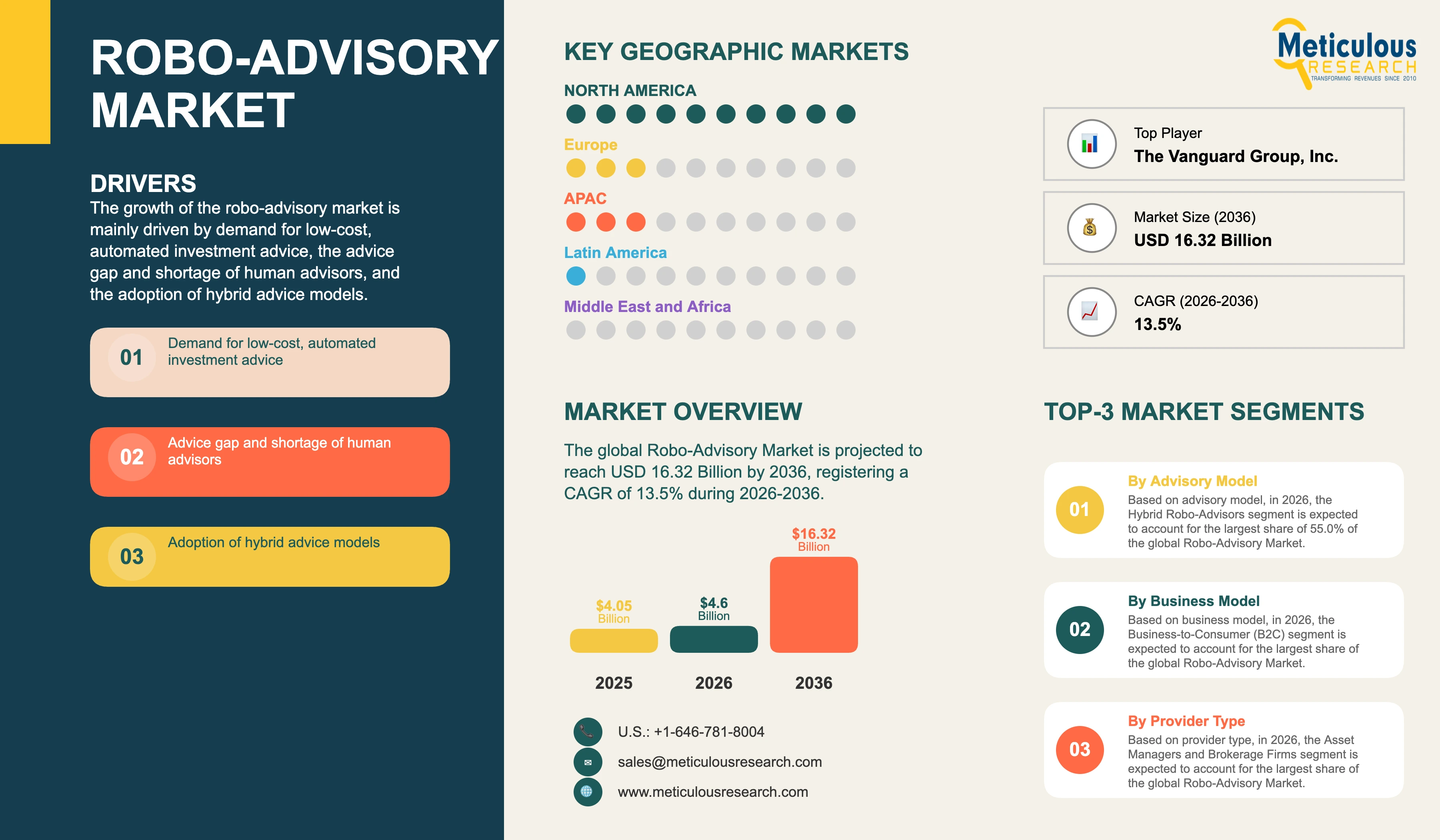
The global robo-advisory market was valued at USD 4.05 billion in 2025. This market is expected to reach USD 16.32 billion by 2036 from an estimated USD 4.60 billion in 2026, registering a CAGR of 13.5% during the forecast period (2026-2036).
- Published
- Nov 2026
- Pages
- 290
- Format
- PDF + Excel
- Report ID
- MRICT - 1042470
- Base year
- 2025
- 2025 · BASELINE
- $4.05B
- 2036
- $16.32B
- CAGR 2026–2036
- 13.5%
2025 baseline · 2026–2036 forecast at 13.5% CAGR · hover a bar for the value
Key highlights
Vanguard runs the largest robo-advisory business in the world through Vanguard Digital Advisor and Vanguard Personal Advisor, with advised assets of more than USD 300 billion reported in its SEC Form ADV filings, followed by Schwab Intelligent Portfolios, Empower, Betterment, and Wealthfront in the U.S.
Wealthfront completed its initial public offering on the Nasdaq in December 2025 and reported record revenue of USD 365.0 million for the fiscal year ended January 31, 2026, up 18%, with total platform assets of USD 94.1 billion and 1.42 million funded clients.
Wealthfront reported that cash management accounted for about three-quarters of its fiscal 2026 revenue, showing how robo-advisors are diversifying beyond investment advisory fees, which remain the core revenue measured in this market.
The median robo-advisor management fee is about 0.25% of assets per year, according to Morningstar, compared with about 1% for many traditional human advisors, which makes robo-advice accessible to investors with smaller balances.
Wealthfront reported that its investment advisory assets grew 29% in fiscal 2026, faster than its cash management assets, showing continued demand for automated investing among digital-native clients, while Betterment reported more than USD 50 billion in assets across its consumer, advisor, and workplace businesses.
In Japan, the expansion of the tax-free NISA investment program from January 2024 encouraged millions of new investors to open accounts, supporting demand for low-cost automated portfolios offered by robo-advisors and online brokers.
Large financial groups continue to buy or build robo-advisors; Japan's MUFG acquired WealthNavi, Japan's largest robo-advisor, in 2025, and Betterment acquired the automated investing accounts of Goldman Sachs' Marcus Invest and of Ellevest.
In the U.K., the Financial Conduct Authority introduced a new targeted support regime in 2026 that allows firms to give lower-cost, ready-made suggestions to groups of consumers, which is expected to expand the use of digital and automated advice.
By advisory model, hybrid robo-advisors account for the largest share of 55.0% in 2026, while pure robo-advisors register the higher CAGR.
By business model, B2C accounts for the largest share in 2026, while B2B registers the higher CAGR.
By provider type, asset managers and brokerage firms account for the largest share in 2026, while banks register the highest CAGR.
By end user, mass affluent investors account for the largest share of 46.0% in 2026, while retirement plan sponsors and employers register the highest CAGR.
By geography, North America accounts for the largest share of 58.0% in 2026, while Asia-Pacific registers the highest CAGR of 17.3%.
Report summary
| Particulars | Details |
|---|---|
| Base Year | 2025 |
| Estimated Year | 2026 |
| Forecast Period | 2026-2036 |
| Market Size in 2025 | USD 4.05 billion |
| Market Size in 2026 | USD 4.60 billion |
| Market Size by 2036 | USD 16.32 billion |
| CAGR (2026-2036) | 13.5% |
| Format | PDF, Excel & Cloud Portal · 290 pages |
| Largest Segment by Advisory Model (2026) | Hybrid Robo-Advisors (55.0%) |
| Largest Segment by End User (2026) | Mass Affluent Investors (46.0%) |
| Largest Region (2026) | North America (58.0%) |
| Fastest-Growing Region | Asia-Pacific (CAGR 17.3%) |
| Segments Covered | Advisory Model, Business Model, Provider Type, End User, and Geography |
| Geographic Scope | North America, Europe, Asia-Pacific, Latin America, and Middle East and Africa |
| Key Companies Profiled | Vanguard, Charles Schwab, Fidelity, Empower, Betterment, Wealthfront, SoFi, Acorns, Wealthsimple, Moneyfarm, Nutmeg, Scalable Capital, WealthNavi, and SigFig |
Report overview
Segments covered: advisory model, business model, provider type, end user.
The growth of this market is mainly driven by the growing demand for low-cost, automated investment advice among younger and mass affluent investors, the large gap between the number of people who need financial advice and the number of human advisors available, the adoption of hybrid models that combine digital tools with access to human advisors, the use of robo-advisory technology by banks, asset managers, and retirement plan providers, and the integration of artificial intelligence into portfolio management and financial planning. However, factors such as low management fees that limit revenue per client, high customer acquisition costs, intense competition from zero-fee platforms and self-directed trading apps, and limited trust in fully automated advice among older and wealthier investors are expected to restrain the growth of this market to some extent.
Robo-advisors are digital platforms that provide automated investment management and financial advice using algorithms, with little or no human involvement. After a client answers questions about their goals, time horizon, and risk tolerance, the platform recommends a diversified portfolio, usually made up of low-cost exchange-traded funds or index funds, and then manages it automatically through rebalancing, tax-loss harvesting, and dividend reinvestment. Hybrid robo-advisors combine this automated management with access to human financial advisors for planning and guidance.
This market covers the global revenue generated from robo-advisory services and solutions, measured in value. It includes advisory and management fees and subscription fees charged by pure and hybrid robo-advisors to investors, and fees earned by technology providers that supply white-label robo-advisory platforms to banks, wealth managers, financial advisors, and retirement plan providers. It is segmented by advisory model, business model, provider type, end user, and geography. Revenue from cash management, lending, brokerage trading, and fund management fees on the underlying funds is not included, and zero-fee robo-advisory programs contribute only their explicit subscription or advisory fees.
Robo-advisors emerged after the 2008 financial crisis, when Betterment and Wealthfront launched services aimed at younger investors who wanted simple, low-cost investing. Large asset managers and brokers, such as Vanguard, Charles Schwab, and Fidelity, then launched their own robo-advisory services and used their existing client bases and low-cost funds to grow rapidly. Today, the largest robo-advisors by assets are owned by traditional asset managers and brokers, while independent fintech companies remain important innovators and lead among younger investors.
A robo-advisory service usually includes several components: a digital onboarding process that collects information about the client's goals and risk tolerance, an algorithm that recommends an asset allocation, portfolio construction using low-cost funds or individual securities, automated rebalancing and tax-loss harvesting, and digital reporting through web and mobile apps. Hybrid services add access to human advisors through video calls, phone calls, or in-person meetings, while advanced services add financial planning tools, retirement income planning, and goal tracking. Many providers also offer specialized portfolios, such as socially responsible, income-focused, or crypto-inclusive portfolios.
Robo-advisory revenue depends mainly on assets under management and fee rates, and fees are low, typically between 0.15% and 0.40% of assets per year for pure robo-advisors and between 0.30% and 0.90% for hybrid services that include human advice, and some providers, such as Schwab Intelligent Portfolios, charge no advisory fee and earn revenue from cash allocations and funds instead. Because fees are low, robo-advisors need large asset bases and low operating costs to be profitable, which favors large providers with existing customer relationships.
The business model of robo-advisors has evolved over the past decade, as many independent robo-advisors have expanded into cash management, high-yield savings, lending, retirement accounts, and financial planning to increase revenue per client, while traditional providers have added hybrid services to serve clients with more complex needs. Technology providers, such as SigFig, Envestnet, and InvestCloud, supply robo-advisory platforms to banks and advisors, and many banks in Europe and Asia-Pacific have launched digital investment services built on these platforms.
Artificial intelligence is starting to change robo-advice, because earlier robo-advisors used rules-based algorithms for portfolio construction and rebalancing, while newer platforms use machine learning and generative AI to personalize portfolios, answer client questions, provide financial planning guidance, and support human advisors in hybrid models. Regulators are watching these developments closely, focusing on suitability, conflicts of interest, and the transparency of automated advice.
The economics of robo-advice also depend on financial markets, because most revenue is charged as a percentage of assets, rising markets increase assets under management and fees automatically, while market downturns reduce revenue even if clients stay invested. Strong equity markets in 2024 and 2025 supported revenue growth, and continued net inflows from new and existing clients are expected to drive growth over the forecast period.
Over the forecast period, the market is expected to grow strongly, supported by the transfer of wealth to younger generations who prefer digital services, the expansion of robo-advice in Europe and Asia-Pacific, the adoption of robo-advisory technology by banks and retirement plans, and the use of AI to make personalized advice affordable for more people.
Our younger customers keep their savings in deposits because traditional advice is too expensive for them. A white-label robo-advisory platform let us offer investing in our app within months, without building the technology ourselves.
Bank demand for white-label platforms supports the growth of the B2B business model and of banks as the fastest-growing provider type.
Benefits Director - large employer, U.S.
Our employees want personalized retirement advice, but most cannot afford a financial planner. Managed accounts and digital advice through our retirement plan give them that guidance at a reasonable cost.
Employer demand for personalized retirement advice explains why retirement plan sponsors and employers are the fastest-growing end user.
Retiree and hybrid robo-advisor client - U.K.
I wanted someone to check my retirement plan and help me with withdrawals, but I did not want to pay full advisory fees, so the hybrid service with a planner on call works well for me.
Older clients' need for occasional human guidance on retirement income and taxes supports continued demand for hybrid services in mature markets.
Report infographic
Market dynamics
17 factors across 5 forcesDemand for low-cost, automated investment advice
Many investors, particularly younger people and those with smaller balances, cannot access or afford traditional financial advisors, who often charge about 1% of assets per year and require high minimum balances. Robo-advisors offer diversified, professionally designed portfolios with automatic rebalancing and tax optimization for a fraction of that cost, with minimum balances as low as USD 100 or less. According to Morningstar, the median robo-advisor fee is about 0.25% of assets per year, which allows investors to keep more of their returns over time.
Lower costs, simple digital onboarding, and mobile access have made robo-advisors attractive to millennials and Gen Z investors, who are comfortable managing their finances online. As these investors accumulate wealth and inherit assets from older generations, demand for low-cost automated advice is expected to rise significantly over the forecast period.
According to a study by Oxford Economics commissioned by Wealthfront, the wealth of digital-native generations is projected to grow from about USD 12 trillion in 2022 to about USD 140 trillion by 2045, which shows the scale of the opportunity for digital advice providers. Robo-advisors that attract these investors early, when their balances are small, can grow with them as their wealth increases over time.
Advice gap and shortage of human advisors
There is a large gap between the number of people who need financial advice and the number of human financial advisors available to serve them. In many countries, the number of advisors is falling as older advisors retire, and advisors focus on wealthier clients because serving clients with smaller balances is not economical. As a result, many mass market and mass affluent investors receive no professional advice at all.
Robo-advisors can serve large numbers of clients at low cost, which helps close this advice gap. Regulators in some countries, such as the U.K., are encouraging lower-cost forms of advice, and the Financial Conduct Authority's targeted support regime, introduced in 2026, allows firms to offer ready-made suggestions to groups of consumers with similar needs, which is expected to increase the use of automated advice.
In the U.S., the number of financial advisors has been broadly flat for many years while the number of households with investable assets has grown, and many advisors are approaching retirement age. Similar gaps exist in Europe and Asia-Pacific, where most retail investors keep their savings in bank deposits rather than investments. Robo-advisory technology allows both new providers and existing advice firms to serve these households at a cost that is economical for clients with smaller balances.
Adoption of hybrid advice models
Hybrid robo-advisors combine automated portfolio management with access to human financial advisors, either on demand or as part of a premium service. This model appeals to investors who want low costs and digital convenience but also value human guidance for complex decisions, such as retirement planning, taxes, and estate planning. Vanguard Personal Advisor, Schwab Intelligent Portfolios Premium, and Betterment Premium are examples of hybrid services.
Hybrid models also allow providers to charge higher fees than pure robo-advisors and to serve wealthier clients, which increases revenue per client. For traditional wealth managers, hybrid models make advisors more productive by automating portfolio management and administration, allowing each advisor to serve more clients. Hybrid robo-advisors account for the largest share of the market by advisory model.
Hybrid services are particularly important for retirement planning, as investors approaching retirement often need help with decisions about withdrawals, Social Security or state pensions, taxes, and annuities, which are difficult to address through fully automated tools.
Adoption by banks, asset managers, and retirement plans
Banks, asset managers, insurance companies, and retirement plan providers are adopting robo-advisory technology to offer low-cost digital investment services to their customers, retain deposits and assets, and reach younger clients. Many banks in Europe and Asia-Pacific have launched digital investment services, either by building their own platforms or by licensing white-label solutions from technology providers. In the U.S., retirement plan providers use robo-advisory technology to offer managed accounts and personalized retirement advice to plan participants.
This B2B adoption allows robo-advisory technology to reach millions of investors through existing financial relationships, without the high customer acquisition costs faced by independent robo-advisors. B2B is the faster-growing business model in this market, and retirement plan sponsors and employers are the fastest-growing end user.
Asset managers also use robo-advisory technology to distribute their funds directly to investors and to offer model portfolios through advisors and platforms. Insurance companies use it to offer investment-linked products and retirement solutions, and employers use it to provide financial wellness services as part of employee benefits.
Table of contents
12 chapters · 121 sections · 290 pages · click to expandGeographic analysis
North America
Largest shareIn 2026, North America is expected to account for the largest share of 58.0% of the global robo-advisory market. The large share of this region is mainly due to the presence of the largest robo-advisors, such as Vanguard, Charles Schwab, Fidelity, Empower, Betterment, and Wealthfront, the large pool of investable assets and retirement savings in the U.S., and high adoption of digital financial services among investors. The U.S. is the world's largest robo-advisory market, where robo-advisors are integrated into brokerage, retirement, and workplace savings platforms, and where hybrid services from large asset managers manage hundreds of billions of U.S. dollars. Canada is also a significant market, led by Wealthsimple, which has grown into one of the largest digital investment platforms in the country, and by robo-advisory services from major Canadian banks. North America is expected to remain the largest region throughout the forecast period. U.S. robo-advisory growth is also supported by the large retirement market, including individual retirement accounts and 401(k) plans, and by the use of robo-advisory technology in managed accounts offered by retirement plan recordkeepers.
Asia-Pacific
Fastest growthAsia-Pacific is projected to register the highest CAGR of 17.3% during the forecast period. Growth is driven by Japan, where WealthNavi and the expanded NISA program are supporting new investors, and by rising adoption in Australia, Singapore, Hong Kong, South Korea, China, and India, where banks, brokers, and fintech companies are launching digital investment services for a growing middle class.
Europe
Europe holds a significant share of the market, led by the U.K., Germany, France, Italy, and the Nordic countries, with providers such as Scalable Capital, Moneyfarm, Nutmeg (J.P. Morgan Personal Investing), Trade Republic, and bank-owned robo-advisors. The U.K.'s targeted support regime and EU initiatives to increase retail investment participation are expected to support growth across the region over the forecast period.
Latin America
Latin America and the Middle East and Africa are smaller robo-advisory markets today but are growing steadily as banks and fintech companies launch digital investment services. In Brazil and Mexico, digital banks and brokers are launching automated investment services for a growing population of first-time investors, while in the Gulf countries, banks are offering Sharia-compliant robo-advisory portfolios to retail customers.
Middle East & Africa
In South Africa, banks and asset managers offer digital investment services to a growing base of retail investors, and regulators across these regions are developing rules for digital advice.
Competitive landscape
The robo-advisory market is concentrated among a few large asset managers and brokers in North America, with a long tail of independent fintech companies, bank-owned services, and B2B technology providers. Leading companies include The Vanguard Group, Charles Schwab, Fidelity Investments, Empower, Betterment, Wealthfront, SoFi Technologies, Acorns, Wealthsimple, Moneyfarm, J.P. Morgan Personal Investing (Nutmeg), Scalable Capital, WealthNavi, and SigFig.
Providers compete on fees, brand trust, ease of use, investment performance, range of services, access to human advisors, and integration with banking and retirement accounts. Large asset managers and brokers have advantages in brand, scale, and existing customer relationships, while independent fintech companies compete through user experience, innovation, and targeted offerings for younger investors.
Vanguard holds the largest share of robo-advisory assets, followed by Charles Schwab, Empower, Betterment, and Wealthfront in the U.S., while in other regions, providers such as Wealthsimple in Canada, WealthNavi in Japan, Scalable Capital in Germany, and Moneyfarm in the U.K. and Italy lead their home markets.
B2B technology providers, such as SigFig, Envestnet, and InvestCloud, compete on platform features, integration with bank and advisor systems, and pricing, and they serve many banks and advisory firms under their clients' brands, which makes their market presence larger than their own brand recognition suggests.
The top five players are estimated to account for 60.0% of the robo-advisory market in 2025, reflecting the dominance of large U.S. asset managers and brokers and the scale of leading independent robo-advisors.
Players use several strategies to grow in this market, including launching hybrid and premium services, adding AI tools, expanding into cash management, retirement, and tax services, acquiring client accounts and smaller providers, partnering with banks and employers, and expanding into new countries and customer segments. Recent examples include Wealthfront's IPO, Betterment's acquisitions of Marcus Invest and Ellevest accounts, and MUFG's acquisition of WealthNavi.
Competition is expected to center on AI-driven personalization, hybrid services, integration with broader financial platforms, and cost. Consolidation is expected to continue, as smaller robo-advisors struggle to reach scale and larger financial groups seek to acquire digital capabilities and younger clients.
Some of the key players operating in the robo-advisory market are The Vanguard Group, Inc., The Charles Schwab Corporation, FMR LLC (Fidelity Investments), Empower Annuity Insurance Company of America, Betterment LLC, Wealthfront Corporation, SoFi Technologies, Inc., Acorns Grow Incorporated, Wealthsimple Technologies Inc., MFM Investment Ltd. (Moneyfarm), JPMorgan Chase & Co. (Nutmeg), Scalable Capital GmbH, WealthNavi Inc., and SigFig Wealth Management, LLC.
- —
Wealthfront completed its IPO in December 2025, MUFG acquired WealthNavi, Betterment acquired client accounts from Marcus Invest and Ellevest, and the U.K. introduced a targeted support regime for lower-cost advice in 2026.
- Vanguard
- Charles Schwab
- Fidelity
- Empower
- Betterment
- Wealthfront
- SoFi
- Acorns
- Wealthsimple
- Moneyfarm
- Nutmeg
- Scalable Capital
- WealthNavi
- SigFig
Expert perspectives
Robo-advisory has moved from a niche fintech innovation to a mainstream part of wealth management, with the largest services run by major asset managers and brokers and robo-advisory technology increasingly used by banks, advisors, and retirement plans. The market's core strength is its ability to provide professional investment management at low cost to investors who are not served by traditional advisors.
Over the forecast period, the market is expected to grow at about 13.5% per year, supported by asset growth, the transfer of wealth to digital-native generations, hybrid and AI-enhanced advice, B2B adoption, and expansion in Asia-Pacific and Europe. Growth in revenue will be slower than growth in assets because of continued fee pressure.
Hybrid robo-advisors remain the largest advisory model, while pure robo-advisors grow faster. B2C is the largest business model, while B2B grows faster. Asset managers and brokerage firms lead by provider type, while banks are the fastest-growing provider type. Mass affluent investors are the largest end user, while retirement plan sponsors and employers grow fastest.
North America remains the largest region, while Asia-Pacific is the fastest-growing region at a CAGR of 17.3%. The main swing factors are financial market performance, fee competition, AI regulation, and the pace of adoption by banks and retirement plans.
For providers, the key priorities are reaching scale, diversifying revenue, building trusted AI advice capabilities, and partnering with banks, employers, and other distribution channels. Independent robo-advisors that lack scale or diversified revenue are likely to face strong pressure to consolidate or sell.
Generative AI is the most important change for the industry, as it could allow robo-advisors to offer personalized financial planning and conversational guidance that previously required a human advisor, which would expand the range of services and support higher fees. However, it also creates regulatory and reputational risks if AI advice is inaccurate or unsuitable, and providers will need strong controls, testing, and human oversight. Providers that use AI responsibly to improve advice quality and lower costs are expected to gain market share, while those that move too quickly without proper controls risk regulatory action and a serious loss of client trust.
A major market downturn would reduce assets under management and advisory revenue in the short term and test investor confidence in automated advice, while strong markets and faster AI adoption could push growth above current expectations. Overall, robo-advisory technology is expected to become a standard part of how financial institutions deliver investment advice, rather than a separate product category, over the forecast period.
Customer perspectives
Software engineer and robo-advisor client - U.S.
I don't have time to pick funds or rebalance, and paying 1% to an advisor didn't make sense at my balance. The robo-advisor handles tax-loss harvesting automatically, and I can talk to an advisor when I need help with bigger decisions.
The demand for low-cost management with occasional human support explains why hybrid robo-advisors account for 55.0% of the market and why mass affluent investors account for 46.0%.
Frequently asked questions
The market was valued at USD 4.05 billion in 2025 and USD 3.45 billion in 2024, and is estimated at USD 4.60 billion in 2026, measured as revenue from robo-advisory services and solutions.
Cite this report
Meticulous Research. (2026). Robo-Advisory Market - Global Opportunity Analysis and Industry Forecast (2026-2036) (Report No. MRICT - 1042470). Meticulous Market Research Pvt. Ltd. https://www.meticulousresearch.com/product/robo-advisory-market-7153