Malaysia Data Center Market (2026-2036)
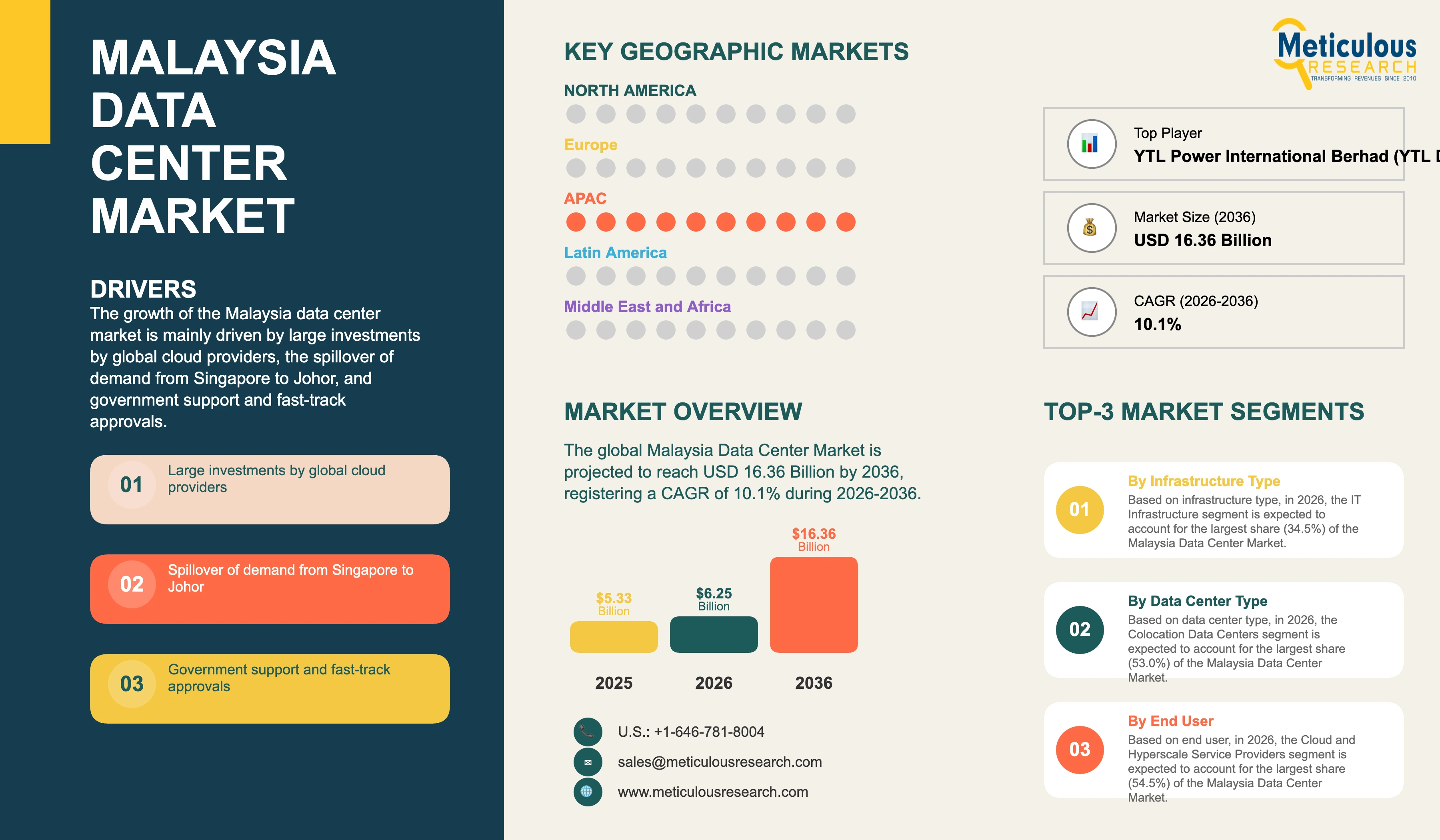
Malaysia Data Center Market Size The Malaysia data center market was valued at USD 5.33 billion in 2025. This market is expected to reach USD 16.36 billion by 2036 from an estimated USD 6.25 billion in 2026, registering a CAGR of 10.1% during the forecast period (2026-2036). In terms of volume, the
- Published
- Nov 2026
- Pages
- 211
- Format
- PDF + Excel
- Report ID
- MRICT - 1042481
- Base year
- 2025
- 2025 · BASELINE
- $5.33B
- 2036
- $16.36B
- CAGR 2026–2036
- 10.1%
2025 baseline · 2026–2036 forecast at 10.1% CAGR · hover a bar for the value
Key highlights
Malaysia approved RM95.8 billion in data center and cloud computing investments in the first half of 2026, close to 44% of all approved investments in the country, and data center-related approvals have reached RM385.7 billion since 2021.
Johor's operational IT capacity rose 24% from the second half of 2025 to 1, 110 MW in the first half of 2026, up from 94 MW in 2023, with 602 MW under construction and colocation vacancy of less than 1%.
Malaysia led Southeast Asia with 1, 039 MW of data center capacity under construction in the first half of 2026, more than two-fifths of the region's total.
Tenaga Nasional Berhad (TNB) has signed electricity supply agreements for 59 data center projects with a combined capacity of 8.3 GW, of which 36 projects with 4.5 GW of maximum demand have been completed, and about 68% of this capacity is in Johor.
Malaysia's Data Centre Task Force has approved 27 flagship data center projects with an estimated investment of RM225.97 billion as of July 2026, including 16 in Johor, 10 in Selangor, and one in Negeri Sembilan.
Microsoft launched its Malaysia West cloud region in Greater Kuala Lumpur as part of a USD 2.2 billion investment, Google is investing USD 2 billion in its first Malaysian data center and cloud region, AWS plans to invest heavily through 2037, and Oracle plans to invest more than USD 6.5 billion in a public cloud region.
DayOne signed renewable energy supply agreements for more than 1 GW under the Corporate Renewable Energy Supply Scheme in June 2026, and the TM and Nxera joint venture secured 280 MW of power from TNB for the first phase of its campus in Iskandar Puteri, Johor.
Mechanical infrastructure is the fastest-growing infrastructure type, hyperscale self-build data centers are the fastest-growing data center type, and AI and GPU cloud providers are the fastest-growing end user.
By infrastructure type, IT infrastructure accounts for the largest share of 34.5% in 2026, while mechanical infrastructure registers the highest CAGR.
By data center type, colocation data centers account for the largest share in 2026, while hyperscale self-build data centers register the highest CAGR.
By tier standard, Tier III data centers account for the largest share in 2026, while Tier IV data centers register the highest CAGR.
By facility size, data centers above 50 MW account for the largest share in 2026 and also register the highest CAGR.
By end user, cloud and hyperscale service providers account for the largest share of 54.5% in 2026, while AI and GPU cloud providers register the highest CAGR.
Report summary
| Particulars | Details |
|---|---|
| Base Year | 2025 |
| Estimated Year | 2026 |
| Forecast Period | 2026-2036 |
| Market Size in 2025 | USD 5.33 billion |
| Market Size in 2026 | USD 6.25 billion |
| Market Size by 2036 | USD 16.36 billion |
| CAGR (2026-2036) | 10.1% |
| Format | PDF, Excel & Cloud Portal · 211 pages |
| Installed IT Capacity (2026 to 2036) | 1,780 MW to 5,146 MW (CAGR 11.2%) |
| Largest Segment by Infrastructure Type (2026) | IT Infrastructure (34.5%) |
| Largest Segment by End User (2026) | Cloud and Hyperscale Service Providers (54.5%) |
| Leading Data Center Locations | Johor and Greater Kuala Lumpur (Selangor, Cyberjaya, and Negeri Sembilan) |
| Segments Covered | Infrastructure Type, Data Center Type, Tier Standard, Facility Size, and End User |
| Geographic Scope | Malaysia |
| Key Companies Profiled | YTL Data Centers, DayOne, AirTrunk, Princeton Digital Group, Bridge Data Centres, NTT DATA, Equinix, Vantage Data Centers, Yondr, TM One, Gamuda, Schneider Electric, Vertiv, and Eaton |
Report overview
Segments covered: infrastructure type, data center type, tier standard, facility size, end user.
Data centers are facilities that house the servers, storage, and network equipment used to run cloud services, business applications, and artificial intelligence (AI) models, along with the electrical, cooling, and building systems needed to keep them running. The Malaysia data center market covers investment in IT infrastructure, electrical infrastructure, mechanical infrastructure, and general construction for colocation, hyperscale, enterprise, and edge data centers across the country. Capacity is usually measured in megawatts of IT load, and investment per megawatt has been rising as new facilities are built for dense AI equipment.
Malaysia has become one of the fastest-growing data center markets in the world in only a few years. In 2023, Johor had less than 100 MW of operational IT capacity, but by the first half of 2026 it had 1,110 MW, making it one of the largest data center locations in Asia-Pacific alongside Tokyo and Singapore. Greater Kuala Lumpur, including Cyberjaya, Selangor, and Negeri Sembilan, has also grown quickly as the home of cloud regions for Microsoft, Google, AWS, and Oracle, and the country led Southeast Asia in capacity under construction in the first half of 2026. Malaysia now accounts for the largest share of data center investment in Southeast Asia, ahead of Singapore, which remains the region's main connectivity hub but has limited room to grow.
This growth was driven by several factors at once, as Singapore's limits on new data centers pushed demand across the border to Johor, global cloud providers chose Malaysia for new cloud regions, and AI created demand for very large campuses with access to power and land. The government supported this growth through the Green Lane Pathway, introduced in August 2023 to speed up approvals and grid connections, and later through the Data Centre Task Force, which coordinates approvals for flagship projects. Data center and cloud projects accounted for close to 44% of all approved investments in Malaysia in the first half of 2026. TNB's willingness to sign large power supply agreements under take-or-pay terms also gave developers confidence that they could secure the power needed for large campuses.
The market is served by a mix of colocation operators, hyperscalers that build their own facilities, telecom-backed operators, and local developers. Major colocation operators include YTL Data Centers, DayOne, AirTrunk, Princeton Digital Group, Bridge Data Centres, NTT DATA, Equinix, Vantage Data Centers, and Yondr, while TM and Singtel's Nxera have formed a joint venture for a campus in Johor. Infrastructure vendors such as Schneider Electric, Vertiv, and Eaton supply power and cooling systems, and local contractors such as Gamuda build many of the facilities. Many of the leading operators are backed by global investment funds, which provide the capital needed to build campuses of hundreds of megawatts in phases.
Most demand comes from global cloud providers and large technology companies, both from the U.S. and from China, and about 72% of data center investment linked to TNB's power supply agreements comes from the U.S. and Singapore. Chinese technology companies also use Malaysian data centers to serve regional and international customers, which has made Malaysia a focus of discussions about U.S. export controls on advanced AI chips. In 2025, Malaysia introduced permit requirements for the export of high-performance AI chips of U.S. origin to strengthen compliance with these rules.
Rapid growth has placed pressure on power and water, and the government is moving from a growth-first approach to a more selective one. Data centers are expected to account for a rising share of electricity use in Peninsular Malaysia, from about 7% in 2026 to as much as 31% by 2035, and Johor asked investors in late 2025 to postpone expansions that rely on water-cooled systems. The government now approves new projects only once power and water supply are confirmed and focuses on AI-related projects, while new guidelines for sustainable data centers set standards for energy and water efficiency. These policies are expected to shape where and how fast new capacity is built over the forecast period.
Report infographic
Market dynamics
15 factors across 5 forcesLarge investments by global cloud providers
Global cloud providers have made Malaysia one of their main investment destinations in Southeast Asia. Microsoft launched its Malaysia West cloud region in Greater Kuala Lumpur in 2025 as part of a USD 2.2 billion investment, Google is building its first Malaysian data center and cloud region in Selangor with a USD 2 billion investment, AWS has launched a Malaysian region and plans to invest heavily through 2037, and Oracle plans to invest more than USD 6.5 billion in its first public cloud region in the country.
These investments create demand for both self-built hyperscale data centers and large wholesale colocation contracts, as cloud providers often lease capacity from operators to expand quickly. Each new cloud region also attracts partners, software providers, and enterprises that want to use local cloud services, which adds further demand for data center capacity. Cloud and hyperscale service providers account for the largest share of the market. AI services offered through these cloud regions are expected to drive further expansion over the forecast period.
Spillover of demand from Singapore to Johor
Singapore paused new data centers from 2019 to 2022 and now allocates small amounts of new capacity through selective calls for applications, which has pushed a large share of new demand across the border to Johor. Johor offers large land banks, lower land and construction costs, access to grid power, and low latency to Singapore's network hub, which make it an attractive location for hyperscale campuses that serve customers in Singapore and across the region.
Johor's operational capacity grew from 94 MW in 2023 to 1,110 MW in the first half of 2026, and its colocation vacancy is below 1%, which shows that new capacity is being taken up quickly. About 68% of the data center capacity under TNB's supply agreements is in Johor, and the Johor-Singapore Special Economic Zone, which attracted RM76.98 billion of approved investment in its first full year, is expected to support further growth. Data centers above 50 MW, most of which are in Johor, account for the largest share of the market.
Government support and fast-track approvals
The Malaysian government has actively promoted data center investment as part of its digital economy and national AI plans. The Green Lane Pathway, introduced in August 2023, speeds up approvals and grid connections for data centers, and the Data Centre Task Force coordinates approvals across ministries, utilities, and state governments, with 27 flagship projects worth RM225.97 billion approved as of July 2026. Malaysia also offers investment incentives through the Malaysian Investment Development Authority and has set aside funding for a sovereign AI cloud.
TNB has supported growth by signing supply agreements with data center developers under five-year take-or-pay contracts, which allow it to recover the cost of grid investment, and it plans to add about 11.8 GW of new generation capacity by 2033. The Corporate Renewable Energy Supply Scheme allows data centers to buy renewable power directly, and DayOne has signed agreements for more than 1 GW of renewable energy under the scheme. These measures make Malaysia one of the easiest places in the region to secure large amounts of power. TNB expects to continue adding about 1 GW of new data center capacity each year.
Rise of AI and high-density computing
AI is creating demand for very large data centers with high power density, liquid cooling, and access to large amounts of power, and Malaysia's land and grid capacity make it a strong location for these facilities. YTL Data Centers has developed an AI-focused campus in Johor, and several operators are designing new facilities for liquid cooling and GPU clusters. The government has made AI a priority, with the prime minister saying in February 2026 that new data center applications not related to AI had been stopped.
AI and GPU cloud providers, which build or lease capacity for training and running AI models, are among the fastest-growing customers in the market. Demand from AI customers is also raising investment per megawatt, because AI facilities need stronger electrical systems, liquid cooling, and costly GPU servers. AI and GPU cloud providers are the fastest-growing end user in this market. Malaysian companies and government agencies are also starting to adopt AI services, which will add local demand over time.
Table of contents
12 chapters · 117 sections · 211 pages · click to expandGeographic analysis
Asia-Pacific
The Malaysia data center market was valued at USD 5.33 billion in 2025. This market is expected to reach USD 16.36 billion by 2036 from an estimated USD 6.25 billion in 2026, registering a CAGR of 10.1% during the forecast period (2026-2036). In terms of volume, the installed operational IT capacity of data centers in Malaysia is expected to reach 5,146 MW by 2036 from an estimated 1,780 MW in 2026, registering a CAGR of 11.2% during the forecast period. The growth of this market is mainly driven by large investments by global cloud providers such as Microsoft, Google, AWS, and Oracle, the spillover of demand from Singapore to Johor, strong government support through the Data Centre Task Force and fast-track approvals, and the availability of land and grid power compared with neighboring markets. However, factors such as pressure on power and water supply, rising electricity tariffs, and a more selective approval policy that favors AI-related projects are expected to restrain the growth of this market to some extent. Johor is the largest data center location in Malaysia, with 1,110 MW of operational IT capacity in the first half of 2026, 602 MW under construction, and a development pipeline of more than 3,000 MW. Johor's growth is mainly due to its proximity to Singapore, large land banks, access to grid power, and strong support from the state government, and about 68% of the data center capacity under TNB's supply agreements is located in the state. Most of Johor's data centers are located in a few key areas, including Sedenak Tech Park and Kulai, where YTL Data Centers, AirTrunk, Microsoft, and others have built large campuses, and Iskandar Puteri and Nusajaya, where Equinix, Princeton Digital Group, Bridge Data Centres, DayOne, and the TM and Nxera joint venture operate or are building facilities. Johor accounted for 16 of the 27 flagship projects approved by the Data Centre Task Force as of July 2026. The Johor-Singapore Special Economic Zone is expected to support further investment by easing cross-border movement of people and goods. However, Johor also faces the strongest pressure on water and power, which led the state to ask investors in late 2025 to postpone expansions that rely on water-cooled systems. Reclaimed water projects and new power plants are expected to support continued growth, but at a more measured pace than in recent years. Johor is expected to remain the largest data center location in Malaysia throughout the forecast period. Greater Kuala Lumpur, including Selangor, Cyberjaya, and parts of Negeri Sembilan, is the second major data center location and the home of the cloud regions of Microsoft, Google, AWS, and Oracle. Selangor accounted for 10 of the 27 flagship projects approved as of July 2026, and the area benefits from its role as Malaysia's business and government center, strong fiber connectivity, and demand from enterprises, banks, and government agencies. NTT DATA, Vantage Data Centers, Bridge Data Centres, and local operators have significant capacity in the area. Google's first Malaysian data center at Elmina Business Park in Selangor is also expected to add significant hyperscale capacity to the area. Other locations, such as Negeri Sembilan, Kedah, Penang, and Sarawak, are emerging as options for new data centers, particularly where land, power, or renewable energy is more available. Sarawak is promoting its hydropower resources to attract green data centers, and new subsea cable landings are expected to support data center growth outside the two main hubs. Malaysia Data Center Market Size Geographic Analysis
Competitive landscape
The Malaysia data center market is moderately fragmented, with a mix of global and regional colocation operators, hyperscalers that build their own campuses, telecom-backed operators, and local developers. Leading colocation operators include YTL Data Centers, DayOne, AirTrunk, Princeton Digital Group, Bridge Data Centres, NTT DATA, Equinix, Vantage Data Centers, and Yondr, each with large campuses or significant capacity in Johor or Greater Kuala Lumpur. Hyperscalers such as Microsoft, Google, and AWS are also major builders of capacity in their own right.
Competition among operators centers on access to power and water, speed of delivery, ability to support high-density AI workloads, renewable energy supply, and relationships with hyperscale customers. Infrastructure vendors such as Schneider Electric, Vertiv, and Eaton compete to supply power and cooling equipment, while local contractors such as Gamuda compete for construction work. Telecom operators, such as TM, also compete through their own data centers and joint ventures with global operators.
The top five operators are estimated to account for 46.5% of operational IT capacity in 2025, reflecting the strong positions of large hyperscale-focused operators in Johor. YTL Data Centers, DayOne, AirTrunk, Princeton Digital Group, and Bridge Data Centres are among the operators with the largest capacity in the country. Hyperscalers' own self-built capacity is not included in this estimate, and Microsoft, Google, and AWS together control a large additional share of the country's capacity through their owned campuses.
Operators use several strategies to grow in this market, including building large master-planned campuses, signing long-term contracts with hyperscale anchor customers, securing power through TNB supply agreements and renewable energy under the Corporate Renewable Energy Supply Scheme, investing in reclaimed water supply, and partnering with local companies and state agencies. Many operators are also designing new facilities for liquid cooling and AI workloads to align with the government's focus on AI-related projects. Competition is expected to center on power and water availability, AI readiness, sustainability, and local value creation, as these factors now play a central role in approvals. Smaller and local operators often compete by focusing on enterprise customers, government contracts, or specific locations outside the main hubs.
Some of the key players operating in the Malaysia data center market are YTL Power International Berhad (YTL Data Centers), DayOne Data Centers Limited, AirTrunk Operating Pty Ltd, Princeton Digital Group, Bridge Data Centres, NTT DATA Group Corporation, Equinix, Inc., Vantage Data Centers, Yondr Group, TM Technology Services Sdn. Bhd. (TM One), Gamuda Berhad, Schneider Electric SE, Vertiv Holdings Co., and Eaton Corporation plc.
- —
Malaysia approved RM95.8 billion of data center investments in the first half of 2026, the Data Centre Task Force approved 27 flagship projects worth RM225.97 billion as of July 2026, DayOne signed more than 1 GW of renewable energy agreements under the Corporate Renewable Energy Supply Scheme, and the TM and Nxera joint venture secured 280 MW of power for its Johor campus.
- YTL Data Centers
- DayOne
- AirTrunk
- Princeton Digital Group
- Bridge Data Centres
- NTT DATA
- Equinix
- Vantage Data Centers
- Yondr
- TM One
- Gamuda
- Schneider Electric
- Vertiv
- Eaton
Expert perspectives
Malaysia has become one of the most important data center markets in Asia-Pacific in a very short time, driven by the spillover of demand from Singapore to Johor, large investments by global cloud providers, the rise of AI, and strong government support. Johor grew from less than 100 MW of operational capacity in 2023 to more than 1,100 MW in the first half of 2026, and data center and cloud projects accounted for close to 44% of all approved investments in Malaysia in the same period. Few markets anywhere have grown this fast.
The market is now entering a more selective phase, as the government focuses on AI-related projects, confirmed power and water supply, efficiency, and local value. This shift is likely to slow the pace of new approvals compared with the peak of the boom, but it should also improve the quality of investment and reduce the risk of stranded capacity. Operators with secured power, water, and anchor customers will have a strong advantage, while speculative projects may struggle.
Mechanical infrastructure is the fastest-growing infrastructure type, as liquid cooling becomes essential for AI workloads and water efficiency, and hyperscale self-build data centers are the fastest-growing data center type as cloud providers build their own campuses. AI and GPU cloud providers are the fastest-growing end user, and data centers above 50 MW hold the largest share and register the highest CAGR among facility sizes.
The main swing factors are the pace of AI and cloud demand, the ability of TNB and state water agencies to supply new capacity, changes in approval rules and tariffs, U.S. export controls on AI chips, and competition from Thailand, Indonesia, and other countries for new investment. The speed at which Singapore releases new capacity will also affect how much demand continues to flow to Johor.
For operators and investors, the key decision is choosing projects with secured resources and customers, rather than chasing announced pipelines. Operators that combine secured power and water, AI-ready designs, renewable energy, and strong local partnerships will be best placed to grow. For hyperscalers, Malaysia remains one of the best locations in the region for large campuses, but they will need to plan earlier and work closely with the government on resource use. Early commitment matters, as capacity with secured power in prime locations is often taken years before completion.
Overall, growth in this market rests on continued cloud and AI investment and on the ability of Malaysia to supply power and water sustainably. Operators that plan carefully around these constraints are expected to capture most of this growth.
Customer perspectives
Head of Data Center Strategy - global cloud provider, Asia-Pacific
Johor gives us the scale and power we cannot get in Singapore, with the latency our customers need. Our priority now is to lock in capacity with operators that already have power and water secured, because that is what the government checks first.
The reliance of cloud providers on colocation operators in Johor is why cloud and hyperscale service providers hold 54.5% of the market and why colocation data centers hold the largest share among data center types. Secured power and water has become the main factor in site selection.
The rapid growth of AI workloads and the government's focus on AI-related projects are driving the fast growth of the AI and GPU cloud providers segment and of mechanical infrastructure, including liquid cooling.
Chief Information Officer - commercial bank, Malaysia
Our regulator expects our critical systems to be in local, highly resilient facilities. Having global cloud regions in Kuala Lumpur and Tier III and Tier IV colocation options nearby has made our hybrid cloud plans much easier.
Local data residency rules and the arrival of global cloud regions are supporting demand from banks and government agencies, which is driving growth in Tier IV facilities and retail colocation in Greater Kuala Lumpur. Financial institutions often spread their systems across several local facilities to meet resilience requirements.
“Our customers want large GPU clusters with liquid cooling, and they want them quickly. The government's focus on AI projects has helped us get approvals, but we have to show that our facility is efficient and uses water carefully.”
Frequently asked questions
The market was valued at USD 5.33 billion in 2025 and USD 4.18 billion in 2024, and is estimated at USD 6.25 billion in 2026.
Cite this report
Meticulous Research. (2026). Malaysia Data Center Market - Global Opportunity Analysis and Industry Forecast (2026-2036) (Report No. MRICT - 1042481). Meticulous Market Research Pvt. Ltd. https://www.meticulousresearch.com/product/malaysia-data-center-market-7164