Privileged Access Management Market (2026-2036)
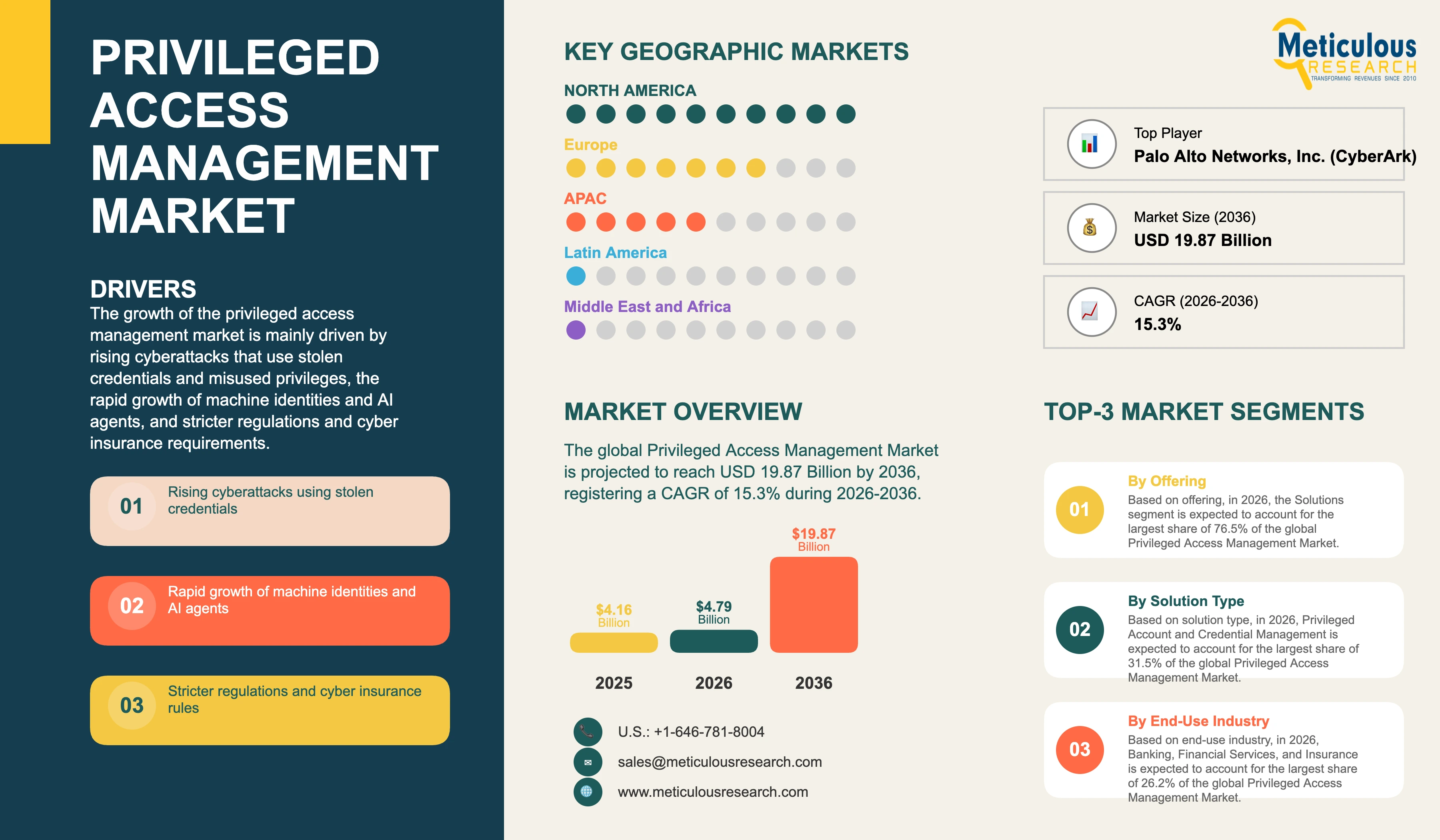
The global privileged access management market was valued at USD 4.16 billion in 2025. This market is expected to reach USD 19.87 billion by 2036 from an estimated USD 4.79 billion in 2026, registering a CAGR of 15.3% during the forecast period (2026-2036).
- Published
- Nov 2026
- Pages
- 310
- Format
- PDF + Excel
- Report ID
- MRICT - 1042475
- Base year
- 2025
- 2025 · BASELINE
- $4.16B
- 2036
- $19.87B
- CAGR 2026–2036
- 15.3%
2025 baseline · 2026–2036 forecast at 15.3% CAGR · hover a bar for the value
Key highlights
Palo Alto Networks completed its USD 25 billion acquisition of CyberArk on 11 February 2026, adding more than 10,000 CyberArk customers and making identity security a core part of its platform, while keeping CyberArk available as a standalone offering.
Delinea completed its acquisition of StrongDM in March 2026 to add just-in-time runtime authorization for developers, machines, and AI agents, and Okta closed its USD 54 million acquisition of Axiom Security in September 2025 to extend Okta Privileged Access to databases and Kubernetes.
Saviynt raised USD 700 million in a Series B round led by KKR in December 2025 at a valuation of about USD 3 billion, to expand its converged identity platform, including privileged access management and AI agent identity management.
BeyondTrust reported research in August 2026 showing that 75% of cyberattacks trace back to identity and privilege exposure, and launched governance for non-human and AI identities in July 2026.
Keeper Security reported annual recurring revenue of more than USD 225 million in 2026, with KeeperPAM revenue growing tenfold year over year after its launch in February 2025, and WALLIX reported 2025 revenue of EUR 40.6 million, up 19.2%.
Regulations such as the EU's NIS2 Directive and Digital Operational Resilience Act, along with PCI DSS v4.0, require organizations to control and monitor privileged access, and cyber insurers increasingly ask for privileged access controls before issuing or renewing policies.
Cloud entitlement and just-in-time access is the fastest-growing solution type, AI agent identities are the fastest-growing identity type, and healthcare and life sciences is the fastest-growing end-use industry.
By offering, solutions account for the largest share of 76.5% in 2026 and also register the higher CAGR.
By solution type, privileged account and credential management accounts for the largest share of 31.5% in 2026, while cloud entitlement and just-in-time access registers the highest CAGR.
By deployment, cloud-based (SaaS) solutions account for the largest share in 2026 and also register the highest CAGR.
By identity type, human identities account for the largest share in 2026, while AI agent identities register the highest CAGR.
By organization size, large enterprises account for the larger share in 2026, while small and medium-sized enterprises register the higher CAGR.
By end-use industry, banking, financial services, and insurance accounts for the largest share of 26.2% in 2026, while healthcare and life sciences registers the highest CAGR.
By geography, North America accounts for the largest share of 43.0% in 2026, while Asia-Pacific registers the highest CAGR of 18.6%.
Report summary
| Particulars | Details |
|---|---|
| Base Year | 2025 |
| Estimated Year | 2026 |
| Forecast Period | 2026-2036 |
| Market Size in 2025 | USD 4.16 billion |
| Market Size in 2026 | USD 4.79 billion |
| Market Size by 2036 | USD 19.87 billion |
| CAGR (2026-2036) | 15.3% |
| Format | PDF, Excel & Cloud Portal · 310 pages |
| Largest Segment by Offering (2026) | Solutions (76.5%) |
| Largest Segment by Solution Type (2026) | Privileged Account and Credential Management (31.5%) |
| Largest Segment by End-Use Industry (2026) | Banking, Financial Services, and Insurance (26.2%) |
| Largest Region (2026) | North America (43.0%) |
| Fastest-Growing Region | Asia-Pacific (CAGR 18.6%) |
| Companies Profiled | 15 companies and other companies |
| Segments Covered | Offering, Solution Type, Deployment, Identity Type, Organization Size, End-Use Industry, Geography |
| Countries Covered | U.S., Canada, Germany, U.K., France, Netherlands, Italy, Spain, Nordics, Rest of Europe, Japan, China, India, Australia, Singapore, South Korea, Indonesia, Rest of Asia-Pacific, Brazil, Mexico, Rest of Latin America, Saudi Arabia, U.A.E., Israel, South Africa, Rest of Middle East & Africa |
Report overview
Segments covered: offering, solution type, deployment, identity type, organization size, end-use industry, industry.
The growth of this market is mainly driven by the rising number of cyberattacks that use stolen credentials and misused privileges, the rapid growth of machine identities and AI agents that need privileged access, stricter regulations and cyber insurance requirements for controlling administrator access, and the move of enterprise workloads to cloud and DevOps environments where access must be granted and removed quickly. Growing board-level attention to identity-based attacks and the consolidation of PAM into large security platforms are also raising the profile and budgets of PAM programs. However, factors such as the complexity and cost of deploying and running privileged access tools across large hybrid environments and the shortage of skilled identity security staff are expected to restrain the growth of this market to some extent.
Privileged access management (PAM) covers the software and services that control, monitor, and audit access to an organization's most sensitive systems and data. Privileged accounts include administrator accounts on servers, databases, network devices, and cloud consoles, as well as service accounts, application credentials, and API keys used by software. Because these accounts can change configurations, read sensitive data, and disable security controls, attackers target them to move through a network and cause the greatest damage. PAM tools reduce this risk by storing privileged credentials in secure vaults, granting elevated rights only when needed, recording privileged sessions, and removing unnecessary administrator rights from endpoints.
The scope of PAM has widened greatly over the past few years. Traditional PAM focused on a small group of IT administrators and the passwords they used. Today, organizations must also secure developers working in cloud and DevOps environments, third-party vendors that need remote access, and a fast-growing number of machine identities, such as service accounts, workloads, containers, and automation scripts. CyberArk research has reported that machine identities now outnumber human identities by more than 80 to 1, and AI agents that act on behalf of users are adding a new class of identities that need privileged access to data and systems. As a result, PAM is increasingly seen as a control layer for every identity that can make sensitive changes, rather than as a password vault for a few administrators.
The market is also going through major consolidation, as Palo Alto Networks completed its USD 25 billion acquisition of CyberArk, the largest PAM vendor, in February 2026, bringing PAM into one of the largest cybersecurity platforms. Delinea acquired StrongDM in March 2026, Okta acquired Axiom Security in 2025, and SailPoint added PAM through its acquisition of Osirium. At the same time, identity governance vendors such as Saviynt, identity platforms such as Okta and Microsoft, and password management vendors such as Keeper Security are adding PAM capabilities, which brings PAM closer to the wider identity security market. Specialist vendors are also expanding their own platforms, for example through CyberArk's earlier acquisitions of Venafi for machine identity security and Zilla Security for identity governance.
Delivery models are shifting from on-premises software to cloud-based services, although many organizations first deployed PAM as on-premises vaults and session managers, which required dedicated infrastructure and specialist staff. Most vendors now offer PAM as a SaaS service that is faster to deploy and easier to maintain, and new buyers, especially mid-sized organizations, increasingly start with cloud-based PAM. Managed PAM services are also growing, as shown by the partnership between NCC Group and Delinea launched in January 2026 to deliver privileged access management as a managed service.
Access models are moving from standing privileges to just-in-time access, because under the traditional model administrators kept permanent privileged rights, which created a large target for attackers. Modern PAM tools grant privileges only for the time and scope needed to complete a task and remove them automatically afterwards, an approach often called zero standing privilege. Delinea's acquisition of StrongDM, Okta's acquisition of Axiom Security, and BeyondTrust's integration with ServiceNow in October 2026 to bring zero standing privilege into enterprise workflows all reflect this shift.
Regulation and insurance are also important demand drivers, as the EU's NIS2 Directive and Digital Operational Resilience Act require organizations in critical sectors and financial services to manage and monitor privileged access, PCI DSS v4.0 strengthens access control requirements for organizations that handle payment card data, and national rules in countries such as Singapore, India, and Saudi Arabia set similar expectations for critical infrastructure and financial institutions. Cyber insurers also commonly ask about privileged access controls when pricing and renewing policies, which pushes mid-sized organizations to adopt PAM. Together, these factors are turning PAM from an optional security project into a baseline requirement for organizations of almost every size. Cyber insurance requirements and audit findings are also reinforcing this shift.
Cloud entitlement and just-in-time access is projected to register the highest CAGR, while privileged account and credential management holds the largest share of 31.5% in 2026.
Cloud-based (SaaS) deployment is both the largest and fastest-growing deployment model, while AI agent identities are projected to register the highest CAGR among identity types.
Banking, financial services, and insurance is expected to account for the largest share of 26.2% of the market in 2026, while healthcare and life sciences is projected to register the highest CAGR.
North America is expected to account for the largest share of 43.0% of the market in 2026.
Asia-Pacific is projected to register the highest CAGR of 18.6% during the forecast period, led by India, Japan, Australia, and Singapore.
The report profiles 15 companies, including Palo Alto Networks, Inc. (CyberArk), BeyondTrust Corporation, Delinea Inc., Microsoft Corporation, Okta, Inc., and Saviynt, Inc. The top five players account for an estimated 52.6% of the market in 2025.
AI agents often need access to data, applications, and infrastructure to perform tasks, which makes them a new type of privileged identity. PAM vendors are adding capabilities to discover AI agents, issue short-lived credentials, enforce least-privilege access, and record agent actions, making AI agent identities the fastest-growing identity type in this market.
Regulations such as the EU's NIS2 Directive and Digital Operational Resilience Act, PCI DSS v4.0, and national critical infrastructure and banking rules require organizations to control, monitor, and audit privileged access. Cyber insurers also commonly require privileged access controls, which is extending PAM adoption to mid-sized organizations.
Report infographic
Market dynamics
15 factors across 5 forcesRising cyberattacks that use stolen credentials and misused privileges
Attackers increasingly gain access to networks by stealing or guessing credentials rather than by exploiting software flaws, and once inside, they seek privileged accounts to move between systems, steal data, and deploy ransomware. BeyondTrust reported research in August 2026 showing that 75% of cyberattacks trace back to identity and privilege exposure. High-profile ransomware attacks on healthcare, manufacturing, and retail organizations have shown how misuse of administrator and remote access accounts can shut down operations for weeks.
These attacks have made privileged access a top priority for security leaders and boards. Organizations are deploying PAM to vault and rotate privileged credentials, remove local administrator rights from endpoints, enforce multi-factor authentication for privileged sessions, and record and monitor what administrators do. Investment in PAM is also increasingly linked to ransomware recovery and business continuity planning, because limiting privileged access reduces how far an attacker can spread. Security teams also use PAM session records and alerts to investigate incidents faster and to show auditors and insurers that privileged activity is being monitored.
Rapid growth of machine identities and AI agents
The number of non-human identities, such as service accounts, application credentials, API keys, certificates, containers, and automation tools, is growing much faster than the number of employees. Each of these identities often holds privileged access to data or infrastructure, and many are poorly managed, with credentials stored in code or configuration files. CyberArk research has reported that machine identities outnumber human identities by more than 80 to 1, and AI agents that take actions on behalf of users are adding a further layer of identities that need controlled access.
Vendors are expanding their platforms to discover, govern, and secure these identities. BeyondTrust launched a unified privileged identity solution for AI agents and workloads in March 2026 and NHI governance for non-human and AI identities in July 2026, Saviynt has added AI agent identity management and non-human identity management, and Palo Alto Networks positioned its acquisition of CyberArk around securing human, machine, and agent identities. Secrets management and machine identity security are therefore among the fastest-growing parts of the PAM market. Many organizations are starting by discovering where credentials are stored in code and pipelines and moving them into central secrets managers, which creates a large and growing installed base for these tools.
Stricter regulations and cyber insurance requirements
Regulators in many countries now require organizations to control and monitor privileged access. The EU's NIS2 Directive covers a much wider range of sectors than earlier rules and holds management personally responsible for cybersecurity, while the Digital Operational Resilience Act, which applies from January 2025, sets detailed access control requirements for banks, insurers, and their technology providers. PCI DSS v4.0 strengthens requirements for multi-factor authentication and access reviews, and critical infrastructure rules in countries such as Singapore, India, Saudi Arabia, and the U.A.E. include similar controls.
Cyber insurers have also tightened their requirements after large ransomware losses, and many now ask whether organizations use PAM, multi-factor authentication for administrators, and endpoint privilege controls before issuing or renewing policies. These requirements are pushing mid-sized organizations, which previously saw PAM as an enterprise tool, to adopt it, and they support demand for simpler, cloud-based PAM products that can be deployed quickly. Boards and audit committees are also asking for regular reporting on privileged access, which increases demand for PAM analytics and compliance reporting features.
Shift of workloads to cloud and DevOps environments
As organizations move workloads to public cloud platforms and adopt DevOps practices, the number of privileged permissions in cloud accounts, Kubernetes clusters, CI/CD pipelines, and databases has grown sharply. Cloud permissions are often granted broadly and rarely removed, which creates large hidden risks. Traditional PAM tools designed for on-premises servers do not cover these environments well, so organizations need new tools that can manage cloud entitlements and grant access on demand.
Vendors are responding with cloud entitlement management, just-in-time access, and secrets management capabilities built for developers. Delinea acquired StrongDM to add just-in-time runtime authorization for databases, containers, and CI/CD pipelines, Okta acquired Axiom Security to extend its PAM to Kubernetes and databases, and IBM's HashiCorp Vault is widely used for secrets management in DevOps environments. This shift is driving strong growth in cloud entitlement and just-in-time access and in secrets management solutions. Cloud providers offer their own identity and access tools, but most organizations use several clouds and need a consistent way to manage privileges across all of them, which supports demand for independent PAM platforms.
Table of contents
14 chapters · 146 sections · 310 pages · click to expandSegmental analysis
| Segment | Largest share (2026) | Fastest growth (2026–2036) |
|---|---|---|
| By Offering | Solutions | — |
By Offering
- Solutions are expected to account for the larger share of 76.5% of the market in 2026 and also register the higher CAGR.
Geographic analysis
North America
Largest shareIn 2026, North America is expected to account for the largest share of 43.0% of the global privileged access management market. The large share of this region is mainly due to the high level of cybersecurity spending in the U.S., the presence of leading vendors such as Palo Alto Networks (CyberArk), BeyondTrust, Delinea, Okta, Saviynt, and Keeper Security, strict requirements for federal agencies and regulated industries, and widespread cyber insurance requirements for privileged access controls. Canada adds demand from financial institutions, government, and critical infrastructure operators. Federal requirements, including zero trust strategies for U.S. government agencies, also support PAM adoption in the public sector and among defense contractors. The U.S. is the largest single country market for PAM, supported by mature security programs in financial services, healthcare, technology, and government, and by frequent high-profile ransomware and identity-based attacks that keep privileged access on the agenda of boards and regulators. U.S. organizations are also among the earliest adopters of cloud entitlement management, secrets management for DevOps, and AI agent security, which supports faster spending on newer PAM capabilities. Most leading PAM vendors are headquartered or have their largest customer bases in the region, which gives buyers access to a wide choice of products, partners, and managed service providers.
Asia-Pacific
Fastest growthAsia-Pacific is projected to register the highest CAGR of 18.6% during the forecast period. Growth is driven by rapid digital transformation and cloud adoption, stricter cybersecurity regulations for banks and critical infrastructure in countries such as India, Singapore, Australia, Japan, and Indonesia, and rising ransomware attacks across the region. Local vendors such as ARCON in India compete with global vendors, and BeyondTrust expanded its identity security insights offering to Australia and India in May 2026. Japan and Australia are the most mature markets in the region, while India and Southeast Asia are growing fastest as banks, telecom operators, and government agencies expand their digital services.
Europe
Europe holds a significant share of the market, supported by the NIS2 Directive, the Digital Operational Resilience Act, and GDPR, which require strong control of privileged access across critical sectors and financial services. Germany, the U.K., France, the Netherlands, and the Nordic countries are the largest markets. European vendors such as WALLIX benefit from demand for European-owned security solutions, and WALLIX reported 2025 revenue growth of 19.2%, with strong growth across its strategic regions. The U.K. has its own regulations for critical infrastructure and financial services, and the EU's emphasis on digital sovereignty is increasing interest in European-hosted SaaS PAM offerings.
Latin America
Latin America and the Middle East & Africa account for smaller shares of the market but are growing faster than the global average. In Latin America, Brazil and Mexico lead adoption, supported by data protection laws and the presence of regional vendors such as Segura (formerly senhasegura) in Brazil.
Middle East & Africa
In the Middle East & Africa, Saudi Arabia, the U.A.E., and Israel are key markets, driven by national cybersecurity frameworks, investment in digital government, and the presence of Israeli identity security companies, while BeyondTrust's distribution partnership with Westcon-Comstor in July 2026 is aimed at expanding access across Africa.
Competitive landscape
The privileged access management market is led by a small group of specialist vendors and large security platforms. Palo Alto Networks, through its acquisition of CyberArk, holds the leading position, with a broad identity security platform covering PAM, secrets management, machine identity security, and identity governance. BeyondTrust and Delinea are the other major specialist PAM vendors, with strong positions in privileged credential management, endpoint privilege management, and remote access, and both have expanded into cloud entitlement, just-in-time access, and non-human identity security.
Identity platform vendors are adding PAM to their portfolios, where Microsoft offers privileged identity management within Entra ID, Okta offers Okta Privileged Access and strengthened it through the acquisition of Axiom Security, and SailPoint added PAM through its acquisition of Osirium. Saviynt combines identity governance and PAM in one platform and raised USD 700 million in December 2025 to expand it. IBM offers secrets management through HashiCorp Vault and privileged access tools for enterprise customers.
A further group of vendors competes on simplicity, price, and regional or vertical focus. Keeper Security has grown quickly with its cloud-native KeeperPAM platform, One Identity offers its Safeguard PAM suite, and WALLIX, ARCON, and Segura are strong in Europe, India, and Latin America respectively. Imprivata focuses on healthcare and vendor privileged access, and Netwrix offers PAM for mid-sized organizations. The top five players are estimated to account for 52.6% of the market in 2025, reflecting the strong position of the leading specialist vendors. This share is expected to remain high as large platform vendors continue to acquire specialist companies.
Competition is expected to center on coverage of machine and AI agent identities, cloud and just-in-time access, ease of deployment, and integration with wider security platforms. Further acquisitions are likely as large security and identity vendors seek to fill gaps in their portfolios and as private equity owners look to consolidate smaller PAM vendors.
Some of the key players operating in the privileged access management market are Palo Alto Networks, Inc. (CyberArk), BeyondTrust Corporation, Delinea Inc., Microsoft Corporation, Okta, Inc., Saviynt, Inc., SailPoint Technologies Holdings, Inc., One Identity LLC, IBM Corporation, Keeper Security, Inc., WALLIX Group SA, ARCON TechSolutions Pvt. Ltd., Segura, Netwrix Corporation, and Imprivata, Inc., among others.
Vendors use several strategies to grow in this market, including acquisitions to add cloud and machine identity capabilities, partnerships with managed security service providers and IT service management platforms, regional expansion through distributors, and the launch of AI-based features. Pricing models are also changing, with vendors moving from licenses based on the number of administrators or servers to subscriptions based on identities or platform bundles, which can make it easier for customers to expand coverage over time.
- —
Palo Alto Networks completed its USD 25 billion acquisition of CyberArk in February 2026, Delinea completed its acquisition of StrongDM in March 2026, Okta acquired Axiom Security in September 2025, and Saviynt raised USD 700 million in December 2025.
- Palo Alto Networks, Inc. (CyberArk)
- BeyondTrust Corporation
- Delinea Inc.
- Microsoft Corporation
- Okta, Inc.
- Saviynt, Inc.
- SailPoint Technologies Holdings, Inc.
- One Identity LLC
- IBM Corporation
- Keeper Security, Inc.
- WALLIX Group SA
- ARCON TechSolutions Pvt. Ltd.
- Segura
- Netwrix Corporation
- Imprivata, Inc.
Expert perspectives
Privileged access management has moved from a compliance tool for a small group of administrators to a core part of enterprise security. The main reason is that attackers now rely heavily on stolen credentials and misused privileges, which makes control of privileged access one of the most effective ways to limit damage from breaches and ransomware. The rise of machine identities and AI agents is expanding the scope of PAM far beyond human users, which supports strong growth through 2036.
Palo Alto Networks' acquisition of CyberArk marks a turning point for the market, as PAM becomes part of large security platforms rather than a standalone category. This will intensify competition between platform vendors and specialists, and it is likely to lead to further consolidation. Specialist vendors such as BeyondTrust and Delinea are responding by expanding into just-in-time access, non-human identity governance, and AI agent security, while identity platform vendors are adding PAM to their portfolios.
Cloud entitlement and just-in-time access is the fastest-growing solution type, as organizations move away from standing privileges, and AI agent identities are the fastest-growing identity type, though from a small base. Cloud-based PAM is both the largest and fastest-growing deployment model, and small and medium-sized enterprises are growing faster than large enterprises as simpler products and managed services make PAM accessible to them. Healthcare and life sciences is the fastest-growing industry because of frequent ransomware attacks and heavy reliance on third-party access.
North America remains the largest market, while Asia-Pacific is the fastest-growing region at a CAGR of 18.6%, supported by digital transformation and stricter regulations. The main swing factors are the speed of AI agent adoption, which could greatly expand the number of identities that need privileged controls, and the success of vendors in making PAM simple enough for mid-sized organizations and developers to adopt without slowing their work.
For buyers, the key decision is shifting from which PAM tool to buy to how privileged access will be governed across all identities and platforms. Organizations are likely to favor vendors that cover human, machine, and AI agent identities, support just-in-time access in cloud environments, and integrate with their wider identity and security tools, which will shape vendor positions over the forecast period.
Overall, growth in this market rests on the central role of privileged access in modern cyberattacks and on the rapid growth of identities that need privileged controls. Vendors that combine broad identity coverage, cloud-native delivery, and automation are expected to capture most of this growth. Managed and SaaS delivery will further widen adoption among mid-sized organizations.
Customer perspectives
Chief Information Security Officer - Global bank, U.K.
DORA made us map every privileged account across the group, including the ones our suppliers use. We already had a vault, but we needed session recording and just-in-time access on top of it to show the regulator we are really in control.
Regulation is a key driver of PAM spending in financial services, which is why banking, financial services, and insurance holds 26.2% of the market and why privileged account and credential management remains the largest solution type at 31.5%. Banks are now extending vault-based controls with session monitoring and just-in-time access.
Head of Cloud Platform Security - Software company, U.S.
Our developers were holding admin rights in cloud accounts all the time because it was easier. Moving to just-in-time access cut standing privileges sharply, and the developers accepted it because it fits into the tools they already use.
The shift to just-in-time access in cloud and DevOps environments is driving cloud entitlement and just-in-time access to the highest CAGR among solution types. Ease of use for developers is a deciding factor in vendor selection for this segment.
Third-party access risks and limited security staff are driving cloud-based PAM adoption in healthcare and emerging markets, supporting the fast growth of the healthcare and life sciences segment and Asia-Pacific's position as the fastest-growing region at a CAGR of 18.6%.
“Dozens of medical device vendors connect to our systems for maintenance, and we could not see what they were doing. A cloud PAM service gave us control of that access without needing a large team to run it.”
Frequently asked questions
The market was valued at USD 4.16 billion in 2025 and USD 3.62 billion in 2024, and is estimated at USD 4.79 billion in 2026.
Cite this report
Meticulous Research. (2026). Privileged Access Management Market - Global Opportunity Analysis and Industry Forecast (2026-2036) (Report No. MRICT - 1042475). Meticulous Market Research Pvt. Ltd. https://www.meticulousresearch.com/product/privileged-access-management-market-7158