Open Banking Market (2026-2036)
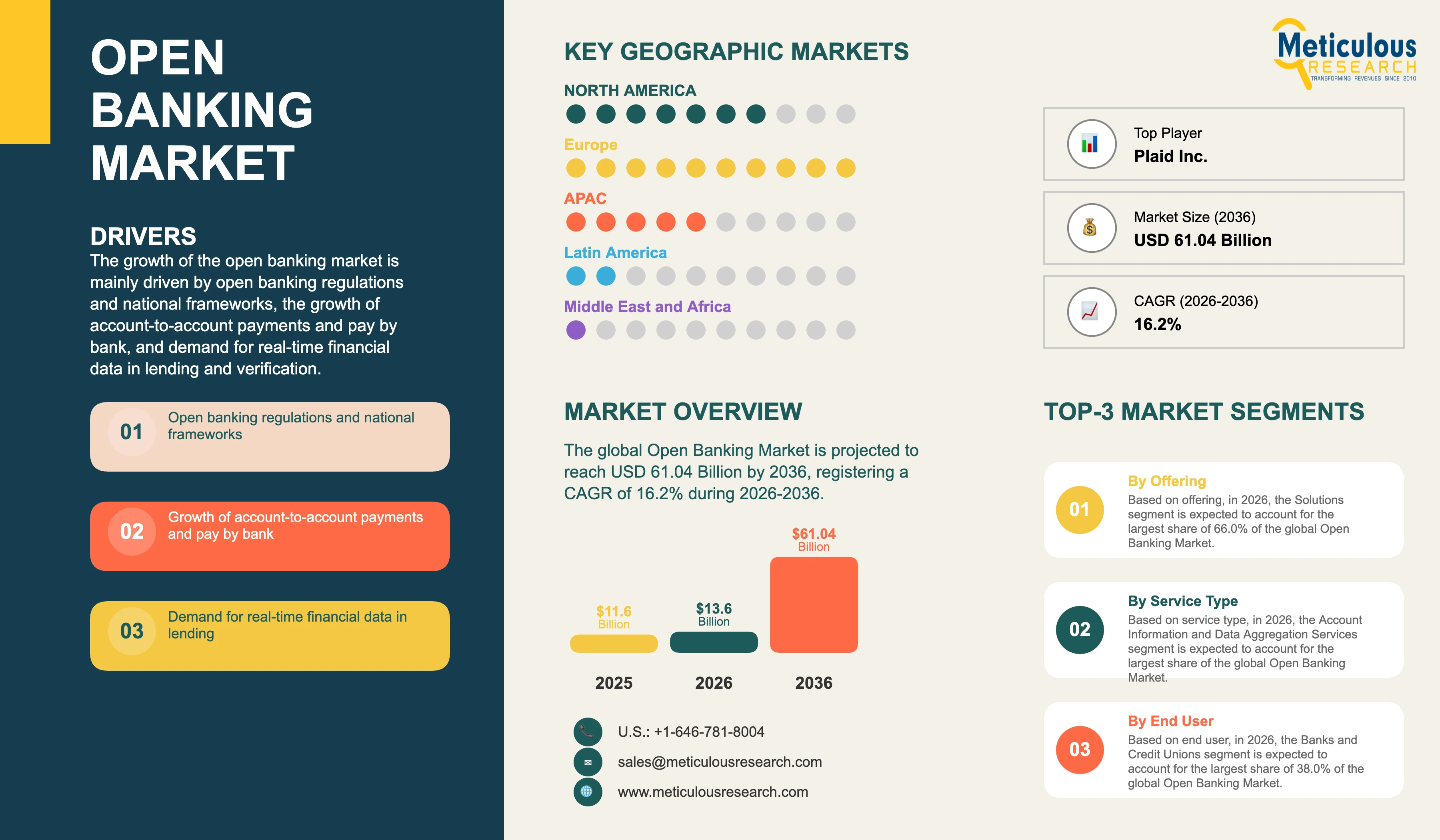
The global open banking market was valued at USD 11.60 billion in 2025. This market is expected to reach USD 61.04 billion by 2036 from an estimated USD 13.60 billion in 2026, registering a CAGR of 16.2% during the forecast period (2026-2036).
- Published
- Nov 2026
- Pages
- 283
- Format
- PDF + Excel
- Report ID
- MRICT - 1042478
- Base year
- 2025
- 2025 · BASELINE
- $11.60B
- 2036
- $61.04B
- CAGR 2026–2036
- 16.2%
2025 baseline · 2026–2036 forecast at 16.2% CAGR · hover a bar for the value
Key highlights
The U.K. open banking ecosystem passed more than 1 billion cumulative open banking payments and 100 billion cumulative API calls in mid-2026, according to Open Banking Limited, and monthly open banking payments exceeded 40 million for the first time in May 2026.
Open banking payment volume in the U.K. grew 45% year on year in the period from August 2025 to July 2026, and sweeping variable recurring payments rose to about 7.73 million in June 2026, according to Open Banking Limited, which reports more than 145 authorized third-party providers in the U.K. ecosystem.
In the U.S., the CFPB finalized its Section 1033 personal financial data rights rule in October 2024, but a federal court enjoined its enforcement in October 2025 while the CFPB reconsiders the rule, and the CFPB sent a revised proposal for review in August 2026.
JPMorgan Chase began charging data aggregators for access to customer data in 2025 and reached a paid data-access agreement with Plaid in September 2025, setting a precedent for commercial data access fees in the U.S. market.
Brazil's central bank launched Pix Automático, a recurring payment feature for the Pix instant payment system, in 2025, and Brazil's Open Finance program now covers accounts, credit, investments, and insurance, making it one of the most comprehensive open finance frameworks in the world.
Card networks are expanding in open banking, with Visa operating Tink in Europe and Mastercard operating Finicity in the U.S. and open banking services in Europe, while both networks are building pay-by-bank and account-to-account payment services for merchants.
The European Parliament and the Council reached a provisional agreement on the third Payment Services Directive and the Payment Services Regulation in November 2025, which will strengthen requirements for bank APIs, while the Financial Data Access Regulation, which extends data sharing to open finance, remained under negotiation in 2026.
By offering, solutions account for the largest share of 66.0% in 2026, while solutions also register the higher CAGR.
By service type, account information and data aggregation services account for the largest share in 2026, while payment initiation services register the highest CAGR.
By deployment mode, cloud accounts for the largest share in 2026 and registers the higher CAGR.
By end user, banks and credit unions account for the largest share of 38.0% in 2026, while merchants and e-commerce businesses register the highest CAGR.
By geography, Europe accounts for the largest share of 40.0% in 2026, while Latin America registers the highest CAGR of 20.7%.
Report summary
| Particulars | Details |
|---|---|
| Base Year | 2025 |
| Estimated Year | 2026 |
| Forecast Period | 2026-2036 |
| Market Size in 2025 | USD 11.60 billion |
| Market Size in 2026 | USD 13.60 billion |
| Market Size by 2036 | USD 61.04 billion |
| CAGR (2026-2036) | 16.2% |
| Format | PDF, Excel & Cloud Portal · 283 pages |
| Largest Segment by Offering (2026) | Solutions (66.0%) |
| Largest Segment by End User (2026) | Banks and Credit Unions (38.0%) |
| Largest Region (2026) | Europe (40.0%) |
| Fastest-Growing Region | Latin America (CAGR 20.7%) |
| Segments Covered | Offering, Service Type, Deployment Mode, End User, and Geography |
| Geographic Scope | Europe, North America, Asia-Pacific, Latin America, and Middle East and Africa |
| Key Companies Profiled | Plaid, Visa (Tink), Mastercard (Finicity), TrueLayer, MX, Yodlee, Akoya, Yapily, Token.io, Belvo, GoCardless, Salt Edge, Ozone API, and Brankas |
Report overview
Segments covered: offering, service type, deployment mode, end user.
The growth of this market is mainly driven by open banking regulations and frameworks in Europe, the U.K., Brazil, Australia, India, Saudi Arabia, the UAE, and other countries, the rapid growth of account-to-account payments and pay by bank, demand from lenders and fintech companies for real-time financial data to improve credit decisions and customer experience, the expansion of open banking into open finance covering savings, investments, pensions, and insurance, and the growing use of open banking for identity verification, fraud prevention, and personal financial management. However, factors such as regulatory uncertainty in the U.S., uneven API quality and performance across banks, consumer concerns about data privacy and security, and disputes over who pays for data access are expected to restrain the growth of this market to some extent.
Open banking allows customers to share their bank account data securely with authorized third parties and to let those third parties initiate payments from their accounts, using application programming interfaces, or APIs, provided by banks. With the customer's consent, fintech companies, lenders, merchants, and other banks can access account balances, transaction histories, and account details, and can initiate account-to-account payments directly from the customer's bank account, without using cards.
This market covers the global revenue generated from open banking solutions and services, measured in value. It includes API platforms and API management solutions for banks, data aggregation and account information services, payment initiation and pay-by-bank services, open finance data services, analytics, identity, and risk services built on open banking data, and consulting, implementation, and managed services. It is segmented by offering, service type, deployment mode, end user, and geography. Revenue from the underlying lending, payment card, and banking products that use open banking data is not included.
Open banking began with regulation in Europe, where, in the EU, the second Payment Services Directive required banks to give licensed third parties access to payment accounts from 2018, and in the U.K., the Competition and Markets Authority required the nine largest banks to build standardized open banking APIs. Other countries, such as Australia, Brazil, India, Saudi Arabia, the UAE, Bahrain, Singapore, and South Korea, have since introduced their own frameworks, while in the U.S., open banking has grown mainly through private data aggregators, such as Plaid, MX, Finicity, and Yodlee, and industry standards, such as those of the Financial Data Exchange.
The open banking ecosystem includes several types of participants, as banks provide the data and payment APIs, often using API management and compliance platforms from technology vendors. Aggregators and open banking platforms, such as Plaid, Tink, TrueLayer, Finicity, MX, Yodlee, Yapily, Token.io, Belvo, and Salt Edge, connect to many banks and provide a single API to fintech companies, lenders, and merchants. These end users build products such as personal finance apps, lending decisions, account verification, payments, and accounting integrations on top of open banking data and payments.
Revenue models vary across the open banking market, as aggregators and platforms typically charge per API call, per connected account, per verification, or per payment, or they charge subscription fees. Pay-by-bank providers charge merchants a fee per transaction, which is often lower than card fees. Banks invest in API platforms to meet regulatory requirements and increasingly to offer premium APIs and data services, and in the U.S., some large banks have started charging aggregators for data access. Technology vendors earn license, subscription, and services revenue from banks and other institutions.
The benefits of open banking for customers include easier switching between financial providers, better visibility of their finances across several accounts, faster loan and mortgage applications, simpler account verification, and cheaper and faster payments. For businesses, open banking supports automated accounting, cash flow management, faster onboarding, and lower payment costs. For banks, open banking creates both competition, as third parties use their data, and opportunities, as they can use data from other banks and offer new services.
The market is moving from open banking to open finance, in which data sharing extends beyond bank accounts to savings, investments, pensions, mortgages, and insurance. Brazil, Australia, and India are among the countries that already include a wider range of financial data, and the EU's proposed Financial Data Access Regulation would extend data access across financial services. Open finance is expected to create new use cases in wealth management, insurance, and financial advice.
Technology standards are also important for the growth of open banking, because the U.K. Open Banking Standard, the Berlin Group's NextGenPSD2 standard in Europe, the Financial Data Exchange standard in the U.S., and national standards in Brazil, Australia, and Saudi Arabia define how APIs work, which helps providers connect to many banks. Security standards, such as the Financial-grade API profile, are increasingly used to protect data sharing and payments.
Over the forecast period, the open banking market is expected to grow strongly, supported by the growth of pay by bank, new regulations, open finance, demand for real-time data in lending and fraud prevention, and adoption in Asia-Pacific, Latin America, and the Middle East.
We built our APIs for compliance, but now we use them to offer new services, partner with fintechs, and bring in data from other banks to win new customers.
Banks' move from compliance to commercial use explains why banks and credit unions account for 38.0% of the market and why solutions account for 66.0%.
Open Finance data and Pix together let us approve and pay out loans in minutes. Our customers share their data because they get better rates.
Brazil's combination of open finance data and Pix instant payments is a key reason why Latin America is the fastest-growing region.
Report infographic
Market dynamics
17 factors across 5 forcesOpen banking regulations and national frameworks
Regulation remains the main driver of open banking adoption in most countries. In the EU, PSD2 established the right of licensed third parties to access payment accounts, and the new Payment Services Regulation, agreed in November 2025, will strengthen requirements for bank API performance, availability, and data access. In the U.K., the government plans to give the Financial Conduct Authority powers to set open banking rules, and the ecosystem is moving to a long-term regulatory framework.
Other countries have introduced comprehensive frameworks, and Brazil's Open Finance program, run by the central bank, covers accounts, credit, investments, and insurance, and it is integrated with the Pix instant payment system. Saudi Arabia, the UAE, and Bahrain have launched open banking frameworks, India's Account Aggregator framework enables consent-based data sharing across financial sectors, and Australia's Consumer Data Right covers banking data. These frameworks require banks to build APIs and create demand for open banking platforms and services.
Regulators are also extending open banking to new areas, as the U.K. is developing a long-term framework that includes commercial services and open finance, Canada is introducing a consumer-driven banking framework, and several countries in Asia-Pacific and Africa are consulting on their own frameworks. Each new framework creates demand for bank API platforms, compliance services, and third-party open banking services.
Growth of account-to-account payments and pay by bank
Open banking enables account-to-account payments, often called pay by bank, which allow customers to pay merchants, billers, and other people directly from their bank accounts. These payments settle quickly, reduce fraud through bank authentication, and are often cheaper for merchants than card payments. In the U.K., Open Banking Limited reported that open banking payments grew 45% in the year to July 2026 and exceeded 40 million per month for the first time in May 2026.
Variable recurring payments, which allow customers to authorize recurring payments with limits, are expanding the range of use cases, such as moving money between accounts, paying bills, and subscriptions. The U.K. is introducing commercial variable recurring payments through a new industry scheme, and card networks, such as Visa and Mastercard, are also building pay-by-bank services. Payment initiation services are the fastest-growing service type in this market.
Government and public sector payments are another growing use case, as tax authorities and public agencies in the U.K. and other countries accept pay by bank for tax payments and fees, which helps build consumer familiarity with the method. Pay by bank is also used for account top-ups, investment funding, and moving money between a customer's own accounts, which are among the most common open banking payment use cases.
Demand for real-time financial data in lending and verification
Lenders use open banking data to verify income, assess affordability, and make faster and more accurate credit decisions, particularly for consumers and small businesses with limited credit histories. Open banking data shows actual income and spending patterns, which can improve risk assessment and allow lenders to approve more applicants at lower risk. Account verification and identity services also use open banking to confirm account ownership and reduce fraud in payments and onboarding.
Fintech companies, such as personal finance apps, investment platforms, and payment providers, rely on open banking to connect to customers' bank accounts and offer their services. In the U.S., aggregators such as Plaid connect thousands of fintech apps to banks, and demand for data is growing with the expansion of digital financial services. Account information and data aggregation services account for the largest share of the market by service type.
Small and medium-sized businesses are also important users, as accounting software providers, such as Xero and QuickBooks, use open banking to import bank transactions automatically, and lenders use business account data to assess loan applications quickly.
Expansion from open banking to open finance
Open finance extends data sharing from bank accounts to savings, investments, pensions, mortgages, insurance, and other financial products. This allows customers to see all their finances in one place, receive personalized advice, switch products more easily, and use their data to access better offers. Brazil's Open Finance program and India's Account Aggregator framework already include a wide range of financial data.
The EU's Financial Data Access Regulation, if adopted, would extend data access across financial services in the EU, and other countries are considering similar steps. Open finance creates new demand for data platforms, consent management, and analytics, and open finance data services are among the fastest-growing service types in this market.
Table of contents
12 chapters · 132 sections · 283 pages · click to expandGeographic analysis
Europe
Largest shareIn 2026, Europe is expected to account for the largest share of 40.0% of the global open banking market. The large share of this region is mainly due to the early introduction of open banking regulation through PSD2 in the EU and the Competition and Markets Authority's open banking order in the U.K., the large number of licensed third-party providers, and the strong growth of open banking payments. The U.K. is one of the most advanced open banking markets in the world, with more than 1 billion cumulative open banking payments and more than 145 authorized third-party providers, according to Open Banking Limited, while the EU's open banking market is led by Germany, France, the Netherlands, Spain, Italy, and the Nordic countries. Leading European providers include Tink, TrueLayer, Yapily, Token.io, GoCardless, and Salt Edge. The EU's Payment Services Regulation and the U.K.'s future regulatory framework are expected to support further growth, and Europe is expected to remain the largest region throughout the forecast period.
Latin America
Fastest growthLatin America is projected to register the highest CAGR of 20.7% during the forecast period. Growth is driven by Brazil's Open Finance program and its integration with Pix, the development of open finance frameworks in Mexico, Colombia, and Chile, and providers such as Belvo that serve the region.
North America
North America holds a significant share, led by the U.S., where aggregators such as Plaid, MX, Finicity, Yodlee, and Akoya connect fintech companies to banks, and Canada, which is introducing a consumer-driven banking framework.
Asia-Pacific
Asia-Pacific is growing with India's Account Aggregator framework and Australia's Consumer Data Right, while the Middle East is growing with frameworks in Saudi Arabia, the UAE, and Bahrain, and Africa is at an early stage led by Nigeria. In the U.S., open banking is driven mainly by market demand rather than regulation, with aggregators connecting thousands of fintech apps to banks and large banks negotiating data access agreements. The outcome of the CFPB's reconsideration of Section 1033 and the debate over data access fees will shape the market's future structure. In Asia-Pacific, India's Account Aggregator framework has grown rapidly by linking banks, lenders, investment firms, and insurers, while Australia is reviewing its Consumer Data Right to make it more effective.
Middle East & Africa
In the Middle East, Saudi Arabia's central bank has launched open banking with account information and payment initiation, and the UAE has introduced an open finance regulation.
Competitive landscape
The open banking market includes data aggregators and open banking platforms, pay-by-bank providers, card networks, API management and compliance vendors, and consulting and IT services firms. Leading companies include Plaid, Visa (Tink), Mastercard (Finicity), TrueLayer, MX Technologies, Yodlee, Akoya, Yapily, Token.io, Belvo, GoCardless, Salt Edge, Ozone API, and Brankas.
Providers compete on bank coverage, API reliability and payment conversion rates, data quality, product range, pricing, compliance and licenses, and ease of integration. Large aggregators benefit from network effects, as wide bank coverage attracts more fintech customers, and card networks bring merchant relationships and payment expertise.
Plaid is the largest aggregator in the U.S., connecting thousands of fintech apps to banks, while Tink, TrueLayer, Yapily, Token.io, and Salt Edge are among the leading providers in Europe. Finicity, MX, Yodlee, and Akoya compete in the U.S., Belvo leads in Latin America, and Brankas serves Southeast Asia. GoCardless combines direct debit and open banking payments, and Ozone API provides open banking API platforms to banks. Regional providers and banks' own platforms also compete in many markets.
The top five players are estimated to account for 38.0% of the open banking market in 2025, reflecting the strong positions of leading aggregators and card networks and the large number of regional providers.
Players use several strategies to grow in this market, including expanding bank coverage and data quality, launching pay-by-bank and variable recurring payment services, building fraud and identity products, entering new countries, signing data access agreements with banks, and acquiring smaller regional and specialist providers to add licenses and coverage. Card networks have used acquisitions, such as Visa's acquisition of Tink and Mastercard's acquisition of Finicity, to enter the market.
Competition is expected to center on payments, open finance, data quality, and fraud prevention. Providers with broad coverage, strong bank relationships, and diversified services are expected to gain share, while consolidation is expected to continue. Card networks and large payment processors are expected to remain active acquirers, as they seek to add account-to-account payments and data services to their networks, and independent providers are expected to focus on specialized services, such as lending data, verification, or regional coverage, or to partner with larger platforms.
Some of the key players operating in the open banking market are Plaid Inc., Visa Inc. (Tink AB), Mastercard Incorporated (Finicity), TrueLayer Limited, MX Technologies, Inc., Yodlee, Inc., Akoya LLC, Yapily Ltd., Token.io Ltd., Belvo, GoCardless Ltd., Salt Edge Inc., Ozone API Limited, and Brankas.
- Plaid
- Visa · Tink
- Mastercard · Finicity
- TrueLayer
- MX
- Yodlee
- Akoya
- Yapily
- Token.io
- Belvo
- GoCardless
- Salt Edge
- Ozone API
- Brankas
Expert perspectives
Open banking has moved from a regulatory compliance exercise to a growing commercial market, particularly in payments, lending, and verification. The U.K., EU, Brazil, and Australia show how regulation can create the infrastructure for open banking, while the U.S. shows how private aggregators can build a large market without a strong regulatory mandate.
Over the forecast period, the market is expected to grow at about 16.2% per year, supported by pay by bank, new regulations, open finance, data-driven lending, fraud prevention, and adoption in emerging markets. Payments are expected to be the most important driver of new revenue.
Solutions are the largest offering and also grow faster than services, while account information and data aggregation services are the largest service type, while payment initiation services grow fastest. Cloud is the leading deployment mode. Banks and credit unions are the largest end user, while merchants and e-commerce businesses grow fastest.
Europe remains the largest region, while Latin America is the fastest-growing region at a CAGR of 20.7%. The main swing factors are U.S. Section 1033 rules and data access fees, EU PSR and FIDA implementation, the growth of pay by bank, and consumer trust.
For banks, the key priorities are improving API performance, finding commercial models for open banking, and using open banking to compete for customers. For providers, success depends on coverage, conversion, payments capabilities, and compliance, as well as the ability to build commercial relationships with banks as data access moves toward paid, contract-based models in the U.S. and premium API models elsewhere.
The most important development for the market over the next few years will be the growth of pay by bank, which could create a large new payment method alongside cards, particularly in e-commerce, bills, and recurring payments. Success will depend on consumer awareness, smooth checkout experiences, merchant adoption, and fair consumer protections. The second key development is the expansion of open finance, which could increase the value of data sharing well beyond banking.
Risks include delays in regulation, disputes over data access fees, slow consumer adoption of pay by bank, and security incidents that reduce trust. On the upside, faster adoption of pay by bank and open finance, supported by card networks and large merchants, could push growth above current expectations.
Overall, open banking is expected to become a standard part of financial infrastructure in most major economies over the forecast period, as data sharing and account-to-account payments become routine for consumers and businesses, and as open finance extends these benefits to savings, investments, pensions, and insurance.
Customer perspectives
Head of Payments - online retailer, U.K.
Pay by bank costs us less than cards and the money arrives in our account faster, and we see fewer fraudulent orders. The challenge is getting customers to choose it at checkout, so we are working on making the option more visible and easier to use on mobile.
Lower costs for merchants are why merchants and e-commerce businesses are the fastest-growing end user and payment initiation services the fastest-growing service type.
Chief Risk Officer - consumer lender, U.S.
Bank transaction data lets us verify income and affordability in minutes instead of asking customers for payslips and statements. We approve more good customers, including those with thin credit files, and we see fewer losses.
Lending and verification use cases support strong demand for account information and data aggregation services, the largest service type in this market.
Frequently asked questions
The market was valued at USD 11.60 billion in 2025 and USD 9.80 billion in 2024, and is estimated at USD 13.60 billion in 2026, measured as revenue from open banking solutions and services.
Cite this report
Meticulous Research. (2026). Open Banking Market - Global Opportunity Analysis and Industry Forecast (2026-2036) (Report No. MRICT - 1042478). Meticulous Market Research Pvt. Ltd. https://www.meticulousresearch.com/product/open-banking-market-7161