Real-Time Payments Market (2026-2036)
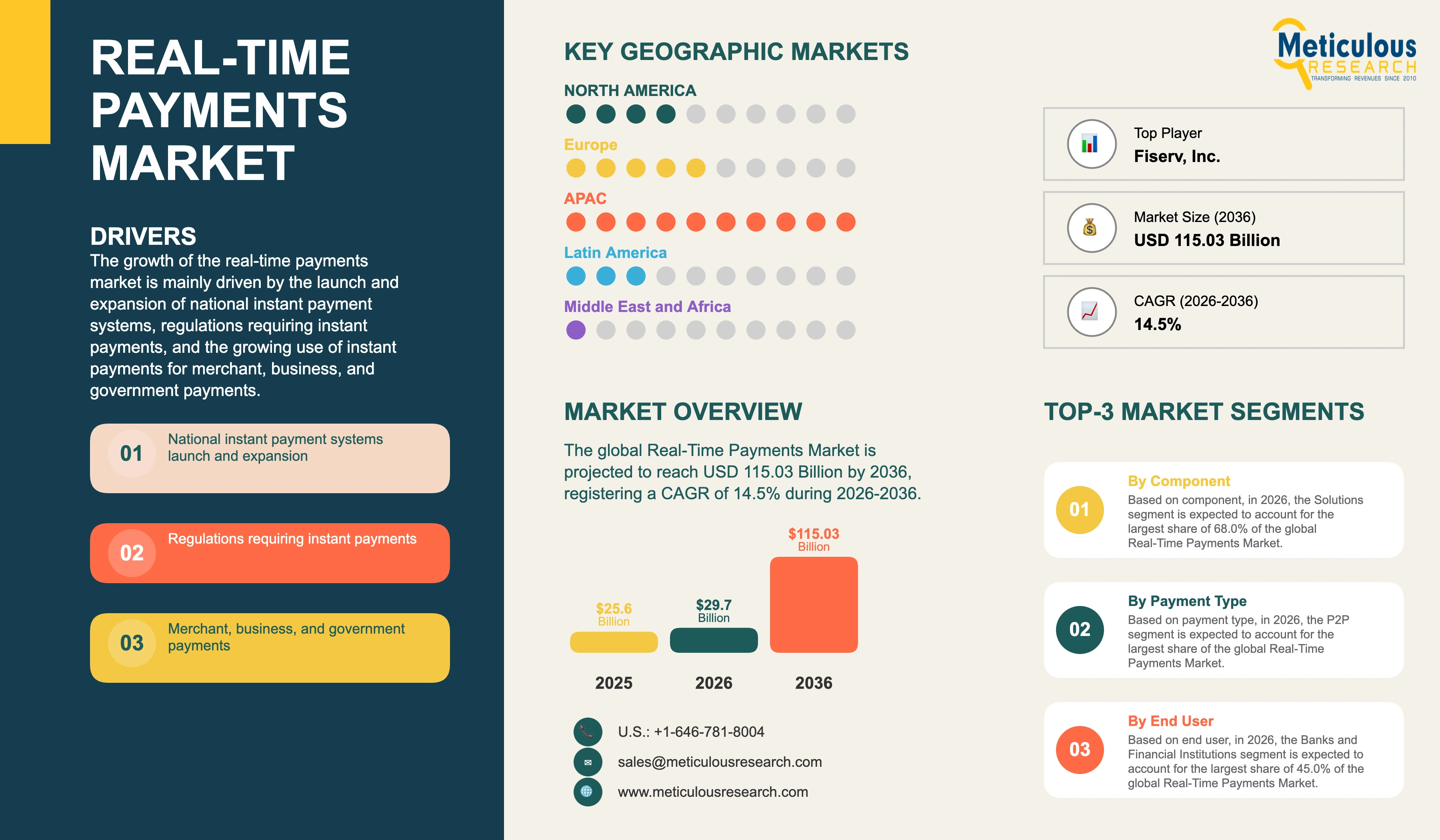
The global real-time payments market was valued at USD 25.60 billion in 2025. This market is expected to reach USD 115.03 billion by 2036 from an estimated USD 29.70 billion in 2026, registering a CAGR of 14.5% during the forecast period (2026-2036).
- Published
- Nov 2026
- Pages
- 305
- Format
- PDF + Excel
- Report ID
- MRICT - 1042473
- Base year
- 2025
- 2025 · BASELINE
- $25.60B
- 2036
- $115.0B
- CAGR 2026–2036
- 14.5%
2025 baseline · 2026–2036 forecast at 14.5% CAGR · hover a bar for the value
Key highlights
India's Unified Payments Interface (UPI) processed 228.3 billion transactions worth about INR 299.7 lakh crore, or about USD 3.4 trillion, in calendar year 2025, according to NPCI data, and reached a monthly record of 22.64 billion transactions in March 2026.
Brazil's Pix, launched by the Central Bank of Brazil in 2020, processed about 79.7 billion transactions worth about BRL 35.3 trillion in 2025, according to Central Bank of Brazil data, up 26% and 34%, respectively, and business-to-business payments have become a large share of Pix transaction value.
The Federal Reserve's FedNow service had more than 1, 600 participating financial institutions by January 2026, and its 2025 transaction volume grew by 460%, with a total value of USD 853.4 billion and an average payment of about USD 101,435.
The Clearing House's RTP network processed more than USD 1.3 trillion in payments in 2025, had about 1,135 participating banks and credit unions, and raised its transaction limit from USD 1 million to USD 10 million in February 2025.
Under the EU Instant Payments Regulation, payment service providers in the euro area were required to receive instant credit transfers from January 2025 and to send them from October 2025, at a price no higher than standard transfers and with a verification of payee service.
The U.K. introduced mandatory reimbursement of victims of authorized push payment fraud on Faster Payments in October 2024, which has increased investment by banks in real-time fraud prevention.
The migration of cross-border and high-value payments to the ISO 20022 messaging standard, which provides richer and more structured payment data, is driving investment in payment infrastructure that also supports real-time payments.
Brazil launched Pix Automático for recurring payments in June 2025, and many countries are linking their instant payment systems for cross-border payments, such as UPI's links with Singapore's PayNow and other systems.
By component, solutions account for the largest share of 68.0% in 2026 and also register the highest CAGR.
By payment type, P2P accounts for the largest share in 2026, while P2B registers the highest CAGR.
By deployment mode, cloud accounts for the largest share in 2026 and also registers the highest CAGR.
By end user, banks and financial institutions account for the largest share of 45.0% in 2026, while retail and e-commerce registers the highest CAGR.
By geography, Asia-Pacific accounts for the largest share of 44.0% in 2026, while North America registers the highest CAGR of 16.3%.
Report summary
| Particulars | Details |
|---|---|
| Base Year | 2025 |
| Estimated Year | 2026 |
| Forecast Period | 2026-2036 |
| Market Size in 2025 | USD 25.60 billion |
| Market Size in 2026 | USD 29.70 billion |
| Market Size by 2036 | USD 115.03 billion |
| CAGR (2026-2036) | 14.5% |
| Format | PDF, Excel & Cloud Portal · 305 pages |
| Largest Segment by Component (2026) | Solutions (68.0%) |
| Largest Segment by End User (2026) | Banks and Financial Institutions (45.0%) |
| Largest Region (2026) | Asia-Pacific (44.0%) |
| Fastest-Growing Region | North America (CAGR 16.3%) |
| Segments Covered | Component, Payment Type, Deployment Mode, End User, and Geography |
| Geographic Scope | Asia-Pacific, Europe, North America, Latin America, and Middle East and Africa |
| Key Companies Profiled | ACI Worldwide, Fiserv, FIS, Jack Henry, Mastercard (Vocalink), Visa, Finastra, Temenos, Volante Technologies, Form3, Montran, Infosys (Finacle), Nexi, and IBM |
Report overview
Segments covered: component, payment type, deployment mode, end user.
The growth of this market is mainly driven by the launch and expansion of national instant payment systems, such as UPI in India, Pix in Brazil, FedNow and the RTP network in the U.S., and SEPA Instant in Europe, regulations that require banks to offer instant payments, the growing use of instant payments for merchant payments, bill payments, payroll, and business-to-business transactions, the modernization of bank payment infrastructure and the adoption of the ISO 20022 messaging standard, and the linking of national instant payment systems for cross-border payments. However, factors such as the high cost and complexity of upgrading legacy banking systems, the risk of authorized push payment fraud, limited adoption in some markets, and the lack of revenue models in systems with low or zero fees are expected to restrain the growth of this market to some extent.
Real-time payments, also called instant payments, are electronic payments that are initiated, cleared, and settled within seconds, at any time of day, every day of the year, with funds immediately available to the recipient. Unlike traditional bank transfers, which can take hours or days and are processed in batches during business hours, real-time payments provide immediate confirmation to both the payer and the payee, which makes them suitable for person-to-person transfers, merchant payments, bill payments, payroll, insurance claims, and business payments. Real-time payments also provide richer payment data, especially when based on the ISO 20022 standard, which helps businesses reconcile payments automatically and helps banks detect fraud.
This market covers the global revenue from real-time payment solutions and services, measured in value, including payment platforms and gateways, processing and switching software, fraud prevention and security solutions, overlay services, such as request-to-pay and QR code payments, and professional and managed services provided to banks, payment providers, businesses, and governments. It is segmented by component, payment type, deployment mode, end user, and geography. The value of the payments themselves is not included. Revenue earned by system operators from transaction fees is included only where it relates to the technology and services they provide.
More than 80 countries have launched real-time payment systems, most of them operated or overseen by central banks. India's UPI, launched in 2016, and Brazil's Pix, launched in 2020, are the largest and most successful systems, with tens of billions of transactions each year, driven by free or low-cost payments for consumers, QR code payments at merchants, and integration with popular mobile apps. Other large systems include the U.K.'s Faster Payments, SEPA Instant in Europe, China's IBPS, Thailand's PromptPay, Mexico's SPEI, Nigeria's NIP, and Australia's New Payments Platform. The International Monetary Fund has estimated that UPI alone accounts for close to half of global real-time payment transactions, which shows how concentrated volumes are in a few large systems.
The U.S. has been slower to adopt real-time payments, but the RTP network, launched by The Clearing House in 2017, and the Federal Reserve's FedNow service, launched in 2023, are growing rapidly. FedNow's transaction volume grew by 460% in 2025, and the RTP network processed more than USD 1.3 trillion in payments. Many U.S. use cases have focused on business payments, payroll, account-to-account transfers, and disbursements, with average payment sizes much higher than in UPI or Pix. The two U.S. systems operate side by side, and many banks have joined one or both of them, while consumer person-to-person payments in the U.S. are dominated by services such as Zelle, Venmo, and Cash App.
Banks and payment providers need new technology to connect to real-time payment systems, process payments in seconds around the clock, manage liquidity, detect fraud in real time, and offer new services to customers. This has created demand for payment platforms, gateways, fraud prevention solutions, and cloud-based services from providers such as ACI Worldwide, Fiserv, FIS, Jack Henry, Mastercard, Volante Technologies, Finastra, Temenos, Form3, and Montran. The migration to ISO 20022, which provides richer payment data, is also driving investment in payment infrastructure. Banks and payment providers are also investing in liquidity management tools, because real-time settlement requires them to manage their balances at the central bank continuously, including at weekends and on holidays.
Over the forecast period, real-time payments are expected to replace a growing share of card, check, cash, and batch bank transfer payments, supported by regulation, consumer and business demand, and new services, such as request-to-pay, recurring payments, and cross-border instant payments. Revenue from solutions and services is expected to grow strongly as banks modernize their systems and as businesses adopt real-time payments for collections and disbursements. The market is also expected to see increasing competition between real-time account-to-account payments and card payments, particularly in e-commerce and in-store payments, as merchants seek lower-cost options and as regulators encourage alternatives to card networks. Card networks, in turn, are investing in real-time payment infrastructure and services, which shows that real-time payments are becoming part of the core strategy of the entire payments industry.
Report infographic
Market dynamics
15 factors across 5 forcesLaunch and expansion of national instant payment systems
Central banks and payment system operators around the world have launched or upgraded instant payment systems to modernize their payment infrastructure, increase competition, support financial inclusion, and reduce the use of cash. The success of UPI and Pix has encouraged other countries to develop similar systems, and many countries in Asia, Latin America, Africa, and the Middle East have launched or upgraded their instant payment systems in recent years.
Each new system creates demand for technology from the central bank or operator, which needs a core platform, and from every participating bank and payment provider, which needs to connect to the system, process payments, and offer services to customers. Upgrades to existing systems, such as higher transaction limits, new overlay services, and ISO 20022 migration, also drive investment. Solutions account for the largest share of the market by component. Many countries in Africa and Asia are building instant payment systems with support from international development organizations and the Gates Foundation's Mojaloop open-source software, which creates further demand for platforms and services.
Regulations requiring instant payments
Regulators are increasingly requiring banks to offer instant payments, and the EU Instant Payments Regulation requires payment service providers in the euro area to receive and send instant credit transfers in euros, at a price no higher than standard credit transfers, and to provide a verification of payee service that checks whether the name of the recipient matches the account. Banks in the euro area had to receive instant payments from January 2025 and send them from October 2025, with deadlines for non-euro EU countries following later. The regulation also requires payment service providers to screen their customers against EU sanctions lists daily, rather than screening each instant payment, which reduces delays.
This regulation has required thousands of banks and payment providers to upgrade their systems, creating significant demand for real-time payment and verification of payee solutions. Other countries have also required banks to join their instant payment systems, such as Brazil, which required large institutions to participate in Pix. Regulation is one of the main reasons for the growth of the market in Europe. In the U.K., the Payment Systems Regulator's reimbursement rules and the plan to replace the Faster Payments infrastructure with a new national payments architecture are also driving investment.
Growing use of instant payments for merchant, business, and government payments
Instant payments are increasingly used for purposes beyond person-to-person transfers, and in India and Brazil, QR code payments at merchants have become one of the main ways to pay in stores and online, and in many countries, real-time payments are used for bill payments, insurance claims, payroll, gig worker payouts, government benefits, and tax refunds.
Business-to-business payments are also growing quickly, and in Brazil, business-to-business Pix payments accounted for a small share of transactions but more than half of Pix transaction value in early 2026, and in the U.S., the high average value of FedNow payments reflects the use of real-time payments by businesses. P2B is the fastest-growing payment type in this market, and B2B payments are also growing rapidly. Governments use real-time payments to deliver social benefits and emergency payments quickly, as Brazil and India have done, which improves efficiency and reduces leakage. Real-time disbursements also allow businesses to offer faster service, such as instant refunds and same-day claim payments, which can improve customer satisfaction.
Bank modernization, cloud adoption, and ISO 20022
Many banks are replacing their legacy payment systems, which were designed for batch processing, with modern platforms that can process payments in real time, handle ISO 20022 messages, and connect to multiple payment systems. Cloud-based payment platforms and payment-as-a-service offerings allow banks, particularly smaller banks and credit unions, to connect to real-time payment systems more quickly and at lower cost.
Providers such as Fiserv, FIS, Jack Henry, Form3, and Volante Technologies offer cloud-based services that allow community banks and credit unions to join FedNow and the RTP network, and many large banks are moving their payment processing to the cloud. Cloud is the largest and fastest-growing deployment mode in this market. ISO 20022 messages carry more data about each payment, such as invoice references and remittance information, which supports automatic reconciliation and better compliance screening.
Table of contents
12 chapters · 131 sections · 305 pages · click to expandSegmental analysis
| Segment | Largest share (2026) | Fastest growth (2026–2036) |
|---|---|---|
| By Component | Solutions | Solutions |
| By Deployment Mode | Cloud | Cloud |
| By Payment Type | P2P | P2B |
| By End User | Banks and financial institutions | Retail and e-commerce |
By Component
- Real-Time Payments Market Analysis by Component
- The solutions segment is expected to account for the largest share of 68.0% of the market and is also projected to register the highest CAGR during the forecast period.
- The large share and fast growth of this segment are mainly due to the investment by banks, payment providers, and system operators in payment platforms, gateways, processing software, and fraud prevention solutions needed to connect to and operate real-time payment systems.
- Real-time payment solutions include a wide range of products, such as core clearing and settlement platforms for system operators, payment hubs and gateways for banks, processing and switching software, liquidity management tools, fraud prevention and verification of payee solutions, and overlay services, such as request-to-pay and QR code payments.
- Leading providers of these solutions include ACI Worldwide, Fiserv, FIS, Jack Henry, Mastercard through Vocalink, Volante Technologies, Finastra, Temenos, Form3, Montran, and Infosys Finacle.
- Demand is being driven by new instant payment systems, the EU Instant Payments Regulation, FedNow and RTP adoption in the U.S., and ISO 20022 migration.
- Solutions are expected to remain the largest component by revenue over the forecast period.
- Fraud prevention and verification of payee are among the fastest-growing solution categories, driven by regulation and rising fraud.
- Services make up the rest of the market and include consulting, implementation, integration, managed services, and support.
- Managed services and payment-as-a-service offerings are growing as banks outsource the operation of their real-time payment infrastructure.
By Deployment Mode
- Real-Time Payments Market Analysis by Deployment Mode
- The cloud segment is expected to account for the largest share of the market and is also projected to register the highest CAGR during the forecast period.
- The large share and fast growth of this segment are mainly due to the adoption of cloud-based payment platforms and payment-as-a-service offerings by banks, credit unions, and payment providers that want to connect to real-time payment systems quickly and at lower cost.
- Cloud deployment allows banks to avoid the cost of building and maintaining their own real-time payment infrastructure, to scale capacity as volumes grow, and to receive updates for new rules, message formats, and services from their providers.
- Smaller banks and credit unions in the U.S. have joined FedNow and the RTP network mainly through cloud-based services from core banking and payment providers, such as Fiserv, FIS, Jack Henry, and Form3, while many European banks have used cloud services to meet the deadlines of the EU Instant Payments Regulation.
- Large banks are also moving their payment hubs to the cloud as part of broader modernization programs.
- Cloud is expected to remain the largest deployment mode over the forecast period.
- On-premise deployment makes up the rest of the market and is used mainly by large banks, central banks, and system operators that require full control over critical infrastructure or face data residency requirements.
- Its share is expected to decline as more institutions adopt cloud and hybrid models.
By Payment Type
- Real-Time Payments Market Analysis by Payment Type
- The P2P segment is expected to account for the largest share of the market by payment type.
- The large share of this segment is mainly due to the very large volume of person-to-person transfers on systems such as UPI and Pix, which were initially adopted for sending money between individuals.
- Person-to-person payments are the most common and best-known use of real-time payments in many countries, as consumers use mobile apps to send money to friends, family, and service providers instantly.
- In India, P2P transactions account for a large share of UPI transaction value, and in Brazil, P2P transfers are a major part of Pix.
- Services such as Zelle in the U.S., which uses its own network, and mobile payment apps in many countries also support instant person-to-person payments.
- P2P is expected to remain a large segment over the forecast period, although its share will decline as merchant and business payments grow faster.
- P2P payments are also used for informal commerce, such as payments to small traders and service providers, in many emerging markets.
- However, the P2B segment is projected to register the highest CAGR during the forecast period.
- The rapid growth of this segment is driven by the use of QR code and pay-by-bank payments at merchants, bill payments, and recurring payments.
- B2B and B2P and G2P payments make up the rest of the market, with B2B payments growing rapidly.
- B2P and G2P payments include payroll, insurance claims, refunds, gig worker payouts, and government benefits, which are increasingly paid instantly.
- B2B payments are supported by higher transaction limits and richer ISO 20022 data, which allow businesses to send invoice information with each payment.
By End User
- Real-Time Payments Market Analysis by End User
- The banks and financial institutions segment is expected to account for the largest share of 45.0% of the market.
- The large share of this segment is mainly due to the need for every bank and payment provider that participates in real-time payment systems to invest in connectivity, processing, fraud prevention, and customer services.
- Banks are the main buyers of real-time payment solutions and services worldwide, as they must connect to national instant payment systems, process payments around the clock, manage liquidity, and offer instant payments through their mobile and online channels.
- Large banks often build or heavily customize their own payment hubs, while smaller banks and credit unions use cloud-based services from providers such as Fiserv, FIS, Jack Henry, and Form3.
- The EU Instant Payments Regulation and FedNow adoption have created significant demand from banks in Europe and the U.S. Banks and financial institutions are expected to remain the largest end user over the forecast period.
- Banks are also investing in new services, such as request-to-pay, real-time treasury services for corporate clients, and instant lending, to earn revenue from real-time payments.
- However, the retail and e-commerce segment is projected to register the highest CAGR during the forecast period.
- The rapid growth of this segment is driven by the adoption of QR code payments, pay-by-bank, and instant refunds by retailers and e-commerce platforms.
- IT and telecommunications, government and public sector, utilities, healthcare, and other end users make up the rest of the market.
- Utilities and telecom companies use real-time payments for bill collection and refunds, while healthcare providers and insurers use them for patient payments and claims.
Geographic analysis
Asia-Pacific
Largest shareIn 2026, Asia-Pacific is expected to account for the largest share of 44.0% of the global real-time payments market. The large share of this region is mainly due to the very large real-time payment volumes in India, China, Thailand, and other countries, and the investment in instant payment infrastructure by banks and payment providers across the region. India's UPI is the world's largest real-time payment system by transaction volume, with 228.3 billion transactions in 2025, and it is used for person-to-person, merchant, and bill payments by hundreds of millions of people. China's central bank instant payment systems and mobile payment platforms, such as Alipay and WeChat Pay, handle very large volumes, and Thailand's PromptPay, Japan's Zengin system, Singapore's PayNow, Malaysia's DuitNow, Indonesia's BI-FAST, the Philippines' InstaPay, and Australia's New Payments Platform are also widely used. Countries in the region are linking their instant payment systems for cross-border payments. Asia-Pacific is expected to remain the largest region throughout the forecast period. India is also promoting UPI internationally, with acceptance in several countries, and NPCI International is helping other countries build UPI-like systems.
North America
Fastest growthNorth America, led by the U.S., is projected to register the highest CAGR of 16.3% during the forecast period. Growth is driven by the rapid adoption of FedNow and the RTP network by banks, credit unions, and businesses, the use of real-time payments for payroll, disbursements, and business payments, and Canada's planned Real-Time Rail. The U.S. has thousands of banks and credit unions, and each one that connects to FedNow or the RTP network creates demand for solutions and services.
Europe
Europe holds a significant share of the market, led by the U.K., Germany, France, Italy, Spain, and the Netherlands, and is supported by the EU Instant Payments Regulation, SEPA Instant, the U.K.'s Faster Payments, and open banking.
Latin America
Latin America is a major market, led by Brazil's Pix and Mexico's SPEI, with Colombia launching its own central bank instant payment system, Bre-B, while the Middle East and Africa is growing quickly, supported by instant payment systems in Nigeria, Saudi Arabia, the UAE, Egypt, and Kenya.
Middle East & Africa
Saudi Arabia's sarie system and the UAE's Aani instant payment platform have grown rapidly, and Nigeria's NIP system handles most of the country's electronic payments. Kenya's mobile money services, such as M-Pesa, also provide instant payments for a large share of the population.
Competitive landscape
The real-time payments market is moderately fragmented, with payment technology providers, core banking vendors, card networks, and specialized payment infrastructure companies. Leading companies include ACI Worldwide, Fiserv, FIS, Jack Henry, Mastercard, Visa, Finastra, Temenos, Volante Technologies, Form3, Montran, Infosys, Nexi, and IBM.
Providers compete on the scalability and reliability of their platforms, support for multiple payment systems and ISO 20022, fraud prevention capabilities, cloud deployment options, speed of implementation, and pricing. Some providers focus on system operators and central banks, while others focus on banks, credit unions, or businesses. Card networks, such as Mastercard and Visa, are investing in real-time payment infrastructure and account-to-account services. Core banking vendors, such as Fiserv, FIS, Jack Henry, Temenos, and Finastra, offer real-time payment capabilities as part of their broader banking platforms, while specialized providers, such as Volante, Form3, and Montran, focus on payment processing and infrastructure. IT services companies, such as Infosys, TCS, and IBM, provide implementation and managed services for large banks.
The top five players are estimated to account for 30.0% of the real-time payments market in 2025, reflecting the strong positions of large payment technology providers and the large number of specialized and regional providers. Market shares vary widely by region. Providers that supply national systems often have strong positions in those countries.
Players use several strategies to grow in this market, including developing cloud-based and payment-as-a-service offerings, adding fraud prevention and verification of payee capabilities, supporting more payment systems and countries, partnering with system operators and banks, and acquiring complementary companies. Mastercard's Vocalink provides infrastructure for several national instant payment systems, and ACI Worldwide, Volante, and Montran have supplied platforms to central banks and operators.
Competition is expected to center on cloud capabilities, fraud prevention, support for cross-border instant payments, and the ability to serve banks of all sizes. Providers with proven, scalable platforms and strong partnerships with system operators are expected to gain share. Consolidation is expected to continue, as larger providers acquire specialized companies in fraud prevention and cloud payments. Partnerships between providers and system operators, such as those for FedNow and the RTP network, are also important for reaching smaller banks.
Some of the key players operating in the real-time payments market are ACI Worldwide, Inc., Fiserv, Inc., Fidelity National Information Services, Inc. (FIS), Jack Henry & Associates, Inc., Mastercard Incorporated (Vocalink), Visa Inc., Finastra, Temenos AG, Volante Technologies, Inc., Form3 Ltd., Montran Corporation, Infosys Limited (Finacle), Nexi S.p.A., and IBM Corporation.
- —
EU banks began sending instant payments under the Instant Payments Regulation in October 2025, FedNow volume grew by 460% in 2025, Brazil launched Pix Automático, and UPI reached a record 22.64 billion monthly transactions in March 2026.
- ACI Worldwide
- Fiserv
- FIS
- Jack Henry
- Mastercard · Vocalink
- Visa
- Finastra
- Temenos
- Volante Technologies
- Form3
- Montran
- Infosys · Finacle
- Nexi
- IBM
Expert perspectives
Real-time payments are becoming the default way to move money in many countries, led by UPI and Pix and supported by regulation in Europe and growing adoption in the U.S. The shift from batch payments to real-time payments is driving a multi-year investment cycle in payment infrastructure, fraud prevention, and new services.
Over the forecast period, the market is expected to grow at about 14.5% per year, supported by new and expanding instant payment systems, regulation, business and merchant adoption, cloud migration, and cross-border links. Growth is expected to be strongest in North America, where adoption is accelerating from a low base. Europe is expected to see strong growth in the near term as banks complete their Instant Payments Regulation projects, while Asia-Pacific and Latin America will continue to generate the largest volumes. New instant payment systems in Africa, the Middle East, and Southeast Asia are also expected to create significant demand for solutions and services. Competition with card payments is expected to increase as pay-by-bank and QR code payments expand.
Solutions are both the largest and fastest-growing component, cloud is both the largest and fastest-growing deployment mode, P2B is the fastest-growing payment type, and retail and e-commerce is the fastest-growing end user. P2P and banks and financial institutions remain the largest segments.
Asia-Pacific remains the largest region, while North America is the fastest-growing region at a CAGR of 16.3%. The main swing factors are regulation, the adoption of FedNow and the RTP network, fraud trends, revenue models in low-fee systems, and progress on cross-border links.
For banks, the key decisions are how to modernize payment infrastructure, whether to build or use cloud services, and how to create value from real-time payments through new services. For providers, success depends on scalable platforms, strong fraud prevention, and the ability to support many payment systems and use cases. Revenue from value-added services, such as fraud prevention, request-to-pay, and analytics, is expected to become increasingly important as basic payment processing becomes commoditized. Providers that help banks earn revenue from real-time payments, rather than only meet regulatory requirements, are expected to win more business.
Overall, real-time payments are expected to become a core part of global payment infrastructure, with growing use for merchant, business, and cross-border payments over the forecast period. Real-time payments could also become an important alternative to card payments in e-commerce and in stores, particularly where regulators and central banks support account-to-account payments. The linking of national systems for cross-border payments is expected to be one of the most important developments later in the forecast period.
Customer perspectives
European banks are expected to continue investing in fraud prevention and new instant payment services after meeting the regulatory deadlines.
Regulation and bank modernization are why solutions account for 68.0% of the market and banks and financial institutions account for 45.0%.
Treasury Director - Insurance company, U.S.
We now pay claims instantly through FedNow and the RTP network, and customers appreciate getting their money the same day instead of waiting for a check, and it has reduced our check printing costs.
Insurers, payroll providers, and other businesses in the U.S. are expected to continue shifting disbursements from checks and batch transfers to real-time payments.
Business adoption of real-time payments in the U.S. is why North America is the fastest-growing region in this market.
Merchant adoption of QR code payments in India, Brazil, and Southeast Asia is expected to continue driving growth in P2B payments.
The growth of merchant payments on UPI and other systems is why Asia-Pacific accounts for 44.0% of the market and P2B is the fastest-growing payment type.
“The Instant Payments Regulation forced us to offer instant transfers and verification of payee at the same price as standard transfers. We used the deadline to modernize our payment hub and move it to the cloud.”
“Most of our customers in our stores and online now pay with UPI QR codes on their phones. It is fast, there are no card fees for us, and the money reaches our account immediately.”
Frequently asked questions
The market was valued at USD 25.60 billion in 2025 and USD 22.00 billion in 2024, and is estimated at USD 29.70 billion in 2026.
Cite this report
Meticulous Research. (2026). Real-Time Payments Market - Global Opportunity Analysis and Industry Forecast (2026-2036) (Report No. MRICT - 1042473). Meticulous Market Research Pvt. Ltd. https://www.meticulousresearch.com/product/real-time-payments-market-7156