Latin America Data Center Market (2026-2036)
Latin America is still a small data center region compared with North America, Europe, and Asia-Pacific, with about 2.5 GW of capacity, but it has become the fastest-growing region in percentage terms. Inventory in the four largest markets grew 41.3% between the first quarter of 2025 and the first quarter of 2026, compared with about 33% in the largest North American markets and less than 20% in Europe and Asia-Pacific. Colocation deliveries in the region reached a record 184 MW in 2025, and a pipeline of 540 projects worth about USD 197 billion is being tracked across the region.
- Published
- Nov 2026
- Pages
- 210
- Format
- PDF + Excel
- Report ID
- MRICT - 1042485
- Base year
- 2025
- 2025 · BASELINE
- $8.85B
- 2036
- $32.17B
- CAGR 2026–2036
- 14.5%
2025 baseline · 2026–2036 forecast at 14.5% CAGR · hover a bar for the value
Key highlights
Data center inventory in Latin America's four largest markets, São Paulo, Querétaro, Santiago, and Bogotá, grew 41.3% between the first quarter of 2025 and the first quarter of 2026 to 1,045 MW, the fastest growth of any region in the world.
Querétaro's inventory rose 450.2% in the year to the first quarter of 2026, to 298.2 MW, as large hyperscale and AI deployments came online, and the city accounted for about 79% of the region's net absorption.
The São Paulo-Campinas area had 661 MW of operational data center capacity in the first half of 2026, up 91% in a year, with 250 MW under construction and 2,066 MW planned.
Brazil signed Redata into law in September 2026, suspending federal taxes on IT equipment for data centers in exchange for commitments on renewable or low-emission energy, water efficiency, and capacity for the domestic market.
TikTok is developing a data center at the Pecém Industrial and Port Complex in Ceará, Brazil, with an estimated investment of more than R$200 billion, and AWS is investing USD 4 billion in its first cloud region in Chile, expected to open in the second half of 2026.
Latin America has about 2.5 GW of data center capacity, and a pipeline of 540 projects worth about USD 197 billion is being tracked across the region, of which almost 1 GW is under construction.
Microsoft, Google, and Oracle operate cloud regions in Brazil, Mexico, and Chile, and AWS has committed USD 5 billion to its Querétaro region alongside its long-established São Paulo region.
Mechanical infrastructure is the fastest-growing infrastructure type, hyperscale self-build data centers are the fastest-growing data center type, and AI and GPU cloud providers are the fastest-growing end user.
By infrastructure type, IT infrastructure accounts for the largest share of 36.0% in 2026, while mechanical infrastructure registers the highest CAGR.
By data center type, colocation data centers account for the largest share in 2026, while hyperscale self-build data centers register the highest CAGR.
By tier standard, Tier III data centers account for the largest share in 2026, while Tier IV data centers register the highest CAGR.
By facility size, data centers above 50 MW account for the largest share in 2026 and also register the highest CAGR.
By end user, cloud and hyperscale service providers account for the largest share of 48.5% in 2026, while AI and GPU cloud providers register the highest CAGR.
By country, Brazil accounts for the largest share of 41.5% in 2026, while Mexico registers the highest CAGR of 14.5%.
Report summary
| Particulars | Details |
|---|---|
| Forecast Period | 2026-2036 |
| Base Year | 2025 |
| Estimated Year | 2026 |
| CAGR (Value) | 11.9% |
| Format | PDF, Excel & Cloud Portal · 210 pages |
| Market Size (Value) in 2025 | USD 8.85 billion |
| Market Size (Value) in 2026 | USD 10.45 billion |
| Market Size (Value) in 2036 | USD 32.17 billion |
| Installed IT Capacity (2026 to 2036) | 2,560 MW to 8,538 MW (CAGR 12.8%) |
| Largest Segment by Infrastructure Type (2026) | IT Infrastructure (36.0%) |
| Largest Segment by End User (2026) | Cloud and Hyperscale Service Providers (48.5%) |
| Largest Country (2026) | Brazil (41.5%) |
| Fastest-Growing Country | Mexico (CAGR 14.5%) |
| Segments Covered | Infrastructure Type, Data Center Type, Tier Standard, Facility Size, End User, and Country |
| Countries Covered | Brazil, Mexico, Chile, Colombia, Argentina, Peru, and Rest of Latin America |
| Key Companies | Scala Data Centers, ODATA, Ascenty, Equinix, Elea Data Centers, KIO, CloudHQ, Vantage Data Centers, Tecto, Triara, Schneider Electric, Vertiv, Eaton, and ABB |
Report overview
Segments covered: infrastructure type, data center type, tier standard, facility size, end user.
Data centers are facilities that house the servers, storage, and network equipment used to run cloud services, business applications, and artificial intelligence (AI) models, together with the electrical, cooling, and building systems needed to keep them running. The Latin America data center market covers investment in IT infrastructure, electrical infrastructure, mechanical infrastructure, and general construction across Brazil, Mexico, Chile, Colombia, Argentina, Peru, and the rest of the region. Capacity is usually measured in megawatts of IT load, and investment per megawatt is rising as new facilities are designed for denser AI equipment.
Almost 1 GW of this pipeline is under construction, and the region's data centers already use about 23 TWh of electricity per year, which shows how quickly the sector is becoming a major power user.
São Paulo, including Barueri, Campinas, and nearby cities, is the largest data center market in Latin America, with 661 MW of operational capacity in the first half of 2026 and more than 2 GW planned. It benefits from Brazil's large economy and population, strong fiber and subsea cable connections through Fortaleza and Rio de Janeiro, and a power grid that is largely supplied by hydropower, wind, and solar. Querétaro in central Mexico has become the region's fastest-growing hub, supported by AWS's cloud region, Microsoft's investments, and large campuses by CloudHQ, ODATA, KIO, and others. Santiago in Chile is the third major hub, while Bogotá, Lima, Buenos Aires, and other cities are emerging markets. Santiago leads the region in hyperscale capacity, and Querétaro absorbed about 79% of the region's net new capacity in the year to the first quarter of 2026, which shows how concentrated recent growth has been.
Demand comes mainly from global cloud providers such as AWS, Microsoft, Google, Oracle, Huawei Cloud, and Alibaba Cloud, and from large digital platforms such as Meta, TikTok, and MercadoLibre. AWS operates cloud regions in Brazil and Mexico and is opening one in Chile, Microsoft has regions in Brazil, Mexico, and Chile, and Google operates regions in Brazil, Chile, and Mexico. Banks, telecom operators, retailers, and governments also need local capacity, often through colocation providers, and data protection rules in Brazil and other countries encourage local data storage. Fintech and digital banking have grown particularly fast in Brazil and Mexico, creating strong demand for secure, low-latency capacity close to users.
The market is served by colocation operators such as Scala Data Centers, ODATA, Ascenty, Equinix, Elea Data Centers, KIO, CloudHQ, Vantage Data Centers, Tecto, and Triara, many of which are backed by global investment funds. Scala, ODATA, Ascenty, Elea, and Equinix are among the largest operators in South America by capacity delivered, under construction, and planned. Infrastructure vendors such as Schneider Electric, Vertiv, Eaton, and ABB supply power and cooling equipment, and local contractors handle much of the construction. Several operators have expanded across multiple countries, allowing them to serve hyperscale customers with a consistent design and service model throughout the region.
The region's large supply of renewable energy is a key advantage, as Brazil, Chile, Uruguay, and other countries generate a large share of their electricity from hydropower, wind, and solar, which helps hyperscalers meet their sustainability targets. However, grid connections and transmission capacity are becoming major constraints in São Paulo and Querétaro, and construction costs in Brazil are higher than in many neighboring countries because of taxes and import duties. Governments are responding with incentives such as Redata in Brazil, while environmental concerns over water use have led to more scrutiny of projects in Chile and other countries.
Report infographic
Market dynamics
15 factors across 5 forcesCloud region investments by global hyperscalers
Global cloud providers are investing heavily in Latin America to serve growing demand for cloud services and AI and to meet local data residency requirements. AWS has committed USD 5 billion to its cloud region in Querétaro, Mexico, and USD 4 billion to its first region in Chile, expected to open in the second half of 2026, alongside its long-established region in São Paulo. Microsoft operates cloud regions in Brazil, Mexico, and Chile, Google operates regions in São Paulo, Santiago, and Querétaro and is building a data center in Uruguay, and Oracle has regions in Brazil, Chile, Mexico, and Colombia.
These investments create demand for self-built hyperscale campuses and for large wholesale colocation contracts, as hyperscalers often lease capacity from operators such as Scala, ODATA, Ascenty, and CloudHQ to expand quickly. Each new cloud region also attracts partners, software providers, and enterprises that need nearby capacity, which adds further demand. Cloud and hyperscale service providers account for the largest share of the market. As AI services are added to these cloud regions, the capacity needs of hyperscalers in the region are expected to grow further.
Rapid growth of hyperscale and AI capacity in Querétaro and São Paulo
Querétaro and São Paulo have become two of the fastest-growing data center hubs in the world. Querétaro's inventory rose 450.2% in the year to the first quarter of 2026, to 298.2 MW, driven by large hyperscale and AI deployments, and it accounted for about 79% of the region's net absorption, while the São Paulo-Campinas area grew 91% in a year to 661 MW of operational capacity in the first half of 2026.
Querétaro's proximity to the U.S., its established industrial base, and the arrival of AWS and other cloud providers have made it a key location for nearshoring of digital infrastructure. São Paulo benefits from Brazil's large domestic market and strong connectivity. Large campuses, such as CloudHQ's 288 MW campuses in Querétaro and Paulínia, are being built to serve hyperscale and AI customers. Data centers above 50 MW account for the largest share of the market. Mexico, led by Querétaro, is the fastest-growing country in this market.
Government incentives and digital policies
Governments in Latin America are introducing incentives to attract data center investment. Brazil signed Redata into law in September 2026, suspending PIS/Cofins, IPI, and import taxes on IT equipment for data centers in exchange for commitments on renewable or low-emission energy, water efficiency, research and development, and capacity for the domestic market, and the government estimated tax relief of R$5.2 billion in 2026 alone. Industry groups had argued that building a data center in Brazil cost 20% to 30% more than in Chile, Colombia, or Argentina before the new regime.
Chile has a national data center plan to attract investment, Colombia and Uruguay offer free trade zones and other incentives, and Mexico's states compete to attract data centers with land and permitting support. Brazil's General Data Protection Law and similar rules in other countries also encourage local storage of personal data. These policies, along with the region's renewable energy, are expected to support strong investment over the forecast period. Large projects such as TikTok's planned data center in Ceará, estimated at more than R$200 billion, show the scale of investment that incentives can attract.
Abundant renewable energy and growing digital economy
Latin America has one of the cleanest power systems in the world, with large shares of hydropower in Brazil, Colombia, and Paraguay and fast-growing wind and solar in Brazil, Chile, and Mexico. This allows data centers to secure renewable power through supply contracts and helps hyperscalers meet their climate targets, which is an important factor in site selection. Northeast Brazil, in particular, has large wind and solar resources and subsea cable landings in Fortaleza, which are attracting very large projects.
The region also has a population of more than 650 million people and a fast-growing digital economy, with strong growth in e-commerce, digital payments, streaming, and online services. Companies such as MercadoLibre, Nubank, and many banks and telecom operators need local data center capacity to serve users with low latency. The adoption of cloud services by businesses and governments and the growth of AI applications in Spanish and Portuguese are expected to add further demand.
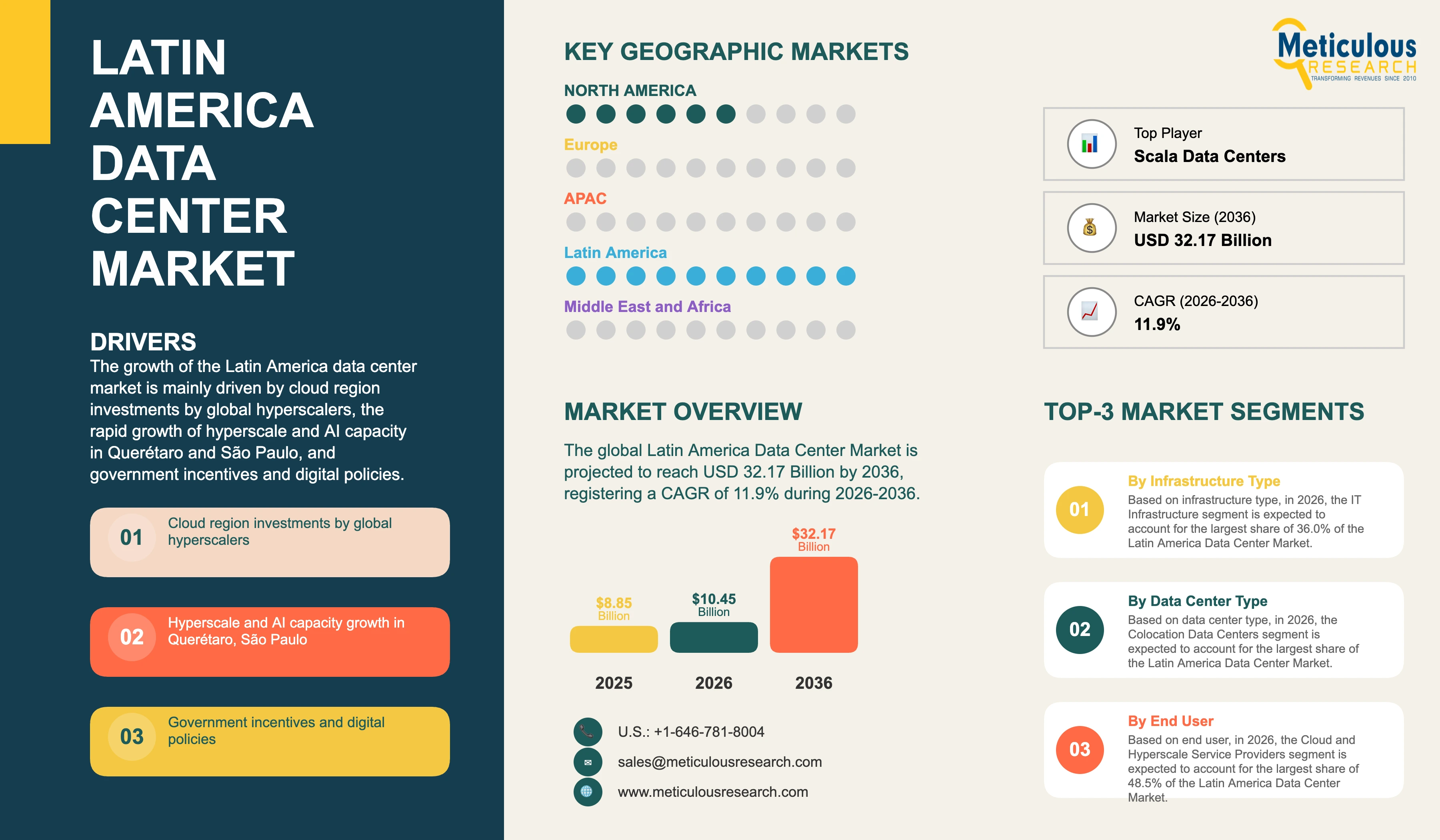
Table of contents
13 chapters · 126 sections · 210 pages · click to expandGeographic analysis
Latin America
Largest shareThe Latin America data center market was valued at USD 8.85 billion in 2025. This market is expected to reach USD 32.17 billion by 2036 from an estimated USD 10.45 billion in 2026, registering a CAGR of 11.9% during the forecast period (2026-2036). In terms of volume, the installed operational IT capacity of data centers in Latin America is expected to reach 8,538 MW by 2036 from an estimated 2,560 MW in 2026, registering a CAGR of 12.8% during the forecast period. The growth of this market is mainly driven by large cloud region investments by AWS, Microsoft, Google, Oracle, and other hyperscalers, the rapid growth of hyperscale and AI capacity in Querétaro and São Paulo, new tax incentives such as Brazil's Special Taxation Regime for Datacenter Services (Redata), and the region's large supply of renewable energy. However, factors such as constraints on grid connections and transmission capacity, high construction and equipment costs, and currency and regulatory uncertainty in several countries are expected to restrain the growth of this market to some extent. In 2026, the IT infrastructure segment is expected to account for the largest share of 36.0% of the Latin America data center market. The large share of this segment is mainly due to the high cost of servers, storage, and network equipment installed in new cloud regions and AI deployments and the shorter replacement cycle of IT equipment compared with facility infrastructure. IT infrastructure includes servers, storage systems, and network equipment such as switches, routers, and cabling. Each new cloud region built by AWS, Microsoft, Google, or Oracle in São Paulo, Querétaro, Santiago, or Bogotá needs large volumes of servers and network gear, and AI clusters add very costly GPU servers and high-speed networking that can cost several times more per megawatt than traditional IT equipment. Most IT equipment in the region is imported, and import duties and taxes have historically raised its cost, particularly in Brazil, which is one reason why Redata focuses on suspending taxes on IT equipment. IT equipment is replaced every few years, which creates recurring demand even in existing facilities, while buildings and electrical systems last for decades. Hyperscalers buy most of this equipment directly from global vendors and original design manufacturers, while colocation customers install their own equipment in leased space. However, the mechanical infrastructure segment is projected to register the highest CAGR during the forecast period. The rapid growth of this segment is driven by the shift to liquid cooling for AI workloads, the need for low-water cooling designs in Chile and Querétaro, and new requirements for water efficiency under Redata. Electrical infrastructure and general construction make up the rest of the market. In 2026, the colocation data centers segment is expected to account for the largest share of the market. Colocation operators build and run data centers and lease space, power, and cooling to customers, ranging from single racks to entire buildings. In Latin America, hyperscalers rely heavily on wholesale colocation from operators such as Scala, ODATA, Ascenty, CloudHQ, KIO, and Vantage Data Centers, because these operators can secure land, power, and permits and deliver capacity faster than hyperscalers could on their own. Scala, ODATA, Ascenty, Elea, and Equinix are among the largest operators in South America by capacity, and most of the recent growth in São Paulo and Querétaro has come from wholesale campuses built for hyperscale customers. Retail colocation remains important in all major cities, where Equinix, Ascenty, KIO, Triara, and others serve enterprises, banks, and network providers that need interconnection. Colocation also allows customers to avoid the high upfront cost and currency risk of building their own facilities. However, the hyperscale self-build data centers segment is projected to register the highest CAGR during the forecast period. Enterprise and edge data centers make up the rest of the market. In 2026, the Tier III segment is expected to account for the largest share of the market. Tier III data centers have redundant power and cooling paths, which allow maintenance without shutting down IT equipment, and most new colocation and hyperscale campuses in the region are designed to this standard. Many customers, including banks, government agencies, and telecom operators, require at least Tier III certification, and the region has a large number of Uptime Institute-certified facilities. Given the reliability issues of some local grids, Tier III designs with strong backup power are particularly important in Latin America. However, the Tier IV segment is projected to register the highest CAGR during the forecast period. Tier I and Tier II data centers make up the rest of the market. In 2026, the above 50 MW segment is expected to account for the largest share of the market, and this segment is also projected to register the highest CAGR during the forecast period. The large share and rapid growth of this segment are mainly due to the construction of large hyperscale and AI campuses in Querétaro, São Paulo, Santiago, and Northeast Brazil. Hyperscale and AI customers need large, contiguous blocks of capacity that can grow over time, and operators are responding by building campuses of more than 50 MW with dedicated substations. CloudHQ's 288 MW campuses in Querétaro and Paulínia, Scala's large campuses in Barueri and the Santiago region, and the planned TikTok data center in Ceará are examples of this trend. Large campuses offer lower costs per megawatt, better access to renewable energy, and the ability to serve single customers with very large demand. Up to 10 MW and 10-50 MW facilities make up the rest of the market, mainly serving enterprises, edge deployments, and retail colocation in city centers, and these smaller facilities remain important in emerging markets such as Peru, Colombia, and Central America. In 2026, the cloud and hyperscale service providers segment is expected to account for the largest share of 48.5% of the market. Cloud and hyperscale providers are the main source of new data center demand in Latin America. AWS operates regions in São Paulo and Querétaro and is opening its Chile region, Microsoft has regions in Brazil, Mexico, and Chile, Google operates regions in São Paulo, Santiago, and Querétaro, and Oracle has regions in Brazil, Chile, Mexico, and Colombia, with each region needing several data centers and large amounts of capacity. Microsoft, AWS, Google, Oracle, and Meta are among the main hyperscale customers of colocation operators in South America. Chinese cloud providers, such as Huawei Cloud and Alibaba Cloud, are also expanding in the region, and data protection rules are encouraging local businesses and governments to use in-country cloud regions. As AI services are added to cloud platforms, the capacity needs of these providers are expected to grow further. However, the AI and GPU cloud providers segment is projected to register the highest CAGR during the forecast period. Telecom and internet service providers, BFSI, government and public sector, e-commerce, media, and digital platforms, and other end users make up the rest of the market. In 2026, Brazil is expected to account for the largest share of 41.5% of the Latin America data center market. The large share of this country is mainly due to the size of São Paulo as the region's largest data center hub, Brazil's large economy and digital market, strong subsea cable connectivity, and the availability of renewable energy. Brazil accounts for about 40% of total data center investment in Latin America, and the São Paulo-Campinas area had 661 MW of operational capacity in the first half of 2026, with 250 MW under construction and more than 2 GW planned. All major cloud providers operate regions in São Paulo, and leading operators such as Scala, ODATA, Ascenty, Elea, Equinix, and Tecto have large campuses there and in Rio de Janeiro. Redata, signed into law in September 2026, is expected to reduce the cost of building data centers and attract new investment, particularly in the Northeast, where TikTok is developing a very large data center in Ceará. However, grid connection queues in São Paulo and the end of most federal tax waivers after 2026 may shape the pace and location of growth. Brazil's share is expected to decline slightly as Mexico grows faster, but it will remain the largest market over the forecast period. Chile holds a significant share of the market, led by Santiago, which hosts cloud regions of Microsoft, Google, Oracle, and AWS and large campuses by Scala, ODATA, Equinix, and others, although water use has been a sensitive issue. Colombia, led by Bogotá, has a pipeline of about 360 MW across 31 projects, while Argentina, Peru, and the rest of Latin America, including Uruguay, Panama, and Costa Rica, are emerging markets with growing interest from hyperscalers and AI developers. Latin America Data Center Market Size Latin America Data Center Market Analysis by Infrastructure Type Geographic Analysis
North America
Fastest growthMexico is projected to register the highest CAGR of 14.5% during the forecast period. Growth is driven by the rapid expansion of Querétaro, where inventory rose 450.2% in the year to the first quarter of 2026, AWS's USD 5 billion cloud region, investments by Microsoft and Google, large campuses by CloudHQ, ODATA, KIO, and Vantage Data Centers, and nearshoring demand linked to the U.S. Power constraints in Querétaro may push some growth to Guanajuato, Nuevo León, and other states. Mexico's share of the regional market is expected to rise steadily over the forecast period as these projects come online.
Competitive landscape
The Latin America data center market is moderately fragmented, with a mix of regional and global colocation operators, hyperscalers that build their own campuses, telecom-backed operators, and local developers. Leading colocation operators include Scala Data Centers, ODATA, Ascenty, Equinix, Elea Data Centers, KIO, CloudHQ, Vantage Data Centers, Tecto, and Triara, each with large campuses or significant portfolios in one or more countries. Hyperscalers such as AWS, Microsoft, and Google are also major builders of capacity in their own right.
Competition among operators centers on access to power and land, speed of delivery, ability to support high-density AI workloads, renewable energy supply, and relationships with hyperscale customers. Infrastructure vendors such as Schneider Electric, Vertiv, Eaton, and ABB compete to supply power and cooling equipment, while IT vendors supply servers, storage, and networking. Vendors with local manufacturing, assembly, or service teams in Brazil and Mexico have an advantage, because they can deliver equipment faster and support operators on site. Telecom operators, such as América Movil through Triara and V.tal through Tecto, also operate data centers, often focusing on enterprise and government customers.
The top five operators are estimated to account for 41.0% of operational IT capacity in 2025, reflecting the strong positions of Scala, ODATA, Ascenty, Equinix, and KIO in the region's main hubs. Hyperscalers' own self-built capacity is not included in this estimate, and AWS, Microsoft, and Google control additional capacity through their owned campuses. Scala, ODATA, and Ascenty have the largest portfolios in Brazil, while KIO, ODATA, and CloudHQ lead in Querétaro.
Operators use several strategies to grow in this market, including building large master-planned campuses, signing long-term contracts with hyperscale anchor customers, securing renewable energy through long-term supply contracts, expanding into new countries, and raising capital from global investment funds. Many operators are also designing new facilities for liquid cooling and AI workloads. Competition is expected to center on power availability, AI readiness, sustainability, and the ability to deliver capacity quickly in several countries. Smaller and local operators often compete by focusing on specific cities, enterprise customers, or edge deployments in secondary markets. Chinese technology companies, such as TikTok and Huawei Cloud, are also adding capacity in the region, which increases competition for land, power, and equipment.
Some of the key players operating in the Latin America data center market are Scala Data Centers, ODATA (Aligned Data Centers), Ascenty, Equinix, Inc., Elea Data Centers, KIO Data Centers, CloudHQ, LLC, Vantage Data Centers, Tecto Data Centers, Triara (América Movil), Schneider Electric SE, Vertiv Holdings Co., Eaton Corporation plc, and ABB Ltd.
- —
Brazil signed Redata into law in September 2026, TikTok is developing a data center in Ceará estimated at more than R$200 billion, AWS is opening its USD 4 billion Chile region in the second half of 2026, and Querétaro's inventory more than quintupled in the year to the first quarter of 2026.
- Scala Data Centers
- ODATA
- Ascenty
- Equinix
- Elea Data Centers
- KIO
- CloudHQ
- Vantage Data Centers
- Tecto
- Triara
- Schneider Electric
- Vertiv
- Eaton
- ABB
Expert perspectives
Latin America has become the fastest-growing data center region in the world in percentage terms, driven by hyperscale cloud expansion, the rapid rise of Querétaro and São Paulo, AI deployments, and new incentives such as Brazil's Redata. Inventory in the region's four largest markets grew 41.3% in the year to the first quarter of 2026, and a pipeline of about USD 197 billion is being tracked across the region. The region's renewable energy and growing digital economy give it strong long-term potential.
However, the market faces real constraints in grid connections, construction costs, water use, and regulatory uncertainty. São Paulo and Querétaro are both facing power limits, which is pushing developers to new locations such as Northeast Brazil and other Mexican states, and environmental concerns have slowed projects in Chile. Operators with secured power, land, and permits will have a strong advantage, and the gap between announced pipelines and buildable capacity is large.
Mechanical infrastructure is the fastest-growing infrastructure type, as liquid cooling and low-water designs become essential, and hyperscale self-build data centers are the fastest-growing data center type as cloud providers and digital platforms build their own campuses. AI and GPU cloud providers are the fastest-growing end user, and data centers above 50 MW hold the largest share and register the highest CAGR among facility sizes.
Brazil remains the largest market, while Mexico is the fastest-growing country at a CAGR of 14.5%. The main swing factors are the pace of hyperscale and AI investment, grid expansion in São Paulo and Querétaro, the impact of Redata after its main tax waivers end, currency and interest rate trends, and the success of large projects such as TikTok's data center in Ceará. Policy stability in Mexico, Argentina, and other countries will also influence investment decisions. The ability of utilities to deliver new substations on time will be critical in both São Paulo and Querétaro.
For operators and investors, the key decision is where to build, given differences in power availability, costs, incentives, and demand across countries. Operators that combine secured power, renewable energy, AI-ready designs, and strong hyperscale relationships will be best placed to grow. For hyperscalers and enterprises, spreading capacity across Brazil, Mexico, and Chile can reduce risk and improve access to local markets. Early commitment matters, as capacity with secured power in prime locations is often taken years before completion.
Overall, growth in this market rests on continued cloud and AI investment and on the ability of the region to expand grid capacity and maintain stable policies. Operators that plan carefully around these factors are expected to capture most of this growth.
Customer perspectives
Director of Infrastructure Strategy - global cloud provider, Latin America
São Paulo and Querétaro are now our two anchors in the region, but power is the hardest thing to get. We sign with operators that already have substation capacity secured, even if we have to commit years ahead.
The reliance of cloud providers on colocation operators in the main hubs is why cloud and hyperscale service providers hold 48.5% of the market and why Brazil holds the largest share at 41.5%. Secured power has become the main factor in capacity decisions across the region.
Nearshoring and AI demand are supporting rapid growth in Mexico, the fastest-growing country at a CAGR of 14.5%, and the fast growth of the AI and GPU cloud providers segment and of mechanical infrastructure.
Head of Technology Infrastructure - digital bank, Brazil
Our regulator and our customers expect data to stay in Brazil, in highly resilient facilities. Redata should make new capacity more affordable, and we are planning our next expansion around Tier IV colocation and the local cloud regions.
Local data protection rules and new tax incentives are supporting demand from financial institutions, which is driving growth in Tier IV facilities and retail colocation in São Paulo. Banks also tend to spread critical systems across several local facilities to meet resilience requirements.
“Being close to the U.S. matters for our customers, and Querétaro gives us that at a lower cost. Our new halls are built for liquid cooling, because GPU racks at these densities cannot run on air alone.”
Frequently asked questions
The market was valued at USD 8.85 billion in 2025 and USD 7.35 billion in 2024, and is estimated at USD 10.45 billion in 2026.
Cite this report
Meticulous Research. (2026). Latin America Data Center Market - Global Opportunity Analysis and Industry Forecast (2026-2036) (Report No. MRICT - 1042485). Meticulous Market Research Pvt. Ltd. https://www.meticulousresearch.com/product/latin-america-data-center-market-7168