RNA Interference Crop Protection Market (2026-2036)
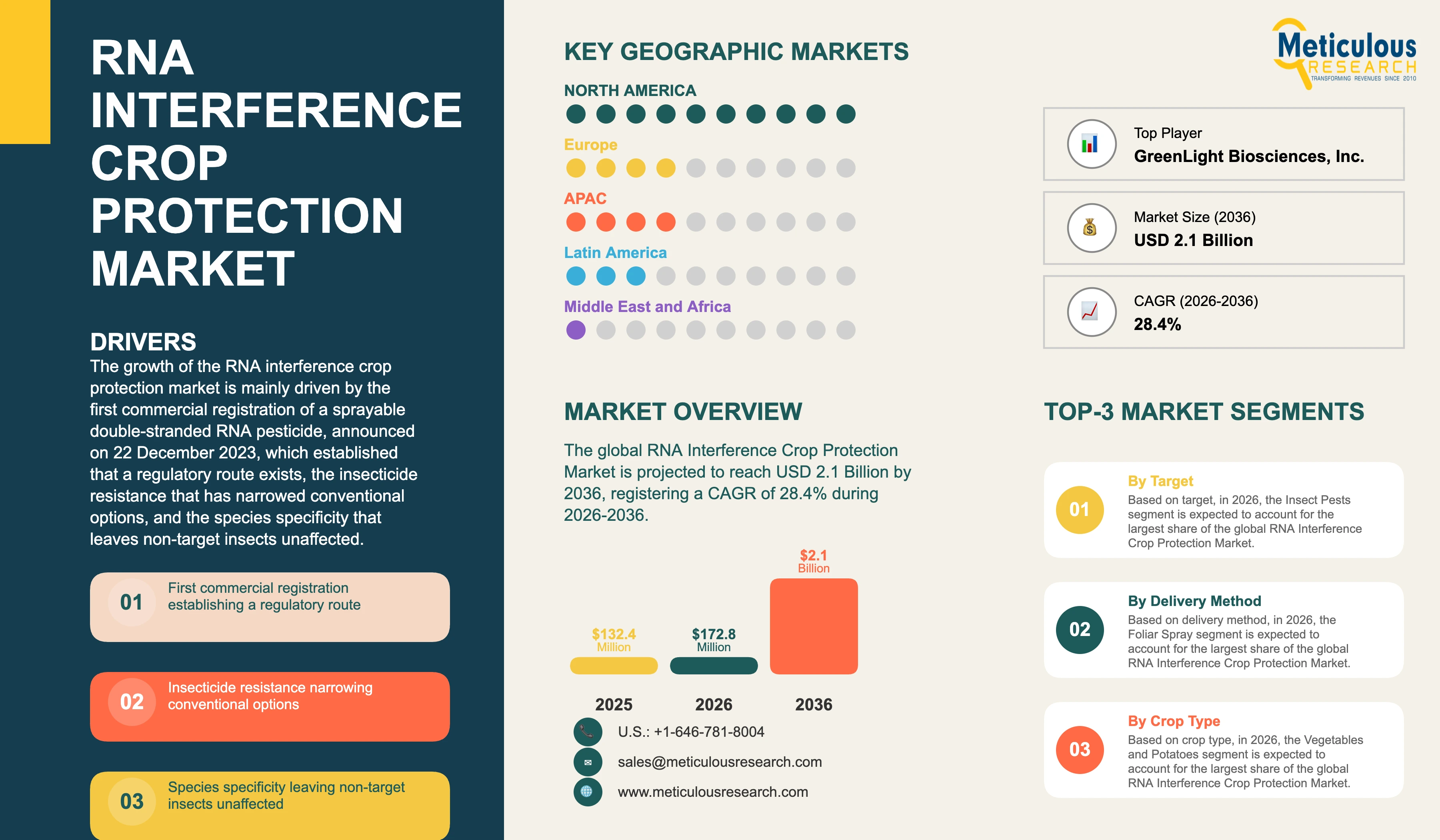
The global RNA interference crop protection market was valued at USD 132.4 million in 2025. This market is expected to reach USD 2.10 billion by 2036 from an estimated USD 172.8 million in 2026, registering a CAGR of 28.4% during the forecast period (2026-2036).
- Published
- Nov 2026
- Pages
- 258
- Format
- PDF + Excel
- Report ID
- MRAGR - 1042667
- Base year
- 2025
- 2025 · BASELINE
- $132.4M
- 2036
- $2.10B
- CAGR 2026–2036
- 28.4%
2025 baseline · 2026–2036 forecast at 28.4% CAGR · hover a bar for the value
Key highlights
The global RNA interference crop protection market is estimated at USD 172.8 million in 2026 and is projected to reach USD 2.10 billion by 2036.
Market volume is estimated at 24.00 tonnes in 2026 and is projected to reach 357.21 tonnes by 2036 at a CAGR of 31.0%, measured as double-stranded RNA active substance supplied.
The average selling price is estimated at USD 7, 200.00 per kg in 2026 and is projected to reach USD 5,891.00 per kg by 2036.
Insect pests are expected to account for the largest target share in 2026, while fungal and bacterial diseases are projected to register the highest CAGR of 36.4%.
Foliar spray is expected to hold the largest delivery method share in 2026, while seed treatment is projected to grow fastest at a CAGR of 34.2%.
Vegetables and potatoes are expected to be the largest crop type in 2026, while field crops are projected to register the highest CAGR of 34.4%.
Microbial fermentation is expected to account for the largest production method share in 2026, while cell-free enzymatic synthesis is projected to grow fastest at a CAGR of 34.8%.
North America is expected to hold the largest regional share in 2026, while Asia-Pacific is projected to register the highest CAGR of 34.6%.
The US Environmental Protection Agency announced on 22 December 2023 the registration of biopesticide products containing the active ingredient ledprona, a sprayable double-stranded RNA product.
The agency described it as the first sprayable dsRNA pesticide in the world allowed to be used commercially.
Ledprona acts by RNA interference, silencing a Colorado potato beetle gene needed to produce the PSMB5 protein that the beetle requires to survive.
The agency states that the product is not a genetically modified organism.
The registration is for use on potatoes, grown in several states including Colorado, Idaho and Maine.
The registration was granted for a three-year term, which the agency states is consistent with its approach to other novel biopesticides.
The agency notes that Colorado potato beetle can quickly become resistant to chemical insecticides.
An experimental use permit was issued in May 2023 for testing in 10 states.
A public comment period on the proposed registration opened in September 2023.
The agency concluded that there is no risk of concern to human health and the environment.
The agency also states that there are no effects on species listed under the Endangered Species Act.
Report summary
| Particulars | Details |
|---|---|
| Base Year | 2025 |
| Forecast Period | 2026-2036 |
| Market Size in 2025 | USD 132.4 million |
| Market Size in 2026 | USD 172.8 million |
| Market Size by 2036 | USD 2.10 billion |
| Value CAGR (2026-2036) | 28.4% |
| Format | PDF, Excel & Cloud Portal · 258 pages |
| Volume in 2026 | 24.00 tonnes |
| Volume by 2036 | 357.21 tonnes |
| Volume CAGR (2026-2036) | 31.0% |
| Volume Basis | Double-stranded RNA active substance supplied, not formulated product |
| Average Selling Price in 2026 | USD 7,200.00 per kg |
| Average Selling Price by 2036 | USD 5,891.00 per kg |
| Measurement Basis | Topically applied crop protection products in which double-stranded RNA is the active substance, delivered by foliar spray, seed treatment, soil application or stem and trunk injection, and excluding plant-incorporated protectant traits in which the RNA is expressed by the crop and sold through seed, gene editing and other trait technologies, RNA products for animal and honeybee health, and chemical, botanical, microbial and pheromone crop protection |
| Largest Target | Insect pests |
| Fastest-Growing Target | Fungal and bacterial diseases (CAGR 36.4%) |
| Largest Delivery Method | Foliar spray |
| Fastest-Growing Delivery Method | Seed treatment (CAGR 34.2%) |
| Largest Crop Type | Vegetables and potatoes |
| Fastest-Growing Crop Type | Field crops (CAGR 34.4%) |
| Largest Production Method | Microbial fermentation |
| Fastest-Growing Production Method | Cell-free enzymatic synthesis (CAGR 34.8%) |
| Largest Region | North America |
| Fastest-Growing Region | Asia-Pacific (CAGR 34.6%) |
| Segments Covered | Target, Delivery Method, Crop Type, Production Method, and Geography |
| Geographies Covered | North America, Europe, Asia-Pacific, Latin America, and Middle East & Africa |
| Companies Profiled | 11 companies, including GreenLight Biosciences, Inc., Bayer AG, Syngenta AG, Corteva, Inc., BASF SE, and Sumitomo Chemical Co., Ltd. |
Report overview
Segments covered: target, delivery method, crop type, production method.
In volume terms, this market is estimated at 24.00 tonnes in 2026 and is projected to reach 357.21 tonnes by 2036, registering a CAGR of 31.0% during the same period, measured as double-stranded RNA active substance supplied rather than as formulated product. The average selling price is estimated at USD 7,200.00 per kg in 2026 and is projected to decline to USD 5,891.00 per kg by 2036 as cell-free enzymatic synthesis and fermentation capacity scale from pilot to commercial volumes, which is the steepest cost reduction expected in any crop protection category over the forecast period.
The growth of this market is mainly driven by the first commercial registration of a sprayable double-stranded RNA pesticide, which established that the regulatory route exists, the insecticide resistance in pests such as Colorado potato beetle that has narrowed conventional options, the species specificity of the mode of action that leaves non-target insects unaffected, and the falling cost of producing double-stranded RNA at scale. However, factors such as the cost per hectare relative to a conventional insecticide application at current production scale, and the stability of applied RNA on a leaf surface under ultraviolet light and rainfall, are expected to restrain the growth of this market to some extent.
Insect pests account for the largest share of this market because the only commercially registered sprayable product addresses an insect pest and because the mechanism of ingestion followed by gene silencing is best characterised in chewing insects. Fungal and bacterial diseases grow faster because the loss of fungicide active substances to resistance and non-renewal has created the widest gap in the conventional portfolio, and because disease targets are addressed by the same delivery systems already built for insects.
RNA interference crop protection covers products in which double-stranded RNA is the active substance, applied to a crop so that a target pest or pathogen ingesting or absorbing it silences a gene required for its survival or reproduction. Market sizing in this report is on both a value basis in USD and a volume basis in tonnes measured as double-stranded RNA active substance supplied rather than as formulated product, with average selling price derived from the two. The measurement basis covers topically applied products delivered by foliar spray, seed treatment, soil application and stem or trunk injection, and it excludes plant-incorporated protectant traits in which the RNA is expressed by the crop itself and sold through seed, gene editing and other trait technologies, RNA products for animal and honeybee health, and chemical, botanical, microbial and pheromone crop protection.
Excluding plant-expressed traits is what makes the figure usable. An RNAi trait is delivered inside a seed and recovered through a trait fee bundled with germplasm and other traits, so valuing it would mean apportioning a seed price rather than measuring a crop protection product, and the resulting total would move with seed pricing rather than with the technology. Topically applied products are sold as pesticides at a price per hectare, registered as pesticides and bought through crop protection channels. The two belong in different markets even though the underlying biology is the same.
The US Environmental Protection Agency announced on 22 December 2023 the registration of biopesticide products containing ledprona, a sprayable double-stranded RNA product for use on potatoes in several states including Colorado, Idaho and Maine, describing it as the first sprayable dsRNA pesticide in the world allowed to be used commercially. The product acts by RNA interference, silencing a Colorado potato beetle gene needed to produce the PSMB5 protein the beetle requires to survive, and the agency states that it is not a genetically modified organism. Registration was granted for a three-year term, which the agency states is consistent with its approach to other novel biopesticides, following an experimental use permit issued in May 2023 for testing in 10 states and a public comment period opened in September 2023.
That decision is the foundation on which the whole market now rests, because it converted an open regulatory question into a settled one. Before it, a company developing a sprayable RNA product could not know whether the active substance would be assessed as a conventional chemical, as a biopesticide or as something requiring a framework that did not exist, and that uncertainty governed what investors and development partners would commit. The agency concluded that there is no risk of concern to human health and the environment and that there are no effects on species listed under the Endangered Species Act. Every subsequent product has a precedent to follow rather than a path to establish.
The three-year term is the qualification that sits alongside the precedent. A conventional pesticide registration runs far longer, and a term the agency describes as consistent with its approach to other novel biopesticides signals a technology under continued review rather than one settled permanently. A company planning capacity, channel investment and crop extension is therefore working against a shorter horizon than in any other crop protection category. The term is a reasonable regulatory response to a first-of-its-kind product, but it is a real constraint on commitment.
Species specificity is the property that distinguishes this technology from everything it competes with. A dsRNA active substance silences a gene sequence present in the target organism, so activity is confined to species carrying that sequence and natural enemies, pollinators and other non-target insects in the same field are unaffected. A conventional insecticide with a physiological target site shared across insect orders cannot make that distinction. The property is what allows the product to sit inside an integrated programme that depends on beneficial insects, and it is also why regulatory assessment reached the conclusion it did.
Resistance is the push factor and the agency identified it directly in noting that Colorado potato beetle can quickly become resistant to chemical insecticides. The same pattern applies to the pests this technology is being developed against more broadly, where repeated use of the same modes of action has eroded the chemistry available and a number of conventional active substances have not been renewed at approval expiry. Gene silencing is unrelated to any chemical mode of action, so it occupies a rotation slot rather than competing for an existing one. Demand arises from the shape of the programme rather than from a comparison of cost per hectare.
Production cost is the variable that will decide how large this market becomes. Double-stranded RNA has historically been produced at research quantities and prices, and the move to agricultural use requires output at tonnes per year rather than kilograms, which is the transition now under way through microbial fermentation and cell-free enzymatic synthesis. Average selling price falls from USD 7,200.00 per kg in 2026 to USD 5,891.00 per kg by 2036 on that basis, which is the steepest decline in any crop protection category over the period. Each reduction in cost per gram widens the set of crops and pests where the arithmetic works.
Stability on the leaf is the technical problem that limits field performance. Applied RNA degrades under ultraviolet light, rainfall and the enzymes present on a leaf surface, so the interval over which a pest can ingest an effective dose is short relative to a conventional residual insecticide, and more frequent application raises both cost and labour. Formulation work addresses this through protective carriers and delivery particles rather than through the active substance itself. The constraint is why foliar application dominates today while seed treatment and soil delivery, where the environment is less hostile, grow faster.
Foliar spray is expected to hold the largest share in 2026, as the registered product is a sprayable formulation applied through equipment growers already operate.
Seed treatment is projected to register the highest CAGR of 34.2% during the forecast period.
Vegetables and potatoes are expected to account for the largest share in 2026, with the first registration covering use on potatoes.
Field crops are projected to register the highest CAGR of 34.4% during the forecast period.
Microbial fermentation is expected to hold the largest share in 2026, on existing capacity and operating experience in the agricultural biologicals sector.
Cell-free enzymatic synthesis is projected to register the highest CAGR of 34.8% during the forecast period.
North America is expected to account for the largest share in 2026, supported by the registration announced on 22 December 2023 for use on potatoes in several states including Colorado, Idaho and Maine, the experimental use permit issued in May 2023 for testing in 10 states, and the concentration of development companies and production capacity in the region. The United States is projected to grow at 26.9%.
Asia-Pacific is projected to register the highest CAGR of 34.6% during the forecast period, with India at 36.2% and China at 34.8%.
Europe is projected to grow at a CAGR of 25.8%, with Spain at 26.4% and the Netherlands at 26.0%. The non-renewal of conventional insecticide and fungicide approvals has narrowed the available chemistry more sharply than anywhere else, though no equivalent registration precedent for a sprayable double-stranded RNA product has yet been established in the region.
The Middle East & Africa is projected to grow at a CAGR of 26.0%, where protected horticulture for export accounts for most demand. Latin America is projected to grow at a CAGR of 29.4%, with Brazil at 30.6%.
GreenLight Biosciences, Inc., Bayer AG, Syngenta AG, Corteva, Inc. and BASF SE together accounted for an estimated 62.4% of this market in 2026. The 11 companies profiled in this report together accounted for an estimated 84.0%.
Report infographic
Market dynamics
15 factors across 5 forcesThe First Commercial Registration Establishing That a Regulatory Route Exists
The US Environmental Protection Agency announced on 22 December 2023 the registration of biopesticide products containing ledprona for use on potatoes, describing it as the first sprayable dsRNA pesticide in the world allowed to be used commercially, and concluding that there is no risk of concern to human health and the environment and no effects on species listed under the Endangered Species Act. Before that decision no company could know how a sprayable RNA active substance would be assessed, and the uncertainty governed what investors and development partners would commit to a programme. A precedent with a published risk conclusion changes the cost of capital for every product behind it. The driver is the removal of regulatory uncertainty rather than any change in the technology, and its effect is felt across every company in the category rather than only the registrant, since the assessment reasoning rather than the product is what carries over to the next dossier in the queue.
Insecticide Resistance Narrowing the Conventional Options
The agency noted in registering ledprona that Colorado potato beetle can quickly become resistant to chemical insecticides, and the same pattern governs the pests this technology is being developed against more widely, where repeated use of the same modes of action has eroded the available chemistry and a number of conventional active substances have not been renewed at the expiry of their approval period. Gene silencing bears no relation to a chemical mode of action, so it occupies a rotation slot rather than competing for one already filled. An adviser facing a pest with no effective conventional option is choosing a mechanism rather than comparing prices. Demand therefore follows the loss of alternatives rather than a judgement on relative performance, and it concentrates on the pests where the conventional portfolio has thinned furthest.
Species Specificity Leaving Non-Target Insects Unaffected
A double-stranded RNA active substance silences a gene sequence present in the target organism, as ledprona does in silencing the Colorado potato beetle gene needed to produce the PSMB5 protein, so activity is confined to species carrying that sequence and the natural enemies, pollinators and other non-target insects in the same field are unaffected. A conventional insecticide acting on a target site shared across insect orders cannot make that distinction at any rate. The property allows the product to sit inside an integrated programme that depends on beneficial insects rather than displacing it. It is also the basis on which the regulatory risk conclusion was reached. In protected and integrated systems where beneficial insects are released deliberately, that distinction is worth more than the pest control itself, because an insecticide that removes the released beneficials costs more than the pest it controls over a season.
Falling Cost of Producing Double-Stranded RNA at Scale
Double-stranded RNA has historically been produced at research quantities and research prices, and agricultural use requires output measured in tonnes per year rather than kilograms, which is the transition now under way through microbial fermentation and cell-free enzymatic synthesis. Average selling price is projected to fall from USD 7,200.00 per kg in 2026 to USD 5,891.00 per kg by 2036, the steepest decline in any crop protection category over the period, and each reduction in cost per gram widens the set of crops and pests where a programme can be justified. Cost rather than efficacy is what currently confines the technology to high-value crops. The driver is a manufacturing scale-up rather than a market development, and it is the one variable in this market whose trajectory can be planned rather than forecast.
Table of contents
12 chapters · 152 sections · 258 pages · click to expandSegmental analysis
| Segment | Largest share (2026) | Fastest growth (2026–2036) |
|---|---|---|
| By Target | Insect pests | — |
| Other segments | — | Fungal and bacterial diseases |
By Target
- Insect pests are expected to account for the largest share in 2026, as the only commercially registered sprayable product addresses an insect pest and the mechanism is best characterised in chewing insects.
Other segments
- Fungal and bacterial diseases are projected to register the highest CAGR of 36.4% during the forecast period.
Geographic analysis
North America
Largest shareIn 2026, North America is expected to account for the largest share of the global RNA interference crop protection market. The large share of this region is mainly due to the registration announced on 22 December 2023 of biopesticide products containing ledprona for use on potatoes in several states including Colorado, Idaho and Maine, the experimental use permit issued in May 2023 for testing in 10 states, the concentration of development companies and production capacity in the region, and the high value potato and specialty crop production facing documented insecticide resistance. The United States is projected to register a CAGR of 26.9% during the forecast period.
Asia-Pacific
Fastest growthHowever, Asia-Pacific is projected to register the highest CAGR of 34.6% during the forecast period. The rapid growth of this region is attributed to the insecticide resistance that has developed under repeated application of the same chemistry in intensively cropped systems, the rice, cotton and vegetable area carrying pests with few remaining conventional options, the export horticulture facing residue specifications in destination markets, and the fermentation capacity established in the region. India is projected to register a CAGR of 36.2% and China a CAGR of 34.8%.
Europe
Europe is projected to grow at 25.8%, with Spain at 26.4% and the Netherlands at 26.0%, where the non-renewal of conventional insecticide and fungicide approvals has narrowed the available chemistry more sharply than anywhere else, though no equivalent registration precedent for a sprayable dsRNA product has yet been established.
Latin America
Latin America is projected to grow at 29.4%, with Brazil at 30.6% as soybean, cotton and sugarcane programmes face resistant pest complexes.
Middle East & Africa
The Middle East & Africa is projected to grow at 26.0%, where protected horticulture for export accounts for most demand. Regulatory precedent rather than agronomic need determines where this technology reaches growers first, and that is the clearest division in the market. One jurisdiction has registered a sprayable dsRNA product and published a risk conclusion, so dossiers elsewhere are being built against an assessment made there rather than against a framework of their own, and launch sequencing follows the regulatory map. Production is also concentrated, because fermentation and cell-free synthesis capacity at agricultural scale exists in few places and the active substance is shipped in small quantity, so manufacturing location constrains supply far less than registration does, so the regional pattern in this market will move with regulatory decisions rather than with capacity additions or with where the pest pressure is greatest.
Competitive landscape
The global RNA interference crop protection market is characterised by the presence of a small number of platform companies built specifically on RNA production and delivery, alongside the large crop protection companies that hold research programmes and distribution but have not yet brought a sprayable product to registration. Competition is contested on production cost at commercial volume, on delivery systems that extend the window over which applied RNA remains available to a target, and on registration precedent rather than on price, since the technology is not yet in price competition with conventional chemistry. GreenLight Biosciences, Inc., Bayer AG, Syngenta AG, Corteva, Inc. and BASF SE together accounted for an estimated 62.4% of this market in 2026, while the companies profiled in this report together accounted for an estimated 84.0%.
The US Environmental Protection Agency announced on 22 December 2023 the registration of biopesticide products containing ledprona, the first sprayable dsRNA pesticide in the world allowed to be used commercially, for a three-year term and for use on potatoes. Production scale-up through fermentation and cell-free enzymatic synthesis, delivery system development to extend uptake windows, and extension of target portfolios from insects into disease and nematode targets accounted for most competitive activity through 2026, with partnership between platform companies and established distributors rather than acquisition the route by which products are reaching growers.
Concentration at this level reflects the stage of the market rather than any durable barrier, since a category with one registered sprayable product is necessarily held by the companies that developed it. GreenLight Biosciences, Inc. competes from the registration precedent and its production platform, AgroSpheres, Inc. and Renaissance BioScience Corp. on delivery systems, and the large crop protection companies on research programmes, regulatory capability and the channels any product will eventually need. Some of the key players operating in the RNA interference crop protection market are GreenLight Biosciences, Inc. (U.S.), Bayer AG (Germany), Syngenta AG (Switzerland), Corteva, Inc. (U.S.), BASF SE (Germany), Sumitomo Chemical Co., Ltd. (Japan), UPL Limited (India), Bioceres Crop Solutions Corp. (U.S.), Renaissance BioScience Corp. (Canada), AgroSpheres, Inc. (U.S.), and RNAissance Ag LLC (U.S.), among others.
- —
The US Environmental Protection Agency announced on 22 December 2023 the registration of biopesticide products containing the active ingredient ledprona, a sprayable double-stranded RNA product, describing it as the first sprayable dsRNA pesticide in the world allowed to be used commercially. The product acts by RNA interference, silencing a Colorado potato beetle gene needed to produce the PSMB5 protein, and the agency states that it is not a genetically modified organism. Registration covers use on potatoes and was granted for a three-year term consistent with the agency approach to other novel biopesticides, following an experimental use permit issued in May 2023 for testing in 10 states and a public comment period opened in September 2023. The agency concluded that there is no risk of concern to human health and the environment and that there are no effects on species listed under the Endangered Species Act.
- GreenLight Biosciences, Inc.
- Bayer AG
- Syngenta AG
- Corteva, Inc.
- BASF SE
- Sumitomo Chemical Co., Ltd
Expert perspectives
Volume grows at 31.0% against 28.4% in value over the forecast period, and the average selling price falls from USD 7,200.00 per kg in 2026 to USD 5,891.00 per kg by 2036, the steepest decline in any crop protection category over the period. The gap between the two rates is the whole story of this market, because volume can only grow that much faster than value if production cost falls, and the technology reaches new crops as it does.
The December 2023 registration matters as a precedent rather than as a product. A single potato insecticide on a three-year term is a small commercial position, but a published conclusion of no risk of concern to human health and the environment, and no effects on Endangered Species Act listed species, answers the question that governed investment in the whole category. Every dossier behind it now follows an assessment rather than proposing one.
The three-year term is the part of that decision the market has not fully absorbed. Production capacity, channel investment and crop extension are long-payback commitments, and no other crop protection category makes them against a renewable three-year horizon. The term is a reasonable regulatory response to a first-of-its-kind product, but capital committed to fermentation or synthesis plant cannot be redeployed if renewal does not follow.
Cost rather than efficacy is what confines the technology today. At present production scale the price per hectare is absorbed only by high-value crops with a resistance problem, which is exactly where the first registration sits. Field crops carry the resistant pest complexes and the area, and they register the highest crop CAGR at 34.4%, but they arrive as the price falls rather than as the product improves.
Species specificity is the property that will hold its value whatever happens to cost. Activity is confined to organisms carrying the target sequence, so natural enemies and pollinators in the same field are unaffected, which no conventional insecticide acting on a shared target site can match. That is what places the technology inside an integrated programme rather than alongside one, and it is the basis on which the regulatory risk conclusion was reached.
What should temper the growth rate is the leaf surface. Applied RNA degrades under ultraviolet light, rainfall and leaf enzymes, so the uptake window is short against a residual insecticide and a programme may need more passes on a product already expensive per hectare. Development effort has moved to protective carriers and delivery particles for that reason, and it is why seed treatment and soil delivery grow faster than the foliar route that currently dominates.
Customer perspectives
Resistance makes an unrelated mode of action valuable irrespective of cost, while the absence of visible knockdown requires assessment through population counts and harvest damage over a period rather than observation after application.
Regulatory precedent has resolved the uncertainty that constrained investment, while the mismatch between a short registration term and long-payback production capacity decisions has become the central commercial problem.
Species specificity carries a premium in systems built on released beneficial insects, where the practical questions concern rainfastness and how long the applied active substance remains available on the leaf rather than the mode of action itself, which is already accepted in those systems.
“Colorado potato beetle has run through our insecticide options faster than anything else we deal with, so a product that works on a completely different principle has a place in the programme regardless of what it costs. What we had to learn is that nothing falls over the next morning. We judge it on the beetle count a week later and on the damage at harvest.”
“The registration settled the question we could not answer for investors, which was whether this class of active substance had a route through at all. The harder problem now is manufacturing. We are making long-horizon decisions about plant capacity against a registration term that is far shorter than the payback on it.”
“Everything we do depends on the beneficial insects we release, so an insecticide that hits them costs us more than the pest does. A product that only affects the target species is worth paying for in our system even at a high price per hectare. Rainfastness and how long it stays active on the leaf are the questions we ask first.”
Frequently asked questions
This market was valued at USD 97.3 million in 2024 and USD 132.4 million in 2025, and is estimated at USD 172.8 million in 2026. In volume terms it is estimated at 24.00 tonnes in 2026 as double-stranded RNA active substance supplied.
Cite this report
Meticulous Research. (2026). RNA Interference Crop Protection Market - Global Opportunity Analysis and Industry Forecast (2026-2036) (Report No. MRAGR - 1042667). Meticulous Market Research Pvt. Ltd. https://www.meticulousresearch.com/product/rna-interference-crop-protection-market-7350