Pheromone Based Crop Protection Market (2026-2036)
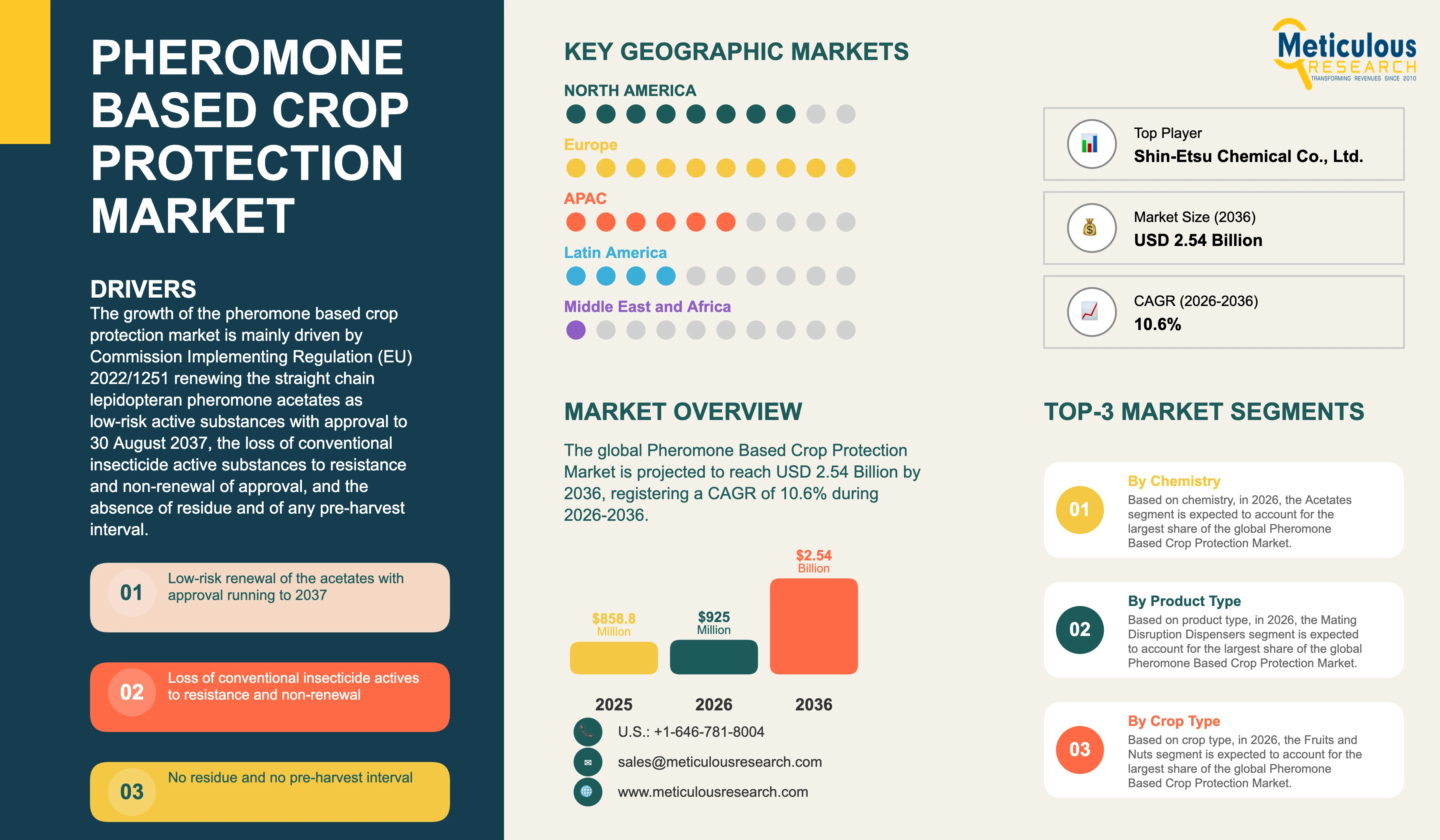
The global pheromone based crop protection market was valued at USD 858.8 million in 2025. This market is expected to reach USD 2.54 billion by 2036 from an estimated USD 925.0 million in 2026, registering a CAGR of 10.6% during the forecast period (2026-2036).
- Published
- Nov 2026
- Pages
- 260
- Format
- PDF + Excel
- Report ID
- MRAGR - 1042666
- Base year
- 2025
- 2025 · BASELINE
- $858.8M
- 2036
- $2.54B
- CAGR 2026–2036
- 10.6%
2025 baseline · 2026–2036 forecast at 10.6% CAGR · hover a bar for the value
Key highlights
The global pheromone based crop protection market is estimated at USD 925.0 million in 2026 and is projected to reach USD 2.54 billion by 2036.
Market volume is estimated at 625.00 tonnes in 2026 and is projected to reach 1, 874.17 tonnes by 2036 at a CAGR of 11.6%, measured as pheromone active substance supplied.
The average selling price is estimated at USD 1, 480.00 per kg in 2026 and is projected to reach USD 1,353.60 per kg by 2036.
Acetates are expected to account for the largest chemistry share in 2026, while aldehydes are projected to register the highest CAGR of 13.4%.
Mating disruption dispensers are expected to hold the largest product type share in 2026, while sprayable and microencapsulated formulations are projected to grow fastest at a CAGR of 14.2%.
Fruits and nuts are expected to be the largest crop type in 2026, while field crops are projected to register the highest CAGR of 13.8%.
Lepidoptera are expected to account for the largest target pest order share in 2026, while Coleoptera are projected to grow fastest at a CAGR of 12.8%.
Europe is expected to hold the largest regional share in 2026, while Asia-Pacific is projected to register the highest CAGR of 14.8%.
Commission Implementing Regulation (EU) 2022/1251 of 19 July 2022 renewed the approval of the active substances Straight Chain Lepidopteran Pheromones under Regulation (EC) No 1107/2009.
The Regulation renewed the acetates as low-risk active substances.
The Regulation renewed the aldehydes and the alcohols as active substances but not as low-risk substances.
Approval of all three groups runs from 1 September 2022 to 30 August 2037, and the Regulation applies from 1 September 2022.
Recital 13 states that the acetates are considered low risk because they are not substances of concern and meet the conditions in point 5 of Annex II to Regulation (EC) No 1107/2009.
The Regulation also amends the Annex to Implementing Regulation (EU) No 540/2011.
Minimum purity for the three groups is set by reference to the renewal assessment in Review Report SANTE/10828/2021.
The specific provisions require the uniform principles under Article 29(6) of Regulation (EC) No 1107/2009 to be applied and the conclusions of the renewal report, including Appendices I and II, to be taken into account.
Member States must pay particular attention to the efficacy of products containing single substances or blends when assessing applications for authorisation.
Conditions of use must include risk mitigation measures where appropriate.
Report summary
| Particulars | Details |
|---|---|
| Base Year | 2025 |
| Forecast Period | 2026-2036 |
| Market Size in 2025 | USD 858.8 million |
| Market Size in 2026 | USD 925.0 million |
| Market Size by 2036 | USD 2.54 billion |
| Value CAGR (2026-2036) | 10.6% |
| Format | PDF, Excel & Cloud Portal · 260 pages |
| Volume in 2026 | 625.00 tonnes |
| Volume by 2036 | 1,874.17 tonnes |
| Volume CAGR (2026-2036) | 11.6% |
| Volume Basis | Pheromone active substance supplied, not formulated dispensers |
| Average Selling Price in 2026 | USD 1,480.00 per kg |
| Average Selling Price by 2036 | USD 1,353.60 per kg |
| Measurement Basis | Products in which a synthesised insect pheromone is the active substance used in agricultural crop protection, covering mating disruption dispensers, sprayable and microencapsulated formulations, aerosol and puffer systems, mass trapping and attract-and-kill lures and monitoring lures, and excluding reusable trap bodies and monitoring electronics, food and plant-derived attractants that are not pheromones, pheromone use in structural, household, veterinary and forestry settings outside crop production, botanical and microbial insecticides, sterile insect technique and RNA-based crop protection |
| Largest Chemistry | Acetates |
| Fastest-Growing Chemistry | Aldehydes (CAGR 13.4%) |
| Largest Product Type | Mating disruption dispensers |
| Fastest-Growing Product Type | Sprayable and microencapsulated formulations (CAGR 14.2%) |
| Largest Crop Type | Fruits and nuts |
| Fastest-Growing Crop Type | Field crops (CAGR 13.8%) |
| Largest Target Pest Order | Lepidoptera |
| Fastest-Growing Target Pest Order | Coleoptera (CAGR 12.8%) |
| Largest Region | Europe |
| Fastest-Growing Region | Asia-Pacific (CAGR 14.8%) |
| Segments Covered | Chemistry, Product Type, Crop Type, Target Pest Order, and Geography |
| Geographies Covered | Europe, North America, Asia-Pacific, Latin America, and Middle East & Africa |
| Companies Profiled | 11 companies, including Shin-Etsu Chemical Co., Ltd., Suterra LLC, Trécé, Incorporated, M2i Group, Russell IPM Ltd, and Koppert B.V. |
Report overview
Segments covered: chemistry, product type, crop type, target pest order.
In volume terms, this market is estimated at 625.00 tonnes in 2026 and is projected to reach 1,874.17 tonnes by 2036, registering a CAGR of 11.6% during the same period, measured as pheromone active substance supplied rather than as formulated dispensers, whose weight is dominated by the polymer and carrier that control release. The average selling price is estimated at USD 1,480.00 per kg in 2026 and is projected to decline to USD 1,353.60 per kg by 2036 as synthesis scales on the higher-volume actives and as sprayable and aerosol systems deliver a given area at lower active loading than hand-applied dispensers.
The growth of this market is mainly driven by the renewal of the straight chain lepidopteran pheromone acetates as low-risk active substances in the European Union with approval running to 30 August 2037, the loss of conventional insecticide active substances to resistance and to non-renewal of approval, the residue and pre-harvest interval position of a product that is not applied to the crop at all, and the sprayable and aerosol systems that remove the labour of hand-applying dispensers. However, factors such as the cost per hectare relative to a conventional insecticide application, and the requirement for area-wide deployment across contiguous blocks rather than single fields, are expected to restrain the growth of this market to some extent.
Acetates account for the largest share of this market because they cover the widest set of economically important Lepidoptera and because they are the only one of the three straight chain lepidopteran pheromone groups renewed as low-risk active substances in the European Union. Aldehydes grow faster because the pests they address are the noctuid moths of cotton, maize, rice and sugarcane, which is where insecticide resistance has advanced furthest and where the treated area is largest.
Pheromone based crop protection covers products in which a synthesised insect pheromone is the active substance, deployed to disrupt mating, to trap or to attract and kill a target pest in an agricultural crop. Market sizing in this report is on both a value basis in USD and a volume basis in tonnes measured as pheromone active substance supplied rather than as formulated dispensers, with average selling price derived from the two. The measurement basis covers mating disruption dispensers, sprayable and microencapsulated formulations, aerosol and puffer systems, mass trapping and attract-and-kill lures and monitoring lures, and it excludes reusable trap bodies and monitoring electronics, food and plant-derived attractants that are not pheromones, pheromone use in structural, household, veterinary and forestry settings outside crop production, botanical and microbial insecticides, sterile insect technique and RNA-based crop protection.
The measurement basis matters more here than in most markets because a formulated dispenser weighs far more than the pheromone it carries. A reservoir or membrane dispenser is largely polymer, and a microencapsulated sprayable is largely carrier and shell material, both of which exist to control release rate over weeks rather than to act on the insect. Measuring formulated product would therefore track polymer consumption rather than the pheromone market, and would make a hand-applied dispenser appear many times larger than an aerosol delivering the same area. Active substance supplied is the only basis on which the delivery formats are comparable.
Commission Implementing Regulation (EU) 2022/1251 of 19 July 2022 renewed the approval of the active substances Straight Chain Lepidopteran Pheromones under Regulation (EC) No 1107/2009 and amended the Annex to Implementing Regulation (EU) No 540/2011. The acetates were renewed as low-risk active substances, while the aldehydes and the alcohols were renewed as active substances but not as low-risk substances. Approval of all three groups runs from 1 September 2022 to 30 August 2037 and the Regulation applies from 1 September 2022. Recital 13 states that the acetates are considered low risk because they are not substances of concern and meet the conditions in point 5 of Annex II to Regulation (EC) No 1107/2009.
That split in status is the most commercially consequential feature of the European framework, because low-risk standing carries procedural consequences at product authorisation and a longer approval period than a conventional active substance receives. An acetate-based product and an aldehyde-based product built on the same technology and sold into the same orchard therefore sit in different regulatory categories. Approval to 30 August 2037 also extends beyond the forecast period for all three groups, which removes the renewal uncertainty that shapes investment decisions for most crop protection actives. The regulation gives the sector a planning horizon the rest of the insecticide market does not have.
Mating disruption works by saturating the air of a block with the female sex pheromone so that males cannot locate females, which means it prevents the next generation rather than killing the current one. Nothing is applied to the crop and nothing is ingested by the pest, so there is no residue of the kind a maximum residue level addresses and no pre-harvest interval to observe. The mechanism is also specific to a single species, so natural enemies, pollinators and non-target insects are unaffected. Those two properties together are why the technology holds a position in retail supply programmes that a conventional insecticide cannot occupy.
The requirement that limits the technology is spatial rather than technical. Air permeation has to be maintained across a contiguous block large enough that males entering from outside do not restore mating, which means a single grower treating an isolated field in a fragmented landscape gets much less than the same treatment delivers across a co-ordinated area. Pome fruit and vine regions with large contiguous plantings adopted the technology first for that reason, and where holdings are small adoption depends on grower groups or publicly co-ordinated programmes. The constraint is one of organisation as much as of agronomy.
Labour rather than active substance cost is what has limited the dominant format. A hand-applied dispenser programme requires workers to hang several hundred units per hectare at the start of each season and in some systems to replace them mid-season, which is a substantial cost and an increasingly uncertain one in regions with tight seasonal labour supply. Sprayable microencapsulated formulations go on through existing equipment in a normal pass, and aerosol puffer systems cover several hectares from a single unit with no per-hectare labour at all. Both formats are growing on labour economics rather than on efficacy.
Resistance on the conventional side is the push factor. Repeated use of the same insecticide modes of action has produced resistance in codling moth, in the noctuid moths of cotton, maize and rice and in Tuta absoluta, and a number of conventional insecticide active substances have not been renewed at the expiry of their approval period. A pheromone acts on behaviour rather than on a physiological target site, so resistance to it has no mechanism comparable to metabolic or target-site resistance. The technology therefore enters a programme as the component that cannot be lost in the same way as the chemistry around it.
Synthesis rather than formulation is where the barrier to entry sits. Pheromones are specific long-chain acetates, alcohols and aldehydes whose biological activity depends on double bond position and geometry, so isomeric purity has to be controlled to a degree that ordinary fine chemical synthesis does not require, and the wrong isomer can inhibit response rather than merely dilute it. A handful of producers hold that capability at commercial scale, which is why this market is led by specialists rather than by the companies that dominate crop protection generally.
Mating disruption dispensers are expected to hold the largest share in 2026, on the established pome fruit and vine programmes and the season-long release they deliver from a single application.
Sprayable and microencapsulated formulations are projected to register the highest CAGR of 14.2% during the forecast period.
Fruits and nuts are expected to account for the largest share in 2026.
Field crops are projected to register the highest CAGR of 13.8% during the forecast period.
Lepidoptera are expected to hold the largest share in 2026, as moth sex pheromone biology is the best characterised of any insect order and moth larvae are direct pests of fruit, fibre and grain.
Coleoptera are projected to register the highest CAGR of 12.8% during the forecast period.
Europe is expected to account for the largest share in 2026, supported by Commission Implementing Regulation (EU) 2022/1251, the non-renewal of conventional insecticide approvals, and the pome fruit and vine production in Italy, Spain and France. Italy is projected to grow at 9.8% and Spain at 9.6%.
Asia-Pacific is projected to register the highest CAGR of 14.8% during the forecast period, with India at 16.2% and China at 14.6%.
Europe is projected to grow at a CAGR of 9.4% and holds the largest regional share, supported by Commission Implementing Regulation (EU) 2022/1251 renewing the acetates as low-risk active substances with approval to 30 August 2037, the narrowing set of conventional insecticides, and the contiguous pome fruit and vine plantings that area-wide permeation requires. Italy is projected at 9.8%, Spain at 9.6% and France at 9.0%.
The Middle East & Africa is projected to grow at a CAGR of 9.6%, where date palm and protected horticulture for export account for most demand. Latin America is projected to grow at a CAGR of 11.0%, with Brazil at 11.6%.
Shin-Etsu Chemical Co., Ltd., Suterra LLC, Trécé, Incorporated, M2i Group and Russell IPM Ltd together accounted for an estimated 48.6% of this market in 2026. The 11 companies profiled in this report together accounted for an estimated 71.4%.
Report infographic
Market dynamics
15 factors across 5 forcesLow-Risk Renewal of the Acetates With Approval Running to 2037
Commission Implementing Regulation (EU) 2022/1251 of 19 July 2022 renewed the approval of the Straight Chain Lepidopteran Pheromones, with the acetates renewed as low-risk active substances on the basis set out in Recital 13 that they are not substances of concern and meet the conditions in point 5 of Annex II to Regulation (EC) No 1107/2009, while the aldehydes and alcohols were renewed as active substances without that status. Approval of all three groups runs from 1 September 2022 to 30 August 2037, which extends past the forecast period and removes the renewal uncertainty that governs investment in most crop protection actives. A fifteen-year horizon changes what a company will spend on registration, synthesis capacity and crop-specific development. The driver is regulatory certainty rather than regulatory pressure, and it is unusual in a sector where most actives are developed against a closing renewal horizon.
Loss of Conventional Insecticide Actives to Resistance and Non-Renewal
Repeated use of the same insecticide modes of action has produced resistance in codling moth, in the noctuid moths of cotton, maize, rice and sugarcane and in Tuta absoluta, and a number of conventional insecticide active substances have not been renewed at the expiry of their approval period, which has narrowed the set of chemistry available for rotation. A pheromone acts on mating behaviour rather than on a physiological target site, so there is no metabolic or target-site mechanism by which resistance to it develops in the way it does to an insecticide. The technology therefore occupies a position in a programme that cannot be eroded as the surrounding chemistry is. Demand follows the loss of alternatives rather than a comparison of cost, and an adviser who has lost two modes of action is choosing a mechanism rather than a product, and the pheromone is the only component of the programme that cannot be eroded the same way.
No Residue and No Pre-Harvest Interval Because Nothing Is Applied to the Crop
Mating disruption saturates the air of a block so that males cannot locate females, which means nothing is applied to the crop, nothing is ingested by the pest and there is no residue of the kind a maximum residue level addresses or a pre-harvest interval to observe. That suits the retail produce specifications that limit both residue levels and the number of detected residues below legal thresholds, and it allows the pest to be managed through the period immediately before harvest when conventional options are closed. The specificity to a single species also leaves natural enemies and pollinators intact, which supports the rest of an integrated programme. The driver reaches the grower through the retailer rather than the regulator, which removes cost per hectare from the decision wherever a residue specification is the binding requirement.
Sprayable and Aerosol Systems Removing the Labour of Hand-Applied Dispensers
A hand-applied dispenser programme requires workers to hang several hundred units per hectare at the start of each season and in some systems to replace them during it, which is a substantial cost and an increasingly uncertain one where seasonal labour is tight. Microencapsulated sprayable formulations are applied through existing spray equipment in a normal pass, and aerosol puffer systems cover several hectares from a single unit with no per-hectare labour at all. Both also deliver a given area at lower active loading than a reservoir dispenser, which lowers the cost of the pheromone itself. Sprayable and microencapsulated formulations consequently grow fastest among the product types at 14.2%. The shift also moves the purchase into a routine spray programme rather than a separate seasonal operation.
Table of contents
12 chapters · 151 sections · 260 pages · click to expandSegmental analysis
| Segment | Largest share (2026) | Fastest growth (2026–2036) |
|---|---|---|
| By Chemistry | Acetates | — |
| Other segments | — | Aldehydes |
By Chemistry
- Acetates are expected to account for the largest share in 2026, covering the widest set of economically important Lepidoptera and holding low-risk active substance status in the European Union.
Other segments
- Aldehydes are projected to register the highest CAGR of 13.4% during the forecast period.
Geographic analysis
Europe
Largest shareIn 2026, Europe is expected to account for the largest share of the global pheromone based crop protection market. The large share of this region is mainly due to Commission Implementing Regulation (EU) 2022/1251 renewing the straight chain lepidopteran pheromones with the acetates as low-risk active substances and approval to 30 August 2037, the non-renewal of conventional insecticide approvals that has narrowed the alternatives, the pome fruit and vine production in Italy, Spain and France with the contiguous plantings area-wide permeation requires, and the retail residue specifications applied to fresh produce. Italy is projected to register a CAGR of 9.8% and Spain a CAGR of 9.6% during the forecast period.
Asia-Pacific
Fastest growthHowever, Asia-Pacific is projected to register the highest CAGR of 14.8% during the forecast period. The rapid growth of this region is attributed to the rice, cotton and sugarcane area carrying the noctuid and stem borer pests that sprayable formulations now address, the insecticide resistance that has developed under repeated application of the same chemistry, the publicly co-ordinated programmes that make fragmented smallholdings addressable, and the export horticulture facing residue specifications in destination markets. India is projected to register a CAGR of 16.2% and China a CAGR of 14.6%.
North America
North America is projected to grow at 8.6%, with the United States at 8.6%, where codling moth and navel orangeworm programmes in pome fruit and tree nuts are long established and where aerosol systems have displaced hand-applied dispensers fastest in response to seasonal labour cost.
Latin America
Latin America is projected to grow at 11.0%, with Brazil at 11.6% as sugarcane, soybean and cotton programmes adopt sprayable formulations against resistant noctuids.
Middle East & Africa
The Middle East & Africa is projected to grow at 9.6%, where date palm and protected horticulture for export account for most demand. Landscape structure rather than crop value determines where this technology can be deployed, which separates it from the rest of crop protection. Permeation must hold across a contiguous block, so regions of large consolidated plantings adopted it first and regions of small fragmented holdings reached it only through co-ordinated programmes, irrespective of pest pressure or the price of the crop. Approval is also specific to each jurisdiction and, in the European Union, to the chemistry group, so a supplier builds registration portfolios pest by pest and country by country. Where the pheromone is synthesised matters less than in most markets, since the active substance is stable and shipped in small quantity.
Competitive landscape
The global pheromone based crop protection market is characterised by the presence of specialist pheromone synthesisers and formulators rather than by the companies that dominate crop protection generally, alongside biocontrol groups that carry pheromone products within integrated pest management portfolios. Competition is contested on synthesis capability and isomeric purity, on the breadth of the pest and crop registration portfolio, and on delivery format rather than on price, since each pest responds to a specific compound or blend and a supplier that cannot make it has no product to offer. Shin-Etsu Chemical Co., Ltd., Suterra LLC, Trécé, Incorporated, M2i Group and Russell IPM Ltd together accounted for an estimated 48.6% of this market in 2026, while the companies profiled in this report together accounted for an estimated 71.4%.
Commission Implementing Regulation (EU) 2022/1251 of 19 July 2022 renewed the Straight Chain Lepidopteran Pheromones with the acetates as low-risk active substances and the aldehydes and alcohols without that status, approval running from 1 September 2022 to 30 August 2037. Aerosol and sprayable format development to displace hand-applied dispensers, extension of registrations into field crops, and agreements with producer organisations and regional programmes accounted for most competitive activity through 2026, with synthesis capacity and crop-specific registration rather than acquisition the principal route by which positions were strengthened, since synthesis capability cannot readily be bought in.
Synthesis capability rather than scale divides this market, which is why it is led by companies whose entire business is semiochemicals. Shin-Etsu Chemical Co., Ltd. competes from a chemical synthesis base, Suterra LLC and Trécé, Incorporated through North American dispenser and lure portfolios, M2i Group and SEDQ Healthy Crops, S.L. through European production and registration, and Koppert B.V., Biobest Group NV and Andermatt Group AG through integrated pest management channels. Some of the key players operating in the pheromone based crop protection market are Shin-Etsu Chemical Co., Ltd. (Japan), Suterra LLC (U.S.), Trécé, Incorporated (U.S.), M2i Group (France), Russell IPM Ltd (U.K.), Koppert B.V. (Netherlands), Biobest Group NV (Belgium), ISCA Technologies, Inc. (U.S.), Pherobank B.V. (Netherlands), Andermatt Group AG (Switzerland), and SEDQ Healthy Crops, S.L. (Spain), among others.
- —
Commission Implementing Regulation (EU) 2022/1251 of 19 July 2022 renewed the approval of the active substances Straight Chain Lepidopteran Pheromones under Regulation (EC) No 1107/2009 and amended the Annex to Implementing Regulation (EU) No 540/2011, renewing the acetates as low-risk active substances and the aldehydes and alcohols as active substances without that status, with approval running from 1 September 2022 to 30 August 2037. The specific provisions require the uniform principles under Article 29(6) to be applied, the conclusions of the renewal report including Appendices I and II to be taken into account, particular attention to be paid to the efficacy of products containing single substances or blends, and risk mitigation measures to be included in the conditions of use where appropriate.
- Shin-Etsu Chemical Co., Ltd.
- Suterra LLC
- Trécé, Incorporated
- M2i Group
- Russell IPM Ltd
- Koppert B.V
Expert perspectives
Volume grows at 11.6% against 10.6% in value over the forecast period, and the average selling price falls from USD 1,480.00 per kg in 2026 to USD 1,353.60 per kg by 2036 as synthesis scales on the higher-volume actives and as sprayable and aerosol systems deliver a given area at lower active loading than hand-applied dispensers. Volume is measured as active substance supplied rather than formulated dispensers, because a dispenser is largely polymer and measuring it would track release hardware rather than the pheromone market.
The acetate and aldehyde split in Regulation (EU) 2022/1251 is the fact to build a European strategy on. Acetates were renewed as low-risk active substances and aldehydes and alcohols were not, all with approval to 30 August 2037, so two products using identical technology on neighbouring pests sit in different regulatory categories. Development pipelines are being sequenced on the chemistry of the pheromone rather than on the damage the pest causes.
Approval running fifteen years to 30 August 2037 is worth as much as the low-risk status itself. Most crop protection actives are developed against a renewal horizon that can close before the investment is recovered, and the renewal uncertainty governs what a company will spend on synthesis capacity and crop-specific registration. This sector now plans past the forecast period, which is unusual.
What caps the market is landscape structure rather than price or performance. Permeation must hold across a contiguous block, so an isolated field in a fragmented region gets a fraction of what the same treatment delivers area-wide, and no amount of product development changes that. The commercial answer has been to sell to producer organisations and co-ordinated regional programmes, which makes the buying unit the region rather than the farm.
Format rather than chemistry is where the growth is being decided. The same pheromone sold as a hand-hung dispenser, a microencapsulated sprayable or an aerosol unit carries entirely different labour and active loading per hectare, and the choice follows seasonal labour cost in a region. Sprayable formulations grow fastest at 14.2% and are also what brings cotton, maize, rice and sugarcane within reach at 13.8%.
Supply concentration is structural and should be read as such. Activity depends on double bond position and geometry, the wrong isomer can inhibit response rather than dilute it, and few producers control that at scale, which is why specialists rather than the large crop protection companies lead this market and why the top five hold an estimated 48.6%. A formulator without a synthesis relationship has no route to a product.
Customer perspectives
Residue position and the absence of a pre-harvest interval secure the programme, while the result depends on district-wide rather than individual deployment, which makes the producer organisation rather than the individual orchard the unit at which the technology is bought and managed.
Labour cost and availability rather than efficacy drove the move from hand-applied dispensers to aerosol release systems, with the hardware investment recovered within a single season and the pest result maintained through the change of format rather than compromised by it.
Insecticide resistance makes a behavioural mode of action valuable in field crops, where sprayable formulations applied with existing equipment rather than hand-applied dispensers are what make the technology usable at scale.
“Mating disruption is the base of our codling moth programme because there is no residue and no interval before picking, which is exactly what our retail customers ask about. The reason it works for us is that we run it across the whole district rather than block by block. A single orchard doing it alone would not see the same result.”
“We moved from hand-hung dispensers to aerosol units almost entirely for labour. Hanging several hundred units a hectare at the start of every season had become both expensive and hard to staff. The hardware cost back itself inside one season and the pest result has held.”
“In our crops the chemistry has been losing ground to resistance for years, so something that works on behaviour rather than a target site is genuinely different. What made it possible for us is the sprayable formulation, because we can put it on with the equipment we already have. A dispenser programme was never going to happen at our scale.”
Frequently asked questions
This market was valued at USD 797.2 million in 2024 and USD 858.8 million in 2025, and is estimated at USD 925.0 million in 2026. In volume terms it is estimated at 625.00 tonnes in 2026 as pheromone active substance supplied.
Cite this report
Meticulous Research. (2026). Pheromone Based Crop Protection Market - Global Opportunity Analysis and Industry Forecast (2026-2036) (Report No. MRAGR - 1042666). Meticulous Market Research Pvt. Ltd. https://www.meticulousresearch.com/product/pheromone-based-crop-protection-market-7349