Microbial Biofungicides Market (2026-2036)
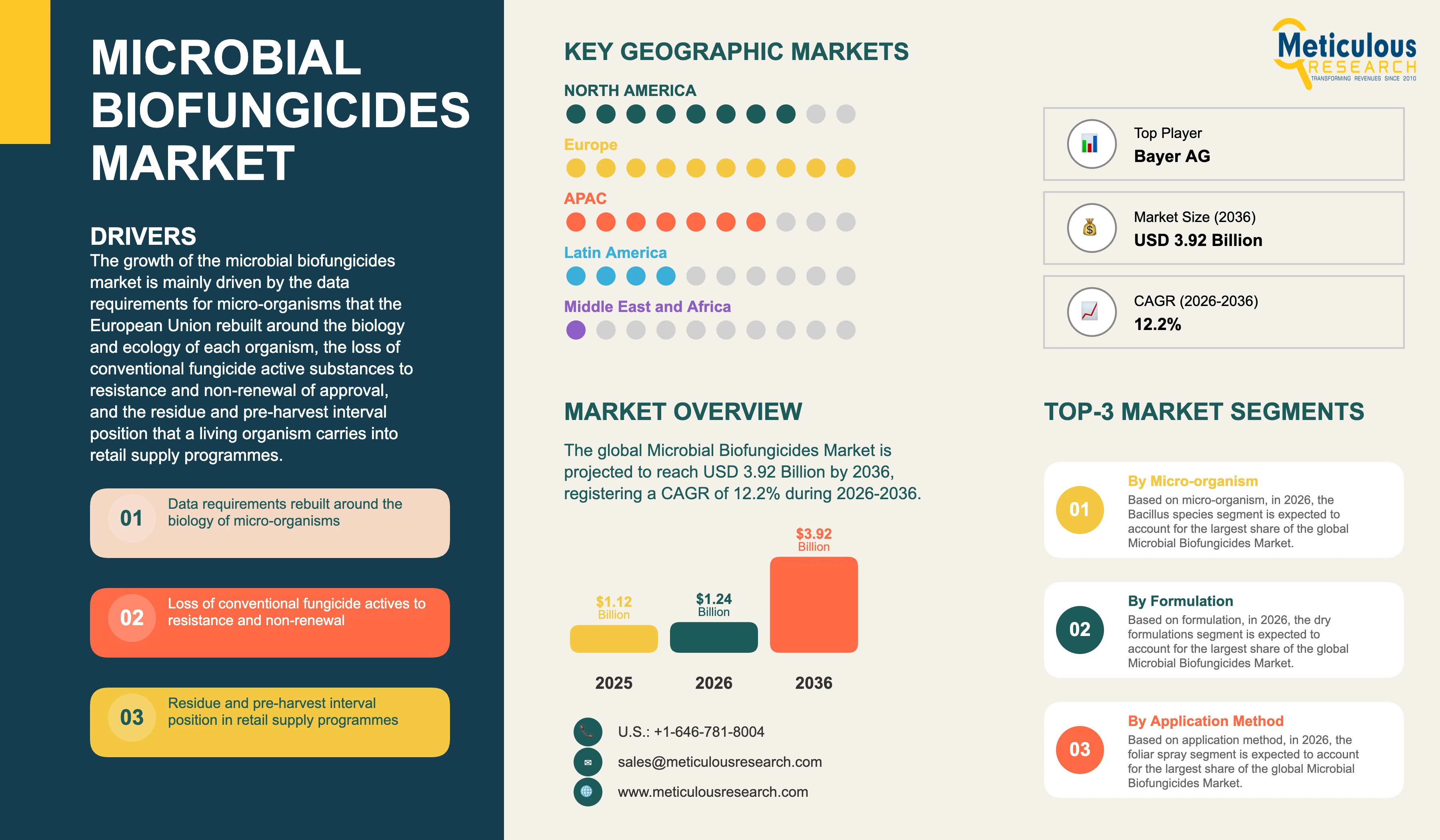
The global microbial biofungicides market was valued at USD 1.12 billion in 2025. This market is expected to reach USD 3.92 billion by 2036 from an estimated USD 1.24 billion in 2026, registering a CAGR of 12.2% during the forecast period (2026-2036).
- Published
- Nov 2026
- Pages
- 267
- Format
- PDF + Excel
- Report ID
- MRAGR - 1042663
- Base year
- 2025
- 2025 · BASELINE
- $1.12B
- 2036
- $3.92B
- CAGR 2026–2036
- 12.2%
2025 baseline · 2026–2036 forecast at 12.2% CAGR · hover a bar for the value
Key highlights
The global microbial biofungicides market is estimated at USD 1.24 billion in 2026 and is projected to reach USD 3.92 billion by 2036.
Market volume is estimated at 32.60 kilotons in 2026 and is projected to reach 112.30 kilotons by 2036 at a CAGR of 13.2%, measured as formulated product supplied.
The average selling price is estimated at USD 38.00 per kg in 2026 and is projected to reach USD 34.90 per kg by 2036.
Bacillus species are expected to account for the largest micro-organism share in 2026, while yeasts and other fungi are projected to register the highest CAGR of 16.4%.
Dry formulations are expected to hold the largest formulation share in 2026, while liquid formulations are projected to grow fastest at a CAGR of 13.8%.
Foliar spray is expected to be the largest application method in 2026, while seed treatment is projected to register the highest CAGR of 15.6%.
Soil-borne and root diseases are expected to account for the largest target disease share in 2026, while post-harvest diseases are projected to grow fastest at a CAGR of 15.2%.
Fruits and vegetables are expected to be the largest crop type in 2026, while cereals and oilseeds are projected to register the highest CAGR of 14.6%.
Europe is expected to hold the largest regional share in 2026, while Asia-Pacific is projected to register the highest CAGR of 15.8%.
Four Commission Regulations applicable from 21 November 2022 rebuilt the European Union framework for micro-organisms as plant protection active substances.
Regulation (EU) 2022/1438 amended Annex II to Regulation (EC) No 1107/2009 with criteria for approving micro-organisms as active substances.
Regulation (EU) 2022/1439 amended Regulation (EU) No 283/2013 on the information to be submitted for active substances and the specific data requirements for micro-organisms.
Regulation (EU) 2022/1440 amended Regulation (EU) No 284/2013 on the information to be submitted for plant protection products containing micro-organisms.
Regulation (EU) 2022/1441 amended Regulation (EU) No 546/2011 with uniform principles for evaluating and authorising products containing micro-organisms.
The previous requirements for micro-organisms were very similar to those applying to chemical active substances, and the new rules instead base requirements on the biology and ecology of each micro-organism.
The Commission states that the revised rules mean fewer animal experiments and are expected to produce streamlined dossiers, simpler risk assessments and shorter timelines.
A micro-organism still cannot be approved unless it is shown not to cause disease in humans or animals.
Two Commission Communications published on 9 June 2023 list the test methods and guidance documents for implementing Part B of the Annexes to Regulations (EU) No 283/2013 and (EU) No 284/2013.
More than 60 micro-organisms are currently approved as plant protection active substances in the European Union.
Report summary
| Particulars | Details |
|---|---|
| Base Year | 2025 |
| Forecast Period | 2026-2036 |
| Market Size in 2025 | USD 1.12 billion |
| Market Size in 2026 | USD 1.24 billion |
| Market Size by 2036 | USD 3.92 billion |
| Value CAGR (2026-2036) | 12.2% |
| Format | PDF, Excel & Cloud Portal · 267 pages |
| Volume in 2026 | 32.60 kilotons |
| Volume by 2036 | 112.30 kilotons |
| Volume CAGR (2026-2036) | 13.2% |
| Volume Basis | Formulated product supplied, not colony forming units |
| Average Selling Price in 2026 | USD 38.00 per kg |
| Average Selling Price by 2036 | USD 34.90 per kg |
| Measurement Basis | Formulated plant protection products containing living bacteria, fungi or yeasts registered for disease control, excluding microbial bioinsecticides and bionematicides, fermentation-derived metabolites sold as chemical actives where the producing organism is not present, botanical and plant extract biofungicides, microbial soil inoculants and biofertilisers sold for nutrition rather than disease control, RNA and peptide biologicals, and chemical plant defence activators |
| Largest Micro-organism Segment | Bacillus species |
| Fastest-Growing Micro-organism Segment | Yeasts and other fungi (CAGR 16.4%) |
| Largest Formulation | Dry formulations |
| Fastest-Growing Formulation | Liquid formulations (CAGR 13.8%) |
| Largest Application Method | Foliar spray |
| Fastest-Growing Application Method | Seed treatment (CAGR 15.6%) |
| Largest Target Disease Segment | Soil-borne and root diseases |
| Fastest-Growing Target Disease Segment | Post-harvest diseases (CAGR 15.2%) |
| Largest Crop Type | Fruits and vegetables |
| Fastest-Growing Crop Type | Cereals and oilseeds (CAGR 14.6%) |
| Largest Region | Europe |
| Fastest-Growing Region | Asia-Pacific (CAGR 15.8%) |
| Segments Covered | Micro-organism, Formulation, Application Method, Target Disease, Crop Type, and Geography |
| Geographies Covered | Europe, North America, Asia-Pacific, Latin America, and Middle East & Africa |
| Companies Profiled | 11 companies, including Bayer AG, BASF SE, Syngenta AG, Sumitomo Chemical Co., Ltd., UPL Limited, and Koppert B.V. |
Report overview
Segments covered: micro-organism, formulation, application method, target disease, crop type.
In volume terms, this market is estimated at 32.60 kilotons in 2026 and is projected to reach 112.30 kilotons by 2036, registering a CAGR of 13.2% during the same period, measured as formulated product supplied rather than as colony forming units. The average selling price is estimated at USD 38.00 per kg in 2026 and is projected to decline to USD 34.90 per kg by 2036 as fermentation capacity expands and dry formulations at higher viable counts reduce the product weight required per hectare.
The growth of this market is mainly driven by the data requirements for micro-organisms that the European Union rebuilt around the biology and ecology of each organism rather than around chemical active substance requirements, the loss of conventional fungicide active substances to resistance and to non-renewal of approval, the residue and pre-harvest interval position that a living organism carries into retail supply programmes, and the seed treatment route that delivers a biological at a cost per hectare a broadacre crop can carry. However, factors such as the viability and shelf life of a living active substance through distribution and storage, and the preventive rather than curative mode of action that requires application before symptoms appear, are expected to restrain the growth of this market to some extent.
Bacillus species account for the largest share of this market because they form spores that survive formulation, distribution and field conditions better than any other group and hold the widest set of approvals across crops and diseases. Yeasts and other fungi grow faster because post-harvest disease control requires an organism that colonises wound sites on harvested produce, which is an application no conventional fungicide serves well under residue scrutiny.
Microbial biofungicides are plant protection products whose active substance is a living micro-organism applied to control fungal and bacterial plant diseases. Market sizing in this report is on both a value basis in USD and a volume basis in kilotons measured as formulated product supplied rather than as colony forming units, with average selling price derived from the two. The measurement basis is formulated products containing living bacteria, fungi or yeasts registered for disease control, and it excludes microbial bioinsecticides and bionematicides, fermentation-derived metabolites sold as chemical actives where the producing organism is not present in the product, botanical and plant extract biofungicides, microbial soil inoculants and biofertilisers sold for nutrition rather than disease control, RNA and peptide biologicals, and chemical plant defence activators.
The boundary with soil inoculants is regulatory rather than biological and it determines the market this report measures. The same Bacillus or Trichoderma strain may be sold as a plant protection product with a disease control claim, in which case it is authorised under Regulation (EC) No 1107/2009, or as a fertilising product with a nutrition or growth claim under Regulation (EU) 2019/1009, and the two routes carry entirely different data, labelling and liability. Only the disease control claim falls within this market. A strain sold under both claims appears here only to the extent of its plant protection registrations.
The package of four Commission Regulations applicable from 21 November 2022, namely Regulation (EU) 2022/1438 amending Annex II to Regulation (EC) No 1107/2009, Regulation (EU) 2022/1439 amending Regulation (EU) No 283/2013, Regulation (EU) 2022/1440 amending Regulation (EU) No 284/2013 and Regulation (EU) 2022/1441 amending Regulation (EU) No 546/2011 rebuilt the European framework for these products. The Commission states that the previous requirements for micro-organisms were very similar to those applying to chemical active substances, and that the new rules instead base requirements on the biology and ecology of each micro-organism, which means fewer animal experiments and is expected to produce streamlined dossiers, simpler risk assessments and shorter timelines. More than 60 micro-organisms are currently approved as plant protection active substances in the European Union.
What changed is the question being asked rather than the standard being applied. Assessing a living organism against a chemical template generated data on metabolites, degradation and residues that a self-replicating organism does not produce in the same way, while leaving the questions that actually matter for a micro-organism, namely identity at strain level, infectivity, pathogenicity and secondary metabolite potential, addressed indirectly. A micro-organism still cannot be approved unless it is shown not to cause disease in humans or animals, so the safety bar is unchanged. Two Commission Communications published on 9 June 2023 list the test methods and guidance for implementing the revised annexes, which is what makes the framework operable in practice.
Strain identity rather than species is the regulatory and commercial unit here, and that has consequences a chemical market does not face. Two strains of the same species can differ in efficacy, host range and metabolite production, so approval, registration and intellectual property all attach to the deposited strain rather than to the organism named on the label. A competitor cannot use an approved strain without access to it, which gives a strain holder a position closer to a patented molecule than to a generic active. Strain collections consequently carry much of the value in this sector.
Resistance and approval loss on the conventional side are what create the opening. Fungicide resistance has reduced the effective life of single-site chemical modes of action, resistance management guidance requires rotation across modes of action within a season, and a number of conventional fungicide active substances have not been renewed at approval expiry. A microbial product with a mode of action unrelated to any chemical class occupies a rotation slot rather than competing for an existing one. Demand therefore arises from the shape of the programme rather than from a comparison of efficacy against the chemical it rotates with.
Residue position is the second structural driver and it operates through the retailer rather than the regulator. A living organism applied to a crop leaves no chemical residue of the kind a maximum residue level addresses, which suits the retail produce specifications that set residue counts and levels below legal thresholds, and it supports short or zero pre-harvest intervals where a conventional fungicide cannot be used at all. Growers facing a disease close to harvest have few conventional options that clear the interval. The product is therefore specified for the position in the season rather than across it.
Formulating a living active substance is a different discipline from formulating a chemical one. The product has to deliver a viable count at the end of its shelf life rather than an assay at manufacture, and viability declines with temperature, moisture and time in ways that a chemical concentration does not. Spore-forming Bacillus species tolerate that far better than vegetative bacteria or fungal hyphae, which is the principal reason they dominate the market rather than any advantage in efficacy. Dry formulations hold viability longer than liquids, which is why they carry the larger share despite being harder to disperse in a tank.
The mode of action constrains how the product can be used. Microbial biofungicides act by competitive colonisation, antibiosis, parasitism of the pathogen or induction of host resistance, all of which require the organism to be established before the pathogen rather than applied after symptoms appear. There is no curative equivalent to a systemic chemical fungicide, so a grower who waits for visible disease has already lost the window. Adoption therefore depends on programme planning and forecasting rather than on the response to an outbreak, which is a harder sale than a curative product.
Seed treatment is where the cost arithmetic changes for broadacre crops. Applying a biological to seed places the organism at the point of germination in the rhizosphere where root pathogens attack, uses a small quantity per hectare and is carried out at the seed plant rather than by the grower, which removes both the application pass and the timing judgement. Cereals, oilseeds and pulses are grown on margins that will not support a foliar biological programme but will support a seed treatment. The route rather than the organism is what opens those crops.
Dry formulations are expected to hold the largest share in 2026, retaining viability better than liquids across distribution and storage.
Liquid formulations are projected to register the highest CAGR of 13.8% during the forecast period.
Foliar spray is expected to account for the largest share in 2026.
Seed treatment is projected to register the highest CAGR of 15.6% during the forecast period.
Fruits and vegetables are expected to account for the largest share in 2026.
Cereals and oilseeds are projected to register the highest CAGR of 14.6% during the forecast period.
Europe is expected to account for the largest share in 2026, supported by the 2022 data requirement reform, the more than 60 micro-organisms now approved as active substances, and the horticultural production in Spain, Italy and France. Spain is projected to grow at 11.6% and Italy at 11.2%.
Asia-Pacific is projected to register the highest CAGR of 15.8% during the forecast period, with India at 17.4% and China at 15.2%.
Europe is projected to grow at a CAGR of 11.0% and holds the largest regional share, supported by the four Commission Regulations applicable from 21 November 2022, the more than 60 approved micro-organisms, the non-renewal of conventional fungicide approvals, and the residue specifications applied in southern European horticulture. Spain is projected at 11.6% and Italy at 11.2%.
The Middle East & Africa is projected to grow at a CAGR of 11.0%, where protected horticulture for export rather than domestic field cropping accounts for most demand. Latin America is projected to grow at a CAGR of 12.6%, with Brazil at 13.4%.
Bayer AG, BASF SE, Syngenta AG, Sumitomo Chemical Co., Ltd. and UPL Limited together accounted for an estimated 43.6% of this market in 2026. The 11 companies profiled in this report together accounted for an estimated 66.5%.
Report infographic
Market dynamics
15 factors across 5 forcesData Requirements Rebuilt Around the Biology of Micro-organisms
Four Commission Regulations applicable from 21 November 2022, namely Regulation (EU) 2022/1438 amending Annex II to Regulation (EC) No 1107/2009, Regulation (EU) 2022/1439 amending Regulation (EU) No 283/2013, Regulation (EU) 2022/1440 amending Regulation (EU) No 284/2013 and Regulation (EU) 2022/1441 amending Regulation (EU) No 546/2011, replaced requirements the Commission describes as very similar to those for chemical active substances with requirements based on the biology and ecology of each micro-organism. The Commission states that this means fewer animal experiments and is expected to produce streamlined dossiers, simpler risk assessments and shorter timelines, and two Communications published on 9 June 2023 list the test methods and guidance that make the framework operable. More than 60 micro-organisms are now approved in the European Union. A lower cost and shorter route to approval changes which strains are worth developing, which is what expands the pipeline rather than only the market. The reform also reduces the advantage that scale alone conferred, because a dossier built around the biology of one organism is within reach of a company that holds strains but not a chemical regulatory department.
Loss of Conventional Fungicide Actives to Resistance and Non-Renewal
Fungicide resistance has shortened the effective life of single-site chemical modes of action, resistance management guidance requires rotation across modes of action within a season, and a number of conventional fungicide active substances have not been renewed at the expiry of their approval period. A microbial product acts by competitive colonisation, antibiosis, parasitism or induced host resistance, none of which corresponds to a chemical mode of action, so it occupies a rotation slot rather than competing for an existing one. An adviser building a programme is choosing a mechanism rather than a product. The driver is written into crop protection practice rather than into regulation, which makes it durable irrespective of relative efficacy. An adviser who has lost two chemical modes of action to resistance has a programme gap that must be filled by something unrelated to either, and price enters that decision only after the mechanism is settled.
Residue and Pre-Harvest Interval Position in Retail Supply Programmes
A living organism leaves no chemical residue of the kind a maximum residue level addresses, which suits the retail produce specifications that limit both residue levels and the number of detected residues below legal thresholds, and it supports short or zero pre-harvest intervals where a conventional fungicide cannot be applied at all. A grower facing disease pressure close to harvest has few conventional options that clear the interval, which is the position where a biological is specified regardless of cost per hectare. The same property serves export programmes into markets with different residue tolerances. Demand therefore concentrates at specific points in the season rather than spreading across it, and the retailer rather than the grower is frequently the party that sets the requirement, which removes cost per hectare from the decision at that point in the programme.
Seed Treatment Delivering a Biological at Broadacre Cost per Hectare
Applying a micro-organism to seed places it at the point of germination in the rhizosphere where root pathogens attack, uses a small quantity of product per hectare and is carried out at the seed plant rather than by the grower, which removes both an application pass and the timing judgement a preventive product otherwise requires. Cereals, oilseeds and pulses are grown on margins that will not support a foliar biological programme but will carry a seed treatment, so the route rather than the organism opens those crops. The sale also moves to the seed company, which changes the route to market. Seed treatment is consequently the fastest-growing application method in this market. It also converts a discretionary in-season purchase into a specification agreed before planting, which stabilises demand against the weather that otherwise governs biological sales.
Table of contents
13 chapters · 162 sections · 267 pages · click to expandSegmental analysis
| Segment | Largest share (2026) | Fastest growth (2026–2036) |
|---|---|---|
| By Micro-organism | Bacillus species | — |
| Other segments | — | Yeasts and other fungi |
By Micro-organism
- Bacillus species are expected to account for the largest share in 2026, as the spores they form survive formulation, distribution, storage and field conditions better than any other group.
- Soil-borne and root diseases are expected to hold the largest share in 2026, as the rhizosphere is where an introduced organism establishes most reliably.
Other segments
- Yeasts and other fungi are projected to register the highest CAGR of 16.4% during the forecast period.
- Post-harvest diseases are projected to register the highest CAGR of 15.2% during the forecast period.
Geographic analysis
Europe
Largest shareIn 2026, Europe is expected to account for the largest share of the global microbial biofungicides market. The large share of this region is mainly due to the four Commission Regulations applicable from 21 November 2022 that rebuilt the data requirements for micro-organisms around their biology rather than around chemical active substance requirements, the more than 60 micro-organisms now approved as active substances in the European Union, the non-renewal of conventional fungicide approvals that has reduced the chemical options available, and the horticultural production in Spain, Italy and France that carries the residue specifications favouring biologicals. Spain is projected to register a CAGR of 11.6% and Italy a CAGR of 11.2% during the forecast period.
Asia-Pacific
Fastest growthHowever, Asia-Pacific is projected to register the highest CAGR of 15.8% during the forecast period. The rapid growth of this region is attributed to the Trichoderma and Bacillus production and formulation base established in India, the horticultural and export crop programmes that face residue specifications in destination markets, the disease pressure in intensively cropped tropical and subtropical systems, and the fungicide resistance that has developed under repeated application of the same chemical classes. India is projected to register a CAGR of 17.4% and China a CAGR of 15.2%.
North America
North America is projected to grow at 10.4%, with the United States at 10.4%, on specialty crop and protected cropping demand and on a biopesticide registration framework that has long applied reduced data requirements to microbial products relative to conventional chemistry.
Latin America
Latin America is projected to grow at 12.6%, with Brazil at 13.4% as soybean, sugarcane and coffee programmes adopt biologicals against both resistance and residue requirements in export markets.
Middle East & Africa
The Middle East & Africa is projected to grow at 11.0%, where protected horticulture for export rather than domestic field cropping accounts for most of the demand. Approval rather than agronomy determines where a strain can be sold, which separates this market from the crop protection market around it. A strain approved in one jurisdiction has no standing in another, and because approval attaches to the deposited strain rather than the species a company cannot substitute a locally approved strain for the one its product is built on. Registration portfolios are therefore regional assets built strain by strain and country by country. Fermentation and formulation are also regional, because a product carrying a living organism with a limited shelf life is not shipped across long distances and through warm climates without losing the count it declares.
Competitive landscape
The global microbial biofungicides market is characterised by the presence of large crop protection companies that have acquired microbial businesses and strain collections, biocontrol specialists with integrated pest management portfolios, fermentation and enzyme companies with agricultural biologicals divisions, and Indian producers with established Trichoderma and Bacillus capacity. Competition is contested on approved strain portfolios and on fermentation and stabilisation capability rather than on formulation, since approval attaches to a deposited strain a competitor cannot access and a strain that cannot be fermented economically cannot be sold at any price. Bayer AG, BASF SE, Syngenta AG, Sumitomo Chemical Co., Ltd. and UPL Limited together accounted for an estimated 43.6% of this market in 2026, while the companies profiled in this report together accounted for an estimated 66.5%.
Regulation (EU) 2022/1438, Regulation (EU) 2022/1439, Regulation (EU) 2022/1440 and Regulation (EU) 2022/1441 became applicable on 21 November 2022, replacing requirements the Commission describes as very similar to those for chemical active substances with requirements based on the biology and ecology of each micro-organism, and two Commission Communications of 9 June 2023 set out the test methods and guidance for implementation. More than 60 micro-organisms are now approved in the European Union. Strain screening and deposit against specific crop and pathogen combinations, seed-applied biological development with seed companies, and post-harvest yeast products accounted for most competitive activity through 2026, with acquisition of strain collections rather than of formulation capacity the principal route by which the larger companies added positions.
Strain access rather than scale is what divides this market, because a deposited strain cannot be replicated by a competitor and a registration cannot be transferred to a different strain. Koppert B.V. and Andermatt Group AG compete through biocontrol portfolios and grower relationships, Novonesis A/S through fermentation capability, and T. Stanes & Company Limited and Bioceres Crop Solutions Corp. through established regional production. Some of the key players operating in the microbial biofungicides market are Bayer AG (Germany), BASF SE (Germany), Syngenta AG (Switzerland), Sumitomo Chemical Co., Ltd. (Japan), UPL Limited (India), Corteva, Inc. (U.S.), Koppert B.V. (Netherlands), Novonesis A/S (Denmark), Andermatt Group AG (Switzerland), Bioceres Crop Solutions Corp. (U.S.), and T. Stanes & Company Limited (India), among others.
- —
Regulation (EU) 2022/1438 amending Annex II to Regulation (EC) No 1107/2009, Regulation (EU) 2022/1439 amending Regulation (EU) No 283/2013, Regulation (EU) 2022/1440 amending Regulation (EU) No 284/2013 and Regulation (EU) 2022/1441 amending Regulation (EU) No 546/2011 became applicable on 21 November 2022, basing data requirements on the biology and ecology of each micro-organism rather than on chemical active substance requirements. Two Commission Communications published on 9 June 2023 set out the test methods and guidance for implementing the revised annexes.
- Bayer AG
- BASF SE
- Syngenta AG
- Sumitomo Chemical Co., Ltd.
- UPL Limited
- Koppert B.V
Expert perspectives
Volume grows at 13.2% against 12.2% in value over the forecast period, and the average selling price falls from USD 38.00 per kg in 2026 to USD 34.90 per kg by 2036 as fermentation capacity expands and dry formulations at higher viable counts reduce the product weight required per hectare. A higher count per kilogram lowers price per kilogram without lowering price per hectare, so the decline overstates any change in what a grower pays to treat a field.
The 2022 regulatory package matters because it changed the question, not the standard. The Commission describes the previous requirements as very similar to those for chemical active substances, and the new rules base them on the biology and ecology of each micro-organism, with fewer animal experiments and expected shorter timelines. The bar that a micro-organism must not cause disease in humans or animals is unchanged, so this is a reform of relevance rather than of stringency.
Strain rather than species is the commercial unit, and that makes this market behave unlike the rest of crop protection. Approval, registration and intellectual property attach to a deposited strain that a competitor cannot access, two strains of one species can differ in efficacy and host range, and the position survives any formulation patent. Strain collections are consequently the asset, and the revised data requirements lower the cost of converting one into an approved product.
Spore formation rather than efficacy explains why Bacillus dominates. A microbial product must deliver a viable count at the end of shelf life, viability falls with temperature, moisture and time, and spores survive formulation, distribution and storage where vegetative bacteria and fungal hyphae do not. The same property determines fermentation and drying economics, so production cost per viable unit differs by an order of magnitude between organisms and is where most promising strains are lost.
Post-harvest is the application where this technology is strongest rather than merely acceptable. The treatment runs in a packhouse at controlled temperature and humidity, which removes the field variability that makes performance hard to demonstrate, the organisms colonise wound sites that pathogens enter, and the loss avoided is the full value of packed produce rather than a yield fraction. That combination, not residue preference alone, is why yeasts and other fungi grow fastest at 16.4%.
What limits adoption is that nothing here is curative. These products act by colonisation, antibiosis, parasitism or induced resistance and must be established before the pathogen, so they are applied against a forecast rather than an observation, and a failure from late application is indistinguishable from a product failure. Seed treatment grows fastest among methods partly because applying at the seed plant removes that timing judgement from the grower entirely.
Customer perspectives
Retail residue counting and short pre-harvest intervals secure the programme slot, while the preventive mode of action requires application against a forecast rather than against visible symptoms.
Revised data requirements have widened the development pipeline and lowered the cost of taking a strain through approval, while fermentation and stabilisation economics rather than field activity remain the point at which most candidate strains are abandoned.
Controlled packhouse conditions make microbial performance reproducible in a way field application does not, and the value of the loss avoided together with buyer residue scrutiny changes the economics of the treatment relative to a field application, where the same product is judged against a fraction of yield and against weather that cannot be controlled.
“Biologicals earn their slot in our programme because our retail customers count residues, not just measure them, and because we can spray three days from picking. What we have had to learn is that they go on before we see anything. If we wait for symptoms we have wasted the application and we blame the product unfairly.”
“The dossier reform changed which strains are worth taking forward, because we were previously generating chemical-style data on an organism that does not behave like a chemical. The harder gate is fermentation. We screen strains that work beautifully in a glasshouse and cannot be produced at a price anyone will pay.”
“In the packhouse I control temperature and humidity, so a biological behaves far more predictably than it does in a field. The loss I am avoiding is a packed carton, not a percentage of yield, so the economics are completely different. Residues on fruit going out in a week are the thing our buyers ask about first.”
Frequently asked questions
This market was valued at USD 1.01 billion in 2024 and USD 1.12 billion in 2025, and is estimated at USD 1.24 billion in 2026. In volume terms it is estimated at 32.60 kilotons in 2026 as formulated product supplied.
Cite this report
Meticulous Research. (2026). Microbial Biofungicides Market - Global Opportunity Analysis and Industry Forecast (2026-2036) (Report No. MRAGR - 1042663). Meticulous Market Research Pvt. Ltd. https://www.meticulousresearch.com/product/microbial-biofungicides-market-7346