Microbial Soil Inoculants Market (2026-2036)
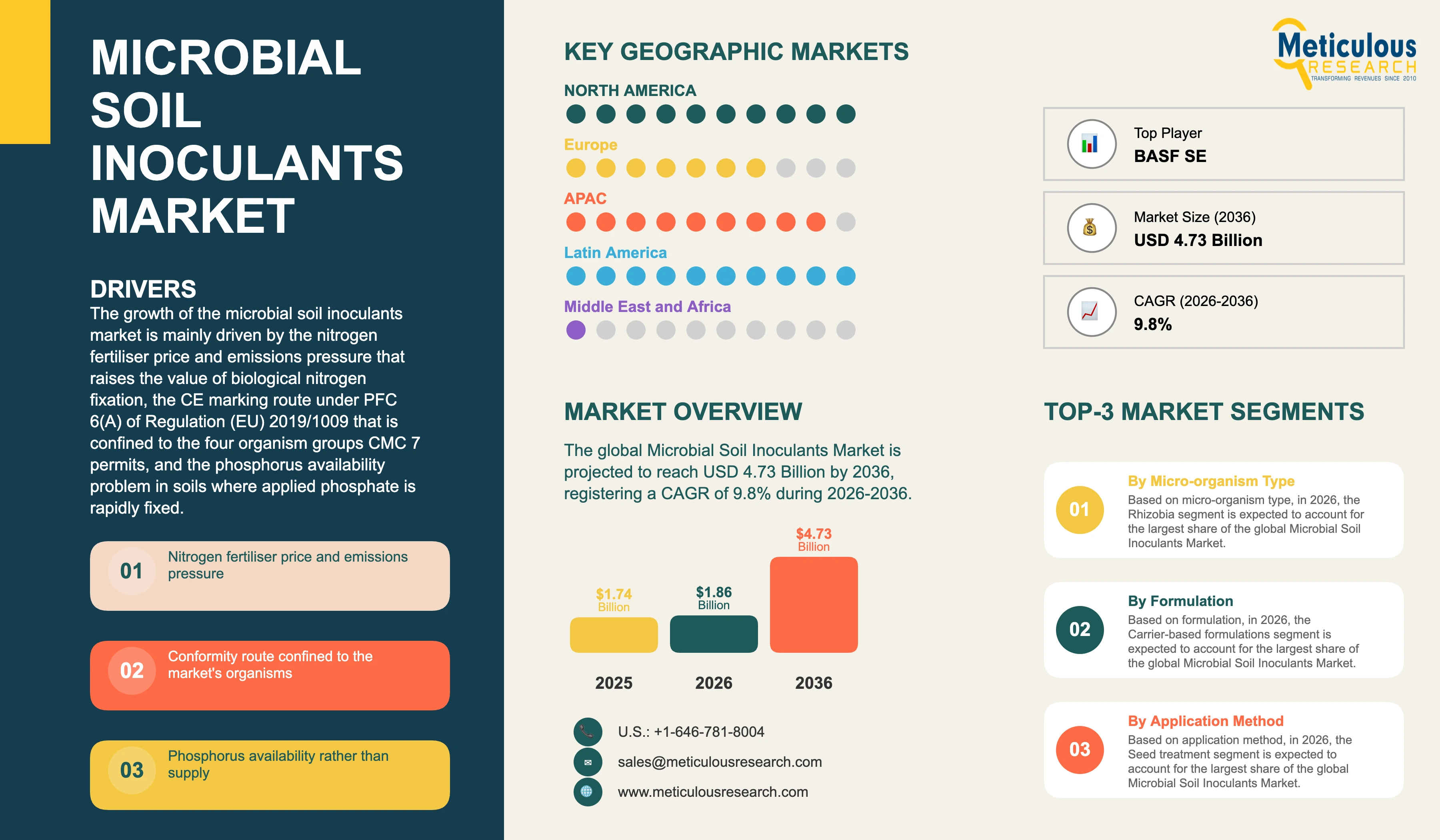
The global microbial soil inoculants market was valued at USD 1.74 billion in 2025. This market is expected to reach USD 4.73 billion by 2036 from an estimated USD 1.86 billion in 2026, registering a CAGR of 9.8% during the forecast period (2026-2036).
- Published
- Nov 2026
- Pages
- 278
- Format
- PDF + Excel
- Report ID
- MRAGR - 1042664
- Base year
- 2025
- 2025 · BASELINE
- $1.74B
- 2036
- $4.73B
- CAGR 2026–2036
- 9.8%
2025 baseline · 2026–2036 forecast at 9.8% CAGR · hover a bar for the value
Key highlights
The global microbial soil inoculants market is estimated at USD 1.86 billion in 2026 and is projected to reach USD 4.73 billion by 2036.
Market volume is estimated at 62.00 kilotons in 2026 and is projected to reach 172.85 kilotons by 2036 at a CAGR of 10.8%, measured as formulated product supplied.
The average selling price is estimated at USD 30.00 per kg in 2026 and is projected to reach USD 27.39 per kg by 2036.
Rhizobia are expected to account for the largest micro-organism share in 2026, while mycorrhizal fungi are projected to register the highest CAGR of 13.4%.
Carrier-based formulations are expected to hold the largest formulation share in 2026, while liquid formulations are projected to grow fastest at a CAGR of 11.8%.
Seed treatment is expected to be the largest application method in 2026, while in-furrow and soil application is projected to register the highest CAGR of 11.6%.
Oilseeds and pulses are expected to account for the largest crop type share in 2026, while fruits and vegetables are projected to grow fastest at a CAGR of 12.6%.
North America is expected to hold the largest regional share in 2026, while Asia-Pacific is projected to register the highest CAGR of 14.2%.
PFC 6(A) of Regulation (EU) 2019/1009 requires a microbial plant biostimulant to consist of a micro-organism or a consortium of micro-organisms referred to in CMC 7 in Part II of Annex II.
CMC 7 permits only four entries: Azotobacter spp., mycorrhizal fungi, Rhizobium spp. and Azospirillum spp.
CMC 7 permits dead or empty-cell micro-organisms and non-harmful residual elements of the media on which they were produced.
CMC 7 permits no processing other than drying or freeze-drying.
A plant biostimulant under Regulation (EU) 2019/1009 must stimulate plant nutrition processes independently of the nutrient content of the product.
The four permitted claim areas are nutrient use efficiency, tolerance to abiotic stress, quality traits, and availability of confined nutrients in the soil or rhizosphere.
A microbial plant biostimulant must have the effects claimed on the label for the plants specified on it.
PFC 6 limits contaminants to 1.5 mg/kg dry matter cadmium, 2 mg/kg hexavalent chromium, 120 mg/kg lead, 1 mg/kg mercury, 50 mg/kg nickel and 40 mg/kg inorganic arsenic.
PFC 6 limits copper to 600 mg/kg dry matter and zinc to 1, 500 mg/kg dry matter.
PFC 6(A) requires absence of Salmonella spp., Listeria monocytogenes, Vibrio spp., Shigella spp. and Staphylococcus aureus in 25 g or 25 ml, and absence of Escherichia coli in 1 g or 1 ml, across five sample units.
A liquid microbial plant biostimulant must have a pH optimal for the contained micro-organisms and for plants.
Annex III requires a microbial plant biostimulant to carry the warning that micro-organisms may have the potential to provoke sensitising reactions.
Report summary
| Particulars | Details |
|---|---|
| Base Year | 2025 |
| Forecast Period | 2026-2036 |
| Market Size in 2025 | USD 1.74 billion |
| Market Size in 2026 | USD 1.86 billion |
| Market Size by 2036 | USD 4.73 billion |
| Value CAGR (2026-2036) | 9.8% |
| Format | PDF, Excel & Cloud Portal · 278 pages |
| Volume in 2026 | 62.00 kilotons |
| Volume by 2036 | 172.85 kilotons |
| Volume CAGR (2026-2036) | 10.8% |
| Volume Basis | Formulated product supplied, not colony forming units |
| Average Selling Price in 2026 | USD 30.00 per kg |
| Average Selling Price by 2036 | USD 27.39 per kg |
| Measurement Basis | Formulated products containing living micro-organisms applied to seed, soil or growing media whose declared function is nutritional, excluding microbial biofungicides and other microbial plant protection products, microbial bioinsecticides and bionematicides, non-microbial biostimulants including seaweed and other plant extracts, humic and fulvic substances, chemical and organic fertilisers, compost and manure, and enzyme or metabolite products in which the producing organism is not present |
| Largest Micro-organism Type | Rhizobia |
| Fastest-Growing Micro-organism Type | Mycorrhizal fungi (CAGR 13.4%) |
| Largest Formulation | Carrier-based formulations |
| Fastest-Growing Formulation | Liquid formulations (CAGR 11.8%) |
| Largest Application Method | Seed treatment |
| Fastest-Growing Application Method | In-furrow and soil application (CAGR 11.6%) |
| Largest Crop Type | Oilseeds and pulses |
| Fastest-Growing Crop Type | Fruits and vegetables (CAGR 12.6%) |
| Largest Region | North America |
| Fastest-Growing Region | Asia-Pacific (CAGR 14.2%) |
| Segments Covered | Micro-organism Type, Formulation, Application Method, Crop Type, and Geography |
| Geographies Covered | North America, Latin America, Asia-Pacific, Europe, and Middle East & Africa |
| Companies Profiled | 11 companies, including BASF SE, Bayer AG, Corteva, Inc., Syngenta AG, Novonesis A/S, and Bioceres Crop Solutions Corp. |
Report overview
Segments covered: micro-organism type, formulation, application method, crop type.
In volume terms, this market is estimated at 62.00 kilotons in 2026 and is projected to reach 172.85 kilotons by 2036, registering a CAGR of 10.8% during the same period, measured as formulated product supplied rather than as colony forming units. The average selling price is estimated at USD 30.00 per kg in 2026 and is projected to decline to USD 27.39 per kg by 2036 as fermentation capacity expands and liquid concentrates at higher viable counts displace carrier-based products that carry inert peat weight.
The growth of this market is mainly driven by the nitrogen fertiliser price and emissions pressure that raises the value of biological nitrogen fixation, the closed list of four micro-organisms the European Union permits in a CE-marked microbial plant biostimulant, which has made a conformity route available to exactly the organisms this market is built on, the phosphorus availability problem in soils where applied phosphate is fixed rather than taken up, and the established seed inoculation practice in soybean and pulses that requires no change in grower behaviour. However, factors such as the viability of a living product through distribution and storage, and the variability of response against soil type, resident microflora and existing nutrient status, are expected to restrain the growth of this market to some extent.
Rhizobia account for the largest share of this market because symbiotic nitrogen fixation in soybean and pulses produces a yield and nitrogen response reliable enough that inoculation is standard practice across tens of millions of hectares. Mycorrhizal fungi grow faster because they act on phosphorus and water uptake in non-legume crops, which is where the addressable area lies, and because they are one of the four organism groups the European Union permits in a CE-marked microbial plant biostimulant.
Microbial soil inoculants are formulated products containing living micro-organisms applied to seed, soil or growing media to improve plant nutrition, nutrient availability or root establishment. Market sizing in this report is on both a value basis in USD and a volume basis in kilotons measured as formulated product supplied rather than as colony forming units, with average selling price derived from the two. The measurement basis is formulated products whose declared function is nutritional, and it excludes microbial biofungicides and other microbial plant protection products, microbial bioinsecticides and bionematicides, non-microbial biostimulants including seaweed and other plant extracts, humic and fulvic substances, chemical and organic fertilisers, compost and manure, and enzyme or metabolite products in which the producing organism is not present.
The claim rather than the organism decides which market a product belongs to, and that boundary is regulatory. A Bacillus or Trichoderma strain sold with a disease control claim is a plant protection product authorised under Regulation (EC) No 1107/2009 and falls outside this market, while the same strain sold with a nutrition or growth claim is a fertilising product under Regulation (EU) 2019/1009 and falls within it. The two routes carry entirely different data, labelling and liability, so a supplier chooses one and builds the dossier for it. A strain registered under both appears here only to the extent of its fertilising product sales.
PFC 6(A) of Regulation (EU) 2019/1009 requires a microbial plant biostimulant to consist of a micro-organism or a consortium of micro-organisms referred to in CMC 7 in Part II of Annex II, and CMC 7 permits only four entries, namely Azotobacter spp., mycorrhizal fungi, Rhizobium spp. and Azospirillum spp. Those four organisms may include dead or empty cells and non-harmful residual elements of the media on which they were produced, and may have undergone no processing other than drying or freeze-drying. A plant biostimulant must stimulate plant nutrition processes independently of the nutrient content of the product, with claims confined to nutrient use efficiency, tolerance to abiotic stress, quality traits and availability of confined nutrients in the soil or rhizosphere, and must have the claimed effects for the plants specified on the label.
That list of four is the single most consequential feature of the European market, because it determines which products can carry a CE mark and move across the single market and which cannot. A phosphate solubilising Bacillus or a Pseudomonas with well-documented nutritional effects is outside CMC 7, so it reaches European growers only under national fertiliser rules in individual member states or not at all. The four permitted organisms are consequently the ones that attract European product development, while the wider organism set remains commercially stronger outside Europe. Market structure in Europe follows the annex rather than the agronomy.
Nitrogen is the economic core of the market. Symbiotic fixation by rhizobia in soybean, groundnut and pulses supplies a substantial share of the nitrogen those crops require, which converts directly into fertiliser not purchased and into a yield response consistent enough that inoculation is standard practice on tens of millions of hectares in South America and North America. Synthetic nitrogen is produced from natural gas and its price follows gas, so every episode of high gas prices raises the value of the biological alternative. Free-living fixers such as Azotobacter and Azospirillum address non-legume crops but fix far less nitrogen and produce a smaller, less consistent response.
Phosphorus is the second nutritional problem the market addresses, and it is a problem of availability rather than supply. Applied phosphate is rapidly fixed by calcium, iron and aluminium in soil, so a large fraction of what is applied is never taken up and accumulates in a pool the crop cannot reach. Mycorrhizal fungi extend the effective root surface and access that pool, and phosphate solubilising bacteria release fixed phosphate into solution. The agronomic case is strongest where soils hold legacy phosphorus and where phosphate fertiliser is expensive, which is a different set of fields from those where nitrogen fixation pays.
Formulating a living product for soil application faces the same viability constraint as any microbial product, and it is why carrier-based formats still hold the largest share. Peat and other carriers protect the organism physically and buffer moisture, extending the period over which the declared count survives, but they carry inert weight that is shipped and handled for no agronomic purpose. Liquid concentrates remove that weight and dose more precisely, and formulation improvements have narrowed the viability gap that previously confined them to short supply chains. The shift is toward liquids on handling economics rather than on performance.
Seed inoculation is the dominant route because it places the organism exactly where it is needed at exactly the right time and uses very little product. Rhizobia must reach the root hair at germination to form nodules, and a seed-applied inoculant does that at a cost per hectare that broadacre crops carry without difficulty. The practice is long established in soybean and pulses, so adoption requires no change in grower behaviour and no additional field pass. In-furrow and soil application grows faster because it suits mycorrhizal and solubilising products that act through the soil volume rather than at the seed surface.
Response variability rather than product quality is what limits the market in practice. An introduced organism has to establish against resident soil microflora in a soil whose pH, texture, organic matter and nutrient status were not chosen by the supplier, and the response is largest where the limiting factor the organism addresses is actually limiting. A mycorrhizal inoculant on a soil already high in available phosphorus produces little, and a rhizobial inoculant on a field cropped to soybean for decades meets an established resident population. Field selection therefore does more for measured performance than formulation does.
Report infographic
Market dynamics
15 factors across 5 forcesNitrogen Fertiliser Price and Emissions Pressure Raising the Value of Biological Fixation
Synthetic nitrogen is produced from natural gas and its price follows gas, so the cost a grower avoids by fixing nitrogen biologically rises and falls with energy markets rather than with anything in the inoculant itself. Symbiotic fixation by rhizobia supplies a substantial share of the nitrogen that soybean, groundnut and pulses require, which converts directly into fertiliser not purchased, and the emissions attributed to nitrogen manufacture and to field application have brought the same substitution into supply chain reporting. A buyer reducing the footprint of a crop and a grower reducing an input bill are pulling in the same direction. The driver strengthens the established part of the market rather than opening a new one, and it is the reason rhizobial inoculation survives price pressure that other biological inputs do not.
A Conformity Route Confined to the Organisms This Market Is Built On
PFC 6(A) of Regulation (EU) 2019/1009 requires a microbial plant biostimulant to consist of a micro-organism or consortium referred to in CMC 7 in Part II of Annex II, and CMC 7 permits only Azotobacter spp., mycorrhizal fungi, Rhizobium spp. and Azospirillum spp., with no processing other than drying or freeze-drying and with dead or empty cells and non-harmful residual media permitted. Those four entries are precisely the organism groups that soil inoculation has always relied on, so the CE marking route is available to this market in a way it is not to the wider microbial sector. A product carrying the mark moves across the single market without separate national registration. The regulation therefore concentrates European development on exactly the organisms this report covers. Organisms outside the list face national rules in each member state, so the regulation sorts the sector as much as it enables it.
Phosphorus Availability Rather Than Phosphorus Supply
Applied phosphate is rapidly fixed by calcium, iron and aluminium compounds in soil, so a large fraction of what is applied is never taken up and accumulates as a pool the crop cannot reach, while phosphate rock is a finite resource whose price has moved sharply. Mycorrhizal fungi extend the effective root surface into that pool and phosphate solubilising bacteria return fixed phosphate to solution, which addresses the availability problem rather than adding more phosphate to a soil that cannot release what it holds. The availability of confined nutrients in the soil or rhizosphere is one of the four claim areas the regulation permits, so the agronomic case and the permitted claim coincide. That makes phosphorus the route by which inoculants reach non-legume crops. Soils that have received phosphate for decades carry the largest unreachable pool, so the oldest cropped land offers the strongest case.
Established Seed Inoculation Practice in Soybean and Pulses
Rhizobia must reach the root hair at germination to form nodules, and seed-applied inoculation does that at a cost per hectare broadacre crops carry without difficulty and with no additional field pass. The practice is long established across tens of millions of hectares of soybean, groundnut and pulses in South America, North America and South Asia, so adoption requires no change in grower behaviour, no new equipment and no agronomic argument that has not already been won. A supplier is competing for a share of an existing practice rather than creating one. That is why rhizobia hold the largest share of this market despite addressing the narrowest set of crops. The same practice also gives a supplier a route to introduce other organisms on the same seed, which is how non-legume products reach broadacre growers who would not evaluate a biological on its own.
Table of contents
12 chapters · 155 sections · 278 pages · click to expandGeographic analysis
North America
Largest shareIn 2026, North America is expected to account for the largest share of the global microbial soil inoculants market. The large share of this region is mainly due to the soybean and pulse area under routine rhizobial inoculation, the seed treatment infrastructure through which inoculants reach growers as part of a seed specification, the established position of biological products within broadacre input programmes, and the high-value horticultural and protected cropping demand for mycorrhizal and solubilising products. The United States is projected to register a CAGR of 8.2% during the forecast period.
Asia-Pacific
Fastest growthHowever, Asia-Pacific is projected to register the highest CAGR of 14.2% during the forecast period. The rapid growth of this region is attributed to the biofertiliser production and distribution base established in India, the pulse and groundnut area that suits rhizobial inoculation, the phosphorus availability problem in soils where applied phosphate is rapidly fixed, and the fertiliser cost pressure on smallholder margins. India is projected to register a CAGR of 15.4% and China a CAGR of 13.6%.
Latin America
Latin America is projected to grow at 9.2%, with Brazil at 9.6% and Argentina at 8.4%, where soybean inoculation is practised at a scale unmatched elsewhere and where the nitrogen avoided is a material share of the input bill.
Europe
Europe is projected to grow at 8.0%, with France at 7.8% and Spain at 8.4%, and is the region where PFC 6(A) and CMC 7 shape the market most directly, since only Azotobacter spp., mycorrhizal fungi, Rhizobium spp. and Azospirillum spp. can carry a CE mark as a microbial plant biostimulant. In Europe a product outside the four CMC 7 entries reaches growers only under national fertiliser rules in individual member states, so phosphate solubilising Bacillus and Pseudomonas products that sell widely elsewhere have no single market route. Production and formulation are also regional, because a product carrying a living organism with a limited shelf life is not shipped across long distances and through warm climates without losing the count it declares. Regional fermentation capacity is therefore a condition of serving a region rather than a cost choice, and it explains why the largest suppliers operate production sites on each continent they serve.
Middle East & Africa
The Middle East & Africa is projected to grow at 9.4%, where protected horticulture and irrigated field cropping account for most demand. Regulation determines which organisms can be sold where, and that divides the market along lines the agronomy does not.
Competitive landscape
The global microbial soil inoculants market is characterised by the presence of large crop protection and seed companies that have acquired inoculant businesses, fermentation and enzyme companies with agricultural biologicals divisions, mycorrhizal specialists whose production systems differ fundamentally from bacterial fermentation, and Indian and South American producers with established regional capacity. Competition is contested on fermentation and formulation capability and on access to seed treatment channels rather than on strain novelty, since the organism groups are defined by biology and, in Europe, by a closed regulatory list. BASF SE, Bayer AG, Corteva, Inc., Novonesis A/S and Bioceres Crop Solutions Corp. together accounted for an estimated 41.2% of this market in 2026, while the companies profiled in this report together accounted for an estimated 63.8%.
PFC 6(A) of Regulation (EU) 2019/1009 requires a microbial plant biostimulant to consist of a micro-organism or consortium referred to in CMC 7 in Part II of Annex II, and CMC 7 permits only Azotobacter spp., mycorrhizal fungi, Rhizobium spp. and Azospirillum spp., processed no further than drying or freeze-drying. Conformity assessment against PFC 6(A) and CMC 7, consortium formulations combining nitrogen and phosphorus organisms, and liquid concentrate development to remove carrier weight accounted for most competitive activity through 2026, with acquisition of mycorrhizal production capacity rather than of strain libraries the route by which the larger companies entered that part of the market rather than building the production systems themselves.
Production capability rather than portfolio breadth separates the competitors, because mycorrhizal fungi are obligate symbionts that cannot be fermented in the systems that produce rhizobia. Groundwork BioAg Ltd. competes through mycorrhizal production specifically, Novonesis A/S and Lallemand Inc. through fermentation capability, and Bioceres Crop Solutions Corp. and T. Stanes & Company Limited through established regional production and distribution. Some of the key players operating in the microbial soil inoculants market are BASF SE (Germany), Bayer AG (Germany), Corteva, Inc. (U.S.), Syngenta AG (Switzerland), Novonesis A/S (Denmark), Bioceres Crop Solutions Corp. (U.S.), Sumitomo Chemical Co., Ltd. (Japan), UPL Limited (India), Lallemand Inc. (Canada), Groundwork BioAg Ltd. (Israel), and T. Stanes & Company Limited (India), among others.
- —
PFC 6(A) of Regulation (EU) 2019/1009 requires a microbial plant biostimulant to consist of a micro-organism or consortium referred to in CMC 7 in Part II of Annex II, and CMC 7 permits only Azotobacter spp., mycorrhizal fungi, Rhizobium spp. and Azospirillum spp., including dead or empty cells and non-harmful residual media, with no processing other than drying or freeze-drying. PFC 6 limits cadmium to 1.5 mg/kg dry matter, hexavalent chromium to 2 mg/kg, lead to 120 mg/kg, mercury to 1 mg/kg, nickel to 50 mg/kg, inorganic arsenic to 40 mg/kg, copper to 600 mg/kg and zinc to 1,500 mg/kg.
- BASF SE
- Bayer AG
- Corteva, Inc.
- Syngenta AG
- Novonesis A/S
- Bioceres Crop Solutions Corp
Expert perspectives
Volume grows at 10.8% against 9.8% in value over the forecast period, and the average selling price falls from USD 30.00 per kg in 2026 to USD 27.39 per kg by 2036 as fermentation capacity expands and liquid concentrates at higher viable counts displace carrier-based products carrying inert peat weight. Removing carrier from the shipped product lowers price per kilogram without lowering price per hectare, so the decline overstates any change in what a grower pays to treat a field.
CMC 7 is the most consequential sentence in this market. Only Azotobacter spp., mycorrhizal fungi, Rhizobium spp. and Azospirillum spp. may be used in a CE-marked microbial plant biostimulant, processed no further than drying or freeze-drying. Those four happen to be what soil inoculation has always relied on, so this market has a single market route the wider microbial sector does not, while phosphate solubilising Bacillus and Pseudomonas products remain confined to national rules in Europe.
The claim rather than the organism decides which market a product sits in. The same strain sold with a disease control claim is a plant protection product under Regulation (EC) No 1107/2009, and sold with a nutrition claim is a fertilising product under Regulation (EU) 2019/1009. That boundary is why this market and the microbial biofungicides market do not overlap despite sharing organisms, and it is a decision a supplier makes once and builds a dossier around.
Rhizobia hold the largest share while addressing the narrowest set of crops, which is the central tension in the market. Legume symbiosis produces a response reliable enough to make inoculation routine on tens of millions of hectares, but it cannot extend past legumes. Mycorrhizal fungi grow fastest at 13.4% because they form associations with most crop species, and that is where the addressable area rather than the current revenue lies.
What constrains growth is attribution rather than efficacy. Soil already contains organisms performing these functions, so an inoculant improves on a function partly supplied rather than introducing a missing one, and the improvement is largest only where the factor it addresses is genuinely limiting. A product can be sound and show no response on a field whose resident population is adequate or whose available phosphorus is already high.
Production economics decide which organisms a company can offer. Rhizobia and the free-living fixers ferment conventionally at predictable yields, while mycorrhizal fungi are obligate symbionts requiring root culture systems with far longer cycles and higher cost per propagule, and the permitted processing is limited to drying or freeze-drying. That is why mycorrhizal supply sits with specialists rather than with the largest companies, and why acquisitions in this market tend to buy production rather than strains.
Customer perspectives
Rhizobial inoculation is established practice justified by the nitrogen fertiliser avoided, while the response to phosphorus-focused products depends on the nutrient status of the individual field rather than on the product.
A single conformity assessment has replaced national registrations for products meeting PFC 6(A), while organisms outside the four CMC 7 entries remain confined to individual member state fertiliser rules.
Precise placement at transplanting and delivery through fertigation suit protected horticulture, where demand is for phosphorus and root establishment products rather than for nitrogen fixation, which places mycorrhizal and solubilising organisms rather than rhizobia at the centre of horticultural programmes, and makes placement at planting rather than in-season application the decisive step.
“Inoculating soybean is not a decision we revisit each year, it is part of how the crop is planted, and the nitrogen we do not buy is the whole argument. Where we are still learning is the phosphorus products. They pay on some of our fields and do nothing on others, and the soil test tells us more about that than the label does.”
“The CE route under the fertilising products regulation changed our European planning completely, because one conformity assessment replaced a stack of national registrations. The catch is the component list. We hold organisms with good nutritional data that are simply not on it, and for those we are back to member state by member state.”
“In transplanted crops we can place inoculum precisely at planting and then feed through the drip, which is a level of control a field crop never has. The products that work for us are the ones acting on phosphorus and root establishment, not nitrogen fixation, because we are not growing legumes.”
Frequently asked questions
This market was valued at USD 1.62 billion in 2024 and USD 1.74 billion in 2025, and is estimated at USD 1.86 billion in 2026. In volume terms it is estimated at 62.00 kilotons in 2026 as formulated product supplied.
Cite this report
Meticulous Research. (2026). Microbial Soil Inoculants Market - Global Opportunity Analysis and Industry Forecast (2026-2036) (Report No. MRAGR - 1042664). Meticulous Market Research Pvt. Ltd. https://www.meticulousresearch.com/product/microbial-soil-inoculants-market-7347