Botanical Insecticides Market (2026-2036)
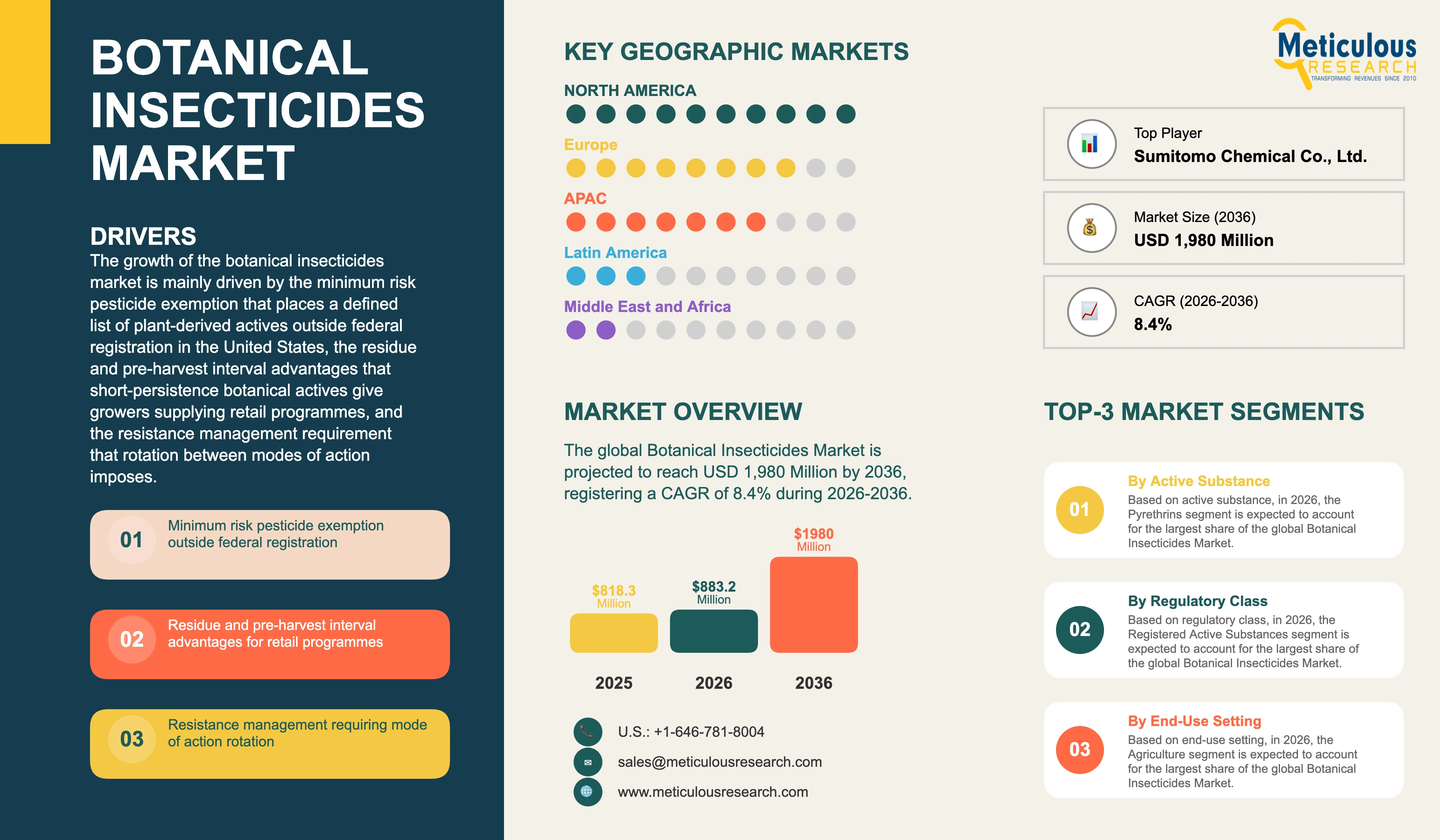
The global botanical insecticides market was valued at USD 818.3 million in 2025. This market is expected to reach USD 1,980.0 million by 2036 from an estimated USD 883.2 million in 2026, registering a CAGR of 8.4% during the forecast period (2026-2036).
- Published
- Nov 2026
- Pages
- 280
- Format
- PDF + Excel
- Report ID
- MRAGR - 1042660
- Base year
- 2025
- 2025 · BASELINE
- $818.3M
- 2036
- $1.98B
- CAGR 2026–2036
- 8.4%
2025 baseline · 2026–2036 forecast at 8.4% CAGR · hover a bar for the value
Key highlights
The global botanical insecticides market is estimated at USD 883.2 million in 2026 and is projected to reach USD 1,980.0 million by 2036.
Market volume is estimated at 36.80 kilotons in 2026 and is projected to reach 88.79 kilotons by 2036 at a CAGR of 9.2%, measured as formulated product supplied.
The average selling price is estimated at USD 24.00 per kg in 2026 and is projected to reach USD 22.30 per kg by 2036.
Pyrethrins are expected to account for the largest active substance share in 2026, while essential oils are projected to register the highest CAGR of 11.8%.
Registered active substances are expected to hold the largest regulatory class share in 2026, while minimum risk and exempt substances are projected to grow fastest at a CAGR of 12.4%.
Agriculture is expected to be the largest end-use setting in 2026, while home and garden is projected to register the highest CAGR of 10.6%.
Emulsifiable concentrate is expected to account for the largest formulation share in 2026, while ready-to-use spray is projected to grow fastest at a CAGR of 11.2%.
Sucking pests are expected to be the largest target pest group in 2026, while mites and acarines are projected to register the highest CAGR of 10.2%.
North America is expected to hold the largest regional share in 2026, while Asia-Pacific is projected to register the highest CAGR of 11.6%.
The minimum risk pesticide exemption at 40 CFR 152.25(f) exempts products containing only listed active ingredients from registration under the Federal Insecticide, Fungicide and Rodenticide Act.
That list includes cedarwood oil, cinnamon and cinnamon oil, citronella and citronella oil, cloves and clove oil, cornmint and cornmint oil, eugenol, garlic and garlic oil, geraniol, geranium oil, lemongrass oil, peppermint and peppermint oil, 2-phenylethyl propionate, rosemary and rosemary oil, sesame and sesame oil, soybean oil, spearmint and spearmint oil, thyme and thyme oil and white pepper, alongside non-botanical entries.
Chitosan was added to that list in November 2022 with an effective date of 9 January 2023.
Pyrethrins, azadirachtin and other extracted botanical actives are not on that list and require full registration.
An exempt product may contain only the inert ingredients permitted under the exemption, drawn from commonly consumed food commodities, animal feed items, edible fats and oils, and a specified list of chemical substances.
The label of an exempt product must identify each active ingredient by its listed display name with its percentage by weight, and list all inert ingredients by their listed display names.
An exempt product must not bear claims to control or mitigate microorganisms that pose a threat to human health, or to control insects or rodents carrying specific diseases, including ticks that carry Lyme disease.
The label must carry the producer or distributing company name, a street address with ZIP code and a telephone number, displayed prominently.
Products for food uses may contain only listed active ingredients that have tolerances or tolerance exemptions under 40 CFR 180, which has to be verified for each food use before labelling.
In the European Union, a botanical active substance reaches the market under Regulation (EC) No 1107/2009 as an approved active substance, a low-risk active substance or a basic substance, each carrying a different data and authorisation burden.
Report summary
| Particulars | Details |
|---|---|
| Base Year | 2025 |
| Forecast Period | 2026-2036 |
| Market Size in 2025 | USD 818.3 million |
| Market Size in 2026 | USD 883.2 million |
| Market Size by 2036 | USD 1,980.0 million |
| Value CAGR (2026-2036) | 8.4% |
| Format | PDF, Excel & Cloud Portal · 280 pages |
| Volume in 2026 | 36.80 kilotons |
| Volume by 2036 | 88.79 kilotons |
| Volume CAGR (2026-2036) | 9.2% |
| Volume Basis | Formulated product supplied, not technical active substance |
| Average Selling Price in 2026 | USD 24.00 per kg |
| Average Selling Price by 2036 | USD 22.30 per kg |
| Measurement Basis | Plant-derived insecticidal and acaricidal product sold for pest control, excluding synthetic pyrethroids and other synthetic analogues of botanical actives, microbial and fermentation-derived insecticides, semiochemicals and pheromones, mineral and horticultural oils, diatomaceous earth and inorganic actives, botanical fungicides, herbicides and nematicides, and plant biostimulants |
| Largest Active Substance Segment | Pyrethrins |
| Fastest-Growing Active Substance Segment | Essential oils (CAGR 11.8%) |
| Largest Regulatory Class | Registered active substances |
| Fastest-Growing Regulatory Class | Minimum risk and exempt substances (CAGR 12.4%) |
| Largest End-Use Setting | Agriculture |
| Fastest-Growing End-Use Setting | Home and garden (CAGR 10.6%) |
| Largest Formulation | Emulsifiable concentrate |
| Fastest-Growing Formulation | Ready-to-use spray (CAGR 11.2%) |
| Largest Target Pest Segment | Sucking pests |
| Fastest-Growing Target Pest Segment | Mites and acarines (CAGR 10.2%) |
| Largest Region | North America |
| Fastest-Growing Region | Asia-Pacific (CAGR 11.6%) |
| Segments Covered | Active Substance, Regulatory Class, End-Use Setting, Formulation, Target Pest, and Geography |
| Geographies Covered | North America, Europe, Asia-Pacific, Latin America, and Middle East & Africa |
| Companies Profiled | 11 companies, including Sumitomo Chemical Co., Ltd., UPL Limited, Corteva, Inc., Syngenta AG, EID Parry (India) Limited, and Andermatt Group AG |
Report overview
Segments covered: active substance, regulatory class, end-use setting, formulation, target pest.
In volume terms, this market is estimated at 36.80 kilotons in 2026 and is projected to reach 88.79 kilotons by 2036, registering a CAGR of 9.2% during the same period, measured as formulated product supplied rather than as technical active substance. The average selling price is estimated at USD 24.00 per kg in 2026 and is projected to decline to USD 22.30 per kg by 2036 as essential oil formulations outside the registration requirement take a larger share of volume and azadirachtin extraction capacity expands in India.
The growth of this market is mainly driven by the minimum risk pesticide exemption that places a defined list of plant-derived actives outside federal registration in the United States, the residue and pre-harvest interval advantages that short-persistence botanical actives give growers supplying retail programmes, the resistance management requirement that rotation between modes of action imposes on conventional insecticide programmes, and the organic production rules that permit specific botanical actives where synthetic insecticides are excluded. However, factors such as the rapid photodegradation that limits residual control and raises application frequency, and the prohibition on public health claims for exempt products, are expected to restrain the growth of this market to some extent.
Pyrethrins account for the largest share of this market because they deliver fast knockdown across a broad pest range and hold registrations in agriculture, professional pest management and public health that no other botanical active matches. Essential oils grow faster because the minimum risk exemption removes the registration cost that a new conventional active carries, which allows a formulator to bring a product to market without a data package.
Botanical insecticides are insecticidal active substances extracted from plants, and the formulated products built on them, applied to control insect and mite pests in crops, buildings and amenity settings. Market sizing in this report is on both a value basis in USD and a volume basis in kilotons measured as formulated product supplied rather than as technical active substance, with average selling price derived from the two. The measurement basis is plant-derived insecticidal and acaricidal product sold for pest control, and it excludes synthetic pyrethroids and other synthetic analogues of botanical actives, microbial insecticides and the fermentation-derived actives, semiochemicals and pheromones, mineral and horticultural oils, diatomaceous earth and inorganic actives, botanical fungicides, herbicides and nematicides, and plant biostimulants.
The exclusion of synthetic pyrethroids is what makes this market definable. Permethrin, cypermethrin and the other pyrethroids are synthetic molecules modelled on the natural pyrethrin structure and are far more photostable and far cheaper per hectare, so they occupy most of the volume that the natural product originated. Natural pyrethrins remain a distinct market because they carry organic approvals, a different residue and persistence profile, and registrations in settings where a synthetic pyrethroid is not acceptable. Conflating the two overstates this market by an order of magnitude.
Two different regulatory routes divide the market more sharply than chemistry does. In the United States, the minimum risk pesticide exemption at 40 CFR 152.25(f), which exempts products containing only listed active ingredients from registration under the Federal Insecticide, Fungicide and Rodenticide Act, while pyrethrins, azadirachtin and other extracted botanical actives are not on that list and require full registration with the associated data package. A formulator can therefore bring an essential oil product to market without a registration while a competitor selling a pyrethrin product carries the full cost of maintaining one.
The exempt list is specific rather than generic. It includes cedarwood oil, cinnamon and cinnamon oil, citronella and citronella oil, cloves and clove oil, cornmint and cornmint oil, eugenol, garlic and garlic oil, geraniol, geranium oil, lemongrass oil, peppermint and peppermint oil, 2-phenylethyl propionate, rosemary and rosemary oil, sesame and sesame oil, soybean oil, spearmint and spearmint oil, thyme and thyme oil and white pepper, alongside non-botanical entries, and chitosan was added in November 2022 with effect from 9 January 2023. An oil not on the list cannot be used in an exempt product however similar it appears to one that is.
The exemption carries conditions that shape what an exempt product can be and claim. Only the permitted inert ingredients may be used, drawn from commonly consumed food commodities, animal feed items, edible fats and oils and a specified list of chemical substances; the label must identify each active ingredient by its listed display name with its percentage by weight and list all inert ingredients by their listed display names; and the producer or distributing company name, street address with ZIP code and telephone number must appear prominently. Formulation latitude is therefore narrower in an exempt product than in a registered one, since surfactants and solvents outside the permitted list cannot be used.
The claim restriction is the most commercially consequential condition. An exempt product must not bear claims to control or mitigate microorganisms that pose a threat to human health, or to control insects or rodents carrying specific diseases, including ticks that carry Lyme disease. A mosquito or tick product that would otherwise be positioned on disease transmission therefore has to be sold on nuisance control instead, which is a weaker proposition to a consumer. Public health and vector applications consequently remain with registered actives, principally pyrethrins, rather than migrating to the exempt essential oils.
Food use adds a second gate inside the exemption. Products for food uses may contain only listed active ingredients that have tolerances or tolerance exemptions under 40 CFR 180, and each food use has to be verified against that part before labelling, while products for non-food uses may contain any listed ingredient. The exempt route is therefore wider in home, garden and amenity settings than on a food crop, which is part of why home and garden grows faster than agriculture in this market. A formulator serving both has to maintain two label positions from one list.
Regulation (EC) No 1107/2009, under which a botanical active substance reaches the European market as an approved active substance, a low-risk active substance or a basic substance. A basic substance approval requires no authorisation of individual products and carries no data protection, which suits a substance already in food or cosmetic use but offers no commercial exclusivity, while a low-risk active substance carries a longer approval period and faster member state authorisation than a conventional active. There is no European equivalent of the United States exemption, so every product placed on the European market requires an authorisation regardless of how benign the active is. European volumes consequently concentrate on the small number of botanical actives that have completed approval.
Performance constraints are inherent to the chemistry rather than to the formulation. Pyrethrins and most botanical actives photodegrade within hours to days in sunlight, which gives the short pre-harvest interval and low residue profile that growers value and simultaneously removes the residual control that a conventional insecticide provides. Application frequency is therefore higher and timing more critical, and the cost per season rather than the cost per litre is the relevant comparison. Azadirachtin acts as a growth regulator and antifeedant over days rather than killing on contact, which requires the application to anticipate the pest rather than react to visible damage.
Registered active substances are expected to hold the largest share in 2026, since pyrethrins and azadirachtin are not on the minimum risk list.
Minimum risk and exempt substances are projected to register the highest CAGR of 12.4% during the forecast period.
Agriculture is expected to account for the largest share in 2026.
Home and garden is projected to register the highest CAGR of 10.6% during the forecast period.
Emulsifiable concentrate is expected to hold the largest share in 2026.
Ready-to-use spray is projected to register the highest CAGR of 11.2% during the forecast period.
North America is expected to account for the largest share in 2026, supported by the minimum risk exemption that has no equivalent in any other major market and by large home and garden and professional pest management channels. The United States is projected to grow at 7.6% and Canada at 7.2%.
Asia-Pacific is projected to register the highest CAGR of 11.6% during the forecast period, with India at 13.4% and China at 10.8%.
Europe is projected to grow at a CAGR of 7.2%, with France at 7.4% and Germany at 7.0%. The region offers no exemption from product authorisation, so volumes concentrate on the small number of botanical actives that have completed approval under Regulation (EC) No 1107/2009 as approved, low-risk or basic substances.
The Middle East & Africa is projected to grow at a CAGR of 7.2%, where Kenya and neighbouring countries supply much of the world pyrethrum flower crop while the regional market itself remains small. Latin America is projected to grow at a CAGR of 8.0%, with Brazil at 8.4%.
Sumitomo Chemical Co., Ltd., UPL Limited, Corteva, Inc., Syngenta AG and EID Parry (India) Limited together accounted for an estimated 36.2% of this market in 2026. The 11 companies profiled in this report together accounted for an estimated 54.5%.
Report infographic
Market dynamics
15 factors across 5 forcesMinimum Risk Pesticide Exemption Placing Listed Actives Outside Federal Registration
The minimum risk pesticide exemption at 40 CFR 152.25(f) exempts products containing only listed active ingredients from registration under the Federal Insecticide, Fungicide and Rodenticide Act, and the list includes cinnamon, citronella, clove, cornmint, garlic, geranium, lemongrass, peppermint, rosemary, sesame, soybean, spearmint and thyme oils together with eugenol, geraniol, 2-phenylethyl propionate and white pepper. A new conventional insecticide active requires a data package costing many years and a substantial sum to assemble, while an exempt product requires none. That difference allows small formulators to enter the market and allows a product to be launched against a seasonal pest problem rather than a development timetable. The exemption is the single largest reason essential oils grow faster than the market as a whole. It also means the competitive set in that part of the market is not the crop protection industry but any formulator able to blend and bottle a listed oil, which is why the exempt part of this market is far more fragmented than the registered part.
Residue and Pre-Harvest Interval Advantages for Retail Supply Programmes
Botanical actives photodegrade within hours to days, which produces short pre-harvest intervals and low detectable residue at harvest, and retail produce programmes commonly set residue specifications and maximum residue number limits below the legal thresholds. A grower facing a pest problem close to harvest has few conventional options that will clear the interval, which is where a botanical product is specified regardless of its cost per hectare. The same property supports export programmes into markets with different residue tolerances, since a degraded active does not create a trade problem. The driver therefore operates on timing within the season rather than on total programme spend, and it holds even where the grower uses conventional products for the rest of the programme, since the requirement applies to the last application before harvest rather than to the season.
Resistance Management Requiring Rotation Between Modes of Action
Repeated use of a single insecticide mode of action selects for resistance, and resistance management guidance requires rotation across a season, which creates a place in the programme for an active with a different mode of action rather than a better one. Pyrethrins act on sodium channels in the same way as the synthetic pyrethroids, so they do not serve rotation against that class, while azadirachtin acts as an insect growth regulator and antifeedant and the essential oils act through octopamine receptor and membrane disruption mechanisms with no conventional equivalent. Those actives occupy rotation slots that a conventional product cannot fill. The requirement is written into crop protection practice rather than into regulation, which makes it durable. An adviser recommending a rotation is choosing a mechanism rather than a product, so the botanical active competes against other non-conventional mechanisms rather than against the conventional insecticide it rotates with, which narrows the competitive set considerably.
Organic Production Rules Permitting Specific Botanical Actives
Organic certification excludes synthetic insecticides while permitting specific botanical actives, which makes pyrethrins, azadirachtin and the essential oils the available chemical options for an organic grower facing a pest outbreak rather than one option among many. Organic area and organic retail demand grow independently of the insecticide market, and the insecticide spend per hectare on an organic crop is constrained by the available actives rather than by price comparison with conventional alternatives. Certification bodies list permitted substances individually, so an approval is specific to the active and in some cases to the formulation. Products holding those listings carry a protected position within the organic segment, and the listing attaches to the formulation rather than only to the active.
Table of contents
13 chapters · 150 sections · 280 pages · click to expandSegmental analysis
| Segment | Largest share (2026) | Fastest growth (2026–2036) |
|---|---|---|
| By Active Substance | Pyrethrins | — |
| Other segments | — | Essential oils |
By Active Substance
- Pyrethrins are expected to account for the largest share in 2026, supported by fast contact knockdown and by registrations in agriculture, professional pest management and public health.
- Sucking pests are expected to account for the largest share in 2026.
Other segments
- Essential oils are projected to register the highest CAGR of 11.8% during the forecast period.
- Mites and acarines are projected to register the highest CAGR of 10.2% during the forecast period.
Geographic analysis
North America
Largest shareIn 2026, North America is expected to account for the largest share of the global botanical insecticides market. The large share of this region is mainly due to the minimum risk pesticide exemption at 40 CFR 152.25(f), which places products containing only listed actives outside federal registration and has no equivalent in any other major market, the large home and garden and professional pest management channels that exempt products serve, and the registered pyrethrin and azadirachtin positions in specialty crop agriculture. The United States is projected to register a CAGR of 7.6% and Canada a CAGR of 7.2% during the forecast period.
Asia-Pacific
Fastest growthHowever, Asia-Pacific is projected to register the highest CAGR of 11.6% during the forecast period. The rapid growth of this region is attributed to the neem seed kernel feedstock and azadirachtin extraction and formulation capacity concentrated in India, the horticultural and export crop production that faces residue specifications in destination markets, and the pest resistance pressure in intensively cropped systems that creates demand for non-conventional modes of action. India is projected to register a CAGR of 13.4% and China a CAGR of 10.8%.
Europe
Europe is projected to grow at 7.2%, with France at 7.4% and Germany at 7.0%, on organic area and protected cropping demand within a framework that offers no exemption from product authorisation, so volumes concentrate on the small number of botanical actives that have completed approval under Regulation (EC) No 1107/2009.
Latin America
Latin America is projected to grow at 8.0%, with Brazil at 8.4% as horticultural and coffee programmes adopt rotation partners.
Middle East & Africa
The Middle East & Africa is projected to grow at 7.2%, where Kenya and neighbouring countries supply much of the world pyrethrum flower crop and the regional market itself remains small. Where the regulatory route exists and where the raw material grows are different places, and the trade follows from that. The exemption that makes an essential oil product commercially straightforward exists only in the United States, pyrethrum flower is grown principally in East Africa and Australia, and azadirachtin extraction sits in India, so active substance and concentrate move between regions while formulation and labelling happen close to the market that will sell the product. A product qualifying for the exemption in one country requires a full authorisation in another, which means the same formulation reaches different markets as different regulatory objects. Formulation is consequently regional even where the active supply is not, and a supplier serving both routes maintains two label systems from one formulation.
Competitive landscape
The global botanical insecticides market is characterised by the presence of crop protection companies holding registered botanical actives, biocontrol specialists with organic and integrated pest management portfolios, Indian azadirachtin extractors and formulators, and consumer product companies selling exempt formulations through retail channels. Competition is contested on registration position and formulation stability rather than on active substance, since the actives themselves are available to any formulator while a registration, an organic listing and a stabilised formulation are not. Sumitomo Chemical Co., Ltd., UPL Limited, Corteva, Inc., Syngenta AG and EID Parry (India) Limited together accounted for an estimated 36.2% of this market in 2026, while the companies profiled in this report together accounted for an estimated 54.5%.
Chitosan was added to the minimum risk active ingredient list in November 2022 with effect from 9 January 2023, and the exemption continues to require that only permitted inert ingredients be used, that every active and inert ingredient be listed by its prescribed display name with active percentages by weight, that company name, street address with ZIP code and telephone number appear prominently, and that no public health claim be made. Suppliers responded through exempt consumer ranges built on listed oils, encapsulated and stabilised formulations of registered actives, and rotation positioning against resistance in high-value crops. Formulation stability and channel-specific ranges accounted for most competitive activity through 2026.
The market remains fragmented, because an exempt product requires no registration and can therefore be brought to market by a formulator with no regulatory function at all. Consumer product companies including Spectrum Brands Holdings, Inc. and Central Garden & Pet Company reach retail shelves directly, while Andermatt Group AG and W. Neudorff GmbH KG serve organic and integrated programmes and EID Parry (India) Limited supplies azadirachtin from Indian feedstock. Some of the key players operating in the botanical insecticides market are Sumitomo Chemical Co., Ltd. (Japan), UPL Limited (India), Corteva, Inc. (U.S.), Syngenta AG (Switzerland), EID Parry (India) Limited (India), Andermatt Group AG (Switzerland), W. Neudorff GmbH KG (Germany), Bioceres Crop Solutions Corp. (U.S.), Gowan Company, L.L.C. (U.S.), Spectrum Brands Holdings, Inc. (U.S.), and Central Garden & Pet Company (U.S.), among others.
- —
Chitosan was added to the minimum risk active ingredient list in November 2022 with an effective date of 9 January 2023. The exemption at 40 CFR 152.25(f) continues to require that only permitted inert ingredients be used, that every active and inert ingredient be listed by its prescribed display name with active percentages by weight, that the company name, street address with ZIP code and telephone number appear prominently, and that no claim be made to control microorganisms posing a threat to human health or insects and rodents carrying specific diseases.
- Sumitomo Chemical Co., Ltd.
- UPL Limited
- Corteva, Inc.
- Syngenta AG
- EID Parry (India) Limited
- Andermatt Group AG
Expert perspectives
Volume grows at 9.2% against 8.4% in value over the forecast period, and the average selling price falls from USD 24.00 per kg in 2026 to USD 22.30 per kg by 2036 as essential oil formulations outside the registration requirement take a larger share of volume and azadirachtin extraction capacity expands in India. The exempt actives are cheaper per kilogram of formulated product than registered pyrethrins, so a mix shift toward them lowers the average price without any single product being discounted.
The regulatory route rather than the chemistry is what divides this market. Products containing only actives on the minimum risk list are exempt from federal registration, while pyrethrins and azadirachtin are not on that list and carry the full data package. One competitor can therefore launch without a registration while another funds one, which is why portfolios are now organised by route and why exempt substances grow at 12.4% against a market at 8.4%.
The exemption is narrower than it first appears, and the limits explain the segment pattern. Only permitted inert ingredients may be used, which constrains the emulsification and stabilisation that volatile, poorly water-soluble oils actually need; food uses require a tolerance or tolerance exemption under 40 CFR 180 while non-food uses do not; and no public health claim may be made. Those three conditions between them push exempt products toward non-food consumer and amenity settings, which is precisely where home and garden growth comes from.
The claim prohibition protects pyrethrins in the one application where the value is highest. An exempt product cannot claim to control insects carrying specific diseases, including ticks that carry Lyme disease, so a mosquito or tick product on the exempt route sells on nuisance rather than on disease. Taking that claim means registering, at which point the cost advantage disappears, so public health and vector work stays with registered actives rather than migrating.
What this market does not compete on is performance against conventional insecticides. Botanical actives photodegrade within hours to days, which removes residual control and raises application frequency, so cost per season rather than cost per litre is the honest comparison and botanical programmes are frequently more expensive. They are specified for what the persistence profile delivers instead, namely short pre-harvest intervals, low residue at harvest, organic eligibility and a rotation slot against resistance.
Natural pyrethrins and synthetic pyrethroids have to be kept apart to size this market correctly. The synthetics are modelled on the natural structure, are far more photostable and far cheaper per hectare, and hold most of the volume the natural product originated. Treating them as one market overstates botanical insecticides by an order of magnitude, and the natural product survives on organic approvals, residue profile and registrations in settings where a synthetic pyrethroid is not acceptable.
Customer perspectives
Pre-harvest interval and rotation requirement rather than efficacy drive selection, with the absence of residual control accepted as the cost of both.
The two regulatory routes are run as separate businesses, with speed to market and formulation and claim restrictions traded against registration cost and access to food crop and public health applications.
Formulation stability and batch consistency rather than extract availability determine distributor selection, since the actives themselves are available to any formulator who wishes to buy them on the open market.
“We use botanicals for two reasons, the interval before harvest and the rotation slot. If I have thrips three days before picking, a conventional product is not available to me and a botanical is. The trade-off is that there is no residual, so I am spraying more often and timing matters far more than it does with a conventional.”
“The exempt route and the registered route are two different businesses inside one company. On the exempt side we can be on shelf in months, but we cannot use the surfactants we would want and we cannot make a disease claim. On the registered side we carry the data package but we can sell into public health and onto food crops.”
“What I ask about now is the formulation, not the extract. Everyone can buy neem or clove oil, but whether it holds up in the tank, on the leaf and on my shelf for two seasons is down to how it was made. Batch-to-batch consistency is the other thing, because a plant extract is not a manufactured molecule.”
Frequently asked questions
This market was valued at USD 765.0 million in 2024 and USD 818.3 million in 2025, and is estimated at USD 883.2 million in 2026. In volume terms it is estimated at 36.80 kilotons in 2026 as formulated product supplied.
Cite this report
Meticulous Research. (2026). Botanical Insecticides Market - Global Opportunity Analysis and Industry Forecast (2026-2036) (Report No. MRAGR - 1042660). Meticulous Market Research Pvt. Ltd. https://www.meticulousresearch.com/product/botanical-insecticides-market-7343