Nitrogen Fixing Biologicals Market (2026-2036)
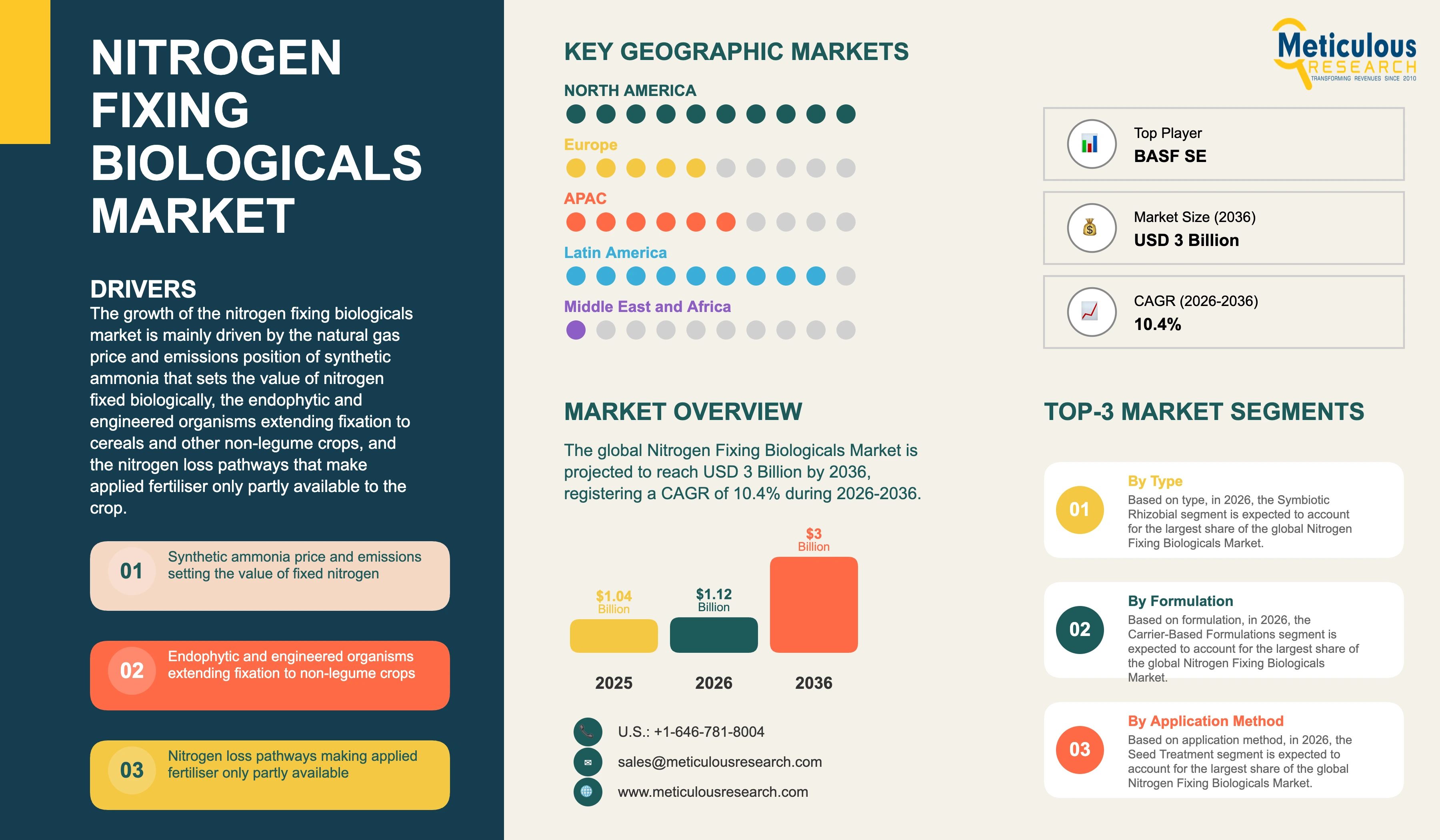
The global nitrogen fixing biologicals market was valued at USD 1.04 billion in 2025. This market is expected to reach USD 3.00 billion by 2036 from an estimated USD 1.12 billion in 2026, registering a CAGR of 10.4% during the forecast period (2026-2036).
- Published
- Nov 2026
- Pages
- 278
- Format
- PDF + Excel
- Report ID
- MRAGR - 1042665
- Base year
- 2025
- 2025 · BASELINE
- $1.04B
- 2036
- $3.00B
- CAGR 2026–2036
- 10.4%
2025 baseline · 2026–2036 forecast at 10.4% CAGR · hover a bar for the value
Key highlights
The global nitrogen fixing biologicals market is estimated at USD 1.12 billion in 2026 and is projected to reach USD 3.00 billion by 2036.
Market volume is estimated at 38.50 kilotons in 2026 and is projected to reach 113.30 kilotons by 2036 at a CAGR of 11.4%, measured as formulated product supplied.
The average selling price is estimated at USD 29.00 per kg in 2026 and is projected to reach USD 26.49 per kg by 2036.
This market is not additive to the microbial soil inoculants market, since the rhizobial and free-living fixer portion is common to both and is measured on the same basis in each.
Symbiotic rhizobial products are expected to account for the largest type share in 2026, while endophytic non-legume fixers are projected to register a CAGR of 18.4%.
Engineered nitrogen-fixing strains are projected to register the highest CAGR of 22.0% from the smallest base.
Carrier-based formulations are expected to hold the largest formulation share in 2026, while liquid formulations are projected to grow fastest at a CAGR of 12.6%.
Seed treatment is expected to be the largest application method in 2026, while in-furrow and soil application is projected to register the highest CAGR of 13.4%.
Oilseeds and pulses are expected to account for the largest crop type share in 2026, while cereals and grains are projected to grow fastest at a CAGR of 15.6%.
North America is expected to hold the largest regional share in 2026, while Asia-Pacific is projected to register the highest CAGR of 14.6%.
PFC 6(A) of Regulation (EU) 2019/1009 requires a microbial plant biostimulant to consist of a micro-organism or a consortium of micro-organisms referred to in CMC 7 in Part II of Annex II.
CMC 7 permits only four entries: Azotobacter spp., mycorrhizal fungi, Rhizobium spp. and Azospirillum spp.
Rhizobium spp., Azotobacter spp. and Azospirillum spp. are therefore the only nitrogen-fixing organisms that can carry a CE mark as a microbial plant biostimulant in the European Union.
Endophytic and engineered nitrogen fixers outside those entries have no CE marking route and reach European growers only under national fertiliser rules.
CMC 7 permits dead or empty-cell micro-organisms and non-harmful residual elements of the media on which they were produced, with no processing other than drying or freeze-drying.
A plant biostimulant under Regulation (EU) 2019/1009 must stimulate plant nutrition processes independently of the nutrient content of the product.
The four permitted claim areas are nutrient use efficiency, tolerance to abiotic stress, quality traits, and availability of confined nutrients in the soil or rhizosphere.
PFC 6 limits contaminants to 1.5 mg/kg dry matter cadmium, 2 mg/kg hexavalent chromium, 120 mg/kg lead, 1 mg/kg mercury, 50 mg/kg nickel and 40 mg/kg inorganic arsenic.
PFC 6 limits copper to 600 mg/kg dry matter and zinc to 1, 500 mg/kg dry matter.
Annex III requires a microbial plant biostimulant to carry the warning that micro-organisms may have the potential to provoke sensitising reactions.
Report summary
| Particulars | Details |
|---|---|
| Base Year | 2025 |
| Forecast Period | 2026-2036 |
| Market Size in 2025 | USD 1.04 billion |
| Market Size in 2026 | USD 1.12 billion |
| Market Size by 2036 | USD 3.00 billion |
| Value CAGR (2026-2036) | 10.4% |
| Format | PDF, Excel & Cloud Portal · 278 pages |
| Volume in 2026 | 38.50 kilotons |
| Volume by 2036 | 113.30 kilotons |
| Volume CAGR (2026-2036) | 11.4% |
| Volume Basis | Formulated product supplied, not colony forming units and not kilograms of nitrogen fixed |
| Average Selling Price in 2026 | USD 29.00 per kg |
| Average Selling Price by 2036 | USD 26.49 per kg |
| Measurement Basis | Formulated products containing living micro-organisms whose declared function is to supply nitrogen through biological fixation, covering symbiotic rhizobial inoculants, associative and free-living fixers, endophytic non-legume fixers and engineered strains, and excluding mycorrhizal fungi, phosphate and potash solubilising organisms, microbial plant protection products, non-microbial biostimulants, chemical and organic nitrogen fertilisers, nitrification and urease inhibitors, and legume cover cropping |
| Relationship to Adjacent Markets | Not additive to the microbial soil inoculants market; the rhizobial and free-living fixer portion is common to both and is measured on the same basis in each |
| Largest Type | Symbiotic rhizobial |
| Fastest-Growing Type | Engineered nitrogen-fixing strains (CAGR 22.0%) |
| Largest Formulation | Carrier-based formulations |
| Fastest-Growing Formulation | Liquid formulations (CAGR 12.6%) |
| Largest Application Method | Seed treatment |
| Fastest-Growing Application Method | In-furrow and soil application (CAGR 13.4%) |
| Largest Crop Type | Oilseeds and pulses |
| Fastest-Growing Crop Type | Cereals and grains (CAGR 15.6%) |
| Largest Region | North America |
| Fastest-Growing Region | Asia-Pacific (CAGR 14.6%) |
| Segments Covered | Type, Formulation, Application Method, Crop Type, and Geography |
| Geographies Covered | North America, Latin America, Asia-Pacific, Europe, and Middle East & Africa |
| Companies Profiled | 11 companies, including BASF SE, Corteva, Inc., Bayer AG, Novonesis A/S, Bioceres Crop Solutions Corp., and Pivot Bio, Inc. |
Report overview
Segments covered: type, formulation, application method, crop type.
In volume terms, this market is estimated at 38.50 kilotons in 2026 and is projected to reach 113.30 kilotons by 2036, registering a CAGR of 11.4% during the same period, measured as formulated product supplied rather than as colony forming units or as kilograms of nitrogen fixed. The average selling price is estimated at USD 29.00 per kg in 2026 and is projected to decline to USD 26.49 per kg by 2036 as fermentation capacity expands and liquid concentrates at higher viable counts displace carrier-based products that carry inert weight.
The growth of this market is mainly driven by the natural gas price and emissions position of synthetic ammonia that sets the value of every kilogram of nitrogen fixed biologically, the endophytic and engineered organisms that extend fixation to cereals and other non-legume crops for the first time, the nitrogen loss pathways that make applied fertiliser only partly available to the crop, and the established seed inoculation practice through which a new organism reaches a grower without any change in behaviour. However, factors such as the small quantity of nitrogen that non-symbiotic organisms fix relative to crop requirement, and the viability of a living product through distribution and storage, are expected to restrain the growth of this market to some extent.
Symbiotic rhizobial products account for the largest share of this market because legume nodulation fixes a quantity of nitrogen large enough to meet much of the requirement of the crop, which produces a response consistent enough to make inoculation routine across tens of millions of hectares. Endophytic non-legume fixers grow faster because cereals and maize represent an area several times that of the legumes rhizobia serve, and because no biological route to their nitrogen requirement previously existed at commercial scale.
Nitrogen fixing biologicals are formulated products containing living micro-organisms applied to seed, soil or foliage whose declared function is to supply nitrogen to the crop through biological fixation of atmospheric nitrogen. Market sizing in this report is on both a value basis in USD and a volume basis in kilotons measured as formulated product supplied rather than as colony forming units or as kilograms of nitrogen fixed, with average selling price derived from the two. The measurement basis covers symbiotic rhizobial inoculants, associative and free-living fixers, endophytic fixers for non-legume crops and engineered nitrogen-fixing strains, and it excludes mycorrhizal fungi, phosphate and potash solubilising organisms, microbial plant protection products, non-microbial biostimulants, chemical and organic nitrogen fertilisers, nitrification and urease inhibitors, and legume cover cropping.
This market is defined by function rather than by product category, which means it is not additive to the microbial soil inoculants market. The rhizobial and free-living fixer portion appears in both and is measured on the same formulated product basis in each, while this report adds the endophytic and engineered organisms that are sold on a nitrogen supply proposition rather than through the classic inoculant channel, and excludes the mycorrhizal and solubilising organisms that the inoculant market includes. The two totals therefore describe overlapping sets and must not be summed.
PFC 6(A) of Regulation (EU) 2019/1009 requires a microbial plant biostimulant to consist of a micro-organism or a consortium of micro-organisms referred to in CMC 7 in Part II of Annex II, and CMC 7 permits only four entries, namely Azotobacter spp., mycorrhizal fungi, Rhizobium spp. and Azospirillum spp., processed no further than drying or freeze-drying and permitted to contain dead or empty cells and non-harmful residual media. Three of those four fix nitrogen, so the established part of this market has a CE marking route, while the endophytic and engineered organisms that account for its growth do not. Those products reach European growers only under national fertiliser rules in individual member states, which is the sharpest regulatory divide in this market.
Synthetic ammonia is the benchmark against which every biological product here is priced. Ammonia is produced from natural gas, so the cost of nitrogen follows gas prices rather than anything agronomic, and the emissions attributed to its manufacture and to subsequent field application have brought the same substitution into supply chain reporting. A product that fixes nitrogen displaces a purchase whose price is volatile and whose footprint is now counted. The value of the biological therefore rises in exactly the periods when growers are least able to absorb fertiliser cost.
Legume symbiosis is the part of the technology that works at the scale of crop requirement. Rhizobia infect root hairs, form nodules and fix nitrogen within a structure the plant builds and supplies with energy, which is why the quantity fixed can meet much of what soybean, groundnut and pulses require. The exchange is specific, so a strain must match the host legume, and inoculation is standard practice across tens of millions of hectares in South America, North America and South Asia. Competition in that part of the market is on strain performance, formulation and seed channel access rather than on the concept.
Non-legume fixation is a different proposition and the quantities are much smaller. Associative organisms such as Azospirillum and free-living ones such as Azotobacter fix nitrogen outside a nodule without the protected, energy-supplied environment symbiosis provides, so the amount delivered is a fraction of what a cereal crop requires and the response is correspondingly variable. Endophytic organisms improve on this by colonising plant tissue, where oxygen levels are lower and plant carbon is available, which is the biological basis on which products for maize, wheat and rice are built. The quantity fixed remains a supplement rather than a replacement.
Engineered strains attack the regulatory constraint that limits fixation in the presence of fertiliser. Nitrogen fixation is energetically expensive, so bacteria switch it off when fixed nitrogen is available, which means a wild organism contributes least on exactly the fields that receive fertiliser. Strains altered so that fixation continues in the presence of applied nitrogen address that directly, and they are developed for cereals rather than legumes. The segment grows fastest at 22.0% from the smallest base, and it is the part of the market where regulatory treatment differs most between jurisdictions.
Nitrogen loss is the second reason biological supply has value, and it is why a small quantity fixed in the root zone is not equivalent to the same quantity broadcast. Applied nitrogen is lost to leaching as nitrate, to volatilisation as ammonia and to denitrification as nitrous oxide, so only part of what a grower buys reaches the crop. Nitrogen fixed by an organism in or beside the root is released close to where it is taken up and over a period rather than in one application. The comparison a grower should make is therefore against nitrogen available to the crop rather than against nitrogen purchased.
Seed treatment is the route by which almost every product in this market reaches a field, including the newest ones. Rhizobia must contact the root hair at germination, and endophytic organisms must be present as the seedling establishes, so seed placement serves both at a very small quantity of product per hectare and with no additional field pass. Treatment is carried out at the seed plant, which puts the commercial relationship with the seed company and removes the timing judgement from the grower. In-furrow and soil application grows faster because products requiring higher rates than a seed coating can carry are placed at planting instead.
Carrier-based formulations are expected to hold the largest share in 2026, as the carrier protects the organism and extends the period over which the declared count survives.
Liquid formulations are projected to register the highest CAGR of 12.6% during the forecast period.
Seed treatment is expected to account for the largest share in 2026, as rhizobia must contact the root hair at germination and endophytic organisms must be present as the seedling establishes.
In-furrow and soil application is projected to register the highest CAGR of 13.4% during the forecast period.
Oilseeds and pulses are expected to account for the largest share in 2026.
Cereals and grains are projected to register the highest CAGR of 15.6% during the forecast period.
North America is expected to account for the largest share in 2026, supported by the soybean and pulse area under routine rhizobial inoculation, the maize area the endophytic and engineered products were developed for, and the single national registration route that has made it the first launch market for organisms with no CE marking pathway. The United States is projected to grow at 10.6%.
Asia-Pacific is projected to register the highest CAGR of 14.6% during the forecast period, with India at 15.8% and China at 13.8%.
Europe is projected to grow at a CAGR of 7.0%, with France at 6.8% and Spain at 7.4%, the slowest of the regions. Only Rhizobium spp., Azotobacter spp. and Azospirillum spp. among the nitrogen fixers fall within the four CMC 7 entries permitted by PFC 6(A) of Regulation (EU) 2019/1009, so the endophytic and engineered products driving growth elsewhere reach European growers only under national fertiliser rules.
The Middle East & Africa is projected to grow at a CAGR of 9.2%, where irrigated field cropping accounts for most demand. Latin America is projected to grow at a CAGR of 9.4%, with Brazil at 9.8% and Argentina at 8.6%.
BASF SE, Corteva, Inc., Bayer AG, Novonesis A/S and Bioceres Crop Solutions Corp. together accounted for an estimated 44.8% of this market in 2026. The 11 companies profiled in this report together accounted for an estimated 68.2%.
Report infographic
Market dynamics
15 factors across 5 forcesSynthetic Ammonia Price and Emissions Setting the Value of Fixed Nitrogen
Ammonia is produced from natural gas, so the cost of synthetic nitrogen follows energy markets rather than anything agronomic, and the emissions attributed to its manufacture and to field application have brought the same substitution into supply chain reporting by food companies and traders. Every kilogram of nitrogen fixed biologically displaces a purchase whose price is volatile and whose footprint is counted, which means the value of the biological rises precisely in the periods when growers are least able to absorb fertiliser cost. A buyer reducing the footprint of a crop and a grower reducing an input bill are pulling in the same direction. The driver is external to the technology and therefore independent of how fast it improves, and it is the reason adoption rises in poor fertiliser years rather than in good ones, which is the opposite of how most crop input categories behave and makes the category counter-cyclical to the rest of an input portfolio.
Endophytic and Engineered Organisms Extending Fixation to Non-Legume Crops
Rhizobial symbiosis is confined to legumes, which caps the area it can address however well it performs, while cereals and maize occupy an area several times larger and have had no biological route to their nitrogen requirement at commercial scale. Endophytic organisms colonise plant tissue where oxygen levels are lower and plant carbon is available, and engineered strains are altered so that fixation continues in the presence of applied nitrogen rather than switching off. Together they open the largest cropped area in the world to a product category previously limited to legumes. Endophytic non-legume fixers register a CAGR of 18.4% and engineered strains 22.0% as a result. Seed treatment carries both through a channel cereal growers already use, so the area reachable is set by seed volume rather than by field trials.
Nitrogen Loss Pathways Making Applied Fertiliser Only Partly Available
Applied nitrogen is lost to leaching as nitrate, to volatilisation as ammonia and to denitrification as nitrous oxide, so only part of what a grower purchases reaches the crop, and the losses are also the subject of water quality and emissions regulation in several jurisdictions. Nitrogen fixed by an organism in or beside the root is released close to where it is taken up and over a period rather than in a single application, which changes the comparison from nitrogen purchased to nitrogen available. A small quantity delivered at the root is not equivalent to the same quantity broadcast. That reframing is what makes supplemental fixation economically defensible in crops it cannot fully supply. Nitrate and nitrous oxide are also the subject of water quality and emissions rules, so the same loss carries a compliance cost alongside the agronomic one.
Seed Inoculation Practice Carrying New Organisms to Growers Without Behaviour Change
Rhizobia must contact the root hair at germination and endophytic organisms must be present as the seedling establishes, so seed placement serves both at a very small quantity of product per hectare with no additional field pass, and the treatment is carried out at the seed plant rather than by the grower. An organism entering the market for the first time therefore travels through a channel that already exists and arrives as part of a seed specification rather than as a decision a grower has to make in season. That removes the adoption barrier that normally slows a new biological. It also stabilises demand against the weather that otherwise governs biological sales, and it places the commercial relationship with the seed company rather than with an in-season distributor who sells on an observed problem.
Table of contents
12 chapters · 153 sections · 278 pages · click to expandSegmental analysis
| Segment | Largest share (2026) | Fastest growth (2026–2036) |
|---|---|---|
| By Type | Symbiotic rhizobial products | — |
| Other segments | — | Engineered nitrogen-fixing strains |
By Type
- Symbiotic rhizobial products are expected to account for the largest share in 2026, as nodulation fixes a quantity of nitrogen large enough to meet much of the requirement of soybean, groundnut and pulses.
Other segments
- Engineered nitrogen-fixing strains are projected to register the highest CAGR of 22.0% during the forecast period, from the smallest base in this market.
- Endophytic non-legume fixers are projected to register a CAGR of 18.4%.
Geographic analysis
North America
Largest shareIn 2026, North America is expected to account for the largest share of the global nitrogen fixing biologicals market. The large share of this region is mainly due to the soybean and pulse area under routine rhizobial inoculation, the maize area that the endophytic and engineered products were developed for, the seed treatment infrastructure through which both reach growers as part of a seed specification, and the single national registration route that has made it the first launch market for organisms with no CE marking pathway. The United States is projected to register a CAGR of 10.6% during the forecast period.
Asia-Pacific
Fastest growthHowever, Asia-Pacific is projected to register the highest CAGR of 14.6% during the forecast period. The rapid growth of this region is attributed to the biofertiliser production and distribution base established in India, the pulse and groundnut area suited to rhizobial inoculation, the rice and wheat area that endophytic products address, and the fertiliser cost pressure on smallholder margins. India is projected to register a CAGR of 15.8% and China a CAGR of 13.8%.
Latin America
Latin America is projected to grow at 9.4%, with Brazil at 9.8% and Argentina at 8.6%, where soybean inoculation is practised at a scale unmatched elsewhere and where the nitrogen avoided is a material share of the input bill.
Europe
Europe is projected to grow at 7.0%, with France at 6.8% and Spain at 7.4%, the slowest of the regions because only Rhizobium spp., Azotobacter spp. and Azospirillum spp. among the nitrogen fixers fall within the four CMC 7 entries, leaving the endophytic and engineered products that drive growth elsewhere without a single market route.
Middle East & Africa
The Middle East & Africa is projected to grow at 9.2%, where irrigated field cropping accounts for most demand. Regulation rather than agronomy sets the order in which this technology reaches regions, and Europe illustrates it most clearly. A product built on an organism outside CMC 7 must be registered under national fertiliser rules member state by member state, so companies launch first where a single national route exists, irrespective of cereal area or fertiliser cost. Production and formulation are also regional, because a product carrying a living organism with a limited shelf life is not shipped across long distances and through warm climates without losing the count it declares. Regional fermentation capacity is therefore a condition of serving a region rather than a cost choice, which is why the largest suppliers operate production on each continent they serve.
Competitive landscape
The global nitrogen fixing biologicals market is characterised by the presence of large crop protection and seed companies holding established rhizobial inoculant businesses, fermentation and enzyme companies with agricultural biologicals divisions, South American and Indian producers with regional capacity, and specialist companies built entirely on non-legume nitrogen fixation. Competition in the established part of the market is contested on strain performance, formulation and seed channel access, while in the non-legume part it is contested on the quantity of nitrogen a product can credibly claim and on the trial programme supporting it. BASF SE, Corteva, Inc., Bayer AG, Novonesis A/S and Bioceres Crop Solutions Corp. together accounted for an estimated 44.8% of this market in 2026, while the companies profiled in this report together accounted for an estimated 68.2%.
PFC 6(A) of Regulation (EU) 2019/1009 requires a microbial plant biostimulant to consist of a micro-organism or consortium referred to in CMC 7 in Part II of Annex II, and CMC 7 permits only Azotobacter spp., mycorrhizal fungi, Rhizobium spp. and Azospirillum spp., processed no further than drying or freeze-drying. Endophytic product launches in maize and cereals, engineered strain development for fixation under applied nitrogen, and seed company agreements placing nitrogen biologicals into seed specifications accounted for most competitive activity through 2026, with the acquisition of non-legume fixation technology rather than of rhizobial capacity the route by which the larger companies entered the growing part of the market.
The specialists rather than the incumbents hold the technology that defines the growth of this market, which has shaped how the large companies have entered it. Pivot Bio, Inc. competes on engineered fixation in cereals and Azotic Technologies Ltd. on endophytic colonisation, while Novonesis A/S and Lallemand Inc. compete through fermentation capability and Bioceres Crop Solutions Corp. through established South American production and distribution. Some of the key players operating in the nitrogen fixing biologicals market are BASF SE (Germany), Corteva, Inc. (U.S.), Bayer AG (Germany), Syngenta AG (Switzerland), Novonesis A/S (Denmark), Bioceres Crop Solutions Corp. (U.S.), Sumitomo Chemical Co., Ltd. (Japan), UPL Limited (India), Lallemand Inc. (Canada), Pivot Bio, Inc. (U.S.), and Azotic Technologies Ltd. (U.K.), among others.
- —
PFC 6(A) of Regulation (EU) 2019/1009 requires a microbial plant biostimulant to consist of a micro-organism or consortium referred to in CMC 7 in Part II of Annex II, and CMC 7 permits only Azotobacter spp., mycorrhizal fungi, Rhizobium spp. and Azospirillum spp., including dead or empty cells and non-harmful residual media, with no processing other than drying or freeze-drying. PFC 6 limits cadmium to 1.5 mg/kg dry matter, hexavalent chromium to 2 mg/kg, lead to 120 mg/kg, mercury to 1 mg/kg, nickel to 50 mg/kg, inorganic arsenic to 40 mg/kg, copper to 600 mg/kg and zinc to 1,500 mg/kg.
- BASF SE
- Corteva, Inc.
- Bayer AG
- Novonesis A/S
- Bioceres Crop Solutions Corp.
- Pivot Bio, Inc
Expert perspectives
Volume grows at 11.4% against 10.4% in value over the forecast period, and the average selling price falls from USD 29.00 per kg in 2026 to USD 26.49 per kg by 2036 as fermentation capacity expands and liquid concentrates at higher viable counts displace carrier-based products carrying inert weight. Removing carrier lowers price per kilogram without lowering price per hectare, so the decline overstates any change in what a grower pays to treat a field.
This total is not additive to the microbial soil inoculants market and should never be summed with it. The rhizobial and free-living fixer portion sits in both on the same formulated product basis, while this report adds the endophytic and engineered organisms sold on a nitrogen supply proposition and excludes the mycorrhizal and solubilising organisms the inoculant market includes. The two describe overlapping sets of products from different definitions.
Symbiosis and supplementation are two different businesses inside one market. Nodulation gives the plant a protected, energy-supplied site for fixation, which is why rhizobial products can meet much of a legume nitrogen requirement and why inoculation became routine. Everything outside a nodule fixes a fraction of what a cereal needs, so those products compete as supplements whose value rests on area rather than on the response per hectare.
The engineered segment matters out of proportion to its size because it addresses the one constraint that caps non-legume fixation. Bacteria switch fixation off when fertiliser nitrogen is present, so a wild organism contributes least on the fields that receive the most nitrogen and cover the most area. Strains that continue fixing under applied nitrogen remove that, which is why the segment grows at 22.0% from the smallest base.
CMC 7 divides this market in a way the agronomy does not. Rhizobium spp., Azotobacter spp. and Azospirillum spp. are among the four permitted entries and carry a CE mark, while the endophytic and engineered organisms behind the growth are outside the list and reach European growers only under national fertiliser rules. Europe is the slowest region at 7.0% for that reason rather than for want of cereal area or fertiliser cost pressure.
What will decide adoption in cereals is whether a contribution can be measured rather than whether it exists. A supplemental quantity of nitrogen is small against both crop requirement and field-to-field variation, and soil supply, residual fertiliser and weather all move the baseline. A grower who reduces fertiliser by the claimed amount and loses yield blames the biological regardless, so programme data over several seasons rather than a demonstration is what builds the market.
Customer perspectives
Legume inoculation is established practice justified by fertiliser avoided, while supplemental fixation in cereals is adopted only once multi-season data on local fields supports a reduction in the nitrogen rate.
Seed plants have become the channel for nitrogen biologicals, where compatibility with other seed-applied products and survival over the interval between treatment and planting determine whether a product can be handled at all.
Nitrogen manufacture and field emissions dominate the reported footprint of most crops, which makes a product that reduces the applied rate attractive enough for buyers to specify it contractually rather than leave it to the grower.
“On soybean, inoculation is simply how the crop is planted and the nitrogen we do not buy is the whole case. On maize the question is different, because the product is giving us a share of the requirement, not the requirement. We will not cut our nitrogen rate by the number on the label until we have seen it hold across several seasons on our own ground.”
“Everything in this category now arrives through us rather than through the farm, which means our question is whether the organism survives on treated seed alongside the fungicide and insecticide until it goes in the ground. A product that needs cold storage or has a three-week window does not fit a seed plant, however good the field data looks.”
“Nitrogen is the largest single item in the footprint of most of the crops we buy, covering both the manufacture and what is released from the field afterwards. A biological that reduces the applied rate shows up in our reported numbers without changing the crop or the rotation, which is why we are willing to specify it in grower contracts.”
Frequently asked questions
This market was valued at USD 972.4 million in 2024 and USD 1.04 billion in 2025, and is estimated at USD 1.12 billion in 2026. In volume terms it is estimated at 38.50 kilotons in 2026 as formulated product supplied.
Cite this report
Meticulous Research. (2026). Nitrogen Fixing Biologicals Market - Global Opportunity Analysis and Industry Forecast (2026-2036) (Report No. MRAGR - 1042665). Meticulous Market Research Pvt. Ltd. https://www.meticulousresearch.com/product/nitrogen-fixing-biologicals-market-7348