Compatibilisers for Recycled Plastics Market (2026-2036)
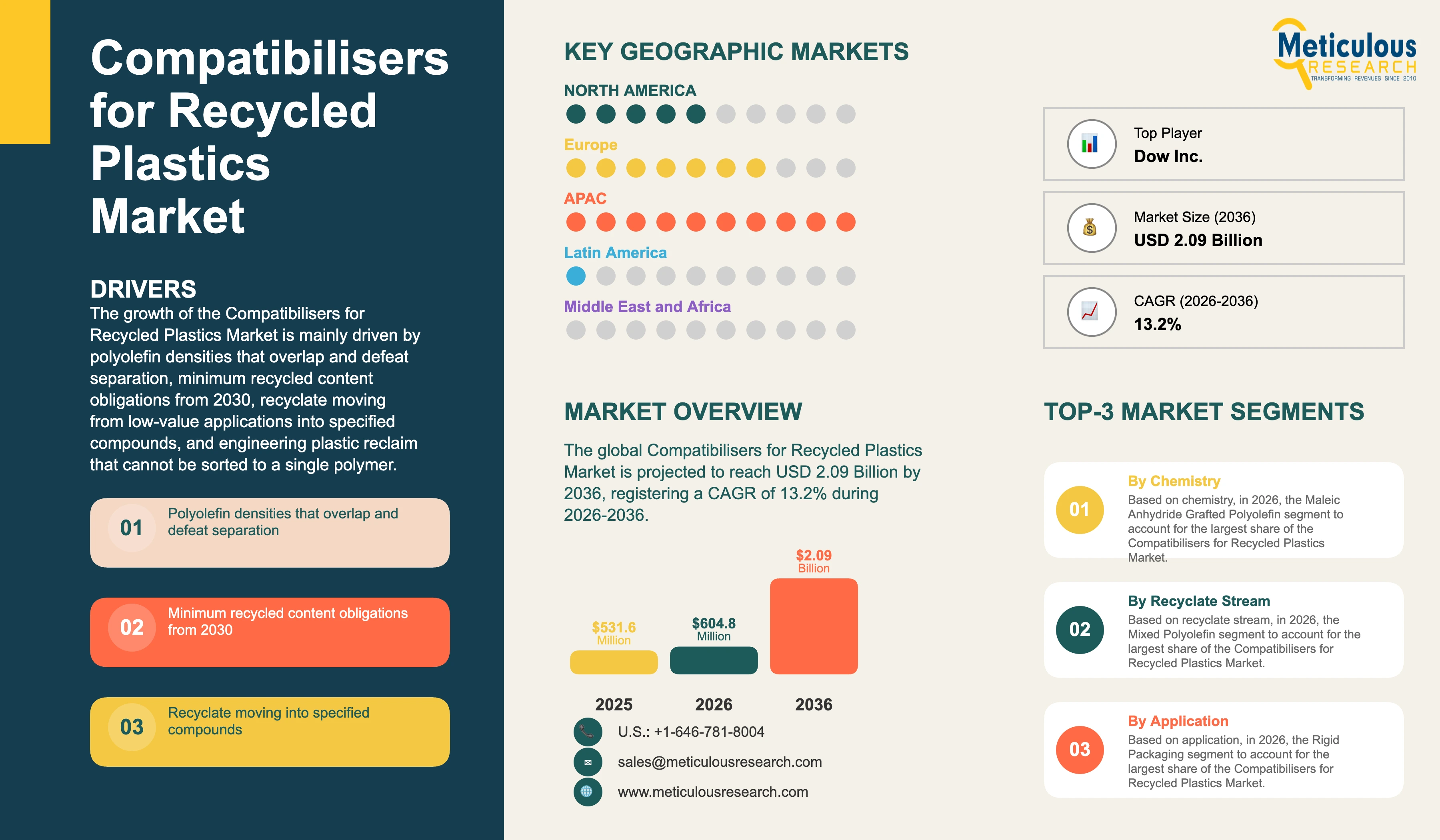
The compatibilisers for recycled plastics market is valued at USD 604.8 million in 2026 and is projected to reach USD 2.09 billion by 2036, at a CAGR of 13.2% during the forecast period. The market was valued at USD 531.6 million in 2025 and at USD 469.3 million in 2024.
- Published
- Nov 2026
- Pages
- 268
- Format
- PDF + Excel
- Report ID
- MRCHM - 1042772
- Base year
- 2025
- 2024 · HISTORICAL
- $469.3M
- 2036
- $2.09B
- CAGR 2026–2036
- 13.2%
2024–2025 baseline · 2026–2036 forecast at 13.2% CAGR · hover a bar for the value
Key highlights
This market measures compatibilisers supplied for the reprocessing and compounding of recycled plastics, covering reactive and non-reactive grades that bridge immiscible polymer phases, on a tonne of compatibiliser basis at the additive supplier gate.
Chain extenders, which rebuild molecular weight within one polymer rather than bridging immiscible polymers, are excluded and are counted in the chain extenders for recycled polyester title in this series.
Maleic anhydride grafted polyolefin, the largest chemistry in this market, is sized at USD 278.2 million in 2026 and is also counted within the maleic anhydride grafted polyolefins title in this series as the recycled plastics compatibilisation application of that market. The two titles are not additive across that chemistry.
Polypropylene and polyethylene have overlapping densities, so float and sink separation cannot readily separate them, which makes cross-contamination a physical consequence of sorting rather than a failure of it.
Contamination below 1% is difficult to determine even by differential scanning calorimetry, and the melting temperatures of block and homopolymer polypropylene overlap, so a compounder frequently cannot measure the blend it is being asked to correct.
Polypropylene contamination in recycled polyethylene lowers elongation at break and impact strength directly, which is the property loss that compatibilisation addresses and the reason mixed polyolefin regranulate sells at a discount to single-polymer grades.
Published screening at a technical university tested six or seven compatibiliser candidates at 5% loading in high-density polyethylene containing 10% polypropylene, and identified an ethylene-based olefin block copolymer as the most effective of them.
That work then added the selected compatibiliser at 2% to 8% loading to recycled high-density polyethylene containing 5% recycled polypropylene, and at 8% to a worst-case blend containing 15% recycled polypropylene.
Loadings of 2% to 8% are five to sixteen times the loading at which a chain extender is dosed, so a compatibiliser is a blend component rather than an additive and its cost enters compound economics directly.
Adding the compatibiliser at 8% to the 15% polypropylene blend improved impact resistance significantly at room temperature and at minus 20 degrees Celsius, and electron microscopy showed improved adhesion between the polyethylene and polypropylene phases.
The same compatibiliser at 5% was applied to regranulates from soft mixed polyolefins and hard mixed polyolefins to improve impact resistance, with blend composition determined by calorimetry and infrared spectroscopy rather than by declaration.
Article 7 of Regulation (EU) 2025/40 requires minimum recycled content in plastic packaging from 1 January 2030 of 35% for plastic packaging outside the contact-sensitive and beverage bottle categories, rising to 65% from 1 January 2040, averaged per manufacturing plant and year.
Those categories carry the highest near-term threshold of the regulation and cover the non-food-contact packaging where mixed polyolefin recyclate is used, so the obligation falls hardest on the stream this market serves.
Contact-sensitive polyethylene terephthalate packaging carries 30% from 2030 and 50% from 2040, and single-use plastic beverage bottles 30% and 65%, so every packaging category tightens twice within the forecast period.
Arkema finalised the divestment of its Functional Polyolefins business to SK Global Chemical on 1 June 2020 at an enterprise value of EUR 335 million on annual sales of about EUR 250 million, transferring about 100 employees in France and an international sales network of around 30 people.
SK Global Chemical was subsequently renamed SK geo centric, which holds that ethylene copolymer and terpolymer range through SK Functional Polymer.
Among recyclate streams, mixed polyolefin is expected to hold the largest share in 2026, while polyolefin and polyester blends are expected to grow fastest.
Among applications, rigid packaging is expected to hold the largest share in 2026, while flexible packaging and film are expected to grow fastest.
Report summary
| Particulars | Details |
|---|---|
| Base Year | 2025 |
| Actual Years | 2024-2025 |
| Forecast Period | 2026-2036 |
| Market Size in 2024 | USD 469.3 million |
| Market Size in 2025 | USD 531.6 million |
| Market Size in 2026 | USD 604.8 million |
| Market Size in 2036 | USD 2.09 billion |
| Value CAGR (2026-2036) | 13.2% |
| Format | PDF, Excel & Cloud Portal · 268 pages |
| Volume in 2025 | 129.03 kilotons |
| Volume in 2026 | 144.00 kilotons |
| Volume in 2036 | 431.48 kilotons |
| Volume CAGR (2026-2036) | 11.6% |
| Average Selling Price, 2026 | USD 4,200 per tonne |
| Average Selling Price, 2036 | USD 4,850 per tonne |
| Units | Value in USD million; volume in kilotons of compatibiliser; price in USD per tonne |
| Measurement Basis | Compatibilisers supplied for the reprocessing and compounding of recycled plastics, covering reactive and non-reactive grades that bridge immiscible polymer phases, measured at the additive supplier gate on a tonne of compatibiliser basis |
| Overlap Note | Maleic anhydride grafted polyolefin, sized at USD 278.2 million in 2026, is also counted within the maleic anhydride grafted polyolefins title in this series as the recycled plastics compatibilisation application of that market; the two titles are not additive across that chemistry |
| Loading Note | Compatibilisers are dosed at 2% to 8% of the blend, five to sixteen times a chain extender loading, so the additive is a blend component whose cost enters compound economics directly |
| Exclusions | The recycled plastic itself; chain extenders, which are counted in the chain extenders for recycled polyester title in this series; chlorinated polyolefin adhesion promoters for plastic part painting, counted in their own title; coupling agents sold for glass and natural fibre reinforcement; adhesive tie-layer resins; impact modifiers sold for virgin polymer toughening; sorting and washing equipment |
| Segments: Chemistry | Maleic Anhydride Grafted Polyolefin; Glycidyl Methacrylate Copolymer and Reactive Terpolymer; Olefin Block Copolymer and Elastomer; Styrenic Block Copolymer; Other Reactive Compatibiliser |
| Segments: Recyclate Stream | Mixed Polyolefin; Polyolefin and Polyester Blends; Polyolefin and Polyamide Blends; Polyolefin and Polystyrene Blends; Engineering Plastic Recyclate |
| Segments: Application | Rigid Packaging; Automotive Components; Building and Construction; Consumer Goods and Appliances; Pipe, Profile and Industrial; Flexible Packaging and Film |
| Largest Segment by Chemistry, 2026 | Maleic Anhydride Grafted Polyolefin |
| Fastest-Growing Segment by Chemistry | Other Reactive Compatibiliser, at 15.6% |
| Largest Segment by Recyclate Stream, 2026 | Mixed Polyolefin |
| Fastest-Growing Segment by Recyclate Stream | Polyolefin and Polyester Blends, at 14.7% |
| Largest Segment by Application, 2026 | Rigid Packaging |
| Fastest-Growing Segment by Application | Flexible Packaging and Film, at 15.6% |
| Largest Region, 2026 | Asia-Pacific, at 44.0% |
| Fastest-Growing Region | Europe, at 14.2% |
| Fastest-Growing Country | Germany, at 15.0% |
| Slowest-Growing Country | Japan, at 11.2% |
| Regions Covered | Asia-Pacific; Europe; North America; Latin America; Middle East & Africa |
| Countries Covered | China; India; Japan; South Korea; Germany; Italy; France; Spain; U.S.; Canada; Mexico; Brazil |
| Key Players | Dow Inc.; SK geo centric Co., Ltd.; ExxonMobil Corporation; Mitsui Chemicals, Inc.; ALTANA AG; Clariant AG |
| Top Five Share, 2026 | 51.2% |
| Profiled Companies Share, 2026 | 54.6% |
| Currency | USD |
Report overview
Market value is measured in in USD million; volume in kilotons of compatibiliser; price in USD per tonne. Segments covered: chemistry, recyclate stream, application.
In volume terms, the market is estimated at 144.00 kilotons of compatibiliser in 2026, rising to 431.48 kilotons by 2036, at a CAGR of 11.6%. The average selling price is estimated at USD 4,200 per tonne in 2026 and USD 4,850 per tonne in 2036, the increase reflecting a shift in the mix from maleic anhydride grafted polyolefin toward reactive terpolymers and olefin block copolymers, which carry a premium over grafted grades.
The growth of this market is mainly driven by polyolefin densities that overlap and defeat float and sink separation, minimum recycled content obligations that take effect from 2030, recyclate moving from low-value applications into specified compounds, and engineering plastic reclaim that cannot be sorted to a single polymer. However, factors such as loadings of several percent that place the additive in the compound cost rather than the additive budget, the option of downgrading recyclate instead of compatibilising it, improved sorting that removes some of the need, and performance that depends on knowing a blend composition that is itself hard to measure are expected to restrain the growth of this market to some extent.
Among chemistries, maleic anhydride grafted polyolefin is expected to hold the largest share of this market in 2026, while other reactive compatibilisers are expected to record the highest CAGR during the forecast period. Geographically, Asia-Pacific is expected to account for the largest share of this market in 2026, while Europe is expected to register the highest CAGR during the forecast period.
Most commodity polymers are thermodynamically immiscible. Melted together they form two phases with a weak interface, and a part moulded from that blend fails at the interface rather than through either polymer, so impact strength and elongation at break fall far below what either component would give on its own. A compatibiliser sits at that interface, lowers interfacial tension, reduces domain size and transmits stress between the phases.
In recycled plastics the mixing is not a formulation choice. Polypropylene and polyethylene have overlapping densities, so float and sink separation, which is the workhorse of mechanical recycling, cannot readily separate them. Near-infrared sorting discriminates better but not perfectly, and contamination below 1% is difficult to determine even by differential scanning calorimetry, with the melting temperatures of block and homopolymer polypropylene overlapping.
A compounder is therefore frequently unable to measure the blend it is being asked to correct, and buys a compatibiliser against a property target rather than against a composition. That is the defining commercial condition of this market and it differs from every other additive category, where a formulator knows what is in the compound and selects an additive against it.
The property loss is real and measurable even where the composition is not. Polypropylene contamination in recycled polyethylene lowers elongation at break and impact strength directly, which is why mixed polyolefin regranulate sells at a discount to single-polymer recyclate and why much of it goes into pallets, pipe, profile and street furniture rather than into specified compounds.
Chemistry divides into reactive and non-reactive families. Maleic anhydride grafted polyolefins carry anhydride groups on a polyethylene or polypropylene backbone that react with amine, hydroxyl and carboxyl functionality, which makes them the standard answer where one phase carries reactive groups, as in polyamide and polyester blends, and the largest chemistry in this market.
Glycidyl methacrylate copolymers and reactive ethylene terpolymers carry epoxy functionality that reacts with carboxyl and hydroxyl ends, and they are specified where a polyolefin has to be bridged to a polyester, which is the hardest of the common recyclate combinations.
Olefin block copolymers and olefin elastomers work without reactive groups, by partitioning to the interface and entangling with both phases through crystallisable and amorphous blocks that each associate with one component. They are the family that addresses polypropylene and polyethylene cross-contamination, where neither phase offers a reactive site and anhydride or epoxy chemistry has nothing to attack.
Published screening at a technical university tested six or seven candidates at 5% loading in high-density polyethylene containing 10% polypropylene and identified an ethylene-based olefin block copolymer as the most effective, with spreading-coefficient prediction and adhesion testing favouring an encapsulated core-shell morphology.
Styrenic block copolymers occupy a similar non-reactive role with a styrene end block that anchors into polystyrene and acrylonitrile butadiene styrene phases, which makes them the family for recyclate from electrical and electronic equipment.
Loading is the economic centre of this market and it is an order of magnitude above other additive categories. The same published work added its selected compatibiliser at 2% to 8% to recycled high-density polyethylene containing 5% recycled polypropylene, and at 8% to a worst-case blend containing 15% recycled polypropylene.
At those levels the compatibiliser is a blend component rather than an additive. Its cost enters the compound cost directly, and the decision a compounder makes is not whether the chemistry works but whether the compatibilised compound sells for enough more than the uncompatibilised regranulate to pay for several percent of a priced polymer.
That spread, rather than the regulation, is what governs adoption. Where it is wide, as in automotive interior parts and appliance housings with a recycled content specification, compatibilisation pays. Where it is narrow, the recyclate is downgraded instead, and downgrading remains the default for most mixed polyolefin regranulate.
This is the structural difference between compatibilisers and additives dosed at a fraction of a percent. A chain extender or a stabiliser is bought because the compound would otherwise fail; a compatibiliser is bought because the compound could otherwise be sold for less, which makes the purchase an investment decision rather than a technical necessity.
The performance gain is nonetheless substantial where it is applied. Adding the selected compatibiliser at 8% to the 15% polypropylene blend improved impact resistance significantly at room temperature and at minus 20 degrees Celsius, with electron microscopy showing improved adhesion between the phases and rheology confirming interfacial interaction.
Regulation sets the demand that widens the spread. Article 7 of Regulation (EU) 2025/40 requires minimum recycled content in plastic packaging from 1 January 2030 of 35% for packaging outside the contact-sensitive and beverage bottle categories, 30% for contact-sensitive polyethylene terephthalate packaging, 30% for single-use plastic beverage bottles and 10% for contact-sensitive non-PET packaging.
Those thresholds rise from 1 January 2040 to 65%, 50%, 65% and 25% respectively, calculated as an average per manufacturing plant and year, so a converter cannot meet the requirement by concentrating recyclate in one product line and must raise recycled content across its output.
Supply has consolidated into large polyolefin producers. Arkema finalised the divestment of its Functional Polyolefins business to SK Global Chemical on 1 June 2020 at an enterprise value of EUR 335 million on annual sales of about EUR 250 million, transferring about 100 employees in France and an international sales network of around 30 people. That business, now held by SK geo centric through SK Functional Polymer, sits alongside positions at Dow, ExxonMobil and Mitsui Chemicals built on the same ethylene copolymer platforms.
Functional polyolefins are made by grafting or copolymerising on reactor and extrusion assets that also make commodity grades, so unit cost favours an owner with upstream monomer rather than a specialty additive house, and that is why the leading positions in this market belong to integrated producers rather than to formulators.
Asia-Pacific is expected to account for 44.0% of this market in 2026, holding the majority of world compounding capacity and the appliance, electronics and automotive component manufacture that consumes compatibilised compound. Europe is projected to grow fastest at 14.2%, and Germany is the fastest growing country at 15.0%.
Europe grows fastest at 14.2% on the recycled content thresholds of Regulation (EU) 2025/40, which are averaged per manufacturing plant and year. The Middle East & Africa grows at 13.8% from the smallest base as compounding capacity is added alongside petrochemical complexes, and Latin America grows at 13.4% on Brazilian and Mexican compounding serving regional packaging and automotive assembly.
Maleic anhydride grafted polyolefin, sized at USD 278.2 million in 2026 and the largest chemistry here, is also counted within that title as its recycled plastics compatibilisation application. The two titles are not additive across that chemistry.
Chain extenders rebuild molecular weight within one polymer, while compatibilisers bridge immiscible polymer phases. The two address different failure modes, are excluded from each other and are counted in separate titles, although a converter facing a mixed stream frequently needs to establish which of the two problems it has.
Their densities overlap, so float and sink separation cannot readily separate them, and contamination below 1% is difficult to determine even by differential scanning calorimetry because the melting temperatures of block and homopolymer polypropylene overlap. Cross-contamination is therefore a physical consequence of sorting rather than a failure of it.
Published work screened candidates at a 5% trial level and dosed the selected compatibiliser at 2% to 8% of the blend, including 8% in a worst-case blend containing 15% recycled polypropylene. That is five to sixteen times a chain extender loading, so the compatibiliser is a blend component rather than an additive.
Adding an ethylene-based olefin block copolymer at 8% to recycled high-density polyethylene containing 15% recycled polypropylene improved impact resistance significantly at room temperature and at minus 20 degrees Celsius, with electron microscopy showing improved adhesion between the phases. Two phases nonetheless remain, so properties do not reach those of a single-polymer grade.
Dow Inc., SK geo centric Co., Ltd., ExxonMobil Corporation, Mitsui Chemicals, Inc., ALTANA AG and Clariant AG. The top five hold 51.2% of this market in 2026 and the six profiled companies hold 54.6%, with integrated polyolefin producers holding the strongest positions.
Report infographic
Market dynamics
20 factors across 5 forcesPolyolefin densities that overlap and defeat separation
Polypropylene and polyethylene have overlapping densities, so float and sink separation cannot readily separate them, and contamination below 1% is difficult to determine even by differential scanning calorimetry because the melting temperatures of block and homopolymer polypropylene overlap.
Cross-contamination is therefore a physical consequence of sorting rather than a failure of it, and no realistic improvement in equipment removes it from the mixed polyolefin stream entirely.
That makes compatibilisation a permanent requirement rather than a transitional technology awaiting better equipment, and it is the reason mixed polyolefin holds 41% of recyclate stream in 2026 and grows at 13.3%.
It also means the problem grows with collection rather than shrinking with investment, since every additional tonne of kerbside polyolefin collected carries the same separation limit as the tonne before it.
Minimum recycled content obligations from 2030
Article 7 of Regulation (EU) 2025/40 requires 35% recycled content from 1 January 2030 in plastic packaging outside the contact-sensitive and beverage bottle categories, rising to 65% from 1 January 2040, averaged per manufacturing plant and year.
That is the highest near-term threshold in the regulation and it falls on non-food-contact packaging, which is precisely where mixed polyolefin recyclate is used, so the obligation lands on the stream this market serves rather than on the cleaner bottle stream.
Because the average is calculated per plant and year, a converter cannot satisfy the requirement with a flagship product and must raise recycled content across its output, which brings contaminated streams into applications that previously used virgin resin only.
Recyclate moving from low-value applications into specified compounds
Mixed polyolefin regranulate has historically gone into pallets, pipe, profile and street furniture, applications that tolerate low elongation at break and impact strength because the part is thick and the specification is loose.
Moving the same material into an appliance housing, an automotive interior trim or a rigid packaging component requires the interface to carry stress, which is what the compatibiliser provides, and the published evidence shows significant impact resistance improvement at room temperature and at minus 20 degrees Celsius in a 15% contaminated blend.
The value created is the spread between a specified compound and a downgraded regranulate, and it is wide enough in rigid packaging, automotive and appliances to pay for several percent of a priced additive.
Engineering plastic reclaim that cannot be sorted to a single polymer
Recyclate from electrical and electronic equipment, automotive shredder residue and end-of-life vehicle interiors arrives as a mixture of acrylonitrile butadiene styrene, polycarbonate, polyamide, polypropylene and filled grades, with no separation route that resolves it to single polymers at acceptable cost.
Those blends need reactive compatibilisation because the phases carry amine, carbonate and carboxyl functionality that a non-reactive elastomer cannot bridge, which is where maleic anhydride grafted and glycidyl methacrylate chemistries are specified.
Engineering plastic recyclate holds 12% of this market in 2026 and grows at 13.1%, and it carries the highest value per tonne of compatibiliser because the compounds it produces are sold on mechanical and thermal specification rather than on price.
Table of contents
11 chapters · 127 sections · 268 pages · click to expandSegmental analysis
| Segment | Largest share (2026) | Fastest growth (2026–2036) |
|---|---|---|
| By Chemistry | Maleic anhydride grafted polyolefin | Other reactive compatibilisers |
| By Recyclate Stream | Mixed polyolefin recyclate | Polyolefin and polyester blends |
| By Application | Rigid packaging | Flexible packaging and film |
| Other segments | Mixed polyolefin | Polyolefin and polyester blends |
By Chemistry
- Compatibilisers for Recycled Plastics Analysis by Chemistry
- Maleic anhydride grafted polyolefin is expected to account for the largest share of this market in 2026.
- Anhydride groups grafted onto a polyethylene or polypropylene backbone react with amine, hydroxyl and carboxyl functionality, which makes the family the standard answer wherever one phase carries a reactive group, as in polyamide and polyester blends.
- It is also the cheapest reactive option per tonne and the most widely available, since the same grades serve glass and natural fibre coupling, adhesive tie layers and metal adhesion, and that shared production base keeps unit cost below purpose-made alternatives.
- The breadth of duty is also a procurement hazard, because a grade optimised for fibre coupling carries a graft level and molecular weight set differently from what interface stabilisation needs.
- The segment grows slowest at 11.4%, because the fastest-growing contamination problem is polyethylene in polypropylene and the reverse, where no reactive site exists for anhydride chemistry to attack.
- Glycidyl methacrylate copolymer and reactive terpolymer grades grow at 15.0%, carrying epoxy functionality that reacts with the carboxyl and hydroxyl ends created by polyester degradation, so one additive can compatibilise a polyolefin to a polyester and scavenge acid ends at the same time.
- Olefin block copolymer and elastomer grades grow at 15.2%, working without reactive groups by partitioning to the interface and entangling with both phases, and published screening of six or seven candidates at 5% loading identified an ethylene-based olefin block copolymer as the most effective in polyethylene containing 10% polypropylene.
- Styrenic block copolymers hold 8% and grow at 12.0%, anchoring into polystyrene and acrylonitrile butadiene styrene phases through a styrene end block, which makes them the family for recyclate from electrical and electronic equipment.
- Other reactive compatibilisers are projected to register the highest CAGR of 15.6% from the smallest base, as ionomers, oxazoline-functional grades and multi-block architectures are specified for particular phase pairs that the four established families serve poorly.
- Maleic anhydride grafted polyolefin is expected to hold the largest share in 2026 as the standard reactive answer and the cheapest option per tonne.
- Other reactive compatibilisers are projected to grow fastest at 15.6%, followed by olefin block copolymer and elastomer grades at 15.2%.
By Recyclate Stream
- Compatibilisers for Recycled Plastics Analysis by Recyclate Stream
- Mixed polyolefin recyclate is expected to account for the largest share of this market in 2026 at 41%.
- Polypropylene and polyethylene have overlapping densities so float and sink separation cannot readily separate them, which makes this the one stream where contamination is a physical consequence of sorting rather than a failure of it.
- The segment grows at 13.3%, and polypropylene contamination in recycled polyethylene lowers elongation at break and impact strength directly, which is the property loss that moves the material from a specified compound to a downgraded regranulate.
- Polyolefin and polyester blends are projected to register the highest CAGR of 14.7% during the forecast period, the hardest of the common pairings because the phases differ in polarity as well as in crystallinity, and the stream where epoxy-functional chemistry commands a premium.
- Polyolefin and polyamide blends grow at 12.1%, the classic application for anhydride chemistry since the amine end groups of polyamide give a reactive site, with demand drawn from automotive under-bonnet and carpet recyclate.
- Polyolefin and polystyrene blends grow slowest at 11.5%, served by styrenic block copolymers and constrained by the declining share of polystyrene in packaging as converters move to polyolefin and paper alternatives.
- Engineering plastic recyclate grows at 13.1% and carries the highest value per tonne of compatibiliser, drawing on electrical and electronic equipment waste and end-of-life vehicle interiors that arrive as mixtures of acrylonitrile butadiene styrene, polycarbonate, polyamide and filled grades with no separation route resolving them at acceptable cost.
By Application
- Compatibilisers for Recycled Plastics Analysis by Application
- Rigid packaging is expected to account for the largest share of this market in 2026 at 26%, and grows at 14.4%.
- Transit packaging, non-food containers and closures draw on mixed polyolefin recyclate and fall within the 35% recycled content threshold applying from 1 January 2030 under Article 7 of Regulation (EU) 2025/40.
- Automotive components hold 23% and grow at 12.3%, with interior trim, wheel arch liners and under-bonnet parts carrying recycled content specifications and sub-zero impact requirements that separate effective compatibilisers from simple tougheners.
- Building and construction grows slowest at 11.9%, since pipe, profile and decking tolerate the property loss that compatibilisation corrects and therefore buy downgraded regranulate rather than specified compound.
- Consumer goods and appliances grow at 13.2%, where housings and structural parts are moulded to tolerance and finished to a visible surface, both of which fail if domain size is large, and pipe, profile and industrial applications grow at 12.6%.
- Flexible packaging and film are projected to register the highest CAGR of 15.6% during the forecast period.
- Film is the application least tolerant of a coarse dispersed phase, because a domain larger than the film gauge becomes a gel or a hole, so recycled content in film requires compatibilisation at the outset rather than as an improvement.
Other segments
- Mixed polyolefin is expected to hold the largest share in 2026 at 41%, since polypropylene and polyethylene densities overlap and cannot be readily separated.
- Polyolefin and polyester blends are projected to grow fastest at 14.7%, followed by engineering plastic recyclate at 13.1%.
- Rigid packaging is expected to hold the largest share in 2026 at 26%, falling within the 35% recycled content threshold from 2030.
- Flexible packaging and film are projected to grow fastest at 15.6%, because a dispersed domain larger than the film gauge becomes a gel or a hole.
Geographic analysis
Asia-Pacific
Largest shareAsia-Pacific is expected to account for the largest share of this market in 2026, at 44%. The region holds the majority of world plastics compounding capacity, the largest mixed plastics recycling industry and the appliance, electronics and automotive component manufacture that consumes compatibilised compound. The region grows at 12.8%, with China, India, Japan and South Korea all holding compounding capacity and with recycled content requirements arriving through export market specifications rather than through domestic obligation in most of the region. A compounder supplying a European or North American brand owner therefore builds to that customer threshold rather than to a local rule, which transmits the obligation without the regulation.
Europe
Fastest growthEurope is projected to register the highest CAGR of 14.2% during the forecast period, driven by Article 7 of Regulation (EU) 2025/40 and its 35% recycled content threshold from 1 January 2030 on packaging outside the contact-sensitive and beverage bottle categories, rising to 65% from 1 January 2040. Germany holds the largest European position on compounding and automotive component manufacture and is the fastest growing country in this market at 15.0%, with Italy, France, Spain and Poland holding recycling and compounding capacity serving packaging and construction.
North America
North America grows at 12.6% and holds 21% of this market, with demand concentrated in rigid packaging, automotive components and appliances, and with state-level recycled content requirements rather than a single federal obligation shaping converter behaviour. A compounder serving several states builds to the strictest requirement it faces, so adoption runs ahead of the average obligation.
Latin America
Latin America grows at 13.4%, with Brazil and Mexico holding compounding capacity serving regional packaging and automotive assembly, while the Middle East & Africa grows at 13.8% from the smallest base as compounding capacity is added alongside petrochemical complexes. Regional shares follow compounding capacity rather than waste generation, because the compatibiliser is metered into an extruder by a compounder and the decision to use it is taken where the compound is made rather than where the waste arises. Regranulate travels, so the two need not coincide.
Competitive landscape
This market is concentrated among integrated polyolefin producers, with the six companies profiled holding 54.6% of it in 2026 and the top five 51.2%. Functional polyolefins sit on the same ethylene copolymer platforms as commodity grades, so the economics favour an owner with upstream monomer and reactor capacity over a specialty additive house, and competition turns on application development rather than on unit price.
Dow Inc. holds the largest position, with maleic anhydride grafted polyolefins, olefin block copolymers and reactive ethylene copolymers all produced on its own ethylene platform, and with compatibilisation sold alongside its recycled polyethylene and compounding activities.
SK geo centric Co., Ltd. holds the ethylene copolymer and terpolymer range acquired when Arkema finalised the divestment of its Functional Polyolefins business on 1 June 2020 at an enterprise value of EUR 335 million on annual sales of about EUR 250 million, operated through SK Functional Polymer with about 100 employees in France and an international sales network of around 30 people.
ExxonMobil Corporation and Mitsui Chemicals, Inc. hold established maleic anhydride grafted and functionalised polyolefin positions serving polyamide and polyester compatibilisation, ALTANA AG supplies grafted coupling agents and compatibilisers through BYK into compounding, and Clariant AG delivers compatibilisation through masterbatch, which addresses the metering and dispersion problem that arises at loadings of several percent.
Position is held through application development rather than through grade breadth. Because a compounder frequently cannot state the blend it is correcting, the sale rests on a trial run on customer material against an impact strength and elongation target, which makes the technical service laboratory the competitive asset and gives the incumbent a durable advantage once a loading is established on a particular feedstock.
Competitive activity has concentrated on recycled content programmes and on masterbatch delivery rather than on new chemistry. Several suppliers now sell compatibilisation alongside their own recyclate and compounding activities, which places them in competition with the compounders they supply, and masterbatch formats address the metering and dispersion difficulty that arises at loadings of several percent.
Some of the key players operating in the compatibilisers for recycled plastics market are Dow Inc., SK geo centric Co., Ltd., ExxonMobil Corporation, Mitsui Chemicals, Inc., ALTANA AG, and Clariant AG, among others.
- —
Regulation (EU) 2025/40 on packaging and packaging waste was adopted on 19 December 2024 and sets a 35% recycled content threshold from 1 January 2030 on packaging outside the contact-sensitive and beverage bottle categories, rising to 65% from 1 January 2040; and Arkema finalised the divestment of its Functional Polyolefins business to SK Global Chemical, now SK geo centric, on 1 June 2020 at an enterprise value of EUR 335 million.
- Dow Inc.
- SK geo centric Co., Ltd.
- ExxonMobil Corporation
- Mitsui Chemicals, Inc.
- ALTANA AG
- Clariant AG
Expert perspectives
The stated demand driver for this market is mixed stream property recovery, and the evidence supports it more firmly than in most recycling additive categories. Polypropylene and polyethylene have overlapping densities, so float and sink separation cannot readily separate them, and contamination below 1% is difficult to determine even by calorimetry.
Contamination is therefore a physical consequence of sorting rather than a failure of it, which makes compatibilisation a permanent requirement rather than a bridge to better sorting. That is a stronger foundation than a voluntary commitment or a one-year allocation order.
The constraint is loading rather than chemistry. Published work dosed its selected compatibiliser at 2% to 8% of the blend and screened candidates at a standard 5% trial level, five to sixteen times a chain extender loading, so the compatibiliser is a blend component whose cost appears in the compound cost sheet.
At that level the purchase is discretionary. A compounder compatibilises only where the spread between a specified compound and a downgraded regranulate exceeds the additive cost, and downgrading into pallets, pipe and profile remains the default for most mixed polyolefin regranulate.
Regulation is what widens that spread, and its structure favours this market specifically. The highest 2030 threshold in Article 7 of Regulation (EU) 2025/40 is 35% on packaging outside the contact-sensitive and beverage bottle categories, rising to 65% by 2040, and that category is where mixed polyolefin recyclate is used.
The chemistry mix is shifting away from the incumbent for a structural reason. Maleic anhydride grafted polyolefin grows at 11.4% while olefin block copolymers grow at 15.2%, because the largest contamination problem is polyolefin in polyolefin, where neither phase offers a reactive site and anhydride chemistry has nothing to attack.
On balance this is the most durably founded of the recycling additive titles in this series, because its driver is a density overlap rather than a policy, and the risk sits in adoption economics rather than in whether the need persists. The supplier that can set a loading against variable feedstock captures that value; the one selling a grade range does not.
Customer perspectives
Compounders buy against an impact strength and elongation target measured on their own feedstock rather than against a stated blend ratio, because contamination below 1% is difficult to determine and polypropylene grades overlap in melting behaviour.
Their first question is therefore whether the supplier will run a trial on their material, since a datasheet generated on a model blend does not predict performance on a real regranulate.
Their second question is cost per tonne of compound rather than price per tonne of additive, since at these loadings the additive is a visible line in the compound cost sheet.
Recyclers and regranulators ask whether compatibilisation lets them sell into a higher-value application themselves rather than selling regranulate to a compounder, which makes them customers and competitors of their own customers at the same time.
Automotive part makers ask for sub-zero impact performance rather than room-temperature impact, because cold impact is the property that fails first in a poorly compatibilised blend and the one their specifications state.
They also ask for a recycled content percentage that can be evidenced to an auditor, and the compatibiliser counts as virgin material in that calculation.
Appliance and consumer goods makers add surface appearance to the requirement, since a coarse dispersed phase shows as flow marks or gloss variation on a visible moulding even where the mechanical specification is met.
Film converters apply the strictest test, because a dispersed domain larger than the film gauge becomes a gel or a hole, so they ask about domain size rather than about bulk properties.
Buyers across every group ask whether a single grade can serve several phase pairs, since a compounder running mixed feedstock cannot hold a separate additive for each combination.
Procurement teams frequently describe a viscosity problem as a compatibility problem or the reverse, and the supplier that diagnoses which is present wins the specification even when the answer is a chain extender.
Across all buyer groups the recurring request is for help setting a loading against variable feedstock, which is why application development capability rather than grade breadth determines who holds position in this market.
Frequently asked questions
The market is valued at USD 604.8 million in 2026, having stood at USD 531.6 million in 2025 and USD 469.3 million in 2024, and is projected to reach USD 2.09 billion by 2036.
A CAGR of 13.2% in value terms and 11.6% in volume terms between 2026 and 2036, with the average selling price rising from USD 4,200 per tonne to USD 4,850 per tonne.
Polyolefin densities that overlap and defeat float and sink separation; minimum recycled content obligations of 35% from 1 January 2030 under Article 7 of Regulation (EU) 2025/40 on packaging outside the contact-sensitive and beverage bottle categories; recyclate moving from low-value applications into specified compounds; and engineering plastic reclaim that cannot be sorted to a single polymer.
Loadings of 2% to 8% that enter compound cost directly, the option of downgrading recyclate instead of correcting it, improved sorting that removes part of the need, blend composition that cannot be measured below 1% contamination, and property recovery that is partial rather than complete.
The 35% threshold on non-contact-sensitive packaging rising to 65% by 2040; non-reactive compatibilisation of polyolefin cross-contamination where no reactive site exists; polyolefin and polyester blends as the hardest pairing and fastest-growing stream at 14.7%; and engineering plastic and electronics recyclate, which carries the highest value per tonne of compatibiliser.
Maleic anhydride grafted polyolefin is expected to hold the largest share in 2026 as the standard reactive answer and the cheapest option per tonne. Other reactive compatibilisers are projected to grow fastest at 15.6%, followed by olefin block copolymer and elastomer grades at 15.2%.
Mixed polyolefin is expected to hold the largest share in 2026 at 41%, since polypropylene and polyethylene densities overlap and cannot be readily separated. Polyolefin and polyester blends are projected to grow fastest at 14.7%, followed by engineering plastic recyclate at 13.1%.
Rigid packaging is expected to hold the largest share in 2026 at 26%, falling within the 35% recycled content threshold from 2030. Flexible packaging and film are projected to grow fastest at 15.6%, because a dispersed domain larger than the film gauge becomes a gel or a hole.
Asia-Pacific is expected to account for 44.0% of this market in 2026, holding the majority of world compounding capacity and the appliance, electronics and automotive component manufacture that consumes compatibilised compound. Europe is projected to grow fastest at 14.2%, and Germany is the fastest growing country at 15.0%.
Europe grows fastest at 14.2% on the recycled content thresholds of Regulation (EU) 2025/40, which are averaged per manufacturing plant and year. The Middle East & Africa grows at 13.8% from the smallest base as compounding capacity is added alongside petrochemical complexes, and Latin America grows at 13.4% on Brazilian and Mexican compounding serving regional packaging and automotive assembly.
Maleic anhydride grafted polyolefin, sized at USD 278.2 million in 2026 and the largest chemistry here, is also counted within that title as its recycled plastics compatibilisation application. The two titles are not additive across that chemistry.
Chain extenders rebuild molecular weight within one polymer, while compatibilisers bridge immiscible polymer phases. The two address different failure modes, are excluded from each other and are counted in separate titles, although a converter facing a mixed stream frequently needs to establish which of the two problems it has.
Their densities overlap, so float and sink separation cannot readily separate them, and contamination below 1% is difficult to determine even by differential scanning calorimetry because the melting temperatures of block and homopolymer polypropylene overlap. Cross-contamination is therefore a physical consequence of sorting rather than a failure of it.
Published work screened candidates at a 5% trial level and dosed the selected compatibiliser at 2% to 8% of the blend, including 8% in a worst-case blend containing 15% recycled polypropylene. That is five to sixteen times a chain extender loading, so the compatibiliser is a blend component rather than an additive.
Adding an ethylene-based olefin block copolymer at 8% to recycled high-density polyethylene containing 15% recycled polypropylene improved impact resistance significantly at room temperature and at minus 20 degrees Celsius, with electron microscopy showing improved adhesion between the phases. Two phases nonetheless remain, so properties do not reach those of a single-polymer grade.
Dow Inc., SK geo centric Co., Ltd., ExxonMobil Corporation, Mitsui Chemicals, Inc., ALTANA AG and Clariant AG. The top five hold 51.2% of this market in 2026 and the six profiled companies hold 54.6%, with integrated polyolefin producers holding the strongest positions.
Regulation (EU) 2025/40 on packaging and packaging waste was adopted on 19 December 2024 and sets a 35% recycled content threshold from 1 January 2030 on packaging outside the contact-sensitive and beverage bottle categories, rising to 65% from 1 January 2040; and Arkema finalised the divestment of its Functional Polyolefins business to SK Global Chemical, now SK geo centric, on 1 June 2020 at an enterprise value of EUR 335 million.
Cite this report
Meticulous Research. (2026). Compatibilisers for Recycled Plastics Market - Global Opportunity Analysis and Industry Forecast (2026-2036) (Report No. MRCHM - 1042772). Meticulous Market Research Pvt. Ltd. https://www.meticulousresearch.com/product/compatibilisers-for-recycled-plastics-market-7455