Chain Extenders for Recycled Polyester Market (2026-2036)
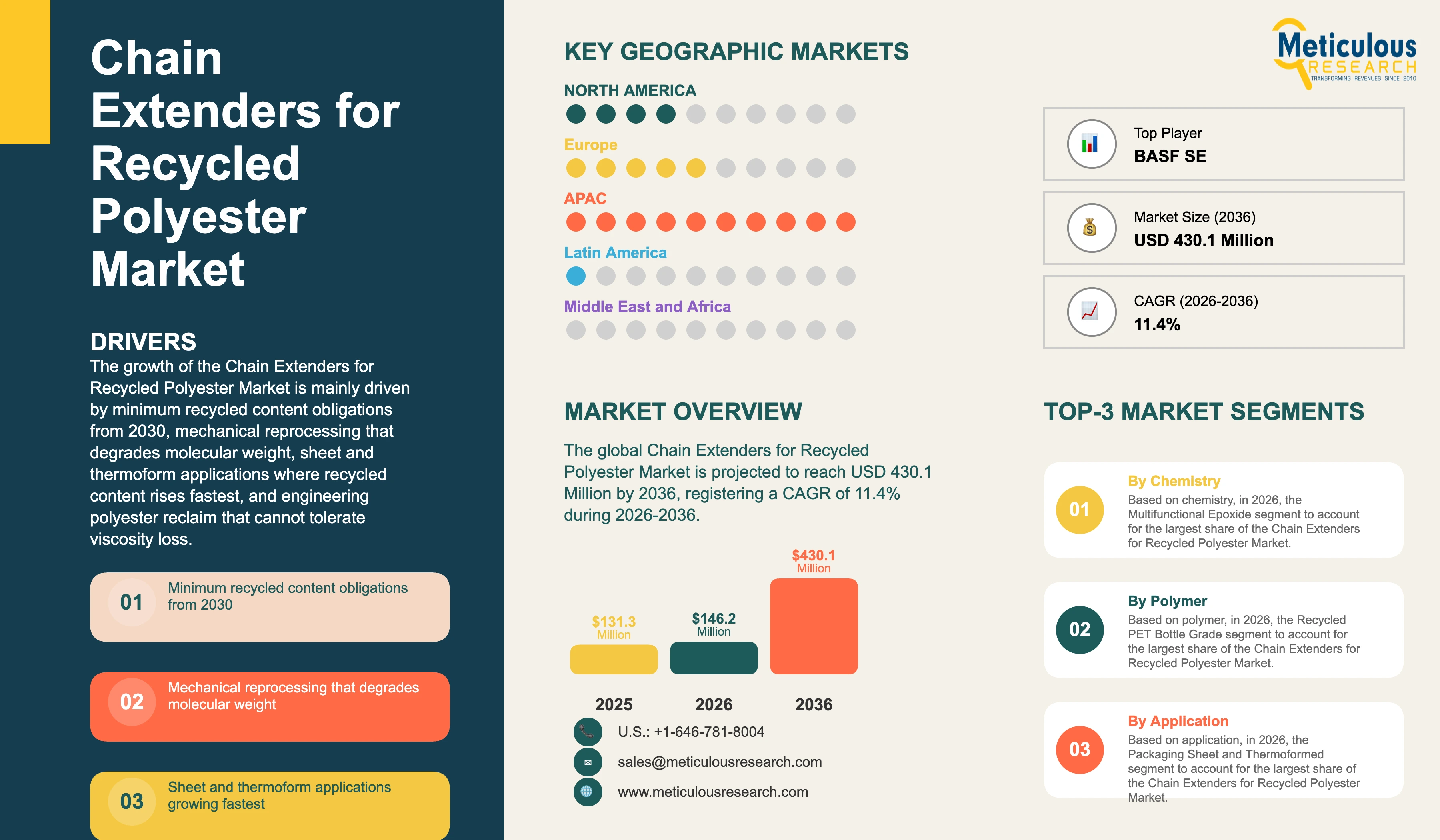
The chain extenders for recycled polyester market is valued at USD 146.2 million in 2026 and is projected to reach USD 430.1 million by 2036, at a CAGR of 11.4% during the forecast period. The market was valued at USD 131.3 million in 2025 and at USD 117.8 million in 2024.
- Published
- Nov 2026
- Pages
- 257
- Format
- PDF + Excel
- Report ID
- MRCHM - 1042775
- Base year
- 2025
- 2024 · HISTORICAL
- $117.8M
- 2036
- $430.1M
- CAGR 2026–2036
- 11.4%
2024–2025 baseline · 2026–2036 forecast at 11.4% CAGR · hover a bar for the value
Key highlights
This market measures chain extenders supplied for the reprocessing of recycled polyester, covering recycled polyethylene terephthalate, recycled polyester fibre and recycled engineering polyester, on a tonne of chain extender basis at the additive supplier gate.
Compatibilisers, which bridge immiscible polymers rather than rebuild molecular weight within one polymer, are excluded and are counted in the compatibilisers for recycled plastics title in this series.
Article 7 of Regulation (EU) 2025/40 requires minimum recycled content in plastic packaging from 1 January 2030 of 30% for contact-sensitive packaging made from polyethylene terephthalate, 30% for single-use plastic beverage bottles, 10% for contact-sensitive non-PET packaging and 35% for all other plastic packaging.
Those thresholds rise from 1 January 2040 to 50% for contact-sensitive PET packaging, 65% for single-use plastic beverage bottles, 25% for contact-sensitive non-PET packaging and 65% for all other plastic packaging, calculated as an average per manufacturing plant and year.
The highest 2030 threshold, 35%, applies to plastic packaging outside the contact-sensitive and beverage bottle categories, which is precisely the stream where a chain extender faces no food-contact approval constraint.
Peer-reviewed characterisation of recycled polyethylene terephthalate compounded from 80% bottles and 20% trays shows that a styrene-acrylic multifunctional epoxide raised weight-average molecular weight from 80,000 to 86,600 grams per mole at 1.5% loading, a gain of 8.3%.
At 3% loading the same additive returned weight-average molecular weight to 81, 900 grams per mole while gel content rose from about 2% to about 32%, so overdosing crosslinks the polymer rather than extending it.
Gel at that level is a defect rather than a property in film, fibre and thin sheet, which is why the commercially useful dosing window is narrow and why suppliers sell a recommended loading rather than a maximum.
Pyromellitic dianhydride at 3% loading reduced number-average molecular weight from 34, 300 to 11,700 grams per mole with dispersity rising from 2.3 to 3.9, degrading the polymer it was intended to repair.
The authors attribute that outcome partly to water generated by the dianhydride reaction, which can accelerate hydrolysis of polyethylene terephthalate, and they record an initial fall in extrusion force consistent with early chain scission.
Some epoxy groups react first with low-molecular-weight contaminants in the recyclate, consuming the additive before it extends polymer chains, so contaminated feedstock requires higher loadings for less effect.
Degradation during melt reprocessing proceeds very rapidly near 300 degrees Celsius through chemical, mechanical, thermal and oxidative pathways at once, which is why viscosity loss cannot be avoided by process control alone.
Chain extenders are dosed at well under one percent of polymer mass, so this market is measured in kilotons against recycled polyester measured in millions of tonnes, and additive volume cannot be inferred from recyclate volume without the dosing assumption.
Solid-state polycondensation rebuilds intrinsic viscosity in bottle-to-bottle recycling without any additive, which is why the largest recyclate stream is the least accessible to this market.
Depolymerisation returns monomer that is repolymerised to virgin specification, so polymer from that route needs no viscosity correction and the chemical recycling title in this series measures a competing solution rather than a complementary one.
Among polymers, recycled polyethylene terephthalate bottle grade is expected to hold the largest share in 2026, while recycled polybutylene terephthalate and engineering polyester are expected to grow fastest.
Among applications, packaging sheet and thermoformed products are expected to hold the largest share in 2026, while foam and engineering compounds are expected to grow fastest.
The six companies profiled hold 58.8% of this market in 2026, with a single multifunctional epoxide product family accounting for the largest share of consumption.
Report summary
| Particulars | Details |
|---|---|
| Base Year | 2025 |
| Actual Years | 2024-2025 |
| Forecast Period | 2026-2036 |
| Market Size in 2024 | USD 117.8 million |
| Market Size in 2025 | USD 131.3 million |
| Market Size in 2026 | USD 146.2 million |
| Market Size in 2036 | USD 430.1 million |
| Value CAGR (2026-2036) | 11.4% |
| Format | PDF, Excel & Cloud Portal · 257 pages |
| Volume in 2025 | 11.52 kilotons |
| Volume in 2026 | 12.60 kilotons |
| Volume in 2036 | 30.94 kilotons |
| Volume CAGR (2026-2036) | 9.4% |
| Average Selling Price, 2026 | USD 11,600 per tonne |
| Average Selling Price, 2036 | USD 13,900 per tonne |
| Units | Value in USD million; volume in kilotons of chain extender; price in USD per tonne |
| Measurement Basis | Chain extenders supplied for the reprocessing of recycled polyester, covering recycled polyethylene terephthalate, recycled polyester fibre and recycled engineering polyester, measured at the additive supplier gate on a tonne of chain extender basis |
| Dosing Note | Chain extenders are dosed at well under one percent of polymer mass, so additive volume cannot be inferred from recyclate volume without the dosing assumption; published characterisation shows molecular weight gains peaking near 1.5% loading and falling at 3% as gelation takes over |
| Exclusions | The recycled polyester itself; compatibilisers, which are counted in the compatibilisers for recycled plastics title in this series; antioxidants, acid scavengers and process stabilisers sold separately; solid-state polycondensation equipment and energy; depolymerisation and chemical recycling, which are counted in the polyester textile depolymerisation title in this series; chain extenders for polyamide, polyurethane and polycarbonate |
| Segments: Chemistry | Multifunctional Epoxide; Dianhydride; Diisocyanate and Carbodiimide; Bis-Oxazoline and Other |
| Segments: Polymer | Recycled PET Bottle Grade; Recycled PET Sheet and Thermoform; Recycled Polyester Fibre; Recycled PBT and Engineering Polyester |
| Segments: Application | Packaging Sheet and Thermoformed; Bottles and Preforms; Fibre and Nonwoven; Strapping and Tape; Foam and Engineering Compounds |
| Largest Segment by Chemistry, 2026 | Multifunctional Epoxide |
| Fastest-Growing Segment by Chemistry | Bis-Oxazoline and Other, at 13.0% |
| Largest Segment by Polymer, 2026 | Recycled PET Bottle Grade |
| Fastest-Growing Segment by Polymer | Recycled PBT and Engineering Polyester, at 12.9% |
| Largest Segment by Application, 2026 | Packaging Sheet and Thermoformed |
| Fastest-Growing Segment by Application | Foam and Engineering Compounds, at 13.2% |
| Largest Region, 2026 | Asia-Pacific, at 49.0% |
| Fastest-Growing Region | Europe, at 12.6% |
| Fastest-Growing Country | Germany, at 13.4% |
| Slowest-Growing Country | Japan, at 9.2% |
| Regions Covered | Asia-Pacific; Europe; North America; Latin America; Middle East & Africa |
| Countries Covered | China; India; Japan; South Korea; Germany; Italy; Spain; France; U.S.; Canada; Mexico; Brazil |
| Key Players | BASF SE; Clariant AG; L. Bruggemann GmbH & Co. KG; Evonik Industries AG; Nagase & Co., Ltd.; Polyvel, Inc. |
| Top Five Share, 2026 | 56.4% |
| Profiled Companies Share, 2026 | 58.8% |
| Currency | USD |
Report overview
Market value is measured in in USD million; volume in kilotons of chain extender; price in USD per tonne. Segments covered: chemistry, polymer, application.
In volume terms, the market is estimated at 12.60 kilotons of chain extender in 2026, rising to 30.94 kilotons by 2036, at a CAGR of 9.4%. The average selling price is estimated at USD 11,600 per tonne in 2026 and USD 13,900 per tonne in 2036, the increase reflecting a shift in the mix from dianhydride chemistry toward multifunctional epoxide oligomers and food-contact-approved grades, which carry a substantial premium.
The growth of this market is mainly driven by minimum recycled content obligations that take effect from 2030, mechanical reprocessing that degrades molecular weight and must be corrected, sheet and thermoform applications where recycled content rises fastest, and engineering polyester reclaim that cannot tolerate viscosity loss. However, factors such as a narrow dosing window beyond which crosslinking replaces chain extension, contaminants that consume the additive before it reaches the polymer, solid-state polycondensation that rebuilds viscosity without any additive, and depolymerisation routes that return polymer needing no correction at all are expected to restrain the growth of this market to some extent.
Among chemistries, multifunctional epoxide is expected to hold the largest share of this market in 2026, while bis-oxazoline and other chemistries are expected to record the highest CAGR during the forecast period. Geographically, Asia-Pacific is expected to account for the largest share of this market in 2026, while Europe is expected to register the highest CAGR during the forecast period.
Polyethylene terephthalate is a condensation polymer, which means its chains are built by eliminating a small molecule and can be broken by putting that molecule back. Water, heat and shear all do so, and during melt reprocessing the three act together. Chain scission reduces molecular weight, intrinsic viscosity falls with it, and the melt that results is too thin to be extruded into film, spun into fibre or blown into a bottle at the rate the line was designed for.
Degradation during reprocessing proceeds through chemical, mechanical, thermal and oxidative pathways simultaneously and becomes very rapid near 300 degrees Celsius, which is within the window an extruder must reach to melt the polymer at all. Drying, vacuum venting and residence-time control reduce the loss but cannot eliminate it, so a recycler either accepts a lower-grade output or rebuilds molecular weight deliberately.
A chain extender rebuilds it chemically. The additive carries two or more functional groups that react with the carboxyl and hydroxyl end groups created by scission, joining two shorter chains into one longer chain and consuming the acid end groups that would otherwise catalyse further hydrolysis. The reaction happens in the extruder within the residence time already available, so no new unit operation is required and the correction costs a metering pump rather than a plant.
That is the commercial proposition in a sentence, and it is why the additive can carry a price per tonne an order of magnitude above the polymer it corrects. At a few tenths of a percent loading the cost per tonne of corrected polymer remains small, so the comparison a converter makes is against scrap rate and line speed rather than against resin price.
Four chemistries compete. Multifunctional epoxides, typically styrene-acrylic oligomers carrying several epoxy groups per molecule, are the largest family because the epoxy group reacts readily with carboxyl ends at melt temperature and the oligomeric backbone allows the functionality per molecule to be tuned.
Dianhydrides, principally pyromellitic dianhydride, react with hydroxyl ends and are the cheapest option by unit cost. Diisocyanates and carbodiimides react with carboxyl ends and are used where acid-end scavenging matters as much as molecular weight. Bis-oxazolines and related chemistries react with carboxyl ends without generating a by-product, which is their main advantage.
Dosing is the central commercial constraint, and the published evidence shows the window is narrow. In recycled polyethylene terephthalate compounded from 80% bottles and 20% trays, a styrene-acrylic multifunctional epoxide raised weight-average molecular weight from 80,000 to 86,600 grams per mole at 1.5% loading.
At 3% loading the same additive gave 81,900 grams per mole, below the 1.5% result, while gel content rose from about 2% to about 32%. Beyond a threshold the additive crosslinks chains into a network rather than extending them end to end, and gel is a defect in film, fibre and thin sheet rather than a property.
Chemistry choice carries the same risk in a different form. Pyromellitic dianhydride at 3% loading reduced number-average molecular weight from 34,300 to 11,700 grams per mole and raised dispersity from 2.3 to 3.9, degrading the polymer rather than repairing it, with the water generated by its own reaction implicated in accelerating hydrolysis.
Feedstock cleanliness is the third constraint. Some epoxy groups react first with low-molecular-weight contaminants carried through from the waste stream, consuming additive before it reaches the polymer, so dirtier recyclate requires a higher loading to achieve a smaller gain and moves closer to the gelation threshold while doing so. Performance in this market is therefore coupled to the quality of collection and sorting rather than to the chemistry alone, and a supplier cannot guarantee an outcome without knowing the feedstock.
Demand is set by recycled content obligation rather than by recyclate availability. Article 7 of Regulation (EU) 2025/40 requires, from 1 January 2030, minimum recycled content of 30% for contact-sensitive polyethylene terephthalate packaging, 30% for single-use plastic beverage bottles, 10% for contact-sensitive non-PET packaging and 35% for all other plastic packaging, averaged per manufacturing plant and year.
Those thresholds rise from 1 January 2040 to 50%, 65%, 25% and 65% respectively, so the obligation tightens twice within the forecast period and is expressed as a percentage that a converter must achieve rather than as a tonnage it must collect. An average calculated per manufacturing plant and year means the requirement cannot be met by concentrating recyclate in one flagship product line.
The structure of those categories matters more to this market than their levels. The highest 2030 threshold of 35% applies to packaging outside the contact-sensitive and beverage bottle categories, which is the stream where a chain extender is not constrained by food-contact approval, while the bottle stream carries a lower 2030 threshold and the tightest approval regime.
Competing routes rebuild viscosity without an additive. Solid-state polycondensation holds dried chip below its melting point under vacuum or inert gas for several hours, driving the condensation equilibrium forward and raising intrinsic viscosity to bottle specification, and it is the established answer in bottle-to-bottle plants.
Depolymerisation goes further and removes the question. Glycolysis, methanolysis and enzymatic routes break the polymer back to monomer that is purified and repolymerised to virgin specification, so the output needs no viscosity correction and no chain extender at any loading.
The addressable position for this market therefore sits between those two, in streams where solid-state polycondensation is not installed and depolymerisation is not economic: sheet and thermoform, fibre, strapping, foam and engineering polyester reclaim, where a few tenths of a percent of additive restores processability at a fraction of the capital cost of either alternative.
Those streams also carry the dirtier and multiply reprocessed recyclate, which raises the loading required per tonne of polymer, so the addressable base is smaller in tonnage but richer in additive consumption than a share of the whole recyclate pool would suggest.
Asia-Pacific is expected to account for 49.0% of this market in 2026, holding the majority of world polyester fibre and film capacity and most merchant recycling capacity. Europe is projected to grow fastest at 12.6% on the recycled content thresholds of Regulation (EU) 2025/40, and Germany is the fastest growing country at 13.4%.
Europe grows fastest at 12.6%, driven by Article 7 thresholds for 2030 and 2040 calculated as an average per manufacturing plant and year. The Middle East & Africa grows at 12.0% from the smallest base as polyester film and sheet capacity is added alongside petrochemical complexes, and Latin America grows at 11.4% on Brazilian and Mexican bottle recycling and fibre capacity.
Article 7 of Regulation (EU) 2025/40 requires, from 1 January 2030, 30% for contact-sensitive packaging made from polyethylene terephthalate, 30% for single-use plastic beverage bottles, 10% for contact-sensitive non-PET packaging and 35% for all other plastic packaging. From 1 January 2040 those become 50%, 65%, 25% and 65% respectively, averaged per manufacturing plant and year.
Published characterisation of recycled polyethylene terephthalate compounded from 80% bottles and 20% trays shows a styrene-acrylic multifunctional epoxide raising weight-average molecular weight from 80,000 to 86,600 grams per mole at 1.5% loading, a gain of 8.3%. At 3% loading the result fell to 81,900 while gel content rose from about 2% to about 32%.
Beyond a threshold the additive links chains into a three-dimensional network rather than joining them end to end, so gel content rises while molecular weight falls back. Gel is a defect in film, fibre and thin sheet rather than a property, which is why suppliers specify a recommended loading tied to a measured starting viscosity rather than a maximum addition level.
Solid-state polycondensation holds dried chip below its melting point under vacuum or inert gas and rebuilds intrinsic viscosity to bottle specification without any additive, and it is installed in bottle-to-bottle plants. Depolymerisation returns monomer repolymerised to virgin specification needing no correction. Both take parts of the growing recyclate pool out of the addressable base of this market.
BASF SE, Clariant AG, L. Bruggemann GmbH & Co. KG, Evonik Industries AG, Nagase & Co., Ltd. and Polyvel, Inc. The top five hold 56.4% of this market in 2026 and the six profiled companies hold 58.8%, with a single multifunctional epoxide product family accounting for the largest share of consumption.
Report infographic
Market dynamics
20 factors across 5 forcesMinimum recycled content obligations from 2030
Article 7 of Regulation (EU) 2025/40 requires minimum recycled content in plastic packaging from 1 January 2030 of 30% for contact-sensitive polyethylene terephthalate packaging, 30% for single-use plastic beverage bottles, 10% for contact-sensitive non-PET packaging and 35% for all other plastic packaging, averaged per manufacturing plant and year.
Those thresholds rise from 1 January 2040 to 50%, 65%, 25% and 65% respectively, and the highest 2030 figure applies to the non-contact-sensitive stream where a chain extender faces no food-contact approval constraint.
An obligation expressed as a percentage per plant per year compels a converter to raise recycled content in every line rather than in a flagship product, and each percentage point of additional recyclate carries a viscosity deficit that has to be corrected somewhere. Because the thresholds tighten again in 2040, the correction has to be designed in rather than retrofitted once.
Mechanical reprocessing that degrades molecular weight
Chain scission during melt reprocessing is unavoidable because polyethylene terephthalate is a condensation polymer and the reaction that builds it is reversible. Degradation proceeds through chemical, mechanical, thermal and oxidative pathways at once and becomes very rapid near 300 degrees Celsius, which is inside the melting window.
Each reprocessing pass compounds the loss, so a recyclate stream that has already been through film or fibre once arrives with a lower starting molecular weight than bottle flake and needs more correction to reach the same specification.
A styrene-acrylic multifunctional epoxide raised weight-average molecular weight from 80,000 to 86,600 grams per mole at 1.5% loading in published characterisation of a bottle and tray blend, which is the quantitative basis for the correction this market supplies.
Sheet and thermoform applications where recycled content rises fastest
Thermoformed trays, punnets and blister packs tolerate higher recycled content than bottles because the wall is thicker, optical requirements are lower and the part is not stretch blown, so converters have raised recyclate fractions there first.
Sheet extrusion is also where viscosity loss shows itself most immediately, as sag and uneven gauge across the web, and a few tenths of a percent of chain extender corrects both without changing the die or the line speed.
Packaging sheet and thermoformed products hold 29% of application in 2026 and grow at 12.4% against 9.2% for bottles and preforms, and that gap is the clearest expression of where this market actually sells. The 35% threshold applying from 2030 to packaging outside the contact-sensitive and beverage bottle categories reinforces it, because that is the stream a chain extender can enter without a food-contact dossier.
Engineering polyester reclaim that cannot tolerate viscosity loss
Recycled polybutylene terephthalate and engineering polyester compounds are specified on impact strength, dimensional stability and electrical properties, all of which fall with molecular weight, and the parts made from them are moulded to tight tolerance rather than extruded to a gauge.
Glass-reinforced and flame-retarded grades compound the problem, because the filler and the additive package both add shear history before the polymer reaches the mould.
That segment grows fastest among polymers at 12.9%, and it carries the highest additive loading per tonne of polymer because the property specification leaves no margin for a partial correction.
Table of contents
11 chapters · 124 sections · 257 pages · click to expandSegmental analysis
| Segment | Largest share (2026) | Fastest growth (2026–2036) |
|---|---|---|
| By Chemistry | Multifunctional epoxide | Bis-oxazoline and other chemistries |
| By Polymer | Recycled polyethylene terephthalate bottle grade | Recycled polybutylene terephthalate and engineering polyester |
| By Application | Packaging sheet and thermoformed products | Foam and engineering compounds |
| Other segments | Recycled polyethylene terephthalate bottle grade | Recycled polybutylene terephthalate and engineering polyester |
By Chemistry
- Chain Extenders for Recycled Polyester Market Analysis by Chemistry
- Multifunctional epoxide is expected to account for the largest share of this market in 2026.
- Styrene-acrylic oligomers carrying several epoxy groups per molecule react readily with the carboxyl end groups created by chain scission at melt temperature, and the oligomeric backbone allows functionality per molecule and molecular weight to be adjusted for a given polymer and process.
- That family is also the one with the most published characterisation behind it, raising weight-average molecular weight from 80,000 to 86,600 grams per mole at 1.5% loading in a bottle and tray blend, and it grows at 12.7%.
- Its limitation is gelation.
- At 3% loading the same additive gave 81, 900 grams per mole with gel content near 32%, so the usable range is narrow and performance depends on accurate metering and dispersion rather than on generous addition.
- Dianhydride chemistry, principally pyromellitic dianhydride, holds the second largest share on unit cost but grows slowest at 7.9%.
- At 3% loading it reduced number-average molecular weight from 34, 300 to 11,700 grams per mole and raised dispersity to 3.9, with the water generated by its own reaction implicated in accelerating hydrolysis.
- Diisocyanate and carbodiimide chemistries grow at 10.5%, reacting with carboxyl end groups and valued where acid-end scavenging matters as much as molecular weight, since residual acid ends catalyse further hydrolysis in service as well as in processing.
- They are specified most often in engineering polyester and in film intended for long service life, where hydrolytic stability rather than initial processability is the requirement.
- Bis-oxazoline and other chemistries are projected to register the highest CAGR of 13.0% during the forecast period, reacting with carboxyl ends without releasing a by-product, which removes the hydrolysis failure mode and allows a higher loading before side reactions dominate.
- Multifunctional epoxide is expected to hold the largest share in 2026, with styrene-acrylic oligomers carrying the most published characterisation.
- Bis-oxazoline and other chemistries are projected to grow fastest at 13.0%, followed by multifunctional epoxide at 12.7%.
By Polymer
- Chain Extenders for Recycled Polyester Market Analysis by Polymer
- Recycled polyethylene terephthalate bottle grade is expected to hold the largest share of this market in 2026, since bottle flake is the largest, cleanest and most consistently collected recyclate stream and therefore the one converters use in the greatest volume.
- It grows slowest at 9.5%, because solid-state polycondensation is installed in bottle-to-bottle plants and rebuilds intrinsic viscosity without an additive, and because any chain extender entering a food-contact bottle requires a migration dossier covering both the additive and its reaction products.
- The largest recyclate stream is therefore the least accessible part of this market, which is the inverse of what its size would suggest.
- Recycled polyethylene terephthalate sheet and thermoform grade grows faster at 12.7%, as thicker walls and lower optical requirements allow higher recyclate fractions and as sag and gauge variation make viscosity loss immediately visible on the line.
- Recycled polyester fibre grows at 11.5%, with spinning imposing a more demanding rheological requirement than extrusion because a filament that cannot sustain draw fails outright rather than degrading in quality, and because a single gel particle causes a break that stops the spinning position.
- Fibre grade therefore demands the narrowest control of loading of any polymer segment.
- Recycled polybutylene terephthalate and engineering polyester are projected to register the highest CAGR of 12.9% during the forecast period, specified on impact strength, dimensional stability and electrical properties that all fall with molecular weight, and carrying the highest additive loading per tonne of polymer because the specification leaves no margin for partial correction.
By Application
- Chain Extenders for Recycled Polyester Market Analysis by Application
- Packaging sheet and thermoformed products are expected to account for the largest share of this market in 2026 at 29%, and grow at 12.4%.
- Trays, punnets and blister packs tolerate higher recycled content than bottles, and viscosity loss presents immediately as sag and uneven gauge across the web, which a few tenths of a percent of additive corrects without changing the die or line speed.
- Bottles and preforms hold 24% and grow slowest at 9.2%, constrained by the installed base of solid-state polycondensation and by food-contact approval rather than by the 30% recycled content threshold that applies to them from 2030.
- Fibre and nonwoven applications hold 22% and grow at 11.2%, where melt strength governs whether a filament can be drawn at all, and where multiple-pass recyclate arrives with a lower starting molecular weight than bottle flake.
- Strapping and tape grow at 11.6%, a demanding application in which tensile strength and creep resistance both depend directly on molecular weight and where recycled content has historically run high because optical quality is irrelevant.
- That combination of high recyclate fraction and property-critical output makes it the application with the highest additive loading per tonne after engineering compounds.
- Foam and engineering compounds are projected to register the highest CAGR of 13.2% during the forecast period.
- Foamed polyethylene terephthalate sheet requires sufficient melt strength to hold a cell structure, which recyclate cannot provide unaided, so the additive is enabling rather than corrective in that application.
Other segments
- Recycled polyethylene terephthalate bottle grade is expected to hold the largest share in 2026 as the largest and cleanest recyclate stream.
- Recycled polybutylene terephthalate and engineering polyester are projected to grow fastest at 12.9%, followed by recycled PET sheet and thermoform at 12.7%.
- Packaging sheet and thermoformed products are expected to hold the largest share in 2026 at 29%, where viscosity loss presents as sag and uneven gauge.
- Foam and engineering compounds are projected to grow fastest at 13.2%, followed by strapping and tape at 11.6%.
Geographic analysis
Asia-Pacific
Largest shareAsia-Pacific is expected to account for the largest share of this market in 2026, at 49%. The region holds the majority of world polyester fibre and film capacity and most of the merchant recycling capacity that feeds it, with China, India, South Korea and Taiwan processing bottle flake into fibre, strapping and sheet at scale. The region grows at 11.0%, and its additive consumption per tonne of recyclate is above the world average because fibre-grade and multiple-pass streams dominate rather than bottle-to-bottle, so the recyclate arrives with a lower starting molecular weight and needs a larger correction.
Europe
Fastest growthEurope is projected to register the highest CAGR of 12.6% during the forecast period, driven by Article 7 of Regulation (EU) 2025/40 and its minimum recycled content thresholds for 1 January 2030 and 1 January 2040, each calculated as an average per manufacturing plant and year. Germany holds the largest European position on thermoformed packaging and engineering polyester compounding, while Italy, Spain, France and Poland hold sheet extrusion and fibre capacity, and Germany is the fastest growing country in this market at 13.4%. Europe therefore grows faster than its share of packaging consumption implies, since the obligation falls on the manufacturing plant and is averaged across its annual output.
North America
North America grows at 10.8% and holds 19% of this market, with demand concentrated in thermoformed packaging, strapping and carpet fibre, and with state-level recycled content requirements rather than a single federal obligation shaping converter behaviour. A patchwork of state rules produces uneven adoption, since a converter serving several states builds to the strictest requirement it faces rather than to a common threshold.
Latin America
Latin America grows at 11.4%, with Brazil and Mexico holding bottle recycling and fibre capacity serving regional packaging and textile demand, while the Middle East & Africa grows at 12.0% from the smallest base as polyester film and sheet capacity is added alongside petrochemical complexes. Regional shares in this market follow where recyclate is converted rather than where packaging is consumed, because the additive is metered into an extruder and the decision to use it is made by the converter rather than by the brand owner.
Competitive landscape
This market is concentrated, with the six companies profiled holding 58.8% of it in 2026 and the top five 56.4%. A single multifunctional epoxide product family accounts for the largest share of consumption, and competition turns on dosing guidance, food-contact dossiers and masterbatch delivery rather than on unit price, because the additive is a fraction of a percent of the compound it corrects.
BASF SE holds the largest position with the Joncryl ADR range of styrene-acrylic multifunctional epoxide oligomers, which is the chemistry carrying the most published characterisation in recycled polyethylene terephthalate and the reference against which alternatives are assessed.
Clariant AG supplies chain extension through masterbatch rather than neat additive, which addresses the metering and dispersion problem that causes local gelation at loadings that work on average, and allows extension to be combined with acid scavenging and stabilisation in one addition.
L. Brüggemann GmbH & Co. KG holds an established position in polycondensate additives built on polyamide and extended to polyester, Evonik Industries AG supplies functional oligomers and reactive additives into compounding, Nagase & Co., Ltd. supplies epoxy-functional chain extenders from Japan, and Polyvel, Inc. holds a North American masterbatch position serving sheet and fibre converters.
Position in this market is held through application development rather than through capacity. The additive is consumed at a few tenths of a percent, so a supplier wins by specifying a loading against a converter measured starting viscosity and demonstrating that gel stays below the level at which film, fibre or sheet is rejected, which makes the technical service team the competitive asset rather than the reactor.
Competitive activity has concentrated on food-contact dossiers and on masterbatch formats rather than on new chemistry, because the recycled content categories in Regulation (EU) 2025/40 decide which stream a product may enter and because accurate metering at low loadings is the practical barrier to adoption in existing plants.
Some of the key players operating in the chain extenders for recycled polyester market are BASF SE, Clariant AG, L. Brüggemann GmbH & Co. KG, Evonik Industries AG, Nagase & Co., Ltd., and Polyvel, Inc., among others.
- —
Regulation (EU) 2025/40 on packaging and packaging waste was adopted on 19 December 2024 and published in the Official Journal on 22 January 2025, setting minimum recycled content thresholds for 2030 and 2040; and peer-reviewed characterisation published in Industrial and Engineering Chemistry Research on 5 July 2024 established the gelation limit on multifunctional epoxide loading and the degradation behaviour of pyromellitic dianhydride in recycled polyethylene terephthalate.
- BASF SE
- Clariant AG
- L. Bruggemann GmbH & Co. KG
- Evonik Industries AG
- Nagase & Co., Ltd.
- Polyvel, Inc
Expert perspectives
The stated demand driver for this market is viscosity recovery in reprocessing, and the published evidence shows that recovery is bounded and non-monotonic rather than proportional. A styrene-acrylic multifunctional epoxide raised weight-average molecular weight from 80,000 to 86,600 grams per mole at 1.5% loading, a gain of 8.3%, but gave only 81,900 at 3% while gel content rose to about 32%.
Pyromellitic dianhydride at 3% did worse than nothing, cutting number-average molecular weight from 34,300 to 11,700 grams per mole and raising dispersity to 3.9, with the water from its own reaction implicated in accelerating hydrolysis. A chain extender restores processability, not the polymer, and it must be sold on that basis.
Contamination compounds the limit. Epoxy groups react first with low-molecular-weight contaminants carried through the waste stream, so dirtier recyclate needs a higher loading for a smaller gain and moves closer to gelation while doing so, which ties this market to collection quality rather than to its own chemistry.
Regulation sets the demand, and its structure matters more than its level. The highest 2030 threshold in Article 7 of Regulation (EU) 2025/40 is 35% on packaging outside the contact-sensitive and beverage bottle categories, which is exactly the stream where no food-contact dossier is required, while the bottle stream carries a lower 2030 threshold and the tightest approval regime.
Two competing routes take the easiest parts of the growing recyclate pool. Solid-state polycondensation rebuilds intrinsic viscosity without any additive in bottle-to-bottle plants, and depolymerisation returns monomer repolymerised to virgin specification needing no correction, so every tonne produced that way leaves the addressable base rather than entering it.
The defensible position is therefore in sheet and thermoform, fibre, strapping, foam and engineering polyester, where neither alternative is installed or economic, and the value accrues to suppliers selling a recommended loading against a measured starting viscosity rather than a drum of additive. That is why value grows at 11.4% against 9.4% of volume, and why a food-contact dossier is worth more to a supplier in this market than an additional grade of the same chemistry.
Customer perspectives
Sheet extruders judge a chain extender on whether sag and gauge variation disappear at the line speed they already run, because any gain that requires slowing the line is a cost rather than a saving.
They ask for a loading tied to the intrinsic viscosity of the incoming flake rather than a single recommended figure, since their feedstock changes with every delivery.
Fibre spinners apply the most demanding test, because a filament that cannot sustain draw breaks outright rather than degrading in quality, and a single gel particle causes a break that stops the position.
For them gel content is the specification that matters most, which is why published evidence of gel near 32% at 3% loading has made them cautious about the headline molecular weight gains.
Bottle and preform converters ask first whether an additive holds a food-contact dossier covering migration of the additive and of its reaction products, and only then about performance.
They also ask how the additive compares with solid-state polycondensation they may already operate, and the honest comparison is capital and residence time against a consumable cost per tonne.
Engineering polyester compounders ask about property retention rather than processability, since impact strength, dimensional stability and electrical performance all fall with molecular weight and all are specified in the part drawing.
Those buyers accept a higher additive loading and a higher price per kilogram because the alternative is a rejected part rather than a slower line.
Brand owners entering the conversation ask whether recycled content achieved with a chain extender counts toward their obligation, and the answer depends on the recyclate rather than on the additive, which is a distinction that still has to be explained.
Converters facing mixed polymer streams frequently describe a compatibility problem as a viscosity problem, and the supplier that diagnoses which of the two is present wins the specification even when the answer is a different product.
Across every buyer group the request that recurs is for dosing support on their own feedstock rather than a datasheet, which is why the suppliers that have grown fastest sell a service with the additive rather than the additive alone.
Frequently asked questions
The market is valued at USD 146.2 million in 2026, having stood at USD 131.3 million in 2025 and USD 117.8 million in 2024, and is projected to reach USD 430.1 million by 2036.
A CAGR of 11.4% in value terms and 9.4% in volume terms between 2026 and 2036, with the average selling price rising from USD 11,600 per tonne to USD 13,900 per tonne.
Minimum recycled content obligations from 1 January 2030 under Article 7 of Regulation (EU) 2025/40; mechanical reprocessing that degrades molecular weight; sheet and thermoform applications where recycled content rises fastest; and engineering polyester reclaim that cannot tolerate viscosity loss.
A narrow dosing window beyond which crosslinking replaces chain extension, contaminants that consume the additive, solid-state polycondensation, depolymerisation, and food-contact approval burden in contact-sensitive applications.
The 35% threshold on non-contact-sensitive packaging from 2030, food-contact-approved grades for the bottle stream, oligomeric chemistries that avoid by-product generation, and multiple-pass and fibre-to-fibre recyclate where additive consumption per tonne is highest.
Multifunctional epoxide is expected to hold the largest share in 2026, with styrene-acrylic oligomers carrying the most published characterisation. Bis-oxazoline and other chemistries are projected to grow fastest at 13.0%, followed by multifunctional epoxide at 12.7%.
Recycled polyethylene terephthalate bottle grade is expected to hold the largest share in 2026 as the largest and cleanest recyclate stream. Recycled polybutylene terephthalate and engineering polyester are projected to grow fastest at 12.9%, followed by recycled PET sheet and thermoform at 12.7%.
Packaging sheet and thermoformed products are expected to hold the largest share in 2026 at 29%, where viscosity loss presents as sag and uneven gauge. Foam and engineering compounds are projected to grow fastest at 13.2%, followed by strapping and tape at 11.6%.
Asia-Pacific is expected to account for 49.0% of this market in 2026, holding the majority of world polyester fibre and film capacity and most merchant recycling capacity. Europe is projected to grow fastest at 12.6% on the recycled content thresholds of Regulation (EU) 2025/40, and Germany is the fastest growing country at 13.4%.
Europe grows fastest at 12.6%, driven by Article 7 thresholds for 2030 and 2040 calculated as an average per manufacturing plant and year. The Middle East & Africa grows at 12.0% from the smallest base, and Latin America grows at 11.4% on Brazilian and Mexican bottle recycling and fibre capacity.
Article 7 of Regulation (EU) 2025/40 requires, from 1 January 2030, 30% for contact-sensitive PET packaging, 30% for single-use plastic beverage bottles, 10% for contact-sensitive non-PET packaging and 35% for all other plastic packaging. From 1 January 2040 those become 50%, 65%, 25% and 65% respectively, averaged per manufacturing plant and year.
A styrene-acrylic multifunctional epoxide raised weight-average molecular weight from 80,000 to 86,600 grams per mole at 1.5% loading, a gain of 8.3%, in recycled PET compounded from 80% bottles and 20% trays. At 3% loading the result fell to 81,900 while gel content rose from about 2% to about 32%.
Beyond a threshold the additive links chains into a three-dimensional network rather than joining them end to end, so gel content rises while molecular weight falls back. Gel is a defect in film, fibre and thin sheet, which is why suppliers specify a recommended loading tied to a measured starting viscosity.
Solid-state polycondensation rebuilds intrinsic viscosity to bottle specification without any additive and is installed in bottle-to-bottle plants. Depolymerisation returns monomer repolymerised to virgin specification needing no correction, so both take parts of the growing recyclate pool out of the addressable base.
BASF SE, Clariant AG, L. Bruggemann GmbH & Co. KG, Evonik Industries AG, Nagase & Co., Ltd. and Polyvel, Inc. The top five hold 56.4% of this market in 2026 and the six profiled companies hold 58.8%.
Regulation (EU) 2025/40 on packaging and packaging waste was adopted on 19 December 2024 and published in the Official Journal on 22 January 2025, setting minimum recycled content thresholds for 2030 and 2040. Peer-reviewed characterisation published in Industrial and Engineering Chemistry Research on 5 July 2024 established the gelation limit on multifunctional epoxide loading and the degradation behaviour of pyromellitic dianhydride.
Cite this report
Meticulous Research. (2026). Chain Extenders for Recycled Polyester Market - Global Opportunity Analysis and Industry Forecast (2026-2036) (Report No. MRCHM - 1042775). Meticulous Market Research Pvt. Ltd. https://www.meticulousresearch.com/product/chain-extenders-for-recycled-polyester-market-7458