Protein Coffee Market (2026-2036)
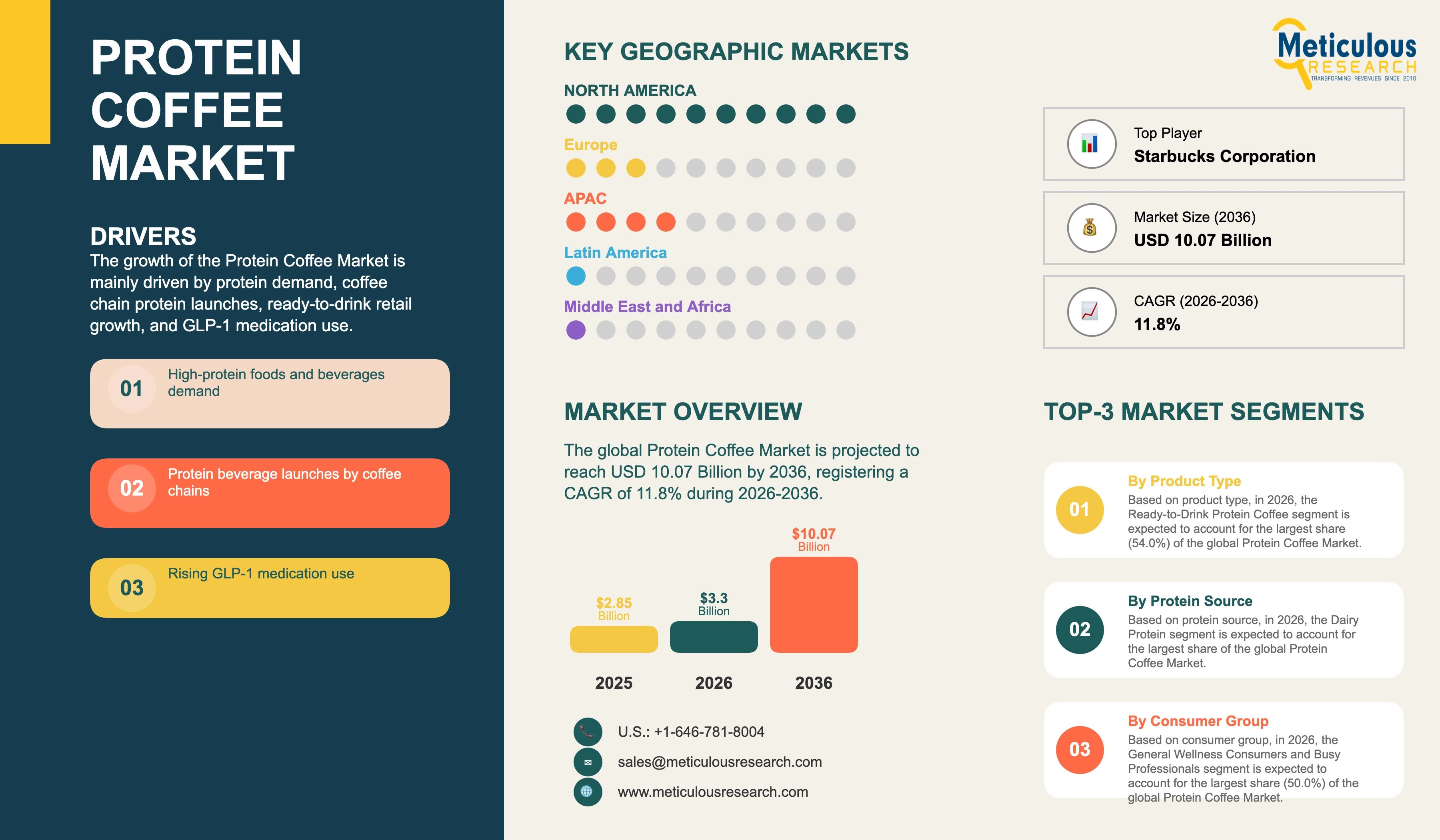
The global protein coffee market was valued at USD 2.85 billion in 2025. This market is expected to reach USD 10.07 billion by 2036 from an estimated USD 3.30 billion in 2026, registering a CAGR of 11.8% during the forecast period (2026-2036).
- Published
- Nov 2026
- Pages
- 245
- Format
- PDF + Excel
- Report ID
- MRFB - 1042565
- Base year
- 2025
- 2025 · BASELINE
- $2.85B
- 2036
- $10.07B
- CAGR 2026–2036
- 11.8%
2025 baseline · 2026–2036 forecast at 11.8% CAGR · hover a bar for the value
Key highlights
Starbucks launched Protein Cold Foam and Protein Lattes across the U.S. and Canada on September 29, 2025, offering between 15 and 36 grams of protein in a grande beverage, and the company noted that cold foam had grown 23% year on year and was included in about one of every seven beverages sold, showing the scale of the opportunity for protein-added coffee drinks across its large store network.
Starbucks expanded its protein beverages to Europe, the Middle East, and Africa in April 2026, starting with the U.K., with protein cold foam containing 15 grams of whey protein, and launched protein beverages in Latin America and the Caribbean on June 4, 2026, extending the protein coffee trend to new regions.
In March 2026, Starbucks ready-to-drink protein coffee beverages entered U.S. grocery stores through the North American Coffee Partnership with PepsiCo, bringing one of the world's best-known coffee brands into the ready-to-drink protein coffee aisle alongside brands such as Premier Protein and Kitu Super Coffee.
Specialty and challenger brands continue to launch protein coffee products, including Wandering Bear's protein cold brew, Slate Milk's protein lattes, and protein coffee creamers and powders from brands such as Laird Superfood, Vital Proteins, and Orgain, expanding choice across many product formats and protein sources and giving consumers more ways to add protein to their daily coffee at home, at work, and on the go.
Interest in high-protein diets has been reinforced by the growing use of GLP-1 weight-loss medications, which reduce appetite and make it especially important for users to get enough protein to protect muscle mass, and food and beverage companies have responded by launching protein-dense, easy-to-consume products, including protein coffee.
By product type, ready-to-drink protein coffee accounts for the largest share of 54.0% in 2026, while protein coffee creamers and add-ins register the highest CAGR.
By protein source, dairy protein accounts for the largest share in 2026, while plant protein registers the highest CAGR.
By consumer group, general wellness consumers and busy professionals account for the largest share of 50.0% in 2026, while weight management and GLP-1 users register the highest CAGR.
By distribution channel, supermarkets and hypermarkets account for the largest share in 2026, while coffee shops and foodservice registers the highest CAGR.
By geography, North America accounts for the largest share of 52.0% in 2026, while Asia-Pacific registers the highest CAGR of 14.7%.
Report summary
| Particulars | Details |
|---|---|
| Forecast Period | 2026-2036 |
| Base Year | 2025 |
| Estimated Year | 2026 |
| CAGR (Value) | 11.8% |
| Format | PDF, Excel & Cloud Portal · 245 pages |
| Market Size (Value) in 2025 | USD 2.85 billion |
| Market Size (Value) in 2026 | USD 3.30 billion |
| Market Size (Value) by 2036 | USD 10.07 billion |
| Largest Segment by Product Type (2026) | Ready-to-Drink Protein Coffee (54.0%) |
| Largest Segment by Consumer Group (2026) | General Wellness Consumers and Busy Professionals (50.0%) |
| Largest Region (2026) | North America (52.0%) |
| Fastest-Growing Region | Asia-Pacific (CAGR 14.7%) |
| Segments Covered | Product Type, Protein Source, Consumer Group, Distribution Channel, Geography |
| Countries Covered | U.S., Canada, China, Japan, South Korea, Australia, India, Indonesia, Thailand, Vietnam, Singapore, Malaysia, Rest of Asia-Pacific, U.K., Germany, France, Netherlands, Spain, Italy, Sweden, Norway, Denmark, Poland, Ireland, Rest of Europe, Mexico, Brazil, Colombia, Chile, Argentina, Rest of Latin America, U.A.E., Saudi Arabia, Turkey, Israel, South Africa, Rest of Middle East & Africa |
| Key Companies | 10 companies and other companies |
Report overview
Segments covered: product type, protein source, consumer group, distribution channel.
The growth of this market is mainly driven by strong consumer demand for high-protein foods and beverages, the popularity of coffee as a daily habit that can easily carry added protein, the launch of protein beverages by major coffee chains such as Starbucks, the growth of ready-to-drink protein coffee in grocery, convenience, and online channels, rising use of GLP-1 weight-loss medications, which has increased interest in protein-dense and convenient foods, and continued innovation in creamers, powders, and plant-based protein coffee products. However, factors such as higher prices than regular coffee, taste and texture challenges, concerns about sugar and additives in some products, and competition from protein shakes and do-it-yourself protein coffee are expected to restrain the growth of this market to some extent.
Protein coffee refers to coffee beverages and coffee products that contain added protein, typically from dairy proteins such as milk protein concentrate, whey, and casein, plant proteins such as pea, soy, oat, and almond, or collagen. Protein coffee is sold as ready-to-drink bottled and canned beverages, powders and instant mixes, protein coffee creamers and add-ins, coffee pods and capsules, and freshly prepared protein drinks in coffee shops. This report covers protein coffee across product types, protein sources, consumer groups, and distribution channels, including foodservice sales of protein coffee drinks, and it excludes general protein shakes that are only coffee-flavored without coffee content. The market is measured on a sales value basis.
Protein coffee combines two of the strongest trends in food and beverages: daily coffee consumption and rising demand for protein. Coffee is consumed by a very large share of adults, often every morning, and adding protein allows consumers to turn their coffee into a more filling drink or quick breakfast replacement. Many consumers had already been making their own protein coffee at home by mixing protein shakes or powders with coffee, a practice often called proffee on social media, and brands have developed products to make this easier and better tasting.
Ready-to-drink protein coffee is the largest product type, led by brands such as Premier Protein from BellRing Brands, Kitu Super Coffee, and Starbucks ready-to-drink beverages produced with PepsiCo. These products typically contain 10 to 30 grams of protein per serving, often with low sugar, and are sold in grocery stores, convenience stores, club stores, and online. Protein coffee powders and instant mixes allow consumers to make protein coffee at home or at work, while protein coffee creamers and add-ins let consumers add protein to their usual coffee.
Coffee shops have become an important and fast-growing part of the protein coffee market since Starbucks launched Protein Cold Foam and Protein Lattes in the U.S. and Canada in September 2025. The company then expanded protein beverages to Europe, the Middle East, Africa, Latin America, and the Caribbean in 2026. Other coffee chains, such as Dutch Bros, have also added protein options, and independent coffee shops increasingly offer protein add-ins. The entry of major coffee chains has greatly increased consumer awareness and has made protein coffee a mainstream product.
Dairy proteins are the main protein source, since they provide complete protein, good taste, and smooth texture, and they work well with coffee. Plant proteins are growing quickly, as consumers look for dairy-free and plant-based options, and brands are improving taste and texture. Collagen is used in some products, especially creamers and powders, for consumers interested in skin, hair, and joint health, although collagen is not a complete protein.
The main consumer groups are general wellness consumers and busy professionals who want a convenient, filling drink, fitness and active consumers who want to meet daily protein targets, and weight management consumers, including people using GLP-1 medications, who need protein-dense foods that are easy to consume when appetite is reduced. Younger consumers are also an important group, supported by social media trends and coffee shop culture.
Protein coffee also appeals to consumers who skip breakfast or eat on the go, since a single drink can provide caffeine, protein, and calories in a convenient format. Many products are also marketed as low in sugar, which helps them fit into weight management and low-carbohydrate diets.
The market includes large beverage and food companies, protein nutrition brands, specialty coffee brands, and coffee chains. Leading companies include Starbucks, PepsiCo, BellRing Brands (Premier Protein), Kitu Super Coffee, Nestlé (Vital Proteins and Orgain), Wandering Bear Coffee, Slate Milk, Dutch Bros, Glanbia, and Laird Superfood.
Over the forecast period, the protein coffee market is expected to grow rapidly, supported by continued demand for protein, expansion of protein offerings by coffee chains, growth of ready-to-drink products in retail, rising GLP-1 medication use, product innovation, and expansion into Europe and Asia-Pacific. Competition is expected to increase as more food, beverage, and coffee companies enter the market.
North America is expected to account for the largest share of 52.0% of the market in 2026, mainly due to high coffee consumption, strong protein demand, leading protein coffee brands, and the launch of Starbucks protein beverages and ready-to-drink products.
Asia-Pacific is projected to register the highest CAGR of 14.7% during the forecast period, driven by fast-growing coffee consumption, coffee chain expansion, ready-to-drink coffee popularity, and fitness trends.
The report profiles 10 companies, including Starbucks, PepsiCo, BellRing Brands (Premier Protein), Kitu Super Coffee, Nestlé (Vital Proteins and Orgain), Wandering Bear Coffee, Slate Milk, Dutch Bros, Glanbia, and Laird Superfood.
Report infographic
Market dynamics
18 factors across 5 forcesStrong consumer demand for high-protein foods and beverages
Protein has become one of the most important nutrition trends in food and beverages. Consumers increasingly associate protein with satiety, muscle health, weight management, energy, and healthy aging, and many are actively trying to increase their daily protein intake. Food and beverage companies have responded with high-protein yogurts, snacks, cereals, beverages, and coffee products, and protein claims have become common on product labels.
Coffee is an ideal carrier for protein because it is consumed daily by a large share of adults, often in the morning when many consumers skip breakfast. Adding protein to coffee allows consumers to get a meaningful amount of protein without changing their daily routine, and it turns coffee into a more filling drink that can replace or supplement breakfast. This convenience is a key reason for the rapid growth of protein coffee.
Social media has also played an important role in building demand, especially through the proffee trend, in which consumers mix protein shakes or powders with coffee, became popular on social media platforms, and many consumers share their protein coffee recipes and routines. This trend increased awareness and encouraged brands to develop ready-made products.
Launch of protein beverages by major coffee chains
The entry of major coffee chains into protein coffee has significantly expanded the market. Starbucks launched Protein Cold Foam and Protein Lattes in the U.S. and Canada on September 29, 2025, with grande beverages containing between 15 and 36 grams of protein. The company noted that cold foam had grown 23% year on year and was included in about one in seven beverages, which shows the potential for protein cold foam to reach a large number of customers. Starbucks expanded protein beverages to Europe, the Middle East, and Africa in April 2026, and to Latin America and the Caribbean in June 2026.
Other coffee chains, including Dutch Bros, have added protein options to their menus, and many regional chains and independent coffee shops now offer protein add-ins. The availability of protein coffee in coffee shops exposes millions of consumers to the product and encourages them to buy protein coffee products for home use.
Coffee chains also benefit from protein add-ins as a way to increase average order value and attract health-conscious customers, which gives them a strong incentive to continue promoting protein beverages.
Growth of ready-to-drink protein coffee in retail
Ready-to-drink protein coffee has grown strongly in grocery, convenience, club, and online channels. Brands such as Premier Protein, Kitu Super Coffee, and others offer shelf-stable bottled and canned protein coffee drinks with high protein and low sugar, and they have gained wide distribution. Starbucks entered the ready-to-drink protein coffee category in grocery stores in March 2026 through its partnership with PepsiCo, which brings strong brand recognition and distribution power to the category.
Retailers have expanded shelf space for ready-to-drink protein coffee, since these products attract health-conscious shoppers and offer high value per unit. Club stores sell multipacks, and convenience stores offer single bottles for on-the-go consumption. The combination of convenience, protein, and caffeine makes these products attractive for busy consumers and commuters.
Rising use of GLP-1 medications and weight management focus
The rapid growth in use of GLP-1 medications for weight loss has increased interest in protein-dense, nutrient-rich foods and beverages. These medications reduce appetite, and health experts recommend that users consume enough protein to help maintain muscle mass while losing weight. Protein coffee offers a convenient way for these consumers to get protein in a small, easy-to-consume serving that fits their daily routine.
Food and beverage companies have launched products marketed as companions for GLP-1 users, and protein coffee products are well positioned for this consumer group. More broadly, consumers focused on weight management use protein coffee to stay full longer and reduce snacking, which supports demand.
Product innovation in creamers, powders, and plant-based options
Brands continue to innovate with protein coffee creamers, flavored powders, instant mixes, coffee pods with added protein, and plant-based options. Protein creamers allow consumers to add protein to their usual coffee without changing their brewing method, and they have become popular with consumers who want flexibility. Improvements in protein ingredients and processing have improved taste, texture, and heat stability, reducing problems such as clumping and grittiness. Plant-based protein coffee made with pea, oat, soy, and almond proteins appeals to vegan and dairy-free consumers.
Table of contents
12 chapters · 153 sections · 245 pages · click to expandSegmental analysis
| Segment | Largest share (2026) | Fastest growth (2026–2036) |
|---|---|---|
| By Product Type | Dairy protein | Plant protein |
By Product Type
- The dairy protein segment is expected to account for the largest share of the protein coffee market, while the plant protein segment is projected to register the highest CAGR during the forecast period.
- The supermarkets and hypermarkets segment is expected to account for the largest share of the protein coffee market, while the coffee shops and foodservice segment is projected to register the highest CAGR during the forecast period.
Geographic analysis
North America
Largest shareIn 2026, North America is expected to account for the largest share of 52.0% of the global protein coffee market. The large share of this region is mainly due to very high coffee consumption, strong consumer demand for protein, the presence of leading protein coffee brands such as Premier Protein, Kitu Super Coffee, Wandering Bear, and Slate Milk, the launch of Starbucks protein beverages in the U.S. and Canada in September 2025, the entry of Starbucks ready-to-drink protein coffee into U.S. grocery through PepsiCo in March 2026, the large number of GLP-1 medication users, and wide distribution in grocery, convenience, club, and online channels. The U.S. is the largest market in the world, while Canada also has strong demand, supported by the launch of Starbucks protein beverages in Canadian stores.
Asia-Pacific
Fastest growthAsia-Pacific is projected to register the highest CAGR of 14.7% during the forecast period. The rapid growth of this region is mainly driven by fast-growing coffee consumption in China, South Korea, Japan, India, and Southeast Asia, the rapid expansion of coffee chains, the popularity of ready-to-drink coffee in Japan and South Korea, growing interest in fitness and protein among younger consumers, and expanding e-commerce. China is expected to be one of the fastest-growing markets, supported by local coffee chains and protein products, while Japan, South Korea, Australia, India, Indonesia, Thailand, Vietnam, and Singapore are important markets.
Europe
Europe accounts for a significant share of the market and is expected to grow rapidly, supported by Starbucks' launch of protein beverages in the region starting with the U.K. in April 2026, growing protein trends, and the presence of protein nutrition brands. The U.K., Germany, the Netherlands, the Nordic countries, France, Spain, Italy, and Poland are important markets, and EU rules on nutrition claims influence how products are marketed. Ireland, Belgium, and Switzerland are also growing markets, supported by high coffee consumption and strong sports nutrition sales.
Latin America
Latin America and the Middle East & Africa account for smaller shares of the market. In Latin America, Starbucks' launch of protein beverages in June 2026 and growing interest in fitness support demand in Mexico, Brazil, Colombia, Chile, and Argentina.
Middle East & Africa
In the Middle East & Africa, the U.A.E., Saudi Arabia, Turkey, Israel, and South Africa have growing demand, supported by coffee shop culture, fitness trends, and modern retail, with the U.A.E. and Saudi Arabia benefiting from rapid growth of international coffee chains.
Competitive landscape
The global protein coffee market is moderately concentrated, with the top five players estimated to account for about 45% of the market in 2025. The market includes coffee chains, large beverage and food companies, protein nutrition brands, specialty coffee brands, and protein ingredient suppliers.
Starbucks is a leading player, with protein cold foam and protein lattes in its coffee shops in North America, Europe, the Middle East, Africa, Latin America, and the Caribbean, and ready-to-drink protein coffee in grocery through its partnership with PepsiCo. PepsiCo produces and distributes Starbucks ready-to-drink beverages in North America through the North American Coffee Partnership. BellRing Brands' Premier Protein is a leading ready-to-drink protein shake brand with a strong presence in coffee-flavored and coffee-containing protein drinks.
Kitu Super Coffee is a leading ready-to-drink protein coffee brand, while Wandering Bear Coffee and Slate Milk offer protein cold brew and protein lattes. Nestlé offers protein coffee products through brands such as Vital Proteins and Orgain, including protein coffee creamers and collagen products. Dutch Bros has added protein options to its coffee shop menu, Laird Superfood offers plant-based coffee creamers and protein products, and Glanbia supplies whey and dairy protein ingredients and owns protein nutrition brands.
Companies compete on taste, protein content, sugar content, ingredients, brand strength, price, product format, and distribution. Key strategies include product launches, menu innovation, partnerships between coffee brands and beverage companies, retail expansion, international expansion, and marketing to fitness, wellness, and weight management consumers.
The entry of large companies such as Starbucks and PepsiCo has raised the competitive bar and increased consumer awareness, which benefits the whole category but also puts pressure on smaller brands. We expect more food, beverage, and coffee companies to enter the market and expect acquisitions of fast-growing protein coffee brands by larger companies.
Private-label protein coffee products from large retailers are also expected to grow, increasing price competition in grocery and club channels. Club retailers in particular have strong private-label protein beverage ranges, and they may extend these ranges into protein coffee.
Protein ingredient suppliers, such as Glanbia, also play an important role, since they develop the heat-stable, foamable, and soluble protein ingredients that make protein coffee products possible.
Some of the key players operating in the protein coffee market are Starbucks Corporation, PepsiCo, Inc., BellRing Brands, Inc. (Premier Protein), Kitu Super Coffee, Nestlé S.A. (Vital Proteins and Orgain), Wandering Bear Coffee, Slate Milk, Dutch Bros Inc., Glanbia plc, and Laird Superfood, Inc., among others.
- —
Starbucks launched Protein Cold Foam and Protein Lattes in the U.S. and Canada in September 2025, brought ready-to-drink protein coffee to U.S. grocery through PepsiCo in March 2026, and expanded protein beverages to Europe, the Middle East, and Africa in April 2026 and Latin America and the Caribbean in June 2026.
- Starbucks Corporation
- PepsiCo, Inc.
- BellRing Brands, Inc. · Premier Protein
- Kitu Super Coffee
- Nestlé S.A. (Vital Proteins and Orgain)
- Wandering Bear Coffee
- Slate Milk
- Dutch Bros Inc.
- Glanbia plc
- Laird Superfood, Inc.
Expert perspectives
Protein coffee has become one of the fastest-growing segments in both the coffee and protein beverage markets, supported by the combination of daily coffee habits and strong consumer demand for protein. The entry of Starbucks into protein beverages in coffee shops and ready-to-drink grocery products has made protein coffee mainstream and has greatly expanded the consumer base.
Over the forecast period, the market is expected to grow at a CAGR of 11.8%, from USD 3.30 billion in 2026 to USD 10.07 billion in 2036. Growth will be supported by protein demand, coffee chain innovation, ready-to-drink retail growth, GLP-1 medication use, product innovation, and international expansion.
Ready-to-drink protein coffee remains the largest product type, while protein coffee creamers and add-ins grow fastest. Dairy protein is the largest protein source, while plant protein grows fastest. General wellness consumers and busy professionals are the largest consumer group, while weight management and GLP-1 users grow fastest. Supermarkets and hypermarkets are the largest channel, while coffee shops and foodservice grow fastest. North America is the largest region, and Asia-Pacific is the fastest-growing region at a CAGR of 14.7%.
In our view, the protein coffee market has moved beyond a niche fitness product and is becoming a mainstream coffee category, much like cold brew and oat milk lattes did in earlier years. The key question is how large the category can become, and we believe that coffee shop protein add-ins will continue to introduce protein coffee to new consumers, who will then buy ready-to-drink products and creamers for home use.
We expect GLP-1 medication use to remain an important driver, as more consumers look for convenient ways to meet protein needs with reduced appetite. However, brands must avoid making unsupported health claims and should focus on clear nutrition benefits. Products that support muscle maintenance with high-quality protein and low sugar are likely to remain the most relevant for this group.
In our view, taste and price will be the main factors determining long-term success in this market, and brands that combine great taste with high protein, low sugar, and reasonable prices will be best positioned, while products with poor taste or high prices may struggle as competition increases.
International expansion, especially in Asia-Pacific and Europe, offers significant long-term growth potential, and we expect large coffee chains and global beverage companies to lead this expansion in the coming years.
Finally, we believe that foodservice will be the main source of new consumers for the category, while retail products will capture repeat daily use.
Customer perspectives
Buyers of protein coffee include busy professionals, commuters, fitness enthusiasts, weight management consumers, people using GLP-1 medications, coffee shop customers, and retailers. Their purchase decisions depend mainly on taste, protein content, sugar content, ingredients, convenience, price, caffeine content, and brand trust.
Office worker, 32 - U.S.
I grab a bottled protein coffee on my way to work because it replaces breakfast and keeps me full until lunch. Taste and grams of protein are what I check first.
This comment explains why ready-to-drink protein coffee accounts for 54.0% of the market, why general wellness consumers and busy professionals account for 50.0% of the market, and why North America is the largest region. It also shows that taste and protein content are the first things consumers compare.
Registered dietitian - Weight management clinic, U.S.
Many of my patients who take GLP-1 medications struggle to eat enough protein, so I suggest easy options like protein coffee that fit into their morning routine.
This comment explains why weight management and GLP-1 users are the fastest-growing consumer group and why protein-dense products are gaining importance among healthcare professionals and their patients.
Store Manager - Coffee chain, U.K.
Since we added protein cold foam, many customers ask for it on their iced drinks, and it brings in people who want something more filling.
This comment explains why coffee shops and foodservice are the fastest-growing distribution channel and why protein coffee creamers and add-ins are the fastest-growing product type. It also shows how coffee shop menus introduce protein coffee to new consumers.
Frequently asked questions
The global protein coffee market was valued at USD 2.85 billion in 2025, up from USD 2.40 billion in 2024, and is estimated at USD 3.30 billion in 2026. The market includes ready-to-drink protein coffee, powders and instant mixes, creamers and add-ins, pods and capsules, and protein coffee drinks sold in coffee shops.
Cite this report
Meticulous Research. (2026). Protein Coffee Market - Global Opportunity Analysis and Industry Forecast (2026-2036) (Report No. MRFB - 1042565). Meticulous Market Research Pvt. Ltd. https://www.meticulousresearch.com/product/protein-coffee-market-7248