Preservative Boosters Market (2026-2036)
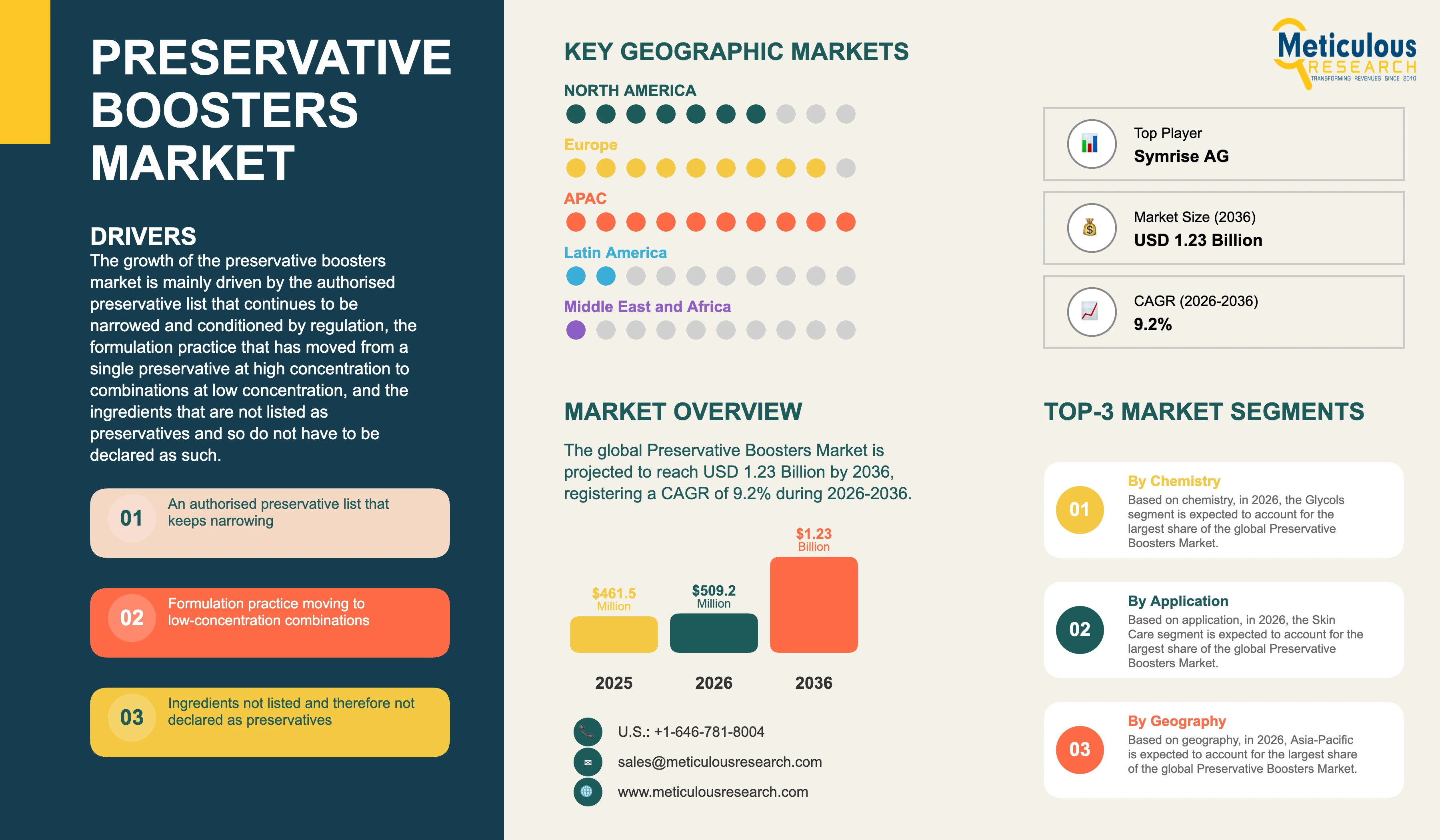
The global preservative boosters market was valued at USD 461.5 million in 2025. This market is expected to reach USD 1.23 billion by 2036 from an estimated USD 509.2 million in 2026, registering a CAGR of 9.2% during the forecast period (2026-2036).
- Published
- Nov 2026
- Pages
- 260
- Format
- PDF + Excel
- Report ID
- MRCHM - 1042821
- Base year
- 2025
- 2025 · BASELINE
- $461.5M
- 2036
- $1.23B
- CAGR 2026–2036
- 9.2%
2025 baseline · 2026–2036 forecast at 9.2% CAGR · hover a bar for the value
Key highlights
The global preservative boosters market is estimated at USD 509.2 million in 2026 and is projected to reach USD 1.23 billion by 2036.
Market volume is estimated at 38.00 kilotons in 2026 and is projected to reach 79.05 kilotons by 2036 at a CAGR of 7.6%, counting the booster component only and excluding any authorised preservative co-formulated with it.
The average selling price is estimated at USD 13.40 per kg in 2026 and is projected to reach USD 15.60 per kg by 2036 as newer organic acid and chelator chemistries take a larger share.
Glycols are expected to account for the largest chemistry share in 2026, while aromatic and organic acid derivatives are projected to register the highest CAGR of 12.4%.
Skin care is expected to hold the largest application share in 2026, while baby and sensitive skin care is projected to register the highest CAGR of 11.6%.
Asia-Pacific is expected to hold the largest regional share in 2026 and is also projected to grow fastest at a CAGR of 10.6%.
Commission Regulation (EU) 2026/909 of 27 April 2026, published in the Official Journal on 28 April 2026, moved silver zinc zeolite out of the Annex II prohibition and into the Annex V preservative list at 1% in deodorant sprays and powder foundations, with silver content in the ingredient not above 2.5%.
Recital 9 of that Regulation gives the shrinking pool of preservatives as part of the reasoning for that move, which is the Commission stating the condition that creates this market.
That Regulation also prohibits triphenyl phosphate and restricts benzyl salicylate, citral, water-soluble zinc salts, acetylated vetiver oil and aluminium-containing ingredients, with non-compliant products barred from being placed on the market from 1 January 2027 and from being made available from 1 July 2028.
Commission Regulation (EU) 2026/78 of 12 January 2026, published on 13 January 2026 and applying from 1 May 2026, replaced Annex V entry 7 to cover biphenyl-2-ol and sodium 2-biphenylate at 0.2% in rinse-off and 0.15% in leave-on products as phenol, and added fifteen substances to the Annex II prohibition.
Neither Regulation names ethylhexylglycerin, caprylyl glycol, 1,2-hexanediol, phenylpropanol, glyceryl caprylate, caprylhydroxamic acid, hydroxyacetophenone or p-anisic acid, because none of them is listed as a preservative.
A study of 83 products published in Scientific Reports on 17 August 2024 by authors at the Shanghai Municipal Center for Disease Control and Prevention and Shanghai Jahwa United Co., Ltd. found caprylyl glycol in 21.4% of 70 infant products and in 61.5% of 13 sensitive skin products.
That study found 1, 2-hexanediol in 15.7% of infant products, pentylene glycol in 2.9%, and ethylhexylglycerin in 23 of the 70 infant products, with measured ethylhexylglycerin content of 0.0079% to 0.55% by weight and a median of 0.096%.
In the sensitive skin group the study found phenoxyethanol in 30.8% of products against caprylyl glycol in 61.5%, so the booster was present about twice as often as the leading conventional preservative.
Of the fourteen products challenge tested in that study, three systems containing boosters failed the fungi criterion, while all systems containing p-anisic acid passed.
The study notes that ethylhexylglycerin may be reclassified as a preservative by European authorities, which is the principal commercial risk in this market, since the value of these ingredients rests on their not being listed as preservatives.
Report summary
| Particulars | Details |
|---|---|
| Base Year | 2025 |
| Forecast Period | 2026-2036 |
| Market Size in 2025 | USD 461.5 million |
| Market Size in 2026 | USD 509.2 million |
| Market Size by 2036 | USD 1.23 billion |
| Value CAGR (2026-2036) | 9.2% |
| Format | PDF, Excel & Cloud Portal · 260 pages |
| Volume in 2026 | 38.00 kilotons |
| Volume by 2036 | 79.05 kilotons |
| Volume CAGR (2026-2036) | 7.6% |
| Volume Basis | Booster ingredient supplied on a product mass basis, booster component only |
| Average Selling Price in 2026 | USD 13.40 per kg |
| Average Selling Price by 2036 | USD 15.60 per kg |
| Price Direction | The average selling price rises across the forecast period as the aromatic and organic acid and chelator chemistries take a larger share of a mix currently dominated by the glycols, rather than through any change in the cost of an individual ingredient |
| Volume Basis Note | A large part of this market reaches the formulator as a blend in which a booster is co-formulated with an authorised preservative, most commonly phenoxyethanol; this report counts the booster component only and excludes the preservative in the blend, because counting the blend whole would place authorised preservative tonnage inside a market defined by the absence of a preservative approval |
| Regulatory Basis Note | Neither Commission Regulation (EU) 2026/78 of 12 January 2026 nor Commission Regulation (EU) 2026/909 of 27 April 2026 names ethylhexylglycerin, caprylyl glycol, 1,2-hexanediol, phenylpropanol, glyceryl caprylate, caprylhydroxamic acid, hydroxyacetophenone or p-anisic acid, because none of them is listed as a preservative; recital 9 of the April Regulation nonetheless gives the shrinking pool of preservatives as part of its reasoning for moving silver zinc zeolite into Annex V, which is the condition that creates demand for these ingredients |
| Measurement Basis | Ingredients that improve the antimicrobial performance of a preservative system without being authorised or declared as preservatives, including glycols, glyceryl ethers, aromatic and organic acid derivatives, and hydroxamic acids and chelators, by chemistry, application, supply form and geography, and excluding authorised preservatives, natural food preservatives, biocidal actives and silver ion antimicrobial additives |
| Relationship to Adjacent Markets | This market is not additive to the markets for authorised preservatives, since the booster component alone is measured and any preservative co-formulated with it in a blend is excluded; silver zinc zeolite sits outside this market in both of its regulatory characters, as an Annex V cosmetic preservative from 27 April 2026 and as a biocidal active, and belongs with the silver ion antimicrobial additives rather than here |
| Note on Challenge Test Evidence | Of the fourteen products challenge tested in the Scientific Reports study of 17 August 2024, three systems containing boosters failed the fungi criterion, one system using only conventional preservatives also failed, and all systems containing p-anisic acid passed; the authors conclude that failure can occur regardless of preservative composition, attributing it to pH, packaging and water content, so booster adoption should be read as a labelling and acceptability decision rather than as a performance upgrade |
| Note on Supplier Disclosure | No participant publishes revenue for preservation boosters separately from its wider personal care ingredients business, and because these ingredients are not listed as preservatives there is no regulatory register of volumes either, so the sizing here is built from formulation prevalence and application demand rather than from disclosed sales |
| Largest Chemistry | Glycols |
| Fastest-Growing Chemistry | Aromatic and organic acid derivatives (CAGR 12.4%) |
| Largest Application | Skin care |
| Fastest-Growing Application | Baby and sensitive skin care (CAGR 11.6%) |
| Largest Region | Asia-Pacific |
| Fastest-Growing Region | Asia-Pacific (CAGR 10.6%) |
| Segments Covered | Chemistry, Application, Supply Form, and Geography |
| Geographies Covered | Asia-Pacific, Europe, North America, Latin America, and Middle East & Africa |
| Companies Profiled | 7 companies, including Symrise AG, Evonik Industries AG, Clariant AG, Arxada AG, Ashland Inc., Schülke & Mayr GmbH, and Inolex, Inc. |
Report overview
Segments covered: chemistry, application, supply form.
In volume terms, this market is estimated at 38.00 kilotons in 2026 and is projected to reach 79.05 kilotons by 2036, registering a CAGR of 7.6% during the same period, measured as booster ingredient supplied on a product mass basis and counting the booster component only, so that any authorised preservative co-formulated with it in a blend is excluded. The average selling price is estimated at USD 13.40 per kg in 2026 and is projected to rise to USD 15.60 per kg by 2036 as the newer organic acid and chelator chemistries take a larger share of the mix.
The growth of this market is mainly driven by the authorised preservative list that continues to be narrowed and conditioned by regulation, the formulation practice that has moved from a single preservative at high concentration to combinations at low concentration, the ingredients that are not listed as preservatives and so do not have to be declared as such, and the baby and sensitive skin categories where the conventional options are least acceptable. However, factors such as the absence of a preservative approval that leaves these ingredients without an established efficacy standard, the challenge test failures that systems built on them can still record, the higher use levels they require than the preservatives they displace, and the reclassification risk that would bring them inside the preservative regime are expected to restrain the growth of this market to some extent.
Glycols account for the largest chemistry share of this market, while aromatic and organic acid derivatives grow fastest from a smaller base. Asia-Pacific holds the largest regional share and is also the fastest-growing region.
Preservative boosters are ingredients that improve the antimicrobial performance of a preservative system without being authorised or declared as preservatives themselves, including glycols such as caprylyl glycol and 1,2-hexanediol, glyceryl ethers such as ethylhexylglycerin, aromatic and organic acid derivatives such as p-anisic acid and the levulinates, and hydroxamic acids and chelators such as caprylhydroxamic acid and sodium phytate. Market sizing in this report is on both a value basis in USD and a volume basis in kilotons measured as booster ingredient supplied on a product mass basis.
Counting the booster component only is the decisive measurement choice here and it needs stating plainly. A large part of this market reaches the formulator as a blend in which a booster is co-formulated with an authorised preservative, most commonly phenoxyethanol, and counting the whole blend would place authorised preservative tonnage inside a market defined by the absence of a preservative approval. The booster component is therefore measured and the preservative in the blend is excluded.
Commission Regulation (EU) 2026/909 of 27 April 2026, published in the Official Journal on 28 April 2026, moved silver zinc zeolite out of the Annex II prohibition and added it to the Annex V preservative list at 1% in deodorant sprays and powder foundations with silver content in the ingredient not above 2.5%, following the opinion of the Scientific Committee on Consumer Safety of 21 December 2023. Recital 9 gives the shrinking pool of preservatives as part of the reasoning for that move.
That recital is the most useful sentence available on this market, because the condition it describes is the condition that creates the demand. The same Regulation prohibits triphenyl phosphate and restricts benzyl salicylate, citral, water-soluble zinc salts, acetylated vetiver oil and aluminium-containing ingredients, with non-compliant products barred from being placed on the market from 1 January 2027 and from being made available from 1 July 2028.
Commission Regulation (EU) 2026/78 of 12 January 2026, published on 13 January 2026 and applying from 1 May 2026, worked in the same direction. It replaced Annex V entry 7 to cover biphenyl-2-ol and sodium 2-biphenylate at 0.2% in rinse-off and 0.15% in leave-on products expressed as phenol, restricted silver powder and hexyl salicylate in Annex III, and added fifteen substances to the Annex II prohibition following the classifications made by Delegated Regulation (EU) 2024/2564.
What matters for this market is what both Regulations leave out. Neither names ethylhexylglycerin, caprylyl glycol, 1,2-hexanediol, phenylpropanol, glyceryl caprylate, caprylhydroxamic acid, hydroxyacetophenone or p-anisic acid, because none of them is listed as a preservative and so none of them is touched by an amendment to the preservative annex. The boosters sit outside the cycle that is steadily narrowing the alternatives to them.
A study of 83 products published in Scientific Reports on 17 August 2024 by authors at the Shanghai Municipal Center for Disease Control and Prevention and Shanghai Jahwa United Co., Ltd. gives the clearest published measure of how far that substitution has gone. Across 70 infant and young children products it found caprylyl glycol in 21.4%, 1,2-hexanediol in 15.7% and pentylene glycol in 2.9%, with ethylhexylglycerin present in 23 of the 70 products.
The sensitive skin group in that study is the more striking of the two. Across 13 products it found caprylyl glycol in 61.5% against phenoxyethanol in 30.8%, methylparaben in 15.4% and sorbic acid in 7.7%, and no other conventional preservative at all. The booster was present about twice as often as the leading authorised preservative, which is the commercial position this market occupies in its most advanced category.
Measured concentrations in that study put the use levels in context. Ethylhexylglycerin was found at 0.0079% to 0.55% by weight with a median of 0.096%, caprylyl glycol at 0.026% to 0.56% with a median of 0.22%, and 1,2-hexanediol at 0.097% to 1.20% with a median of 0.51%, against phenoxyethanol at 0.01% to 0.99% with a mean of 0.44%. The glycols are therefore dosed at broadly comparable levels to the preservative they are displacing rather than at trace levels.
The same study is also the most candid published account of the limits of this chemistry. Of fourteen products challenge tested, three systems containing boosters failed the fungi criterion, being 1,2-hexanediol alone, a phenoxyethanol with caprylyl glycol and ethylhexylglycerin blend, and a pentylene glycol with caprylyl glycol and phenoxyethanol blend. One system using only conventional preservatives also failed, and the authors conclude that failure can occur regardless of preservative composition, pointing to pH, packaging and water content.
All the systems containing p-anisic acid in that study passed, which is a small sample but is consistent with the growth of the aromatic and organic acid chemistries from a smaller base. That segment registers the highest chemistry CAGR at 12.4%, while the glycols hold the largest share.
The study carries one caution that should be read alongside its findings. Its Discussion describes caprylyl glycol as the leading booster in both groups, while its results show butylene glycol at 27.1% against caprylyl glycol at 21.4% in the infant group, so the two statements do not agree. Butylene glycol is in any case used principally as a humectant at much higher levels, with a median of 4.65% in that study, which is why it is not counted as a booster here.
The reclassification question is the single largest commercial risk carried by this market and the study names it directly, noting that ethylhexylglycerin may be reclassified as a preservative by European authorities. The entire value of a booster rests on its not being a listed preservative, so a reclassification would move the ingredient into the annex that is being narrowed and would remove at a stroke the labelling advantage that justifies its premium.
This market is not additive to the markets for authorised preservatives, since the booster component alone is measured and any preservative co-formulated with it in a blend is excluded. Silver zinc zeolite is outside this market in both of its regulatory characters, as an Annex V cosmetic preservative from 27 April 2026 and as a biocidal active, and belongs with the silver ion antimicrobial additives rather than here.
A chelator does not inhibit microorganisms directly but sequesters the metal ions they require and destabilises cell walls, so it raises the performance of whatever preservative is present rather than substituting for part of its spectrum.
That makes it additive to any system rather than an alternative within one, and hydroxamic acids and chelators are projected to grow at 11.0% over the forecast period.
These four opportunities divide into two kinds that will not arrive together. The 2026 reformulation deadlines and the Asia-Pacific formulation growth expand the number of specifications being opened, while the newer acid chemistries and the chelators change what can be put into them once they are open.
The deadlines are the most precisely dated opportunity in this market. Commission Regulation (EU) 2026/909 bars non-compliant products from being placed on the market from 1 January 2027 and from being made available from 1 July 2028, and Commission Regulation (EU) 2026/78 applies from 1 May 2026, so the work has to be completed on a published timetable rather than when a brand chooses.
A formulation reopened under that pressure is reconsidered as a whole. The preservative system is rebuilt rather than adjusted, because the restriction that forced the change usually affects one component of a system that was balanced around it, and that is the point at which an ingredient enters a specification it would not otherwise have been trialled for.
The antifungal opportunity is the one that would change the technical standing of this market rather than its size. Every challenge test failure recorded among the booster systems in the Scientific Reports study was on the fungi criterion and none was on bacteria alone, so a chemistry that closes that gap addresses the only published evidence against these systems.
A fifth route sits alongside them and is growing from almost nothing. Household and surface care products face the same ingredient list scrutiny that personal care met a decade earlier, and the formulations are simpler and the sensory tolerance wider, so a substitution that took years in skin care can be completed there in months once the brief is written.
The Asia-Pacific opportunity is also where the evidence base sits, which matters for how confidently it can be read. The published prevalence data on booster adoption in infant and sensitive skin products comes from the Chinese market, so the region with the largest share is also the one whose formulation practice is best documented.
Asia-Pacific is expected to account for the largest share in 2026, on the scale of its personal care manufacturing and the infant and sensitive skin categories where substitution has gone furthest. India is projected to grow at 12.0%, China at 11.4%, South Korea at 10.0% and Japan at 7.0%.
Asia-Pacific is also projected to register the highest CAGR of 10.6% during the forecast period, holding both the largest share and the fastest growth.
Europe holds the second largest share and is where the regulatory driver originates, with France growing at 8.6%, Germany at 8.4% and the United Kingdom at 8.0%. Commission Regulation (EU) 2026/78 applies from 1 May 2026 and Commission Regulation (EU) 2026/909 sets deadlines of 1 January 2027 for placing on the market and 1 July 2028 for making available.
The Middle East & Africa is projected to grow at a CAGR of 8.0%, where warm climates and long distribution chains raise the preservation requirement. Latin America is projected to grow at a CAGR of 9.0%, with Brazil at 9.0%.
Symrise AG, Evonik Industries AG, Clariant AG, Arxada AG and Ashland Inc. together accounted for an estimated 52.4% of this market in 2026. The 7 companies profiled in this report together accounted for an estimated 60.2%.
Report infographic
Market dynamics
13 factors across 5 forcesAn Authorised Preservative List That Keeps Narrowing
Each amendment cycle removes or conditions authorised preservatives, and the reasoning is set out in the recitals rather than left to inference. Recital 9 of Commission Regulation (EU) 2026/909 of 27 April 2026 gives the shrinking pool of preservatives as part of the reason for moving silver zinc zeolite into Annex V.
Commission Regulation (EU) 2026/78 of 12 January 2026 worked the same way, replacing Annex V entry 7 for biphenyl-2-ol and its sodium salt at 0.2% rinse-off and 0.15% leave-on as phenol, and adding fifteen substances to the Annex II prohibition.
Formulation Practice Moving to Low-Concentration Combinations
Preservation has moved away from a single preservative at high concentration toward combinations of several ingredients at low concentration, which is the structure in which a booster earns its place rather than competing directly with a preservative.
The Scientific Reports study of 17 August 2024 records that shift and the accompanying move away from parabens, isothiazolinones and formaldehyde releasers, finding none of the latter in any of its 83 products and methylisothiazolinone in only 2.9% of the infant group.
Ingredients Not Listed and Therefore Not Declared as Preservatives
A booster is declared by its cosmetic function, commonly as a skin conditioning agent, emollient or humectant, so a formulation built on boosters and a single low-level preservative presents a shorter and less contentious ingredient list than the system it replaced.
Neither of the two 2026 Regulations names any booster chemistry, because none is on the preservative annex, which is both the reason these ingredients are specified and the reason they are not affected by amendments to it.
Baby and Sensitive Skin Categories
These are the categories in which the conventional options are least acceptable to the purchaser, and they are where substitution has gone furthest.
The Scientific Reports study found caprylyl glycol in 61.5% of its 13 sensitive skin products against phenoxyethanol in 30.8%, with no conventional preservative other than phenoxyethanol, methylparaben and sorbic acid present at all. Baby and sensitive skin care registers the highest application CAGR at 11.6%.
These four drivers are not parallel claims but one mechanism observed at four points. Regulation removes or conditions an authorised preservative; the formulator responds by building a system of several ingredients at low concentration rather than one at high concentration; the ingredients recruited into that system are not on the preservative list and so carry no preservative declaration; and the categories where the declaration matters most to the purchaser are where the practice spreads first.
That sequence is why demand here is more predictable than in most ingredient markets. An amendment to the preservative annex arrives with a date attached, reformulation has to be completed before it, and the reformulation almost always widens rather than narrows the number of ingredients performing the preservation duty. The direction of travel does not depend on anyone preferring these chemistries.
The regulatory record of the first half of 2026 shows the pace. Fifteen substances were added to the prohibition annex in January and a further six substance groups were prohibited or restricted in April, with the Commission itself citing the shrinking pool of preservatives in the April recitals while moving a substance into the preservative list to partly offset it.
What none of these drivers rests on is a performance advantage. The Scientific Reports study of 17 August 2024 found three booster-containing systems failing the fungi criterion among fourteen challenge tested, and concluded that failure can occur regardless of preservative composition. Adoption is being driven by what can be declared and what is permitted, not by what preserves better.
Each driver accordingly answers a different question, and a supplier has to satisfy all four in the same specification before a substitution proceeds.
Table of contents
11 chapters · 134 sections · 260 pages · click to expandSegmental analysis
| Segment | Largest share (2026) | Fastest growth (2026–2036) |
|---|---|---|
| By Chemistry | Glycols | Aromatic and organic acid derivatives |
| By Application | Skin care | Baby and sensitive skin care |
| By Supply Form | Glycols | Baby and sensitive skin care |
By Chemistry
- Preservative Boosters Analysis by Chemistry
- The glycols segment is expected to account for the largest share of the global preservative boosters market.
- The large share of this segment is mainly due to caprylyl glycol and 1, 2-hexanediol holding established positions in skin care and in the baby and sensitive skin categories, to their acceptance as skin conditioning and humectant ingredients rather than as preservatives, and to their compatibility with the low-concentration combination systems that have replaced single preservatives.
- However, the aromatic and organic acid derivatives segment is projected to register the highest CAGR of 12.4% during the forecast period.
- The rapid growth of this segment is attributed to its performance against yeasts and moulds, which is the gap the glycols leave and where booster-based systems fail challenge testing, and all the p-anisic acid systems in the Scientific Reports challenge testing passed while three glycol-containing systems failed the fungi criterion.
- Glyceryl ethers, principally ethylhexylglycerin, hold a substantial position and were found in 23 of the 70 infant products in that study.
- Hydroxamic acids and chelators work by sequestering the metal ions microorganisms require rather than by inhibiting them, which makes them additive to any system.
- Chemistry determines the spectrum covered, the dose required and the cosmetic function under which the ingredient is declared.
- Glycols are expected to account for the largest share in 2026, on caprylyl glycol and 1,2-hexanediol holding established positions in skin care and in the baby and sensitive skin categories and on their acceptance as skin conditioning and humectant ingredients.
- Aromatic and organic acid derivatives are projected to register the highest CAGR of 12.4% during the forecast period, on performance against yeasts and moulds, which is the gap the glycols leave.
By Application
- Preservative Boosters Analysis by Application
- The skin care segment is expected to account for the largest share of the global preservative boosters market.
- The large share of this segment is mainly due to the water content and long opened shelf life of emulsions requiring a preservation system at all, to the scale of the category, and to skin care being where short ingredient lists carry the most weight with the purchaser.
- However, the baby and sensitive skin care segment is projected to register the highest CAGR of 11.6% during the forecast period.
- The rapid growth of this segment is attributed to the conventional preservatives being least acceptable to the purchaser in these categories, and the Scientific Reports study found caprylyl glycol in 61.5% of its sensitive skin products against phenoxyethanol in 30.8%, with no conventional preservative other than those two, methylparaben and sorbic acid present.
- Hair care uses boosters in rinse-off systems where contact time is short and the preservation requirement is lower.
- Colour cosmetics apply them in anhydrous and low-water formats where the requirement is different again.
- Household and other applications cover surface and fabric products.
- Application determines the water activity, the packaging and the opened shelf life, and those three decide how much preservation is needed before any ingredient is chosen.
- Skin care is expected to hold the largest share in 2026, on the water content and long opened shelf life of emulsions requiring a preservation system, the scale of the category, and short ingredient lists carrying most weight there.
- Baby and sensitive skin care is projected to register the highest CAGR of 11.6% during the forecast period, and the Scientific Reports study found caprylyl glycol in 61.5% of its sensitive skin products against phenoxyethanol in 30.8%.
By Supply Form
- Preservative Boosters Analysis by Supply Form
- Most volume in this market reaches the formulator blended with an authorised preservative, most commonly phenoxyethanol, rather than as a neat ingredient, because the blend has been validated as a system and the buyer is purchasing that validation alongside the chemistry.
- That form holds the larger share throughout the period.
- Neat ingredient supply grows faster at 10.0% as larger formulators assemble their own systems and want to vary the ratio rather than buy a fixed one.
- This axis is also the reason the measurement basis in this report counts the booster component alone, since counting a blend whole would place authorised preservative tonnage inside a market defined by the absence of a preservative approval.
- The three axes answer different questions and none substitutes for another.
- Chemistry determines the spectrum covered, the dose required and the cosmetic function under which the ingredient is declared; application determines the water activity, the packaging and the opened shelf life, which decide how much preservation is needed at all; and supply form determines whether the buyer is purchasing a substance or a validated system.
- The second of those is the one most often skipped.
- A low-water or anhydrous formulation needs very little preservation whatever is available, while an aqueous emulsion opened daily for three months needs a great deal, so the choice of booster is only reached after the format has set the requirement.
- That is why prevalence differs so widely between categories in the published evidence.
- The highest growth sits where the regulatory pressure and the purchaser sensitivity coincide.
- Baby and sensitive skin care grows fastest among applications at 11.6% because that is where conventional preservatives are least acceptable, and aromatic and organic acid derivatives grow fastest among chemistries at 12.4% because they address the antifungal gap that the published challenge test evidence identifies in glycol-based systems.
- One axis is deliberately absent, and that is a split by claimed cosmetic function.
- These ingredients are declared as skin conditioning agents, emollients or humectants, and that declaration is the commercial point of the market rather than a description of what the buyer is purchasing, so a split on it would sort the market by label wording rather than by anything a formulator decides.
- The three axes used here follow the decisions actually made.
- Reading them together also resolves why value grows faster than volume.
- Volume grows at 7.6% while value grows at 9.2%, and the whole difference is the chemistry mix moving toward the newer acid and chelator ingredients, which are dosed at lower levels but priced well above the glycols they supplement.
- The fastest-growing position in this market, read across all three axes, is an aromatic or organic acid chemistry supplied as a validated blend into a baby or sensitive skin formulation, and it is that combination rather than any one of its parts that is taking share from the glycol systems now being reopened.
- Chemistry and application also interact rather than varying independently.
- The glycols hold their largest positions in the categories where they were adopted first, and the newer acid chemistries are entering through the formulations being rebuilt now, so the chemistry mix in any category reflects when that category was last reformulated as much as what performs best in it.
Geographic analysis
Asia-Pacific
Largest shareThe published evidence on booster adoption in infant and sensitive skin products comes from the Chinese market, and the categories driving it are growing faster there than in the mature regions. Asia-Pacific holds the largest regional share and is also projected to register the highest CAGR at 10.6%, with India at 12.0%, China at 11.4% and South Korea at 10.0%. In 2026, Asia-Pacific is expected to account for the largest share of the global preservative boosters market and is also projected to register the highest CAGR of 10.6% during the forecast period. The large share and rapid growth of this region are attributed to the scale of its personal care manufacturing, to the infant and sensitive skin categories where substitution has gone furthest, and to the published evidence on booster adoption in those categories coming from the Chinese market. India is projected to register a CAGR of 12.0%, China a CAGR of 11.4%, South Korea a CAGR of 10.0% and Japan a CAGR of 7.0%. Asia-Pacific Personal Care Formulation Geographic Analysis
Europe
Europe holds the second largest share and is where the regulatory driver originates. Commission Regulation (EU) 2026/78 applies from 1 May 2026 and Commission Regulation (EU) 2026/909 bars non-compliant products from being placed on the market from 1 January 2027 and from being made available from 1 July 2028, which sets reformulation deadlines that reach suppliers worldwide. France is projected to grow at 8.6%, Germany at 8.4% and the United Kingdom at 8.0%. In Europe an amendment removes an option and a date follows, so reformulation is obligatory and scheduled; in North America and much of Asia-Pacific the same substitution happens because a retailer or a brand has set an ingredient policy, which is a slower and less certain process but one that is not bounded by what any annex happens to list. Country rates within each region spread widely and follow category growth rather than regulation: India at 12.0% and China at 11.4% against Japan at 7.0% within Asia-Pacific, and France at 8.6% against the United Kingdom at 8.0% within Europe. A region without a narrowing authorised list still generates demand in this market, which is the difference between a regulatory driver and a commercial one, but it generates it more slowly and without a date by which the work must be finished. Regional shares in this market are also closer together than in most ingredient markets, with the three leading regions within ten points of one another, because the formulation decision is made by the same multinational brand owners wherever the product is manufactured.
North America
North America is projected to grow at 8.4%, with the United States at 8.4%, where the driver is retailer and brand ingredient policy rather than a narrowing authorised list.
Latin America
Latin America is projected to grow at 9.0%, with Brazil at 9.0%.
Middle East & Africa
The Middle East & Africa is projected to grow at 8.0%, where warm climates and long distribution chains raise the preservation requirement. What differs between regions is whether the pressure is legal or commercial.
Competitive landscape
The global preservative boosters market is moderately fragmented, with fragrance and ingredient houses, specialty chemical groups and preservation specialists all holding positions. Competition is contested on validated challenge test data for a blend in a specific formulation type, on the regulatory documentation that supports a non-preservative declaration, and on formulation support, rather than on ingredient price. Symrise AG, Evonik Industries AG, Clariant AG, Arxada AG and Ashland Inc. together accounted for an estimated 52.4% of this market in 2026, while the companies profiled in this report together accounted for an estimated 60.2%.
The commercial position of every participant rests on a regulatory classification none of them controls. These ingredients command a premium because they are not listed as preservatives, and the Scientific Reports study of 17 August 2024 notes that ethylhexylglycerin may be reclassified as a preservative by European authorities, which would move the most widely used non-glycol booster into the annex that the January and April 2026 Regulations have been narrowing.
No participant publishes revenue for preservation boosters separately from its wider personal care ingredients business, and neither of the 2026 Regulations names any booster chemistry, so there is no regulatory register of volumes either. Shares here are built from formulation prevalence and application demand rather than from disclosed sales. Some of the key players operating in the preservative boosters market are Symrise AG (Germany), Evonik Industries AG (Germany), Clariant AG (Switzerland), Arxada AG (Switzerland), Ashland Inc. (U.S.), Schülke & Mayr GmbH (Germany), and Inolex, Inc. (U.S.), among others.
Competition is therefore contested on data rather than on substance, and the position that data buys is durable. A supplier that has validated a blend in a specific formulation type holds that specification for as long as the product runs, because displacing it would mean repeating the challenge testing at the cost and risk of the customer.
The regulatory documentation supporting a non-preservative declaration is the second thing being bought. A formulator relying on an ingredient that is not on the preservative annex needs to be able to defend that position to a regulator and to a retailer, and the supplier that supplies the dossier alongside the chemistry is the one that wins the specification.
- —
Commission Regulation (EU) 2026/909 of 27 April 2026, published in the Official Journal on 28 April 2026, moved silver zinc zeolite out of the Annex II prohibition and added it to the Annex V preservative list at 1% in deodorant sprays and powder foundations with silver content in the ingredient not above 2.5%, following the Scientific Committee on Consumer Safety opinion of 21 December 2023, and recital 9 gives the shrinking pool of preservatives as part of its reasoning. That Regulation also prohibits triphenyl phosphate and restricts benzyl salicylate, citral, water-soluble zinc salts, acetylated vetiver oil and aluminium-containing ingredients, with non-compliant products barred from being placed on the market from 1 January 2027 and from being made available from 1 July 2028. Commission Regulation (EU) 2026/78 of 12 January 2026, published on 13 January 2026 and applying from 1 May 2026, replaced Annex V entry 7 to cover biphenyl-2-ol and sodium 2-biphenylate at 0.2% in rinse-off and 0.15% in leave-on products as phenol, restricted silver powder and hexyl salicylate in Annex III, and added fifteen substances to the Annex II prohibition. Neither Regulation names any booster chemistry. A study of 83 products published in Scientific Reports on 17 August 2024 by authors at the Shanghai Municipal Center for Disease Control and Prevention and Shanghai Jahwa United Co., Ltd. found caprylyl glycol in 21.4% of 70 infant products and 61.5% of 13 sensitive skin products, ethylhexylglycerin in 23 of the 70 infant products at 0.0079% to 0.55% by weight, and three booster-containing systems failing the fungi criterion out of fourteen challenge tested, while noting that ethylhexylglycerin may be reclassified as a preservative by European authorities.
- Symrise AG
- Evonik Industries AG
- Clariant AG
- Arxada AG
- Ashland Inc.
- Schülke & Mayr GmbH
- Inolex, Inc
Expert perspectives
Value grows at 9.2% against 7.6% in volume over the forecast period, and the average selling price rises from USD 13.40 per kg in 2026 to USD 15.60 per kg by 2036. The gap is the aromatic and organic acid and chelator chemistries taking a larger share of a mix currently dominated by the glycols, not a change in the cost of any one ingredient.
This market exists because of a line that is not drawn around it. A booster is valuable precisely because it is not on the authorised preservative list, so it carries no preservative declaration and is untouched when that list is amended. Recital 9 of Commission Regulation (EU) 2026/909 of 27 April 2026 cites the shrinking pool of preservatives in reasoning about an entirely different substance, and in doing so states the condition this market lives on.
That is also its single largest risk and it is a regulatory one rather than a commercial one. The Scientific Reports study of 17 August 2024 notes that ethylhexylglycerin may be reclassified as a preservative by European authorities. Reclassification would not change the chemistry or its performance; it would move the ingredient into the annex being narrowed and remove the labelling advantage that justifies its premium.
The same study is unusually honest about performance and should temper the clean-label argument. Three of its fourteen challenge-tested systems containing boosters failed the fungi criterion, one system using only conventional preservatives also failed, and the authors conclude that failure can occur regardless of preservative composition, attributing it to pH, packaging and water content. Booster adoption is a labelling and acceptability decision, not a performance upgrade.
The measured concentrations make the cost position plain. Caprylyl glycol at a median of 0.22% and 1,2-hexanediol at a median of 0.51% sit at broadly the same level as phenoxyethanol at a mean of 0.44%, so these are not trace additions, and at a higher unit price the preservation system costs more rather than less. The premium is recovered from the positioning of the finished product.
Measuring the booster component alone, excluding any preservative co-formulated with it in a blend, keeps this market separate from the preservatives it supplements and non-additive to them. Silver zinc zeolite is outside this market in both of its regulatory characters, as an Annex V cosmetic preservative from 27 April 2026 and as a biocidal active, and belongs with the silver ion antimicrobial additives.
Customer perspectives
Because a booster is not authorised as a preservative there is no approved concentration and no established spectrum to specify against, so the formulator carries the whole burden of demonstrating that the finished system preserves.
That is why challenge testing rather than ingredient specification governs adoption in this market.
Two Regulations in the first half of 2026 added fifteen prohibitions in January and prohibited or restricted a further six substance groups in April, while naming no booster chemistry, and the Scientific Reports study notes that ethylhexylglycerin may be reclassified as a preservative by European authorities.
Most boosters reach the formulator blended with an authorised preservative rather than as neat ingredients, because the blend has been validated as a system and the buyer is purchasing that validation alongside the chemistry.
What these three accounts share is that none of them is about preservation performance. The formulator is meeting a brief written about the ingredient list, the regulatory manager is tracking a list these ingredients are deliberately not on, and the buyer is purchasing validation data rather than chemistry. That is the market in three sentences.
That also explains why adoption has not stalled despite the challenge test evidence. The decision being made is not whether these ingredients preserve better, which the published evidence does not support, but whether a formulation can be built that preserves adequately while declaring nothing a purchaser will object to.
“The brief says the ingredient list must not read like a preservative system. What actually preserves the product is then our problem, and we prove it with a challenge test rather than with a specification.”
“Every amendment takes something off the authorised list. The ingredients we are replacing it with are not on that list at all, which is useful until the day one of them is put on it.”
“We buy the blend rather than the components because we are buying the data behind it. Mixing our own would mean repeating the validation.”
Frequently asked questions
This market was valued at USD 419.1 million in 2024 and USD 461.5 million in 2025, and is estimated at USD 509.2 million in 2026. In volume terms it is estimated at 38.00 kilotons in 2026, counting the booster component only.
This market is projected to reach USD 1.23 billion by 2036 in value and 79.05 kilotons in volume.
This market is projected to register a value CAGR of 9.2% and a volume CAGR of 7.6% during the forecast period 2026-2036. The average selling price is projected to move from USD 13.40 per kg in 2026 to USD 15.60 per kg by 2036 as the chemistry mix shifts.
Growth is driven by an authorised preservative list that keeps narrowing, formulation practice moving to low-concentration combinations, ingredients that are not listed and therefore not declared as preservatives, and the baby and sensitive skin categories. Recital 9 of Commission Regulation (EU) 2026/909 of 27 April 2026 gives the shrinking pool of preservatives as part of its reasoning.
There is no preservative approval and therefore no efficacy standard to specify against, and systems built on boosters can still fail challenge testing, as three did on the fungi criterion in the Scientific Reports study. Use levels are comparable to the preservatives displaced at a higher unit price, and reclassification as a preservative would remove the labelling advantage.
Reformulation deadlines created by the 2026 amendments, with non-compliant products barred from being placed on the market from 1 January 2027 and from being made available from 1 July 2028. Aromatic and organic acid chemistries addressing antifungal performance, Asia-Pacific personal care formulation, and chelators that are additive to any system.
Glycols are expected to account for the largest share in 2026, on caprylyl glycol and 1,2-hexanediol holding established positions in skin care and in the baby and sensitive skin categories and on their acceptance as skin conditioning and humectant ingredients.
Aromatic and organic acid derivatives are projected to register the highest CAGR of 12.4% during the forecast period, on performance against yeasts and moulds, which is the gap the glycols leave.
Skin care is expected to hold the largest share in 2026, on the water content and long opened shelf life of emulsions requiring a preservation system, the scale of the category, and short ingredient lists carrying most weight there.
Baby and sensitive skin care is projected to register the highest CAGR of 11.6% during the forecast period, and the Scientific Reports study found caprylyl glycol in 61.5% of its sensitive skin products against phenoxyethanol in 30.8%.
Asia-Pacific is expected to account for the largest share in 2026, on the scale of its personal care manufacturing and the infant and sensitive skin categories where substitution has gone furthest. India is projected to grow at 12.0%, China at 11.4%, South Korea at 10.0% and Japan at 7.0%.
Asia-Pacific is also projected to register the highest CAGR of 10.6% during the forecast period, holding both the largest share and the fastest growth.
Europe holds the second largest share and is where the regulatory driver originates, with France growing at 8.6%, Germany at 8.4% and the United Kingdom at 8.0%. Commission Regulation (EU) 2026/78 applies from 1 May 2026 and Commission Regulation (EU) 2026/909 sets deadlines of 1 January 2027 for placing on the market and 1 July 2028 for making available.
The Middle East & Africa is projected to grow at a CAGR of 8.0%, where warm climates and long distribution chains raise the preservation requirement. Latin America is projected to grow at a CAGR of 9.0%, with Brazil at 9.0%.
Symrise AG, Evonik Industries AG, Clariant AG, Arxada AG and Ashland Inc. together accounted for an estimated 52.4% of this market in 2026. The 7 companies profiled in this report together accounted for an estimated 60.2%.
Commission Regulation (EU) 2026/909 of 27 April 2026 moved silver zinc zeolite from the Annex II prohibition into the Annex V preservative list, and Commission Regulation (EU) 2026/78 of 12 January 2026 replaced Annex V entry 7 and added fifteen substances to the Annex II prohibition. Neither Regulation names any booster chemistry, and a Scientific Reports study of 17 August 2024 found boosters widely used in infant and sensitive skin products while noting that ethylhexylglycerin may be reclassified as a preservative.
Cite this report
Meticulous Research. (2026). Preservative Boosters Market - Global Opportunity Analysis and Industry Forecast (2026-2036) (Report No. MRCHM - 1042821). Meticulous Market Research Pvt. Ltd. https://www.meticulousresearch.com/product/preservative-boosters-market-7504