Power Plant Water Treatment Market (2026-2036)
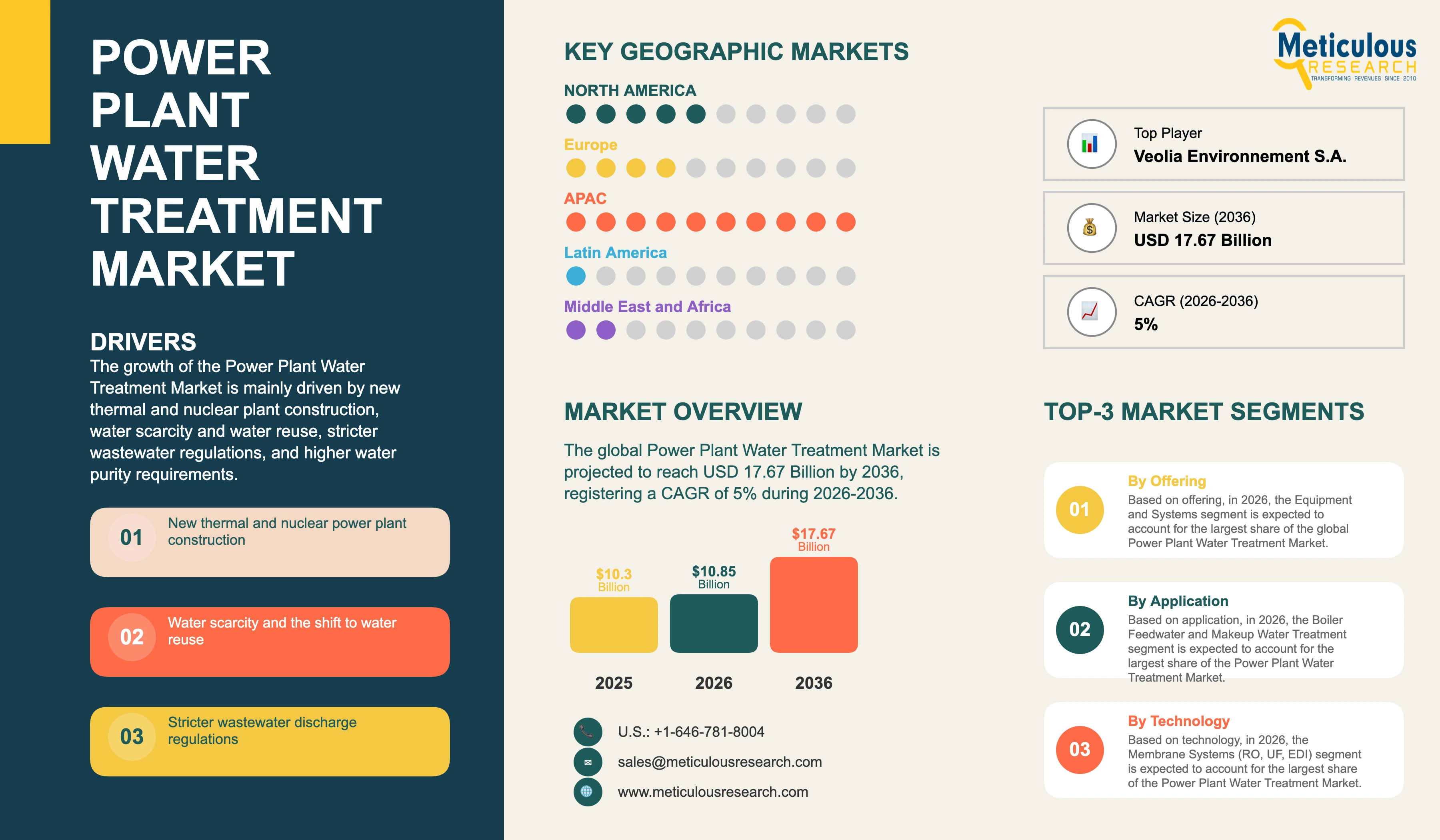
The global power plant water treatment market was valued at USD 10.30 billion in 2025. This market is expected to reach USD 17.67 billion by 2036 from an estimated USD 10.85 billion in 2026, registering a CAGR of 5.0% during the forecast period (2026-2036).
- Published
- Nov 2026
- Pages
- 258
- Format
- PDF + Excel
- Report ID
- MREP - 1042728
- Base year
- 2025
- 2025 · BASELINE
- $10.30B
- 2036
- $17.67B
- CAGR 2026–2036
- 5.0%
2025 baseline · 2026–2036 forecast at 5.0% CAGR · hover a bar for the value
Key highlights
GE Vernova reported that its Gas Power equipment backlog and slot reservation agreements grew from 62 GW to 83 GW during 2025, and Saudi Arabia had about 35.8 GW of gas-fired capacity under construction in early 2025, according to MEED. Each new combined cycle plant requires demineralized makeup water, condensate polishing, and cooling water treatment, and plants in water-scarce regions often depend on desalinated water and extensive water recycling.
China commissioned 78 GW of new coal power capacity in 2025, according to the Centre for Research on Energy and Clean Air (CREA) and Global Energy Monitor (GEM), and new Chinese coal plants are typically built with zero liquid discharge or advanced wastewater treatment systems to meet strict discharge requirements and reduce water consumption.
The World Nuclear Industry Status Report 2026 counted 73 reactors under construction worldwide in mid-2026, the highest number since 1987. Nuclear plants require very high-purity water for their primary and secondary circuits and extensive water chemistry control, which makes them among the most demanding customers for water treatment systems and services.
In December 2025, the U.S. Environmental Protection Agency finalized a rule extending the deadlines for zero-discharge limitations on flue gas desulfurization wastewater, bottom ash transport water, and combustion residual leachate at coal-fired plants from 2029 to 2034, which reduces near-term pressure on U.S. plants to install new wastewater treatment systems but keeps long-term requirements in place.
India's July 2025 notification exempting about 78% of coal-fired units from mandatory sulfur dioxide limits, as reported by CREA, has reduced the number of new flue gas desulfurization systems and associated FGD wastewater treatment plants expected in India, although new coal units and plants near large cities continue to require them.
Leading suppliers such as Veolia, Ecolab (Nalco Water), Kurita, Xylem (Evoqua), DuPont, Solenis, ChemTreat, Thermax, Ion Exchange (India), Aquatech, and WABAG continue to expand their offerings in membranes, ion exchange, zero liquid discharge, chemical programs, and digital water monitoring for power plants.
By offering, equipment and systems account for the largest share of 44.0% in 2026, while services register the highest CAGR.
By application, boiler feedwater and makeup water treatment accounts for the largest share of 34.0% in 2026, while wastewater treatment and zero liquid discharge registers the highest CAGR.
By technology, membrane systems (RO, UF, EDI) accounts for the largest share in 2026, while evaporation and crystallization registers the highest CAGR.
By plant type, coal-fired power plants account for the largest share in 2026, while gas-fired and combined cycle power plants register the highest CAGR.
By geography, Asia-Pacific accounts for the largest share of 45.0% in 2026, while Middle East & Africa registers the highest CAGR of 6.2%.
Report summary
| Particulars | Details |
|---|---|
| Base Year | 2025 |
| Estimated Year | 2026 |
| Forecast Period | 2026-2036 |
| Market Size in 2025 | USD 10.30 billion |
| Market Size in 2026 | USD 10.85 billion |
| Market Size by 2036 | USD 17.67 billion |
| CAGR (2026-2036) | 5.0% |
| Format | PDF, Excel & Cloud Portal · 258 pages |
| Largest Segment by Offering (2026) | Equipment and Systems (44.0%) |
| Largest Segment by Application (2026) | Boiler Feedwater and Makeup Water Treatment (34.0%) |
| Largest Region (2026) | Asia-Pacific (45.0%) |
| Fastest-Growing Region | Middle East & Africa (CAGR 6.2%) |
| Companies Profiled | 16 companies and other companies |
| Segments Covered | Offering, Application, Technology, Plant Type, Geography |
| Countries Covered | U.S., Canada, Germany, France, U.K., Poland, Italy, Spain, Rest of Europe, China, India, Japan, South Korea, Indonesia, Vietnam, Taiwan, Australia, Rest of Asia-Pacific, Mexico, Brazil, Chile, Argentina, Rest of Latin America, Saudi Arabia, U.A.E., Qatar, Kuwait, Egypt, Turkey, South Africa, Rest of Middle East & Africa |
Report overview
Segments covered: offering, application, technology, plant type.
The growth of this market is mainly driven by the large number of new combined cycle, coal, and nuclear plants under construction in Asia, the Middle East, and North America, each of which needs systems for makeup water, boiler feedwater, cooling water, and wastewater treatment, the growing scarcity of freshwater in many power-producing regions, which pushes plants toward water reuse, desalination, and zero liquid discharge, stricter wastewater discharge rules in China, India, the U.S., and Europe, the need for high-purity water in modern high-pressure boilers, heat recovery steam generators, and nuclear steam cycles, and the shift by plant owners toward outsourced water treatment services and performance-based chemical programs. However, factors such as coal plant retirements in Europe and North America, the extension of U.S. wastewater compliance deadlines, the high cost of zero liquid discharge systems, and price competition in water treatment chemicals are expected to restrain the growth of this market to some extent.
Power plant water treatment includes the equipment, chemicals, and services used to prepare, condition, and treat water in thermal and nuclear power plants. This report covers global revenue from water treatment equipment and systems, such as clarifiers, filters, membrane systems, ion exchange units, condensate polishers, evaporators, and crystallizers, from water treatment chemicals, such as scale and corrosion inhibitors, biocides, oxygen scavengers, pH control agents, and coagulants, and from services, such as operation and maintenance, mobile water treatment, build-own-operate water supply, and water chemistry monitoring, for coal-fired, gas-fired and combined cycle, nuclear, and other power plants.
Water is essential to thermal power generation, and its quality directly affects plant efficiency, reliability, and equipment life. Steam plants need high-purity water for their boilers or steam generators, because even small amounts of dissolved solids, silica, or oxygen can cause scaling, corrosion, and turbine deposits that reduce efficiency and damage equipment. Most plants also use large volumes of cooling water to condense steam, and the cooling system must be treated to prevent scaling, corrosion, and biological growth. Plants also produce wastewater from cooling tower blowdown, boiler blowdown, flue gas desulfurization, ash handling, and other processes, which must be treated before discharge or reuse.
The level of water treatment required at a power plant depends strongly on plant type, steam conditions, cooling design, and water source. Modern supercritical and ultra-supercritical coal units, combined cycle plants with high-pressure heat recovery steam generators, and nuclear plants require ultrapure water with very low conductivity and silica levels, which is produced by multi-stage systems that combine reverse osmosis, ion exchange, and electrodeionization. Nuclear plants also require strict control of primary circuit chemistry and treatment of radioactive liquid waste. Older drum-type subcritical units can tolerate somewhat lower water quality, but they still need reliable demineralization and chemical conditioning to avoid tube failures.
Water scarcity is becoming a major factor in power plant design and operation. Many plants in China, India, the Middle East, the western U.S., and Australia face limited freshwater supplies, and some use treated municipal wastewater, brackish water, or desalinated seawater as their source. Zero liquid discharge systems, which recover almost all water from wastewater and produce solid waste, are increasingly used in China and India and at some plants in the U.S. and the Middle East, and dry and hybrid cooling systems reduce water use but change the treatment requirements. In coastal regions, plants that use seawater for cooling require specialized treatment to control biofouling and corrosion in condensers and cooling circuits.
Business models include supply of equipment and systems under engineering, procurement, and construction contracts, long-term chemical supply and service programs, build-own-operate and outsourced water supply contracts, and mobile water treatment services for emergencies, outages, and commissioning. Chemical suppliers often provide on-site service engineers and monitoring systems as part of their programs, and they increasingly offer performance-based contracts linked to equipment reliability and water savings. Membrane and resin manufacturers sell their products both directly to plants and through system integrators and original equipment manufacturers.
The market includes large international water technology and chemical companies, regional equipment suppliers, and engineering contractors. The market has consolidated in recent years through acquisitions by large international groups, while regional suppliers remain strong in China and India. Leading companies include Veolia, Ecolab (Nalco Water), Kurita, Xylem (Evoqua), DuPont, Solenis, ChemTreat, Thermax, Ion Exchange (India), Aquatech, WABAG, Organo, LANXESS, Toray, Buckman, and Mitsubishi Chemical.
Over the forecast period, the power plant water treatment market is expected to grow steadily, supported by new combined cycle, coal, and nuclear plants, the expansion of zero liquid discharge and water reuse, stricter wastewater rules, and outsourced services. The market is also expected to shift toward membranes, evaporation and crystallization, digital monitoring, and services, while demand from coal plants in mature markets declines. Data center operators that build dedicated gas-fired plants are also emerging as a new customer group, as these plants need complete water treatment systems and often face local water constraints.
Report infographic
Market dynamics
16 factors across 5 forcesNew thermal and nuclear power plant construction
The construction of new thermal and nuclear power plants is a major driver of demand for water treatment equipment. Record gas turbine orders, with GE Vernova's backlog and slot reservations reaching 83 GW at the end of 2025, point to a large wave of new combined cycle plants in the U.S., the Middle East, and Asia, while China and India continue to build large coal units and 73 nuclear reactors were under construction worldwide in mid-2026. Each new plant needs a complete water treatment system, including raw water pretreatment, demineralization, condensate polishing, cooling water treatment, and wastewater treatment.
The water treatment package for a large combined cycle or coal plant can be worth tens of millions of dollars, and nuclear plants require even more extensive and specialized systems. New plants also create long-term demand for chemicals and services, as water treatment programs must be maintained throughout the life of the plant. In the Middle East, many new plants are located in coastal or desert areas where they depend on seawater desalination and extensive water recycling.
Combined cycle plants also tend to have higher purity requirements than older drum boilers because of the high pressures in modern heat recovery steam generators, which increases the value of demineralization and condensate polishing systems in these plants. Many combined cycle plants also use evaporative cooling towers, which require continuous cooling water treatment programs.
Water scarcity and the shift to water reuse
Many of the world's largest power-producing regions, including northern China, much of India, the Middle East, the western U.S., South Africa, and Australia, face growing water stress. Power plants are among the largest industrial users of water, and governments are restricting freshwater withdrawals and encouraging plants to use alternative sources, such as treated municipal wastewater, brackish groundwater, and seawater.
Using lower-quality water sources requires more advanced treatment, such as membrane systems and advanced pretreatment, and recycling cooling tower blowdown and other wastewater streams within the plant can greatly reduce freshwater consumption. Zero liquid discharge systems, which combine membranes, evaporators, and crystallizers, allow plants to recover almost all of their wastewater, and they are increasingly required for new plants in water-scarce regions of China and India. These trends increase the value of water treatment systems per plant. Some new plants in the Middle East and the U.S. Southwest are being designed with dry or hybrid cooling and full water recycling to minimize water withdrawals.
Stricter wastewater discharge regulations
Regulators in many countries have tightened limits on discharges from power plants, especially for metals, selenium, mercury, arsenic, nitrogen, and total dissolved solids in flue gas desulfurization wastewater, ash handling water, and cooling tower blowdown. China's water pollution control rules and industrial wastewater standards, India's discharge norms, the EU's Industrial Emissions Directive, and the U.S. steam electric effluent limitations guidelines all require advanced treatment for some wastewater streams.
Although the U.S. EPA extended the deadlines for zero-discharge limitations on several coal plant wastewater streams to 2034 in December 2025, the long-term requirements remain in place for plants that continue to burn coal, and many states have their own requirements. Emerging concerns about per- and polyfluoroalkyl substances and other contaminants are also expected to affect wastewater treatment requirements at some plants. Cooling water intake and thermal discharge rules also influence plant water system design in several countries.
Higher water purity requirements for modern plants
Modern power plants operate at higher pressures and temperatures than older units, which makes them more sensitive to water quality. Ultra-supercritical coal units, combined cycle plants with three-pressure heat recovery steam generators, and nuclear plants require ultrapure water with extremely low levels of dissolved solids, silica, and oxygen, and they need continuous monitoring of water chemistry to prevent corrosion, flow-accelerated corrosion, and deposits.
Plants that cycle frequently to balance renewables face additional water chemistry challenges, as start-ups and shutdowns can introduce oxygen and contaminants into the system. These requirements increase demand for advanced demineralization systems, condensate polishers, online analyzers, and specialized chemical programs, and they make water chemistry expertise an important part of plant operations. Tube failures caused by poor water chemistry are among the leading causes of forced outages in boilers and heat recovery steam generators, which gives plant owners a strong incentive to invest in water treatment.
Table of contents
12 chapters · 160 sections · 258 pages · click to expandSegmental analysis
| Segment | Largest share (2026) | Fastest growth (2026–2036) |
|---|---|---|
| By Offering | Equipment and systems | Services |
| By Application | Boiler feedwater and makeup water treatment | Wastewater treatment and zero liquid discharge |
| By Technology | Membrane systems (RO, UF, EDI) | Evaporation and crystallization |
| By Plant Type | Coal-fired power plants | Gas-fired and combined cycle power plants |
| Other segments | Coal-fired power plants | Gas-fired and combined cycle power plants |
By Offering
- Power Plant Water Treatment Market Analysis by Offering
- The equipment and systems segment is expected to account for the largest share of 44.0% of the global power plant water treatment market.
- The large share of this segment is mainly attributed to the large number of new combined cycle, coal, and nuclear plants under construction, each of which requires a complete water treatment system, the high value of advanced systems such as membrane plants, condensate polishers, and zero liquid discharge systems, and retrofits of existing plants to meet stricter wastewater rules and water reuse targets.
- Equipment packages for large plants include raw water pretreatment, demineralization, condensate polishing, cooling water side-stream treatment, and wastewater treatment.
- Demand for equipment and systems is closely linked to new plant construction and regulatory deadlines, and it is expected to remain strong in the near term because of the current wave of combined cycle and nuclear projects.
- Retrofits of older systems with modern membranes, automation, and controls also contribute significantly to this segment.
- However, the services segment is projected to register the highest CAGR during the forecast period.
- The rapid growth of this segment is primarily driven by the shift by plant owners toward outsourced water treatment, build-own-operate contracts, and long-term operation and maintenance agreements, the growing complexity of water treatment systems that require specialized operation, the use of mobile water treatment for commissioning, outages, and emergencies, and the expansion of remote monitoring and digital services.
- Service contracts also give plant owners access to specialized water chemistry expertise and remote monitoring, which reduces the risk of corrosion and scaling damage.
- Meanwhile, the chemicals segment is expected to witness steady growth, supported by the continuous need for scale, corrosion, and biological control chemicals at every operating plant, regardless of age or fuel.
By Application
- Power Plant Water Treatment Market Analysis by Application
- The boiler feedwater and makeup water treatment segment is expected to account for the largest share of 34.0% of the global power plant water treatment market.
- The large share of this segment is mainly attributed to the essential need for high-purity water in all steam-based power plants, the high value of demineralization systems that combine pretreatment, reverse osmosis, ion exchange, and electrodeionization, and the growing purity requirements of modern high-pressure boilers, heat recovery steam generators, and nuclear steam cycles.
- Every new thermal and nuclear plant needs a makeup water system, and existing plants must maintain and upgrade their systems.
- Boiler feedwater treatment also includes chemical conditioning, such as oxygen scavengers and pH control agents, and continuous monitoring of water chemistry.
- Plants that cycle frequently need more makeup water and more careful chemistry control, which increases demand in this segment.
- However, the wastewater treatment and zero liquid discharge segment is projected to register the highest CAGR during the forecast period.
- The rapid growth of this segment is primarily driven by stricter wastewater discharge rules in China, India, the U.S., and Europe, the adoption of zero liquid discharge for new plants in water-scarce regions, the recycling of cooling tower blowdown and other wastewater to reduce freshwater use, and the treatment of flue gas desulfurization wastewater at coal plants.
- Meanwhile, the cooling water treatment, condensate polishing, and other applications segments are expected to witness steady growth, supported by the large water demand of cooling systems in thermal plants and the high purity requirements of nuclear and supercritical units.
By Technology
- Power Plant Water Treatment Market Analysis by Technology
- The membrane systems (RO, UF, EDI) segment is expected to account for the largest share of the global power plant water treatment market.
- The large share of this segment is mainly attributed to the widespread use of reverse osmosis, ultrafiltration, and electrodeionization for makeup water production in new plants, the use of membranes for wastewater recycling and zero liquid discharge pretreatment, the lower chemical use and waste generation of membrane systems compared with traditional ion exchange, and the regular replacement of membranes in existing systems.
- Membrane systems are now the standard technology for producing demineralized water in most new power plants, often combined with polishing ion exchange or electrodeionization.
- Their use is also growing in plants that use lower-quality water sources, such as treated municipal wastewater and brackish water.
- Membrane replacement every few years also creates recurring and predictable demand in the installed base.
- However, the evaporation and crystallization segment is projected to register the highest CAGR during the forecast period.
- The rapid growth of this segment is primarily driven by the adoption of zero liquid discharge systems at new plants in China, India, and the Middle East, the treatment of flue gas desulfurization wastewater and cooling tower blowdown to meet discharge limits, and advances in brine concentrators and crystallizers that reduce energy consumption.
- Meanwhile, the ion exchange, clarification and filtration, and chemical treatment programs segments are expected to witness steady growth, supported by condensate polishing and final polishing needs in nuclear and supercritical plants, pretreatment requirements, and recurring chemical consumption at operating plants.
By Plant Type
- Power Plant Water Treatment Market Analysis by Plant Type
- The coal-fired power plants segment is expected to account for the largest share of the global power plant water treatment market.
- The large share of this segment is mainly attributed to the very large installed base of coal plants worldwide, their large cooling water systems, the treatment of flue gas desulfurization wastewater and ash handling water, the construction of new coal units with advanced water treatment in China and India, and continued demand for chemicals and services at existing coal plants.
- Coal plants typically have the most complex water systems of any power plant type.
- Demand from coal plants is expected to grow slowly, as new construction declines after the current Chinese and Indian pipelines are completed and coal plants are retired in Europe and North America.
- Wastewater treatment requirements and continued operation of coal plants in Asia will support demand throughout the forecast period, especially for chemicals, spare parts, and services.
- However, the gas-fired and combined cycle power plants segment is projected to register the highest CAGR during the forecast period.
- The rapid growth of this segment is primarily driven by the strong wave of new combined cycle plants in the U.S., the Middle East, and Asia, the high purity requirements of modern heat recovery steam generators, the use of desalinated water and water recycling at plants in water-scarce regions, and the growing need for water chemistry management in plants that cycle frequently.
- Meanwhile, the nuclear power plants and other power plants segments are expected to witness steady growth, supported by new reactor construction, long-term operation of existing nuclear plants, and water treatment needs at biomass, waste-to-energy, and other thermal plants.
Other segments
- The coal-fired power plants segment is expected to account for the largest share of the power plant water treatment market, while the gas-fired and combined cycle power plants segment is projected to register the highest CAGR during the forecast period.
Geographic analysis
Asia-Pacific
Largest shareIn 2026, Asia-Pacific is expected to account for the largest share of 45.0% of the global power plant water treatment market. The large share of this region is mainly due to the very large coal power construction programs in China and India, the widespread use of zero liquid discharge and advanced wastewater treatment at new plants in water-scarce regions of China and India, China's leadership in nuclear construction, new combined cycle plants in Japan, South Korea, Taiwan, and Southeast Asia, and the strong presence of water treatment suppliers such as Kurita, Organo, Toray, Thermax, Ion Exchange (India), and WABAG. Water stress in northern China and much of India is a key factor driving investment in water reuse and zero liquid discharge.
North America
North America is the second-largest market, supported by the strong revival of combined cycle construction in the U.S., the large nuclear fleet, wastewater requirements for coal plants, and the widespread use of outsourced water treatment services and performance-based chemical programs. Although the EPA extended zero-discharge deadlines to 2034, many plants are still planning and implementing wastewater treatment projects, and water scarcity in the Southwest and Texas drives water reuse at new plants. Many new data center-related gas plants in Texas and Arizona are designed with water recycling from the start.
Middle East & Africa
Fastest growthThe Middle East & Africa is projected to register the highest CAGR of 6.2% during the forecast period. The rapid growth of this region is mainly driven by Saudi Arabia's very large program of new combined cycle plants, new power plants in the U.A.E., Qatar, Kuwait, and other Gulf countries that depend on desalinated water and extensive water recycling, new nuclear plants in Egypt and Turkey, and water reuse and zero liquid discharge requirements at plants in South Africa and other water-scarce countries. Outsourced water services are common in independent power projects in the region, which supports service revenue.
Europe
Europe is a mature market, with demand coming mainly from chemicals and services for existing plants, upgrades to meet stricter discharge requirements under the Industrial Emissions Directive, nuclear plants in France and other countries, and new combined cycle plants in Poland, Germany, and other countries.
Latin America
Latin America accounts for a smaller share of the market, with demand from combined cycle plants in Mexico, Brazil, Argentina, and Chile and from coal and biomass plants. Chile's water scarcity in the north has led several plants to use desalinated seawater.
Competitive landscape
The global power plant water treatment market is fragmented, with the top five players estimated to account for about 35% of the market in 2025. The market includes large international water technology companies, water treatment chemical companies, membrane and resin manufacturers, regional equipment suppliers, and engineering contractors.
Veolia, Xylem (Evoqua), Kurita, Aquatech, Thermax, Ion Exchange (India), WABAG, and Organo are leading suppliers of water treatment equipment and systems for power plants, including demineralization, condensate polishing, and zero liquid discharge systems. Ecolab (Nalco Water), Solenis, ChemTreat, Kurita, Veolia, and Buckman are leading suppliers of water treatment chemicals and service programs, while DuPont, Toray, LANXESS, and Mitsubishi Chemical supply membranes and ion exchange resins used in power plant systems.
Water treatment chemical programs typically involve multi-year contracts with on-site support, which creates strong and long-lasting customer relationships with plant operators and owners. Many suppliers offer integrated solutions that combine equipment, chemicals, and services, and they are investing in digital monitoring and remote services to strengthen their offerings. Regional suppliers in China and India compete strongly in their domestic markets, often at significantly lower prices than international companies. Engineering, procurement, and construction contractors for new power plants often select water treatment suppliers as subcontractors, which makes relationships with these contractors important.
Companies in this market compete on technology performance, reliability, lifecycle cost, chemical program effectiveness, service quality, digital capabilities, and local presence. Key strategies include expansion of outsourced and build-own-operate services, development of zero liquid discharge and high-recovery membrane technologies, performance-based chemical programs, acquisitions of regional suppliers and technologies, and investment in digital water platforms.
The competitive landscape has been shaped by significant consolidation, including Veolia's acquisition of Suez's water technologies business and Xylem's acquisition of Evoqua, which created larger companies with broad technology and service portfolios. Further consolidation is expected as companies seek scale, technology, and access to growing markets in Asia and the Middle East. Smaller technology specialists in zero liquid discharge, brine management, and digital monitoring are likely acquisition targets for larger groups.
Some of the key players operating in the power plant water treatment market are Veolia Environnement S.A., Ecolab Inc. (Nalco Water), Kurita Water Industries Ltd., Xylem Inc. (Evoqua), DuPont de Nemours, Inc., Solenis LLC, ChemTreat, Inc. (Veralto Corporation), Thermax Limited, Ion Exchange (India) Ltd., Aquatech International LLC, VA Tech WABAG Limited, Organo Corporation, LANXESS AG, Toray Industries, Inc., Buckman Laboratories International, Inc., and Mitsubishi Chemical Group Corporation, among others.
- —
The U.S. EPA extended zero-discharge deadlines for coal plant wastewater to 2034 in December 2025, India exempted most coal units from mandatory FGD installation in July 2025, GE Vernova's gas turbine backlog reached 83 GW, and Saudi Arabia continued to build about 35.8 GW of gas-fired capacity that will need extensive water treatment.
- Veolia Environnement S.A.
- Ecolab Inc. · Nalco Water
- Kurita Water Industries Ltd.
- Xylem Inc. · Evoqua
- DuPont de Nemours, Inc.
- Solenis LLC
- ChemTreat, Inc. · Veralto Corporation
- Thermax Limited
- Ion Exchange (India) Ltd.
- Aquatech International LLC
- VA Tech WABAG Limited
- Organo Corporation
- LANXESS AG
- Toray Industries, Inc.
- Buckman Laboratories International, Inc.
- Mitsubishi Chemical Group Corporation
Expert perspectives
The power plant water treatment market is supported by two long-term forces: the construction of new thermal and nuclear plants, especially combined cycle plants, and the growing pressure on power plants to use less water and discharge cleaner wastewater. We see water scarcity becoming one of the most important factors in power plant siting and design, which will increase the value of water treatment per plant over time.
Over the forecast period, the market is expected to grow at a CAGR of 5.0%, from USD 10.85 billion in 2026 to USD 17.67 billion in 2036. Growth will be supported by new combined cycle and nuclear plants, zero liquid discharge and water reuse, stricter wastewater rules, and outsourced services, while coal plant retirements in mature markets and regulatory delays in the U.S. and India will moderate growth.
In terms of segments, equipment and systems remain the largest offering, while services grow fastest. Boiler feedwater and makeup water treatment remains the largest application, while wastewater treatment and zero liquid discharge grows fastest. Coal-fired power plants remain the largest plant type, while gas-fired and combined cycle power plants grow fastest. Asia-Pacific remains the largest region, and the Middle East & Africa is the fastest-growing region at a CAGR of 6.2%.
For suppliers, the key priorities are to win water treatment packages for the large number of new combined cycle and nuclear plants, to offer cost-effective zero liquid discharge and water reuse solutions, to expand outsourced and build-own-operate services, to integrate digital monitoring into their programs, and to help plants manage water chemistry during flexible operation.
We expect services and zero liquid discharge to become the main sources of value growth in this market. In our view, suppliers that can combine equipment, chemicals, and digital services in integrated offerings will have an advantage, as plant owners seek to reduce complexity and transfer operational risk. The nuclear segment, though smaller, offers high-value opportunities for qualified suppliers as new reactors and small modular reactors are built.
Regulation and water availability will remain the key factors shaping demand in each region. Clear and consistently enforced wastewater rules and growing water scarcity will support investment in advanced treatment, while delays and rollbacks could slow it in some markets. Over the longer term, we expect water availability constraints to become as important as emission rules in shaping power plant design. Suppliers that can help plant owners reduce both water use and operating cost at the same time will be best positioned to grow.
Customer perspectives
Plant Chemistry Manager - Combined cycle power plant, U.S.
Our plant now starts and stops almost every day, which makes water chemistry much harder to control. We rely on our chemical supplier's monitoring and on-site support, and we are looking at outsourcing more of our water treatment.
“Water is scarce in our region, so our new units are designed for zero liquid discharge, and we recycle almost all of our wastewater. We need treatment systems that are reliable and do not use too much energy.”
“Our plants depend on desalinated water, and every cubic meter we recycle saves money. We chose a water treatment partner that can design, operate, and maintain the system for the life of the project.”
Frequently asked questions
The global power plant water treatment market was valued at USD 10.30 billion in 2025, up from USD 9.80 billion in 2024, and is estimated at USD 10.85 billion in 2026. The market includes water treatment equipment and systems, chemicals, and services for coal-fired, gas-fired, nuclear, and other power plants.
The global power plant water treatment market is expected to reach USD 17.67 billion by 2036, supported by new combined cycle and nuclear plants, zero liquid discharge and water reuse, stricter wastewater rules, and outsourced services.
The market is expected to register a CAGR of 5.0% from 2026 to 2036, as new plants are built and existing plants invest in water reuse and wastewater treatment.
Steam plants need high-purity water to prevent scaling, corrosion, and turbine deposits, cooling systems must be treated to prevent fouling and biological growth, and wastewater must be treated to meet discharge rules or be reused.
Market growth is mainly driven by new thermal and nuclear power plant construction, water scarcity and the shift to water reuse, stricter wastewater discharge regulations, and higher water purity requirements for modern plants.
Coal plant retirements, regulatory delays, and the high cost of zero liquid discharge restrain growth, while managing water chemistry in flexible operation and skilled labor shortages are key challenges.
Key opportunities include zero liquid discharge for new plants in water-scarce regions, outsourced water services and build-own-operate models, digital water chemistry monitoring and AI optimization, and water treatment for nuclear new build and small modular reactors.
Equipment and systems are expected to account for the largest share of 44.0% of the market in 2026, while services are projected to register the highest CAGR.
Boiler feedwater and makeup water treatment is expected to account for the largest share of 34.0% of the market in 2026, while wastewater treatment and zero liquid discharge is projected to register the highest CAGR.
Evaporation and crystallization is projected to register the highest CAGR during the forecast period, driven by the adoption of zero liquid discharge systems.
Asia-Pacific is expected to account for the largest share of 45.0% of the market in 2026, mainly due to coal construction and zero liquid discharge adoption in China and India and nuclear construction in China.
The Middle East & Africa is projected to register the highest CAGR of 6.2% during the forecast period, driven by new combined cycle plants in the Gulf that depend on desalinated water and extensive recycling.
The report profiles 16 companies, including Veolia Environnement S.A., Ecolab Inc. (Nalco Water), Kurita Water Industries Ltd., Xylem Inc. (Evoqua), DuPont de Nemours, Inc., Solenis LLC, ChemTreat, Inc. (Veralto Corporation), Thermax Limited, Ion Exchange (India) Ltd., Aquatech International LLC, VA Tech WABAG Limited, Organo Corporation, LANXESS AG, Toray Industries, Inc., Buckman Laboratories International, Inc., and Mitsubishi Chemical Group Corporation.
The U.S. EPA extended zero-discharge deadlines for coal plant wastewater to 2034 in December 2025, India exempted most coal units from mandatory FGD installation in July 2025, GE Vernova's gas turbine backlog reached 83 GW, and Saudi Arabia continued to build about 35.8 GW of gas-fired capacity that will need extensive water treatment.
In 2026, the coal-fired power plants segment is expected to account for the largest share of the power plant water treatment market, while the gas-fired and combined cycle power plants segment is projected to register the highest CAGR during the forecast period.
Cite this report
Meticulous Research. (2026). Power Plant Water Treatment Market - Global Opportunity Analysis and Industry Forecast (2026-2036) (Report No. MREP - 1042728). Meticulous Market Research Pvt. Ltd. https://www.meticulousresearch.com/product/power-plant-water-treatment-market-7411