Produced Water Treatment Market (2026-2036)
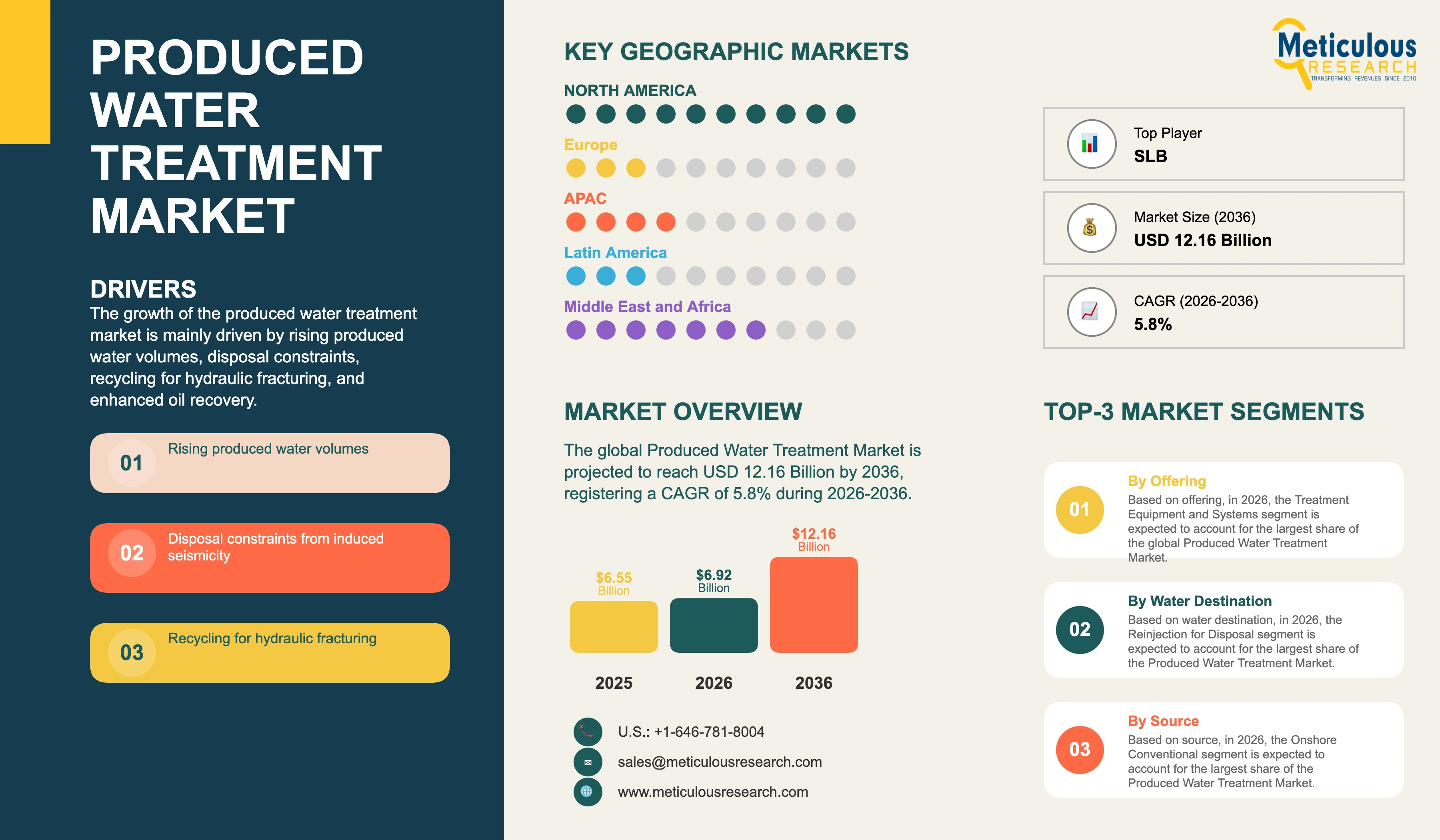
The global produced water treatment market was valued at USD 6.55 billion in 2025. This market is expected to reach USD 12.16 billion by 2036 from an estimated USD 6.92 billion in 2026, registering a CAGR of 5.8% during the forecast period (2026-2036).
- Published
- Nov 2026
- Pages
- 244
- Format
- PDF + Excel
- Report ID
- MREP - 1042729
- Base year
- 2025
- 2025 · BASELINE
- $6.55B
- 2036
- $12.16B
- CAGR 2026–2036
- 5.8%
2025 baseline · 2026–2036 forecast at 5.8% CAGR · hover a bar for the value
Key highlights
According to the 2026 Texas Produced Water Consortium report to the Texas Legislature, about 25.3 million barrels per day of produced water were generated in the Permian Basin in 2025. Of this, 5.2 million barrels per day, or 21%, were recycled for hydraulic fracturing, 2.9 million barrels per day, or 11%, were used for enhanced oil recovery, and the remaining 68% were mainly sent to disposal.
Recycling produced water for hydraulic fracturing costs about USD 0.15 to USD 0.20 per barrel, which is cheaper than disposal at about USD 0.25 to USD 1.00 per barrel, according to the Journal of Petroleum Technology. Permian produced water volumes, which exceeded 20 million barrels per day in 2024, are projected to exceed 26 million barrels per day by 2030.
Western Midstream Partners completed its acquisition of Aris Water Solutions in October 2025 in a transaction with an enterprise value of about USD 2.0 billion, adding about 790 miles of produced water pipeline, 1.8 million barrels per day of produced water handling capacity, and 1.4 million barrels per day of recycling capacity.
On April 30, 2026, the Texas Commission on Environmental Quality approved publication of proposed rules implementing Senate Bill 1145 for the land application of treated produced water, and six discharge permit applications for treated produced water were under review, most of them proposing discharge to the Pecos River system.
New Mexico's 2025 rule generally prohibits the discharge of treated or untreated produced water outside oil and gas activities, but on May 12, 2026, the state's Water Quality Control Commission voted 7 to 4 to reopen the rule for off-oilfield reuse, with a decision expected in 2027. About 35% of New Mexico's produced water is transported to Texas for disposal.
Texas Pacific Water Resources, a subsidiary of Texas Pacific Land, is using freeze desalination technology to treat produced water in the Permian Basin and has applied to discharge treated produced water to a tributary of the Pecos River, and the Bureau of Land Management issued a 2026 instruction memorandum encouraging reuse and recycling of produced water on public lands.
By offering, treatment equipment and systems account for the largest share of 38.0% in 2026, while treatment and recycling services register the highest CAGR.
By treatment stage, primary treatment accounts for the largest share in 2026, while tertiary treatment and desalination registers the highest CAGR.
By water destination, reinjection for disposal accounts for the largest share in 2026, while beneficial reuse outside the oilfield registers the highest CAGR.
By source, onshore conventional accounts for the largest share of 40.0% in 2026, while onshore unconventional registers the highest CAGR.
By geography, North America accounts for the largest share of 38.0% in 2026, while Latin America registers the highest CAGR of 6.7%.
Report summary
| Particulars | Details |
|---|---|
| Base Year | 2025 |
| Estimated Year | 2026 |
| Forecast Period | 2026-2036 |
| Market Size in 2025 | USD 6.55 billion |
| Market Size in 2026 | USD 6.92 billion |
| Market Size by 2036 | USD 12.16 billion |
| CAGR (2026-2036) | 5.8% |
| Format | PDF, Excel & Cloud Portal · 244 pages |
| Largest Segment by Offering (2026) | Treatment Equipment and Systems (38.0%) |
| Largest Segment by Source (2026) | Onshore Conventional (40.0%) |
| Largest Region (2026) | North America (38.0%) |
| Fastest-Growing Region | Latin America (CAGR 6.7%) |
| Companies Profiled | 12 companies and other companies |
| Segments Covered | Offering, Treatment Stage, Water Destination, Source, Geography |
| Countries Covered | U.S., Canada, Saudi Arabia, Kuwait, UAE, Oman, Iraq, Nigeria, Angola, Rest of Middle East & Africa, China, Indonesia, Malaysia, India, Australia, Rest of Asia-Pacific, Argentina, Brazil, Guyana, Mexico, Colombia, Rest of Latin America, Norway, U.K., Russia, Rest of Europe |
Report overview
Segments covered: offering, treatment stage, water destination, source.
The growth of this market is mainly driven by rising volumes of produced water as oil fields mature and shale production grows, constraints on saltwater disposal caused by induced seismicity and limited pore space, particularly in the Permian Basin, the economic and environmental benefits of recycling produced water for hydraulic fracturing, the growing use of produced water for waterflooding and enhanced oil recovery in mature fields, stricter discharge standards for offshore and onshore produced water, and emerging regulatory pathways for beneficial reuse of treated produced water outside the oilfield. However, factors such as the high cost and energy use of desalination, the complex and variable composition of produced water, regulatory uncertainty around discharge and reuse, and the cyclical nature of oil and gas spending are expected to restrain the growth of this market to some extent.
Produced water is the water that comes to the surface with oil and gas during production. It includes formation water naturally present in reservoirs, water injected into reservoirs for waterflooding or enhanced oil recovery, and flowback water from hydraulic fracturing. Produced water is the largest waste stream in the oil and gas industry, and in many mature fields and shale basins, several barrels of water are produced for every barrel of oil. Produced water typically contains dispersed and dissolved oil, suspended solids, high levels of dissolved salts that can be several times saltier than seawater, metals, naturally occurring radioactive material, production chemicals, and bacteria, so it must be treated before it can be reinjected, recycled, discharged, or reused.
This report covers global revenue from produced water treatment, including treatment equipment and systems such as hydrocyclones, separators, flotation units, filters, membranes, and thermal and freeze desalination systems, treatment chemicals such as demulsifiers, water clarifiers, flocculants, biocides, and scale and corrosion inhibitors applied to produced water, and treatment and recycling services, including mobile treatment and water recycling for hydraulic fracturing. Saltwater disposal well services, water transport by truck and pipeline, water gathering systems, and source water supply are excluded from the scope of this report, as are production chemicals used mainly to treat oil and gas streams rather than water.
Produced water treatment can be divided into three main stages, depending on the contaminants removed. Primary treatment removes free oil and solids using gravity separators, skim tanks, and hydrocyclones. Secondary treatment removes smaller oil droplets and solids using gas flotation, coalescers, media filters such as walnut shell filters, and chemical treatment. Tertiary treatment, which includes membranes, ion exchange, evaporation, and desalination, removes dissolved salts and other contaminants to produce water suitable for beneficial reuse or discharge to the environment.
The final destination of produced water largely determines the level of treatment that is required. Most produced water worldwide is reinjected, either into disposal wells or into producing reservoirs for pressure maintenance and enhanced oil recovery, which requires removal of oil and solids to protect injection wells. Offshore, produced water is often treated and discharged to the sea under limits on oil content, such as the OSPAR limit of 30 milligrams of dispersed oil per liter in the North-East Atlantic. In U.S. shale basins, a growing share of produced water is treated and recycled for hydraulic fracturing, and there is increasing interest in desalinating produced water for beneficial uses such as agriculture, industry, and environmental flows.
The Permian Basin in Texas and New Mexico is the world's most dynamic produced water market. According to the 2026 Texas Produced Water Consortium report, the basin generated about 25.3 million barrels per day of produced water in 2025, far more than its oil production. Disposal capacity is constrained by induced seismicity, which has led regulators in Texas and New Mexico to create seismic response areas where disposal volumes are monitored and curtailed, and by rising reservoir pressures in shallow disposal zones. These constraints are driving investment in recycling, desalination, and beneficial reuse.
Outside North America, the Middle East is a major market, as large mature oil fields in Saudi Arabia, Kuwait, Oman, the UAE, and Iraq produce large volumes of water that are treated for reinjection and pressure maintenance. Offshore fields in the North Sea, Brazil, West Africa, Southeast Asia, and the Gulf of Mexico require compact treatment systems to meet discharge or reinjection requirements, and new FPSOs are equipped with advanced produced water treatment systems.
The market includes oilfield service companies, water technology companies, chemical suppliers, equipment manufacturers, and water midstream companies. Leading companies include SLB, Baker Hughes, Halliburton, Veolia, Xylem, Aquatech International, Ecolab, NOV, Sulzer, Select Water Solutions, Western Midstream Partners, and Texas Pacific Land through Texas Pacific Water Resources.
Over the forecast period, the market is expected to grow steadily, driven by rising produced water volumes, disposal constraints, recycling for hydraulic fracturing, enhanced oil recovery, and the development of beneficial reuse. Treatment and recycling services are expected to be the fastest-growing offering, and Latin America is expected to be the fastest-growing region, while North America remains the largest.
Report infographic
Market dynamics
17 factors across 5 forcesRising produced water volumes in mature and shale fields
Produced water volumes increase as oil fields mature, because the share of water in produced fluids rises over the life of a field. Many of the world's largest oil fields in the Middle East, North America, Russia, and other regions are mature, and water cuts of 80% or more are common. In U.S. shale basins, wells produce large volumes of water from the start, and the Permian Basin produces several barrels of water for every barrel of oil.
According to the 2026 Texas Produced Water Consortium report, the Permian Basin generated about 25.3 million barrels per day of produced water in 2025, and the Journal of Petroleum Technology has reported projections that Permian volumes will exceed 26 million barrels per day by 2030. The Texas Railroad Commission has noted that produced water increases over the lifespan of a well, even as oil and gas production from the well declines. Rising volumes require more treatment capacity for reinjection, recycling, and reuse.
Growth in offshore production in Brazil, Guyana, and other regions also adds to produced water volumes, as offshore fields mature and water production rises. In the Middle East, some of the world's largest oil fields have been producing for decades and now produce significant volumes of water, which must be treated and reinjected to maintain reservoir pressure. Rising water volumes also increase the cost of lifting, separating, and handling fluids, which encourages operators to invest in more efficient treatment.
Disposal constraints from induced seismicity and pore pressure
Disposal of produced water in deep injection wells has been linked to induced seismicity in the Permian Basin, Oklahoma, and other regions. In response, regulators in Texas and New Mexico have created seismic response areas where disposal volumes are monitored and curtailed, and operators have shifted disposal from deep formations to shallower zones. However, shallow disposal zones are experiencing rising pressures, which can cause well integrity problems and limit future injection capacity.
These constraints are increasing the cost of disposal and encouraging operators to recycle and treat produced water instead. The Texas Produced Water Consortium has identified produced water management as a critical challenge for Texas, citing constraints on traditional disposal, induced seismicity, disposal well integrity, and pore space. About 35% of New Mexico's produced water is currently transported to Texas for disposal, which adds to pressure on Texas disposal capacity. Disposal well failures and surface breakouts in parts of West Texas have also raised concerns about the long-term safety of large-scale injection, and regulators have tightened permit conditions for new disposal wells. As disposal becomes more expensive and restricted, operators are more willing to pay for treatment that allows recycling or reuse.
Economics and sustainability of recycling for hydraulic fracturing
Recycling produced water for hydraulic fracturing reduces the need for fresh water, lowers disposal volumes, and can reduce costs. According to the Journal of Petroleum Technology, recycling costs about USD 0.15 to USD 0.20 per barrel, compared with disposal costs of about USD 0.25 to USD 1.00 per barrel. In the Permian Basin, about 5.2 million barrels per day of produced water were recycled for hydraulic fracturing in 2025, and the basin has reached the point where more produced water than fresh water is used for fracturing.
Recycling requires treatment to remove oil, solids, bacteria, and some dissolved constituents, so that the water is compatible with fracturing fluids. Water midstream companies such as Western Midstream, through its acquisition of Aris Water Solutions, and Select Water Solutions operate large recycling facilities and pipeline networks, and operators increasingly specify recycled water in their completion programs. Recycling also reduces the need for truck transport and fresh water purchases, which lowers costs and reduces traffic, road damage, and emissions in production areas. Many large operators have set targets to reduce fresh water use in completions, which further supports recycling.
Enhanced oil recovery and pressure maintenance
Waterflooding and enhanced oil recovery use produced water to maintain reservoir pressure and increase oil recovery. In the Permian Basin's Central Basin Platform, about 2.9 million barrels per day of produced water were used for enhanced oil recovery in 2025, and in the Middle East, large volumes of produced water are treated and reinjected into reservoirs. Reinjection requires removal of oil and solids to prevent plugging of injection wells and reservoirs, and it often requires control of scale, corrosion, and bacteria.
National oil companies in Saudi Arabia, Kuwait, the UAE, Oman, and Iraq are investing in water injection and enhanced oil recovery to sustain production from mature fields, which creates demand for produced water treatment facilities, equipment, and chemicals. Polymer flooding and other chemical enhanced oil recovery methods often require higher-quality water with low hardness and salinity, which increases the need for advanced treatment such as softening and desalination.
Table of contents
12 chapters · 134 sections · 244 pages · click to expandSegmental analysis
| Segment | Largest share (2026) | Fastest growth (2026–2036) |
|---|---|---|
| By Offering | Primary treatment | Tertiary treatment and desalination |
By Offering
- The primary treatment segment is expected to account for the largest share of the produced water treatment market, while the tertiary treatment and desalination segment is projected to register the highest CAGR during the forecast period.
Geographic analysis
North America
Largest shareIn 2026, North America is expected to account for the largest share of 38.0% of the global produced water treatment market. The large share of this region is mainly due to very large produced water volumes in the Permian Basin and other U.S. shale and conventional basins, disposal constraints caused by induced seismicity, the large scale of produced water recycling for hydraulic fracturing, the presence of large water midstream companies, and emerging regulatory pathways for beneficial reuse in Texas. Canada also contributes, with produced water from oil sands and conventional production, where water recycling is widely used in steam-assisted gravity drainage operations. Other U.S. basins, including the Bakken, Eagle Ford, and DJ Basin, also generate significant produced water volumes and use recycling and treatment.
Middle East & Africa
The Middle East & Africa is the second-largest market, driven by large mature oil fields in Saudi Arabia, Kuwait, Oman, the UAE, and Iraq, where produced water is treated and reinjected for pressure maintenance and enhanced oil recovery, and by offshore production in West Africa. Saudi Arabia, Kuwait, and Oman have large water injection programs to maintain production from mature fields, and Oman has used engineered wetlands to treat some produced water from its oil fields in the south of the country.
Latin America
Fastest growthLatin America is projected to register the highest CAGR of 6.7% during the forecast period. The rapid growth of this region is mainly due to growing unconventional oil production in Argentina's Vaca Muerta, which requires water treatment and recycling for hydraulic fracturing, new FPSOs offshore Brazil and Guyana with extensive water treatment and injection systems, and maturing fields in Mexico, Colombia, and other countries. Argentina's shale production has grown rapidly, and operators are investing in water infrastructure to support completions. In Brazil, pre-salt FPSOs require large seawater and produced water treatment systems for injection. Guyana's rapidly growing offshore production, with multiple FPSOs in operation and under construction, also requires produced water treatment and reinjection systems.
Asia-Pacific
Asia-Pacific is supported by mature fields in China, Indonesia, Malaysia, and India and by offshore production in Southeast Asia and Australia.
Europe
Europe is expected to grow slowly, as North Sea production declines, although offshore discharge standards and reinjection requirements continue to support demand. Norway and the U.K. have strict rules on produced water discharge, and operators are investing in better treatment and reinjection to reduce environmental impact.
Competitive landscape
The global produced water treatment market is fragmented, with the top five players estimated to account for about 30% of the market in 2025. The market includes oilfield service companies, water technology companies, chemical suppliers, equipment manufacturers, and water midstream companies.
SLB, Baker Hughes, and Halliburton offer produced water treatment chemicals, equipment, and services as part of their oilfield portfolios, and SLB expanded its chemical business through its acquisition of ChampionX in 2025. Veolia, Xylem, and Aquatech International are leading water technology companies that supply advanced treatment and desalination systems, while Ecolab supplies water treatment chemicals and services. NOV and Sulzer supply separation and treatment equipment for onshore and offshore applications.
Select Water Solutions and Western Midstream Partners, which acquired Aris Water Solutions, operate large produced water recycling and disposal networks in the Permian Basin, and Texas Pacific Land, through Texas Pacific Water Resources, is developing desalination and beneficial reuse. Western Midstream has highlighted desalination and mineral extraction as part of its integrated produced water value chain. Companies compete on technology, reliability, cost per barrel, scale, service capabilities, and the ability to offer integrated solutions. Key strategies include expanding recycling and treatment capacity, developing desalination and mineral extraction technologies, acquiring water infrastructure, and offering long-term contracts with operators.
The competitive landscape is expected to evolve as beneficial reuse and mineral extraction develop and as water midstream companies consolidate. Companies with large infrastructure networks and advanced treatment technologies will be best positioned. Smaller technology companies are developing new desalination, membrane, and mineral extraction technologies, and many are partnering with operators and water midstream companies to run pilot projects. Partnerships between water technology companies and oilfield service companies are also common, combining treatment expertise with field operations. Regional service companies in the Middle East, China, and Latin America also compete for treatment contracts with national oil companies. Pricing pressure is strong in recycling services, where operators compare costs per barrel across providers. In offshore markets, competition focuses on technology performance, footprint, and reliability, and suppliers with proven references on FPSOs and platforms have an advantage. Chemical suppliers compete on product performance, field service, and the ability to optimize chemical programs for specific waters.
Some of the key players operating in the produced water treatment market are SLB, Baker Hughes Company, Halliburton Company, Veolia Environnement S.A., Xylem Inc., Aquatech International LLC, Ecolab Inc., NOV Inc., Sulzer Ltd., Select Water Solutions, Inc., Western Midstream Partners, LP, and Texas Pacific Land Corporation, among others.
- —
Western Midstream completed its acquisition of Aris Water Solutions in October 2025, the TCEQ proposed rules for land application of treated produced water in April 2026, New Mexico's Water Quality Control Commission voted to reopen its produced water reuse rule in May 2026, and the Texas Produced Water Consortium issued its 2026 report.
- SLB
- Baker Hughes Company
- Halliburton Company
- Veolia Environnement S.A.
- Xylem Inc.
- Aquatech International LLC
- Ecolab Inc.
- NOV Inc.
- Sulzer Ltd.
- Select Water Solutions, Inc.
- Western Midstream Partners
- LP
- Texas Pacific Land Corporation
Expert perspectives
The produced water treatment market is driven by a structural challenge: produced water volumes are rising faster than oil production, and traditional disposal is becoming constrained. We expect steady growth over the forecast period, with the fastest growth in recycling, desalination, and beneficial reuse.
Over the forecast period, the market is expected to grow at a CAGR of 5.8%, from USD 6.92 billion in 2026 to USD 12.16 billion in 2036. Growth will be supported by rising produced water volumes, disposal constraints, recycling for fracturing, and enhanced oil recovery, while desalination costs, water complexity, regulatory uncertainty, and oil price cycles will moderate growth.
In terms of segments, treatment equipment and systems remain the largest offering, while treatment and recycling services grow fastest. Primary treatment remains the largest treatment stage, while tertiary treatment and desalination grow fastest. Reinjection for disposal remains the largest destination, while beneficial reuse outside the oilfield grows fastest from a small base. Onshore conventional sources remain the largest, while onshore unconventional sources grow fastest. North America remains the largest region, while Latin America grows fastest at a CAGR of 6.7%.
For suppliers, the key priorities are to reduce the cost of recycling and desalination, to develop solutions for high-salinity water and mineral extraction, and to build long-term partnerships with operators and water midstream companies. Regulatory engagement and data on treated water quality will be essential for beneficial reuse. Suppliers should also focus on reducing chemical and energy use per barrel, which is increasingly important to operators. We expect the Permian Basin to remain the center of innovation in produced water treatment. In our view, the pace of beneficial reuse will depend mainly on regulatory decisions in Texas and New Mexico and on reductions in desalination costs.
Our estimates are based on produced water volumes in key basins, the share treated for each destination, typical treatment costs per barrel for recycling, reinjection, and desalination, investment in new treatment facilities and FPSOs, and the water treatment chemical sales of leading suppliers. We expect recycling and services to grow faster than equipment and chemicals, as operators outsource water management to specialized companies. We also expect consolidation among water midstream companies to continue, and we expect oilfield service companies to expand their water businesses through acquisitions and partnerships. Mineral extraction could become a significant source of value later in the forecast period if technologies prove commercially viable at scale. We note that our scope excludes disposal well services and water transport, which together represent a larger spending pool in the Permian Basin than treatment itself.
Customer perspectives
Water Manager - oil producer, Permian Basin
Disposal is getting harder and more expensive because of seismicity restrictions, so we recycle as much produced water as possible for our completions. Treatment cost per barrel is the key metric.
Production Engineer - national oil company, Middle East
Our mature fields produce more water every year, and we treat and reinject it for pressure maintenance. Reliable treatment is essential to protect our injection wells.
Business Development Director - water treatment company, U.S.
Desalination of produced water is technically possible, but costs and permits are the main barriers.
Frequently asked questions
The global produced water treatment market was valued at USD 6.55 billion in 2025, up from USD 6.20 billion in 2024, and is estimated at USD 6.92 billion in 2026. The market includes treatment equipment and systems, treatment chemicals, and treatment and recycling services.
The global produced water treatment market is expected to reach USD 12.16 billion by 2036, supported by rising produced water volumes, disposal constraints, and recycling.
The market is expected to register a CAGR of 5.8% from 2026 to 2036, with the fastest growth in recycling services, desalination, and beneficial reuse.
According to the 2026 Texas Produced Water Consortium report, the Permian Basin generated about 25.3 million barrels per day of produced water in 2025, of which 21% was recycled for hydraulic fracturing, 11% was used for enhanced oil recovery, and 68% was mainly sent to disposal.
Market growth is mainly driven by rising produced water volumes in mature and shale fields, disposal constraints from induced seismicity and pore pressure, the economics of recycling for hydraulic fracturing, and enhanced oil recovery and pressure maintenance.
The high cost and energy use of desalination and complex water composition restrain growth, while regulatory uncertainty for discharge and reuse and cyclical oil and gas activity are key challenges.
Key opportunities include beneficial reuse and desalination, mineral extraction from produced water, compact offshore and subsea treatment, and digital monitoring and automation.
Treatment equipment and systems are expected to account for the largest share of 38.0% of the market in 2026, while treatment and recycling services are projected to register the highest CAGR.
Beneficial reuse outside the oilfield is projected to register the highest CAGR from a small base, driven by new permitting pathways in Texas, while reinjection for disposal remains the largest destination.
Onshore conventional sources are expected to account for the largest share of 40.0% of the market in 2026, while onshore unconventional sources are projected to register the highest CAGR.
North America is expected to account for the largest share of 38.0% of the market in 2026, mainly due to large produced water volumes in the Permian Basin and other U.S. basins and disposal constraints.
Latin America is projected to register the highest CAGR of 6.7% during the forecast period, driven by Vaca Muerta development and new FPSOs in Brazil and Guyana.
The report profiles 12 companies, including SLB, Baker Hughes Company, Halliburton Company, Veolia Environnement S.A., Xylem Inc., Aquatech International LLC, Ecolab Inc., NOV Inc., Sulzer Ltd., Select Water Solutions, Inc., Western Midstream Partners, LP, and Texas Pacific Land Corporation.
Western Midstream completed its acquisition of Aris Water Solutions in October 2025, the TCEQ proposed rules for land application of treated produced water in April 2026, New Mexico's Water Quality Control Commission voted to reopen its produced water reuse rule in May 2026, and the Texas Produced Water Consortium issued its 2026 report.
In 2026, the primary treatment segment is expected to account for the largest share of the produced water treatment market, while the tertiary treatment and desalination segment is projected to register the highest CAGR during the forecast period.
Cite this report
Meticulous Research. (2026). Produced Water Treatment Market - Global Opportunity Analysis and Industry Forecast (2026-2036) (Report No. MREP - 1042729). Meticulous Market Research Pvt. Ltd. https://www.meticulousresearch.com/product/produced-water-treatment-market-7412