Power Plant Boilers Market (2026-2036)
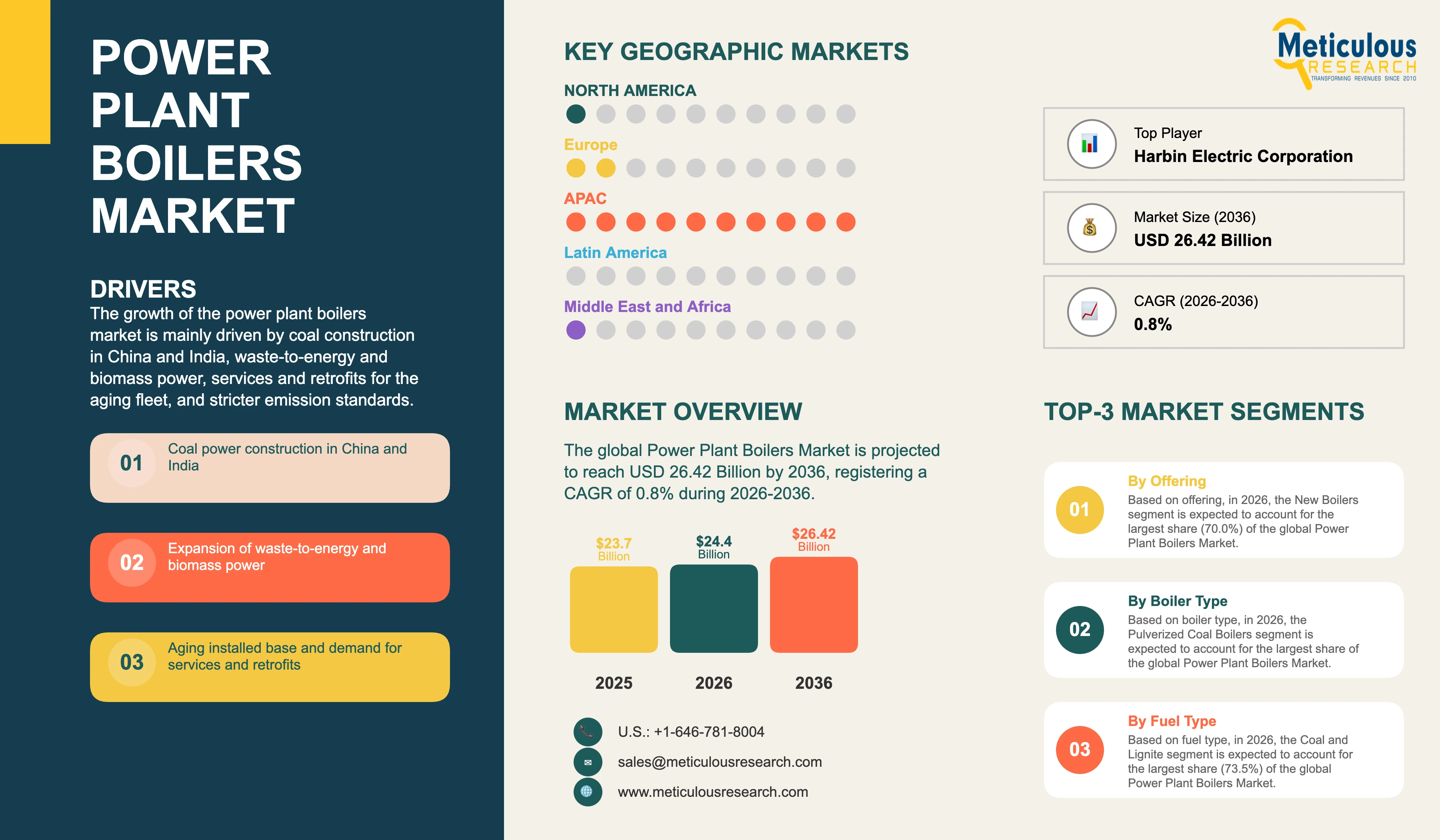
The global power plant boilers market was valued at USD 23.70 billion in 2025. This market is expected to reach USD 26.42 billion by 2036 from an estimated USD 24.40 billion in 2026, registering a CAGR of 0.8% during the forecast period (2026-2036).
- Published
- Nov 2026
- Pages
- 248
- Format
- PDF + Excel
- Report ID
- MREP - 1042724
- Base year
- 2025
- 2025 · BASELINE
- $23.70B
- 2036
- $26.42B
- CAGR 2026–2036
- 0.8%
2025 baseline · 2026–2036 forecast at 0.8% CAGR · hover a bar for the value
Key highlights
According to the Centre for Research on Energy and Clean Air (CREA) and Global Energy Monitor (GEM), China commissioned 78 GW of new coal power capacity in 2025, the most in a decade, and about 291 GW of coal capacity remained permitted or under construction at the end of 2025, equal to about 23% of the country's operating coal fleet, which secures a large pipeline of utility boiler deliveries for Harbin Electric, Dongfang Electric, and Shanghai Electric.
Bharat Heavy Electricals Limited (BHEL) recorded its highest-ever annual order inflow of Rs 92,534 crore in fiscal year 2025, with the power sector accounting for 88% of the total, and in November 2026 it won orders from Adani Power for boiler, turbine, and generator packages for four 2 x 800 MW ultra-supercritical projects, as India pursues its target of adding at least 80 GW of coal-based capacity by 2031-32.
Global Energy Monitor reports that coal plant commissioning outside China and India was only 9.2 GW in 2025, which shows that demand for new utility coal boilers is now heavily concentrated in Asia, while operators in other regions are spending mainly on boiler maintenance, life extension, and conversion projects.
China's daily household waste incineration capacity reached 1.158 million tonnes in 2024, according to China's Urban and Rural Construction Statistical Yearbook, well above the 2025 target of 800,000 tonnes per day, and Chinese companies had invested in, built, or operated more than 43 overseas waste-to-energy projects in 13 countries by mid-2025 as the domestic market became saturated.
In March 2026, Babcock & Wilcox signed a full notice to proceed on a USD 2.4 billion project to deliver 1.2 GW of natural gas-fired boiler and steam turbine capacity for Applied Digital's AI Factory data center campuses, showing that boiler-based power plants are being used as a faster alternative to large gas turbines, whose delivery slots are booked for several years.
Valmet signed its largest waste-to-energy boiler delivery in China for a greenfield refuse-derived fuel combined heat and power plant in Urumqi able to burn one million tonnes of fuel per year, while Valmet, Andritz, Sumitomo SHI FW, Kanadevia, and Martin continue to supply fluidized bed and grate-fired boilers for biomass and waste plants worldwide.
By offering, new boilers account for the larger share of 70.0% in 2026, while aftermarket services and retrofits register the higher CAGR.
By boiler type, pulverized coal boilers account for the largest share in 2026, while grate and stoker-fired boilers register the highest CAGR.
By steam conditions, ultra-supercritical accounts for the largest share in 2026 and also registers the highest CAGR.
By fuel type, coal and lignite accounts for the largest share of 73.5% in 2026, while municipal solid waste and refuse-derived fuel registers the highest CAGR.
By capacity, above 500 MW accounts for the largest share in 2026, while up to 100 MW registers the highest CAGR.
By end user, utilities and independent power producers account for the larger share in 2026, while industrial captive power plants register the higher CAGR.
By geography, Asia-Pacific accounts for the largest share of 72.0% in 2026, while Middle East & Africa registers the highest CAGR of 3.0%.
Report summary
| Particulars | Details |
|---|---|
| Forecast Period | 2026-2036 |
| Base Year | 2025 |
| Estimated Year | 2026 |
| CAGR (Value) | 0.8% |
| Format | PDF, Excel & Cloud Portal · 248 pages |
| Market Size (Value) in 2025 | USD 23.70 billion |
| Market Size (Value) in 2026 | USD 24.40 billion |
| Market Size (Value) in 2036 | USD 26.42 billion |
| Largest Segment by Offering (2026) | New Boilers (70.0%) |
| Largest Segment by Fuel Type (2026) | Coal and Lignite (73.5%) |
| Largest Region (2026) | Asia-Pacific (72.0%) |
| Fastest-Growing Region | Middle East & Africa (CAGR 3.0%) |
| Segments Covered | Offering, Boiler Type, Steam Conditions, Fuel Type, Capacity, End User, Geography |
| Countries Covered | U.S., Canada, Germany, U.K., Poland, Italy, France, Spain, Netherlands, Nordic Countries, Czech Republic, Rest of Europe, China, India, Indonesia, Japan, South Korea, Vietnam, Taiwan, Philippines, Bangladesh, Australia, Thailand, Malaysia, Rest of Asia-Pacific, Brazil, Mexico, Chile, Argentina, Rest of Latin America, Saudi Arabia, U.A.E., Qatar, Turkey, South Africa, Egypt, Morocco, Rest of Middle East & Africa |
| Key Companies | 17 companies and other companies |
Report overview
Segments covered: offering, boiler type, steam condition, fuel type, capacity, end user.
The growth of this market is mainly driven by the large pipeline of supercritical and ultra-supercritical coal units under construction in China and India, the expansion of waste-to-energy plants in Southeast Asia, the Middle East, Central Asia, and Europe, the use of biomass boilers in combined heat and power and industrial plants, rising demand for boiler services, pressure part replacement, and emission control retrofits from an aging installed base, and new demand for gas-fired boiler plants that can be built quickly to power data centers in the U.S. However, factors such as coal phase-out commitments in Europe, North America, and other regions, the expected slowdown of new coal plant construction in China after the current pipeline is completed, competition from renewables and battery storage, and overcapacity in China's waste incineration sector are expected to restrain the growth of this market to some extent.
Power plant boilers are large pressure vessels and heat exchangers that burn fuel to convert water into high-pressure, high-temperature steam, which drives a steam turbine to generate electricity and, in combined heat and power plants, also supplies heat to industrial processes or district heating networks. This report covers global revenue from new utility and industrial power generation boilers, including pulverized coal, circulating and bubbling fluidized bed, grate and stoker-fired, and oil and gas-fired boilers, and from aftermarket services such as maintenance, pressure part replacement, upgrades, fuel conversions, and life extension. Heat recovery steam generators used in combined cycle plants and nuclear steam generators are excluded from the scope of this report.
Boilers are among the largest and most expensive pieces of equipment in a thermal power plant, and the boiler island typically accounts for a larger share of plant equipment cost than the steam turbine. Modern utility boilers for 660 MW to 1,000 MW coal units stand more than 80 meters tall and contain hundreds of kilometers of tubing made from advanced steel and nickel alloys that can withstand steam temperatures above 600 degrees Celsius and pressures above 25 megapascals.
Demand for new utility boilers has shifted strongly to Asia over the past decade, as new coal plant construction has almost stopped in Europe and North America while China, India, Indonesia, and a few other countries continue to build large units. Chinese boiler manufacturers, mainly Harbin Electric, Dongfang Electric, and Shanghai Electric, supply nearly all utility boilers built in China, while BHEL dominates large boiler orders in India. Japanese, Korean, and Western manufacturers, including Mitsubishi Heavy Industries, IHI, Doosan Enerbility, and Babcock & Wilcox, compete mainly in export projects, services, and specialized boilers.
A second important part of the market consists of smaller boilers that burn biomass, municipal solid waste, refuse-derived fuel, industrial residues, and coal in industrial and municipal plants. Grate-fired boilers from companies such as Martin, Kanadevia Inova, Andritz, and SUS Environment are widely used for waste-to-energy, while circulating fluidized bed boilers from Valmet, Sumitomo SHI FW, Andritz, and Chinese manufacturers are used for biomass, waste, and low-grade coal because they can burn a wide range of fuels with low emissions.
The service and retrofit business is large and relatively stable, as the global fleet of coal-fired boilers is more than 2,000 GW and many units in Europe, North America, Japan, and India are more than 30 years old. Operators spend on regular inspections, replacement of waterwalls, superheaters, reheaters, and economizers, burner upgrades to reduce nitrogen oxide emissions, controls upgrades, and changes that allow boilers to operate more flexibly alongside renewables. Some operators are also converting coal boilers to burn biomass or natural gas instead of retiring them.
Business models include engineering, procurement, and construction contracts for complete boiler islands, supply of boiler pressure parts and auxiliary equipment, long-term service agreements, and outage service contracts. In China and India, boiler supply is often bundled with turbine and generator supply in a single contract with a state-owned manufacturer, while in waste-to-energy projects the boiler is usually supplied together with the grate, flue gas treatment, and controls.
The market is moderately concentrated in large utility boilers, where a few manufacturers dominate each national market, and fragmented in small industrial, biomass, and waste-to-energy boilers. Leading companies include Harbin Electric, Dongfang Electric, Shanghai Electric, BHEL, Mitsubishi Heavy Industries, IHI, Doosan Enerbility, Babcock & Wilcox, Sumitomo SHI FW, Valmet, Andritz, Kanadevia, Martin, Thermax, and Isgec Heavy Engineering.
Over the forecast period, the power plant boilers market is expected to grow slowly in value, as continued construction in China and India in the near term, waste-to-energy and biomass growth, and rising service demand are largely offset by the expected decline in new coal boiler orders in the 2030s. The value of the market is expected to shift steadily from new utility coal boilers toward services, retrofits, fuel conversions, and boilers for waste and biomass fuels.
We are adding 800 MW ultra-supercritical units because the grid needs firm power in the evening peak. Domestic manufacturing and reliable delivery are essential for us, and we expect our boilers to run for thirty years or more.
This comment explains why Asia-Pacific accounts for 72.0% of the market, why coal and lignite account for 73.5% of the market, and why new boilers account for 70.0% of the market. It also shows why ultra-supercritical boilers lead the steam conditions segment.
Our cities are running out of landfill space, and waste-to-energy is the only practical solution at this scale. We need boilers that can handle wet, mixed waste reliably, so we choose suppliers with many reference plants.
This comment explains why municipal solid waste and refuse-derived fuel is the fastest-growing fuel type and why grate and stoker-fired boilers are the fastest-growing boiler type.
Plant Manager - coal-fired power station, U.S.
Our retirement date was pushed back because demand is rising, so we are investing in tube replacements, burner upgrades, and controls. We also run the unit much more flexibly than it was designed for, which means more inspections.
This comment shows why aftermarket services and retrofits are the faster-growing offering and why services remain important even in markets where new coal boilers are no longer built.
Report infographic
Market dynamics
16 factors across 5 forcesCoal power construction in China and India
The largest source of demand for new power plant boilers is the construction of large coal-fired units in China and India, where governments are adding firm capacity to meet peak demand and support the integration of very large wind and solar fleets. CREA and Global Energy Monitor report that China commissioned 78 GW of coal power capacity in 2025 and had about 291 GW permitted or under construction at the end of the year, while new and reactivated project proposals reached a record 161 GW. This pipeline supports high production at Chinese boiler factories through the end of the decade.
India has also returned to large-scale coal plant construction after several years with very few new orders. The Ministry of Power plans to add at least 80 GW of coal-based capacity by 2031-32, and BHEL, which received no thermal orders between August 2019 and September 2022, recorded its highest-ever order inflow in fiscal year 2025 and has since won large boiler, turbine, and generator orders from NTPC, state utilities, Adani Power, and other private developers. Most of these orders are for 800 MW supercritical and ultra-supercritical units, which require large, high-value boilers.
Indonesia, Vietnam, the Philippines, and some other Asian countries are also completing coal plants that were already under construction, and captive coal plants for nickel and aluminum smelters in Indonesia have added significant boiler demand. Although new coal construction is expected to slow after 2030, the units being built now will create service and retrofit demand for decades.
Expansion of waste-to-energy and biomass power
Waste-to-energy plants are expanding in many countries as cities try to reduce landfill use, recover energy from waste, and meet environmental targets. China built the world's largest waste incineration fleet over the past decade, with daily capacity of more than one million tonnes, and Chinese companies are now building plants in Southeast Asia, Central Asia, and other regions. Countries in the Middle East, such as Saudi Arabia, the U.A.E., and Qatar, and countries in Europe, such as Poland, Italy, and the U.K., are also developing new waste-to-energy capacity.
Biomass boilers are used in combined heat and power plants, district heating systems, sugar mills, pulp and paper mills, and other industrial plants, especially in Europe, Brazil, India, Japan, and Southeast Asia. Renewable energy policies, carbon pricing, and corporate decarbonization targets support the use of biomass instead of coal or oil, while policies in Japan and South Korea have supported biomass power and co-firing. These segments mainly use grate-fired and fluidized bed boilers, which are supplied by companies such as Valmet, Andritz, Sumitomo SHI FW, Kanadevia, Martin, Thermax, and Isgec.
Aging installed base and demand for services and retrofits
The global installed base of coal-fired and other utility boilers is very large, and a significant share of it is more than 30 years old, especially in the U.S., Europe, Japan, Russia, and parts of India. Boilers suffer from creep, fatigue, corrosion, and erosion, and they require regular replacement of pressure parts such as waterwall panels, superheaters, reheaters, and economizers, along with repairs to burners, fans, and other auxiliaries. Many utilities are extending the life of existing units rather than building new plants, which supports steady service demand.
Demand for services is also increasing because boilers are being asked to operate more flexibly, with more frequent starts, faster load changes, and lower minimum loads to balance wind and solar power. Flexible operation increases thermal stress and wear, which requires more inspections and repairs. In the U.S., higher electricity demand from data centers and industry has led some utilities to delay coal plant retirements, which supports additional spending on boiler maintenance and upgrades.
Stricter emission standards and efficiency requirements
Governments in China, India, Europe, and other regions have tightened emission limits for nitrogen oxides, sulfur dioxide, and particulate matter from power plants, and many have introduced efficiency standards that encourage the replacement of old subcritical units with supercritical or ultra-supercritical units. China's ultra-low emission program required most coal plants to meet emission levels similar to those of gas-fired plants, which led to large investments in low-NOx burners, boiler modifications, and air pollution control systems.
India's emission standards for thermal power plants and its policy of favoring supercritical and ultra-supercritical units for new projects also support demand for advanced boilers and retrofits. These requirements increase the value of new boilers, which use more advanced materials and combustion systems, and create demand for burner upgrades, combustion optimization, and controls retrofits at existing plants.
Table of contents
14 chapters · 172 sections · 248 pages · click to expandSegmental analysis
| Segment | Largest share (2026) | Fastest growth (2026–2036) |
|---|---|---|
| By Offering | — | Rapid growth of this |
| By Boiler Type | Pulverized coal boilers | Grate and stoker-fired boilers |
| By Steam Condition | Ultra-supercritical | Ultra-supercritical |
| By Fuel Type | Coal and lignite | Municipal solid waste and refuse-derived fuel |
| By Capacity | Above 500 MW | Rapid growth of this |
| By End User | Large share of this | Rapid growth of this |
| Other segments | Above 500 MW | — |
By Offering
- Power Plant Boilers Market Analysis by Offering
- The new boilers segment is expected to account for the larger share of 70.0% of the global power plant boilers market.
- The large share of this segment is mainly attributed to the large number of supercritical and ultra-supercritical coal boilers being manufactured for projects in China and India, the high value of each utility boiler island, and continued demand for new biomass and waste-to-energy boilers.
- A single boiler for a 1, 000 MW ultra-supercritical unit is one of the most valuable equipment packages in a power plant, and Chinese and Indian manufacturers have large order books that will support deliveries for several years.
- New boiler demand is concentrated in a small number of countries and is closely linked to government energy policies, which makes this segment more cyclical than services.
- However, the aftermarket services and retrofits segment is projected to register the higher CAGR during the forecast period.
- The rapid growth of this segment is primarily driven by the large and aging installed base of utility and industrial boilers, the need for pressure part replacement and life extension as operators keep plants running longer, the increase in wear caused by flexible operation alongside renewables, emission control and efficiency retrofits, coal-to-biomass and coal-to-gas conversions, and the expansion of digital monitoring and long-term service agreements.
By Boiler Type
- Power Plant Boilers Market Analysis by Boiler Type
- The pulverized coal boilers segment is expected to account for the largest share of the global power plant boilers market.
- The large share of this segment is mainly attributed to the use of pulverized coal boilers in nearly all large utility coal units, including the 660 MW to 1,000 MW supercritical and ultra-supercritical units being built in China and India, the high value of these large boilers, and the very large installed base that needs regular services and upgrades.
- Pulverized coal boilers grind coal into a fine powder that is burned in suspension, which allows very large unit sizes and high efficiency.
- Demand for new units in this segment will depend mainly on coal plant construction in China and India, while services and flexibility upgrades will remain important in all regions.
- However, the grate and stoker-fired boilers segment is projected to register the highest CAGR during the forecast period.
- The rapid growth of this segment is primarily driven by the expansion of waste-to-energy plants in emerging markets and Europe, the use of grate-fired boilers for biomass in combined heat and power plants and industrial applications, and the ability of grate systems to burn mixed and wet fuels such as municipal solid waste.
- Grate-fired boilers are the standard technology for municipal solid waste incineration, and new waste-to-energy capacity in Southeast Asia, the Middle East, and Eastern Europe is creating steady orders for these units.
- Meanwhile, the circulating and bubbling fluidized bed boilers and the oil and gas-fired utility boilers segments are expected to witness steady growth, supported by demand for flexible fuel boilers that burn biomass, refuse-derived fuel, and low-grade coal, and gas-fired boiler projects for data centers and industrial users.
By Steam Condition
- Power Plant Boilers Market Analysis by Steam Conditions
- The ultra-supercritical segment is expected to account for the largest share of the global power plant boilers market.
- The large share of this segment is mainly attributed to the dominance of ultra-supercritical technology in new large coal units in China, the growing use of ultra-supercritical designs in India, and the high value of these boilers, which use advanced materials to operate at steam temperatures of around 600 to 620 degrees Celsius.
- Ultra-supercritical boilers allow plants to use less coal and emit less carbon dioxide per unit of electricity than older designs.
- Most new large coal units approved in China are ultra-supercritical, and many Indian developers are moving from supercritical to ultra-supercritical designs for new 800 MW units.
- The ultra-supercritical segment is also projected to register the highest CAGR during the forecast period, driven by the shift of new coal construction toward higher-efficiency designs, policies in China and India that favor efficient units, replacement of old small subcritical units with large efficient units in China, and continued research into advanced ultra-supercritical boilers.
- The technology requires high-quality alloy tubes, advanced welding, and precise manufacturing, which increases the value of each boiler and supports demand for specialized services during operation.
- Meanwhile, subcritical boilers remain important in biomass, waste-to-energy, and industrial applications, while demand for new supercritical boilers is expected to soften as new utility projects move to higher steam conditions.
By Fuel Type
- Power Plant Boilers Market Analysis by Fuel Type
- The coal and lignite segment is expected to account for the largest share of 73.5% of the global power plant boilers market.
- The large share of this segment is mainly attributed to the large number of new coal boilers being built in China and India, the very large installed base of coal and lignite boilers worldwide that needs services and retrofits, and the high value of large coal boilers compared with boilers for other fuels.
- Coal remains the largest source of electricity in the world, and nearly all coal-fired electricity is produced in boiler-based steam plants.
- Demand in this segment will remain strong in the near term but is expected to decline gradually after 2030 as new coal plant construction slows, and future revenue will depend increasingly on services, flexibility upgrades, emission control retrofits, and conversion of coal boilers to biomass, gas, or co-firing with ammonia.
- However, the municipal solid waste and refuse-derived fuel segment is projected to register the highest CAGR during the forecast period.
- The rapid growth of this segment is primarily driven by the construction of waste-to-energy plants in Southeast Asia, Central Asia, the Middle East, and Europe, policies that restrict landfill use, the use of refuse-derived fuel in fluidized bed boilers, and the expansion of Chinese, Japanese, and European waste-to-energy companies into new markets.
- Meanwhile, the biomass, natural gas and oil, and other fuels segments are expected to witness steady growth, supported by renewable heat and power policies, coal-to-biomass conversions, gas-fired boiler plants for data centers, and industrial decarbonization.
By Capacity
- Power Plant Boilers Market Analysis by Capacity
- The above 500 MW segment is expected to account for the largest share of the global power plant boilers market.
- The large share of this segment is mainly attributed to the dominance of 660 MW to 1, 000 MW units in new coal construction in China and India, the high value of large boilers, and the large share of large units in the global installed base.
- Large boilers are built by a small number of manufacturers with the necessary design capability, production facilities, and project experience.
- Large units benefit from economies of scale and higher efficiency, which is why governments in China and India favor them for new projects.
- However, the up to 100 MW segment is projected to register the highest CAGR during the forecast period.
- The rapid growth of this segment is primarily driven by waste-to-energy plants, biomass combined heat and power plants, industrial captive power plants, and district heating plants, which usually use boilers below 100 MW, and by the expansion of these applications in Europe, Asia, the Middle East, and Latin America.
- Meanwhile, the 100 MW to 500 MW segment is expected to witness steady growth, supported by large waste-to-energy and biomass units, circulating fluidized bed units, and gas-fired boiler plants for data centers.
By End User
- Power Plant Boilers Market Analysis by End User
- The utilities and independent power producers segment is expected to account for the larger share of the global power plant boilers market.
- The large share of this segment is mainly attributed to the dominance of large utility coal units in new boiler demand, the large utility installed base that needs services and retrofits, and the role of state-owned utilities in China and India as the largest buyers of boilers.
- Independent power producers that develop waste-to-energy, biomass, and gas-fired plants are also important customers.
- Utilities also purchase most boiler services, flexibility upgrades, and emission control retrofits, and they are the main buyers of coal-to-biomass and coal-to-gas conversions in mature markets.
- However, the industrial captive power plants segment is projected to register the higher CAGR during the forecast period.
- The rapid growth of this segment is primarily driven by captive power plants at metals, chemicals, cement, pulp and paper, sugar, and other industrial sites in Asia, especially captive coal plants for nickel and aluminum processing in Indonesia, biomass and waste-fuel boilers that help industries reduce carbon dioxide emissions, and industrial combined heat and power plants that improve energy efficiency.
Other segments
- The above 500 MW segment is expected to account for the largest share of the power plant boilers market, while the up to 100 MW segment is projected to register the highest CAGR during the forecast period.
Geographic analysis
Asia-Pacific
Largest shareIn 2026, Asia-Pacific is expected to account for the largest share of 72.0% of the global power plant boilers market. The large share of this region is mainly due to the very large coal power construction programs in China and India, China's 78 GW of coal capacity commissioned in 2025 and its large remaining pipeline, India's plan to add at least 80 GW of coal capacity by 2031-32, the world's largest waste incineration fleet in China, and the strong position of Asian boiler manufacturers such as Harbin Electric, Dongfang Electric, Shanghai Electric, BHEL, Mitsubishi Heavy Industries, IHI, and Doosan Enerbility. Indonesia, Vietnam, Japan, South Korea, and Taiwan also contribute demand for coal, biomass, and waste-to-energy boilers. Asia-Pacific also has the largest installed base of utility boilers, which supports the largest service market in the world.
Europe
Europe is the second-largest market, supported by biomass and waste-to-energy boilers, boiler services, and conversions of coal plants to biomass and gas. Waste-to-energy plants are being built or expanded in Poland, Italy, the U.K., the Nordic countries, and Eastern Europe, and biomass combined heat and power plants remain important in Scandinavia, Germany, and the Baltic countries. European manufacturers such as Valmet, Andritz, Martin, Kanadevia Inova, and Sumitomo SHI FW are leaders in these segments. Germany, Poland, and the Czech Republic also have large lignite and coal fleets that require services until they are retired under national coal exit plans.
Middle East & Africa
Fastest growthThe Middle East & Africa is projected to register the highest CAGR of 3.0% during the forecast period. The rapid growth of this region is mainly driven by new waste-to-energy plants in Saudi Arabia, the U.A.E., Qatar, and other Gulf countries, coal and biomass projects in Africa, industrial captive power plants, and the growing need for services at existing oil, gas, and coal-fired boiler plants. South Africa, Egypt, Morocco, and Turkey also contribute to demand for services and new boilers.
North America
North America is expected to show moderate growth, supported by services and life extension at existing coal plants whose retirement has been delayed, coal-to-gas conversions, biomass plants in the pulp and paper industry, and new gas-fired boiler plants for data centers.
Latin America
Latin America accounts for a smaller share of the market, with demand coming mainly from biomass boilers in Brazilian sugar mills and pulp mills, waste-to-energy projects in Mexico, Chile, and Brazil, and services for existing thermal plants. Colombia, Peru, and Argentina also show demand for industrial and biomass boilers in sugar, palm oil, and food processing industries.
Competitive landscape
The global power plant boilers market is moderately concentrated, with the top five players estimated to account for about 55% of the market in 2025. The market includes Chinese state-owned power equipment groups, national champions in India, Japan, and South Korea, Western utility boiler manufacturers, and specialists in fluidized bed, biomass, and waste-to-energy boilers.
Harbin Electric, Dongfang Electric, and Shanghai Electric supply most of the large utility boilers built in China and are expanding exports to Asia, Africa, and the Middle East. BHEL dominates the Indian market for large coal boilers, supported by its large manufacturing facilities and its role in public and private projects. Mitsubishi Heavy Industries, IHI, and Doosan Enerbility are leading suppliers of large boilers in Japan and South Korea and compete in export markets, while Babcock & Wilcox has a large installed base and service business in North America and is expanding into gas-fired boiler plants for data centers.
In fluidized bed, biomass, and waste-to-energy boilers, Valmet, Andritz, Sumitomo SHI FW, Kanadevia, Martin, Thermax, Isgec Heavy Engineering, Xizi Clean Energy, and Taiyuan Boiler Group are important suppliers, each with strengths in specific fuels, boiler technologies, and regions. Chinese waste-to-energy companies are also expanding their technology exports.
Companies compete on efficiency, emissions performance, fuel flexibility, reliability, price, delivery time, local manufacturing and content, project execution capability, and service network coverage. Key strategies include long-term service agreements, retrofit and conversion offerings, localization of manufacturing, partnerships with engineering and construction companies and steam turbine suppliers, and investment in technologies for biomass, waste, and low-carbon fuels.
The competitive landscape has changed significantly over the past decade, as several Western companies reduced or exited the new coal boiler business and Chinese manufacturers expanded their share of export markets. Further consolidation is possible as the market for new coal boilers declines, while companies with strong service businesses and leading positions in waste and biomass boilers are expected to gain share. Partnerships between boiler suppliers and waste-to-energy developers are also becoming more common.
Some of the key players operating in the power plant boilers market are Harbin Electric Corporation, Dongfang Electric Corporation, Shanghai Electric Group Co., Ltd., Bharat Heavy Electricals Limited, Mitsubishi Heavy Industries, Ltd., IHI Corporation, Doosan Enerbility Co., Ltd., Babcock & Wilcox Enterprises, Inc., Sumitomo Heavy Industries, Ltd. (Sumitomo SHI FW), Valmet Oyj, Andritz AG, Kanadevia Corporation, Martin GmbH, Thermax Limited, Isgec Heavy Engineering Ltd., Xizi Clean Energy Equipment Manufacturing Co., Ltd., and Taiyuan Boiler Group Co., Ltd., among others.
- —
China commissioned 78 GW of coal capacity in 2025, BHEL won orders for four 2 x 800 MW ultra-supercritical projects from Adani Power in November 2026, Babcock & Wilcox signed a USD 2.4 billion project for 1.2 GW of gas-fired boiler capacity for data centers, and Valmet won its largest waste-to-energy boiler order in China.
- Harbin Electric Corporation
- Dongfang Electric Corporation
- Shanghai Electric Group Co., Ltd.
- Bharat Heavy Electricals Limited
- Mitsubishi Heavy Industries, Ltd.
- IHI Corporation
- Doosan Enerbility Co., Ltd.
- Babcock & Wilcox Enterprises, Inc.
- Sumitomo Heavy Industries, Ltd. (Sumitomo SHI FW)
- Valmet Oyj
- Andritz AG
- Kanadevia Corporation
- Martin GmbH
- Thermax Limited
- Isgec Heavy Engineering Ltd.
- Xizi Clean Energy Equipment Manufacturing Co., Ltd.
- Taiyuan Boiler Group Co., Ltd.
Expert perspectives
The power plant boilers market is at a turning point, in which very strong near-term demand for coal boilers in China and India hides a longer-term shift toward services, retrofits, and boilers for waste, biomass, and gas. We see the market as mature and slow-growing in value, but still large, because boilers remain essential equipment in thermal power plants that will operate for decades.
Over the forecast period, the market is expected to grow at a CAGR of 0.8%, from USD 24.40 billion in 2026 to USD 26.42 billion in 2036. Growth will be supported by the Chinese and Indian coal pipelines in the near term, waste-to-energy and biomass projects, services and retrofits for an aging fleet, and new gas-fired boiler plants for data centers, while the expected decline in new coal boiler orders after 2030 will hold back overall growth.
New boilers remain the larger offering, while aftermarket services and retrofits grow faster. Pulverized coal boilers remain the largest boiler type, while grate and stoker-fired boilers grow fastest. Coal and lignite remain the largest fuel type, while municipal solid waste and refuse-derived fuel grow fastest. Asia-Pacific remains the largest region, and the Middle East & Africa is the fastest-growing region at a CAGR of 3.0%.
For manufacturers, the key priorities are to make the most of the current Chinese and Indian coal pipelines without overinvesting in capacity that will be underused in the 2030s, to grow service and retrofit revenue, to build positions in waste-to-energy and biomass boilers in emerging markets, and to develop technologies for fuel conversions and co-firing with low-carbon fuels.
We expect services, conversions, and boilers for non-coal fuels to account for a growing share of market value over time. In our view, manufacturers with large installed bases and strong service networks will be better placed than those that depend mainly on new coal orders, and the use of boiler-based plants for data centers could become a meaningful new niche in the U.S. if gas turbine shortages continue. Boiler makers that can deliver complete plants quickly, in partnership with steam turbine suppliers, may win a share of this demand that would otherwise go to gas turbine manufacturers.
Government energy and climate policy will remain the main source of uncertainty for the power plant boilers market over the next decade. Coal approvals in China, India's thermal capacity plans, coal phase-out timelines in Southeast Asia, waste management policies in emerging markets, and support for biomass in Europe and Japan will determine the pace and direction of demand. We also expect manufacturers to diversify further into related businesses such as air pollution control, hydrogen and ammonia combustion, and thermal energy storage to reduce their dependence on coal.
Customer perspectives
Buyers of power plant boilers include state-owned and private utilities, independent power producers, waste-to-energy developers and operators, industrial companies with captive power plants, and engineering, procurement, and construction contractors. Their decisions depend mainly on efficiency, emissions performance, fuel flexibility, reliability, price, delivery time, and local service support.
Frequently asked questions
The global power plant boilers market was valued at USD 23.70 billion in 2025, up from USD 22.60 billion in 2024, and is estimated at USD 24.40 billion in 2026. The market includes new utility and industrial power generation boilers and aftermarket services and retrofits, and excludes heat recovery steam generators and nuclear steam generators.
The global power plant boilers market is expected to reach USD 26.42 billion by 2036, supported by coal construction in China and India in the near term, waste-to-energy and biomass projects, and services and retrofits for the aging installed base.
The market is expected to register a CAGR of 0.8% from 2026 to 2036, as growth in services, waste-to-energy, biomass, and gas-fired boilers is largely offset by the expected decline in new coal boiler orders after 2030.
New coal boilers account for most of the market today, and demand for them is expected to fall in the 2030s as the current Chinese and Indian pipelines are completed and coal phase-out policies take effect. Faster growth in services and boilers for other fuels offsets much, but not all, of this decline.
Market growth is mainly driven by coal power construction in China and India, the expansion of waste-to-energy and biomass power, the aging installed base that needs services and retrofits, and stricter emission standards and efficiency requirements.
Coal phase-out commitments, competition from renewables, and overcapacity in Chinese waste incineration and equipment manufacturing restrain growth, while price competition, low margins, policy uncertainty, and financing constraints are key challenges.
Key opportunities include coal-to-biomass and coal-to-gas conversions, boiler-based power plants for data centers, waste-to-energy growth in emerging markets, and digital services and flexibility upgrades.
New boilers are expected to account for the larger share of 70.0% of the market in 2026, while aftermarket services and retrofits are projected to register the higher CAGR.
Coal and lignite are expected to account for the largest share of 73.5% of the market in 2026, while municipal solid waste and refuse-derived fuel are projected to register the highest CAGR.
Grate and stoker-fired boilers are projected to register the highest CAGR during the forecast period, driven by waste-to-energy and biomass projects.
Asia-Pacific is expected to account for the largest share of 72.0% of the market in 2026, mainly due to large coal construction programs in China and India and the world's largest waste incineration fleet in China.
The Middle East & Africa is projected to register the highest CAGR of 3.0% during the forecast period, driven by waste-to-energy projects in the Gulf, industrial captive power, and services at existing plants.
The report profiles 17 companies, including Harbin Electric Corporation, Dongfang Electric Corporation, Shanghai Electric Group Co., Ltd., Bharat Heavy Electricals Limited, Mitsubishi Heavy Industries, Ltd., IHI Corporation, Doosan Enerbility Co., Ltd., Babcock & Wilcox Enterprises, Inc., Sumitomo Heavy Industries, Ltd. (Sumitomo SHI FW), Valmet Oyj, Andritz AG, Kanadevia Corporation, Martin GmbH, Thermax Limited, Isgec Heavy Engineering Ltd., Xizi Clean Energy Equipment Manufacturing Co., Ltd., and Taiyuan Boiler Group Co., Ltd.
China commissioned 78 GW of coal capacity in 2025, BHEL won orders for four 2 x 800 MW ultra-supercritical projects from Adani Power in November 2026, Babcock & Wilcox signed a USD 2.4 billion project for 1.2 GW of gas-fired boiler capacity for data centers, and Valmet won its largest waste-to-energy boiler order in China.
In 2026, the above 500 MW segment is expected to account for the largest share of the power plant boilers market, while the up to 100 MW segment is projected to register the highest CAGR during the forecast period.
Cite this report
Meticulous Research. (2026). Power Plant Boilers Market - Global Opportunity Analysis and Industry Forecast (2026-2036) (Report No. MREP - 1042724). Meticulous Market Research Pvt. Ltd. https://www.meticulousresearch.com/product/power-plant-boilers-market-7407