Power Plant Condensers Market (2026-2036)
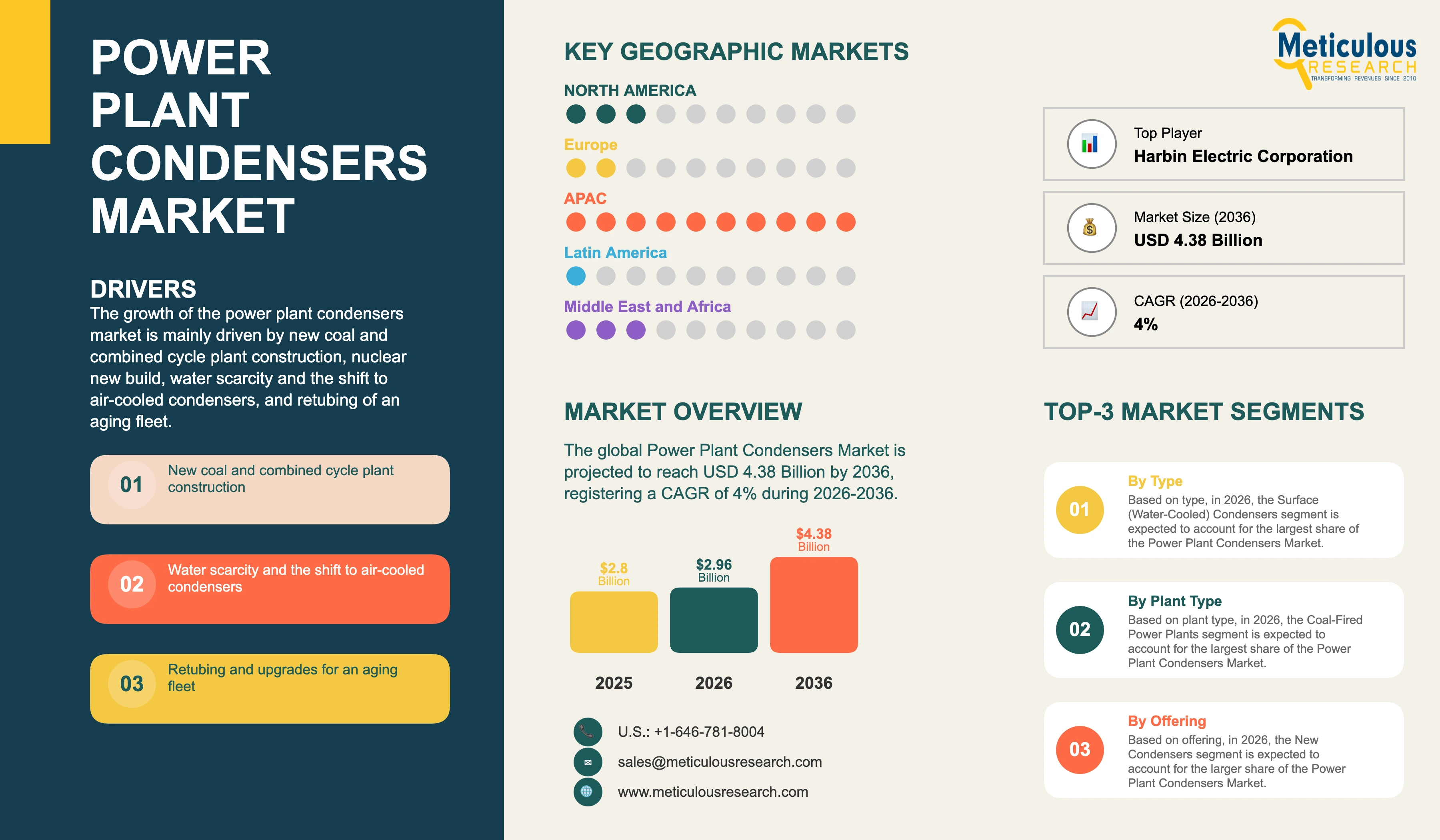
The global power plant condensers market was valued at USD 2.80 billion in 2025. This market is expected to reach USD 4.38 billion by 2036 from an estimated USD 2.96 billion in 2026, registering a CAGR of 4.0% during the forecast period (2026-2036).
- Published
- Nov 2026
- Pages
- 249
- Format
- PDF + Excel
- Report ID
- MREP - 1042725
- Base year
- 2025
- 2025 · BASELINE
- $2.80B
- 2036
- $4.38B
- CAGR 2026–2036
- 4.0%
2025 baseline · 2026–2036 forecast at 4.0% CAGR · hover a bar for the value
Key highlights
China commissioned 78 GW of new coal power capacity in 2025 and had about 291 GW permitted or under construction at the end of the year, according to the Centre for Research on Energy and Clean Air (CREA) and Global Energy Monitor (GEM). Every new steam turbine requires a condenser, and many new coal units in water-scarce northern and western China use air-cooled condensers.
GE Vernova reported that its Gas Power equipment backlog and slot reservation agreements grew from 62 GW to 83 GW during 2025, and Saudi Arabia had about 35.8 GW of gas-fired capacity under construction in early 2025, according to MEED. The steam turbines in these combined cycle plants need condensers, and plants in the Gulf and other arid regions often use air-cooled condensers.
The World Nuclear Industry Status Report 2026 counted 73 reactors under construction worldwide in mid-2026, the highest number since 1987. Large nuclear units require some of the largest condensers in the power industry, and EDF's Arabelle Solutions signed a 10-year service agreement in 2025 with Dongfang Electric covering the steam turbines, condensers, and other turbine island equipment at the Taishan nuclear plant in China.
Holtec International is supplying air-cooled condenser systems for five 800 MW coal-fired generating units in India, fabricated at its Dahej facility, which will reject waste heat entirely with air and eliminate the need for water-based cooling.
SPG Dry Cooling agreed in 2026 to supply a standardized air-cooled condenser for the first SOLO micro-modular reactor deployment of Terra Innovatum, which shows how dry cooling is enabling advanced nuclear plants in water-scarce and remote locations.
India plans to add at least 80 GW of coal-based capacity by 2031-32, and Indian manufacturers such as BHEL and international suppliers such as Holtec are supplying condensers for new 660 MW and 800 MW supercritical and ultra-supercritical units.
By type, surface (water-cooled) condensers account for the largest share of 60.0% in 2026, while air-cooled condensers register the highest CAGR.
By offering, new condensers account for the larger share in 2026, while retubing, retrofit, and services register the higher CAGR.
By tube material, stainless steel accounts for the largest share in 2026, while carbon steel finned tubes register the highest CAGR.
By plant type, coal-fired power plants account for the largest share of 42.0% in 2026, while gas-fired and combined cycle power plants register the highest CAGR.
By capacity, above 500 MW accounts for the largest share in 2026, while 100 MW to 500 MW registers the highest CAGR.
By geography, Asia-Pacific accounts for the largest share of 52.0% in 2026, while Middle East & Africa registers the highest CAGR of 5.4%.
Report summary
| Particulars | Details |
|---|---|
| Forecast Period | 2026-2036 |
| Base Year | 2025 |
| Estimated Year | 2026 |
| CAGR (Value) | 4.0% |
| Format | PDF, Excel & Cloud Portal · 249 pages |
| Market Size (Value) in 2025 | USD 2.80 billion |
| Market Size (Value) in 2026 | USD 2.96 billion |
| Market Size (Value) by 2036 | USD 4.38 billion |
| Largest Segment by Type (2026) | Surface (Water-Cooled) Condensers (60.0%) |
| Largest Segment by Plant Type (2026) | Coal-Fired Power Plants (42.0%) |
| Largest Region (2026) | Asia-Pacific (52.0%) |
| Fastest-Growing Region | Middle East & Africa (CAGR 5.4%) |
| Key Companies | 16 companies and other companies |
| Segments Covered | Type, Offering, Tube Material, Plant Type, Capacity, Geography |
| Countries Covered | U.S., Canada, Germany, U.K., France, Poland, Italy, Spain, Rest of Europe, China, India, Japan, South Korea, Taiwan, Indonesia, Vietnam, Australia, Rest of Asia-Pacific, Mexico, Brazil, Chile, Argentina, Rest of Latin America, Saudi Arabia, U.A.E., Qatar, Kuwait, Iraq, Egypt, Turkey, South Africa, Rest of Middle East & Africa |
Report overview
Segments covered: type, offering, tube material, plant type, capacity.
The growth of this market is mainly driven by the construction of large coal-fired units in China and India, the strong wave of new combined cycle gas plants in the U.S., the Middle East, and Asia, the largest nuclear construction pipeline in more than three decades and the first small modular reactor projects, the growing use of air-cooled condensers in water-scarce regions, and the need to retube, upgrade, and maintain the condensers of an aging thermal and nuclear fleet that is operating longer and more flexibly. However, factors such as coal plant retirements in Europe and North America, the expected slowdown of new coal construction in China after the current pipeline, the higher cost and lower efficiency of air-cooled condensers compared with water-cooled systems, and price competition from Chinese manufacturers are expected to restrain the growth of this market to some extent.
Power plant condensers are heat exchangers that condense the exhaust steam from steam turbines back into water, which is then returned to the boiler, heat recovery steam generator, or steam generator. By condensing steam at low pressure, the condenser creates a vacuum at the turbine exhaust, which allows the turbine to extract more energy from the steam and greatly increases plant efficiency. This report covers global revenue from new surface (water-cooled) condensers, air-cooled condensers, and other condensers for coal-fired, gas-fired combined cycle, nuclear, and other power plants, as well as retubing, retrofit, and service work on existing condensers.
Surface condensers are large shell-and-tube heat exchangers in which steam condenses on the outside of thousands of tubes through which cooling water flows. The cooling water comes from rivers, lakes, the sea, or cooling towers, and the condenser tubes are made of stainless steel, titanium, or copper alloys depending on water quality. Large condensers for 1,000 MW coal units and nuclear plants can contain more than 50,000 tubes and are among the largest components in a power plant. The condenser also collects the condensate, removes non-condensable gases through air removal equipment such as steam jet ejectors or vacuum pumps, and in many plants receives steam from turbine bypass systems during start-ups and trips.
Air-cooled condensers condense steam directly in large arrays of finned tubes arranged in A-frame structures, with large fans that blow ambient air across the tubes. They eliminate the need for cooling water, which makes them essential for power plants in arid regions, but they cost more, take up more space, and result in lower plant efficiency, especially in hot weather. Air-cooled condensers are widely used at coal plants in northern China, where several large provinces restrict water use for new thermal plants, at combined cycle plants in the Middle East, the U.S. Southwest, and Mexico, and at some plants in India, South Africa, and Australia.
Condensers are usually supplied as part of the turbine island by steam turbine manufacturers or by specialized heat exchanger companies working with them. In China, condensers are mainly supplied by the large power equipment groups and specialized manufacturers, while in India, BHEL is the main supplier for large units. Condenser design must be closely coordinated with the steam turbine's last-stage blades and exhaust configuration, which is why many turbine makers work with preferred condenser suppliers. Air-cooled condensers are supplied by specialized companies such as SPG Dry Cooling, ENEXIO, John Cockerill (Hamon), Holtec International, Harbin Air Conditioning, and Shuangliang Eco-Energy.
The aftermarket for condensers is significant because condenser tubes suffer from corrosion, erosion, fouling, and vibration damage over time, which reduces plant efficiency and can allow cooling water to leak into the steam cycle. Plants regularly clean, inspect, plug, and eventually retube their condensers, and many upgrade to more durable tube materials, such as stainless steel or titanium, when they retube. Online tube cleaning systems, air removal equipment, and performance monitoring are also important parts of the market. Air-cooled condensers also need regular cleaning of finned surfaces, fan and gearbox maintenance, and inspection for corrosion in steam ducts and tube inlets.
The market is moderately concentrated in large surface condensers, which are supplied by turbine manufacturers and a few specialized companies, and in air-cooled condensers, which are supplied by a small number of global and Chinese companies. Leading companies include Harbin Electric, Dongfang Electric, Shanghai Electric, BHEL, Mitsubishi Heavy Industries, Doosan Enerbility, Toshiba Energy Systems & Solutions, Arabelle Solutions, Holtec International, ENEXIO, SPG Dry Cooling, John Cockerill, Harbin Air Conditioning, Shuangliang Eco-Energy, Graham Corporation, and Taprogge.
Over the forecast period, the power plant condensers market is expected to grow steadily, supported by combined cycle, nuclear, and coal plant construction in Asia and the Middle East, the growing use of air-cooled condensers, and retubing and services for the existing fleet. The market is also expected to shift toward air-cooled condensers, combined cycle and nuclear applications, and aftermarket services as new coal construction slows after 2030. Condensers for small modular reactors and data center power plants are expected to become meaningful new segments in the 2030s.
Report infographic
Market dynamics
16 factors across 5 forcesNew coal and combined cycle plant construction
The construction of new steam-based power plants is the most important driver of demand for new condensers. China commissioned 78 GW of coal capacity in 2025 and had a large pipeline of projects under construction, India plans to add at least 80 GW of coal capacity by 2031-32, and the large gas turbine manufacturers have record backlogs for combined cycle plants in the U.S., the Middle East, and Asia. Each new steam turbine needs a condenser sized for its exhaust steam flow, and large coal units require some of the largest condensers in the industry.
Combined cycle plants have smaller steam turbines than coal plants of the same total output, but they are being built in large numbers. GE Vernova's gas turbine backlog and slot reservations reached 83 GW at the end of 2025, and Saudi Arabia had about 35.8 GW of gas-fired capacity under construction in early 2025, much of it in combined cycle plants. These projects will create strong demand for condensers through the end of the decade.
Steam turbine generator sets for gas-fired boiler plants serving data centers in the U.S., a new type of project that has emerged in 2025 and 2026, also require condensers, often air-cooled because of local water constraints. This adds a new source of demand in North America, where many large data center campuses are being developed in Texas, the Southwest, and other regions with limited water.
Nuclear new build and small modular reactors
Nuclear power plants require very large condensers, because nuclear steam turbines operate with lower steam temperatures and pressures than fossil units and therefore exhaust larger volumes of steam. With 73 reactors under construction worldwide in mid-2026 and national programs in China, India, Russia, Turkey, Egypt, the U.K., France, Poland, and other countries, nuclear construction is a significant driver of demand for large, high-value condensers with titanium or stainless steel tubes.
Small modular reactors and microreactors are creating new demand for medium and small condensers, and many of these projects are designed for air-cooled condensers so that they can be located away from large water bodies. SPG Dry Cooling's agreement to supply an air-cooled condenser for Terra Innovatum's SOLO microreactor and Holtec's plans for its own reactor designs show how dry cooling is becoming part of the advanced nuclear supply chain.
Water scarcity and the shift to air-cooled condensers
Water scarcity is a growing constraint for power plants in China, India, the Middle East, the U.S. Southwest, Mexico, South Africa, and Australia, and regulators in many of these regions limit the use of water for power plant cooling. Air-cooled condensers eliminate the need for cooling water, which makes them the preferred choice for new plants in arid regions and for projects where water rights are difficult to obtain.
Holtec's supply of air-cooled condensers for five 800 MW coal units in India, the widespread use of air-cooled condensers at coal plants in northern China, and their use at combined cycle plants in the Gulf countries show how water constraints are shaping condenser selection. Air-cooled condensers are more expensive than surface condensers, so their growing share increases the average value of condenser systems per plant.
Retubing and upgrades for an aging fleet
A large share of the world's thermal and nuclear power plants is more than 30 years old, and many of their condensers have reached or passed the end of their original design life. Condenser tubes suffer from corrosion, erosion, biofouling, and vibration damage, and tube leaks allow cooling water to contaminate the steam cycle, which can damage boilers, steam generators, and turbines. Retubing a condenser with new, more durable tubes can restore performance and extend plant life.
Nuclear plants that are extending their operation to 60 and 80 years, such as those receiving subsequent license renewals in the U.S., often retube or replace condensers as part of their life extension programs. Plants that cycle frequently to balance renewables also face more condenser stress and air ingress, which increases demand for upgrades, air removal equipment, and monitoring systems. Improving condenser performance is one of the most cost-effective ways to increase plant output and efficiency, since even a small improvement in vacuum can add several megawatts of output at a large unit.
Table of contents
13 chapters · 156 sections · 249 pages · click to expandSegmental analysis
| Segment | Largest share (2026) | Fastest growth (2026–2036) |
|---|---|---|
| By Type | Above 500 MW | 100 MW |
By Type
- The above 500 MW segment is expected to account for the largest share of the power plant condensers market, while the 100 MW to 500 MW segment is projected to register the highest CAGR during the forecast period.
Geographic analysis
Asia-Pacific
Largest shareIn 2026, Asia-Pacific is expected to account for the largest share of 52.0% of the global power plant condensers market. The large share of this region is mainly due to the very large coal construction programs in China and India, China's leadership in nuclear construction, the widespread use of air-cooled condensers at coal plants in northern China, new combined cycle plants in Japan, South Korea, Taiwan, and Southeast Asia, and the strong presence of condenser manufacturers such as Harbin Electric, Dongfang Electric, Shanghai Electric, BHEL, Mitsubishi Heavy Industries, Doosan Enerbility, Toshiba, Harbin Air Conditioning, and Shuangliang Eco-Energy. India's plan to add at least 80 GW of coal capacity by 2031-32 and its use of air-cooled condensers at some new units also support demand.
Middle East & Africa
The Middle East & Africa is the second-largest market and is projected to register the highest CAGR of 5.4% during the forecast period. The rapid growth of this region is mainly driven by Saudi Arabia's very large combined cycle construction program, new combined cycle plants in the U.A.E., Qatar, Kuwait, and Iraq, the widespread use of air-cooled condensers in the region's arid climate, industrial cogeneration in the petrochemical sector, and new nuclear plants in Egypt and Turkey. Saudi Arabia alone had about 35.8 GW of gas-fired capacity under construction in early 2025.
North America
North America is the third-largest market and is also expected to grow quickly, supported by the strong revival of combined cycle construction in the U.S., data center power projects, the use of air-cooled condensers at plants in the Southwest and Texas, and small modular reactor projects in Canada and the U.S. Holtec International, SPG Dry Cooling, and other suppliers have strong positions in this market. Canada's small modular reactor program at Darlington and planned microreactor projects in remote northern communities also create demand for both surface and air-cooled condensers. Mexico's arid northern regions make extensive use of air-cooled condensers at combined cycle plants.
Europe
Europe is a mature market, with demand coming mainly from retubing and upgrades at existing plants, new nuclear projects in the U.K., France, Poland, and other countries, and new combined cycle plants that replace coal capacity.
Latin America
Latin America accounts for a smaller share of the market, with demand from combined cycle plants in Mexico, Brazil, Argentina, and Chile and from coal and biomass plants.
Competitive landscape
The global power plant condensers market is moderately concentrated, with the top five players estimated to account for about 40% of the market in 2025. The market includes steam turbine manufacturers that supply condensers as part of their turbine islands, specialized surface condenser manufacturers, air-cooled condenser specialists, and aftermarket service and component suppliers.
Harbin Electric, Dongfang Electric, and Shanghai Electric supply most of the condensers for large coal and nuclear units in China, while BHEL is the leading supplier in India. Mitsubishi Heavy Industries, Doosan Enerbility, Toshiba Energy Systems & Solutions, and Arabelle Solutions supply condensers for coal, combined cycle, and nuclear plants in international markets, and Holtec International is a leading supplier of both surface and air-cooled condensers, with major projects in India and the U.S.
In air-cooled condensers, SPG Dry Cooling, ENEXIO, John Cockerill (Hamon), Holtec International, Harbin Air Conditioning, and Shuangliang Eco-Energy are leading suppliers, with Chinese companies dominating their domestic market and competing in export projects. In the aftermarket, Graham Corporation supplies vacuum and condenser equipment, and Taprogge is a leading supplier of online tube cleaning systems.
Companies compete on thermal performance, reliability, corrosion resistance, delivery time, price, project execution capability, and aftermarket service. Several suppliers have also invested in manufacturing in India, China, and the Middle East to be closer to customers. Key strategies include partnerships with steam turbine manufacturers and engineering contractors, development of standardized and modular designs for combined cycle plants and small modular reactors, expansion of retubing and service businesses, and localization of manufacturing in growth markets such as India and the Middle East.
The competitive landscape is shifting as air-cooled condensers gain share and as Chinese manufacturers expand exports. Suppliers with strong air-cooled condenser technology, nuclear qualifications, and aftermarket capabilities are expected to gain share, while those focused mainly on coal plant surface condensers face slower growth. Partnerships between air-cooled condenser specialists and small modular reactor developers are expected to become more common as these projects move toward construction.
Some of the key players operating in the power plant condensers market are Harbin Electric Corporation, Dongfang Electric Corporation, Shanghai Electric Group Co., Ltd., Bharat Heavy Electricals Limited, Mitsubishi Heavy Industries, Ltd., Doosan Enerbility Co., Ltd., Toshiba Energy Systems & Solutions Corporation, Arabelle Solutions (EDF Group), Holtec International, ENEXIO Management GmbH, SPG Dry Cooling, John Cockerill Group (Hamon), Harbin Air Conditioning Co., Ltd., Shuangliang Eco-Energy Systems Co., Ltd., Graham Corporation, and Taprogge GmbH, among others.
- —
Holtec International is supplying air-cooled condensers for five 800 MW units in India, SPG Dry Cooling agreed to supply an air-cooled condenser for Terra Innovatum's SOLO microreactor, Arabelle Solutions signed a 10-year service agreement covering condensers at Taishan nuclear plant, and SNT Energy won a contract to supply air-cooled condensers to SABIC in 2026.
- Harbin Electric Corporation
- Dongfang Electric Corporation
- Shanghai Electric Group Co., Ltd.
- Bharat Heavy Electricals Limited
- Mitsubishi Heavy Industries, Ltd.
- Doosan Enerbility Co., Ltd.
- Toshiba Energy Systems & Solutions Corporation
- Arabelle Solutions (EDF Group)
- Holtec International
- ENEXIO Management GmbH
- SPG Dry Cooling
- John Cockerill Group · Hamon
- Harbin Air Conditioning Co., Ltd.
- Shuangliang Eco-Energy Systems Co., Ltd.
- Graham Corporation
- Taprogge GmbH
Expert perspectives
The power plant condensers market is closely tied to the construction of steam-based power plants, and it is benefiting from the current wave of coal construction in Asia, combined cycle construction in the U.S., the Middle East, and Asia, and nuclear construction worldwide. We see the growing shift to air-cooled condensers and the aging of the installed base as the two most important structural trends in this market.
Over the forecast period, the market is expected to grow at a CAGR of 4.0%, from USD 2.96 billion in 2026 to USD 4.38 billion in 2036. Growth will be supported by combined cycle and nuclear construction, air-cooled condensers for water-scarce regions, small modular reactors, and retubing and upgrades for the existing fleet, while the decline of new coal construction after 2030 and coal plant retirements in mature markets will moderate growth.
In terms of segments, surface condensers remain the largest type, while air-cooled condensers grow fastest. New condensers remain the larger offering, while retubing, retrofit, and services grow faster. Coal-fired power plants remain the largest plant type, while gas-fired and combined cycle power plants grow fastest. Asia-Pacific remains the largest region, and the Middle East & Africa is the fastest-growing region at a CAGR of 5.4%.
For suppliers, the key priorities are to win condenser and air-cooled condenser packages for the large number of new combined cycle and nuclear plants, to develop standardized designs for small modular reactors, to expand retubing and upgrade services for aging plants, and to compete effectively against Chinese manufacturers through technology, quality, and service.
We expect air-cooled condensers and aftermarket services to account for a growing share of market value over time. In our view, water availability constraints will increasingly and directly determine condenser selection for new plants, and suppliers that can reduce the cost and efficiency penalty of air-cooled condensers will be best positioned. Nuclear plants pursuing long-term operation will also provide valuable retubing and replacement opportunities. We also expect demand from data center power plants to become a visible part of the market in North America within the next few years.
Power plant construction cycles and water policies will remain the key factors for this market. A slowdown in combined cycle or nuclear construction would reduce demand for new condensers, while stricter water rules would accelerate the shift to air-cooled systems, and suppliers will need to stay flexible as these conditions change. A diversified portfolio across plant types, regions, and aftermarket services is the best protection against these cycles.
Customer perspectives
Engineering Manager - independent power producer, Saudi Arabia
Water is very limited at our sites, so our new combined cycle plants use air-cooled condensers. We need designs that perform well in extreme heat and suppliers who can deliver on schedule for several projects at once.
Chief Engineer - coal-fired power utility, China
Our new units in the north use air-cooled condensers, while our coastal units use seawater with titanium-tubed surface condensers. Both types must be reliable for decades, and we pay close attention to tube materials and cleaning systems.
Plant Manager - nuclear power plant, U.S.
Our plant is licensed to run to 80 years, and we are retubing the condenser with stainless steel to stop leaks and improve performance. A few megawatts of extra output from a better condenser is very valuable to us.
Frequently asked questions
The global power plant condensers market was valued at USD 2.80 billion in 2025, up from USD 2.62 billion in 2024, and is estimated at USD 2.96 billion in 2026. The market includes new surface condensers, air-cooled condensers, and other condensers for power plants, as well as retubing, retrofit, and service work.
The global power plant condensers market is expected to reach USD 4.38 billion by 2036, supported by combined cycle and nuclear construction, air-cooled condensers, small modular reactors, and retubing of existing plants.
The market is expected to register a CAGR of 4.0% from 2026 to 2036, as growth in combined cycle, nuclear, and aftermarket segments offsets slower demand from new coal plants after 2030.
Condensers turn turbine exhaust steam back into water and create a vacuum at the turbine exhaust, which allows the turbine to extract more energy and greatly increases plant efficiency.
Market growth is mainly driven by new coal and combined cycle plant construction, nuclear new build and small modular reactors, water scarcity and the shift to air-cooled condensers, and retubing and upgrades for an aging fleet.
Coal plant retirements, slowing coal construction, and the higher cost and efficiency penalty of air-cooled condensers restrain growth, while price competition from Chinese manufacturers and material costs are key challenges.
Key opportunities include air-cooled condensers for data center and industrial power, condenser retubing and performance upgrades, condensers for small modular reactors and advanced nuclear, and digital monitoring and online cleaning systems.
Surface (water-cooled) condensers are expected to account for the largest share of 60.0% of the market in 2026, while air-cooled condensers are projected to register the highest CAGR.
Coal-fired power plants are expected to account for the largest share of 42.0% of the market in 2026, while gas-fired and combined cycle power plants are projected to register the highest CAGR.
Retubing, retrofit, and services are projected to register the higher CAGR during the forecast period, driven by the aging thermal and nuclear fleet.
Asia-Pacific is expected to account for the largest share of 52.0% of the market in 2026, mainly due to coal and nuclear construction in China and India and the use of air-cooled condensers in northern China.
The Middle East & Africa is projected to register the highest CAGR of 5.4% during the forecast period, driven by Saudi Arabia's combined cycle program and the widespread use of air-cooled condensers in the region.
The report profiles 16 companies, including Harbin Electric Corporation, Dongfang Electric Corporation, Shanghai Electric Group Co., Ltd., Bharat Heavy Electricals Limited, Mitsubishi Heavy Industries, Ltd., Doosan Enerbility Co., Ltd., Toshiba Energy Systems & Solutions Corporation, Arabelle Solutions (EDF Group), Holtec International, ENEXIO Management GmbH, SPG Dry Cooling, John Cockerill Group (Hamon), Harbin Air Conditioning Co., Ltd., Shuangliang Eco-Energy Systems Co., Ltd., Graham Corporation, and Taprogge GmbH.
Holtec International is supplying air-cooled condensers for five 800 MW units in India, SPG Dry Cooling agreed to supply an air-cooled condenser for Terra Innovatum's SOLO microreactor, Arabelle Solutions signed a 10-year service agreement covering condensers at Taishan nuclear plant, and SNT Energy won a contract to supply air-cooled condensers to SABIC in 2026.
In 2026, the above 500 MW segment is expected to account for the largest share of the power plant condensers market, while the 100 MW to 500 MW segment is projected to register the highest CAGR during the forecast period.
Cite this report
Meticulous Research. (2026). Power Plant Condensers Market - Global Opportunity Analysis and Industry Forecast (2026-2036) (Report No. MREP - 1042725). Meticulous Market Research Pvt. Ltd. https://www.meticulousresearch.com/product/power-plant-condensers-market-7408