Power Plant Life Extension Services Market (2026-2036)
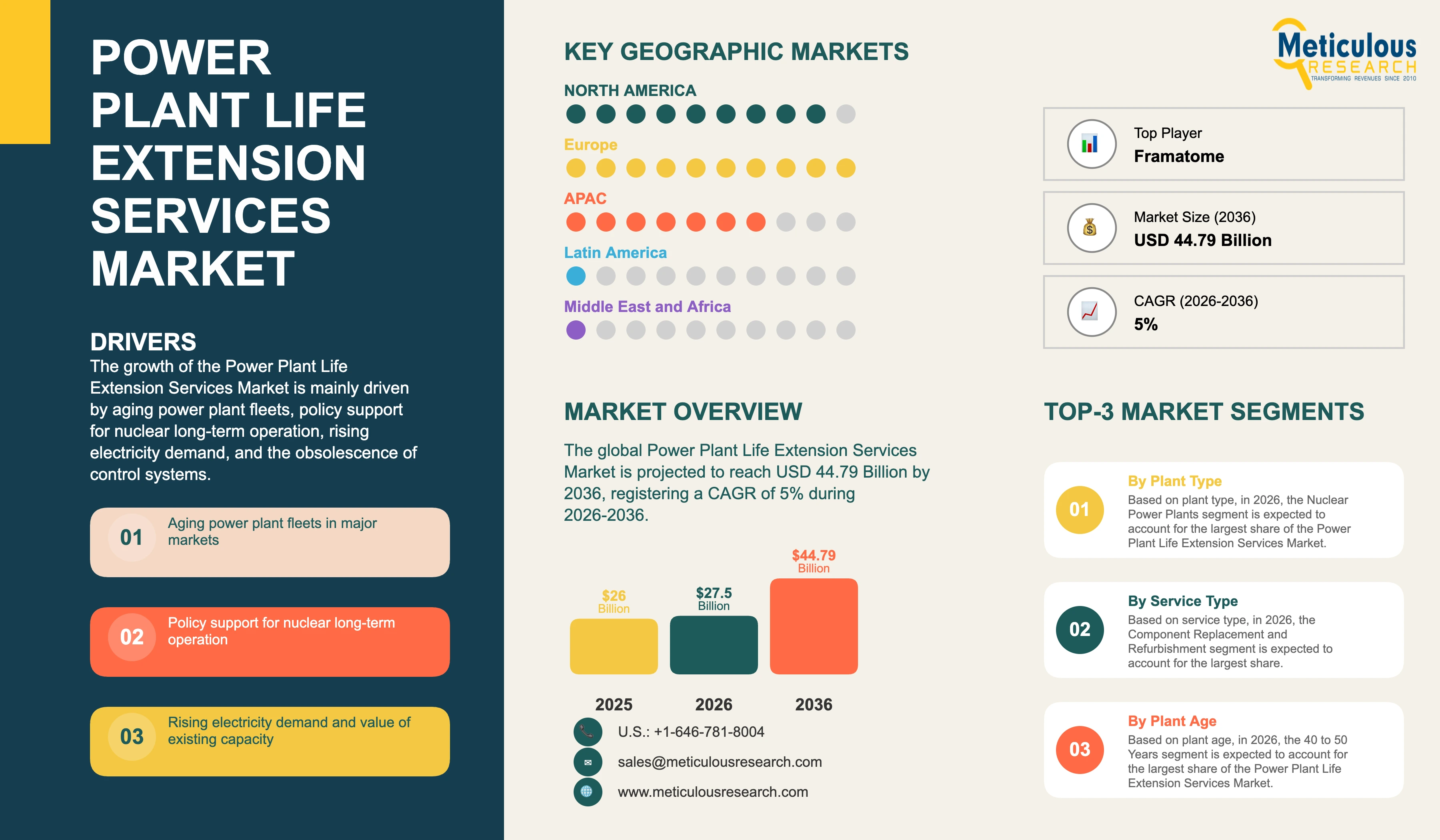
The global power plant life extension services market was valued at USD 26.00 billion in 2025. This market is expected to reach USD 44.79 billion by 2036 from an estimated USD 27.50 billion in 2026, registering a CAGR of 5.0% during the forecast period (2026-2036).
- Published
- Nov 2026
- Pages
- 267
- Format
- PDF + Excel
- Report ID
- MREP - 1042726
- Base year
- 2025
- 2025 · BASELINE
- $26.00B
- 2036
- $44.79B
- CAGR 2026–2036
- 5.0%
2025 baseline · 2026–2036 forecast at 5.0% CAGR · hover a bar for the value
Key highlights
France's Court of Auditors estimated in November 2025 that EDF's Grand Carénage program to extend the life of the French nuclear fleet will cost EUR 100.8 billion between 2014 and 2035, or EUR 131.9 billion including additional operating costs, and concluded that extending reactors from 40 to 60 years remains very competitive compared with building new capacity.
In November 2025, the Province of Ontario approved Ontario Power Generation's plan to refurbish Units 5 to 8 at the Pickering Nuclear Generating Station at a cost of CAD 26.8 billion, providing about 38 more years of operation, and the units were scheduled to be removed from service by the end of September 2026 for the start of refurbishment.
Ontario Power Generation reported that the Darlington refurbishment, a 10-year program to refurbish four CANDU reactors, was expected to return its final unit to service in March 2026, more than four months ahead of schedule and under budget, while Bruce Power's Major Component Replacement program continues at its site.
The U.S. Nuclear Regulatory Commission granted 13 subsequent license renewals in 2025, which allow reactors to operate for up to 80 years, and renewed 18 operating reactor licenses over 15 months to early 2026. Under Executive Order 14300, the NRC now aims to complete license renewal reviews within 12 months, and it approved the Hatch subsequent license renewal in June 2026 in less than a year.
Rising U.S. electricity demand from data centers and industry has led utilities to delay the retirement of coal and gas units and to invest in their continued operation, while Diablo Canyon, which had been scheduled to close in 2025, received a 20-year license renewal from the NRC in 2026.
Hydroelectric plant owners in North America, Europe, Latin America, and Asia are carrying out large modernization programs to replace turbines, generators, and control systems at plants that are more than 40 years old, supported by suppliers such as Andritz, Voith, GE Vernova, and Toshiba.
By plant type, nuclear power plants account for the largest share of 52.0% in 2026, while gas-fired and combined cycle power plants register the highest CAGR.
By service type, component replacement and refurbishment accounts for the largest share of 48.0% in 2026, while instrumentation and control modernization registers the highest CAGR.
By plant age, 40 to 50 years account for the largest share in 2026, while above 50 years register the highest CAGR.
By service provider, original equipment manufacturers account for the largest share in 2026, while independent service providers register the highest CAGR.
By geography, Europe accounts for the largest share of 36.0% in 2026, while Asia-Pacific registers the highest CAGR of 6.1%.
Report summary
| Particulars | Details |
|---|---|
| Base Year | 2025 |
| Estimated Year | 2026 |
| Forecast Period | 2026-2036 |
| Market Size in 2025 | USD 26.00 billion |
| Market Size in 2026 | USD 27.50 billion |
| Market Size by 2036 | USD 44.79 billion |
| CAGR (2026-2036) | 5.0% |
| Format | PDF, Excel & Cloud Portal · 267 pages |
| Largest Segment by Plant Type (2026) | Nuclear Power Plants (52.0%) |
| Largest Segment by Service Type (2026) | Component Replacement and Refurbishment (48.0%) |
| Largest Region (2026) | Europe (36.0%) |
| Fastest-Growing Region | Asia-Pacific (CAGR 6.1%) |
| Companies Profiled | 17 companies and other companies |
| Segments Covered | Plant Type, Service Type, Plant Age, Service Provider, Geography |
| Countries Covered | U.S., Canada, France, U.K., Belgium, Spain, Sweden, Finland, Switzerland, Czech Republic, Romania, Germany, Norway, Rest of Europe, Japan, South Korea, China, India, Taiwan, Australia, Rest of Asia-Pacific, Brazil, Argentina, Mexico, Colombia, Rest of Latin America, South Africa, Saudi Arabia, U.A.E., Egypt, Rest of Middle East & Africa |
Report overview
Segments covered: plant type, service type, plant age, service provider.
The growth of this market is mainly driven by the aging of nuclear, hydroelectric, coal, and gas-fired power plant fleets in North America, Europe, and Asia, government policies that support long-term operation of existing nuclear reactors to 60 and 80 years, large refurbishment programs such as France's Grand Carénage and Ontario's CANDU refurbishments, rising electricity demand from data centers, industry, and electrification that makes existing capacity more valuable, the long lead times and high costs of new generating capacity, and the need to modernize instrumentation and control systems and improve flexibility at existing plants. However, factors such as the high cost and long duration of major refurbishment projects, regulatory and technical uncertainty about operation beyond 60 years, shortages of skilled labor and specialized components, and coal phase-out policies that limit investment in some thermal plants are expected to restrain the growth of this market to some extent.
Power plant life extension services include the engineering, refurbishment, component replacement, upgrades, and regulatory work required to keep existing power plants operating safely and economically beyond their original design life. This report covers global revenue from condition assessment and engineering, replacement and refurbishment of major components such as reactor components, steam generators, turbines, generators, boilers, and transformers, performance upgrades and uprates, instrumentation and control modernization, licensing and regulatory support, and project management for nuclear, hydroelectric, coal-fired, gas-fired, and other thermal power plants. Routine operation and maintenance services are excluded from the scope of this report.
Most of the world's power plants were built between the 1970s and the early 2000s, and a large share of the global nuclear, hydro, and coal fleets is now more than 30 or 40 years old. For many of these plants, extending operation is much cheaper and faster than building replacement capacity, especially at a time when electricity demand is rising and new plants face long lead times, high costs, and permitting challenges. France's Court of Auditors, for example, has found that extending French reactors from 40 to 60 years is very competitive compared with building new capacity.
Nuclear power plants account for the largest share of life extension spending, as operators in the U.S., France, Canada, Belgium, Spain, Sweden, Finland, Switzerland, the Czech Republic, Slovakia, Hungary, South Korea, Japan, Argentina, and other countries extend reactor operation to 60 years and, in the U.S., to 80 years. Nuclear life extension involves replacing steam generators, reactor vessel heads, turbines, generators, transformers, and control systems, carrying out periodic safety reviews and license renewals, and implementing safety upgrades required after the Fukushima accident.
CANDU reactors in Canada, Argentina, Romania, and South Korea require major refurbishments after about 30 years of operation, in which pressure tubes, calandria tubes, and feeder pipes are replaced, along with steam generators and other components. Ontario's refurbishment programs at Darlington, Bruce, and Pickering are among the largest infrastructure projects in North America, and Romania is refurbishing Cernavoda Unit 1. These programs involve years of planning, extensive mock-up testing, and thousands of workers, and they create long-term demand for specialized tooling, components, and engineering services.
Hydroelectric plants can operate for 80 to 100 years or more if their turbines, generators, and control systems are replaced periodically. Hydro modernization projects replace turbine runners, generator windings, governors, excitation systems, and control systems, and often increase output and efficiency. Coal and gas-fired plants also undergo life extension projects that replace boiler pressure parts, turbine components, and controls, although coal phase-out policies limit such investment in many countries.
Business models include large engineering, procurement, and construction contracts for refurbishment projects, component supply contracts with original equipment manufacturers, alliance contracts in which utilities and contractors share risks and rewards, and engineering and licensing support contracts. Many large nuclear refurbishments use alliance or target-cost models to manage the complexity and risk of the work. Smaller projects, such as hydro unit overhauls or turbine upgrades, are usually awarded through competitive bids to original equipment manufacturers or independent service providers.
The market is served by original equipment manufacturers such as Framatome, Westinghouse, GE Vernova, Siemens Energy, Mitsubishi Heavy Industries, Doosan Enerbility, Arabelle Solutions, Ansaldo Energia, Andritz, and Voith, nuclear component and service suppliers such as AtkinsRéalis, BWX Technologies, and Curtiss-Wright, boiler suppliers such as Babcock & Wilcox, and engineering and construction firms such as Bechtel, Aecon, and Sargent & Lundy.
Over the forecast period, the power plant life extension services market is expected to grow steadily, supported by nuclear long-term operation programs, CANDU refurbishments, hydro modernization, instrumentation and control upgrades, and the continued operation of thermal plants needed for reliability. The market is expected to benefit from the growing recognition by governments and utilities that existing low-carbon plants, especially nuclear and hydro, are among the most cost-effective sources of clean and reliable electricity. Technology companies seeking firm low-carbon power for data centers are also supporting life extension through long-term power purchase agreements with existing plants.
Refurbishing our reactors gives us decades more of clean power at a cost far below new construction. The key is careful planning, strong partnerships with our contractors, and a skilled workforce.
This comment explains why component replacement and refurbishment accounts for 48.0% of the market and why North America remains a major market for life extension services.
Many of our plants are more than 40 years old, and we need to keep them running safely while we decide on future capacity. We are investing in upgrades and long-term operation programs across our fleet.
This comment shows why Asia-Pacific is the fastest-growing region and why the above 50 years age segment is growing fastest. It also explains why Europe, with its large nuclear and hydro fleets, accounts for 36.0% of the market.
Europe is expected to account for the largest share of 36.0% of the market in 2026, mainly due to France's Grand Carénage program and life extension of nuclear and hydro fleets across the region.
Asia-Pacific is projected to register the highest CAGR of 6.1% during the forecast period, driven by nuclear long-term operation in South Korea and Japan and renovation and modernization programs in India and China.
The report profiles 17 companies, including Framatome, Westinghouse Electric Company LLC, AtkinsRéalis Group Inc., GE Vernova Inc., Siemens Energy AG, Mitsubishi Heavy Industries, Ltd., Doosan Enerbility Co., Ltd., BWX Technologies, Inc., Arabelle Solutions (EDF Group), Ansaldo Energia S.p.A., Andritz AG, Voith Group, Babcock & Wilcox Enterprises, Inc., Curtiss-Wright Corporation, Aecon Group Inc., Bechtel Corporation, and Sargent & Lundy, L.L.C.
Report infographic
Market dynamics
16 factors across 5 forcesAging power plant fleets in major markets
A large share of the world's power plant capacity is now more than 30 years old. Most nuclear reactors in the U.S., France, and other early nuclear countries entered service between the 1970s and 1990s, many hydroelectric plants in North America, Europe, and Russia date from the mid-20th century, and a significant part of the coal and gas fleet in the U.S., Europe, and Japan was built before 2000. As these plants age, components such as steam generators, turbines, generators, transformers, boilers, and control systems wear out or become obsolete and must be replaced to keep the plants running.
Plant owners face a choice between retiring aging plants and replacing them with new capacity or investing in life extension. In many cases, life extension offers lower costs, shorter schedules, and lower risks than new construction, and it keeps existing sites, grid connections, and workforces in use. This basic economic advantage is the most important driver of the life extension market.
The age profile of the global fleet means that a growing number of plants will reach key decision points over the next decade. Many reactors built in the 1980s will reach 50 years of operation in the 2030s, and many hydro plants will need their second or third major overhaul, which ensures a steady stream of life extension projects throughout the forecast period. Many gas-fired combined cycle plants built in the early 2000s will also reach 30 years of operation during the forecast period.
Policy support for nuclear long-term operation
Governments in many countries have shifted from planning nuclear phase-outs to supporting the continued operation of existing reactors. France's president announced in 2022 that no reactor would be closed except for safety reasons and asked EDF to study operation beyond 50 and 60 years, and the French Court of Auditors has endorsed extension as a cost-effective option. Belgium reversed its phase-out to extend Doel 4 and Tihange 3, Spain has debated extending its reactors, and Sweden, Finland, Switzerland, and the Netherlands support long-term operation.
In the U.S., the NRC has approved subsequent license renewals that allow reactors to operate for up to 80 years, granting 13 in 2025 alone, and federal policy now aims to complete renewal reviews within 12 months. Federal and state support programs, including production tax credits for existing nuclear plants, help make life extension investments economic. In Canada, Ontario has committed to refurbishing all of its CANDU reactors at Darlington, Bruce, and Pickering, while South Korea and Japan are extending or restarting reactors to support energy security and decarbonization goals.
Rising electricity demand and the value of existing capacity
Electricity demand is rising in many countries because of data centers, manufacturing, electrification of transport and heating, and population growth, and grid operators in the U.S. and elsewhere have warned of capacity shortfalls. In this environment, existing power plants that provide firm, dispatchable capacity have become more valuable, and utilities are delaying retirements and investing in continued operation.
Technology companies have also signed long-term power purchase agreements with existing nuclear plants, which improve the economics of life extension and uprates. Capacity markets in several U.S. regions have also cleared at much higher prices in recent auctions, which increases the revenue that existing plants can earn. Uprates, which increase the output of existing reactors through equipment upgrades, are attracting renewed interest as a fast and low-cost way to add capacity, and hydro and thermal plant owners are also pursuing efficiency upgrades and capacity increases.
Obsolescence of instrumentation and control systems
Many power plants still use analog instrumentation and control systems that were installed when the plants were built, and spare parts and expertise for these systems are becoming scarce, which increases the risk of failures and forced outages. Replacing them with digital systems improves reliability, performance monitoring, and cybersecurity, and it can reduce staffing and maintenance costs. In nuclear plants, digital instrumentation and control upgrades require extensive engineering and regulatory review, which adds to their value.
Hydro, coal, and gas plants are also upgrading control systems to support more flexible operation, faster ramping, and integration with grids that have high shares of renewables. These upgrades are often combined with other life extension work and represent one of the fastest-growing parts of the market, as utilities seek to modernize plants for decades of additional operation.
Table of contents
12 chapters · 155 sections · 267 pages · click to expandSegmental analysis
| Segment | Largest share (2026) | Fastest growth (2026–2036) |
|---|---|---|
| By Plant Age | 40 to 50 years | Above 50 years |
| By Plant Type | Original equipment manufacturers | Independent service providers |
By Plant Age
- The above 50 years segment is projected to register the highest CAGR during the forecast period, driven by reactors planning operation to 80 years and older hydro and thermal plants.
By Plant Type
- The original equipment manufacturers segment is expected to account for the largest share of the power plant life extension services market, while the independent service providers segment is projected to register the highest CAGR during the forecast period.
Geographic analysis
Europe
Largest shareIn 2026, Europe is expected to account for the largest share of 36.0% of the global power plant life extension services market. The large share of this region is mainly due to France's Grand Carénage program, which is expected to cost more than EUR 100 billion between 2014 and 2035, life extension programs for reactors in Belgium, Spain, Sweden, Finland, Switzerland, the Czech Republic, Slovakia, and Hungary, the refurbishment of Cernavoda Unit 1 in Romania, large hydro modernization programs in Norway, Switzerland, Austria, and other countries, and the strong presence of European suppliers such as Framatome, Siemens Energy, Arabelle Solutions, Ansaldo Energia, Andritz, and Voith.
North America
North America is the second-largest market, supported by Ontario's CANDU refurbishments at Bruce and Pickering, U.S. subsequent license renewals that allow reactors to operate to 80 years, nuclear uprates, life extension of coal and gas plants needed for reliability, and modernization of large hydro fleets in the U.S. and Canada. Rising electricity demand from data centers and industry is increasing the value of existing plants and supporting investment in their continued operation.
Asia-Pacific
Fastest growthAsia-Pacific is projected to register the highest CAGR of 6.1% during the forecast period. The rapid growth of this region is mainly driven by long-term operation programs for nuclear reactors in South Korea and Japan, including continued operation of older units and safety upgrades at restarted reactors, renovation and modernization programs for coal and hydro plants in India, life extension and upgrades at aging coal and hydro plants in China, and growing demand for life extension at gas-fired plants in Japan, South Korea, Taiwan, and Southeast Asia. India's renovation and modernization program for older thermal units and its hydro rehabilitation projects are also expected to support demand.
Latin America
Latin America accounts for a smaller share of the market, with demand from hydro modernization in Brazil, Colombia, Argentina, Chile, and Peru and from nuclear life extension in Argentina and Brazil, including work at Atucha and Angra.
Middle East & Africa
The Middle East & Africa also accounts for a small share, with demand from life extension at South Africa's Koeberg nuclear plant, which received approval to operate beyond 40 years, hydro rehabilitation in Africa supported by development banks, and upgrades of older gas-fired plants in the Gulf countries. Several African countries are also rehabilitating large hydro plants built in the 1960s and 1970s with support from development finance institutions.
Competitive landscape
The global power plant life extension services market is moderately fragmented, with the top five players estimated to account for about 35% of the market in 2025. The market includes original equipment manufacturers, nuclear component and service suppliers, hydro equipment suppliers, engineering and construction firms, and independent service providers.
Framatome, Westinghouse, Mitsubishi Heavy Industries, Doosan Enerbility, and BWX Technologies are leading suppliers of nuclear components and services for life extension, including steam generators, reactor components, and fuel handling and control systems. AtkinsRéalis, which owns the CANDU technology, plays a central role in CANDU refurbishments together with BWX Technologies, Aecon, and other partners. GE Vernova, Siemens Energy, Arabelle Solutions, Ansaldo Energia, and Mitsubishi Heavy Industries supply turbines, generators, and services for nuclear and thermal plant life extension.
In hydro, Andritz, Voith, GE Vernova, and Toshiba are leading suppliers of modernization services and equipment. Babcock & Wilcox provides boiler life extension services for thermal plants, while Bechtel, Aecon, Sargent & Lundy, and other engineering and construction firms provide project management, engineering, and construction services. Curtiss-Wright supplies specialized components and digital control systems for nuclear plants.
Companies compete on technical capability, design knowledge, track record in similar projects, safety and quality performance, ability to manage large and complex projects, cost, schedule, and local presence and supply chains. Key strategies include long-term partnerships and alliance contracts with plant owners, investment in workforce and manufacturing capacity, development of digital condition monitoring and engineering tools, and expansion into international refurbishment markets.
The competitive landscape is shaped by the large, long-term nature of major refurbishment programs, which favor suppliers with established relationships and proven performance. Consolidation and partnerships are expected to continue as companies seek to build complete capabilities for nuclear, hydro, and thermal life extension, and suppliers with strong positions in Ontario, France, and the U.S. are expected to use their experience to win projects in other countries. Independent service providers are also gaining share in turbine, generator, and control system work, which increases competition for original equipment manufacturers.
Some of the key players operating in the power plant life extension services market are Framatome, Westinghouse Electric Company LLC, AtkinsRéalis Group Inc., GE Vernova Inc., Siemens Energy AG, Mitsubishi Heavy Industries, Ltd., Doosan Enerbility Co., Ltd., BWX Technologies, Inc., Arabelle Solutions (EDF Group), Ansaldo Energia S.p.A., Andritz AG, Voith Group, Babcock & Wilcox Enterprises, Inc., Curtiss-Wright Corporation, Aecon Group Inc., Bechtel Corporation, and Sargent & Lundy, L.L.C., among others.
- —
Ontario approved the CAD 26.8 billion Pickering refurbishment in November 2025, the Darlington refurbishment was completed ahead of schedule and under budget in 2026, the NRC granted 13 subsequent license renewals in 2025 and approved Hatch in under 12 months in 2026, and France's Court of Auditors confirmed the cost-effectiveness of the Grand Carénage.
- Framatome
- Westinghouse Electric Company LLC
- AtkinsRéalis Group Inc.
- GE Vernova Inc.
- Siemens Energy AG
- Mitsubishi Heavy Industries, Ltd.
- Doosan Enerbility Co., Ltd.
- BWX Technologies, Inc.
- Arabelle Solutions (EDF Group)
- Ansaldo Energia S.p.A
- Andritz AG
- Voith Group
- Babcock & Wilcox Enterprises, Inc.
- Curtiss-Wright Corporation
- Aecon Group Inc.
- Bechtel Corporation
- Sargent & Lundy
- L.L.C
Expert perspectives
The power plant life extension services market is benefiting from a fundamental change in how governments and utilities view existing power plants. We see existing nuclear and hydro plants increasingly recognized as some of the most valuable assets in the electricity system, as they provide reliable, low-carbon power at a cost that is very competitive with new capacity, and this recognition is driving large life extension programs in Europe, North America, and Asia.
Over the forecast period, the market is expected to grow at a CAGR of 5.0%, from USD 27.50 billion in 2026 to USD 44.79 billion in 2036. Growth will be supported by nuclear long-term operation, CANDU refurbishments, hydro modernization, gas plant life extension, and instrumentation and control upgrades, while the high cost of major refurbishments, labor and supply chain constraints, and coal phase-out policies will moderate growth.
In terms of segments, nuclear power plants remain the largest plant type, while gas-fired and combined cycle power plants grow fastest. Component replacement and refurbishment remains the largest service type, while instrumentation and control modernization grows fastest. Original equipment manufacturers remain the largest service providers, while independent service providers grow fastest. Europe remains the largest region, and Asia-Pacific is the fastest-growing region at a CAGR of 6.1%.
For service providers, the key priorities are to build workforce and manufacturing capacity to meet demand from overlapping refurbishment programs, to develop digital tools for condition assessment and life management, to offer integrated solutions that combine life extension with uprates and flexibility upgrades, and to use their experience from major programs to win projects in new markets.
We expect nuclear long-term operation to remain the main source of value in this market, with operation to 80 years becoming increasingly common in the U.S. and possibly in other countries. In our view, the success of Ontario's Darlington refurbishment shows that large life extension projects can be delivered on time and on budget, which should encourage other countries to pursue similar programs and strengthen confidence in the Pickering and Bruce projects.
Government policy and regulatory decisions will remain key factors for the power plant life extension services market. Support for nuclear long-term operation, efficient licensing processes, and recognition of the value of existing low-carbon capacity will strengthen demand, while cost overruns or safety concerns at major projects could slow investment in some regions. We also expect workforce availability to become one of the main limits on how fast the market can grow, which makes investment in training a strategic priority for suppliers.
Customer perspectives
Buyers of power plant life extension services include nuclear operators, hydro utilities, owners of coal and gas-fired plants, state-owned and investor-owned utilities, and independent power producers. Their decisions depend mainly on safety, technical capability, track record, project execution performance, cost, schedule, and the ability of suppliers to manage complex work during planned outages.
Chief Nuclear Officer - nuclear utility, U.S.
Our plants are now licensed to run to 80 years, and we are investing in new turbines, generators, and control systems to make sure they can do that reliably. With demand rising, every megawatt we keep on the grid is valuable.
This comment explains why nuclear power plants account for 52.0% of the market and why instrumentation and control modernization is the fastest-growing service type.
Frequently asked questions
The global power plant life extension services market was valued at USD 26.00 billion in 2025, up from USD 24.60 billion in 2024, and is estimated at USD 27.50 billion in 2026. The market excludes routine operation and maintenance.
The global power plant life extension services market is expected to reach USD 44.79 billion by 2036, supported by nuclear long-term operation, CANDU refurbishments, hydro modernization, and gas plant life extension.
The market is expected to register a CAGR of 5.0% from 2026 to 2036, as aging fleets and rising electricity demand encourage owners to extend the life of existing plants.
Extending existing plants is usually cheaper and faster than building new capacity, and it keeps sites, grid connections, and workforces in use. France's Court of Auditors found that extending reactors from 40 to 60 years is very competitive compared with new capacity.
Market growth is mainly driven by aging power plant fleets, policy support for nuclear long-term operation, rising electricity demand and the value of existing capacity, and the obsolescence of instrumentation and control systems.
The high cost and long duration of major refurbishments and uncertainty about operation beyond 60 years restrain growth, while skilled labor and supply chain constraints and coal phase-out policies are key challenges.
Key opportunities include nuclear uprates, hydro modernization and pumped storage upgrades, CANDU refurbishment programs worldwide, and digital twins and advanced condition monitoring.
Nuclear power plants are expected to account for the largest share of 52.0% of the market in 2026, while gas-fired and combined cycle power plants are projected to register the highest CAGR.
Component replacement and refurbishment is expected to account for the largest share of 48.0% of the market in 2026, while instrumentation and control modernization is projected to register the highest CAGR.
The above 50 years segment is projected to register the highest CAGR during the forecast period, driven by reactors planning operation to 80 years and older hydro and thermal plants.
Europe is expected to account for the largest share of 36.0% of the market in 2026, mainly due to France's Grand Carénage program and life extension of nuclear and hydro fleets across the region.
Asia-Pacific is projected to register the highest CAGR of 6.1% during the forecast period, driven by nuclear long-term operation in South Korea and Japan and renovation and modernization programs in India and China.
The report profiles 17 companies, including Framatome, Westinghouse Electric Company LLC, AtkinsRéalis Group Inc., GE Vernova Inc., Siemens Energy AG, Mitsubishi Heavy Industries, Ltd., Doosan Enerbility Co., Ltd., BWX Technologies, Inc., and others.
Ontario approved the CAD 26.8 billion Pickering refurbishment in November 2025, the Darlington refurbishment was completed ahead of schedule and under budget in 2026, the NRC granted 13 subsequent license renewals in 2025 and approved Hatch in under 12 months in 2026, and France's Court of Auditors confirmed the cost-effectiveness of the Grand Carénage.
In 2026, the original equipment manufacturers segment is expected to account for the largest share of the power plant life extension services market, while the independent service providers segment is projected to register the highest CAGR during the forecast period.
Cite this report
Meticulous Research. (2026). Power Plant Life Extension Services Market - Global Opportunity Analysis and Industry Forecast (2026-2036) (Report No. MREP - 1042726). Meticulous Market Research Pvt. Ltd. https://www.meticulousresearch.com/product/power-plant-life-extension-services-market-7409