Polyaspartic Flooring Coatings Market (2026-2036)
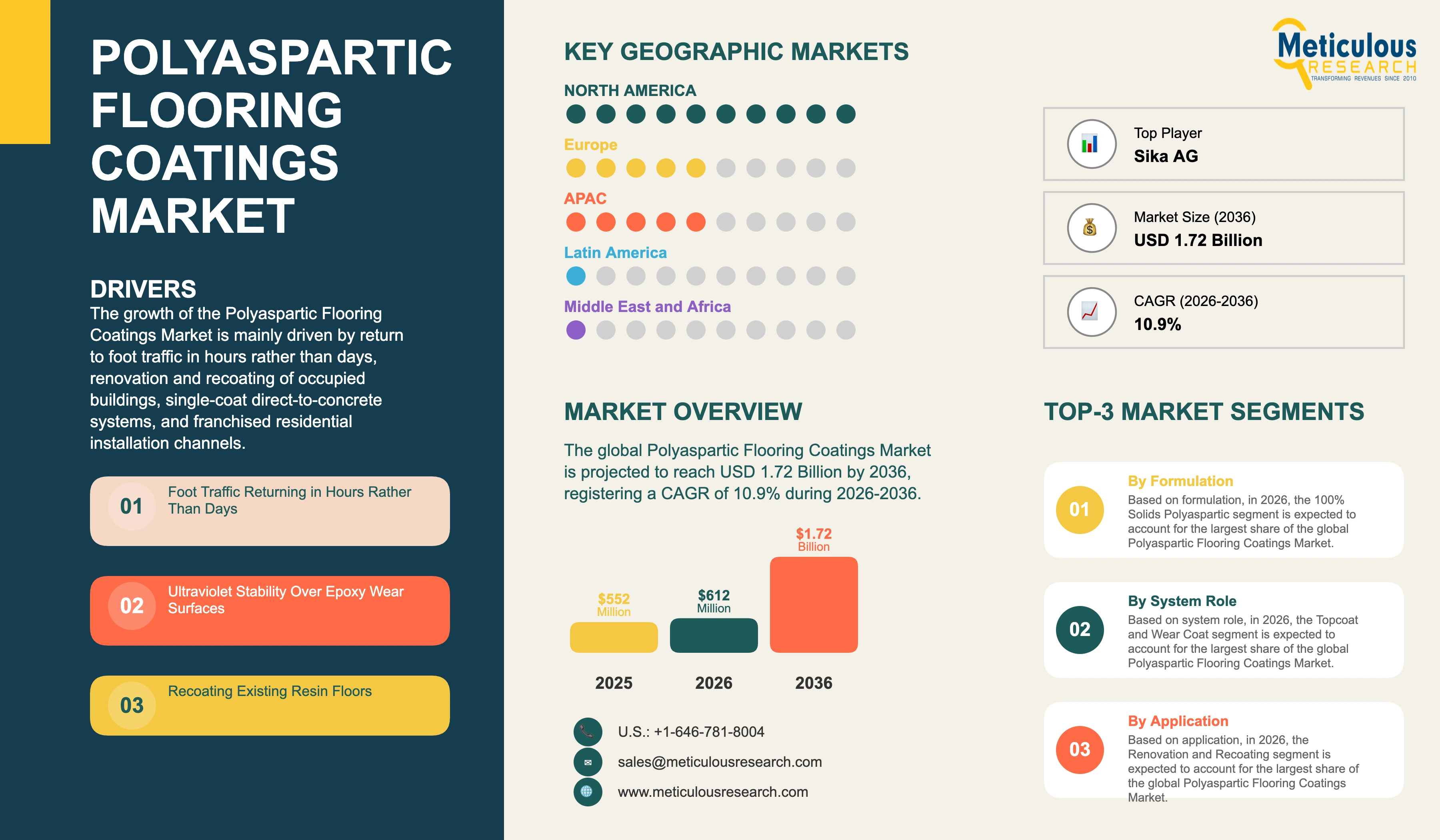
The global Polyaspartic Flooring Coatings Market was valued at USD 552.0 million in 2025. This market is expected to reach USD 1.72 billion by 2036 from an estimated USD 612.0 million in 2026, registering a CAGR of 10.9% during the forecast period (2026-2036).
- Published
- Nov 2026
- Pages
- 262
- Format
- PDF + Excel
- Report ID
- MRCHM - 1042787
- Base year
- 2025
- 2025 · BASELINE
- $552.0M
- 2036
- $1.72B
- CAGR 2026–2036
- 10.9%
2025 baseline · 2026–2036 forecast at 10.9% CAGR · hover a bar for the value
Key highlights
The global Polyaspartic Flooring Coatings Market is projected to reach USD 1.72 billion by 2036, driven by return to foot traffic in hours, cure up to eight times faster than conventional systems, renovation and recoating of occupied buildings, and single-coat direct-to-concrete systems.
North America is expected to account for the largest market share in 2026 and is also projected to register the fastest growth during the forecast period, supported by the depth of the residential garage and light commercial coating channel in the region together with the installed base of resin floors now reaching recoating.
By formulation, 100% Solids Polyaspartic systems are expected to account for the largest market share, whereas Hybrid Polyaspartic-Polyurea and Blends are projected to witness the fastest growth through 2036.
By system role, Topcoat and Wear Coat applications are expected to account for the largest market share, whereas Single-Coat and Direct-to-Concrete Systems are projected to witness the fastest growth through 2036.
By application, Renovation and Recoating work are expected to account for the largest market share, whereas Renovation and Recoating work are projected to witness the fastest growth through 2036.
Published cure data for one polyaspartic flooring resin system gives foot traffic at about 8 hours at 10 degrees Celsius, about 4 hours at 23 degrees and about 3 hours at 30 degrees, with light traffic at about 18, 12 and 8 hours and full cure at about 7, 5 and 4 days respectively.
Pot life on the same system runs at about 20 minutes at 10 degrees Celsius, about 15 minutes at 20 degrees and about 10 minutes at 30 degrees, so the working time falls as the cure speed rises.
Recoat windows are correspondingly short at about 7 hours at 10 degrees Celsius and about 3 hours at 30 degrees, which forces the whole system to be sequenced within a shift.
The resin technology is described by its developer as curing up to eight times faster than conventional floor coating systems, allowing floor coating projects to be completed in a single day and reducing the number of coating layers required.
Volatile organic compound content on the published system is 34.4 grams per liter for the mixed components, and the technology is stated to comply with the European decorative paints directive 2004/42/EC.
Application is bounded rather than open, with ambient and substrate temperatures of 10 degrees to 30 degrees Celsius, the substrate held at least 3 degrees Celsius above dew point, ambient relative humidity between 30% and 75% during application and curing, and substrate moisture limited to 4% by mass or 85% relative humidity by in-situ probe.
Film build is specified by coat function, at 6 to 10 mils wet for primer, 10 to 15 mils for topcoat or broadcast binder and 12 to 15 mils for wear coat, with coverage of 105 to 266 square feet per gallon depending on the coat, and measured performance includes Shore D hardness of 75 and abrasion loss of 0.054 gram under a 1,000 gram load over 1,000 cycles with a CS-17 wheel.
Supply has consolidated at the formulator level, with a construction chemicals acquisition closing on 2 May 2023 and bringing CHF 2.1 billion of 2022 sales, 6,200 employees and 95 production facilities into one portfolio, conditional on divestment of the acquired chemical admixtures assets in the United Kingdom, United States, Canada, Europe, Australia and New Zealand.
Report summary
| Particulars | Details |
|---|---|
| Forecast Period | 2026-2036 |
| Base Year | 2025 |
| Estimated Year | 2026 |
| CAGR (Value) | 10.9% |
| Format | PDF, Excel & Cloud Portal · 262 pages |
| CAGR (Volume) | 9.8% |
| Market Size (Value) in 2026 | USD 612.0 million |
| Market Size (Value) in 2036 | USD 1.72 billion |
| Market Size (Volume) in 2026 | 58.00 kilotons of coating as supplied |
| Market Size (Volume) in 2036 | 147.60 kilotons |
| Average Selling Price, 2026 | USD 10,550 per ton |
| Average Selling Price, 2036 | USD 11,650 per ton |
| Segments Covered | By Formulation: 100% Solids Polyaspartic, High-Solids Solventborne, Hybrid Polyaspartic-Polyurea and Blends. By System Role: Topcoat and Wear Coat, Broadcast Binder and Body Coat, Primer and Basecoat, Single-Coat and Direct-to-Concrete Systems. By Application: New Construction, Renovation and Recoating. By End Use: Residential Garages and Interiors, Industrial and Manufacturing, Commercial and Retail, Food and Beverage Processing, Healthcare and Institutional, Parking Structures and Other Applications. |
| Countries Covered | U.S.; Canada; Germany; U.K.; France; Italy; China; India; Japan; Australia; Brazil; Mexico |
| Key Companies | Sika AG, The Sherwin-Williams Company, PPG Industries, Inc., RPM International Inc., MAPEI S.p.A., Dur-A-Flex, Inc., and Laticrete International, Inc. |
Report overview
Segments covered: formulation, system role, application, end use.
The growth of this market is mainly driven by foot traffic returning in three to four hours against full cure in days, cure stated at up to eight times faster than conventional floor coating systems, renovation and recoating work growing at 11.4% where occupied buildings cannot be closed, and single-coat direct-to-concrete systems growing at 13.2%. However, factors such as pot life of 10 to 20 minutes depending on temperature, an application window bounded at 10 degrees to 30 degrees Celsius and 30% to 75% relative humidity, concrete moisture limited to 4% by mass, and a price per ton far above epoxy are expected to restrain the growth of this market to some extent.
The Polyaspartic Flooring Coatings Market comprises formulated polyaspartic flooring coatings as supplied, covering resin and hardener components for primers, body coats, broadcast binders, wear coats and single-coat systems, taken at the manufacturer gate on a ton basis. The market includes 100% Solids Polyaspartic, High-Solids Solventborne and Hybrid Polyaspartic-Polyurea and Blends, used as topcoat and wear coat, broadcast binder and body coat, primer and basecoat, or single-coat direct-to-concrete systems, across new construction and renovation work in residential garages and interiors, industrial and manufacturing, commercial and retail, food and beverage processing, healthcare and institutional, and parking structures. Polyaspartic ester resins and aliphatic polyisocyanates sold to formulators, epoxy, polyurethane, methyl methacrylate and cementitious flooring systems, quartz and flake broadcast media, and surface preparation and installation labor fall outside the scope.
A polyaspartic coating is a polyurea formed from a polyaspartic ester and an aliphatic polyisocyanate, and the reaction rate is set by the ester chosen rather than by a catalyst. That is what allows the same chemistry to be formulated for a ten-minute working time or a longer one, and it is the commercial foundation of the technology. The developer states that the system cures up to eight times faster than conventional floor coating systems, allows floor projects to be completed in a single day and reduces the number of coating layers required.
The value sold is return to service rather than coating performance. Published cure data gives foot traffic at about 8 hours at 10 degrees Celsius, about 4 hours at 23 degrees and about 3 hours at 30 degrees, with light traffic at about 18, 12 and 8 hours and full cure at about 7, 5 and 4 days. A retail floor, a hospital corridor or a food plant aisle can therefore be coated between shifts, which is the comparison an epoxy system loses rather than the comparison on hardness or chemical resistance.
Speed is bought at the cost of working time. Pot life on the same system runs at about 20 minutes at 10 degrees Celsius, about 15 minutes at 20 degrees and about 10 minutes at 30 degrees, and recoat windows close at about 7 hours at 10 degrees and about 3 hours at 30 degrees. The whole system must therefore be sequenced within a shift, mixed in small batches and applied by crews that cannot stop. Application skill, not material selection, determines whether the job succeeds.
The application envelope is narrow and specified. Ambient and substrate temperatures must sit between 10 degrees and 30 degrees Celsius, the substrate at least 3 degrees Celsius above dew point, and ambient relative humidity between 30% and 75% during application and curing. Substrate moisture is limited to 4% by mass measured with a surface meter, or 85% relative humidity where the in-situ probe method is used. Material preconditioning for at least 24 hours at 18 degrees to 24 degrees Celsius is required, which means the product cannot be used straight from a cold van on a winter morning.
Ultraviolet resistance is the structural performance advantage, because the aliphatic backbone does not amber or chalk the way an aromatic system does. That is why polyaspartic is specified as the wear coat over an epoxy body coat rather than as the whole system, and why Topcoat and Wear Coat holds the largest system role share of this market at 46.0% in 2026. Measured properties on the published system include Shore D hardness of 75 and abrasion loss of 0.054 gram under a 1,000 gram load over 1,000 cycles with a CS-17 wheel.
Renovation rather than new build carries the market. Renovation and Recoating accounts for 58.0% of this market in 2026 and is projected to grow at 11.4% against 10.2% for new construction, because the downtime avoided is worth most in a building already in use. Supply has consolidated at the formulator level, with a construction chemicals acquisition closing on 2 May 2023 bringing CHF 2.1 billion of 2022 sales, 6,200 employees and 95 production facilities into one portfolio, conditional on divestment of the acquired chemical admixtures assets across six markets.
Parking decks combine ultraviolet exposure, vehicular wear and an owner that loses revenue while levels are closed, which aligns all three arguments for the chemistry at once. The aliphatic backbone resists ambering where aromatic systems discolor, the abrasion performance of 0.054 gram loss under a 1,000 gram load over 1,000 cycles supports traffic loading, and a level can be returned to use within hours. Deck coating is a larger area per project than most interior work.
North America is expected to account for the largest share of this market in 2026 at 44.0%, supported by the deepest residential garage coating channel and the largest installed base of resin floors now reaching recoating.
Europe accounts for 24.0% of this market in 2026 and is projected to grow at 9.6%. Demand is weighted toward commercial, institutional and food processing floors, where volatile organic compound content of 34.4 grams per liter and stated compliance with the European decorative paints directive 2004/42/EC are conditions of use in occupied buildings. Germany, the United Kingdom, France and Italy hold most of the regional volume, and the residential garage channel is less developed than in North America.
The Middle East & Africa region holds 3.5% of this market in 2026 with projected growth of 12.2%, driven by commercial and institutional construction in the Gulf states and by parking structures where ultraviolet exposure rules out aromatic systems, with ambient temperatures above the 30 degree Celsius application limit restricting work to conditioned interiors or night application. Latin America holds 5.5% with projected growth of 10.2%, with Brazil and Mexico carrying commercial, retail and food processing work and ambient humidity above the 75% limit constraining coastal application.
Some of the key players operating in the polyaspartic flooring coatings market are Sika AG, The Sherwin-Williams Company, PPG Industries, Inc., RPM International Inc., MAPEI S.p.A., Dur-A-Flex, Inc., and Laticrete International, Inc., among others.
Key strategies include acquiring construction chemicals portfolios so that flooring is sold within a broader relationship, developing hybrid blends that lengthen working time without extending return to service, introducing single-coat direct-to-concrete products for the residential and light commercial channel, building certified contractor networks to expand installation capacity, and bringing emissions declarations forward as specification points for occupied buildings.
Report infographic
Market dynamics
18 factors across 4 forcesFoot Traffic Returning in Hours Rather Than Days
Published cure data for a polyaspartic flooring resin system gives foot traffic at about 4 hours at 23 degrees Celsius and about 3 hours at 30 degrees, with light traffic at 12 and 8 hours respectively, against full cure at 5 and 4 days. An epoxy system on the same floor requires the space to be closed for days. The resin developer states cure up to eight times faster than conventional floor coating systems, allowing projects to be completed in a single day and reducing the number of coating layers. The saving accrues to the building owner as avoided closure rather than to the contractor as reduced labor, which is why the technology commands a price per ton far above epoxy. In retail, healthcare and food processing the value of a weekend rather than a week of closure exceeds the whole coating cost, and that calculation is the primary reason this market grows at 10.9%.
Ultraviolet Stability Over Epoxy Wear Surfaces
An aromatic coating ambers and chalks under ultraviolet exposure, which is a visible defect on a decorative or showroom floor and a maintenance trigger on a parking deck. The aliphatic backbone of a polyaspartic does not, which allows the chemistry to be used as a thin wear coat over an epoxy body coat that carries the build and the broadcast media. That system architecture keeps the expensive material in a 12 to 15 mil wear coat rather than through the full build, and it is why Topcoat and Wear Coat holds the largest system role share at 46.0% in 2026. Measured performance supports the role, with Shore D hardness of 75 and abrasion loss of 0.054 gram under a 1,000 gram load over 1,000 cycles with a CS-17 wheel on the published system.
Recoating Existing Resin Floors
A large installed base of epoxy and urethane floors laid over the past two decades is now reaching the point where the wear surface has failed while the body coat remains sound. Recoating with a polyaspartic wear coat restores the surface without removing the existing build, and the short cure allows the work to be done between operating periods. Renovation and Recoating accounts for 58.0% of this market in 2026 and is projected to be the fastest-growing application at 11.4%. This demand is independent of construction activity and is driven by the condition of floors already in service, which makes it the more stable part of the market through building cycles.
Single-Coat Direct-to-Concrete Systems
Systems formulated to be applied directly to prepared concrete in one coat remove the primer and body coat steps, which compresses a multi-shift sequence into a single application. With recoat windows of about 3 hours at 30 degrees Celsius and about 7 hours at 10 degrees, eliminating coats removes the sequencing risk that makes multi-coat polyaspartic work demanding. Single-Coat and Direct-to-Concrete Systems are projected to be the fastest-growing system role in this market at 13.2%. The segment is where the residential and light commercial channel is expanding, because a single-coat system is within reach of a crew that cannot sequence three coats inside one pot life after another.
Residential and Light Commercial Installation Channels
Residential garage and interior floor coating has become a franchised and contractor-led service sold on same-day completion, which is a claim only a fast-curing chemistry can support. The customer is buying a finished floor by the end of the day rather than a coating specification, and the decorative flake finish that the broadcast-and-wear-coat build produces suits that channel. Residential Garages and Interiors hold the largest end use share of this market in 2026 at 24.0% and are projected to be the fastest-growing end use at 12.4%. The channel also normalizes the chemistry for light commercial work, since the same crews and the same product range serve both.
Table of contents
12 chapters · 130 sections · 262 pages · click to expandSegmental analysis
| Segment | Largest share (2026) | Fastest growth (2026–2036) |
|---|---|---|
| By Formulation | 100% Solids Polyaspartic systems | Hybrid Polyaspartic-Polyurea and Blends |
| By System Role | Topcoat and Wear Coat | Single-Coat and Direct-to-Concrete Systems |
| By Application | Renovation and Recoating work | Renovation and Recoating work |
| By End use | Residential Garages and Interiors | Residential Garages and Interiors |
| Other segments | Topcoat and Wear Coat | Hybrid Polyaspartic-Polyurea and Blends |
By Formulation
- 100% Solids Polyaspartic systems are expected to account for the largest share of the global Polyaspartic Flooring Coatings Market.
- The large share of this segment is mainly due to the suitability of solvent-free systems for occupied buildings, where volatile organic compound content of 34.4 grams per liter on the published mixed system and compliance with the European decorative paints directive are specification conditions, together with the film build achievable in a single coat.
- However, Hybrid Polyaspartic-Polyurea and Blends are projected to register the highest CAGR during the forecast period.
- The rapid growth of this segment is attributed to the ability to position working time and cure speed independently of the pure polyaspartic profile, which addresses the pot life of 10 to 20 minutes that limits batch size and crew productivity.
- 100% Solids Polyaspartic systems are expected to account for the largest market share in 2026.
By System Role
- Topcoat and Wear Coat applications are expected to account for the largest market share.
- The large share of this segment is mainly due to the system architecture that places an epoxy body coat under a polyaspartic wear coat, keeping the ultraviolet stability and the abrasion performance where they are needed while limiting the use of the more expensive material to a 12 to 15 mil layer.
- However, Single-Coat and Direct-to-Concrete Systems are projected to register the highest CAGR during the forecast period.
- The rapid growth of this segment is attributed to the removal of primer and body coat steps, which compresses a multi-shift sequence into one application and eliminates the recoat window risk that makes multi-coat work demanding.
By Application
- Renovation and Recoating work are expected to account for the largest market share.
- The large share of this segment is mainly due to the value of avoided closure in a building already in use, where a floor coated between shifts saves revenue that exceeds the whole coating cost, and the installed base of epoxy and urethane floors whose wear surface has failed over a sound body coat.
- However, Renovation and Recoating work are projected to register the highest CAGR during the forecast period.
- The rapid growth of this segment is attributed to the same avoided-downtime economics, which are independent of construction activity and driven by the condition of floors already in service.
By End use
- Residential Garages and Interiors are expected to account for the largest market share.
- The large share of this segment is mainly due to the development of franchised and contractor-led installation selling same-day completion, a claim only a fast-curing chemistry supports, together with the decorative flake finish the broadcast-and-wear-coat build produces.
- However, Residential Garages and Interiors are projected to register the highest CAGR during the forecast period.
- The rapid growth of this segment is attributed to the continued expansion of that channel and the availability of single-coat products within reach of crews that cannot sequence successive coats inside short recoat windows.
Other segments
- Hybrid Polyaspartic-Polyurea and Blends are projected to register the highest CAGR during the forecast period, owing to the ability to position working time and cure speed independently of the pure polyaspartic profile, which addresses the pot life of 10 to 20 minutes that limits batch size and crew productivity.
- Topcoat and Wear Coat applications are expected to account for the largest market share in 2026.
- Single-Coat and Direct-to-Concrete Systems are projected to register the highest CAGR during the forecast period, owing to the removal of primer and body coat steps, which compresses a multi-shift sequence into one application and eliminates the recoat window risk that makes multi-coat work demanding.
- Renovation and Recoating work are expected to account for the largest market share in 2026.
- Renovation and Recoating work are projected to register the highest CAGR during the forecast period, owing to the same avoided-downtime economics, which are independent of construction activity and driven by the condition of floors already in service.
- Residential Garages and Interiors are expected to account for the largest market share in 2026.
- Residential Garages and Interiors are projected to register the highest CAGR during the forecast period, owing to the continued expansion of that channel and the availability of single-coat products within reach of crews that cannot sequence successive coats inside short recoat windows.
Geographic analysis
Asia-Pacific
Fastest growthAsia-Pacific holds 23.0% of this market in 2026 and is projected to be the fastest-growing region at 13.0%, with India projected to be the fastest-growing country at 15.4%. The region is adding commercial and residential floor area faster than elsewhere and has a smaller installed base of epoxy flooring to displace, which allows polyaspartic systems to be specified at first fit rather than at recoating. Local formulation and contractor training are the conditions for capturing it. Asia-Pacific represents 23.0% of this market in 2026 and is projected to be the fastest-growing region at 13.0%. India is projected to be the fastest-growing country in this market at 15.4%, with commercial and residential floor area being added faster than elsewhere and a smaller installed base of epoxy flooring to displace, which allows polyaspartic systems to be specified at first fit. China holds the largest regional volume across commercial and industrial work. Japan is projected to be the slowest-growing country at 7.8%, where construction activity is flat and the flooring base is mature. Australian demand is concentrated in commercial and parking structure work. Asia-Pacific is projected to register the highest CAGR at 13.0%, driven by commercial and residential floor area growth and a smaller installed base of epoxy flooring to displace, with India projected to be the fastest-growing country at 15.4%. Asia-Pacific Commercial and Residential Construction Geographic Analysis
North America
Largest shareNorth America holds the largest share of this market in 2026 at 44.0% and is projected to grow at 10.4%. The United States carries the deepest residential garage coating channel, delivered through franchised and contractor networks selling same-day completion, and the largest installed base of epoxy and urethane resin floors now reaching the point where the wear surface requires recoating. Commercial, healthcare and food processing work adds the segment where avoided closure carries the highest value. Canadian demand follows the same pattern with a shorter installable season, since the application window bounded at 10 degrees to 30 degrees Celsius and preconditioning at 18 degrees to 24 degrees Celsius exclude much of the winter.
Europe
Europe accounts for 24.0% of this market in 2026 with projected growth of 9.6%. Demand is weighted toward commercial, institutional and food processing floors, where volatile organic compound content of 34.4 grams per liter on the published mixed system and stated compliance with the European decorative paints directive 2004/42/EC are conditions of use in occupied buildings. Germany, the United Kingdom, France and Italy hold most of the regional volume. The residential garage channel is less developed than in North America, so the regional mix sits further toward specified commercial work and further from the decorative flake finish.
Latin America
Latin America holds 5.5% of this market in 2026 and is projected to grow at 10.2%. Brazil and Mexico account for most regional volume, with commercial, retail and food processing floors carrying the specified work and a developing residential channel in the larger cities. Ambient humidity above the 75% application limit is a practical constraint in coastal and tropical areas, which concentrates work in conditioned interiors and in the drier months.
Middle East & Africa
The Middle East & Africa region accounts for 3.5% of this market in 2026 and is projected to grow at 12.2% from a small base. Commercial, retail and institutional construction in the Gulf states drives regional demand, with parking structures a significant application given ultraviolet exposure and the ambering of aromatic systems. Ambient temperatures above the 30 degree Celsius application limit for much of the year restrict work to conditioned interiors or to night application, and pot life of about 10 minutes at 30 degrees sets the practical batch size.
Competitive landscape
The global Polyaspartic Flooring Coatings Market is moderately consolidated, with competition among global construction chemicals groups, coatings companies with flooring divisions and specialist resin flooring formulators. Market participants compete primarily on cure and return-to-service profile at realistic site temperatures, working time available to the crew, system architecture and coat count, contractor training and channel support, and emissions declarations for occupied buildings.
acquiring construction chemicals portfolios to sell flooring within a broader relationship, developing hybrid blends that lengthen working time without extending cure, introducing single-coat direct-to-concrete systems for the residential channel, and building certified contractor networks
The report provides a comprehensive competitive assessment of the leading companies operating in the global Polyaspartic Flooring Coatings Market. The key players profiled in the report include Sika AG (Switzerland), The Sherwin-Williams Company (U.S.), PPG Industries, Inc. (U.S.), RPM International Inc. (U.S.), MAPEI S.p.A. (Italy), Dur-A-Flex, Inc. (U.S.), and Laticrete International, Inc. (U.S.).
- Sika AG
- Sherwin-Williams Company
- PPG Industries, Inc.
- RPM International Inc.
- MAPEI S.p.A
- Dur-A-Flex, Inc.
- Laticrete International, Inc
Expert perspectives
What is being sold here is a closure window, not a floor. Foot traffic at about 4 hours at 23 degrees Celsius against full epoxy cure measured in days is the entire basis of a price per ton of USD 10,550 in 2026, and it is why Renovation and Recoating at 58.0% of the market grows faster than new construction. Suppliers that market abrasion and hardness numbers are competing on the ground where epoxy wins. The specification conversation that works is with the facility manager who knows what a day of closure costs.
The constraint on growth is the crew, not the chemistry. Pot life of about 10 minutes at 30 degrees Celsius, recoat windows closing at about 3 hours, film build specified to a few mils and a defect that can only be ground out mean the material demands more of the applicator than any other resin flooring system. That is why Single-Coat and Direct-to-Concrete Systems grow at 13.2% and why hybrid blends grow at 11.8%: both reduce what the crew has to get right. Suppliers that invest in contractor certification are expanding their own addressable market rather than performing a service.
Defensible positions sit where the application envelope is hardest to meet and the downtime value is highest. Occupied healthcare, retail and food facilities combine a tight working window with low price resistance, and the emissions position given by 34.4 grams per liter and the European decorative paints directive is a condition of entry there. Cold-climate and high-humidity markets remain partly unserved because of the 10 to 30 degree Celsius and 30% to 75% humidity bounds, and the formulator that moves those bounds takes installable weeks rather than market share.
Customer perspectives
Insights gathered during primary interviews with flooring contractors, facility managers, construction chemicals formulators, and commercial building owners operating in this market highlight where specification priorities are shifting. The following perspectives reflect recurring themes raised across these discussions.
This reflects a purchasing decision made on avoided closure rather than on coating cost, which is where the price premium over epoxy is absorbed without resistance.
This indicates that crew capability and coat count, rather than material availability, determine how much work a contractor can take, and that single-coat systems directly expand capacity.
This points to formulation effort concentrating on decoupling working time from cure speed, with low-temperature cure remaining the unresolved limitation on the installable season.
“We cannot close a corridor for a week, so for years those floors simply did not get recoated. Being able to coat on a Friday night and have foot traffic by morning changed what we can maintain. The price per gallon is not the number I look at. The number I look at is how many nights the corridor is out of use.”
“Ten minutes of pot life on a hot day means small batches and nobody stops. We mix, we lay, we move. If a crew is not drilled on it you get lap lines and then you are grinding the floor back. The single-coat products are what let us put a second crew out, because there is one window instead of three.”
“The ester sets the reaction, not a catalyst, so we can move working time and traffic time separately. Every customer asks for the same thing: give me thirty minutes in the bucket and keep the four hours to traffic. That is where the hybrid work is going. The other request we cannot yet answer is reliable cure below ten degrees.”
Frequently asked questions
The global Polyaspartic Flooring Coatings Market is estimated at USD 612.0 million in 2026.
The market is projected to reach USD 1.72 billion by 2036.
The market is expected to grow at a CAGR of 10.9% during 2026-2036.
Growth is driven by return to foot traffic in about 4 hours at 23 degrees Celsius against full epoxy cure measured in days, renovation and recoating work growing at 11.4%, single-coat direct-to-concrete systems growing at 13.2%, and franchised residential installation channels selling same-day completion.
Published data for one system gives foot traffic at about 8 hours at 10 degrees Celsius, about 4 hours at 23 degrees and about 3 hours at 30 degrees, with full cure at about 7, 5 and 4 days. Pot life runs at about 20 minutes at 10 degrees, about 15 minutes at 20 degrees and about 10 minutes at 30 degrees.
Ambient and substrate temperatures must sit between 10 degrees and 30 degrees Celsius, with the substrate at least 3 degrees Celsius above dew point and relative humidity between 30% and 75%. Substrate moisture is limited to 4% by mass or 85% relative humidity by in-situ probe, and material must be preconditioned for at least 24 hours at 18 degrees to 24 degrees Celsius.
The aliphatic backbone does not amber or chalk under ultraviolet exposure, so polyaspartic provides the UV stability and abrasion surface while an epoxy body coat carries the film build. That confines the more expensive material to a 12 to 15 mil wear coat.
The principal challenges are pot life falling to about 10 minutes at 30 degrees Celsius, a narrow application window, substrate moisture limits frequently exceeded in older slabs, a price per ton far above epoxy, and film defects that cannot be corrected once the recoat window closes.
Emerging technologies include hybrid polyaspartic-polyurea blends growing at 11.8%, single-coat direct-to-concrete systems growing at 13.2%, solvent-free formulations at 34.4 grams per liter of VOC content, and moisture-tolerant primers for slabs exceeding the 4% by mass substrate limit.
The principal factor is VOC regulation of decorative and industrial coatings, with the published system at 34.4 grams per liter and stated compliance with the European decorative paints directive 2004/42/EC. Work in occupied healthcare and food processing facilities also carries emissions and odor requirements.
100% Solids Polyaspartic systems are expected to account for the largest market share in 2026.
Hybrid Polyaspartic-Polyurea and Blends are projected to register the highest CAGR during the forecast period, owing to the ability to position working time and cure speed independently of the pure polyaspartic profile.
Topcoat and Wear Coat applications are expected to account for the largest market share in 2026.
Single-Coat and Direct-to-Concrete Systems are projected to register the highest CAGR, owing to the removal of primer and body coat steps, which compresses a multi-shift sequence into one application.
Renovation and Recoating work are expected to account for the largest market share in 2026.
Renovation and Recoating work are projected to register the highest CAGR, owing to avoided-downtime economics that are independent of construction activity and driven by the condition of floors already in service.
Residential Garages and Interiors are expected to account for the largest market share in 2026.
Residential Garages and Interiors are projected to register the highest CAGR, owing to the continued expansion of that channel and the availability of single-coat products within reach of crews that cannot sequence successive coats inside short recoat windows.
North America is expected to account for the largest share of this market in 2026 at 44.0%, supported by the deepest residential garage coating channel and the largest installed base of resin floors now reaching recoating.
Asia-Pacific is projected to register the highest CAGR at 13.0%, driven by commercial and residential floor area growth and a smaller installed base of epoxy flooring to displace, with India the fastest-growing country at 15.4%.
Europe accounts for 24.0% of this market in 2026 and is projected to grow at 9.6%. Demand is weighted toward commercial, institutional and food processing floors, and the residential garage channel is less developed than in North America.
The Middle East & Africa region holds 3.5% of this market in 2026 with projected growth of 12.2%, driven by Gulf commercial and institutional construction and parking structures. Latin America holds 5.5% with projected growth of 10.2%, with ambient humidity above the 75% limit constraining coastal application.
Some of the key players are Sika AG, The Sherwin-Williams Company, PPG Industries, Inc., RPM International Inc., MAPEI S.p.A., Dur-A-Flex, Inc., and Laticrete International, Inc., among others.
Key strategies include acquiring construction chemicals portfolios, developing hybrid blends that lengthen working time without extending return to service, introducing single-coat direct-to-concrete products, building certified contractor networks, and bringing emissions declarations forward as specification points for occupied buildings.
Cite this report
Meticulous Research. (2026). Polyaspartic Flooring Coatings Market - Global Opportunity Analysis and Industry Forecast (2026-2036) (Report No. MRCHM - 1042787). Meticulous Market Research Pvt. Ltd. https://www.meticulousresearch.com/product/polyaspartic-flooring-coatings-market-7470