Autodeposition Coatings Market (2026-2036)
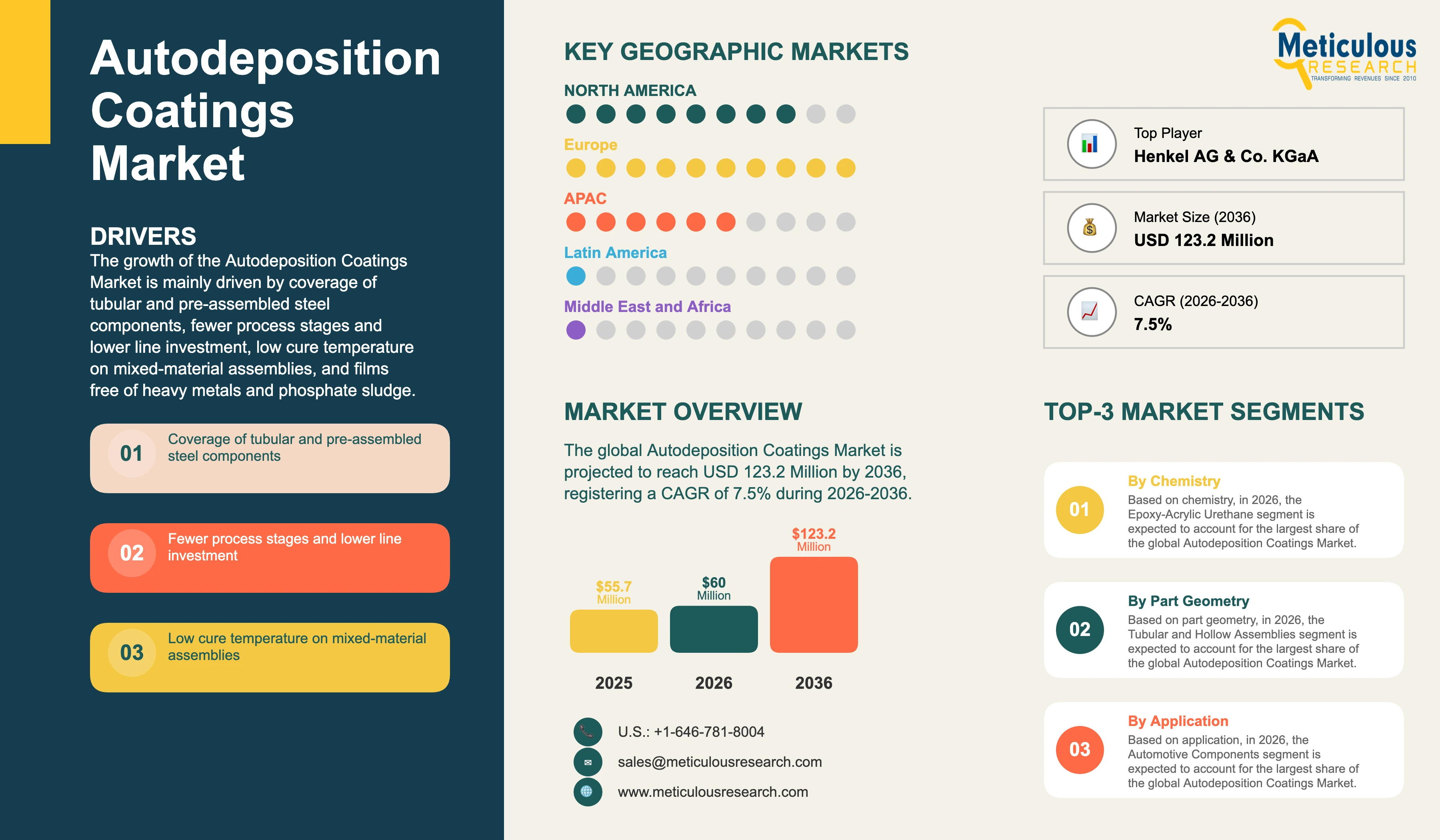
The autodeposition coatings market is valued at USD 60.0 million in 2026 and is projected to reach USD 123.2 million by 2036, at a CAGR of 7.5% during the forecast period. The market was valued at USD 55.7 million in 2025 and at USD 52.1 million in 2024.
- Published
- Nov 2026
- Pages
- 265
- Format
- PDF + Excel
- Report ID
- MRCHM - 1042796
- Base year
- 2025
- 2024 · HISTORICAL
- $52.1M
- 2036
- $123.2M
- CAGR 2026–2036
- 7.5%
2024–2025 baseline · 2026–2036 forecast at 7.5% CAGR · hover a bar for the value
Key highlights
This market measures autodeposition coating chemistry, namely the waterborne polymer emulsion, the acidified ferric fluoride starter, the oxidiser and the reaction seal rinse, taken at the chemistry supplier gate on a tonne basis as supplied.
Excluded are generic alkaline cleaners and acid pickles common to all finishing lines, process tanks, ovens, conveyors and material handling equipment, electrodeposition and powder coatings applied over an autodeposition primer, and the coating service fee charged by job coaters.
Deposition proceeds without electrical current, because the polymer emulsion is stable in ferric ions and unstable in ferrous ions, so acid release of ferrous ions from an iron-bearing surface destabilises the emulsion locally and the polymer deposits on the metal.
Ferric ions become trapped in the deposited film, which gives the uncured coating enough cohesive strength to survive the rinse stages before the oven.
Henkel AG & Co. KGaA documentation puts the polymer emulsion in the bath at about 4% to 8% solids by weight, with no heavy anticorrosive pigments, so the bath does not sediment and the acidity resists bacterial growth through weekends and shutdowns.
Deposition is self-limiting, with the rate slowing as the film builds, and film thickness is controlled by time, temperature, concentration and agitation rather than by applied voltage.
Dry film thickness runs 18 to 25 microns for both the polyvinylidene chloride 800 series and the epoxy-acrylic urethane 900 series.
The low-bake 800 series grade cures at 100 to 104 degrees Celsius, low enough to coat metal, rubber and plastic composite assemblies without damaging the elastomer.
Neutral salt spray testing recorded in the same documentation gives 3 millimetres of creep or less at 504 hours for both series, and less than 5% face rust at 1,008 hours.
Cyclic corrosion testing to SAE J2334 reaches 20 cycles at 3 millimetres of creep or less for the 800 series and 40 cycles for the 900 series, and humidity resistance reaches 1,000 hours with no face rust for the 900 series.
Thermal stability separates the two families, with the 800 series carrying a caution above about 90 degrees Celsius in life-cycle testing and the 900 series rated above 230 degrees Celsius.
Both series are applied to clean ferrous surfaces without a phosphate or chromate conversion stage and contain no chromium, strontium, zinc, manganese or nickel.
A commercial autodeposition line runs seven baths, namely four cleaning and rinsing stages, the coating bath and a two-stage post-rinse, against twelve or more stages for an equivalent electrocoat line, a reduction of about 40% in steps and floor space.
Investment cost for an autodeposition line is recorded at about 20% below an equivalent electrocoating line, with a co-cure bake of about 170 degrees Celsius against about 190 degrees Celsius for classic electrocoating.
The coating is in use at more than 130 locations in more than 20 countries, covering captive lines at component makers and independent job coaters.
Deposition occurs only on iron-bearing metal, so plastics, rubber and non-ferrous parts in an assembly remain uncoated, which allows pre-assembled units to be finished in one pass.
That same selectivity is the structural limit of the market, because the chemistry bonds only to iron and cannot coat aluminium, magnesium or their castings.
Automotive components are expected to hold the largest share of this market in 2026 at 41.0% and the standalone single-layer finish the largest coating role at 58.0%, while the co-cure primer position under powder coating grows fastest among roles at 9.0%.
Report summary
| Particulars | Details |
|---|---|
| Forecast Period | 2026-2036 |
| Base Year | 2025 |
| Actual Years | 2024-2025 |
| CAGR (Value) | 7.5% |
| Format | PDF, Excel & Cloud Portal · 265 pages |
| Market Size (Value) in 2024 | USD 52.1 million |
| Market Size (Value) in 2025 | USD 55.7 million |
| Market Size (Value) in 2026 | USD 60.0 million |
| Market Size (Value) in 2036 | USD 123.2 million |
| Volume in 2025 | 12.00 kilotons |
| Volume in 2026 | 12.60 kilotons |
| Volume in 2036 | 20.60 kilotons |
| Volume CAGR (2026-2036) | 5.0% |
| Average Selling Price, 2026 | USD 4,760 per tonne |
| Average Selling Price, 2036 | USD 5,980 per tonne |
| Units | Value in USD million; volume in kilotons of autodeposition chemistry as supplied; price in USD per tonne |
| Measurement Basis | Autodeposition coating chemistry, namely the waterborne polymer emulsion, the acidified ferric fluoride starter, the oxidiser and the reaction seal rinse, taken at the chemistry supplier gate on a tonne basis as supplied |
| Historical Value Growth | Value grew at 7.3% a year between 2024 and 2026 against volume growth of 4.7% a year and price growth of 2.5% a year; the forecast of 7.5% is effectively unchanged from that historical rate, which is consistent with a process whose adoption is set by line replacement cycles rather than by specification change |
| Chemistry Supply Note | Henkel AG & Co. KGaA holds the technology, marketed as BONDERITE M-PP and earlier as Aquence and as the autophoretic coating chemical series, and no competing supplier offers an equivalent bath, so the chemistry layer is a single source and competition sits one layer downstream among job coaters and captive lines |
| Deposition Mechanism | The polymer emulsion is stable in ferric ions and unstable in ferrous ions; acid release of ferrous ions from an iron-bearing surface destabilises the emulsion locally and the polymer deposits on the metal, with ferric ions trapped in the film giving it cohesive strength through the rinse stages; deposition is self-limiting and requires no electrical current |
| Substrate Limit Note | Deposition depends on ferrous ion release, so the chemistry bonds only to iron and cannot coat aluminium, magnesium or their castings; plastics, rubber and non-ferrous parts within an assembly remain uncoated, which is both the commercial advantage on mixed-material assemblies and the structural limit of the market |
| Film and Cure Basis | Dry film thickness runs 18 to 25 microns for both the polyvinylidene chloride 800 series and the epoxy-acrylic urethane 900 series; the low-bake 800 series grade cures at 100 to 104 degrees Celsius, the co-cure bake with powder runs at about 170 degrees Celsius against about 190 degrees Celsius for classic electrocoating, and the bath holds about 4% to 8% polymer solids by weight |
| Corrosion Performance Basis | Neutral salt spray gives 3 millimetres of creep or less at 504 hours for both series and less than 5% face rust at 1,008 hours; cyclic corrosion testing to SAE J2334 reaches 20 cycles at 3 millimetres of creep or less for the 800 series and 40 cycles for the 900 series; humidity resistance reaches 240 hours for the 800 series and 1,000 hours with no face rust for the 900 series |
| Thermal Limit Note | The 800 series carries a caution above about 90 degrees Celsius in life-cycle testing while the 900 series is rated above 230 degrees Celsius, so the low-bake advantage on elastomer-containing assemblies and the thermal duty required under-body cannot be obtained on the same part |
| Line Comparison Basis | A commercial autodeposition line runs seven baths, namely four cleaning and rinsing stages, the coating bath and a two-stage post-rinse, against twelve or more stages for an equivalent electrocoat line, a reduction of about 40% in steps and floor space, with investment cost about 20% lower and no anodes, rectifiers or electrical contact systems |
| Installed Base Note | The coating is in use at more than 130 locations in more than 20 countries after four decades of commercial availability, covering captive lines at component makers and independent job coaters |
| Substitution Note | Autodeposition removes the phosphate or chromate conversion stage entirely, so adoption displaces rather than overlaps the Chrome Free Conversion Coatings Market, Silane Pretreatment Chemicals Market and Zirconium Pretreatment Chemicals Market titles |
| Overlap Note | Electrodeposition primers are counted in the Electrophoretic Coatings Market title and powder topcoats applied over an autodeposition primer in the relevant powder coating titles, so those titles are non-additive with this one on the parts they share |
| Lightweighting Basis | European Aluminium recorded aluminium content in the average European car at 174 kilograms in 2019 and 205 kilograms in 2022, with 237 kilograms forecast for 2026 and 256 kilograms for 2030, and put a battery electric vehicle at 283 kilograms against 169 kilograms for a petrol or diesel car, with e-drive housings, battery pack housings, ballistic battery protection, cooling plates and mega-cast body structures named as the components gaining aluminium |
| Exclusions | Generic alkaline cleaners and acid pickles common to all finishing lines; process tanks, ovens, conveyors, cranes and material handling equipment; electrodeposition primers; powder and liquid topcoats applied over an autodeposition film; the coating service fee charged by job coaters; conversion coatings, phosphates, silanes and zirconium pretreatments |
| Segments: Chemistry | Epoxy-Acrylic Urethane; Polyvinylidene Chloride; Epoxy; Other Chemistries |
| Segments: Part Geometry | Tubular and Hollow Assemblies; Stamped and Formed Parts; Castings and Forgings; Wire Forms, Springs and Fasteners |
| Segments: Application | Automotive Components; Commercial Vehicle and Trailer; Agricultural and Construction Equipment; Fasteners, Springs and Small Hardware; Appliance and Electrical Enclosures; Other Applications |
| Segments: Coating Role | Standalone Single-Layer Finish; Primer Under Powder Coating by Co-Cure; Primer Under Liquid Topcoat |
| Largest Segment by Chemistry, 2026 | Epoxy-Acrylic Urethane, at 46.0% |
| Fastest-Growing Segment by Chemistry | Epoxy, at 11.4% |
| Slowest-Growing Segment by Chemistry | Polyvinylidene Chloride, at 4.6% |
| Largest Segment by Part Geometry, 2026 | Tubular and Hollow Assemblies, at 34.0% |
| Fastest-Growing Segment by Part Geometry | Tubular and Hollow Assemblies, at 8.4% |
| Largest Segment by Application, 2026 | Automotive Components, at 41.0% |
| Fastest-Growing Segment by Application | Fasteners, Springs and Small Hardware, at 10.0% |
| Slowest-Growing Segment by Application | Appliance and Electrical Enclosures, at 6.2% |
| Largest Segment by Coating Role, 2026 | Standalone Single-Layer Finish, at 58.0% |
| Fastest-Growing Segment by Coating Role | Primer Under Powder Coating by Co-Cure, at 9.0% |
| Largest Region, 2026 | Europe, at 38.0% |
| Fastest-Growing Region | Asia-Pacific, at 9.6% |
| Fastest-Growing Country | China, at 10.4% |
| Slowest-Growing Country | U.K., at 5.6% |
| Regions Covered | Europe; North America; Asia-Pacific; Latin America; Middle East & Africa |
| Countries Covered | Germany; France; Italy; U.K.; U.S.; Canada; Mexico; Brazil; China; Japan; India; South Korea |
| Key Companies | Henkel AG & Co. KGaA; Therma-Tron-X, Inc.; Latem Industries Limited; BBL Oberflächentechnik GmbH; Steelcote Inc.; EPSI Surface Technologies Group; Valley Design Enterprises |
| Company List Note | The list spans the single chemistry supplier, the principal independent applicators and the principal process line builder, because no participant other than the chemistry supplier holds a material position at the chemistry gate and the competitive field sits at the applicator layer |
| Top Five Applicator Share, 2026 | 31.5% |
| Profiled Companies Share, 2026 | 42.0% |
| Currency | USD |
Report overview
Market value is measured in in USD million; volume in kilotons of autodeposition chemistry as supplied; price in USD per tonne. Segments covered: chemistry, part geometry, application, coating role.
The growth of this market is mainly driven by uniform coverage of tubular and pre-assembled steel components that electrodeposition cannot reach, a seven-bath sequence against twelve or more stages for electrocoating, cure temperatures low enough to coat assemblies containing rubber and plastic, and films free of chromium, zinc, nickel, manganese and strontium. However, factors such as deposition chemistry that bonds only to iron, aluminium content in vehicles rising toward 256 kilograms a car by 2030, a single source of supply for the coating chemistry, and an installed base of just over 130 locations after four decades are expected to restrain the growth of this market to some extent.
An autodeposition bath holds a waterborne polymer emulsion at about 4% to 8% solids, an acidified ferric fluoride starter and an oxidiser that keeps dissolved iron in the ferric state. The emulsion is stable in ferric ions and unstable in ferrous ions, so when a clean steel part enters the bath the acid releases ferrous ions from the surface and the polymer destabilises and deposits exactly where the metal is. Nothing else in the tank drives the reaction.
That mechanism produces the one property this market sells. Electrodeposition relies on an electrical field, and a field does not reach into the inside of a tube, the bottom of a box section or the gap between two densely racked parts, which is the Faraday cage limit. Autodeposition coats every surface the bath wets, inside and out, at a thickness set by immersion time rather than by current density.
Film build is self-limiting, running 18 to 25 microns for both commercial families, because the deposited layer slows further ion diffusion to and from the surface. A thicker film on an outer face and a bare interior, the normal result of coating a complex steel weldment electrically, does not arise.
The process also removes a whole stage from the finishing line. Autodeposition is applied to clean ferrous surfaces without a phosphate or chromate conversion coating, so a commercial line runs seven baths against twelve or more for an equivalent electrocoat line, a reduction of about 40% in steps and floor space, with investment cost about 20% lower.
Chemistry composition carries the environmental case. Both the polyvinylidene chloride 800 series and the epoxy-acrylic urethane 900 series are waterborne with very low or no volatile organic compound content and contain no chromium, strontium, zinc, manganese or nickel, and the absence of heavy anticorrosive pigments means the bath does not sediment and generates no heavy-metal sludge.
Corrosion performance is adequate rather than exceptional for a 20-micron film. Neutral salt spray testing gives 3 millimetres of creep or less at 504 hours for both series and less than 5% face rust at 1,008 hours, with cyclic testing to SAE J2334 reaching 20 cycles for the 800 series and 40 cycles for the 900 series.
The two families divide the market by thermal duty. Curing at 100 to 104 degrees Celsius, the 800 series coats pre-assembled units containing rubber bushings, plastic clips or elastomer mountings without damaging them, but carries a caution above about 90 degrees Celsius in service, while the 900 series is rated above 230 degrees Celsius and serves as a primer under powder coatings and baking enamels.
Commercial reality narrows all of that to one substrate. The chemistry depends on ferrous ion release, so it bonds only to iron, and applicators state the position plainly: other metals in an assembly are left untouched. Aluminium, magnesium and their castings cannot be coated at all.
That matters because the complex structural parts entering vehicles are the ones changing metal. European Aluminium recorded aluminium content in the average European car at 205 kilograms in 2022 against 174 kilograms in 2019, with 237 kilograms forecast for 2026 and 256 kilograms for 2030, and put a battery electric vehicle at 283 kilograms against 169 kilograms for a petrol or diesel car.
The components named in that study as gaining aluminium are e-drive housings, battery pack housings, ballistic battery protection, cooling plates and body structures made as large and mega castings. Those are precisely the complex, cavity-rich parts that the autodeposition argument was built to win, and they are moving out of reach of the chemistry rather than into it.
What remains is the large and durable population of ferrous parts that are not being lightweighted. Seat frames, brackets, hinges, pedal assemblies, suspension links, brake components, fasteners, springs, wire forms, agricultural and construction equipment weldments, trailer frames and appliance chassis remain steel for cost, stiffness or wear reasons and will remain steel across the forecast period.
Supply of the chemistry comes from a single source. Henkel AG & Co. KGaA holds the technology, marketed as BONDERITE M-PP and earlier as Aquence and as the autophoretic coating chemical series, and no competing supplier offers an equivalent bath. Competition in this market therefore takes place one layer downstream, among the job coaters and captive lines that buy the chemistry and sell coated parts.
Installed capacity reflects four decades of slow adoption rather than a growth curve. The coating is in use at more than 130 locations in more than 20 countries, a count that includes single-line job shops alongside captive lines at component makers, against an electrocoat installed base measured in thousands of lines.
Individual installations are nonetheless substantial where the part geometry suits the process. Räckers at Ahaus in Germany coats complex tubular and pre-assembled commercial vehicle components up to 8 metres long and powder coats about 95% of them over the autodeposition primer, and BBL Oberflächentechnik GmbH at Roth handles steel parts up to 500 kilograms in a dip tank of 3,000 by 1,600 by 800 millimetres with no wastewater discharge through continuous bath maintenance.
Latem Industries Limited at Cambridge in Ontario runs a thirteen-stage rack line with three robotic cranes supporting both the 866 and 930 platforms, coats millions of parts a week across automotive seating components, brackets and hinges, heavy equipment, agricultural manufacturing, office furniture and architectural work, and sells the whole line capacity as a service.
Europe holds 38.0% of this market in 2026 because the commercial vehicle, agricultural equipment and tier component base that generates long tubular steel weldments is concentrated there and because the phosphate-free, heavy-metal-free position carries weight in European plant permitting. Asia-Pacific grows fastest at 9.6% from 24.5% on component manufacture for export and on new line installations rather than on conversions of existing electrocoat capacity.
Report infographic
Market dynamics
17 factors across 5 forcesCoverage of Tubular and Pre-Assembled Steel Components
An electrical field does not reach into the inside of a tube, the bottom of a box section or the gap between densely racked parts, so electrodeposition leaves those surfaces thin or bare, and that limit is what sends complex steel weldments to autodeposition.
Deposition without current coats every surface the bath wets at a thickness set by immersion time, with film build self-limiting at 18 to 25 microns, so an interior cavity receives the same coating as an outer face.
Räckers at Ahaus in Germany coats complex tubular and pre-assembled commercial vehicle components up to 8 metres long on that basis, and Latem Industries Limited reports coating millions of parts a week on a thirteen-stage rack line.
Fewer Process Stages and Lower Line Investment
Autodeposition is applied to clean ferrous surfaces without a phosphate or chromate conversion stage, which removes the chemical pretreatment section that an electrocoat line requires.
A commercial autodeposition line runs seven baths, namely four cleaning and rinsing stages, the coating bath and a two-stage post-rinse, against twelve or more stages for an equivalent electrocoat line, a reduction of about 40% in steps and floor space.
Investment cost is recorded at about 20% below an equivalent electrocoating line, with no anodes, rectifiers or electrical contact systems to install or maintain, and the co-cure bake runs at about 170 degrees Celsius against about 190 degrees Celsius for classic electrocoating.
Low Cure Temperature on Mixed-Material Assemblies
The polyvinylidene chloride 800 series cures at 100 to 104 degrees Celsius, far below the bake required by electrocoat or powder, which allows a unit already fitted with rubber bushings, plastic clips or elastomer mountings to be coated without damaging them.
Deposition occurs only on iron-bearing metal, so the plastic and rubber in that assembly remains uncoated and no masking is required, and the part leaves the line finished rather than returning for sub-assembly.
Coating a completed assembly rather than its individual components removes handling, racking and secondary assembly labour from the part cost, which is where the saving against a conventional route is realised rather than in the chemistry price.
Films Free of Heavy Metals and Phosphate Sludge
Both commercial families are waterborne with very low or no volatile organic compound content and contain no chromium, strontium, zinc, manganese or nickel, and the absence of heavy anticorrosive pigments means the bath does not sediment.
Removing the phosphate stage removes the zinc and nickel loading, the sludge handling and the associated wastewater treatment duty, and BBL Oberflächentechnik GmbH operates with no wastewater discharge through continuous bath maintenance.
Neither process requires air pollution control equipment, and the chemistry is neither flammable nor explosive, which lowers the permitting and insurance burden on a new line relative to a solvent-borne alternative.
Bath stability reinforces the operating case, since the absence of heavy anticorrosive pigments means nothing settles out and the acidity suppresses bacterial growth, so the tank survives weekends and plant shutdowns without agitation or biocide dosing and restarts without a reconditioning cycle.
Table of contents
12 chapters · 130 sections · 265 pages · click to expandSegmental analysis
| Segment | Largest share (2026) | Fastest growth (2026–2036) |
|---|---|---|
| By Chemistry | Epoxy-acrylic urethane | Epoxy grades |
| By Part Geometry | Tubular and hollow assemblies | Tubular and hollow assemblies |
| By Application | Automotive components | Fasteners, springs and small hardware |
| By Coating Role | Standalone single-layer finish | Primer under powder coating by co-cure |
By Chemistry
- Autodeposition Coatings Analysis by Chemistry
- This market is segmented into epoxy-acrylic urethane, polyvinylidene chloride, epoxy, and other chemistries.
- Epoxy-acrylic urethane is expected to account for the largest share of this market in 2026.
- The family is rated above 230 degrees Celsius, reaches 40 cycles of cyclic corrosion testing to SAE J2334 at 3 millimetres of creep or less and 1,000 hours of humidity resistance with no face rust, and serves both as a standalone finish and as a primer under powder coatings and baking enamels, which gives it the widest qualified position of the commercial grades.
- Polyvinylidene chloride holds the second position and is the slowest-growing chemistry in this market.
- The low-bake grade cures at 100 to 104 degrees Celsius and is the only route to coating a pre-assembled unit containing rubber or plastic, but it carries a caution above about 90 degrees Celsius in life-cycle testing and chlorinated polymer content attracts scrutiny in material declarations, so it is specified where the assembly demands it rather than preferred.
- Epoxy grades are projected to register the highest CAGR among chemistries during the forecast period.
- Newer epoxy autodepositing systems carry the thermal and cyclic corrosion position of the acrylic urethane family without the chlorinated content of the legacy chemistry, and they are the default on specifications written since the thermal and declaration constraints became explicit.
- Other chemistries cover modified and hybrid emulsions developed for specific abrasion, flexibility or topcoat adhesion requirements, and grow slightly above the market rate from the smallest base.
By Part Geometry
- Autodeposition Coatings Analysis by Part Geometry
- This market is segmented into tubular and hollow assemblies, stamped and formed parts, castings and forgings, and wire forms, springs and fasteners.
- Tubular and hollow assemblies are expected to hold the largest share of this market in 2026 and are also projected to register the highest CAGR during the forecast period.
- An electrical field does not reach the inside of a tube or the bottom of a box section, so the whole premium for current-free deposition is collected on this geometry, and installations such as the commercial vehicle weldments up to 8 metres long coated at Ahaus exist for no other reason.
- Stamped and formed parts hold the second position and are the slowest-growing geometry class.
- A flat or shallow-formed panel is coated adequately by electrodeposition or powder, so the choice turns on line economics rather than on coverage, and the work is held where an existing autodeposition line has spare capacity.
- Castings and forgings grow close to the market rate, with raw ferrous castings taking the coating directly without a conversion stage, and the self-limiting film following the as-cast surface without the thickness variation that a sprayed or electrically deposited coating shows on a rough profile.
- Wire forms, springs and fasteners grow modestly above the market rate, coated in bulk at high rack density where the field is most obstructed, and the absence of electrical contact points removes the uncoated witness marks that racking for electrocoat leaves on a small part.
By Application
- Autodeposition Coatings Analysis by Application
- This market is segmented into automotive components, commercial vehicle and trailer, agricultural and construction equipment, fasteners, springs and small hardware, appliance and electrical enclosures, and other applications.
- Automotive components are expected to account for the largest share of this market in 2026.
- Seat frames, brackets, hinges, pedal assemblies, suspension links and brake components remain steel for cost, stiffness or wear reasons, are geometrically awkward, and frequently arrive at the finishing line already fitted with rubber or plastic, which is the combination the process was built for.
- Automotive components nonetheless grow below the market rate, because the structural parts gaining content in a vehicle are the aluminium e-drive housings, battery pack housings, ballistic battery protection, cooling plates and mega castings identified by European Aluminium, and the chemistry bonds only to iron.
- Commercial vehicle and trailer work holds the second position and grows above the market rate, built on long tubular steel weldments, chassis and frame components that remain ferrous for load and cost reasons and that are almost always powder coated over the autodeposition primer.
- Fasteners, springs and small hardware are projected to register the highest CAGR among applications during the forecast period, on bulk coating at high rack density, a self-limiting film that does not fill threads, and the absence of contact marks on small parts.
- Agricultural and construction equipment grows above the market rate on heavy steel weldments where cavity corrosion determines service life, while appliance and electrical enclosures grow slowest, competing against pre-coated steel coil and powder coating on flat panels where coverage is not the constraint.
By Coating Role
- Autodeposition Coatings Analysis by Coating Role
- This market is segmented into standalone single-layer finish, primer under powder coating by co-cure, and primer under liquid topcoat.
- Standalone single-layer finish is expected to hold the largest share of this market in 2026 and is also the slowest-growing role.
- A single 18 to 25 micron film giving 3 millimetres of creep or less at 504 hours of neutral salt spray is sufficient for under-body, structural, interior and hidden positions, which is where most autodeposited parts sit, but the film arrives in the colour of the polymer emulsion and cannot deliver Class A appearance.
- Primer under powder coating by co-cure is projected to register the highest CAGR among coating roles during the forecast period.
- Curing both films together in one oven at about 170 degrees Celsius removes a separate primer bake, and the pairing gives bath-process cavity coverage with the appearance and film build of powder, which is the specification commercial vehicle, agricultural equipment and furniture work requires.
- Primer under liquid topcoat holds the smallest share and grows close to the market rate, retained where a baking enamel or a specific colour and gloss is specified and where the topcoat line already exists.
Geographic analysis
Europe
Largest shareEurope is expected to account for the largest share of this market in 2026. The commercial vehicle, agricultural equipment and tier component base that generates long tubular steel weldments is concentrated in the region, and the phosphate-free, heavy-metal-free position carries weight in plant permitting, which is why the most substantial single installations sit there. Germany holds the largest country position by a wide margin, with the commercial vehicle component line at Ahaus handling parts up to 8 metres long and the job coat line at Roth taking steel parts up to 500 kilograms in a dip tank of 3,000 by 1,600 by 800 millimetres with no wastewater discharge. France and Italy follow on automotive and appliance component work, and the U.K. is the slowest-growing country in this market.
North America
North America holds the second regional position and grows below the market rate. The U.S. carries the larger part of the installed base on automotive, agricultural equipment and hardware component work, and Canada holds a disproportionate position for its size through the rack line at Cambridge in Ontario that sells its whole capacity as a service.
Asia-Pacific
Fastest growthAsia-Pacific is projected to register the highest CAGR among regions during the forecast period, with China the fastest-growing country in this market. A plant installing finishing capacity for the first time compares autodeposition against electrocoat on capital cost and footprint rather than against a written-down asset, and steel content remains high in the agricultural equipment, two-wheeler, trailer, appliance and hardware manufacture concentrated in the region. India grows ahead of the regional average on agricultural equipment, two-wheeler and fastener manufacture, while Japan and South Korea hold smaller and slower positions, where an extensive and well-run electrocoat installed base leaves little new capacity to be specified.
Latin America
Latin America grows close to the market rate, with Mexico the larger of the two covered countries on automotive and commercial vehicle component manufacture for the North American market and Brazil on agricultural equipment, while the Middle East & Africa holds the smallest regional share and grows slowest on a thin component manufacturing base.
Competitive landscape
Supply of autodeposition chemistry comes from a single source. Henkel AG & Co. KGaA holds the technology, marketed as BONDERITE M-PP and earlier as Aquence and as the autophoretic coating chemical series, and no competing supplier offers an equivalent bath, so the chemistry layer of this market is not a competitive field at all.
Competition takes place one layer downstream, among the independent job coaters and captive lines that buy the chemistry and sell coated parts, and the companies listed for this market therefore span the chemistry supplier, the principal applicators and the process line builders, because no other participant holds a material position at the chemistry gate.
The top five applicator groups account for a combined 31.5% of coated parts value in 2026 and the companies profiled in this report account for 42.0%, a fragmented structure in which most participants operate a single line at a single site and compete within a freight radius rather than internationally.
Competitive activity among applicators turns on part size envelope, rack and crane capability, whether both the low-bake and the high-temperature platforms are supported, and whether a powder line sits downstream for co-cure, since a customer sending an 8-metre weldment or a 500-kilogram fabrication has very few places to send it. Price competition is correspondingly weak at the top of the size range and strong on small and medium parts that many sites can take.
Process line builders hold the third position in the supply structure, because converting a plant requires a tank train, conveyor, crane set and oven designed around a self-limiting bath rather than around a rectifier, and Therma-Tron-X, Inc. builds autodeposition into turnkey finishing systems from Sturgeon Bay in Wisconsin with sales and manufacturing coverage extending into Mexico.
Captive lines at component makers sit outside the merchant competition entirely, since a line sized to one product family at a single customer neither bids for work nor releases capacity, and those installations account for a substantial part of the chemistry consumed while contributing nothing to the coated parts market that the applicators compete in.
Some of the key players operating in the autodeposition coatings market are Henkel AG & Co. KGaA, Therma-Tron-X, Inc., Latem Industries Limited, BBL Oberflächentechnik GmbH, Steelcote Inc., EPSI Surface Technologies Group, and Valley Design Enterprises, among others.
- Henkel AG & Co. KGaA
- Therma-Tron-X, Inc.
- Latem Industries Limited
- BBL Oberflächentechnik GmbH
- Steelcote Inc.
- EPSI Surface Technologies Group
- Valley Design Enterprises
Expert perspectives
The named demand driver for this title is complex metal part corrosion protection, and it is one of the few drivers in this batch that is technically correct without qualification. An electrical field cannot reach the inside of a tube or the bottom of a box section, autodeposition coats every surface the bath wets at a self-limiting 18 to 25 microns, and no competing process does the same thing at the same cost.
The line economics support it as well. Seven baths against twelve or more for an equivalent electrocoat line, about 40% less floor space, about 20% less capital, a co-cure bake at about 170 degrees Celsius against about 190, no anodes or rectifiers, and no phosphate stage with its zinc, nickel and sludge.
Four decades of that argument have produced just over 130 locations in more than 20 countries. The constraint has never been the technical case but the fact that adopting the process means replacing a line rather than changing a product, which places the decision with capital committees and makes a depreciated electrocoat line the cheapest option available to most plants.
The chemistry itself now sets a harder limit. Deposition depends on ferrous ion release, so it bonds only to iron, and European Aluminium put aluminium content in the average European car at 205 kilograms in 2022 rising to 237 kilograms in 2026 and 256 kilograms by 2030, with a battery electric vehicle at 283 kilograms against 169 kilograms for a petrol or diesel car.
The parts named in that study as gaining aluminium, namely e-drive housings, battery pack housings, ballistic battery protection, cooling plates and mega-cast body structures, are the cavity-rich complex geometries this process exists to serve. The best new addressable parts in a vehicle are changing metal, which is why automotive components grow below the market rate despite holding the largest share.
What is left is durable rather than expanding, and the defensible positions follow from it: the co-cure primer role under powder coating at 9.0%, small hardware and fasteners at 10.0%, tubular geometry at 8.4%, new line installations in Asia-Pacific at 9.6%, and the epoxy chemistries replacing the chlorinated legacy grade at 11.4%. A single-source chemistry at a 7.5% market rate is a stable niche, not a growth market.
Customer perspectives
A tier component maker sending complex steel weldments out for coating compares the delivered cost of a coated part against an in-house electrocoat line, and the comparison turns on racking, handling and secondary assembly labour rather than on the price of the chemistry.
That buyer values the ability to coat an assembly already fitted with rubber or plastic in one pass, because it removes a disassembly and reassembly step from the part route.
A plant engineer evaluating new finishing capacity compares about 20% lower capital and about 40% less floor space against committing to a chemistry with no second source for the life of the asset.
Procurement organisations that require dual sourcing on a production consumable cannot clear that single-source condition, which keeps the process out of specification at some tier suppliers regardless of the technical case.
An environmental or permitting function reads the same decision differently, because removing the phosphate stage removes zinc and nickel loading, sludge handling and the associated wastewater treatment duty.
A commercial vehicle or agricultural equipment buyer specifies cavity corrosion performance over a service life measured in decades, and accepts that appearance will be carried by a powder topcoat applied over the autodeposition film.
A fastener or spring maker buys bulk throughput at high rack density and a film that does not fill threads or leave contact witness marks, which is a dimensional requirement rather than a corrosion one.
An appliance maker with flat panel work has no coverage problem to solve and compares the process against pre-coated coil and powder coating on cost alone.
Any buyer whose parts are moving from steel to aluminium removes them from the process entirely rather than negotiating, since the chemistry will not deposit on the new substrate.
The choice of applicator is constrained by physical envelope more than by price, because a customer sending an 8-metre weldment or a 500-kilogram fabrication has very few sites capable of handling it.
Across every buyer the purchase is of a coated part rather than of a coating, so the chemistry supplier holds a specification position with the plant and a commercial relationship with the applicator rather than with the part owner.
Frequently asked questions
The market is valued at USD 60.0 million in 2026 and is projected to reach USD 123.2 million by 2036, at a CAGR of 7.5%. It was valued at USD 55.7 million in 2025 and USD 52.1 million in 2024.
It measures autodeposition coating chemistry, namely the waterborne polymer emulsion, the acidified ferric fluoride starter, the oxidiser and the reaction seal rinse, at the chemistry supplier gate on a tonne basis as supplied. Excluded are generic cleaners and pickles, tanks, ovens and material handling equipment, electrodeposition primers, powder and liquid topcoats applied over the film, job coater service fees, and conversion coatings and pretreatments.
It holds technically without qualification. An electrical field does not reach the inside of a tube or the bottom of a box section, while autodeposition coats every surface the bath wets at a self-limiting 18 to 25 microns; the driver fails only on the substrate, because the chemistry bonds exclusively to iron.
The polymer emulsion is stable in ferric ions and unstable in ferrous ions. Acid in the bath releases ferrous ions from an iron-bearing surface, which destabilises the emulsion locally so the polymer deposits on the metal, and deposition is self-limiting.
A commercial autodeposition line runs seven baths against twelve or more stages for an equivalent electrocoat line, a reduction of about 40% in steps and floor space. Investment cost is about 20% lower, there are no anodes, rectifiers or electrical contacts, and the co-cure bake runs at about 170 degrees Celsius against about 190 degrees Celsius for classic electrocoating.
Neutral salt spray testing gives 3 millimetres of creep or less at 504 hours for both commercial series and less than 5% face rust at 1,008 hours. Cyclic corrosion testing to SAE J2334 reaches 20 cycles for the 800 series and 40 cycles for the 900 series, with humidity resistance of 240 hours and 1,000 hours respectively.
Only iron-bearing metals. Aluminium, magnesium and their castings cannot be coated, and plastics, rubber and non-ferrous parts within an assembly remain uncoated, which is both the commercial advantage on mixed-material assemblies and the structural limit of the market.
Seat frames, brackets, hinges, pedal assemblies, suspension links and brake components remain steel and are geometrically awkward, which holds the largest share at 41.0%. However, e-drive housings, battery pack housings, cooling plates and mega-cast body structures are gaining aluminium, so the best new addressable parts are leaving the process.
Adopting the process replaces a line rather than a product in a drum, so the decision sits with plant engineering and capital committees on a multi-year cycle. A depreciated electrocoat line carries no capital charge, so the 20% investment advantage applies only to new capacity or end-of-life lines, leaving the installed base at just over 130 locations after four decades.
It is a single source. Henkel AG & Co. KGaA holds the technology, marketed as BONDERITE M-PP and earlier as Aquence and as the autophoretic coating chemical series, and no competing supplier offers an equivalent bath.
Epoxy grades grow fastest at 11.4% from a 17.0% share, without the chlorinated content of the legacy chemistry. Polyvinylidene chloride grows slowest at 4.6% from 31.0%, because chlorinated polymer content attracts scrutiny and the grade carries a caution above about 90 degrees Celsius.
Tubular and hollow assemblies, which hold the largest geometry share at 34.0% in 2026 and also grow fastest at 8.4%. Stamped and formed parts grow slowest at 6.4% because a flat stamping is coated adequately by any process.
Curing the autodeposition film together with a powder topcoat in one oven at about 170 degrees Celsius removes a separate primer bake, and the pairing gives bath-process cavity coverage with the appearance and film build of powder. The role grows at 9.0% against 6.7% for the standalone finish.
Europe holds the largest share in 2026 at 38.0%, with Germany the largest country. Asia-Pacific grows fastest at 9.6% and China is the fastest-growing country at 10.4%, because a plant installing capacity for the first time compares capital cost rather than a written-down asset.
Key players include Henkel AG & Co. KGaA, Therma-Tron-X, Inc., Latem Industries Limited, BBL Oberflächentechnik GmbH, Steelcote Inc., EPSI Surface Technologies Group, and Valley Design Enterprises, among others. The top five applicator groups hold 31.5% of coated parts value in 2026 and the profiled companies 42.0%.
The chemistry bonds only to iron while aluminium content in vehicles keeps rising, supply of the chemistry comes from one source, and adoption requires replacing a line rather than changing a product. The low-bake grade also cannot be used above about 90 degrees Celsius in service.
Cite this report
Meticulous Research. (2026). Autodeposition Coatings Market - Global Opportunity Analysis and Industry Forecast (2026-2036) (Report No. MRCHM - 1042796). Meticulous Market Research Pvt. Ltd. https://www.meticulousresearch.com/product/autodeposition-coatings-market-7479