Parylene Coatings Market (2026-2036)
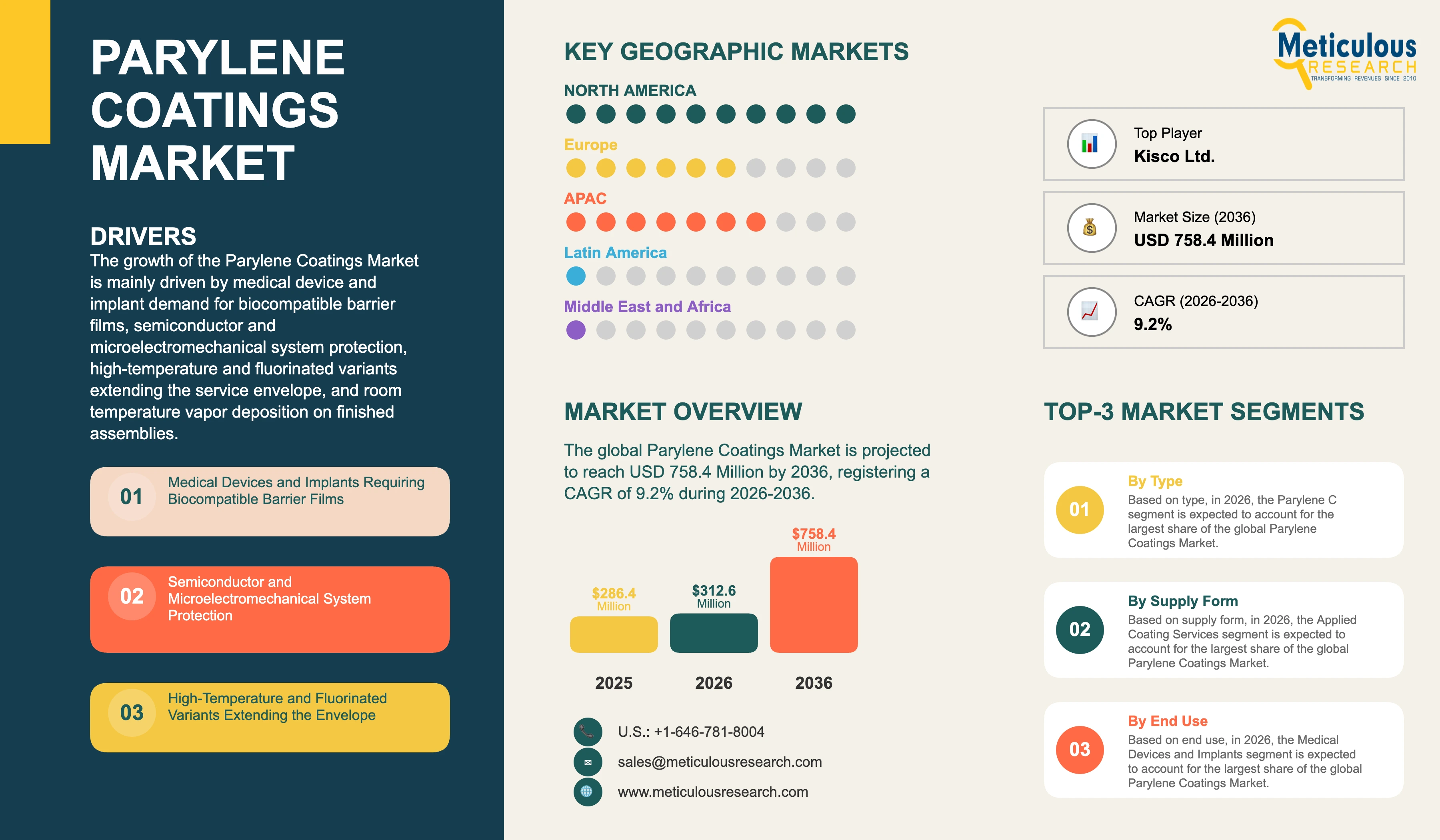
The global Parylene Coatings Market was valued at USD 286.4 million in 2025. This market is expected to reach USD 758.4 million by 2036 from an estimated USD 312.6 million in 2026, registering a CAGR of 9.2% during the forecast period (2026-2036).
- Published
- Nov 2026
- Pages
- 270
- Format
- PDF + Excel
- Report ID
- MRCHM - 1042785
- Base year
- 2025
- 2025 · BASELINE
- $286.4M
- 2036
- $758.4M
- CAGR 2026–2036
- 9.2%
2025 baseline · 2026–2036 forecast at 9.2% CAGR · hover a bar for the value
Key highlights
The global Parylene Coatings Market is projected to reach USD 758.4 million by 2036, driven by medical device and implant demand, semiconductor and microelectromechanical system protection, high-temperature and fluorinated variants, and room temperature vapor deposition.
North America is expected to account for the largest market share in 2026 and is also projected to register the fastest growth during the forecast period, supported by the concentration of medical device, aerospace and defense manufacture in the region together with the largest installed base of coating chambers and the qualification records that regulated work requires.
By type, Parylene C are expected to account for the largest market share, whereas Parylene HT and Fluorinated Variants are projected to witness the fastest growth through 2036.
By supply form, Applied Coating Services are expected to account for the largest market share, whereas Applied Coating Services are projected to witness the fastest growth through 2036.
By coating thickness, the 5 to 20 Micrometers band are expected to account for the largest market share, whereas the Below 5 Micrometers band are projected to witness the fastest growth through 2036.
Deposition follows a vapor process in which dimer is vaporized at about 150 degrees Celsius, pyrolyzed above 650 degrees into monomer, and polymerized onto parts in a chamber held at about 0.1 torr at room temperature.
Substrate temperature rises only a few degrees above ambient and the process runs between about 20 degrees and a maximum of 60 degrees Celsius, which is why temperature-sensitive assemblies can be coated at all.
The process is not line of sight, so monomer reaches every surface of a part, and one source records parylene penetrating a 0.002 inch wire-to-board gap.
Adhesion requires preparation rather than being inherent, with dilute organic silane treatments applied before coating and vapor-phase silane application also used.
Variants have widened the family beyond the original four, with a halogen-free type retaining the barrier performance of parylene C, a fluorescing type allowing coating verification under blacklight, and an antimicrobial type reporting more than a 5 log reduction against 14 common microorganisms.
Biocompatibility certification is held for types C and N, and coating services are qualified to the conformal coating specification IPC-CC-830 and to United States Pharmacopeia Class VI for both dimer and coating.
Dimer purity is stated at 99.6% by one provider, and the family descends from a small number of original process licenses, with one coating business having bought its license in 1968.
Consolidation has continued in that small field, with the acquisition of a Swiss parylene business announced on 18 November 2021 making it the twenty-first coating facility and fifth in Europe of the acquiring group.
Report summary
| Particulars | Details |
|---|---|
| Forecast Period | 2026-2036 |
| Base Year | 2025 |
| Estimated Year | 2026 |
| CAGR (Value) | 9.2% |
| Format | PDF, Excel & Cloud Portal · 270 pages |
| CAGR (Volume) | 7.5% |
| Market Size (Value) in 2026 | USD 312.6 million |
| Market Size (Value) in 2036 | USD 758.4 million |
| Market Size (Volume) in 2026 | 232.0 tons of dimer consumed |
| Market Size (Volume) in 2036 | 480.0 tons |
| Average Selling Price, 2026 | USD 1,350 per kilogram |
| Average Selling Price, 2036 | USD 1,580 per kilogram |
| Segments Covered | By Type: Parylene C, Parylene N, Parylene HT and Fluorinated Variants, Parylene D, Other Variants. By Supply Form: Applied Coating Services, Dimer Supplied for In-House Coating. By Coating Thickness: Below 5 Micrometers, 5 to 20 Micrometers, Above 20 Micrometers. By End Use: Medical Devices and Implants, Electronics and Printed Circuit Assemblies, Aerospace and Defense, Automotive and Transport, Semiconductor and Microelectromechanical Systems, Other End Uses. |
| Countries Covered | U.S.; Canada; China; Japan; South Korea; India; Germany; Switzerland; France; U.K.; Brazil; Mexico |
| Key Companies | Kisco Ltd., Curtiss-Wright Corporation, HZO, Inc., Para-Coat Technologies, Inc., Diamond-MT, Inc., and Plasma Ruggedized Solutions, Inc. |
Report overview
Segments covered: type, supply form, coating thickness, end use.
In volume terms, the market is estimated at 232.0 tons of dimer consumed in 2026 and is expected to reach 480.0 tons by 2036, registering a CAGR of 7.5% during the forecast period. The average selling price is estimated at USD 1,350 per kilogram in 2026 and USD 1,580 per kilogram in 2036.
The growth of this market is mainly driven by medical device and implant demand for biocompatible pinhole-free barrier films, semiconductor and microelectromechanical system protection, high-temperature and fluorinated variants extending the service envelope, and a vapor deposition process that coats assemblies at room temperature without a liquid phase. However, factors such as a batch vacuum process with chamber volumes of 6 liters to 300 liters, deposition at roughly 1 to 5 microns per hour, masking and adhesion promotion required on almost every part, and coatings that cannot be reworked or repaired once applied are expected to restrain the growth of this market to some extent.
Among coating thicknesss, the 5 to 20 Micrometers band are expected to account for the largest market share in 2026, while the Below 5 Micrometers band are projected to register the highest CAGR during the forecast period. Geographically, North America is expected to account for the largest share of this market in 2026 and is also expected to register the highest CAGR during the forecast period.
The Parylene Coatings Market comprises parylene reaching a part, covering applied coating services and dimer sold for in-house coating, taken at the supplier gate with volume expressed as dimer consumed. The market includes parylene C, parylene N, parylene HT and fluorinated variants, parylene D and other variants, supplied as applied coating services or as dimer, in films below 5 micrometers, 5 to 20 micrometers and above 20 micrometers, serving medical devices and implants, electronics and printed circuit assemblies, aerospace and defense, automotive and transport, and semiconductor and microelectromechanical systems. Coating systems, vacuum chambers and pyrolysis furnaces, masking materials and fixtures, other conformal coating chemistries such as acrylic, silicone and urethane, and atomic layer deposition coatings fall outside the scope.
The deposition route explains both the performance and the cost structure of this market. Dimer is vaporized at about 150 degrees Celsius, pyrolyzed above 650 degrees into monomer and polymerized onto parts in a chamber held at about 0.1 torr at room temperature. The substrate temperature rises only a few degrees above ambient, with the process running between about 20 degrees and a maximum of 60 degrees Celsius, which is the reason temperature-sensitive assemblies, released microstructures and populated boards can be coated at all.
Because the monomer arrives as a gas rather than as a liquid film, the process is not line of sight and reaches every surface of a part, including internal cavities and connector gaps. One source records parylene penetrating a 0.002 inch wire-to-board gap. That conformality is the property that liquid conformal coatings cannot match, since a sprayed or dipped coating bridges fine features, pools at edges and loads released structures.
Adhesion is not inherent to the film and must be created. Dilute organic silane treatments are applied before coating, with vapor-phase silane application also used, and masking is required on almost every part to keep the coating off connectors, sealing faces and electrical contacts. Because a cured parylene film cannot be reworked or repaired, the masking and preparation step carries the quality risk for the whole job, and the qualification attaches to the specific part rather than to the coating alone.
The family has widened beyond the four original types. A halogen-free type retains the barrier performance of parylene C, a fluorescing type allows coating verification under blacklight, and an antimicrobial type reports more than a 5 log reduction against 14 common microorganisms. Parylene HT and fluorinated variants, which extend the thermal and ultraviolet envelope of the base types, are projected to register the fastest growth in this market at 13.8%, while parylene C holds the largest share at 54.0% in 2026.
Qualification rather than material price governs purchasing. Biocompatibility certification is held for types C and N, and coating services are qualified to the conformal coating specification IPC-CC-830 and to United States Pharmacopeia Class VI for both dimer and coating. Dimer purity is stated at 99.6% by one provider. A medical device or flight hardware customer is buying a qualified process on a named part, which makes switching coating suppliers a requalification exercise rather than a procurement decision.
The economics are set by chamber time rather than by material. Deposition runs at roughly 1 to 5 microns per hour in batch chambers with standard volumes of 6 liters to 300 liters, so throughput is a function of fixture density and film thickness, and the applied coating service carries the value. Applied Coating Services accordingly account for 82.0% of this market in 2026, and the average realization of USD 1,350 per kilogram of dimer in 2026 reflects the service rather than the material price alone. The field remains small and is consolidating, with the acquisition of a Swiss parylene business announced on 18 November 2021 bringing the acquiring group to twenty-one coating facilities and five in Europe.
Multilayer constructions that alternate parylene with inorganic layers deposited by atomic layer deposition achieve barrier performance that neither layer reaches alone, with the parylene providing crack tolerance and conformality and the inorganic layer providing permeation resistance. This positions the family alongside rather than against atomic layer deposition and opens applications in flexible electronics, displays and long-duration implants where permeation requirements exceed what a polymer film can deliver.
Films below 5 micrometers are projected to be the fastest-growing thickness band in this market at 10.8%, against 52.0% of 2026 volume in the 5 to 20 micrometer band. Thinner films consume less dimer and less chamber time per part, which improves throughput against a batch process limited to roughly 1 to 5 microns per hour. Coaters that can hold uniformity and pinhole freedom at reduced thickness improve capacity utilization without capital addition.
North America is expected to account for the largest share of this market in 2026 at 42.0%, supported by the concentration of medical device, aerospace and defense manufacture in the region and by the largest installed base of qualified coating chambers.
Europe accounts for 24.0% of this market in 2026 and is projected to grow at 8.2%. Germany and Switzerland carry the concentration of medical device and precision instrument manufacture that specifies parylene, with France and the United Kingdom adding aerospace and defense work. The regional coating field is small and has consolidated, with the acquisition of a Swiss parylene business announced on 18 November 2021 making it the twenty-first coating facility and fifth in Europe of the acquiring group.
The Middle East & Africa region holds 2.5% of this market in 2026 with projected growth of 10.4%, concentrated in aerospace and defense electronics and in medical device service with little local coating capacity. Latin America holds 2.5% with projected growth of 8.8%, with Brazil and Mexico accounting for regional volume across medical device and electronics contract manufacture, and a share of the work still sent to providers in North America.
Some of the key players operating in the parylene coatings market are Kisco Ltd., Curtiss-Wright Corporation, HZO, Inc., Para-Coat Technologies, Inc., Diamond-MT, Inc., and Plasma Ruggedized Solutions, Inc., among others.
Key strategies include adding coating facilities through acquisition and greenfield installation near customer clusters, extending variant portfolios into high-temperature, fluorinated, halogen-free, fluorescing and antimicrobial grades, holding the biocompatibility and conformal coating qualifications that regulated customers require, developing thin-film capability below 5 micrometers to recover chamber time, and combining dimer supply with equipment and technical support for customers coating in house.
Report infographic
Market dynamics
17 factors across 4 forcesMedical Devices and Implants Requiring Biocompatible Barrier Films
A stent, a neural electrode, a catheter or an implanted sensor needs a continuous barrier of a few micrometers that does not stiffen the device, does not load fine features and is tolerated in tissue. Parylene meets that combination because it deposits from the vapor phase at room temperature, reaches every surface of the part and holds biocompatibility certification for types C and N, with coating and dimer qualified to United States Pharmacopeia Class VI. Medical Devices and Implants hold the largest end use share of this market in 2026 at 38.0% and are projected to grow at 10.0%. The qualification attaches to the finished device, so once a coating process is written into a device master record the volume stays with the coater for the life of the product, which makes this the most defensible demand in the market.
Semiconductor and Microelectromechanical System Protection
Released microstructures, sensor dies and wafer-level packages cannot tolerate a liquid conformal coating, which would bridge features by capillary action and load moving elements. A vapor process that polymerizes at about 0.1 torr and raises the substrate only a few degrees above ambient coats these parts without mechanical loading, and the absence of line of sight allows coverage under overhangs and inside cavities. Semiconductor and Microelectromechanical Systems are projected to be the fastest-growing end use in this market at 12.6%. Growth tracks the spread of sensors into automotive, medical and industrial products, where the die is exposed to media rather than hermetically packaged and a thin conformal barrier is the only practical protection.
High-Temperature and Fluorinated Variants Extending the Envelope
The base types are limited in continuous service temperature and in ultraviolet stability, which excludes them from engine bay, downhole and outdoor applications. Parylene HT and fluorinated variants raise both limits while retaining the conformality and the room temperature deposition of the family, and they also deposit into narrower gaps than the base types. Parylene HT and Fluorinated Variants are projected to register the highest type CAGR in this market at 13.8% from a small base, against 8.2% for parylene C and 7.0% for parylene D. The variants are taking applications that previously went to other chemistries rather than substituting within the family, which is why their growth exceeds the market as a whole.
Assemblies That Cannot Be Sprayed or Dipped
Populated boards with fine-pitch components, connectors with internal contacts, wound components and parts with blind cavities present geometries that a liquid coating cannot cover evenly. The vapor process reaches every surface, and one source records parylene penetrating a 0.002 inch wire-to-board gap, a dimension no sprayed coating will enter. Electronics and Printed Circuit Assemblies therefore specify parylene where acrylic, silicone and urethane coatings have failed qualification on coverage rather than on material performance. The driver is geometric rather than chemical, and it strengthens as component pitch falls and as assemblies are asked to survive condensation and salt exposure.
Room Temperature Deposition on Temperature-Sensitive Assemblies
The process runs between about 20 degrees and a maximum of 60 degrees Celsius, with the substrate rising only a few degrees above ambient, so batteries, adhesives, elastomeric seals, magnets and preloaded mechanisms survive coating. No thermal cure step is required and no solvent is present, which removes both the thermal budget and the solvent compatibility question from the specification. That makes parylene the available option for finished assemblies rather than bare components, and it is the reason coating is performed late in the build sequence on complete devices. Coating a finished assembly also removes the handling damage that pre-coating and subsequent assembly introduce.
Table of contents
12 chapters · 130 sections · 270 pages · click to expandSegmental analysis
| Segment | Largest share (2026) | Fastest growth (2026–2036) |
|---|---|---|
| By Type | Parylene C | Parylene HT and Fluorinated Variants |
| By Supply Form | Applied Coating Services | Applied Coating Services |
| By Coating Thickness | 5 to 20 Micrometers band | Below 5 Micrometers band |
| By End use | Medical Devices and Implants | Semiconductor and Microelectromechanical Systems |
| Other segments | Applied Coating Services | Applied Coating Services |
By Type
- Parylene Coatings Market Analysis by Type
- Parylene C are expected to account for the largest share of the global Parylene Coatings Market.
- The large share of this segment is mainly due to the balance it holds between barrier performance, deposition rate and cost, together with its biocompatibility certification and the qualification records already written against it in medical device and electronics specifications.
- However, Parylene HT and Fluorinated Variants are projected to register the highest CAGR during the forecast period.
- The rapid growth of this segment is attributed to the extension of the thermal and ultraviolet envelope beyond the limits of the base types, which opens engine bay, downhole and outdoor applications that the family could not previously serve, and the ability of these grades to deposit into narrower gaps.
- Parylene C are expected to account for the largest market share in 2026.
- Parylene HT and Fluorinated Variants are projected to register the highest CAGR during the forecast period, owing to the extension of the thermal and ultraviolet envelope beyond the limits of the base types, which opens engine bay, downhole and outdoor applications that the family could not previously serve, and the ability of these grades to deposit into narrower gaps.
- The 5 to 20 Micrometers band are expected to account for the largest market share in 2026.
- Semiconductor and Microelectromechanical Systems are projected to register the highest CAGR during the forecast period, owing to the spread of sensor dies and released microstructures into automotive, medical and industrial products, where a liquid conformal coating would bridge features and load moving elements and where no hermetic package is available.
By Supply Form
- Parylene Coatings Market Analysis by Supply Form
- Applied Coating Services are expected to account for the largest market share.
- The large share of this segment is mainly due to the capital and qualification burden of operating a vacuum chamber, pyrolysis furnace and masking operation, which most users cannot justify for their own volume, leaving the coating to specialist providers that also hold the required certifications.
- However, Applied Coating Services are projected to register the highest CAGR during the forecast period.
- The rapid growth of this segment is attributed to the same concentration of qualification and capacity in service providers, with in-house coating confined to the largest medical device and semiconductor manufacturers that have installed their own chambers.
By Coating Thickness
- Parylene Coatings Market Analysis by Coating Thickness
- The 5 to 20 Micrometers band are expected to account for the largest market share.
- The large share of this segment is mainly due to the range specified for printed circuit assemblies and most medical devices, where it delivers pinhole-free coverage without the chamber occupancy that thicker films require.
- However, the Below 5 Micrometers band are projected to register the highest CAGR during the forecast period.
- The rapid growth of this segment is attributed to device miniaturization and the need to avoid mechanical loading on released microstructures and flexible arrays, together with the throughput gain from shorter chamber occupancy at a deposition rate of roughly 1 to 5 microns per hour.
By End use
- Parylene Coatings Market Analysis by End Use
- Medical Devices and Implants are expected to account for the largest market share.
- The large share of this segment is mainly due to the requirement for a biocompatible pinhole-free barrier of a few micrometers on stents, electrodes, catheters and implanted sensors, and the qualification of coating and dimer to United States Pharmacopeia Class VI.
- However, Semiconductor and Microelectromechanical Systems are projected to register the highest CAGR during the forecast period.
- The rapid growth of this segment is attributed to the spread of sensor dies and released microstructures into automotive, medical and industrial products, where a liquid conformal coating would bridge features and load moving elements and where no hermetic package is available.
Other segments
- Applied Coating Services are expected to account for the largest market share in 2026.
- Applied Coating Services are projected to register the highest CAGR during the forecast period, owing to the same concentration of qualification and capacity in service providers, with in-house coating confined to the largest medical device and semiconductor manufacturers that have installed their own chambers.
- The Below 5 Micrometers band are projected to register the highest CAGR during the forecast period, owing to device miniaturization and the need to avoid mechanical loading on released microstructures and flexible arrays, together with the throughput gain from shorter chamber occupancy at a deposition rate of roughly 1 to 5 microns per hour.
- Medical Devices and Implants are expected to account for the largest market share in 2026.
Geographic analysis
Asia-Pacific
Fastest growthAsia-Pacific holds 29.0% of this market in 2026 and is projected to grow at 11.0%, the fastest regional rate, with India projected to be the fastest-growing country at 13.4%. Because regional share follows where chambers are installed rather than where dimer is made, capacity additions near electronics and device manufacturing clusters convert directly into regional share. Qualification records built with local customers are difficult for a distant coater to displace. Asia-Pacific accounts for 29.0% of this market in 2026 and is projected to be the fastest-growing region at 11.0%. The region carries the bulk of electronics assembly and a rapidly expanding medical device manufacturing base, and coating capacity is being installed alongside it. India is projected to be the fastest-growing country in this market at 13.4%, reflecting both device manufacture and electronics assembly growth. China holds the largest regional volume across printed circuit assemblies and sensors. Japan is projected to be the slowest-growing country at 7.0%, where the coating base is mature and demand growth tracks a flat electronics manufacturing output. Asia-Pacific is projected to register the highest CAGR at 11.0%, driven by electronics assembly and an expanding medical device manufacturing base, with India projected to be the fastest-growing country at 13.4%. Asia-Pacific Electronics and Medical Device Manufacture Geographic Analysis
North America
Largest shareNorth America holds the largest share of this market in 2026 at 42.0% and is projected to grow at 8.4%. The United States accounts for most regional volume and carries the deepest concentration of medical device, aerospace and defense manufacture, which is the demand that requires qualified coating on named parts. The installed base of coating chambers is correspondingly the largest, and because regional share follows where chambers are installed rather than where dimer is made, that capacity holds the work. Qualification of coating services to the conformal coating specification and to United States Pharmacopeia Class VI is routine among regional providers. Canadian demand is smaller and concentrated in medical devices and electronics assembly.
Europe
Europe represents 24.0% of this market in 2026 with projected growth of 8.2%. Germany and Switzerland carry the concentration of medical device and precision instrument manufacture that specifies parylene, with France and the United Kingdom adding aerospace and defense work. The coating field in the region is small and has consolidated, with the acquisition of a Swiss parylene business announced on 18 November 2021 making it the twenty-first coating facility and fifth in Europe of the acquiring group. Regional demand is weighted toward thin films on implantable and precision devices rather than toward volume electronics.
Latin America
Latin America holds 2.5% of this market in 2026 and is projected to grow at 8.8%. Brazil and Mexico account for regional volume, with Mexican demand supported by medical device and electronics contract manufacture serving North American customers and Brazilian demand concentrated in medical devices and industrial electronics. Regional coating capacity is limited, so a share of the work continues to be sent to providers in North America, and local chamber installation is the condition for that work to be retained.
Middle East & Africa
The Middle East & Africa region accounts for 2.5% of this market in 2026 and is projected to grow at 10.4% from a small base. Demand is concentrated in aerospace and defense electronics and in medical device import and service, with little local coating capacity. Growth follows the establishment of regional electronics and defense manufacturing programs, and the qualification requirements attached to that work mean capacity is added with certification from the outset rather than retrofitted.
Competitive landscape
The global Parylene Coatings Market is consolidated, with competition among specialist parylene coating service providers, diversified surface treatment groups and regional coating houses. Market participants compete primarily on installed chamber capacity and geographic proximity, qualification records including biocompatibility and conformal coating certification, breadth of type and variant portfolio, and masking and fixturing capability on complex assemblies.
adding coating facilities through acquisition and greenfield installation, extending variant portfolios into high-temperature, halogen-free, fluorescing and antimicrobial grades, holding qualifications that regulated customers require, and combining dimer supply with equipment and service for customers coating in house
The report provides a comprehensive competitive assessment of the leading companies operating in the global Parylene Coatings Market. The key players profiled in the report include Kisco Ltd. (Japan), Curtiss-Wright Corporation (U.S.), HZO, Inc. (U.S.), Para-Coat Technologies, Inc. (U.S.), Diamond-MT, Inc. (U.S.), and Plasma Ruggedized Solutions, Inc. (U.S.).
- Kisco Ltd.
- Curtiss-Wright Corporation
- HZO, Inc.
- Para-Coat Technologies, Inc.
- Diamond-MT, Inc.
- Plasma Ruggedized Solutions, Inc
Expert perspectives
Chamber time, not dimer, is the product being sold in this market. Deposition at roughly 1 to 5 microns per hour in batch chambers of 6 liters to 300 liters means the cost of a coated part is set by fixture density and film thickness, and the average realization of USD 1,350 per kilogram of dimer in 2026 carries the service rather than the material. Applied Coating Services hold 82.0% of the market for that reason, and a supplier that positions itself as a materials vendor is competing for a small share of the delivered cost.
Qualification is the moat and it is narrower than it appears. Approval attaches to the specific part, the specific coating process and the sterilization route, not to the coating material, so an incumbent coater holds the work for the life of the device but holds it part by part. That makes organic growth slow and acquisition fast, which is the pattern the field has followed, including the Swiss transaction announced on 18 November 2021 that took the acquiring group to twenty-one facilities. Capacity bought near a customer cluster converts into share more quickly than capacity built.
Defensible positions sit at the two ends of the technical range rather than in the middle. At the thin end, films below 5 micrometers growing at 10.8% demand uniformity and pinhole control that few coaters can certify, and they free chamber time. At the extended-envelope end, parylene HT and fluorinated variants growing at 13.8% take work from other chemistries altogether and carry pricing that reflects it. The 5 to 20 micrometer parylene C business in the middle is where capacity competition will concentrate as chambers are added.
Customer perspectives
“The coating is inside our device master record, which means it is not a purchasing decision any more. We qualified one coater, on one chamber, against one sterilization route, and moving any of those three reopens the file. People assume we stay for price reasons. We stay because requalification costs more than the coating does over the life of the product.”
“We moved to parylene because the liquid coatings kept failing coverage inspection on fine-pitch parts and around connector shells. The vapor gets everywhere, which is the point, and that is also the problem. Masking is most of our labor on the job, and if we get it wrong we have scrapped a populated board, not a coating.”
“Everything in this business is chamber hours. We add capacity in whole chambers, and a thicker spec means fewer jobs through the same box in a week. The growth we see is in thin films and in the high-temperature grades, and those are the two places where customers are not asking us to match a price.”
Frequently asked questions
The global Parylene Coatings Market is estimated at USD 312.6 million in 2026.
The market is projected to reach USD 758.4 million by 2036.
The market is expected to grow at a CAGR of 9.2% during 2026-2036.
Growth is driven by medical device and implant applications growing at 10.0%, semiconductor and microelectromechanical system work growing at 12.6%, and high-temperature and fluorinated variants growing at 13.8%. A vapor deposition process that runs between about 20 and 60 degrees Celsius also allows coating of finished temperature-sensitive assemblies.
Dimer is vaporized at about 150 degrees Celsius, pyrolyzed above 650 degrees into monomer, and polymerized onto parts in a chamber held at about 0.1 torr at room temperature. Deposition proceeds at roughly 1 to 5 microns per hour in batch chambers with standard volumes of 6 liters to 300 liters.
The process is not line of sight, so monomer reaches every surface of a part including internal cavities and connector gaps, with one source recording parylene penetrating a 0.002 inch wire-to-board gap. There is no liquid phase and no thermal cure, so the coating does not bridge fine features and finished assemblies containing batteries, adhesives, seals and magnets can be coated.
Biocompatibility certification is held for types C and N, and coating services are qualified to the conformal coating specification IPC-CC-830 and to United States Pharmacopeia Class VI for both dimer and coating. Qualification attaches to the specific part, coating process and sterilization route rather than to the coating material alone.
The principal challenges are a batch vacuum process with low deposition rates, masking and silane adhesion promotion required on almost every part with no possibility of rework, and limited temperature and ultraviolet stability on the base types. Qualification tied to the individual part lengthens entry timelines, and growth is constrained by installed chamber capacity rather than by dimer supply.
Emerging technologies include parylene HT and fluorinated variants, a halogen-free type, a fluorescing type allowing verification under blacklight, and an antimicrobial type reporting more than a 5 log reduction against 14 common microorganisms. Vapor-phase silane adhesion promotion and multilayer barrier stacks combining parylene with inorganic atomic layer deposition films are also emerging.
Requirements center on biocompatibility certification for types C and N, qualification of coating and dimer to United States Pharmacopeia Class VI, and qualification of coating services to IPC-CC-830, with flight and space hardware carrying an additional documentation burden. Medical device approval attaches to the coated part and sterilization route, so coating process changes reopen device qualification.
Parylene C are expected to account for the largest market share in 2026.
Parylene HT and Fluorinated Variants are projected to register the highest CAGR during the forecast period, owing to the extension of the thermal and ultraviolet envelope beyond the limits of the base types. These grades can also deposit into narrower gaps.
Applied Coating Services are expected to account for the largest market share in 2026.
Applied Coating Services are projected to register the highest CAGR during the forecast period, owing to the concentration of qualification and capacity in service providers. In-house coating is confined to the largest medical device and semiconductor manufacturers that have installed their own chambers.
the 5 to 20 Micrometers band are expected to account for the largest market share in 2026.
the Below 5 Micrometers band are projected to register the highest CAGR during the forecast period, owing to device miniaturization and the need to avoid mechanical loading on released microstructures and flexible arrays. Shorter chamber occupancy also gives a throughput gain.
Medical Devices and Implants are expected to account for the largest market share in 2026.
Semiconductor and Microelectromechanical Systems are projected to register the highest CAGR during the forecast period, owing to the spread of sensor dies and released microstructures into automotive, medical and industrial products. A liquid conformal coating would bridge features and load moving elements, and no hermetic package is available.
North America is expected to account for the largest share of this market in 2026 at 42.0%, supported by the concentration of medical device, aerospace and defense manufacture and by the largest installed base of qualified coating chambers.
Asia-Pacific is projected to register the highest CAGR at 11.0%, driven by electronics assembly and an expanding medical device manufacturing base. India is projected to be the fastest-growing country at 13.4%.
Europe accounts for 24.0% of this market in 2026 and is projected to grow at 8.2%. Germany and Switzerland carry the concentration of medical device and precision instrument manufacture, with France and the United Kingdom adding aerospace and defense work.
The Middle East & Africa region holds 2.5% of this market in 2026 with projected growth of 10.4%, concentrated in aerospace and defense electronics and medical device service. Latin America holds 2.5% with projected growth of 8.8%, with Brazil and Mexico accounting for regional volume.
Some of the key players operating in the parylene coatings market are Kisco Ltd., Curtiss-Wright Corporation, HZO, Inc., Para-Coat Technologies, Inc., Diamond-MT, Inc., and Plasma Ruggedized Solutions, Inc., among others.
Key strategies include adding coating facilities through acquisition and greenfield installation near customer clusters, and extending variant portfolios into high-temperature, fluorinated, halogen-free, fluorescing and antimicrobial grades. Companies also hold the qualifications regulated customers require, develop thin-film capability below 5 micrometers, and combine dimer supply with equipment and technical support.
Cite this report
Meticulous Research. (2026). Parylene Coatings Market - Global Opportunity Analysis and Industry Forecast (2026-2036) (Report No. MRCHM - 1042785). Meticulous Market Research Pvt. Ltd. https://www.meticulousresearch.com/product/parylene-coatings-market-7468