Photon-Counting CT Market (2026-2036)
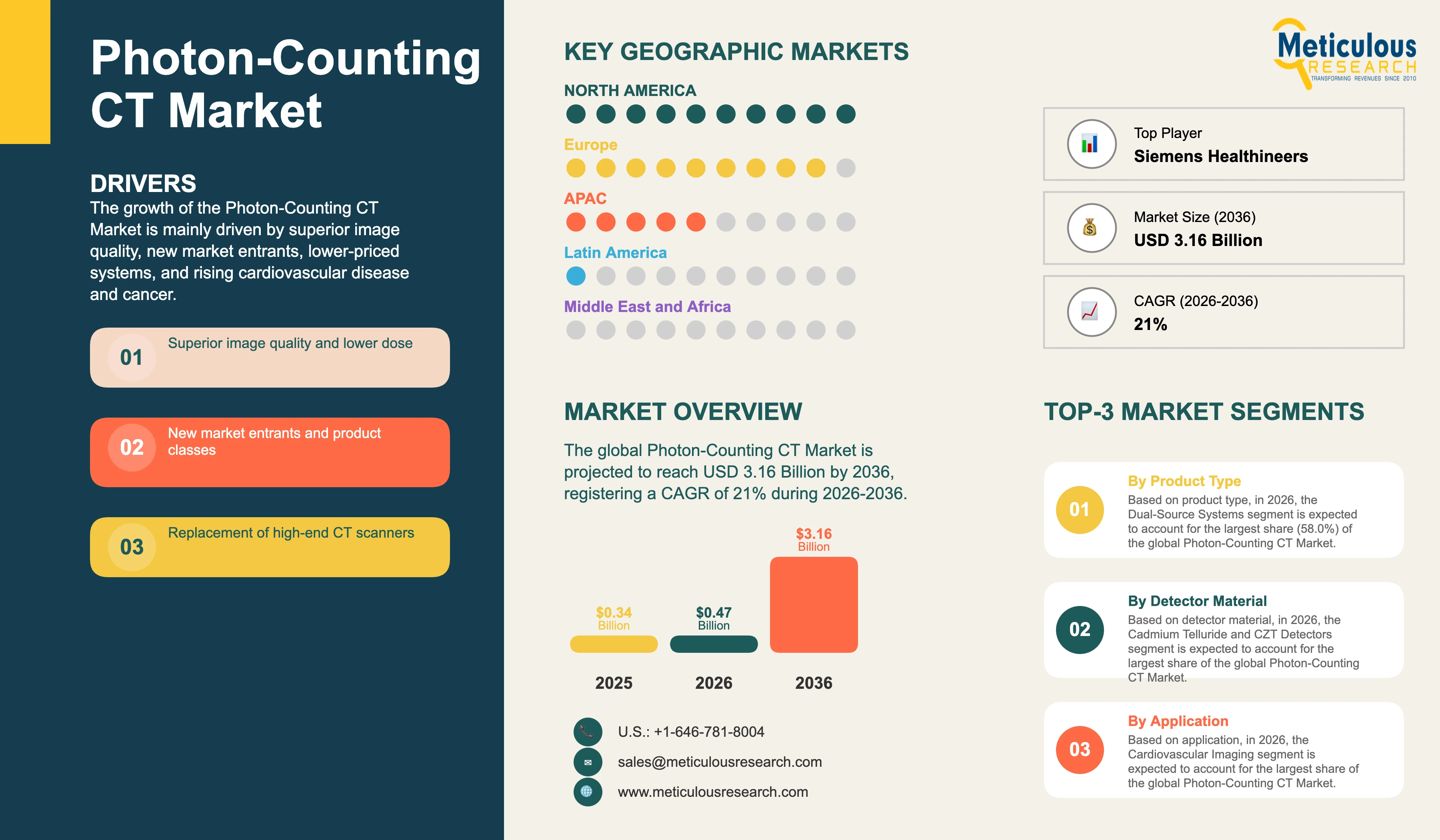
The global photon-counting CT market was valued at USD 0.34 billion in 2025. This market is expected to reach USD 3.16 billion by 2036 from an estimated USD 0.47 billion in 2026, registering a CAGR of 21.0% during the forecast period (2026-2036).
- Published
- Nov 2026
- Pages
- 260
- Format
- PDF + Excel
- Report ID
- MRHC - 1042634
- Base year
- 2025
- 2025 · BASELINE
- $340.0M
- 2036
- $3.16B
- CAGR 2026–2036
- 21.0%
2025 baseline · 2026–2036 forecast at 21.0% CAGR · hover a bar for the value
Key highlights
Siemens Healthineers received FDA 510(k) clearance for the Naeotom Alpha, the first photon-counting CT scanner to reach the U.S. market, in 2021, and in March 2025 the FDA cleared the Naeotom Alpha class, which added the dual-source Naeotom Alpha.Pro and the Naeotom Alpha.Prime, described by the company as the world's first single-source photon-counting CT scanner, according to Siemens Healthineers and MedTech Dive.
At the J.P. Morgan Healthcare Conference in January 2026, Siemens Healthineers CEO Bernd Montag said that the company's photon-counting CT business had generated EUR 1 billion in orders and EUR 700 million in revenue, according to MedTech Dive, and by September 2025 more than 2 million patients had been scanned with the company's photon-counting CT systems worldwide, according to Imaging Technology News.
In March 2026, GE HealthCare received FDA clearance for Photonova Spectra, a photon-counting CT system that uses the company's Deep Silicon detector technology with 8-bin energy resolution and integrates NVIDIA-based computing to process the larger data sets generated by photon-counting imaging, according to DOTmed. GE HealthCare introduced the system at RSNA 2025 and built the technology on its 2020 acquisition of Prismatic Sensors.
Citi Research analysts expect orders for GE HealthCare's Photonova to ramp throughout 2026 and contribute to the company's sales from 2027, while Siemens Healthineers has been investing about USD 86 million to expand photon-counting detector production in Forchheim, Germany, according to MedTech Dive and Imaging Technology News.
The Naeotom Alpha class offers scan speeds of 737 mm per second for the dual-source Naeotom Alpha.Peak, 491 mm per second for the dual-source Naeotom Alpha.Pro, and 345 mm per second for the single-source Naeotom Alpha.Prime, which Siemens Healthineers has positioned for inpatient, ambulatory, and emergency examinations at a wider range of facilities, according to AuntMinnie and Applied Radiology. Hospitals and imaging centers evaluating new CT purchases increasingly include photon-counting systems in their tenders, which is broadening competition between manufacturers and supporting faster adoption. Several manufacturers are also expanding detector production.
By product type, dual-source photon-counting CT systems account for the largest share of 58.0% in 2026, while single-source photon-counting CT systems register the highest CAGR.
By detector material, cadmium telluride and CZT detectors account for the larger share in 2026, while deep silicon detectors register the higher CAGR.
By application, cardiovascular imaging accounts for the largest share in 2026, while oncology imaging registers the highest CAGR.
By end user, hospitals account for the largest share of 82.0% in 2026, while diagnostic imaging centers register the highest CAGR.
By geography, North America accounts for the largest share of 40.0% in 2026, while Asia-Pacific registers the highest CAGR of 24.9%.
Report summary
| Particulars | Details |
|---|---|
| Base Year | 2025 |
| Estimated Year | 2026 |
| Forecast Period | 2026-2036 |
| Market Size in 2025 | USD 0.34 billion |
| Market Size in 2026 | USD 0.47 billion |
| Market Size by 2036 | USD 3.16 billion |
| CAGR (2026-2036) | 21.0% |
| Format | PDF, Excel & Cloud Portal · 260 pages |
| Largest Segment by Product Type (2026) | Dual-Source Systems (58.0%) |
| Largest Segment by End User (2026) | Hospitals (82.0%) |
| Largest Region (2026) | North America (40.0%) |
| Fastest-Growing Region | Asia-Pacific (CAGR 24.9%) |
| Companies Profiled | 11 companies and other companies |
| Segments Covered | Product Type, Detector Material, Application, End User, Geography |
| Countries Covered | U.S., Canada, Rest of North America, Germany, U.K., France, Italy, Spain, Netherlands, Switzerland, Belgium, Sweden, Denmark, Norway, Finland, Austria, Poland, Ireland, Rest of Europe, Japan, China, South Korea, India, Australia, Singapore, Indonesia, Thailand, Malaysia, Vietnam, Philippines, Taiwan, New Zealand, Rest of Asia-Pacific, Brazil, Mexico, Argentina, Colombia, Chile, Peru, Rest of Latin America, Saudi Arabia, U.A.E., Israel, South Africa, Turkey, Egypt, Rest of Middle East & Africa |
Report overview
Segments covered: product type, detector material, application, end user.
The growth of this market is mainly driven by the superior image quality, higher spatial resolution, and lower radiation dose that photon-counting detectors offer compared with conventional energy-integrating CT detectors, the expansion of product portfolios from a single premium scanner to a broader class of dual-source and single-source systems, the entry of a second major manufacturer with GE HealthCare's FDA-cleared Photonova Spectra, the rising burden of cardiovascular disease and cancer, which require precise imaging, and the growing use of spectral and quantitative imaging in clinical practice. However, factors such as the high price of photon-counting CT systems, the large data volumes and computing requirements of photon-counting imaging, limited reimbursement differentiation from conventional CT, and constraints in the supply of detector materials are expected to restrain the growth of this market to some extent.
Photon-counting computed tomography (CT) is a new generation of CT technology that uses detectors made of semiconductor materials, such as cadmium telluride or silicon, to directly convert individual X-ray photons into electrical signals and measure the energy of each photon. Conventional CT scanners use energy-integrating detectors that first convert X-rays into visible light using scintillator materials and then convert the light into an electrical signal, which loses information and adds electronic noise. By eliminating the intermediate conversion step, photon-counting detectors provide higher spatial resolution, lower image noise, better contrast, inherent spectral information, and the potential for lower radiation and contrast doses.
This report covers the global photon-counting CT market, including dual-source photon-counting CT systems, single-source photon-counting CT systems, and dedicated and compact photon-counting CT systems, such as head and point-of-care scanners. The market is analyzed by product type, detector material, application, end user, and geography. The market value includes new system sales and related software and upgrades at manufacturer selling prices. Service revenue from the installed base, conventional and dual-energy CT systems with energy-integrating detectors, and preclinical photon-counting systems used only in research are analyzed separately. The market is measured on a sales basis in each country.
The clinical benefits of photon-counting CT are particularly important in cardiovascular imaging, where higher spatial resolution allows better visualization of coronary arteries, stents, and calcified plaques, in oncology, where spectral information supports tumor characterization and the detection of small lesions, in lung imaging, where ultra-high resolution helps assess interstitial lung disease and small nodules, and in musculoskeletal imaging, where fine bone structures can be seen more clearly. Photon-counting CT also enables material decomposition and virtual non-contrast images in every scan, which may reduce the need for additional scans.
Siemens Healthineers introduced the first clinically available photon-counting CT system, the Naeotom Alpha, in 2021 and was the only company with a commercially available whole-body photon-counting CT scanner until 2026. In 2025, Siemens Healthineers expanded its portfolio into the Naeotom Alpha class, which includes the premium dual-source Naeotom Alpha.Peak, the dual-source Naeotom Alpha.Pro, and the single-source Naeotom Alpha.Prime. The single-source system is designed to broaden access to photon-counting CT for hospitals and imaging centers that do not need the highest-end dual-source performance. Samsung NeuroLogica also offers a compact photon-counting CT system for head imaging.
In March 2026, GE HealthCare received FDA clearance for Photonova Spectra, the first photon-counting CT system based on deep silicon detectors, which marked the entry of a second major manufacturer into the whole-body photon-counting CT market. GE HealthCare has emphasized that Photonova can be installed with minimal changes to existing CT rooms, which could reduce barriers to adoption. Canon Medical Systems, Philips, and United Imaging Healthcare are also developing photon-counting CT technology, and their expected market entry over the forecast period is likely to increase competition and accelerate adoption.
Dual-source photon-counting CT systems account for the largest share of the market by product type, while single-source systems are the fastest-growing product type. Cadmium telluride and cadmium zinc telluride detectors account for the largest share by detector material, while deep silicon detectors are the fastest-growing detector material. Cardiovascular imaging is the largest application, while oncology imaging is the fastest-growing application. Hospitals are the largest end user, while diagnostic imaging centers are the fastest-growing end user. North America accounts for the largest share of the market, while Asia-Pacific is the fastest-growing region.
Photon-counting CT is currently a premium segment of the global CT market, with systems priced significantly higher than conventional high-end CT scanners. Early adoption has been concentrated in academic medical centers, large hospitals, and cardiovascular centers in North America, Europe, and Japan. As more manufacturers enter the market, as product portfolios expand to include lower-priced single-source systems, and as clinical evidence accumulates, photon-counting CT is expected to gradually replace conventional high-end CT scanners at a growing number of facilities.
Over the forecast period, the photon-counting CT market is expected to grow rapidly, supported by replacement of the large installed base of high-end CT scanners, new market entrants, expanding clinical evidence, and new applications enabled by spectral imaging and artificial intelligence. The pace of growth will depend on system pricing, reimbursement, detector manufacturing capacity, data management capabilities, and the speed at which hospitals replace existing CT scanners.
Cardiovascular imaging is expected to account for the largest share of the market in 2026, while oncology imaging is projected to register the highest CAGR.
North America is expected to account for the largest share of 40.0% of the market in 2026, mainly due to high healthcare spending, early FDA clearances, the large number of academic and cardiovascular centers, and the presence of GE HealthCare.
Asia-Pacific is projected to register the highest CAGR of 24.9% during the forecast period, driven by rising healthcare investment, the large number of CT scanners in Japan, demand in China and South Korea, and regional manufacturers developing photon-counting CT.
The report profiles 11 companies, including Siemens Healthineers, GE HealthCare, Canon Medical Systems, Philips, Samsung NeuroLogica, United Imaging Healthcare, MARS Bioimaging, Neusoft Medical Systems, Varex Imaging, DECTRIS, and Kromek.
The main clinical applications include cardiovascular imaging, such as coronary CT angiography and stent and plaque assessment, oncology imaging, thoracic and lung imaging, musculoskeletal imaging, and neurological imaging, where higher resolution and spectral information improve diagnostic confidence.
What comes next: Photon-Counting CT and the Future of Advanced Imaging, a Meticulous Next™ foresight brief.
Report infographic
Market dynamics
18 factors across 5 forcesSuperior image quality and lower radiation dose
Photon-counting detectors provide significantly higher spatial resolution than conventional CT detectors, allowing radiologists to see smaller structures, such as coronary artery stents, small lung nodules, fine bone details, and small blood vessels. Photon-counting CT also reduces electronic noise, which improves image quality at low radiation doses and benefits patients who require repeated scans, children, and patients with larger body sizes. The ability to measure photon energy provides spectral information in every scan without the need for special dual-energy protocols.
These advantages have been demonstrated in a growing number of clinical studies across cardiovascular, thoracic, oncologic, and musculoskeletal imaging. As radiologists and referring physicians become familiar with the benefits of photon-counting CT, demand for the technology is expected to increase, particularly at facilities that perform complex cardiac and oncology imaging.
Lower radiation and contrast doses are particularly important for patients with kidney disease, for whom iodinated contrast agents carry risks, and for children and young adults, for whom cumulative radiation exposure is a concern, which further supports demand for photon-counting CT. Clinical societies are also beginning to include photon-counting CT in research agendas and educational programs, which increases awareness among radiologists and referring physicians.
Expansion of product portfolios and new market entrants
The photon-counting CT market is moving from a single premium product to a broader range of systems at different price points. Siemens Healthineers expanded its offering in 2025 with the Naeotom Alpha class, which includes single-source and dual-source systems, and GE HealthCare received FDA clearance for Photonova Spectra in March 2026. Other major CT manufacturers, including Canon Medical Systems, Philips, and United Imaging Healthcare, are developing photon-counting systems.
The entry of additional manufacturers and the introduction of lower-priced single-source systems are expected to broaden access to photon-counting CT, increase competition, and accelerate adoption among hospitals and imaging centers that could not justify the cost of the first premium systems. Competition between manufacturers is also expected to drive innovation in detector technology, software, and workflow.
Rising burden of cardiovascular disease and cancer
Cardiovascular disease and cancer are the leading causes of death worldwide, and their incidence is increasing as populations age. CT plays a central role in diagnosing and monitoring these conditions, including coronary CT angiography for coronary artery disease, CT for cancer staging and treatment monitoring, and lung cancer screening. Photon-counting CT offers particular advantages in these applications, including better visualization of calcified coronary plaques and stents and improved detection and characterization of tumors.
The growing use of coronary CT angiography as a first-line test for chest pain, recommended in clinical guidelines in the U.S. and Europe, and the expansion of lung cancer screening programs are expected to increase demand for high-performance CT systems, including photon-counting CT. Coronary CT angiography also benefits from photon-counting CT's ability to reduce blooming artifacts from calcium, which has historically limited the accuracy of conventional CT in patients with heavily calcified arteries.
Replacement of the installed base of high-end CT scanners
Hospitals and imaging centers replace CT scanners on a regular cycle, typically every seven to ten years. The large installed base of high-end conventional CT scanners in North America, Europe, and Japan represents a significant opportunity for photon-counting CT, as hospitals increasingly consider photon-counting systems when replacing premium CT scanners. Manufacturers are positioning photon-counting CT as the next standard for high-end CT imaging.
As prices decline and product portfolios expand, photon-counting CT is expected to capture a growing share of high-end CT replacement purchases, which will be a major driver of market growth over the forecast period.
Growing use of spectral and quantitative imaging
Photon-counting CT provides spectral information in every scan, which allows radiologists to create virtual monoenergetic images, iodine maps, virtual non-contrast images, and material-specific images. These capabilities support more accurate diagnosis, reduce artifacts from metal implants and calcifications, and may eliminate the need for additional scans. The growing use of quantitative imaging in oncology, cardiology, and other specialties is increasing demand for CT systems that provide reliable spectral information.
Artificial intelligence is also being integrated with photon-counting CT to support image reconstruction, noise reduction, and automated analysis, which further increases the clinical value of the technology. These tools can also shorten reading times for the larger photon-counting data sets. Leading hospitals also use photon-counting CT to attract referrals and clinical research partnerships.
Table of contents
12 chapters · 157 sections · 260 pages · click to expandSegmental analysis
| Segment | Largest share (2026) | Fastest growth (2026–2036) |
|---|---|---|
| By Product Type | Dual-source photon-counting CT systems | Single-source photon-counting CT systems |
By Product Type
- The cadmium telluride and CZT detectors segment is expected to account for the larger share of the photon-counting CT market, while the deep silicon detectors segment is projected to register the higher CAGR during the forecast period.
- The hospitals segment is expected to account for the largest share of 82.0% of the photon-counting CT market, while the diagnostic imaging centers segment is projected to register the highest CAGR during the forecast period.
Geographic analysis
North America
Largest shareIn 2026, North America is expected to account for the largest share of 40.0% of the global photon-counting CT market. The large share of this region is mainly due to the high level of healthcare spending in the U.S., the early FDA clearance of Siemens Healthineers' Naeotom Alpha in 2021 and the Naeotom Alpha class in March 2025, the FDA clearance of GE HealthCare's Photonova Spectra in March 2026, the large number of academic medical centers and cardiovascular centers that adopt advanced imaging early, the strong use of coronary CT angiography and lung cancer screening, and the presence of GE HealthCare's headquarters in the U.S. Canada also contributes to the regional market, with photon-counting CT installed at leading academic hospitals.
Asia-Pacific
Fastest growthAsia-Pacific is projected to register the highest CAGR of 24.9% during the forecast period. The rapid growth of this region is mainly driven by rising healthcare investment, the large number of CT scanners in Japan, growing demand for advanced imaging in China, South Korea, India, and Australia, the high burden of cardiovascular disease and cancer, and the development of photon-counting CT technology by regional manufacturers such as Canon Medical Systems and United Imaging Healthcare. Japan is an early adopter of advanced CT technology, while China's large hospital market and domestic manufacturing capabilities are expected to support strong growth.
Europe
Europe accounts for a significant share of the market, supported by the early adoption of photon-counting CT at academic hospitals in Germany, the Netherlands, Switzerland, the Nordic countries, and other countries, the presence of Siemens Healthineers' headquarters and detector manufacturing in Germany, and strong clinical research in photon-counting imaging.
Latin America
Latin America accounts for a smaller share of the market, with demand concentrated in Brazil and Mexico, where private hospital groups are investing in advanced imaging, while the Middle East & Africa accounts for the smallest share, with growing investment in advanced healthcare infrastructure in Saudi Arabia, the U.A.E., and Israel. Regional differences in healthcare spending, CT replacement cycles, reimbursement, regulatory approvals, and the availability of systems from multiple manufacturers shape the adoption of photon-counting CT around the world. Regions with large installed bases of high-end CT scanners and growing healthcare investment are expected to see the fastest growth over the forecast period. The availability of systems from multiple manufacturers in each region will also affect pricing and the pace of adoption. Latin America and the Middle East & Africa account for small shares of the market, with early installations at leading private hospitals and academic centers in Brazil, Mexico, Saudi Arabia, the U.A.E., Israel, and Turkey. Gulf countries are investing heavily in advanced medical technology as part of national healthcare strategies, and several new hospitals are evaluating premium CT systems, including photon-counting CT. In Latin America, adoption is expected to start with large private hospital groups in Brazil and Mexico that compete on advanced imaging capabilities, while public hospitals are likely to adopt the technology later as prices decline.
Competitive landscape
The global photon-counting CT market is highly consolidated, with Siemens Healthineers accounting for the large majority of revenue in 2025 as the first manufacturer to commercialize whole-body photon-counting CT. The competitive landscape is expected to change significantly over the forecast period as GE HealthCare begins commercial deliveries of Photonova Spectra and as other CT manufacturers enter the market.
Siemens Healthineers offers the Naeotom Alpha class, which includes the Naeotom Alpha.Peak, Naeotom Alpha.Pro, and Naeotom Alpha.Prime, and has the largest installed base and clinical experience in photon-counting CT. GE HealthCare received FDA clearance for Photonova Spectra in March 2026 and is preparing for commercial availability in the U.S. Samsung NeuroLogica offers a compact photon-counting CT system for head imaging, while Canon Medical Systems, Philips, and United Imaging Healthcare are developing photon-counting CT technology. MARS Bioimaging develops spectral photon-counting CT for research and specialized applications, and Neusoft Medical Systems is developing photon-counting CT technology. Detector and component suppliers such as Varex Imaging, DECTRIS, and Kromek also play important roles in the value chain.
Companies in this market compete on image quality, spatial and temporal resolution, spectral capabilities, radiation dose, scan speed, workflow, AI and computing capabilities, system price, installation requirements, and service. Key strategies include expanding product portfolios to cover different price points, investing in detector manufacturing capacity, building clinical evidence through research partnerships, integrating AI and high-performance computing, and obtaining regulatory approvals in new markets.
Recent competitive activity has focused on new product clearances and the expansion of manufacturing capacity. Siemens Healthineers received FDA clearance for the Naeotom Alpha class in March 2025 and has invested in detector production, while GE HealthCare received FDA clearance for Photonova Spectra in March 2026 after introducing it at RSNA 2025. Siemens Healthineers' CEO said in January 2026 that the company was well ahead in turning photon-counting CT into a business, while Citi Research analysts expect GE HealthCare's orders to ramp through 2026.
We expect competition to intensify significantly over the forecast period as GE HealthCare ramps up commercial deliveries and as Canon Medical Systems, Philips, and United Imaging Healthcare bring photon-counting systems to market. Increased competition is expected to reduce prices, broaden access, and accelerate the replacement of conventional high-end CT scanners with photon-counting systems.
Some of the key players operating in the photon-counting CT market are Siemens Healthineers AG, GE HealthCare Technologies Inc., Canon Medical Systems Corporation, Koninklijke Philips N.V., Samsung NeuroLogica Corp., Shanghai United Imaging Healthcare Co., Ltd., MARS Bioimaging Ltd., Neusoft Medical Systems Co., Ltd., Varex Imaging Corporation, DECTRIS Ltd., and Kromek Group plc, among others.
- —
GE HealthCare received FDA clearance for Photonova Spectra in March 2026, Siemens Healthineers received FDA clearance for the Naeotom Alpha class in March 2025, and Siemens Healthineers reported EUR 1 billion in photon-counting CT orders and EUR 700 million in revenue in January 2026.
- Naeotom Alpha.Peak
- Naeotom Alpha.Pro
- Naeotom Alpha.Prime
Expert perspectives
Photon-counting CT represents the most significant technological change in CT imaging in decades. After several years in which Siemens Healthineers was the only supplier of whole-body photon-counting CT systems, the market is entering a new phase with expanded product portfolios, the entry of GE HealthCare, and the expected arrival of other manufacturers. These developments are expected to transform photon-counting CT from a premium niche technology into a mainstream option for high-end CT imaging.
Over the forecast period, the market is expected to grow at a CAGR of 21.0%, from USD 0.47 billion in 2026 to USD 3.16 billion in 2036. Growth will be supported by the replacement of conventional high-end CT scanners, new market entrants, lower-priced single-source systems, growing clinical evidence, and new applications. The market's growth rate reflects its early stage of adoption and the large installed base of high-end CT scanners that could be replaced with photon-counting systems.
Among the market segments, dual-source systems are the largest product type, while single-source systems grow fastest. Cadmium telluride and CZT detectors are the largest detector material, while deep silicon detectors grow fastest. Cardiovascular imaging is the largest application, while oncology imaging grows fastest, and hospitals are the largest end user, while diagnostic imaging centers grow fastest. North America is the largest region, and Asia-Pacific is the fastest-growing region at a CAGR of 24.9%.
In our view, the most important factor for the market over the forecast period will be the pace at which competition reduces prices and broadens access. The entry of GE HealthCare with a deep silicon detector and the expected entry of Canon Medical Systems, Philips, and United Imaging Healthcare will give hospitals more choice and put pressure on prices, which should accelerate adoption. Siemens Healthineers' large installed base and clinical experience give it a strong position, but its market share is expected to decline as competitors enter.
We also expect data management and computing to become increasingly important factors in hospital purchasing decisions for photon-counting CT. Hospitals will need to invest in IT infrastructure to manage photon-counting data, and manufacturers that offer integrated computing, AI, and workflow solutions will be better positioned to win customers. Service revenue from software upgrades and computing platforms is also likely to become a larger part of manufacturers' photon-counting CT business.
Overall, we believe the photon-counting CT market will grow rapidly over the forecast period, with single-source systems, deep silicon detectors, oncology imaging, diagnostic imaging centers, and Asia-Pacific providing the fastest growth. Photon-counting CT is likely to become the standard technology for high-end CT imaging by the end of the forecast period.
Customer perspectives
Chief of Cardiac Imaging - U.S. Academic Medical Center
Photon-counting CT lets us see inside stents and heavily calcified arteries in a way we could not before, which has reduced the number of patients we send for invasive angiography.
“The first systems were beyond our budget, but single-source photon-counting scanners make the technology realistic for our centers when we replace our current CT scanners.”
“Spectral information in every scan helps us characterize tumors and follow treatment response more precisely, with lower doses for patients who need frequent scans.”
Frequently asked questions
The global photon-counting CT market was valued at USD 0.34 billion in 2025, up from USD 0.24 billion in 2024, and is estimated at USD 0.47 billion in 2026. The market includes dual-source, single-source, and dedicated and compact photon-counting CT systems and related software and upgrades.
The global photon-counting CT market is expected to reach USD 3.16 billion by 2036, supported by superior image quality and lower dose, new market entrants, lower-priced single-source systems, the rising burden of cardiovascular disease and cancer, and the replacement of high-end CT scanners.
The market is expected to register a CAGR of 21.0% from 2026 to 2036.
Photon-counting CT uses semiconductor detectors that directly convert individual X-ray photons into electrical signals and measure their energy, while conventional CT detectors first convert X-rays into light. This provides higher spatial resolution, lower noise, inherent spectral information, and the potential for lower radiation doses.
Market growth is mainly driven by superior image quality and lower radiation dose, the expansion of product portfolios and new market entrants, the rising burden of cardiovascular disease and cancer, the replacement of the installed base of high-end CT scanners, and the growing use of spectral and quantitative imaging.
The high price of photon-counting CT systems and limited reimbursement differentiation restrain growth, while large data volumes and computing requirements and detector manufacturing and supply constraints are key challenges.
Key growth opportunities include single-source and lower-priced systems, expansion in oncology and lung imaging, the integration of AI and advanced computing, and expansion in Asia-Pacific.
Dual-source photon-counting CT systems are expected to account for the largest share of 58.0% of the market in 2026, while single-source systems are projected to register the highest CAGR.
In 2026, the cadmium telluride and CZT detectors segment is expected to account for the larger share of the photon-counting CT market, while the deep silicon detectors segment is projected to register the higher CAGR during the forecast period.
Cardiovascular imaging is expected to account for the largest share of the market in 2026, while oncology imaging is projected to register the highest CAGR.
In 2026, the hospitals segment is expected to account for the largest share of 82.0% of the photon-counting CT market, while the diagnostic imaging centers segment is projected to register the highest CAGR during the forecast period.
North America is expected to account for the largest share of 40.0% of the market in 2026, mainly due to high healthcare spending, early FDA clearances, the large number of academic and cardiovascular centers, and the presence of GE HealthCare.
Asia-Pacific is projected to register the highest CAGR of 24.9% during the forecast period, driven by rising healthcare investment, the large number of CT scanners in Japan, demand in China and South Korea, and regional manufacturers developing photon-counting CT.
The report profiles 11 companies, including Siemens Healthineers, GE HealthCare, Canon Medical Systems, Philips, Samsung NeuroLogica, United Imaging Healthcare, MARS Bioimaging, Neusoft Medical Systems, Varex Imaging, DECTRIS, and Kromek.
The main clinical applications include cardiovascular imaging, such as coronary CT angiography and stent and plaque assessment, oncology imaging, thoracic and lung imaging, musculoskeletal imaging, and neurological imaging, where higher resolution and spectral information improve diagnostic confidence.
GE HealthCare received FDA clearance for Photonova Spectra in March 2026, Siemens Healthineers received FDA clearance for the Naeotom Alpha class in March 2025, and Siemens Healthineers reported EUR 1 billion in photon-counting CT orders and EUR 700 million in revenue in January 2026.
Cite this report
Meticulous Research. (2026). Photon-Counting CT Market - Global Opportunity Analysis and Industry Forecast (2026-2036) (Report No. MRHC - 1042634). Meticulous Market Research Pvt. Ltd. https://www.meticulousresearch.com/product/photon-counting-ct-market-7317