Endometriosis Treatment Market (2026-2036)
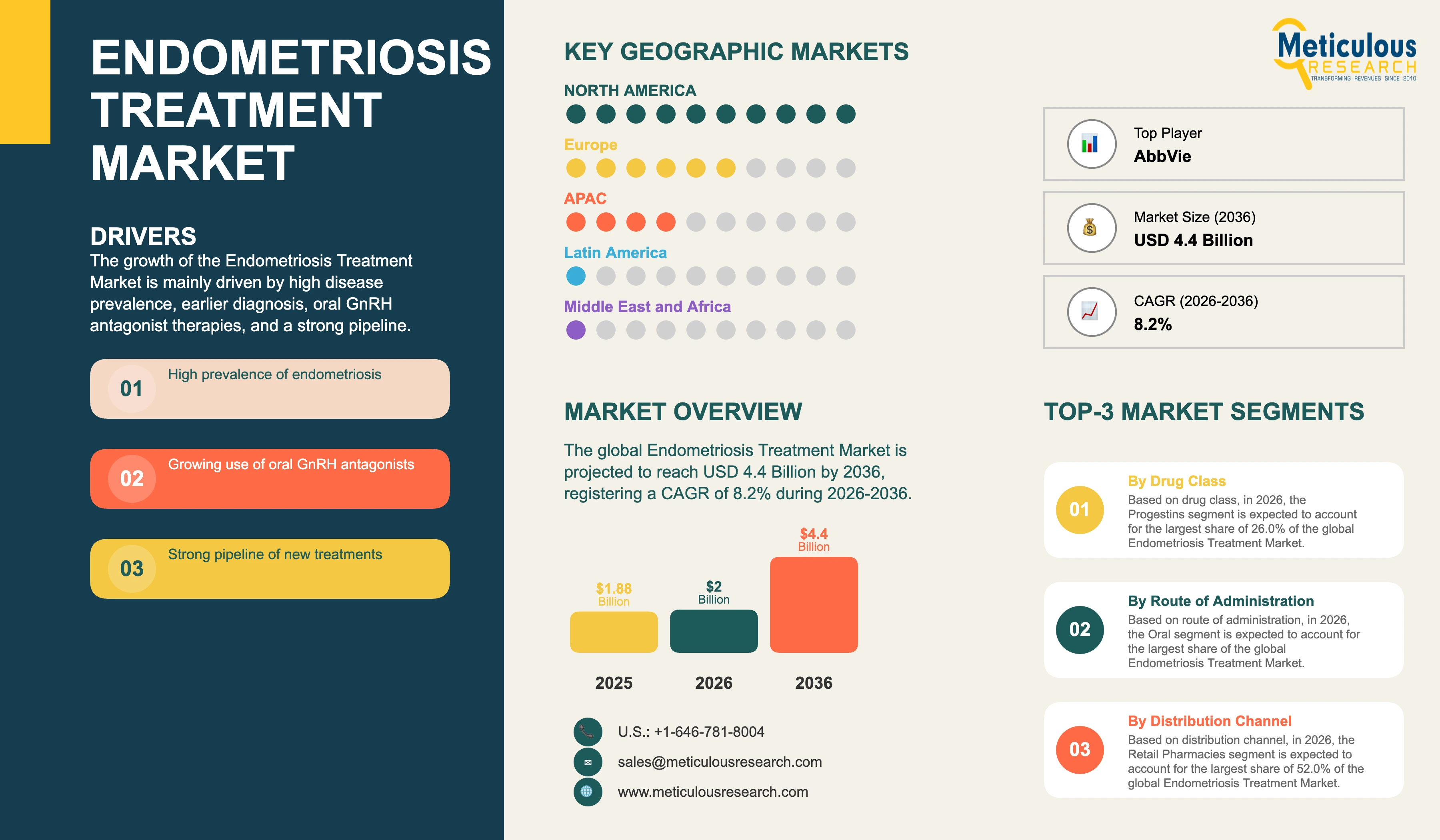
The global endometriosis treatment market was valued at USD 1.88 billion in 2025. This market is expected to reach USD 4.40 billion by 2036 from an estimated USD 2.00 billion in 2026, registering a CAGR of 8.2% during the forecast period (2026-2036).
- Published
- Nov 2026
- Pages
- 281
- Format
- PDF + Excel
- Report ID
- MRHC - 1042636
- Base year
- 2025
- 2025 · BASELINE
- $1.88B
- 2036
- $4.40B
- CAGR 2026–2036
- 8.2%
2025 baseline · 2026–2036 forecast at 8.2% CAGR · hover a bar for the value
Key highlights
According to the World Health Organization, endometriosis affects roughly 10% of women and girls of reproductive age globally, or about 190 million people, and it can cause severe pelvic pain, painful periods, pain during intercourse, and infertility.
The U.S. Food and Drug Administration approved Myfembree (relugolix, estradiol, and norethindrone acetate) for moderate to severe pain associated with endometriosis on August 5, 2022, based on the SPIRIT 1 and SPIRIT 2 phase III trials in more than 1,200 women, making it the first once-daily oral GnRH antagonist combination therapy for endometriosis that can be used for up to 24 months, according to the FDA label and company announcements.
AbbVie's Orilissa (elagolix), launched in the U.S. in 2018, was the first oral GnRH antagonist approved for endometriosis pain, while Gedeon Richter's Ryeqo and Theramex's Yselty (linzagolix, originally developed by Kissei) have extended oral GnRH antagonist options in Europe.
Hope Medicine's HMI-115, a monoclonal antibody that targets the prolactin receptor and is being developed in partnership with Bayer, received FDA Fast Track Designation for endometriosis in December 2025, according to company announcements, highlighting growing interest in non-hormonal treatments.
Several countries have adopted national plans to improve endometriosis care, including Australia's National Action Plan for Endometriosis, France's national endometriosis strategy, and U.K. clinical guidance from the National Institute for Health and Care Excellence, which aim to shorten diagnostic delays, improve the education of healthcare professionals, and expand access to specialist care. These initiatives are expected to increase the number of women who receive a diagnosis and begin medical treatment over the forecast period. They also encourage earlier referral of adolescents and young women with severe period pain to specialists.
Gesynta Pharma received approval in the U.K. in September 2025 to start a phase II trial of vipoglanstat, a non-hormonal oral drug candidate for endometriosis, and other pipeline candidates include Tiumbio's merigolix and several programs targeting inflammation and pain pathways. Several pharmaceutical companies are also evaluating new indications and formulations for existing hormonal treatments, which could extend their use in endometriosis care.
By drug class, progestins account for the largest share of 26.0% in 2026, while GnRH antagonists register the highest CAGR.
By treatment line, first-line therapy accounts for the largest share in 2026, while second-line therapy registers the highest CAGR.
By route of administration, oral accounts for the largest share in 2026 and also registers the highest CAGR.
By distribution channel, retail pharmacies account for the largest share of 52.0% in 2026, while online pharmacies register the highest CAGR.
By geography, North America accounts for the largest share of 46.0% in 2026, while Asia-Pacific registers the highest CAGR of 10.3%.
Report summary
| Particulars | Details |
|---|---|
| Base Year | 2025 |
| Estimated Year | 2026 |
| Forecast Period | 2026-2036 |
| Market Size in 2025 | USD 1.88 billion |
| Market Size in 2026 | USD 2.00 billion |
| Market Size by 2036 | USD 4.40 billion |
| CAGR (2026-2036) | 8.2% |
| Format | PDF, Excel & Cloud Portal · 281 pages |
| Largest Segment by Drug Class (2026) | Progestins (26.0%) |
| Largest Segment by Distribution Channel (2026) | Retail Pharmacies (52.0%) |
| Largest Region (2026) | North America (46.0%) |
| Fastest-Growing Region | Asia-Pacific (CAGR 10.3%) |
| Companies Profiled | 13 companies and other companies |
| Segments Covered | Drug Class, Treatment Line, Route of Administration, Distribution Channel, Geography |
| Countries Covered | U.S., Canada, Rest of North America, Germany, U.K., France, Italy, Spain, Netherlands, Poland, Switzerland, Belgium, Sweden, Denmark, Norway, Finland, Austria, Ireland, Rest of Europe, Japan, China, India, South Korea, Australia, Indonesia, Thailand, Singapore, Malaysia, Vietnam, Philippines, Taiwan, New Zealand, Rest of Asia-Pacific, Brazil, Mexico, Argentina, Colombia, Chile, Peru, Rest of Latin America, Saudi Arabia, U.A.E., Israel, South Africa, Turkey, Egypt, Rest of Middle East & Africa |
Report overview
Segments covered: drug class, treatment line, route of administration, distribution channel.
The growth of this market is mainly driven by the high prevalence of endometriosis among women of reproductive age, rising awareness and earlier diagnosis of the disease, the growing use of oral gonadotropin-releasing hormone (GnRH) antagonists and combination therapies that can be taken for longer periods, the strong pipeline of new non-hormonal and hormonal treatments, and increasing government and advocacy attention to women's health. However, factors such as long diagnostic delays, the side effects and duration limits of hormonal therapies, the availability of low-cost generic progestins and contraceptives, and limited reimbursement for newer branded drugs in many countries are expected to restrain the growth of this market to some extent. Nevertheless, the large number of undiagnosed and undertreated women represents a significant long-term growth opportunity for the market.
Endometriosis is a chronic inflammatory disease in which tissue similar to the lining of the uterus grows outside the uterus, typically on the ovaries, fallopian tubes, and pelvic lining. This tissue responds to hormonal changes during the menstrual cycle, causing inflammation, scarring, and adhesions. The main symptoms include severe pelvic pain, painful periods, pain during intercourse, painful bowel movements or urination, fatigue, and infertility. The disease usually begins at the onset of menstruation and can continue until menopause, significantly affecting quality of life, education, work, and relationships.
This report covers the global endometriosis treatment market, including prescription drugs used to manage endometriosis and its symptoms, such as progestins, combined oral contraceptives, oral GnRH antagonists and combination therapies, injectable and implant GnRH agonists, non-steroidal anti-inflammatory drugs (NSAIDs) and analgesics used for endometriosis pain, and other drug classes such as aromatase inhibitors and danazol. The market is analyzed by drug class, route of administration, distribution channel, and geography. Surgical procedures, diagnostic tests, and fertility treatments are not included in the market value. The market is measured on a revenue basis at manufacturer selling prices.
There is no cure for endometriosis, and treatment aims to relieve pain, slow disease progression, and preserve fertility. First-line treatment usually consists of NSAIDs for pain and hormonal therapies, such as progestins or combined oral contraceptives, which suppress menstruation and reduce the growth of endometriosis lesions. For women who do not respond to first-line treatments, physicians may prescribe GnRH agonists or GnRH antagonists, which reduce estrogen levels more strongly, or recommend laparoscopic surgery to remove lesions. Many women require long-term treatment, and symptoms often return after stopping therapy or after surgery.
Diagnosis remains a major challenge in endometriosis care and is one of the main factors limiting treatment rates. Because symptoms are often dismissed as normal period pain and confirmation has traditionally required surgery, many women wait several years from the onset of symptoms to receive a diagnosis. Greater awareness, improved imaging techniques such as transvaginal ultrasound and magnetic resonance imaging, updated clinical guidelines that allow treatment to begin based on clinical diagnosis, and the development of non-invasive diagnostic tests are expected to shorten diagnostic delays and increase the number of women who receive treatment.
The treatment landscape has changed significantly over the past decade with the introduction of oral GnRH antagonists. AbbVie's Orilissa was approved by the FDA in 2018, and Myfembree, a once-daily combination of relugolix with estradiol and norethindrone acetate, was approved for endometriosis pain in August 2022. The add-back hormones in combination products reduce bone loss and hot flashes, allowing longer treatment durations of up to 24 months. In Europe, Ryeqo and Yselty provide similar oral options. These products have created a new category of branded therapies between generic first-line hormonal treatments and surgery.
Progestins account for the largest share of the market by drug class, while GnRH antagonists are the fastest-growing drug class. Oral drugs are the largest and fastest-growing route of administration. Retail pharmacies are the largest distribution channel, while online pharmacies are the fastest-growing channel. First-line therapy is the largest treatment line, while second-line therapy is the fastest-growing treatment line. North America accounts for the largest share of the market, while Asia-Pacific is the fastest-growing region.
The market includes pharmaceutical companies with branded GnRH antagonists and agonists, such as AbbVie, Sumitomo Pharma, Gedeon Richter, Theramex, Kissei, Ipsen, and Takeda, companies with branded progestins and hormonal products, such as Bayer and Organon, generic manufacturers such as Viatris and Teva, and biotechnology companies developing new treatments, such as Hope Medicine, Tiumbio, and Gesynta Pharma. A large share of prescriptions for progestins, contraceptives, and NSAIDs is filled with low-cost generics, while branded GnRH antagonist products generate a growing share of market revenue.
Over the forecast period, the endometriosis treatment market is expected to grow steadily, supported by rising diagnosis rates, the growing use of oral GnRH antagonist combination therapies, the expected approval of new treatments with novel mechanisms, and increasing policy attention to women's health. The pace of growth will depend on improvements in diagnosis, the clinical success of pipeline candidates, pricing and reimbursement, and access to specialist care in emerging markets. Specialist endometriosis centers that bring together surgeons, gynecologists, and pain specialists are also expanding in many countries.
North America is expected to account for the largest share of 46.0% of the market in 2026, mainly due to the large patient population in the U.S., high healthcare spending, early launches of oral GnRH antagonist therapies, and strong awareness.
Asia-Pacific is projected to register the highest CAGR of 10.3% during the forecast period, driven by a large population of women of reproductive age, rising awareness and diagnosis, improving healthcare access, and expanding availability of branded treatments.
The report profiles 13 companies, including AbbVie, Sumitomo Pharma, Gedeon Richter, Bayer, Kissei, Theramex, Ipsen, Takeda, Organon, Viatris, Teva, Hope Medicine, and Tiumbio.
Approved oral GnRH antagonist therapies include AbbVie's Orilissa and Myfembree in the U.S., and Ryeqo and Yselty in Europe. Myfembree was approved by the FDA in August 2022 and can be used for up to 24 months.
Current hormonal treatments suppress estrogen and ovulation, which prevents pregnancy and can cause side effects such as bone loss and hot flashes. Non-hormonal treatments could provide relief without these drawbacks and could be used for longer periods and by women who wish to conceive.
Report infographic
Market dynamics
18 factors across 5 forcesHigh prevalence of endometriosis among women of reproductive age
Endometriosis is one of the most common gynecological conditions affecting women of reproductive age worldwide. According to the World Health Organization, it affects roughly 10% of women and girls of reproductive age globally, or about 190 million people. The disease is a leading cause of chronic pelvic pain and is found in a significant share of women with infertility. Because endometriosis usually requires long-term management from adolescence until menopause, the large patient population creates sustained demand for treatment over many years.
Many women with endometriosis use several treatments over the course of their lives, moving from NSAIDs and contraceptives to progestins, GnRH antagonists, and surgery as their symptoms change. This long treatment journey increases the overall demand for endometriosis therapies and creates opportunities for products at each stage of care.
The economic burden of endometriosis is also significant, including healthcare costs, lost productivity, and reduced participation in education and work, which is encouraging governments, employers, and payers to support better diagnosis and treatment.
Rising awareness and earlier diagnosis
Awareness of endometriosis has increased significantly in recent years, driven by advocacy organizations, public figures who have shared their experiences, media coverage, and government initiatives. Several countries, including Australia, the U.K., and France, have launched national action plans or strategies to improve awareness, diagnosis, and care for endometriosis. These efforts encourage women to seek help for severe period pain and encourage healthcare professionals to consider endometriosis earlier.
Updated clinical guidelines now support starting treatment based on symptoms and imaging findings rather than requiring surgical confirmation, and advances in ultrasound and magnetic resonance imaging are improving non-invasive detection. As diagnostic delays shorten, more women are expected to begin treatment earlier and to remain on therapy longer, which increases demand for endometriosis drugs. Greater use of transvaginal ultrasound by trained sonographers in particular allows many cases of deep endometriosis and ovarian endometriomas to be identified without surgery.
Growing use of oral GnRH antagonists and combination therapies
Oral GnRH antagonists have become an important option for women with moderate to severe endometriosis pain who do not respond adequately to first-line treatments. Unlike injectable GnRH agonists, oral antagonists act quickly, do not cause an initial flare of symptoms, and allow physicians to adjust the degree of estrogen suppression. Combination products that include add-back estradiol and progestin, such as Myfembree and Ryeqo, reduce side effects such as bone loss and hot flashes, which allows treatment for up to 24 months.
Growing physician familiarity with these products, expanding insurance coverage, and approvals in new markets are expected to drive strong growth in the GnRH antagonist segment. Because these products are branded and priced at a premium compared with generic progestins and contraceptives, their growing use has a significant effect on market revenue.
Strong pipeline of new treatments
The pipeline for endometriosis treatments has expanded considerably, with candidates targeting both hormonal and non-hormonal mechanisms. Hope Medicine's HMI-115, a prolactin receptor antibody being developed with Bayer, received FDA Fast Track Designation in December 2025. Gesynta Pharma is developing vipoglanstat, a non-hormonal oral candidate that entered phase II testing in the U.K., while Tiumbio is developing merigolix, an oral GnRH antagonist. Other programs target inflammation, pain signaling, and the immune system.
Non-hormonal treatments are particularly important because they could provide relief without suppressing estrogen and without affecting fertility, which would make them suitable for women who wish to conceive and for long-term use. The approval of new treatments with novel mechanisms is expected to expand the market significantly over the forecast period.
Increasing government and advocacy attention to women's health
Governments and health organizations are paying greater attention to women's health, including endometriosis. National strategies, increased research funding, and public awareness campaigns are improving recognition of the disease and access to care. Advocacy organizations are also pushing for better education of healthcare professionals, faster diagnosis, and improved access to effective treatments.
Greater investment in women's health research is also supporting the development of new diagnostic tests and treatments, which is expected to strengthen the endometriosis treatment pipeline over the forecast period. Employers and payers are also showing greater interest in endometriosis because of its impact on productivity and healthcare costs, which supports better coverage of diagnosis and treatment. Patient advocacy groups continue to push for faster diagnosis and better access to effective care.
Table of contents
12 chapters · 160 sections · 281 pages · click to expandSegmental analysis
| Segment | Largest share (2026) | Fastest growth (2026–2036) |
|---|---|---|
| By Drug Class | Retail pharmacies | Online pharmacies |
By Drug Class
- The retail pharmacies segment is expected to account for the largest share of 52.0% of the endometriosis treatment market, while the online pharmacies segment is projected to register the highest CAGR during the forecast period.
- The first-line therapy segment is expected to account for the largest share of the endometriosis treatment market, while the second-line therapy segment is projected to register the highest CAGR during the forecast period.
Geographic analysis
North America
Largest shareIn 2026, North America is expected to account for the largest share of 46.0% of the global endometriosis treatment market. The large share of this region is mainly due to the large population of women with endometriosis in the U.S., high healthcare spending, the early approval and launch of oral GnRH antagonist therapies such as Orilissa and Myfembree, the higher prices of branded drugs, strong awareness and advocacy, and the presence of major pharmaceutical companies such as AbbVie and Sumitomo Pharma's U.S. operations. The FDA approved Myfembree for endometriosis pain in August 2022, and FDA Fast Track Designation for HMI-115 in December 2025 highlights continued pipeline activity in the region. Canada also contributes to the regional market, with growing use of dienogest and oral GnRH antagonists.
Asia-Pacific
Fastest growthAsia-Pacific is projected to register the highest CAGR of 10.3% during the forecast period. The rapid growth of this region is mainly driven by its large population of women of reproductive age, rising awareness and diagnosis of endometriosis, improving access to gynecological care and imaging, increasing healthcare spending, and the expanding availability of branded treatments. Japan has an established market for endometriosis drugs, including dienogest and relugolix, while China, India, South Korea, and Southeast Asia have large numbers of undiagnosed women and growing demand for effective treatment. Australia has implemented a national action plan for endometriosis, which supports diagnosis and care.
Europe
Europe accounts for a significant share of the market, supported by the widespread use of dienogest and other progestins, the approval of oral GnRH antagonist therapies such as Ryeqo and Yselty, national endometriosis strategies in France and the U.K., and the presence of companies such as Bayer, Gedeon Richter, Theramex, and Ipsen.
Latin America
Latin America accounts for a smaller share of the market, with demand concentrated in Brazil and Mexico, while the Middle East & Africa accounts for the smallest share, with growing awareness and access to care in Saudi Arabia, the U.A.E., and South Africa. Regional differences in awareness, diagnostic capacity, treatment guidelines, drug availability, and reimbursement shape the use of endometriosis treatments around the world. Regions with large undiagnosed populations and improving healthcare access are expected to see the fastest growth over the forecast period. Wider availability of oral GnRH antagonist therapies outside North America and Europe is also expected to support regional growth. Improving reimbursement in large markets such as China is also expected to increase access to branded treatments. Latin America and the Middle East & Africa account for smaller shares of the market, but awareness of endometriosis is increasing in Brazil, Mexico, Argentina, Colombia, Saudi Arabia, the U.A.E., Israel, and South Africa. Brazil has active endometriosis advocacy groups and specialist centers in major cities, while Mexico and Colombia are expanding gynecological services in private hospitals.
Middle East & Africa
In the Middle East, growing investment in women's health services and fertility care is supporting earlier diagnosis and treatment, although access to newer branded treatments remains limited by cost and reimbursement.
Competitive landscape
The global endometriosis treatment market is moderately consolidated in the branded segment and highly fragmented in the generic segment, with the top five players estimated to account for about 45% of the market in 2025. The market includes companies with branded GnRH antagonists and agonists, companies with branded progestins, generic manufacturers, and biotechnology companies developing new treatments.
AbbVie markets Orilissa and Lupron Depot, while Sumitomo Pharma markets Myfembree in the U.S. Gedeon Richter markets Ryeqo in Europe and other markets, and Theramex markets Yselty, which was originally developed by Kissei. Bayer markets Visanne (dienogest) and is partnering with Hope Medicine on HMI-115. Ipsen markets triptorelin, Takeda markets leuprorelin in several markets, and Organon offers hormonal products used in endometriosis. Viatris and Teva supply generic progestins, contraceptives, and GnRH agonists, while Tiumbio and Gesynta Pharma are developing new treatments.
Companies in this market compete on efficacy, safety and tolerability, treatment duration, convenience, pricing, market access, and physician relationships. Key strategies include expanding approvals and launches of oral GnRH antagonist therapies, generating long-term safety data, developing non-hormonal treatments, licensing products for new regions, investing in physician and patient education, and partnering with advocacy organizations to raise awareness.
Recent competitive activity in the endometriosis treatment market has focused mainly on pipeline development, licensing, and partnerships. Bayer's collaboration with Hope Medicine on HMI-115 and the FDA Fast Track Designation for the candidate in December 2025, Gesynta Pharma's U.K. phase II trial approval for vipoglanstat in September 2025, and continued development of merigolix by Tiumbio illustrate the growing interest in new mechanisms. Licensing deals, such as the agreement under which Theramex commercializes linzagolix in Europe, have also been important for expanding access to new treatments.
We expect competition to intensify as more oral GnRH antagonists and non-hormonal treatments reach the market. Companies with differentiated non-hormonal products are likely to gain a significant competitive advantage, while companies relying on mature generic products will continue to face pricing pressure. Partnerships with diagnostic developers, digital health companies, and advocacy organizations are also expected to become more important for building awareness and supporting earlier treatment. Companies that invest in specialist education are also likely to gain share.
Some of the key players operating in the endometriosis treatment market are AbbVie Inc., Sumitomo Pharma Co., Ltd., Gedeon Richter Plc, Bayer AG, Kissei Pharmaceutical Co., Ltd., Theramex, Ipsen S.A., Takeda Pharmaceutical Company Limited, Organon & Co., Viatris Inc., Teva Pharmaceutical Industries Ltd., Hope Medicine Inc., and Tiumbio Co., Ltd., among others.
- —
Hope Medicine's HMI-115, developed with Bayer, received FDA Fast Track Designation in December 2025, and Gesynta Pharma received U.K. approval in September 2025 to start a phase II trial of vipoglanstat, while oral GnRH antagonist therapies continued to expand in the U.S. and Europe.
- AbbVie Inc.
- Sumitomo Pharma Co., Ltd.
- Gedeon Richter Plc
- Bayer AG
- Kissei Pharmaceutical Co., Ltd.
- Theramex
- Ipsen S.A.
- Takeda Pharmaceutical Company Limited
- Organon & Co.
- Viatris Inc.
- Teva Pharmaceutical Industries Ltd.
- Hope Medicine Inc.
- Tiumbio Co., Ltd.
Expert perspectives
The endometriosis treatment market is entering a period of steady growth after many years in which treatment options were limited to generic hormonal therapies, injectable GnRH agonists, and surgery. The introduction of oral GnRH antagonist combination therapies, rising awareness, and a growing pipeline of new treatments are expanding the market and improving the options available to women with this chronic and often debilitating disease.
Over the forecast period, the market is expected to grow at a CAGR of 8.2%, from USD 2.00 billion in 2026 to USD 4.40 billion in 2036. Growth will be supported by the high prevalence of endometriosis, earlier diagnosis, the growing use of oral GnRH antagonists, new treatment approvals, and increasing policy attention to women's health. The market's growth rate reflects the combination of a large generic base and a growing share of premium branded products.
Among the market segments, progestins are the largest drug class, while GnRH antagonists grow fastest. Oral drugs are the largest and fastest-growing route of administration, and retail pharmacies are the largest distribution channel, while online pharmacies grow fastest. First-line therapy is the largest treatment line, while second-line therapy grows fastest. North America is the largest region, and Asia-Pacific is the fastest-growing region at a CAGR of 10.3%.
In our view, the most important factor for the market over the forecast period will be the success of non-hormonal treatments in clinical development. A safe and effective non-hormonal treatment that does not affect fertility could transform the treatment landscape and significantly expand the market. Because endometriosis is biologically complex and clinical trials are challenging, investors and companies should expect some setbacks, but the large unmet need makes this area highly attractive. We also expect licensing and acquisition activity to increase as large pharmaceutical companies seek late-stage endometriosis assets to strengthen their women's health portfolios. Pricing and reimbursement decisions in Europe and Asia will also shape the uptake of new branded therapies and should be monitored closely by market participants.
We also expect improvements in diagnosis to be a major driver of growth. National strategies, updated guidelines, better imaging, and potential non-invasive tests are expected to reduce diagnostic delays and increase the number of women receiving treatment. Companies that support these efforts and build strong relationships with gynecologists and endometriosis specialists are likely to benefit.
Overall, we believe the endometriosis treatment market will grow steadily over the forecast period, with GnRH antagonists, oral therapies, and Asia-Pacific providing the fastest growth. The market's long-term potential depends on bringing innovative treatments to the many women whose symptoms are not adequately controlled by current options.
Customer perspectives
Patients for endometriosis treatments include adolescents and women of reproductive age with pelvic pain, painful periods, and infertility, while prescribers include gynecologists, endometriosis specialists, primary care physicians, and fertility specialists. Treatment decisions depend mainly on symptom severity, efficacy, side effects, the desire for pregnancy, treatment duration, cost, insurance coverage, and patient preference. Payers influence treatment choices through formulary decisions and step therapy requirements that often require women to try generic treatments first. Fertility goals are particularly important, as many women prioritize treatments that allow them to conceive when they choose. Many women also seek care from multiple physicians before finding an effective treatment, which highlights the importance of specialist referral pathways. Specialists also consider long-term bone health, cost, and insurance coverage when selecting therapies.
Gynecologist and Endometriosis Specialist - U.S.
For women whose pain is not controlled by progestins or the pill, oral combination therapy has become an important option because they can stay on it much longer than with older injections.
This comment explains why GnRH antagonists are the fastest-growing drug class and why oral drugs are the largest route of administration. Most of these oral treatments are dispensed through retail pharmacies, which account for 52.0% of the market.
This comment explains why progestins account for 26.0% of the market and why non-hormonal treatments that preserve fertility represent a major opportunity.
This comment explains why Asia-Pacific is the fastest-growing region and why earlier diagnosis is a key driver of market growth.
“It took years to be diagnosed. Dienogest has helped with my pain, but I worry about what happens when I want to have children.”
“Many women here still think severe period pain is normal. Awareness is improving, and more patients are coming for treatment.”
Frequently asked questions
The global endometriosis treatment market was valued at USD 1.88 billion in 2025, up from USD 1.78 billion in 2024, and is estimated at USD 2.00 billion in 2026. The market includes prescription drugs used to treat endometriosis and its symptoms.
The global endometriosis treatment market is expected to reach USD 4.40 billion by 2036, supported by the high prevalence of the disease, earlier diagnosis, the growing use of oral GnRH antagonist therapies, and new treatment approvals.
The market is expected to register a CAGR of 8.2% from 2026 to 2036.
According to the World Health Organization, endometriosis affects roughly 10% of women and girls of reproductive age globally, or about 190 million people.
Market growth is mainly driven by the high prevalence of endometriosis, rising awareness and earlier diagnosis, the growing use of oral GnRH antagonists and combination therapies, a strong pipeline of new treatments, and increasing government and advocacy attention to women's health.
The side effects and duration limits of hormonal therapies and generic competition restrain growth, while long diagnostic delays and complex disease biology are key challenges.
Key growth opportunities include non-hormonal treatments, the expansion of oral GnRH antagonist therapies, improved diagnosis through non-invasive tests, and expansion in Asia-Pacific and emerging markets.
Progestins are expected to account for the largest share of 26.0% of the market in 2026, while GnRH antagonists are projected to register the highest CAGR.
Oral drugs are expected to account for the largest share of the market in 2026 and are also projected to register the highest CAGR.
In 2026, the retail pharmacies segment is expected to account for the largest share of 52.0% of the endometriosis treatment market, while the online pharmacies segment is projected to register the highest CAGR during the forecast period.
In 2026, the first-line therapy segment is expected to account for the largest share of the endometriosis treatment market, while the second-line therapy segment is projected to register the highest CAGR during the forecast period.
North America is expected to account for the largest share of 46.0% of the market in 2026, mainly due to the large patient population in the U.S., high healthcare spending, early launches of oral GnRH antagonist therapies, and strong awareness.
Asia-Pacific is projected to register the highest CAGR of 10.3% during the forecast period, driven by a large population of women of reproductive age, rising awareness and diagnosis, improving healthcare access, and expanding availability of branded treatments.
The report profiles 13 companies, including AbbVie, Sumitomo Pharma, Gedeon Richter, Bayer, Kissei, Theramex, Ipsen, Takeda, Organon, Viatris, Teva, Hope Medicine, and Tiumbio.
Hope Medicine's HMI-115, developed with Bayer, received FDA Fast Track Designation in December 2025, and Gesynta Pharma received U.K. approval in September 2025 to start a phase II trial of vipoglanstat, while oral GnRH antagonist therapies continued to expand in the U.S. and Europe.
Approved oral GnRH antagonist therapies include AbbVie's Orilissa and Myfembree in the U.S., and Ryeqo and Yselty in Europe. Myfembree was approved by the FDA in August 2022 and can be used for up to 24 months.
Current hormonal treatments suppress estrogen and ovulation, which prevents pregnancy and can cause side effects such as bone loss and hot flashes. Non-hormonal treatments could provide relief without these drawbacks and could be used for longer periods and by women who wish to conceive.
Cite this report
Meticulous Research. (2026). Endometriosis Treatment Market - Global Opportunity Analysis and Industry Forecast (2026-2036) (Report No. MRHC - 1042636). Meticulous Market Research Pvt. Ltd. https://www.meticulousresearch.com/product/endometriosis-treatment-market-7319