FemTech Market (2026-2036)
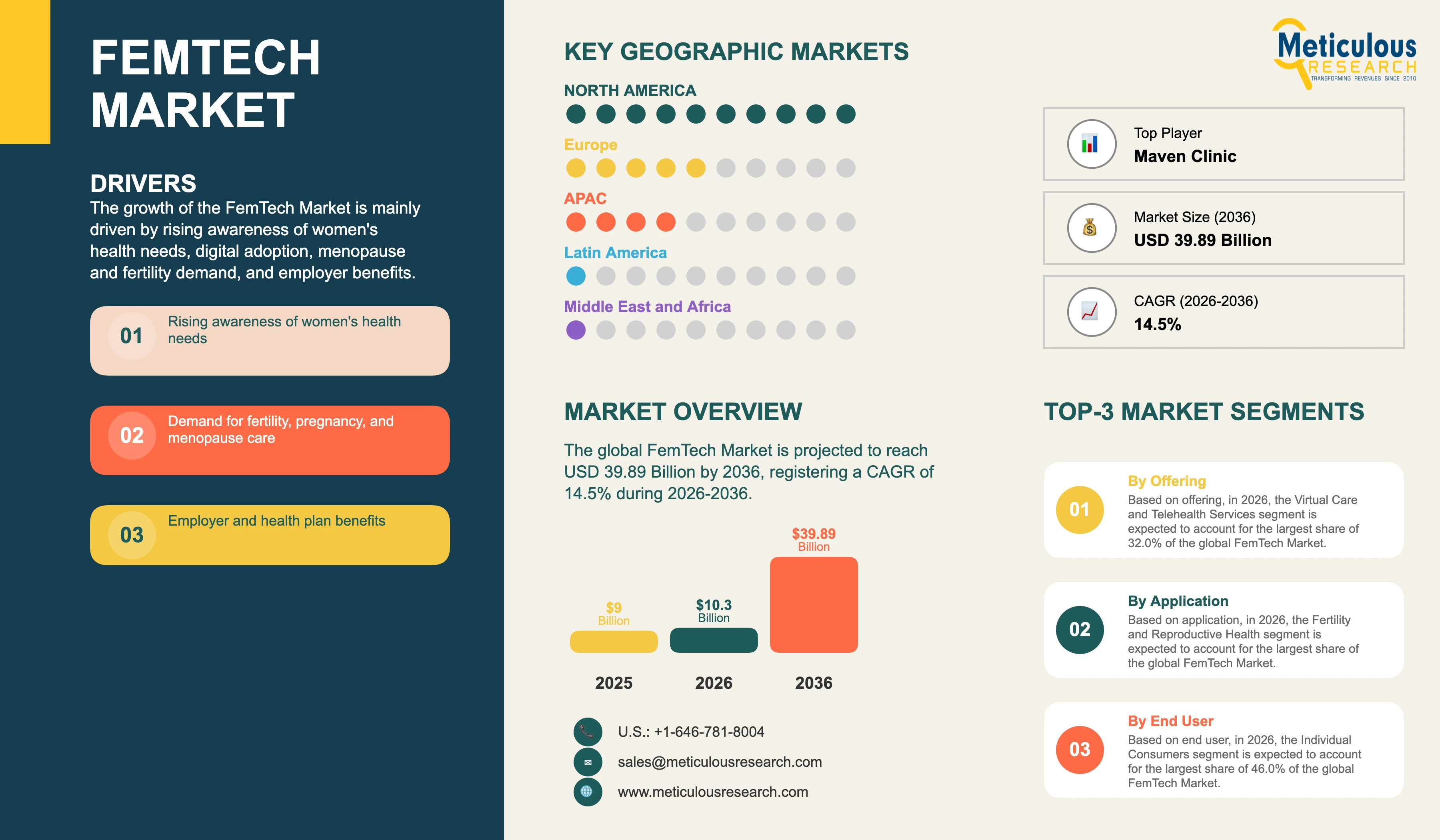
The global FemTech market was valued at USD 9.00 billion in 2025. This market is expected to reach USD 39.89 billion by 2036 from an estimated USD 10.30 billion in 2026, registering a CAGR of 14.5% during the forecast period (2026-2036).
- Published
- Nov 2026
- Pages
- 270
- Format
- PDF + Excel
- Report ID
- MRHC - 1042638
- Base year
- 2025
- 2025 · BASELINE
- $9.00B
- 2036
- $39.89B
- CAGR 2026–2036
- 14.5%
2025 baseline · 2026–2036 forecast at 14.5% CAGR · hover a bar for the value
Key highlights
Flo Health raised more than USD 200 million from General Atlantic in July 2024, making it the first digital consumer women's health app to achieve unicorn status, according to FemTech World, and the round was positioned to support the company's expansion into perimenopause and menopause.
Maven Clinic, a virtual clinic for women's and family health, raised a USD 125 million Series F round in October 2024, bringing its valuation to USD 1.7 billion and its total funding to more than USD 425 million. Maven reported that more than 2,000 clients in 175 countries used its platform as of October 2024.
In February 2026, Midi Health raised USD 100 million in a Series D round led by Goodwater Capital for virtual perimenopause and menopause care, as noted in the Meticulous Next brief on FemTech, reflecting strong investor backing for menopause-focused virtual care. Top femtech venture deals in 2024 also included Comanche Biopharma's USD 90 million Series B for a preeclampsia therapy, according to PitchBook.
Oura, whose smart ring measures body temperature and supports menstrual cycle tracking, raised more than USD 900 million in a Series E round in October 2025 at a post-money valuation of USD 11 billion, according to TechRound, illustrating how mainstream wearables are embedding women's health features.
According to the World Economic Forum and BCG in January 2026, women's health captured only 6% of private healthcare investment, with most of that funding going to women's cancers, reproductive health, and maternal health, highlighting the gap between women's health needs and investment. Natural Cycles, which offers an FDA-cleared digital contraception app, raised a USD 55 million Series C round in May 2024, and Maven Clinic opened nationwide direct access for women in the U.S. in March 2026, moving beyond its employer-only model. This expansion reflects growing consumer demand for direct access to women's health specialists. Employers and health plans are also adding menopause and midlife health benefits alongside fertility benefits, which is broadening the range of services covered for women.
By offering, virtual care and telehealth services account for the largest share of 32.0% in 2026, while devices and wearables register the highest CAGR.
By application, fertility and reproductive health accounts for the largest share in 2026, while menopause care registers the highest CAGR.
By age group, reproductive age (18-44) accounts for the largest share in 2026, while midlife (45-64) registers the highest CAGR.
By end user, individual consumers account for the largest share of 46.0% in 2026, while employers and health plans register the highest CAGR.
By geography, North America accounts for the largest share of 48.0% in 2026, while Asia-Pacific registers the highest CAGR of 17.8%.
Report summary
| Particulars | Details |
|---|---|
| Base Year | 2025 |
| Estimated Year | 2026 |
| Forecast Period | 2026-2036 |
| Market Size in 2025 | USD 9.00 billion |
| Market Size in 2026 | USD 10.30 billion |
| Market Size by 2036 | USD 39.89 billion |
| CAGR (2026-2036) | 14.5% |
| Format | PDF, Excel & Cloud Portal · 270 pages |
| Largest Segment by Offering (2026) | Virtual Care and Telehealth Services (32.0%) |
| Largest Segment by End User (2026) | Individual Consumers (46.0%) |
| Largest Region (2026) | North America (48.0%) |
| Fastest-Growing Region | Asia-Pacific (CAGR 17.8%) |
| Companies Profiled | 12 companies and other companies |
| Segments Covered | Offering, Application, Age Group, End User, Geography |
| Countries Covered | U.S., Canada, Rest of North America, U.K., Germany, France, Sweden, Netherlands, Italy, Spain, Switzerland, Belgium, Denmark, Norway, Finland, Austria, Poland, Ireland, Rest of Europe, China, Japan, India, South Korea, Australia, Singapore, Indonesia, Thailand, Malaysia, Vietnam, Philippines, Taiwan, New Zealand, Rest of Asia-Pacific, Brazil, Mexico, Argentina, Chile, Colombia, Peru, Rest of Latin America, Saudi Arabia, U.A.E., Israel, South Africa, Turkey, Egypt, Rest of Middle East & Africa |
Report overview
Segments covered: offering, application, end user.
The growth of this market is mainly driven by rising awareness of women's health needs that have historically been underserved, the rapid adoption of digital health apps, telehealth, and connected devices by women, growing demand for fertility, pregnancy, and menopause care, the expansion of employer-sponsored and health plan-sponsored women's health benefits, the integration of women's health features into mainstream wearables, and increasing investment by venture capital firms and large technology and healthcare companies in women's health. However, factors such as concerns about the privacy and security of sensitive reproductive health data, limited reimbursement for many digital women's health services, the need for stronger clinical evidence, regulatory uncertainty for some products, and the relatively low share of healthcare investment directed to women's health are expected to restrain the growth of this market to some extent.
FemTech refers to technology-enabled products and services designed to address health needs specific to women or that disproportionately affect women. It includes digital health apps for menstrual tracking, fertility awareness, contraception, pregnancy, and menopause, virtual care and telehealth services for fertility, maternity, menopause, and pelvic health, connected devices and wearables such as smart breast pumps, pelvic floor trainers, fertility monitors, and cycle-tracking wearables, and diagnostics and home testing products such as hormone tests, fertility tests, and at-home screening kits. FemTech companies serve women across their life stages, from menstruation and fertility through pregnancy, postpartum, and menopause.
This report covers the global FemTech market, including virtual care and telehealth services, devices and wearables, digital health apps and platforms, and diagnostics and home testing products focused on women's health. The market is analyzed by offering, application, end user, and geography. Prescription drugs, hospital obstetric and gynecological equipment, general-purpose fitness devices without women's health features, and fertility clinic services are analyzed in separate reports. The market is measured on a revenue basis, based on subscriptions, service fees, device and test sales, and contracts with employers and health plans.
Women's health has historically received less research, investment, and product development than its burden of disease would suggest. Conditions such as endometriosis, polycystic ovary syndrome, infertility, perimenopause, and menopause are often underdiagnosed or poorly managed, and many women report difficulty accessing specialized care. According to the World Health Organization, endometriosis alone affects about 10% of women of reproductive age worldwide. FemTech companies aim to close these gaps by giving women convenient access to information, tracking tools, specialists, and products, often through smartphones and connected devices. Many FemTech companies were founded by women who experienced these gaps themselves.
The market has grown rapidly over the past decade, supported by venture capital investment and consumer demand. Flo Health became the first purely digital consumer women's health app to reach unicorn status after raising more than USD 200 million in July 2024, and Maven Clinic reached a valuation of USD 1.7 billion after raising USD 125 million in October 2024. However, women's health still receives a small share of overall healthcare investment, and the World Economic Forum and BCG reported in January 2026 that women's health captured only 6% of private healthcare investment.
Menopause has become one of the most important growth areas in the market. Hundreds of millions of women are in perimenopause or menopause, and many report that their symptoms are not well managed. Virtual menopause clinics, such as Midi Health, which raised USD 100 million in February 2026, menopause tracking apps, and digital programs offered through employers are expanding rapidly. Large companies are also entering the market, with consumer wearable companies such as Oura, Apple, Samsung, and Garmin adding cycle tracking and women's health insights to their devices.
Employers and health plans are becoming an increasingly important commercial channel for FemTech companies. Many employers now offer fertility, maternity, and menopause benefits to attract and retain employees, and companies such as Maven Clinic, Progyny, and Carrot Fertility deliver these benefits through digital platforms and care networks. This business-to-business model provides more stable revenue than consumer subscriptions and allows FemTech companies to reach large populations of women.
Virtual care and telehealth services account for the largest share of the market by offering, while devices and wearables are the fastest-growing offering. Fertility and reproductive health is the largest application, while menopause care is the fastest-growing application. Individual consumers are the largest end user, while employers and health plans are the fastest-growing end user. The reproductive age (18-44) group is the largest age group, while the midlife (45-64) group is the fastest-growing age group. North America accounts for the largest share of the market, while Asia-Pacific is the fastest-growing region.
Over the forecast period, the FemTech market is expected to grow rapidly, supported by rising awareness, digital adoption, menopause and fertility demand, employer benefits, wearables, and investment. At the same time, the market's growth will depend on protecting sensitive health data, building clinical evidence, securing reimbursement, and expanding access beyond high-income consumers. The market also includes a growing number of companies focused on underserved areas, such as pelvic floor health, endometriosis, and polycystic ovary syndrome, which have historically received limited attention.
I use an app to track my cycle and plan a pregnancy, and I can consult a gynecologist online when I have questions. It is easier than visiting a clinic for every concern. The app also reminds me about tests during pregnancy planning. I pay for the premium version.
This comment explains why fertility and reproductive health is the largest application, why individual consumers account for 46.0% of the market, and why Asia-Pacific is the fastest-growing region.
North America is expected to account for the largest share of 48.0% of the market in 2026, mainly due to the large number of FemTech companies, high digital health adoption, employer-sponsored women's health benefits, and significant investment.
Asia-Pacific is projected to register the highest CAGR of 17.8% during the forecast period, driven by large female populations, smartphone and digital health adoption, rising incomes, and growing attention to women's health.
The report profiles 12 companies, including Maven Clinic, Flo Health, Midi Health, Progyny, Carrot Fertility, Kindbody, Clue, Natural Cycles, Elvie, Willow, Oura, and Hologic.
Menopause care is growing fastest because of the large number of women in perimenopause and menopause, high unmet need for symptom management, growing public discussion, new treatment options, employer interest in supporting midlife women, and significant investment in virtual menopause clinics.
Report infographic
Market dynamics
18 factors across 5 forcesRising awareness of underserved women's health needs
Awareness of women's health needs has increased significantly in recent years, driven by advocacy, media coverage, research, and public discussion of topics such as menstruation, fertility, endometriosis, polycystic ovary syndrome, pregnancy complications, and menopause. Women are increasingly seeking information and care for conditions that were once rarely discussed, and they are more willing to use digital tools to understand and manage their health. Governments and health systems in several countries are also developing women's health strategies that highlight gaps in research and care.
This growing awareness creates demand for FemTech products and services that provide accessible information, tracking, diagnosis, and treatment. FemTech companies are well positioned to meet this demand because they can reach women directly through smartphones and online channels and offer specialized services that may be difficult to access through traditional healthcare systems.
The underrepresentation of women in clinical research and the historical lack of products designed for women's physiology also create opportunities for companies that develop evidence-based solutions specifically for women.
Adoption of digital health apps, telehealth, and connected devices
Women are among the most active users of digital health tools, and the widespread use of smartphones has made health apps a common way to track menstrual cycles, fertility, pregnancy, and symptoms. Period and fertility tracking apps such as Flo, Clue, and Natural Cycles have attracted large user bases, and telehealth services have made it easier for women to consult specialists in fertility, menopause, and pelvic health without traveling to clinics.
Connected devices and wearables, such as smart rings, fertility monitors, smart breast pumps, and pelvic floor trainers, provide continuous data and personalized insights, which increases the value of FemTech solutions. As digital health adoption continues to grow, FemTech is expected to benefit from greater consumer comfort with digital care. Younger women in particular expect to manage their health through apps and online services.
Growing demand for fertility, pregnancy, and menopause care
Demand for fertility support is increasing as more women delay childbearing, and infertility affects a significant share of couples worldwide. FemTech companies offer fertility tracking, ovulation testing, fertility benefits management, and virtual fertility care that help women and couples understand their fertility and access treatment. Pregnancy and postpartum care is another large area, with apps, remote monitoring, and virtual maternity programs that support women throughout pregnancy and after birth.
Menopause care is growing especially rapidly, as large numbers of women enter perimenopause and menopause and seek better management of symptoms such as hot flashes, sleep problems, mood changes, and genitourinary symptoms. Virtual menopause clinics, symptom tracking apps, and employer menopause programs are expanding to meet this demand, supported by new treatment options and greater public discussion of menopause.
Expansion of employer- and health plan-sponsored women's health benefits
Employers are increasingly offering women's health benefits, including fertility, maternity, parenting, and menopause support, to attract and retain talent and to reduce healthcare costs associated with complications. Health plans are also adding women's health programs to improve outcomes and member satisfaction. These benefits are often delivered by FemTech companies through digital platforms combined with care networks and coaching.
Maven Clinic, Progyny, and Carrot Fertility are among the companies that have built large businesses serving employers and health plans. Employer and health plan contracts provide stable recurring revenue and allow FemTech companies to reach large populations of women, which supports market growth. Employer programs also give FemTech companies access to large populations and claims data that can demonstrate outcomes.
Integration of women's health features into mainstream wearables
Large consumer technology and wearable companies are adding women's health features to their devices and platforms, including cycle tracking, ovulation estimates based on temperature data, pregnancy insights, and perimenopause symptom tracking. Oura, which raised more than USD 900 million at an USD 11 billion valuation in October 2025, measures body temperature and supports cycle tracking, and companies such as Apple, Samsung, and Garmin have added women's health features to their watches and apps.
The integration of women's health features into widely used wearables exposes large numbers of women to FemTech capabilities and generates continuous data that can support more accurate insights and earlier detection of health issues. Partnerships between wearable companies and FemTech providers are also expanding the reach of specialized services. Social media has also increased open discussion of women's health topics that were previously taboo.
Table of contents
12 chapters · 165 sections · 270 pages · click to expandSegmental analysis
| Segment | Largest share (2026) | Fastest growth (2026–2036) |
|---|---|---|
| By Offering | Virtual care and telehealth services | Devices and wearables |
| By Application | Fertility and reproductive health | Menopause care |
| By Age Group | Reproductive age (18-44) | Midlife (45-64) |
| By End User | Individual consumers | Employers and health plans |
| Other segments | Individual consumers | Employers and health plans |
By Offering
- The virtual care and telehealth services segment is expected to account for the largest share of 32.0% of the global FemTech market.
- The large share of this segment is mainly due to the growing use of virtual clinics for fertility, maternity, menopause, and pelvic health, the ability of virtual care to provide access to specialists who may be scarce in local healthcare systems, the expansion of employer- and health plan-sponsored virtual women's health programs, and the higher revenue per user of clinical services compared with consumer apps.
- Companies such as Maven Clinic and Midi Health have built large virtual care businesses that combine consultations, prescriptions, care coordination, and coaching.
- Virtual care also allows FemTech companies to address conditions that require ongoing management, such as menopause, fertility treatment, and postpartum recovery, and to coordinate with in-person care when needed.
- The expansion of telehealth regulations and reimbursement in many countries has supported the growth of this segment.
- Virtual care providers are increasingly building multidisciplinary care teams that include obstetricians, gynecologists, reproductive endocrinologists, menopause specialists, nurses, midwives, doulas, mental health professionals, nutritionists, and pelvic floor physical therapists.
- This team-based model allows them to address the full range of women's health needs and to coordinate care across life stages, which increases the value of their services to employers and health plans and supports long-term relationships with members.
- However, the devices and wearables segment is projected to register the highest CAGR during the forecast period.
- The rapid growth of this segment is driven by the integration of women's health features into mainstream wearables such as smart rings and smartwatches, the growth of connected devices such as smart breast pumps, fertility monitors, and pelvic floor trainers, the development of new wearable hormone monitors, and growing consumer interest in continuous health data.
- The digital health apps and platforms segment forms the third-largest segment, supported by large user bases for period, fertility, and pregnancy tracking apps, while the diagnostics and home testing segment accounts for the remaining share and is growing with home hormone and fertility tests.
- Smart breast pumps and connected pelvic floor trainers have also become popular categories, supported by reimbursement for breast pumps under some insurance plans and growing awareness of pelvic health after childbirth.
- Many FemTech companies are combining offerings, such as apps with devices, tests, and virtual care, to create integrated solutions that provide greater value to users and support higher revenue per user.
By Application
- The fertility and reproductive health segment is expected to account for the largest share of the global FemTech market.
- The large share of this segment is mainly due to the large number of women and couples seeking to understand and manage their fertility, the growing number of women delaying childbearing, the widespread use of fertility and ovulation tracking apps and devices, the growth of employer-sponsored fertility benefits, and the use of digital contraception and family planning tools.
- Fertility benefits management companies, fertility tracking apps, and fertility testing products all contribute to this segment.
- However, the menopause care segment is projected to register the highest CAGR during the forecast period.
- The rapid growth of this segment is driven by the large population of women in perimenopause and menopause, growing awareness and discussion of menopause symptoms, the expansion of virtual menopause clinics and employer menopause programs, large funding rounds for menopause-focused companies, and new treatment options for menopause symptoms.
- Pregnancy and maternal health forms the second-largest segment, supported by pregnancy apps, remote monitoring, virtual maternity programs, and smart breast pumps, followed by menstrual health, pelvic and sexual health, and general wellness and other applications.
- Pelvic health, including pelvic floor disorders and incontinence after childbirth or with aging, is also an important and growing area, supported by connected pelvic floor trainers and digital physical therapy programs.
- Menstrual health remains one of the most widely used FemTech applications, with hundreds of millions of women using period tracking apps worldwide, although many of these apps are free or low-cost, which limits revenue per user.
- Companies are increasingly adding premium features, such as personalized insights, symptom analysis, and access to clinicians, to convert users to paid subscriptions and to identify conditions such as polycystic ovary syndrome and endometriosis earlier.
By Age Group
- The reproductive age (18-44) segment is expected to account for the largest share of the global FemTech market.
- The large share of this segment is mainly due to the large number of women in this age group who use period and fertility tracking apps, fertility and pregnancy services, contraception and sexual health services, and connected devices such as wearables and breast pumps, as well as the strong focus of employer-sponsored fertility and family-building benefits on this age group.
- Women aged 18 to 44 are also the most active users of digital health tools and the most frequent buyers of direct-to-consumer women's health products.
- Fertility and pregnancy services generate high spending per user, as fertility treatment, egg freezing, and maternity care programs are costly and often funded through employer benefits.
- Period and fertility tracking apps reach very large user bases in this age group and generate revenue through subscriptions and premium features, while connected breast pumps and postpartum services serve new mothers.
- As more women in this age group delay pregnancy and seek fertility preservation, demand for related FemTech services is expected to remain strong.
- However, the midlife (45-64) segment is projected to register the highest CAGR during the forecast period.
- The rapid growth of this segment is driven by the rising awareness of perimenopause and menopause, the growth of virtual menopause clinics and menopause-focused apps, employer interest in supporting women in midlife who are in senior roles, and increasing attention to midlife health issues such as bone health, heart health, and pelvic floor disorders.
- The adolescents and young adults segment and the older women segment account for smaller shares of the market, with adolescents mainly using menstrual tracking and education tools and older women using pelvic health, bone health, and chronic condition management services.
By End User
- The individual consumers segment is expected to account for the largest share of 46.0% of the global FemTech market.
- The large share of this segment is mainly due to the large number of women who purchase apps, subscriptions, devices, and tests directly, the popularity of consumer period, fertility, and pregnancy tracking apps, the growth of direct-to-consumer virtual care services, and the purchase of wearables and connected devices by consumers.
- Direct-to-consumer channels allow FemTech companies to reach women quickly and build large user bases.
- Consumer spending is concentrated in subscriptions for premium app features, purchases of wearables and connected devices, home tests, and out-of-pocket payments for virtual consultations.
- Consumers in North America and Europe account for most of this spending, while consumer adoption in Asia-Pacific is growing rapidly as smartphone use and incomes increase.
- Health savings and flexible spending accounts in the U.S. also allow some consumers to use pre-tax funds for eligible women's health products and services.
- However, the employers and health plans segment is projected to register the highest CAGR during the forecast period.
- The rapid growth of this segment is driven by the expansion of employer-sponsored fertility, maternity, and menopause benefits, health plans' interest in improving maternal and women's health outcomes, and the ability of FemTech companies to demonstrate cost savings and improved outcomes.
- The hospitals and clinics segment accounts for the remaining share of the market, supported by the use of remote monitoring, digital care pathways, and FemTech products by healthcare providers to support patients.
- Health systems are increasingly partnering with FemTech companies to extend maternity and menopause care beyond hospital walls.
- Remote monitoring programs for high-risk pregnancies, such as those for hypertension and gestational diabetes, are an important use case in this segment, since they can help detect complications early and reduce hospital admissions.
- Fertility clinics also use digital tools to manage patient communication, medication schedules, and monitoring during treatment cycles.
- Adoption is growing steadily.
Other segments
- The individual consumers segment is expected to account for the largest share of 46.0% of the FemTech market, while the employers and health plans segment is projected to register the highest CAGR during the forecast period.
- The reproductive age (18-44) segment is expected to account for the largest share of the FemTech market, while the midlife (45-64) segment is projected to register the highest CAGR during the forecast period.
Geographic analysis
North America
Largest shareIn 2026, North America is expected to account for the largest share of 48.0% of the global FemTech market. The large share of this region is mainly due to the large number of FemTech companies headquartered in the U.S., high adoption of digital health apps, telehealth, and wearables, the widespread availability of employer-sponsored women's health benefits, significant venture capital investment, and high healthcare spending. Leading companies such as Maven Clinic, Midi Health, Progyny, Carrot Fertility, Oura's U.S. operations, and many others serve large populations of women in the U.S., and Canada also has a growing FemTech sector.
Asia-Pacific
Fastest growthAsia-Pacific is projected to register the highest CAGR of 17.8% during the forecast period. The rapid growth of this region is mainly driven by the large population of women in China, India, Southeast Asia, Japan, and South Korea, rapid growth in smartphone use and digital health adoption, growing awareness of women's health, rising incomes, and government and employer initiatives to support women's health. Japan has seen increased attention to women's health in the workplace, including menstrual and menopause support, and China and India have large and growing markets for period tracking apps, online consultations, and fertility and pregnancy solutions. South Korea and Australia also have active FemTech sectors with strong digital health adoption.
Europe
Europe accounts for a significant share of the market, supported by FemTech companies such as Flo Health, Clue, Natural Cycles, and Elvie, high adoption of digital health apps, national women's health strategies in countries such as the U.K., and strong data protection regulations. National health systems in Europe are also beginning to evaluate and adopt digital women's health tools, which could expand access significantly. Germany's system for prescribing digital health applications offers one route for reimbursement.
Latin America
Latin America accounts for a smaller share of the market, with growth supported by digital health adoption in Brazil and Mexico, while the Middle East & Africa accounts for the smallest share, with growing interest in women's health solutions in Saudi Arabia, the U.A.E., and South Africa. Regional differences in digital adoption, healthcare systems, employer benefits, and cultural attitudes toward women's health shape the adoption of FemTech around the world. Regions with growing digital adoption and rising awareness of women's health are expected to see the fastest growth. Latin America and the Middle East & Africa account for smaller shares of the market, but FemTech adoption is growing in Brazil, Mexico, Colombia, Chile, Saudi Arabia, the U.A.E., Israel, and South Africa as smartphone use increases and awareness of women's health grows.
Middle East & Africa
Israel also has an active FemTech start-up community. Saudi Arabia is investing in women's health as part of its health sector transformation. Israel has a strong FemTech startup ecosystem, while Brazil and Mexico have large populations of young women who are active users of digital health apps. In the Gulf countries, government health strategies and rising investment in women's health services are supporting the growth of telehealth and fertility services, although cultural factors and regulation influence how services are delivered.
Competitive landscape
The global FemTech market is highly fragmented, with the top five players estimated to account for about 25% of the market in 2025. The market includes virtual women's health clinics, fertility and family benefits companies, consumer women's health apps, connected device and wearable makers, diagnostics and home testing companies, and large technology and healthcare companies with women's health offerings.
Maven Clinic is a leading virtual clinic for women's and family health serving employers and health plans, while Progyny and Carrot Fertility manage fertility and family-building benefits. Flo Health and Clue offer widely used period and fertility tracking apps, and Natural Cycles offers an FDA-cleared digital contraception app. Midi Health focuses on virtual perimenopause and menopause care, Kindbody operates fertility clinics combined with digital care, and Elvie and Willow make connected breast pumps and pelvic health devices. Oura offers smart rings with cycle tracking features, and companies such as Hologic, Apple, Samsung, and Garmin also offer women's health products and features.
Companies in this market compete on clinical quality and evidence, user experience, data privacy and trust, breadth of services across life stages, employer and payer relationships, regulatory approvals, pricing, and brand. Key strategies include expansion into menopause and midlife care, partnerships with employers, health plans, and wearable companies, investment in AI and personalized insights, regulatory approvals for medical claims, geographic expansion, and acquisitions. Partnerships with pharmaceutical companies launching new women's health treatments also create opportunities for FemTech companies to support diagnosis, education, and adherence.
We expect the market to consolidate as leading companies acquire smaller players and expand across life stages, and as large technology and healthcare companies increase their presence. Companies with clinical services, employer and payer contracts, regulatory approvals, and strong privacy practices are likely to gain share, while standalone consumer apps will face increasing competition from features in large platforms. Menopause and employer channels are expected to be the most important areas of competition over the forecast period. Brand trust built over years of user engagement will remain a valuable asset for leading consumer apps. Partnerships with wearable companies will also be important for app providers seeking to reach new users. Scale will matter. So will clinical quality.
Some of the key players operating in the FemTech market are Maven Clinic, Flo Health, Inc., Midi Health, Progyny, Inc., Carrot Fertility, Kindbody, Clue (BioWink GmbH), Natural Cycles, Elvie (Chiaro Technology Ltd.), Willow Innovations, Inc., Oura Health Oy, and Hologic, Inc., among others. Partnerships between FemTech companies, employers, health plans, and providers are increasingly common.
- —
Midi Health raised USD 100 million in February 2026 for virtual menopause care, Oura raised more than USD 900 million at an USD 11 billion valuation in October 2025, Maven Clinic raised USD 125 million at a USD 1.7 billion valuation in October 2024, and Flo Health became a unicorn in July 2024.
- Hologic
- Apple
- Samsung
- Garmin also
Expert perspectives
FemTech has moved from a niche category to a significant and growing part of the healthcare and consumer technology markets. Women's health needs have long been underserved, and digital tools, virtual care, and connected devices offer an opportunity to close gaps in information, access, and care across women's life stages.
Over the forecast period, the market is expected to grow at a CAGR of 14.5%, from USD 10.30 billion in 2026 to USD 39.89 billion in 2036. Growth will be supported by awareness, digital adoption, fertility and menopause demand, employer benefits, wearables, and investment.
Among the market segments, virtual care and telehealth services are the largest offering, while devices and wearables grow fastest. Fertility and reproductive health is the largest application, while menopause care grows fastest, and individual consumers are the largest end user, while employers and health plans grow fastest. The reproductive age group is the largest age group, while the midlife group grows fastest. North America is the largest region, and Asia-Pacific is the fastest-growing region at a CAGR of 17.8%.
In our view, the most important development in the market over the forecast period will be the growth of menopause and midlife women's health. This segment combines a very large population, high unmet need, new treatment options, and strong employer interest, and it is attracting significant investment. Companies that offer comprehensive, evidence-based menopause care through digital and virtual channels, ideally integrated with employer benefits, are likely to become some of the largest FemTech businesses.
We also expect the market to shift from standalone consumer apps toward integrated care models that combine digital tools, virtual clinicians, diagnostics, and devices, and that are paid for by employers, health plans, and increasingly by public health systems. Data privacy and clinical evidence will be essential for building trust and securing reimbursement, and companies that invest in these areas will be best positioned. Asia-Pacific will become an increasingly important source of users and revenue. Employers will remain the most important commercial channel in North America. We also expect large technology and pharmaceutical companies to play a bigger role in the market through partnerships and acquisitions.
Overall, we believe the FemTech market will grow rapidly over the forecast period, with value concentrating among companies that deliver clinical outcomes, serve women across life stages, and reach large populations through employers, health plans, and wearables. Increased investment in women's health research and products would further accelerate this growth. Pharmaceutical partnerships and new treatments for menopause and endometriosis are also likely to create new demand for digital support services. Clinical evidence will be the key to sustained growth.
Customer perspectives
Customers of FemTech products and services include individual women, employers, health plans, hospitals, clinics, and healthcare providers. Women's purchase decisions depend mainly on trust, privacy, ease of use, accuracy, access to qualified clinicians, cost, and relevance to their life stage, while employers and health plans focus on clinical outcomes, cost savings, employee satisfaction, and the breadth of services offered. Employers and health plans focus on engagement rates, clinical outcomes, and return on investment, while individual consumers focus on ease of use, privacy, cost, and the credibility of clinical advice.
Woman, aged 48, working professional, U.S.
My perimenopause symptoms were affecting my sleep and work, and my regular doctor did not have much time to discuss them. A virtual menopause clinic gave me a specialist and a treatment plan within a week.
This comment explains why menopause care is the fastest-growing application and why virtual care and telehealth services account for 32.0% of the market.
Head of Benefits, technology company, U.S.
Fertility and menopause support have become important for recruiting and keeping talented women. We now offer a women's health platform to all employees and their partners.
This comment explains why employers and health plans are the fastest-growing end user and why North America accounts for 48.0% of the market.
Frequently asked questions
The global FemTech market was valued at USD 9.00 billion in 2025, up from USD 7.90 billion in 2024, and is estimated at USD 10.30 billion in 2026. The market includes virtual care and telehealth services, devices and wearables, digital health apps and platforms, and diagnostics and home testing products focused on women's health.
Cite this report
Meticulous Research. (2026). FemTech Market - Global Opportunity Analysis and Industry Forecast (2026-2036) (Report No. MRHC - 1042638). Meticulous Market Research Pvt. Ltd. https://www.meticulousresearch.com/product/femtech-market-7321