Intraoperative Imaging Market (2026-2036)
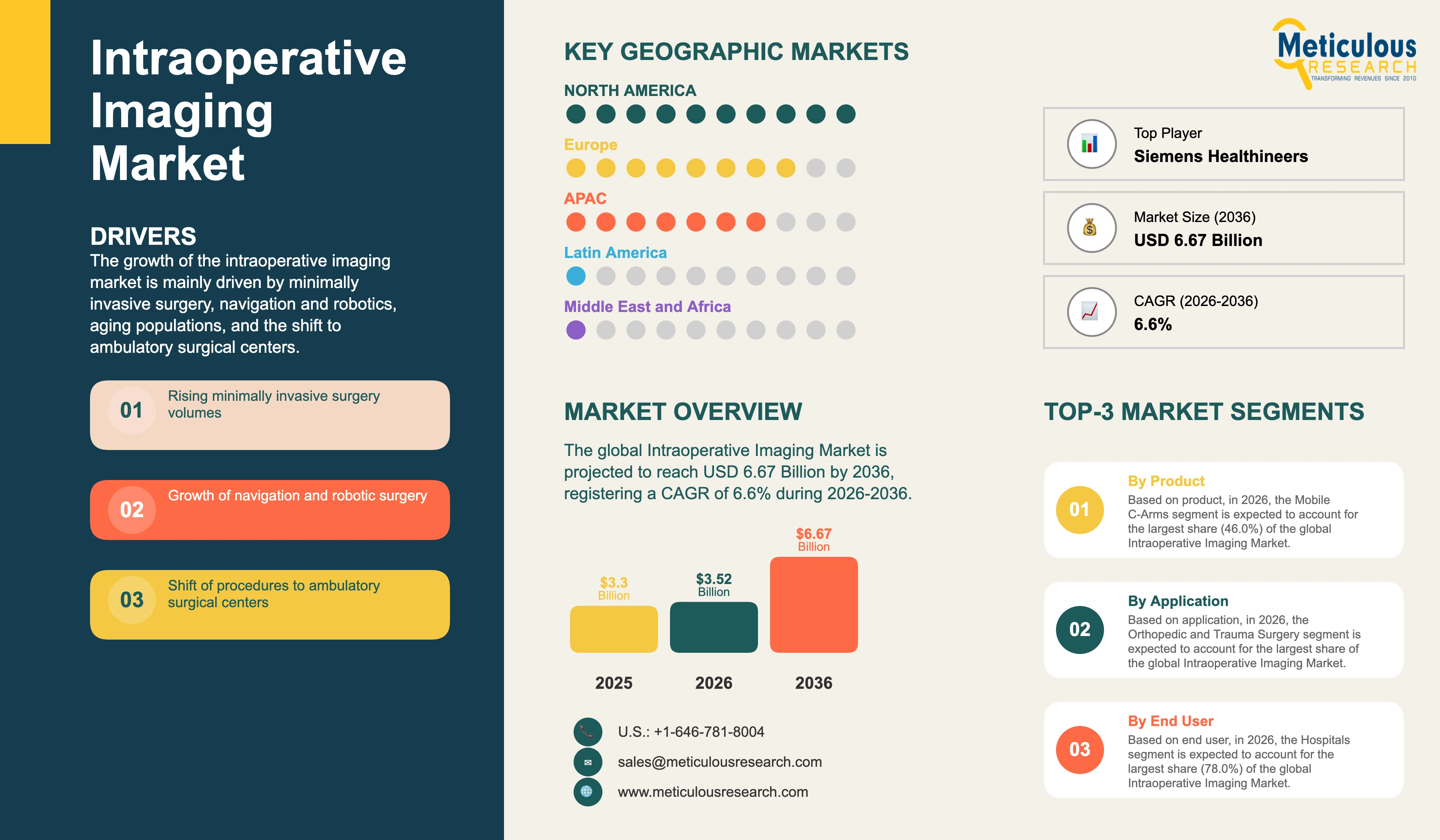
The global intraoperative imaging market was valued at USD 3.30 billion in 2025. This market is expected to reach USD 6.67 billion by 2036 from an estimated USD 3.52 billion in 2026, registering a CAGR of 6.6% during the forecast period (2026-2036).
- Published
- Nov 2026
- Pages
- 258
- Format
- PDF + Excel
- Report ID
- MRHC - 1042635
- Base year
- 2025
- 2025 · BASELINE
- $3.30B
- 2036
- $6.67B
- CAGR 2026–2036
- 6.6%
2025 baseline · 2026–2036 forecast at 6.6% CAGR · hover a bar for the value
Key highlights
On October 20, 2026, Siemens Healthineers introduced its new Cios Go mobile C-arm platform, including Cios Go and Cios Go ID with a display integrated on the C-arm, at the German Congress of Orthopedics and Traumatology (DKOU), noting that mobile C-arms are widely used in orthopedic, spine, vascular, and other minimally invasive procedures where real-time imaging supports intraoperative decision-making, according to the company's press release.
Siemens Healthineers received FDA clearance for CIARTIC Move, its first self-driving mobile C-arm for 2D fluoroscopy and 3D cone-beam CT imaging, which the company said can cut intraoperative imaging time roughly in half for spine surgeries and by 55% for pelvic surgeries compared with conventional mobile C-arms, according to HospiMedica.
On November 22, 2024, GE HealthCare added a Lung Suite to its OEC 3D mobile cone-beam CT C-arm, which was first introduced in 2021, and verified an interface with Intuitive's Ion robotic bronchoscopy system, bringing the number of third-party robotics, navigation, and augmented reality systems verified with its OEC Open interface to eight, according to the company's announcement.
Brainlab's Loop-X mobile imaging robot, which combines 2D and 3D imaging with robotic positioning and integrates with Brainlab's navigation software, and Medtronic's O-arm system, which is widely used with its StealthStation navigation platform for spine and cranial surgery, illustrate the growing integration of intraoperative imaging with navigation and robotics.
Hospitals continue to replace older image intensifier C-arms with flat-panel detector systems, which offer better image quality and lower radiation doses, while ambulatory surgical centers are adding compact mobile C-arms and 3D systems as more orthopedic and spine procedures move to outpatient settings. Many hospitals are also standardizing on a single vendor's C-arm fleet to simplify training, service, and image management across their operating rooms. Fleet standardization also helps hospitals negotiate better pricing and service terms, and it simplifies the integration of imaging data with hospital picture archiving systems and surgical navigation platforms. Imaging vendors are also adding artificial intelligence features that improve image quality at lower radiation doses.
By product, mobile c-arms account for the largest share of 46.0% in 2026, while intraoperative CT and cone-beam CT registers the highest CAGR.
By imaging dimension, 2D imaging systems account for the larger share in 2026, while 3D imaging systems register the higher CAGR.
By application, orthopedic and trauma surgery accounts for the largest share in 2026, while spine surgery registers the highest CAGR.
By end user, hospitals account for the largest share of 78.0% in 2026, while ambulatory surgical centers register the highest CAGR.
By geography, North America accounts for the largest share of 38.0% in 2026, while Asia-Pacific registers the highest CAGR of 9.0%.
Report summary
| Particulars | Details |
|---|---|
| Base Year | 2025 |
| Estimated Year | 2026 |
| Forecast Period | 2026-2036 |
| Market Size in 2025 | USD 3.30 billion |
| Market Size in 2026 | USD 3.52 billion |
| Market Size by 2036 | USD 6.67 billion |
| CAGR (2026-2036) | 6.6% |
| Format | PDF, Excel & Cloud Portal · 258 pages |
| Largest Segment by Product (2026) | Mobile C-Arms (46.0%) |
| Largest Segment by End User (2026) | Hospitals (78.0%) |
| Largest Region (2026) | North America (38.0%) |
| Fastest-Growing Region | Asia-Pacific (CAGR 9.0%) |
| Companies Profiled | 15 companies and other companies |
| Segments Covered | Product, Imaging Dimension, Application, End User, Geography |
| Countries Covered | U.S., Canada, Rest of North America, Germany, U.K., France, Italy, Spain, Netherlands, Switzerland, Belgium, Sweden, Denmark, Norway, Finland, Austria, Poland, Ireland, Rest of Europe, China, Japan, India, South Korea, Australia, Indonesia, Thailand, Singapore, Malaysia, Vietnam, Philippines, Taiwan, New Zealand, Rest of Asia-Pacific, Brazil, Mexico, Argentina, Colombia, Chile, Peru, Rest of Latin America, Saudi Arabia, U.A.E., Israel, South Africa, Turkey, Egypt, Rest of Middle East & Africa |
Report overview
Segments covered: product, application, end user.
The growth of this market is mainly driven by the rising volume of minimally invasive and image-guided surgeries, the growing use of surgical navigation and robotic systems that depend on intraoperative 3D imaging, the increasing number of orthopedic, spine, and neurosurgical procedures linked to aging populations, the need to confirm surgical results before the patient leaves the operating room, and the shift of surgical procedures to ambulatory surgical centers. However, factors such as the high cost of intraoperative CT and MRI systems, concerns about radiation exposure for patients and staff, space and workflow constraints in operating rooms, and limited capital budgets in many hospitals are expected to restrain the growth of this market to some extent. Nevertheless, continued innovation in automated and 3D imaging is expected to support steady growth.
Intraoperative imaging refers to imaging systems used inside the operating room during surgery to guide surgeons, confirm the position of implants and instruments, assess the completeness of tumor removal, and verify surgical results before the procedure ends. These systems include mobile C-arms that provide real-time 2D fluoroscopy and, in advanced models, 3D imaging, intraoperative computed tomography (CT) and cone-beam CT systems that provide high-quality 3D images, intraoperative ultrasound systems, intraoperative magnetic resonance imaging (MRI) systems, and fluorescence imaging and other optical systems that help surgeons visualize tissue, blood flow, and tumors.
This report covers the global intraoperative imaging market, including mobile C-arms, intraoperative CT and cone-beam CT systems, intraoperative ultrasound systems, intraoperative MRI systems, and fluorescence and other imaging systems used during surgery. The market is analyzed by product, application, end user, and geography. Fixed angiography systems in hybrid operating rooms, surgical navigation software, surgical robots, and pre-operative diagnostic imaging are analyzed in separate reports. The market is measured on a revenue basis, including system sales and related software and upgrades, at manufacturer selling prices.
Intraoperative imaging plays an important role in modern surgery because it allows surgeons to see anatomy and instruments in real time rather than relying only on pre-operative images, which may not reflect the patient's position or anatomy during surgery. In orthopedic and trauma surgery, mobile C-arms are used to guide fracture reduction and confirm implant placement. In spine surgery, intraoperative 3D imaging combined with navigation helps surgeons place screws accurately and reduces the need for revision surgery. In neurosurgery, intraoperative MRI and ultrasound help surgeons remove as much of a brain tumor as possible while protecting healthy tissue.
Mobile C-arms are the most widely used intraoperative imaging systems and are found in almost every hospital operating room suite. They are used in a wide range of procedures, including orthopedic, trauma, spine, vascular, urology, pain management, and cardiac procedures. Over the past decade, flat-panel detectors have largely replaced image intensifiers in new systems, offering better image quality, larger fields of view, and lower radiation doses. Advanced mobile C-arms, such as Siemens Healthineers' Cios Spin and CIARTIC Move and GE HealthCare's OEC 3D, also offer 3D cone-beam CT imaging, which allows surgeons to check results in three dimensions during surgery.
Intraoperative CT and cone-beam CT systems, such as Medtronic's O-arm, Brainlab's Loop-X, and mobile CT systems from Samsung NeuroLogica and others, provide higher-quality 3D images and are often used with surgical navigation and robotic systems. These systems are increasingly important as robotic-assisted spine and cranial surgery grows, because navigation and robotic systems require accurate 3D images of the patient's anatomy at the start of the procedure. Intraoperative MRI systems, such as those offered by IMRIS (Deerfield Imaging), are used mainly in neurosurgery at specialized centers because of their high cost and space requirements.
Mobile C-arms account for the largest share of the market by product, while intraoperative CT and cone-beam CT systems are the fastest-growing product. Orthopedic and trauma surgery is the largest application, while spine surgery is the fastest-growing application. Hospitals are the largest end user, while ambulatory surgical centers are the fastest-growing end user. 2D imaging systems account for the larger share by imaging dimension, while 3D imaging systems are growing faster. North America accounts for the largest share of the market, while Asia-Pacific is the fastest-growing region.
The market includes large medical imaging companies, such as Siemens Healthineers, GE HealthCare, Philips, Canon Medical Systems, Fujifilm, and Shimadzu, surgical technology companies that combine imaging with navigation and robotics, such as Medtronic, Brainlab, and Stryker, and specialized companies, such as Ziehm Imaging, IMRIS (Deerfield Imaging), Samsung NeuroLogica, Carl Zeiss Meditec, Esaote, and Hologic. Competition centers on image quality, radiation dose, ease of use, integration with navigation and robotics, footprint, and price.
Over the forecast period, the intraoperative imaging market is expected to grow steadily, supported by rising surgical volumes, the growth of navigation and robotic surgery, the replacement of older C-arms, the expansion of ambulatory surgical centers, and new technologies such as robotic and self-driving imaging systems and artificial intelligence. The pace of growth will depend on hospital capital budgets, reimbursement, workflow integration, and the adoption of 3D imaging outside specialized centers.
North America is expected to account for the largest share of 38.0% of the market in 2026, mainly due to high surgical volumes, early adoption of navigation and robotic surgery, high healthcare spending, and the presence of leading companies.
Asia-Pacific is projected to register the highest CAGR of 9.0% during the forecast period, driven by rising surgical volumes, hospital investment, adoption of minimally invasive surgery, and aging populations.
The report profiles 15 companies, including Siemens Healthineers, GE HealthCare, Philips, Medtronic, Brainlab, Ziehm Imaging, Canon Medical Systems, Fujifilm, Stryker, IMRIS (Deerfield Imaging), Samsung NeuroLogica, Shimadzu, Carl Zeiss Meditec, Esaote, and Hologic.
Navigation and robotic systems require accurate 3D images of the patient's anatomy, which are often acquired during surgery using intraoperative CT, cone-beam CT, or 3D mobile C-arms. These images allow the systems to register the patient's anatomy automatically and guide instruments accurately.
Many orthopedic, spine, and pain management procedures are moving to ambulatory surgical centers, which need compact, easy-to-use, and affordable imaging systems. This shift is making ambulatory surgical centers the fastest-growing end user of intraoperative imaging.
In 2026, the 2D imaging systems segment is expected to account for the larger share of the intraoperative imaging market, while the 3D imaging systems segment is projected to register the higher CAGR during the forecast period.
Report infographic
Market dynamics
18 factors across 5 forcesRising volume of minimally invasive and image-guided surgeries
Minimally invasive surgery has become the preferred approach for many procedures because it reduces pain, blood loss, complications, and recovery time compared with open surgery. However, minimally invasive procedures give surgeons a limited direct view of the anatomy, which increases their reliance on imaging to guide instruments and implants. Mobile C-arms, intraoperative CT, cone-beam CT, and ultrasound allow surgeons to see inside the body in real time and to confirm the position of instruments and implants during surgery.
The number of minimally invasive orthopedic, spine, vascular, urology, and pain management procedures is growing worldwide, supported by advances in surgical techniques, instruments, and imaging. This growth is a major driver of demand for intraoperative imaging systems, as many of these procedures cannot be performed safely without real-time imaging.
Siemens Healthineers has noted that mobile C-arms are widely used in orthopedic, spine, vascular, and other minimally invasive procedures where real-time imaging supports intraoperative decision-making, which highlights the central role of these systems in modern surgery.
Growing use of surgical navigation and robotics
Surgical navigation and robotic systems are increasingly used in spine, cranial, orthopedic, and other procedures to improve accuracy and consistency. These systems depend on accurate 3D images of the patient's anatomy, which are often acquired during surgery using intraoperative CT, cone-beam CT, or 3D mobile C-arms. Intraoperative imaging allows navigation and robotic systems to register the patient's anatomy automatically, reducing errors associated with using pre-operative images.
Imaging companies are building ecosystems that connect their systems with third-party navigation and robotic platforms. GE HealthCare's OEC Open interface, for example, had been verified with eight third-party robotics, navigation, and augmented reality systems by November 2024, including Intuitive's Ion robotic bronchoscopy system. Medtronic's O-arm works with its StealthStation navigation and robotic systems, while Brainlab's Loop-X integrates with Brainlab's navigation software. The growth of navigation and robotics is therefore expected to drive strong demand for 3D intraoperative imaging.
Aging populations and rising orthopedic, spine, and neurosurgical procedures
Aging populations are increasing the number of people with conditions that require surgery, such as fractures, osteoarthritis, degenerative spine disease, and brain tumors. Older patients are more likely to experience hip and other fractures that require surgical repair, and degenerative spine conditions are a leading cause of back pain and disability. These trends are increasing the volume of orthopedic, trauma, spine, and neurosurgical procedures, which are among the largest users of intraoperative imaging. Rising rates of obesity and diabetes also increase the complexity of many orthopedic and spine procedures, which increases reliance on imaging to guide implants accurately.
Population aging is particularly pronounced in Europe, Japan, China, and North America, where demand for orthopedic and spine surgery is expected to remain strong over the forecast period.
Need to confirm surgical results in the operating room
Intraoperative 3D imaging allows surgeons to check the position of implants, screws, and other devices before the patient leaves the operating room. Detecting and correcting misplaced implants during surgery can reduce the need for revision surgery, which is costly and carries additional risks for patients. Studies in spine and trauma surgery have shown that intraoperative 3D imaging can identify implant positioning problems that are not visible on 2D images.
Hospitals and surgeons are increasingly adopting intraoperative 3D imaging to improve quality, reduce revision rates, and avoid post-operative CT scans, which supports demand for cone-beam CT, intraoperative CT, and 3D mobile C-arms.
Shift of surgical procedures to ambulatory surgical centers
Many orthopedic, spine, pain management, and other procedures are moving from hospitals to ambulatory surgical centers, driven by lower costs, patient preference, and changes in reimbursement. In the U.S., the Centers for Medicare & Medicaid Services has added a growing number of orthopedic and spine procedures to the list of procedures that can be performed in ambulatory surgical centers. These centers need compact, easy-to-use, and affordable imaging systems, particularly mobile C-arms, and some are also adopting 3D imaging and navigation for spine procedures.
The growth of ambulatory surgical centers is expected to create significant new demand for intraoperative imaging, particularly for compact mobile C-arms with flat-panel detectors and advanced 3D capabilities. Ambulatory surgical centers typically have fewer imaging staff than hospitals, which increases the importance of easy-to-use systems with automated features. Surgeons' growing familiarity with 3D imaging also supports adoption in smaller hospitals.
Table of contents
12 chapters · 166 sections · 258 pages · click to expandSegmental analysis
| Segment | Largest share (2026) | Fastest growth (2026–2036) |
|---|---|---|
| By Product | Mobile C-arms | Intraoperative CT and cone-beam CT |
| By Imaging Dimension | — | Rapid growth of this |
| By Application | Orthopedic and trauma surgery | Spine surgery |
| By End User | Hospitals | Ambulatory surgical centers |
| Other segments | Hospitals | Ambulatory surgical centers |
By Product
- Intraoperative Imaging Market Analysis by Product
- The mobile C-arms segment is expected to account for the largest share of 46.0% of the global intraoperative imaging market.
- The large share of this segment is mainly due to the widespread use of mobile C-arms across almost all surgical specialties, including orthopedic, trauma, spine, vascular, urology, pain management, and cardiac procedures, their relatively low cost and flexibility compared with intraoperative CT and MRI systems, their presence in nearly every hospital operating room suite, and the ongoing replacement of older image intensifier C-arms with flat-panel detector systems.
- Mobile C-arms are offered by companies such as Siemens Healthineers, GE HealthCare, Philips, Ziehm Imaging, Canon Medical Systems, Fujifilm, and Shimadzu, and new products such as Siemens Healthineers' Cios Go platform, introduced in October 2026, continue to refresh the segment.
- Mobile C-arms range from compact mini C-arms used for hand and foot surgery, which are offered by companies such as Hologic, to full-size 2D C-arms and advanced 3D C-arms with cone-beam CT capabilities.
- The large installed base of mobile C-arms creates steady replacement demand, and the shift of procedures to ambulatory surgical centers is creating new demand for compact systems.
- However, the intraoperative CT and cone-beam CT segment is projected to register the highest CAGR during the forecast period.
- The rapid growth of this segment is driven by the growing use of navigation and robotic systems in spine, cranial, and orthopedic surgery, which require accurate 3D images, the need to confirm implant placement and surgical results during surgery, the introduction of robotic and self-driving 3D systems, such as Brainlab's Loop-X and Siemens Healthineers' CIARTIC Move, and new applications such as robotic bronchoscopy.
- Products in this segment include Medtronic's O-arm, Brainlab's Loop-X, GE HealthCare's OEC 3D, Siemens Healthineers' Cios Spin and CIARTIC Move, Ziehm Imaging's 3D systems, and mobile CT systems from Samsung NeuroLogica and others.
- The intraoperative ultrasound segment forms a significant segment, supported by the use of ultrasound in neurosurgery, liver and abdominal surgery, vascular surgery, and breast surgery, its lack of ionizing radiation, real-time imaging capabilities, and relatively low cost.
- Companies such as Esaote, Fujifilm, Canon Medical Systems, and Philips offer intraoperative ultrasound systems and probes.
- The intraoperative MRI segment accounts for a smaller share of the market because of the high cost and space requirements of these systems, which are used mainly in neurosurgery at specialized centers.
- However, intraoperative MRI provides the best soft-tissue imaging for brain tumor surgery and remains important in leading neurosurgical centers.
- The fluorescence and other imaging systems segment includes fluorescence imaging used in neurosurgery and other procedures, such as surgical microscopes with fluorescence capabilities offered by Carl Zeiss Meditec, and other optical imaging technologies.
- Product preferences in the intraoperative imaging market also differ significantly by region and by type of facility.
- Large academic hospitals in North America and Europe are the main buyers of intraoperative CT and MRI systems, while community hospitals, ambulatory surgical centers, and hospitals in emerging markets focus mainly on 2D mobile C-arms and, increasingly, on affordable 3D C-arms.
By Imaging Dimension
- Intraoperative Imaging Market Analysis by Imaging Dimension
- The 2D imaging systems segment is expected to account for the larger share of the global intraoperative imaging market.
- The large share of this segment is mainly due to the very large installed base of 2D mobile C-arms used across orthopedic, trauma, vascular, urology, pain management, and other procedures, the lower cost of 2D systems, their ease of use, and their suitability for real-time fluoroscopic guidance during most routine procedures.
- Intraoperative ultrasound systems, which provide real-time 2D images in neurosurgery, abdominal surgery, and vascular surgery, also contribute to this segment.
- Two-dimensional fluoroscopy remains the standard imaging method for many procedures because surgeons need continuous real-time images to guide instruments and implants, and new flat-panel 2D C-arms offer better image quality and lower dose than older systems.
- Replacement of image intensifier systems and demand from ambulatory surgical centers continue to support sales of 2D systems, particularly compact mobile C-arms designed for outpatient settings.
- However, the 3D imaging systems segment is projected to register the higher CAGR during the forecast period.
- The rapid growth of this segment is driven by the growing use of navigation and robotic surgery, which depend on intraoperative 3D images, the need to confirm implant placement before the patient leaves the operating room, the introduction of robotic and self-driving 3D systems such as Brainlab's Loop-X and Siemens Healthineers' CIARTIC Move, and the availability of 3D capabilities in more mid-range mobile C-arms.
- Intraoperative CT, cone-beam CT, 3D mobile C-arms, and intraoperative MRI are included in this segment.
By Application
- Intraoperative Imaging Market Analysis by Application
- The orthopedic and trauma surgery segment is expected to account for the largest share of the global intraoperative imaging market.
- The large share of this segment is mainly due to the high volume of orthopedic and trauma procedures, such as fracture fixation, joint replacement, and limb reconstruction, the routine use of mobile C-arms to guide fracture reduction and confirm implant placement, the rising number of fractures among older adults, and the growing use of 3D imaging to assess complex fractures, particularly in the pelvis, ankle, and wrist.
- Orthopedic and trauma surgery is one of the most common uses of mobile C-arms in hospitals.
- However, the spine surgery segment is projected to register the highest CAGR during the forecast period.
- The rapid growth of this segment is driven by the increasing number of spine procedures due to aging populations and degenerative spine disease, the growing use of navigation and robotic systems for spinal screw placement, the need to confirm screw positions during surgery to avoid revision surgery, and the shift of some spine procedures to ambulatory surgical centers.
- Spine surgery is one of the main applications for intraoperative CT, cone-beam CT, and 3D mobile C-arms, and Siemens Healthineers has reported that its CIARTIC Move system can significantly reduce imaging time in spine surgery.
- The neurosurgery segment forms the second-largest segment, supported by the use of intraoperative CT, MRI, ultrasound, and fluorescence imaging in brain tumor surgery, cranial procedures, and deep brain stimulation, as well as the growing use of navigation and robotics in cranial surgery.
- The cardiovascular surgery segment includes vascular procedures, cardiac surgery, and endovascular procedures that use mobile C-arms and ultrasound.
- The oncology surgery segment includes tumor resection procedures that use ultrasound, fluorescence, and 3D imaging to locate tumors and assess margins, while the ENT and other surgeries segment includes ear, nose, and throat procedures, urology, pain management, and other applications such as interventional pulmonology.
- The use of intraoperative imaging in new applications, such as robotic bronchoscopy and interventional pulmonology, is expected to create additional demand over the forecast period, particularly for cone-beam CT systems.
By End User
- Intraoperative Imaging Market Analysis by End User
- The hospitals segment is expected to account for the largest share of 78.0% of the global intraoperative imaging market.
- The large share of this segment is mainly due to the large number of surgical procedures performed in hospitals, the presence of multiple operating rooms requiring imaging systems, the use of advanced intraoperative CT, cone-beam CT, and MRI systems in large hospitals and academic medical centers, and hospitals' greater financial resources for purchasing expensive equipment.
- Hospitals perform complex trauma, spine, neurosurgical, and cardiovascular procedures that require advanced imaging.
- However, the ambulatory surgical centers segment is projected to register the highest CAGR during the forecast period.
- The rapid growth of this segment is driven by the shift of orthopedic, spine, pain management, and other procedures to outpatient settings, changes in reimbursement policies that allow more procedures to be performed in ambulatory surgical centers, the lower cost and greater convenience of these centers, and the introduction of compact and affordable mobile C-arms and 3D systems designed for outpatient use.
- The specialty clinics and other end users segment accounts for the remaining share of the market and includes orthopedic clinics, pain management clinics, and other outpatient facilities that use mobile C-arms and mini C-arms.
Other segments
- The hospitals segment is expected to account for the largest share of 78.0% of the intraoperative imaging market, while the ambulatory surgical centers segment is projected to register the highest CAGR during the forecast period.
Geographic analysis
North America
Largest shareIn 2026, North America is expected to account for the largest share of 38.0% of the global intraoperative imaging market. The large share of this region is mainly due to the high volume of surgical procedures in the U.S., the early and widespread adoption of navigation and robotic surgery, high healthcare spending, the presence of leading imaging and surgical technology companies, the large installed base of intraoperative imaging systems, and the rapid growth of ambulatory surgical centers. The FDA clearance of Siemens Healthineers' CIARTIC Move and GE HealthCare's expansion of its OEC 3D platform with new clinical applications illustrate continued innovation in the region. Canada also contributes to the regional market, supported by investment in hospital infrastructure and surgical capacity.
Asia-Pacific
Fastest growthAsia-Pacific is projected to register the highest CAGR of 9.0% during the forecast period. The rapid growth of this region is mainly driven by rising surgical volumes, growing investment in hospital infrastructure and operating rooms, increasing adoption of minimally invasive and image-guided surgery, aging populations in Japan, China, and South Korea, and expanding access to healthcare in India and Southeast Asia. Local manufacturers in China and India are also expanding the availability of affordable mobile C-arms, which supports wider adoption.
Europe
Europe accounts for a significant share of the market, supported by advanced healthcare systems, a large number of orthopedic, spine, and neurosurgical procedures, strong adoption of intraoperative 3D imaging and navigation in Germany and other countries, and the presence of companies such as Siemens Healthineers, Philips, Brainlab, Ziehm Imaging, Carl Zeiss Meditec, and Esaote. Siemens Healthineers introduced its Cios Go platform at the German Congress of Orthopedics and Traumatology in October 2026.
Latin America
Latin America accounts for a smaller share of the market, with demand concentrated in Brazil and Mexico, where private hospital groups are investing in surgical capacity, while the Middle East & Africa accounts for the smallest share, with growing investment in hospital infrastructure in Saudi Arabia, the U.A.E., and other Gulf countries. Regional differences in surgical volumes, healthcare spending, reimbursement, and adoption of navigation and robotic surgery shape the demand for intraoperative imaging around the world. Regions with growing hospital investment and rising surgical volumes are expected to see the fastest growth over the forecast period. Government programs to expand surgical capacity and reduce waiting lists in several countries are also expected to support demand for intraoperative imaging systems. Latin America and the Middle East & Africa account for smaller shares of the market, but demand is growing as private hospital groups in Brazil, Mexico, Colombia, Chile, Saudi Arabia, the U.A.E., Israel, and South Africa invest in modern operating rooms and minimally invasive surgery. In Latin America, most demand is for 2D mobile C-arms, with 3D systems adopted mainly by leading private hospitals.
Middle East & Africa
Saudi Arabia and the U.A.E. are building new hospitals with advanced surgical suites as part of national healthcare strategies, which creates demand for 3D imaging and navigation systems.
Competitive landscape
The global intraoperative imaging market is moderately consolidated, with the top five players estimated to account for about 60% of the market in 2025. The market includes large medical imaging companies, surgical technology companies that combine imaging with navigation and robotics, and specialized intraoperative imaging companies.
Siemens Healthineers offers a broad portfolio of mobile C-arms, including Cios Go, Cios Flow, Cios Spin, and the self-driving CIARTIC Move. GE HealthCare offers the OEC portfolio of mobile C-arms, including the OEC 3D cone-beam CT system and the OEC Open interface. Philips offers mobile C-arms and intraoperative ultrasound, while Medtronic offers the O-arm imaging system integrated with its StealthStation navigation and robotic platforms. Brainlab offers the Loop-X mobile imaging robot along with navigation software, and Ziehm Imaging specializes in mobile C-arms and 3D systems. Canon Medical Systems, Fujifilm, and Shimadzu offer mobile C-arms and ultrasound, Stryker offers navigation-integrated imaging solutions, IMRIS (Deerfield Imaging) offers intraoperative MRI, Samsung NeuroLogica offers mobile CT systems, Carl Zeiss Meditec offers surgical microscopes with fluorescence imaging, Esaote offers intraoperative ultrasound, and Hologic offers mini C-arms.
Companies in this market compete on image quality, radiation dose, ease of use, automation, integration with navigation and robotic systems, footprint, service, and price. Key strategies include launching new mobile C-arms and 3D systems, developing robotic and self-driving systems, building open ecosystems with third-party navigation and robotic platforms, incorporating AI, expanding in ambulatory surgical centers, and growing in emerging markets.
Recent competitive activity in the intraoperative imaging market has focused mainly on new product launches, automation, and ecosystem development. Siemens Healthineers introduced its Cios Go platform in October 2026 and received FDA clearance for CIARTIC Move, GE HealthCare expanded its OEC 3D platform with Lung Suite and a verified interface with Intuitive's Ion system in November 2024, and Brainlab continues to expand Loop-X adoption in spine and cranial surgery. These developments show how competition is shifting toward automated 3D imaging and integration with surgical robots and navigation.
We expect competition to intensify as companies seek to provide complete solutions for navigation and robotic surgery and as ambulatory surgical centers become an important customer segment. Companies with strong 3D imaging capabilities, automation, and open ecosystems are likely to gain share, while price competition is expected to increase in the 2D mobile C-arm segment, particularly in emerging markets.
Some of the key players operating in the intraoperative imaging market are Siemens Healthineers AG, GE HealthCare Technologies Inc., Koninklijke Philips N.V., Medtronic plc, Brainlab AG, Ziehm Imaging GmbH, Canon Medical Systems Corporation, Fujifilm Holdings Corporation, Stryker Corporation, IMRIS (Deerfield Imaging, Inc.), Samsung NeuroLogica Corp., Shimadzu Corporation, Carl Zeiss Meditec AG, Esaote S.p.A., and Hologic, Inc., among others.
- —
Siemens Healthineers introduced the Cios Go mobile C-arm platform at DKOU in October 2026 and received FDA clearance for the self-driving CIARTIC Move, while GE HealthCare added Lung Suite and a verified Intuitive Ion interface to its OEC 3D system in November 2024.
- Cios Go
- Cios Flow
- Cios Spin
Expert perspectives
The intraoperative imaging market is benefiting from fundamental changes in surgery, including the growth of minimally invasive procedures, the adoption of navigation and robotic systems, and the shift of procedures to ambulatory surgical centers. Intraoperative imaging has become an essential part of many surgical workflows, and the move from 2D to 3D imaging is increasing the value of imaging systems in the operating room.
Over the forecast period, the market is expected to grow at a CAGR of 6.6%, from USD 3.52 billion in 2026 to USD 6.67 billion in 2036. Growth will be supported by rising surgical volumes, navigation and robotics, the replacement of older systems, ambulatory surgical center expansion, and new automated and AI-enabled systems. The market's moderate growth rate reflects the large and mature installed base of 2D mobile C-arms, while 3D and automated systems grow much faster.
Among the market segments, mobile C-arms are the largest product, while intraoperative CT and cone-beam CT grow fastest. Orthopedic and trauma surgery is the largest application, while spine surgery grows fastest. Hospitals are the largest end user, while ambulatory surgical centers grow fastest. 2D imaging systems account for the larger share by imaging dimension, while 3D systems grow faster. North America is the largest region, and Asia-Pacific is the fastest-growing region at a CAGR of 9.0%.
In our view, the most important factor for the market over the forecast period will be the growth of navigation and robotic surgery, which depends on accurate intraoperative 3D imaging. As robotic systems become more common in spine, cranial, and orthopedic surgery, demand for cone-beam CT and intraoperative CT systems is expected to grow strongly. Imaging companies that integrate closely with robotic and navigation platforms, either through their own systems or through open interfaces, are best positioned to benefit.
We also expect automation and AI to become key differentiators, as hospitals look for ways to address staff shortages and improve operating room efficiency. Self-driving and robotic imaging systems can save time and reduce the workload of operating room teams, which may justify their higher prices. We also expect service contracts, software upgrades, and fleet management solutions to become a more important source of recurring revenue for imaging companies.
Overall, we believe the intraoperative imaging market will grow steadily over the forecast period, with 3D imaging, spine surgery, ambulatory surgical centers, and Asia-Pacific providing the fastest growth. Companies that combine strong imaging technology with automation, integration, and service will be best placed to capture this growth. Hospitals should evaluate imaging investments as part of broader operating room strategies that include navigation, robotics, and workflow automation.
Customer perspectives
Customers for intraoperative imaging systems include hospitals, academic medical centers, ambulatory surgical centers, and specialty clinics, while key decision-makers include surgeons, radiology and operating room managers, biomedical engineers, and procurement teams. Purchasing decisions depend mainly on image quality, radiation dose, ease of use, integration with navigation and robotic systems, footprint, reliability, service, total cost of ownership, and the range of procedures the system can support. Many hospitals also consider vendor service quality, uptime guarantees, and cybersecurity features, as connected imaging systems become part of the hospital network. Hospital buyers often prefer platforms that can be upgraded with 3D, navigation, and AI capabilities over time, while ambulatory surgical centers focus on compact size, price, and ease of use.
Spine Surgeon - U.S.
Intraoperative 3D imaging has changed how we do spine surgery. We can check every screw before closing, and our navigation system depends on those images.
This comment explains why spine surgery is the fastest-growing application and why intraoperative CT and cone-beam CT are the fastest-growing product.
This comment explains why mobile C-arms account for 46.0% of the market and why automation is becoming an important feature.
Orthopedic Surgeon - Ambulatory surgical center, U.S.
As we move more joint and spine procedures to our center, we need compact imaging that fits our rooms and our budget.
This comment explains why ambulatory surgical centers are the fastest-growing end user, even though hospitals account for 78.0% of the market, and why compact systems are in demand. Outpatient centers also value fast setup and short training times.
“In our hospital, mobile C-arms are used in almost every operating room every day, across many specialties. Ease of use and reliability matter a great deal because we do not always have a radiographer available.”
Frequently asked questions
The global intraoperative imaging market was valued at USD 3.30 billion in 2025, up from USD 3.12 billion in 2024, and is estimated at USD 3.52 billion in 2026. The market includes mobile C-arms, intraoperative CT and cone-beam CT, ultrasound, MRI, and fluorescence and other imaging systems used during surgery.
Cite this report
Meticulous Research. (2026). Intraoperative Imaging Market - Global Opportunity Analysis and Industry Forecast (2026-2036) (Report No. MRHC - 1042635). Meticulous Market Research Pvt. Ltd. https://www.meticulousresearch.com/product/intraoperative-imaging-market-7318