
Phasor Measurement Unit (PMU) Market (2025-2035)
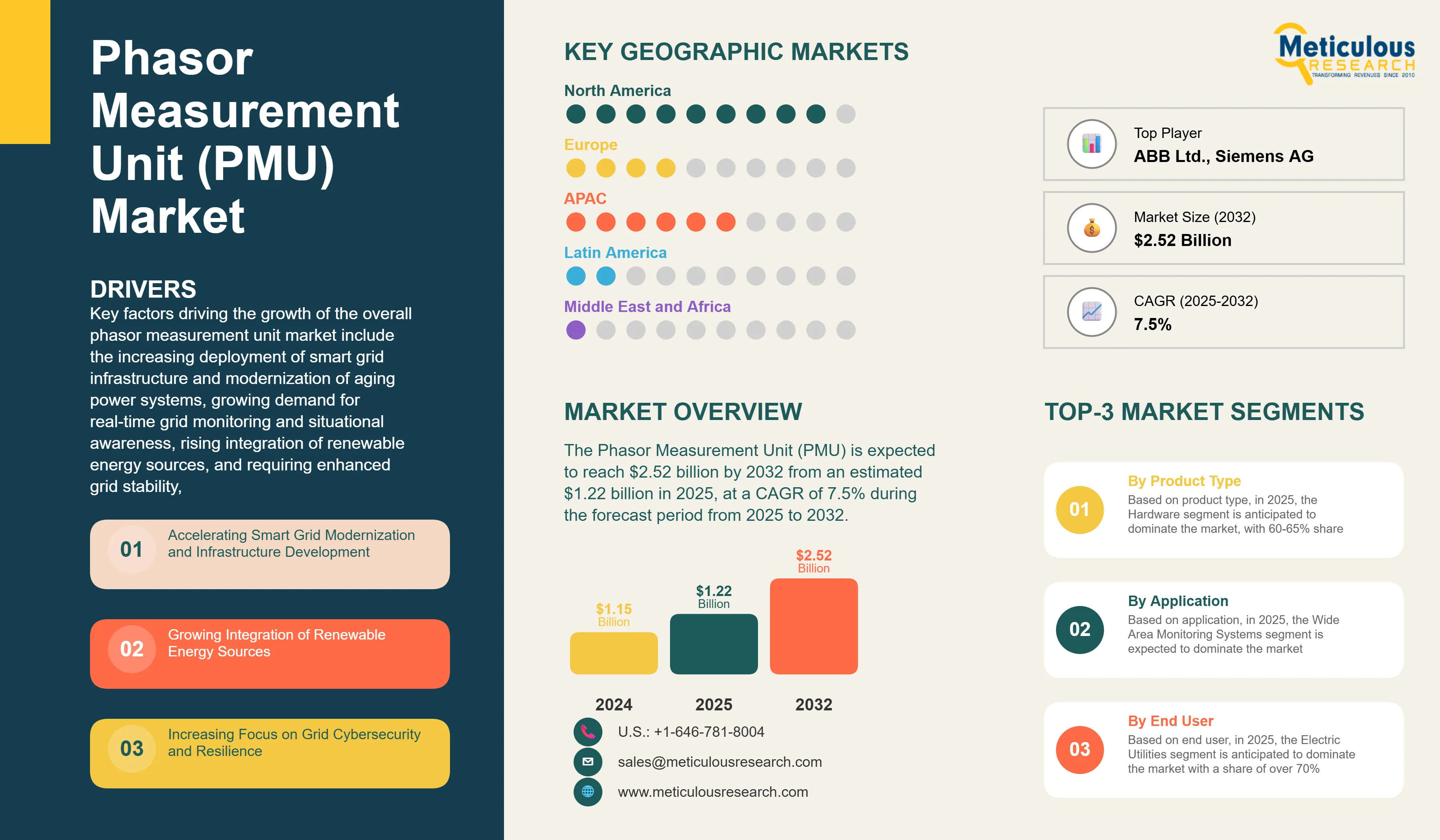
The Phasor Measurement Unit (PMU) was valued at USD 1.15 billion in 2024. This market is expected to reach $2.52 billion by 2032 from an estimated $1.22 billion in 2025, at a CAGR of 7.5% during the forecast period from 2025 to 2032. Phasor Measurement Unit (PMU) Market Size Key factors driving the
- Published
- Jun 2025
- Pages
- 210
- Format
- PDF + Excel
- Report ID
- MREP - 1041520
- Base year
- 2024
- 2024 · BASELINE
- $1.15B
- 2035
- $2.25B
- CAGR 2025–2035
- 7.5%
2024 baseline · 2025–2035 forecast at 7.5% CAGR · hover a bar for the value
Key highlights
The Phasor Measurement Unit (PMU) was valued at USD 1.15 billion in 2024.
This market is expected to reach $2.52 billion by 2032 from an estimated $1.22 billion in 2025, at a CAGR of 7.5% during the forecast period from 2025 to 2032.
In 2025, North America is anticipated to account for the major share of over 40-45% of the PMU market, reflecting the region's advanced smart grid initiatives, established IEEE C37.118 standards implementation, mature synchrophasor technology adoption, and comprehensive wide-area monitoring system deployments.
The market in Asia-Pacific is slated to record the highest CAGR of 8.5% during the forecast period of 2025-2035.
Europe follows as a significant market, driven by stringent grid code requirements, renewable energy integration mandates, cross-border electricity trading needs, advanced grid modernization programs, and the region's emphasis on energy security and sustainability contributing significantly to PMU adoption.
Latin America and the Middle East & Africa represent emerging markets with substantial growth potential, driven by grid expansion projects, increasing electrification rates, growing focus on power system reliability and efficiency, and expanding renewable energy integration requirements.
Report summary
| Particulars | Details |
|---|---|
| Number of Pages | 210 |
| Forecast Period | 2025-2035 |
| Base Year | 2024 |
| CAGR (Value) | 7.5% |
| Format | PDF, Excel & Cloud Portal · 210 pages |
| Market Size 2024 | USD 1.15 billion |
| Market Size 2025 | USD 1.22 billion |
| Market Size 2035 | USD 2.25 billion |
| Segments Covered | By Product Type, PMU Type, Communication Technology, Application, End-User |
| Countries Covered | North America (U.S., Canada, Mexico), Europe (Germany, France, U.K., Italy, Netherlands, Spain, Nordic Countries, and Rest of Europe), Asia-Pacific (China, Japan, South Korea, India, Australia, Southeast Asia, and Rest of Asia-Pacific), Latin America (Brazil, Mexico, Argentina, and Rest of Latin America), and the Middle East & Africa (UAE, Saudi Arabia, South Africa, and Rest of Middle East & Africa) |
Report overview
Segments covered: product type, pmu type, communication technology, installation type, application, end user. Regions: North America, Europe, Asia-Pacific, Latin America, Middle East & Africa.
Key factors driving the growth of the overall phasor measurement unit market include the increasing deployment of smart grid infrastructure and modernization of aging power systems, growing demand for real-time grid monitoring and situational awareness, rising integration of renewable energy sources requiring enhanced grid stability, accelerating adoption of synchrophasor technology for wide-area monitoring systems, increasing focus on grid cybersecurity and resilience, and stringent regulatory requirements for power quality and reliability standards. However, this growth is restrained by high initial capital investment and implementation costs, complex integration challenges with legacy grid infrastructure, limited skilled workforce for PMU deployment and maintenance, cybersecurity concerns related to data transmission and storage, and standardization issues across different regional markets.
Additionally, emerging opportunities in microgrid development and distributed energy resources integration, expansion of electric vehicle charging infrastructure requiring grid optimization, growing demand for predictive maintenance and asset management solutions, development of advanced analytics and artificial intelligence applications, and rising adoption of cloud-based grid management platforms are poised to offer significant growth opportunities for market players. The integration of Internet of Things (IoT) capabilities and machine learning algorithms in PMU systems are emerging as notable trends in this market.
Report infographic
Market dynamics
4 factors across 1 forceAccelerating Smart Grid Modernization and Infrastructure Development
The demand for PMUs is experiencing unprecedented growth due to the global push toward smart grid modernization and the need to upgrade aging electrical infrastructure. Utilities worldwide are investing heavily in grid modernization projects to improve reliability, efficiency, and resilience of power systems. Modern power grids require sophisticated monitoring and control systems that can provide real-time visibility into grid conditions, enabling operators to make informed decisions and respond quickly to system disturbances.
The rise of distributed energy resources, coupled with increasing consumer expectations for reliable power supply, is driving this trend. Advanced PMU solutions, featuring high-precision time synchronization, multi-parameter measurement capabilities, and seamless communication interfaces, appeal to utility companies who prioritize grid stability and operational efficiency while meeting regulatory compliance requirements.
The smart grid revolution has gained significant momentum in recent years, with governments and utilities demanding sophisticated measurement solutions that can accommodate complex grid dynamics, support renewable energy integration, and maintain grid stability under varying load conditions.
Growing Integration of Renewable Energy Sources
Phasor measurement units offer enhanced grid stability compared to traditional monitoring systems due to their ability to provide synchronized measurements across wide geographic areas, support dynamic grid analysis, and enable real-time assessment of renewable energy impacts. The renewable energy integration process, which includes managing variable generation patterns, grid frequency fluctuations, and power quality issues, results in improved system reliability and operational efficiency. Research suggests that PMU-based monitoring systems may provide superior performance in managing renewable energy integration challenges due to their high-speed data acquisition and advanced analytical capabilities.
PMUs are regarded as critical enablers for renewable energy integration due to their role in supporting grid stability assessment, power system oscillation monitoring, and voltage regulation in networks with high renewable penetration. Modern PMU solutions maintain measurement accuracy under dynamic conditions while providing enhanced situational awareness, making them particularly attractive to utility operators, independent power producers, and renewable energy developers.
The growing body of research supporting renewable energy integration benefits, combined with regulatory mandates for clean energy adoption, has led to increased PMU deployment among utilities seeking to optimize renewable energy utilization and maintain grid stability.
Increasing Focus on Grid Cybersecurity and Resilience
In recent decades, the power industry has undergone continuous digital transformation, with the implementation of advanced monitoring and control systems representing a critical evolution. This trend was further accelerated following major grid disturbances and cybersecurity incidents that highlighted the need for enhanced grid visibility and protection. The grid security segment is experiencing faster growth as utilities increasingly require secure, reliable monitoring solutions for critical infrastructure protection, cyber threat detection, and system resilience enhancement.
The cybersecurity and resilience market is being driven by increasing cyber threats targeting critical infrastructure, growing regulatory requirements for grid security, rising adoption of advanced threat detection systems, and expanding implementation of security-by-design principles. PMUs, being recognized as essential components for secure grid monitoring and situational awareness, are positioned to capture a significant share of this growing security-focused market.
Furthermore, regulatory agencies and grid operators are increasingly emphasizing cybersecure PMU solutions due to their critical role in maintaining grid stability and their potential vulnerability to cyber attacks, further driving demand for advanced security features and encrypted communication protocols.
Market Segmentation Analysis
Table of contents
14 chapters · 189 sections · 210 pages · click to expandGeographic analysis
North America
Largest shareIn 2025, North America is anticipated to account for the major share of over 40-45% of the PMU market, reflecting the region's advanced smart grid initiatives, established IEEE C37.118 standards implementation, mature synchrophasor technology adoption, and comprehensive wide-area monitoring system deployments.
Asia-Pacific
Fastest growthThe market in Asia-Pacific is slated to record the highest CAGR of 8.5% during the forecast period of 2025-2035. This growth is fueled by rapid grid expansion and modernization programs, massive transmission infrastructure investments, increasing electricity demand, growing renewable energy capacity additions, and government initiatives supporting smart grid development. For PMU deployment specifically, Asia-Pacific's growth is further strengthened by major utility digitalization programs, expanding interconnection projects, and increasing focus on grid reliability and operational efficiency.
Europe
Europe follows as a significant market, driven by stringent grid code requirements, renewable energy integration mandates, cross-border electricity trading needs, advanced grid modernization programs, and the region's emphasis on energy security and sustainability contributing significantly to PMU adoption.
Latin America
Latin America and the Middle East & Africa represent emerging markets with substantial growth potential, driven by grid expansion projects, increasing electrification rates, growing focus on power system reliability and efficiency, and expanding renewable energy integration requirements.
Competitive landscape
The phasor measurement unit market is characterized by a mix of established power system equipment manufacturers, specialized PMU technology providers, and emerging innovative companies. Leading players in the global PMU market include ABB Ltd., Siemens AG, Schneider Electric SE, General Electric Company (GE Vernova), Hitachi Energy Ltd., Eaton Corporation plc, Mitsubishi Electric Corporation, Schweitzer Engineering Laboratories Inc. (SEL), Qualitrol Corporation, Arbiter Systems Inc., VIAVI Solutions Inc., Grid Solutions (GE Grid Solutions), NR Electric Co. Ltd., Reason Tecnologia S.A., and others. These companies are focusing on strategies such as advanced PMU technology development, integration with IoT and edge computing capabilities, strategic partnerships with utilities and system integrators, expansion of product portfolios to include comprehensive synchrophasor solutions, enhancement of cybersecurity features, and development of AI-powered analytics platforms to strengthen their market position.
- ABB Ltd.
- Siemens AG
- Schneider Electric SE
- General Electric Company (GE Vernova)
- Hitachi Energy Ltd.
- Eaton Corporation plc
- Mitsubishi Electric Corporation
- Schweitzer Engineering Laboratories Inc. (SEL)
- Qualitrol Corporation
- Arbiter Systems Inc.
- VIAVI Solutions Inc.
- Grid Solutions (GE Grid Solutions)
- NR Electric Co. Ltd.
- Reason Tecnologia S.A.
Frequently asked questions
The phasor measurement unit market is projected to reach USD 2.52 billion by 2035 from USD 1.22 billion in 2025, at a CAGR of 7.5% during the forecast period.
Cite this report
Meticulous Research. (2025). Phasor Measurement Unit (PMU) Market - Global Opportunity Analysis and Industry Forecast (2025-2035) (Report No. MREP - 1041520). Meticulous Market Research Pvt. Ltd. https://www.meticulousresearch.com/product/phasor-measurement-unit-market-6203