Patient Registry Software Market (2026-2036)
The global patient registry software market was valued at USD 1.85 billion in 2025 and is projected to reach USD 5.52 billion by 2036 from USD 2.04 billion in 2026, at a CAGR of 10.5% during the forecast period from 2026 to 2036.
- Published
- Feb 2026
- Pages
- 262
- Format
- PDF + Excel
- Report ID
- MRHC - 10413
- Base year
- 2025
- 2025 · BASELINE
- $1.85B
- 2036
- $5.52B
- CAGR 2026–2036
- 10.5%
2025 baseline · 2026–2036 forecast at 10.5% CAGR · hover a bar for the value
Key highlights
The global patient registry software market is projected to reach USD 5.52 billion by 2036.
The market is expected to grow at a CAGR of 10.5% from 2026 to 2036.
Disease registries are expected to dominate the market by registry type, accounting for the largest revenue share in 2026
Cloud-based solutions are projected to witness the fastest growth among software types through 2036.
Population health management is expected to be the largest functionality segment in 2026.
Hospitals and medical practices are projected to be the dominant end-user segment in 2026.
North America is expected to hold the largest market share in 2026.
Asia-Pacific and Europe are projected to experience steady growth from 2026 to 2036
Report summary
| Particulars | Details |
|---|---|
| Market Size by 2036 | USD 5.52 Billion |
| Market Size in 2026 | USD 2.04 Billion |
| Revenue Growth Rate (2026-2036) | CAGR of 10.5% |
| Format | PDF, Excel & Cloud Portal · 262 pages |
| Dominating Registry Type | Disease Registries |
| Fastest Growing Deployment Type | Cloud-Based Solutions |
| Largest Functionality Segment | Population Health Management |
| Dominant End-User Segment | Hospitals and Medical Practices |
| Leading Geographic Region | North America |
| Base Year | 2025 |
| Forecast Period | 2026 to 2036 |
Report overview
Segments covered: type, delivery, functionality, database, pricing model, end user.
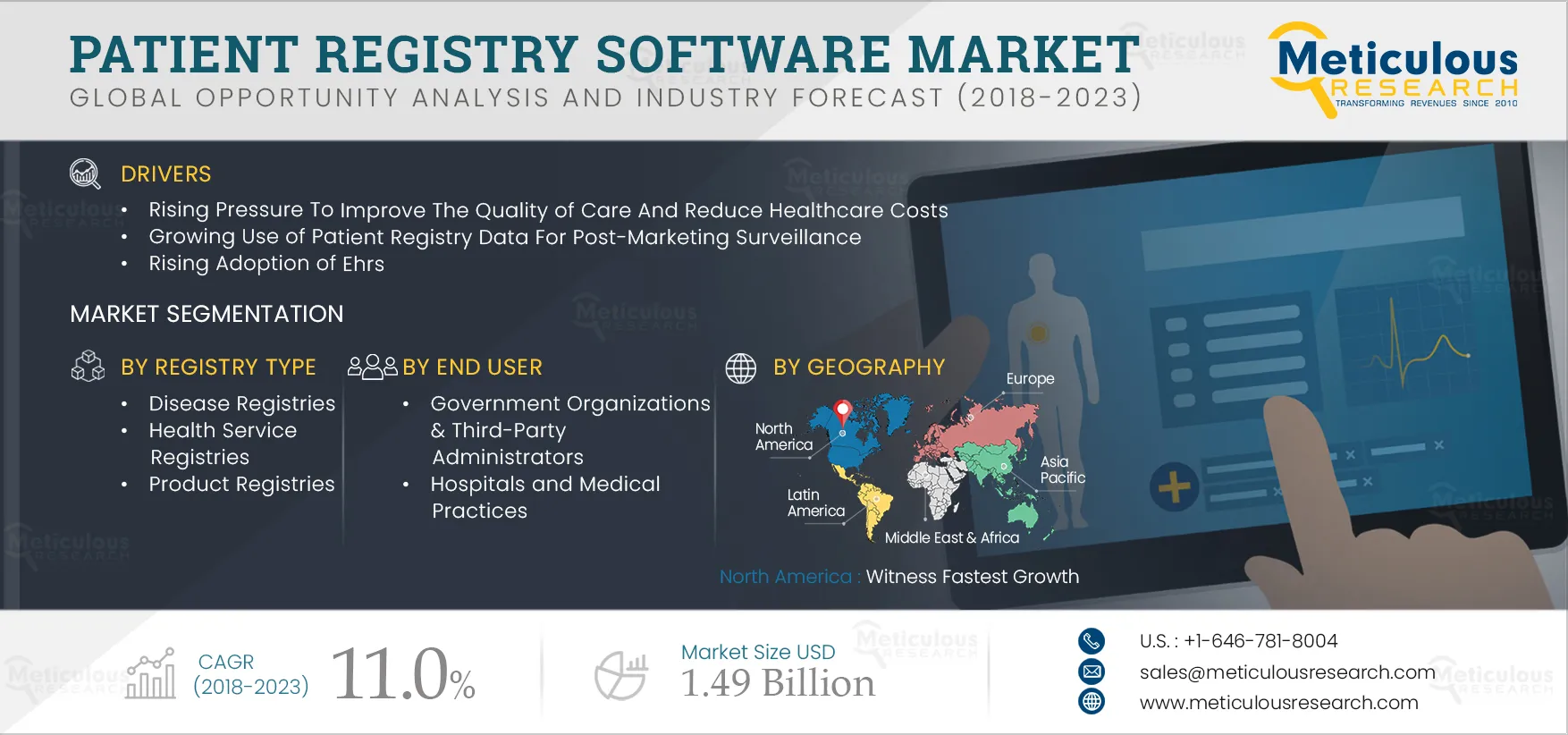
The patient registry software solutions are used to collect, store, and manage patient data for various purposes, including clinical research, post-marketing surveillance, and population health management. The growth of the patient registry software market is driven by the increasing adoption of electronic health records (EHRs), the rising pressure to improve the quality of care and reduce healthcare costs, and the growing use of patient registry data for post-marketing surveillance. Additionally, the growing emphasis on population health management initiatives and the expansion of cloud-based solutions are expected to support the growth of this market throughout the forecast period.
The global patient registry software market is mainly driven by technological advancements, regulatory requirements, and the growing emphasis on data-driven healthcare decision-making. Patient registry software is a fundamental component in modern healthcare, enabling applications ranging from clinical trial management to public health surveillance and post-marketing surveillance. The market includes key manufacturers such as Phytel, Inc. (an IBM Corporation Company), Quintiles IMS Holdings, Inc., and McKesson Corporation, alongside emerging specialized manufacturers focusing on specific disease areas and functionalities.
The transition from paper-based records to electronic health records (EHRs) has been one of the most significant market drivers. This shift has created substantial demand for patient registry software that can integrate with EHRs and other healthcare IT systems to provide a comprehensive view of the patient journey. Furthermore, the integration of advanced analytics and artificial intelligence (AI) is expanding the addressable market for patient registry software, enabling new applications in predictive modeling, risk stratification, and personalized medicine. The development of cloud-based patient registry solutions has revolutionized the accessibility and scalability of registry platforms, enabling healthcare organizations to manage patient data more efficiently.
Report infographic
Market dynamics
4 factors across 3 forcesRising Adoption of EHRs and Pressure to Improve Quality of Care
The primary drivers of the patient registry software market include the rising adoption of electronic health records (EHRs) and the increasing pressure to improve the quality of care while reducing healthcare costs. Government regulations promoting the adoption of EHRs, combined with declining software costs, are accelerating market penetration. The increasing demand for advanced data management and analytics capabilities in healthcare organizations is fueling growth in the registry software segment. The proliferation of chronic diseases and the growing need for disease-specific registries is creating sustained demand for specialized registry solutions. Additionally, the expansion of population health management programs is driving demand for registry software used in health monitoring and preventive care initiatives.
Table of contents
14 chapters · 116 sections · 262 pages · click to expandSegmental analysis
| Segment | Largest share (2026) | Fastest growth (2026–2036) |
|---|---|---|
| By Registry Type | Disease Registries | Drug and device registries |
| By End-User | Hospitals and Medical Practices | — |
By Registry Type
- Disease registries represent the largest registry type segment in the patient registry software market, driven by the increasing prevalence of chronic diseases and the growing need for data to support clinical research and public health initiatives.
- The development of new and advanced disease registries for a wide range of conditions, including cardiovascular diseases, diabetes, cancer, and rare diseases, has accelerated market adoption.
- Disease registries enable healthcare organizations to track patient outcomes, monitor treatment effectiveness, and identify best practices for disease management.
- The integration of disease-specific registries with EHRs and clinical decision support systems is expanding the addressable market.
- Major manufacturers including Phytel, Inc., Quintiles IMS Holdings, Inc., and Veradigm LLC have established strong market positions through continuous innovation and product development focused on disease-specific solutions.
- Drug and device registries represent the fastest-growing registry type segments within the patient registry software market.
- The proliferation of new pharmaceutical products and medical devices has created substantial demand for post-marketing surveillance registries.
- Regulatory requirements for post-market surveillance of drugs and devices are driving adoption of specialized registry software among pharmaceutical and medical device manufacturers.
- The expansion of real-world evidence initiatives for regulatory submissions is creating new opportunities for registry software providers.
- Manufacturers such as McKesson Corporation and Inovalon Holdings, Inc. are investing heavily in drug and device registry solutions to address emerging market demands and regulatory requirements.
By End-User
- Hospitals and medical practices represent the largest end-user segment for patient registry software, driven by the increasing adoption of EHRs and the growing emphasis on quality improvement initiatives.
- Healthcare organizations are utilizing patient registry software to track patient outcomes, monitor treatment effectiveness, and support clinical decision-making.
- The integration of registry software with EHRs and other clinical systems is enabling healthcare providers to access comprehensive patient data and improve care coordination.
- The development of user-friendly registry platforms that integrate seamlessly with existing healthcare IT infrastructure is accelerating adoption among hospitals and medical practices.
- Major healthcare systems are investing in advanced registry solutions to support population health management and value-based care models.
- Pharmaceutical and medical device manufacturers are expanding their use of patient registry software for post-marketing surveillance, real-world evidence collection, and regulatory compliance.
- The increasing regulatory requirements for post-market surveillance are driving adoption of specialized registry solutions among pharmaceutical and device companies.
- The use of patient registries to collect real-world evidence for regulatory submissions and health economic studies is creating new opportunities for registry software providers.
- Companies such as Quintiles IMS Holdings, Inc. and Medidata Solutions are developing specialized registry solutions tailored to the needs of pharmaceutical and device manufacturers.
- The expansion of real-world evidence initiatives is expected to drive continued growth in this end-user segment.
Geographic analysis
North America
Largest shareNorth America is expected to hold the largest share of the global patient registry software market in 2026, driven by the advanced healthcare infrastructure, high adoption of EHRs, and strong regulatory framework for data management. The U.S. has emerged as a major market for patient registry software, with numerous healthcare organizations implementing advanced registry solutions. Canada is also experiencing significant growth in patient registry adoption, driven by government initiatives to improve healthcare quality and efficiency. The region has established manufacturers such as Phytel, Inc. (IBM), Optum, Inc., and Health Catalyst, Inc. driving innovation in registry solutions. The key companies operating in the North America patient registry software market are Phytel, Inc., Optum, Inc., Health Catalyst, Inc., Inovalon Holdings, Inc., and Cerner Corporation.
Europe
Europe and Asia-Pacific are projected to experience steady growth in the patient registry software market, driven by the adoption of advanced healthcare technologies and increasing focus on population health management. Europe is characterized by a strong demand for data privacy-compliant registry solutions and advanced analytics capabilities. The expansion of healthcare IT initiatives across European countries is creating demand for patient registry software.
Asia-Pacific
Asia-Pacific is experiencing rapid growth driven by the expansion of healthcare infrastructure, increasing adoption of EHRs, and growing demand for population health management solutions. The region offers significant opportunities for registry software providers, with countries such as China, Japan, and India investing heavily in healthcare IT infrastructure.
Latin America
Latin America and the Middle East & Africa are emerging markets with growing demand for patient registry software, driven by healthcare infrastructure development and increasing adoption of digital health solutions.
Competitive landscape
- Phytel, Inc. (IBM Corporation)
- Quintiles IMS Holdings, Inc.
- McKesson Corporation
- Medidata Solutions
- Veradigm LLC
- Inovalon Holdings, Inc.
- Health Catalyst, Inc.
- Optum, Inc.
- Allscripts Healthcare Solutions
- Cerner Corporation
Frequently asked questions
The global patient registry software market is valued at USD 2.04 billion in 2026 and is expected to reach USD 5.52 billion by 2036.
Cite this report
Meticulous Research. (2026). Patient Registry Software Market - Global Opportunity Analysis and Industry Forecast (2026-2036) (Report No. MRHC - 10413). Meticulous Market Research Pvt. Ltd. https://www.meticulousresearch.com/product/patient-registry-software-market-4227