Retinal Implants Market (2026-2036)
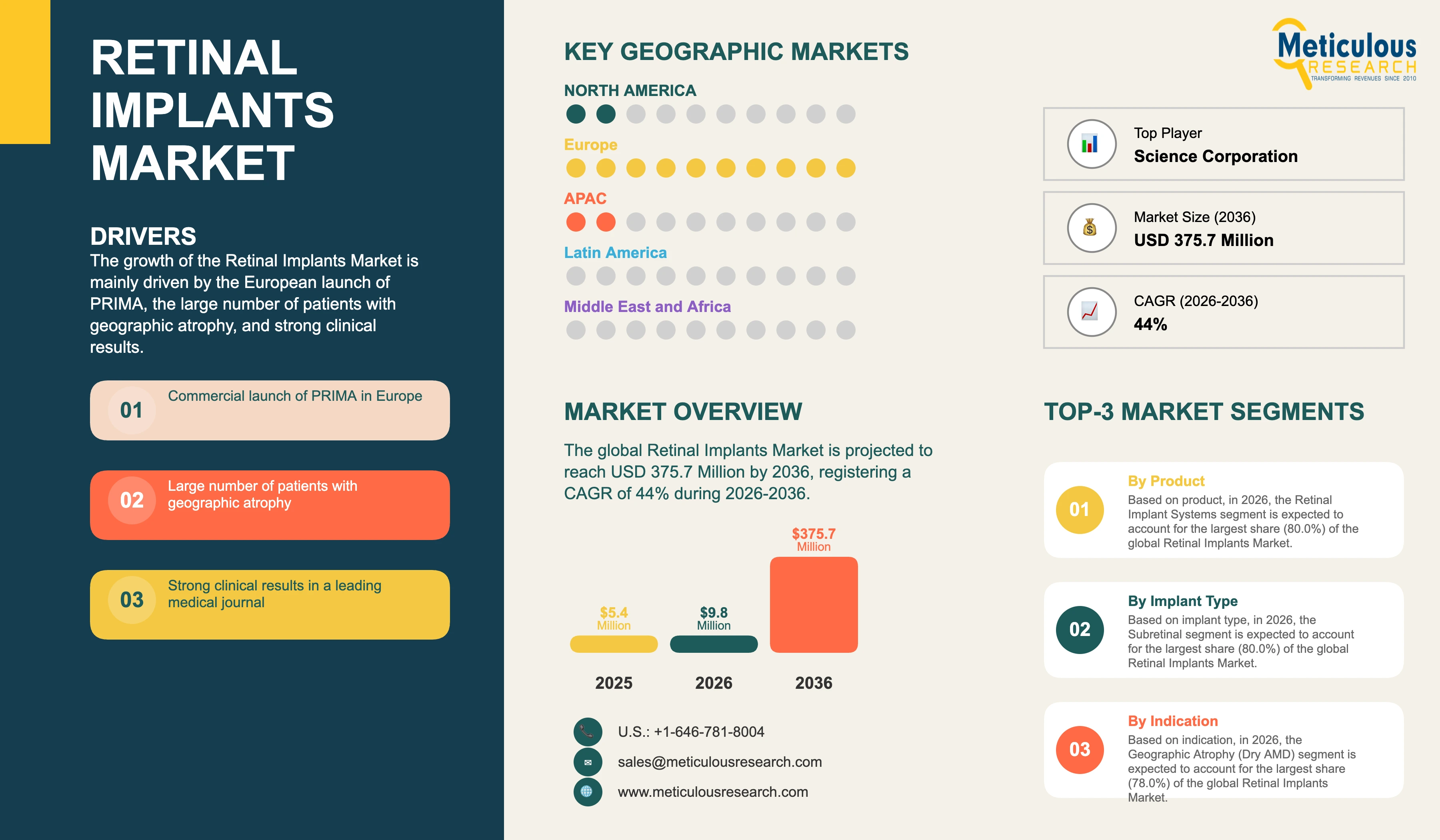
The global retinal implants market was valued at USD 5.4 million in 2025. This market is expected to reach USD 375.7 million by 2036 from an estimated USD 9.8 million in 2026, registering a CAGR of 44.0% during the forecast period (2026-2036).
- Published
- Nov 2026
- Pages
- 222
- Format
- PDF + Excel
- Report ID
- MRHC - 1042605
- Base year
- 2025
- 2025 · BASELINE
- $5.4M
- 2036
- $375.7M
- CAGR 2026–2036
- 44.0%
2025 baseline · 2026–2036 forecast at 44.0% CAGR · hover a bar for the value
Key highlights
Science Corporation launched its PRIMA retinal implant commercially in Europe on July 22, 2026, after receiving a CE mark under the EU Medical Device Regulation from DEKRA. The approval allows sales across 30 European countries, and PRIMA is the first brain-computer interface device to receive CE marking for form vision restoration, meaning the ability to read letters, numbers, and words, according to Science Corporation.
In the PRIMA clinical study of 38 patients across 17 sites, patients with geographic atrophy gained a mean of 25.5 letters on the ETDRS eye chart, and 84% of patients regained the ability to read letters, numbers, and words, according to Science Corporation and Healio. The results were published in the New England Journal of Medicine in January 2026 by Holz and colleagues.
Science Corporation expected to implant its first commercial patient in August 2026, most likely in Germany, and planned to treat dozens of patients in 2026 and around 200 patients in 2027, according to a Bloomberg report carried by Business Today. The company plans to expand to Italy and the Netherlands soon after Germany, according to reports by STAT and the Financial Times summarized by Advisory Board.
PRIMA received FDA Breakthrough Device designation and, in July 2026, two Humanitarian Use Device designations, one for advanced geographic atrophy and one for Stargardt disease. A Humanitarian Use Device designation is not an approval, and the company must still obtain a Humanitarian Device Exemption before selling in the U.S., according to MobiHealthNews and Science Corporation. Science hopes to enter the U.S. market in 2027.
Science Corporation raised USD 230 million in a Series C round in March 2026, bringing its total funding to about USD 490 million, much of which is being used for the commercial rollout of PRIMA, according to MobiHealthNews and Science Corporation. Science bought the PRIMA technology from Pixium Vision in 2024, and the technology was first developed by researchers at Stanford University.
In China, the IMIE 256 epiretinal implant, developed by IntelliMicro Medical and Golden Eye Bionic, allowed a completely blind patient with retinitis pigmentosa to recognize basic Chinese characters and move around indoors on her own in a 2026 clinical trial at Xiangya Hospital, according to CGTN. Hangzhou-based Nanochap Electronics raised 300 million yuan in May 2026 to fund clinical trials of its retinal and visual cortex implants, according to G-Medtech. These developments show that the market is moving from research toward early sales, led by Europe, with new products being tested in China and Australia.
By product, retinal implant systems account for the largest share of 80.0% in 2026, while external devices and upgrades register the highest CAGR.
By implant type, subretinal accounts for the largest share in 2026 and also registers the highest CAGR.
By indication, geographic atrophy (dry AMD) accounts for the largest share in 2026 and also registers the highest CAGR.
By end user, hospitals account for the largest share of 70.0% in 2026, while specialty eye hospitals and clinics register the highest CAGR.
By geography, Europe accounts for the largest share of 66.0% in 2026, while North America registers the highest CAGR of 55.8%.
Report summary
| Particulars | Details |
|---|---|
| Base Year | 2025 |
| Estimated Year | 2026 |
| Forecast Period | 2026-2036 |
| Market Size in 2025 | USD 5.4 million |
| Market Size in 2026 | USD 9.8 million |
| Market Size by 2036 | USD 375.7 million |
| CAGR (2026-2036) | 44.0% |
| Format | PDF, Excel & Cloud Portal · 222 pages |
| Largest Segment by Product (2026) | Retinal Implant Systems (80.0%) |
| Largest Segment by End User (2026) | Hospitals (70.0%) |
| Largest Region (2026) | Europe (66.0%) |
| Fastest-Growing Region | North America (CAGR 55.8%) |
| Companies Profiled | 6 companies and other companies |
| Segments Covered | Product, Implant Type, Indication, End User, Geography |
| Countries Covered | U.S., Canada, Germany, France, Italy, Netherlands, Spain, U.K., Switzerland, Belgium, Austria, Sweden, Denmark, Norway, Finland, Poland, Ireland, Rest of Europe, China, Japan, India, South Korea, Australia, Singapore, Taiwan, Thailand, Malaysia, Indonesia, Vietnam, Philippines, New Zealand, Rest of Asia-Pacific, Brazil, Mexico, Argentina, Colombia, Chile, Peru, Rest of Latin America, Saudi Arabia, U.A.E., Israel, Turkey, South Africa, Egypt, Rest of Middle East & Africa |
Report overview
Segments covered: product, implant type, indication, end user.
The market is at a very early commercial stage, and the high growth rate reflects a small starting base rather than a large existing business.
The growth of this market is mainly driven by the European commercial launch of Science Corporation's PRIMA subretinal implant for geographic atrophy in July 2026, the very large number of people who have lost central vision to geographic atrophy and have no treatment that brings vision back, strong clinical results published in the New England Journal of Medicine in 2026, the expected U.S. launch of PRIMA through the FDA's Humanitarian Device Exemption pathway, and new funding and clinical trials for retinal implants in China and Australia. In addition, the growing number of implanted patients will create steady demand for replacement glasses, software updates, and training services. However, the high cost of the implant and surgery, the lack of settled reimbursement in most countries, the limited quality of the vision that current devices restore, and the history of earlier retinal implant makers that left the market are expected to restrain the growth of this market to some extent.
A retinal implant, also called a retinal prosthesis or bionic eye, is a medical device that gives back some vision to people who have lost sight because the light-sensing cells of the retina have died. In diseases such as geographic atrophy, the advanced form of dry age-related macular degeneration, and retinitis pigmentosa, the photoreceptor cells stop working, but many of the nerve cells behind them remain alive. A retinal implant places a small electronic chip or electrode array on, under, or behind the retina and sends signals to these remaining nerve cells. The brain then learns to read these signals as patterns of light. Most systems also include a pair of glasses with a camera or a light projector and a small processor that turns images into signals for the implant.
This report covers the global retinal implants market, including retinal implant systems, which consist of the implant and the first set of glasses and processor supplied at the time of surgery, external devices and upgrades, such as replacement glasses, processors, and software updates bought later by implanted patients, and services, such as surgical support, device fitting, and vision training provided or charged by the manufacturer. The market is analyzed by product, implant type, indication, end user, and geography. Market size is measured on a revenue basis at manufacturer selling prices and includes commercial sales and paid early access and clinical supply. Surgeon and hospital fees, implants placed in the visual cortex of the brain, such as Cortigent's Orion and Neuralink's Blindsight, gene therapies, and drug treatments are not included.
The need for treatments that bring back lost sight is very large among older adults and people with inherited eye disease. Science Corporation states that geographic atrophy linked to age-related macular degeneration affects more than five million people worldwide. Two drugs, Syfovre and Izervay, are approved in the U.S. to slow the growth of geographic atrophy lesions, but neither drug brings back vision that has already been lost. Retinitis pigmentosa and other inherited retinal diseases add a smaller but important group of patients, many of them working-age adults, who lose their sight over many years. For most of these patients, low vision aids and support services have been the only options until now.
Retinal implants have a long history, but earlier products did not build lasting businesses. A 2024 study in Ophthalmology Science noted that more than 500 people had received retinal implants by that time, but that the Argus II from Second Sight, the Alpha IMS and Alpha AMS from Retina Implant AG, and the IRIS II from Pixium Vision were no longer sold. These earlier devices gave users the ability to see light, shapes, and movement, but most users could not read, and sales were too low to support the companies. Second Sight later moved its focus to the Orion device, which is placed on the brain, through its successor Cortigent, part of Vivani Medical.
The market entered a new stage in 2026 with the first approval of a retinal implant that helps patients read again. Science Corporation's PRIMA system uses a tiny wireless photovoltaic chip, about 2 by 2 millimeters, placed under the retina in the area of the macula where vision has been lost, together with glasses that project near-infrared light onto the chip. The chip turns this light into small electrical pulses that reach the remaining retinal cells. Because the light is not visible to the human eye, the system works alongside the patient's remaining side vision. PRIMA is the first retinal implant to show that patients with geographic atrophy can read letters, numbers, and words again, and it received a CE mark in July 2026.
Other developers are working on different implant designs and placements in the eye, mainly for retinitis pigmentosa. In China, IntelliMicro Medical, based in Changsha, makes the IMIE 256 epiretinal implant, which it co-developed with Golden Eye Bionic of California, and Nanochap Electronics of Hangzhou has started human trials of a retinal implant with up to 1,280 channels. In Australia, Bionic Vision Technologies is developing a 44-electrode implant placed in the suprachoroidal space behind the retina, which was tested in four patients with retinitis pigmentosa over more than two and a half years. Researchers at Fudan University in Shanghai and other groups are also working on new light-sensitive materials for future implants.
In 2026, retinal implant systems account for the largest share of the market by product, while external devices and upgrades are the fastest-growing product. Subretinal implants account for the largest share by implant type and are also the fastest-growing type. Geographic atrophy (dry AMD) accounts for the largest share by indication and is also the fastest-growing indication. Hospitals are the largest end user, while specialty eye hospitals and clinics are the fastest-growing end user. Europe accounts for the largest share of the market, while North America is the fastest-growing region.
Over the forecast period, the retinal implants market is expected to grow quickly from a small base as PRIMA reaches more European countries, as the device is expected to enter the U.S., as reimbursement decisions are made country by country, and as new devices from China and Australia move through clinical trials. Growth will depend heavily on how quickly surgeons are trained, how health systems decide to pay for the implant, and how well patients do in daily life after the first commercial implants. Because the market depends on very few companies, delays at any one company could change the market outlook.
Retinal implants could help patients with other diseases that destroy the light-sensing cells of the retina. Science Corporation is testing PRIMA in patients with inherited retinal diseases that affect central vision, such as Stargardt disease and retinitis pigmentosa, and it has received an FDA Humanitarian Use Device designation for Stargardt disease. Many patients with these diseases lose their sight at a younger age than patients with geographic atrophy, so the benefit of an implant can last for many years. Epiretinal and suprachoroidal implants from IntelliMicro Medical, Golden Eye Bionic, Nanochap Electronics, and Bionic Vision Technologies are also being tested mainly in retinitis pigmentosa. Wider approved uses would increase the number of patients who can receive an implant and would support growth in the other inherited retinal diseases segment. Patient groups for inherited retinal diseases are well organized in many countries, which can help raise awareness and support clinical trial enrollment.
Each patient who receives a retinal implant will use the external glasses and processor for many years. These devices can be replaced, repaired, and upgraded with new features, such as better image processing or the zoom feature included in PRIMA, which lets users enlarge letters. Software updates can also improve how images are turned into signals for the implant without new surgery. As the number of implanted patients grows, this installed base is expected to create steady repeat revenue for manufacturers. Vision training and follow-up services are also needed after each implant. External devices and upgrades are the fastest-growing product segment in this market, and companies that design their systems to accept future upgrades are expected to benefit most from this opportunity. Lighter and better-looking glasses could also make users more willing to wear the device for longer each day.
Asia-Pacific has a large and aging population with a high number of people with retinal disease, and several local companies are developing retinal implants. In China, IntelliMicro Medical's IMIE 256 implant allowed a completely blind patient with retinitis pigmentosa to recognize basic Chinese characters and move around indoors on her own in a 2026 trial at Xiangya Hospital, and Nanochap Electronics has started human trials of its retinal implant. China has also named brain-computer interfaces as a future industry in its 2026 government work report, according to CGTN. In Australia, Bionic Vision Technologies continues to develop its suprachoroidal implant with the Centre for Eye Research Australia and the Bionics Institute. Once local products are approved by regulators, such as China's NMPA, and once international products enter the region, Asia-Pacific could become an important source of growth. Local companies may also be able to offer lower prices than Western companies, which could widen access in the region.
Hospitals are expected to account for the largest share of 70.0% of the market in 2026, while specialty eye hospitals and clinics are projected to register the highest CAGR as more surgical centers are trained.
Europe is expected to account for the largest share of 66.0% of the market in 2026, mainly due to PRIMA's CE mark covering 30 European countries, the start of commercial implants in Germany, and reimbursement applications across the region.
North America is projected to register the highest CAGR of 55.8% during the forecast period, driven mainly by the expected U.S. launch of PRIMA in 2027 through the Humanitarian Device Exemption pathway and the large number of patients with geographic atrophy.
The report profiles 6 companies: Science Corporation, IntelliMicro Medical, Golden Eye Bionic, Nanochap Electronics, Bionic Vision Technologies, and Vivani Medical (Cortigent). Science Corporation is the only company with a retinal implant on commercial sale in 2026.
Earlier devices, such as the Argus II, Alpha IMS, and IRIS II, gave users limited vision, mainly light, shapes, and movement, and most users could not read. Sales were too low to support the companies, and the products were withdrawn.
Science Corporation hopes to launch PRIMA in the U.S. in 2027, subject to an FDA decision. The device has FDA Breakthrough Device designation and two Humanitarian Use Device designations, but it must still receive a Humanitarian Device Exemption from the FDA before it can be sold.
Report infographic
Market dynamics
16 factors across 5 forcesCommercial launch of PRIMA in Europe
The most important driver of the retinal implants market is the commercial launch of Science Corporation's PRIMA system in Europe. PRIMA received a CE mark under the EU Medical Device Regulation in July 2026, which allows it to be sold in 30 European countries. Science expected its first commercial implant in Germany in August 2026 and planned to treat dozens of patients in 2026 and around 200 patients in 2027, according to Bloomberg. The company has also started country-by-country reimbursement applications and is preparing clinical sites across Europe, with Italy and the Netherlands expected to follow Germany.
Before this launch, there was no retinal implant on sale anywhere in the world for geographic atrophy, and the earlier implants for retinitis pigmentosa had been withdrawn. The launch of PRIMA turns the market from one based mainly on clinical trials into one with real commercial sales. Each new hospital that is trained and each new country that agrees to pay for the device is expected to add patients, which makes the European rollout the main source of market revenue in the early years of the forecast period.
Large number of patients with geographic atrophy and no way to restore vision
Geographic atrophy is a leading cause of blindness in older adults in developed countries around the world. Science Corporation states that it affects more than five million people worldwide, and the number is rising as populations age in Europe, North America, Japan, China, and other countries. In geographic atrophy, the cells of the central retina die, and patients lose the ability to read, recognize faces, and see fine detail, while side vision usually remains. The drugs approved in the U.S. for geographic atrophy, Syfovre and Izervay, can slow the growth of the damaged area but cannot bring back lost vision.
This large group of patients with no treatment that restores sight creates strong demand for retinal implants. Even if only a small share of patients with advanced geographic atrophy in both eyes are suitable for an implant and choose to have one, the number of procedures could grow to many thousands each year over the forecast period. Eye doctors see these patients routinely in their clinics but have had little to offer them beyond low vision aids, which is expected to support referrals once the device becomes more widely available and paid for.
Strong clinical results published in a leading medical journal
The clinical results for PRIMA have been much stronger than those of earlier retinal implants. In the study published in the New England Journal of Medicine in January 2026 by Holz and colleagues, patients with geographic atrophy who received the implant gained a mean of 25.5 letters on the ETDRS eye chart, which is more than five lines. Science Corporation reported that 84% of patients regained the ability to read letters, numbers, and words, that 80% achieved a clinically meaningful gain in vision at 12 months, and that patients did not lose any of their existing natural vision after the implant was placed.
Publication in a leading medical journal is important because it gives eye surgeons, hospitals, and payers confidence that the device works. Strong data also supports reimbursement applications in Europe and the FDA review in the U.S. As more data is collected from commercial patients, doctors will be able to judge which patients benefit most, which is expected to make referral and patient selection easier over time.
Expected U.S. entry through the humanitarian device exemption pathway
The U.S. is expected to become a major market for retinal implants once a device is approved. PRIMA has received FDA Breakthrough Device designation and, in July 2026, two Humanitarian Use Device designations, one for very advanced geographic atrophy that has caused blindness in both eyes and one for Stargardt disease. Science Corporation must still obtain a Humanitarian Device Exemption before it can sell in the U.S., but the company hopes to bring PRIMA to the U.S. market in 2027, according to Bloomberg and Advisory Board.
The Humanitarian Device Exemption pathway is designed for devices that treat rare conditions and offers a shorter route to market than a full approval. A U.S. launch would give the market access to a large number of patients and to higher device prices than in many other countries. This is the main reason North America is expected to be the fastest-growing region over the forecast period, although U.S. sales will start from a very small base and will depend on the timing of the FDA decision.
New funding and clinical programs for retinal implants
Investment in retinal implants and other vision-restoring devices has increased sharply since 2025 in the U.S. and China. Science Corporation raised USD 230 million in March 2026, bringing its total funding to about USD 490 million, which makes it one of the best-funded companies in the field. In China, Nanochap Electronics raised 300 million yuan in May 2026 to fund clinical trials of its retinal and visual cortex products, and the IMIE 256 implant from IntelliMicro Medical showed good results in a new clinical trial at Xiangya Hospital in 2026. In Australia, Bionic Vision Technologies continues to work toward bringing its suprachoroidal implant to market. Science Corporation is also testing PRIMA in patients with Stargardt disease and retinitis pigmentosa. This new funding allows companies to run larger trials, build manufacturing, train surgeons, and prepare for commercial launches, which is expected to increase the number of products and countries in the market over the forecast period.
Table of contents
12 chapters · 165 sections · 222 pages · click to expandSegmental analysis
| Segment | Largest share (2026) | Fastest growth (2026–2036) |
|---|---|---|
| By Product | Subretinal | External devices and upgrades |
By Product
- The subretinal segment is expected to account for the largest share of the retinal implants market, and it is also projected to register the highest CAGR during the forecast period.
- The geographic atrophy (dry AMD) segment is expected to account for the largest share of the retinal implants market, and it is also projected to register the highest CAGR during the forecast period.
Geographic analysis
Europe
Largest shareIn 2026, Europe is expected to account for the largest share of 66.0% of the global retinal implants market. The large share of this region is mainly due to the CE mark for PRIMA under the EU Medical Device Regulation, which allows sales across 30 European countries, the start of commercial implants in Germany in 2026, plans to expand to Italy and the Netherlands soon after, the presence of leading clinical trial centers, such as the University Hospital of Bonn, and the country-by-country reimbursement applications that Science Corporation has started across the region. Europe also has a large aging population with a high number of patients with geographic atrophy, and many European countries have health systems that pay for new medical devices once they have been reviewed. Science Corporation also has an office in Paris, close to many of the clinical sites that took part in the PRIMA trials, and France is a possible next market once reimbursement is in place.
North America
Fastest growthNorth America is projected to register the highest CAGR of 55.8% during the forecast period. The rapid growth of this region is mainly driven by the expected U.S. launch of PRIMA in 2027 through the FDA's Humanitarian Device Exemption pathway, the two Humanitarian Use Device designations granted in July 2026 for advanced geographic atrophy and Stargardt disease, the large number of patients with geographic atrophy in the U.S., higher device prices than in most other countries, and the large network of retinal surgeons and specialty eye centers. Science Corporation is based in California, and the U.S. was also the home market of the earlier Argus II. The region starts from a very small base in 2026, when implants are limited to clinical trials, so its growth rate depends mainly on the timing of the FDA decision and on how Medicare and private insurers choose to pay for the device. Canada is expected to follow the U.S. after separate approval.
Asia-Pacific
Asia-Pacific accounts for a notable share of the market, supported by clinical trials of retinal implants in China and Australia, a large and aging population with retinal disease, and growing investment in brain-computer interface and vision restoration companies. In China, IntelliMicro Medical's IMIE 256 implant and Nanochap Electronics' retinal implant are in human trials, and China named brain-computer interfaces as a future industry in its 2026 government work report. In Australia, Bionic Vision Technologies continues to develop its suprachoroidal implant. Japan and South Korea also have aging populations and advanced eye care systems, which make them potential markets once devices are approved there. Approval of local devices by China's NMPA would be an important step for growth in this region over the forecast period.
Latin America
Latin America and the Middle East & Africa account for small shares of the market in 2026, as retinal implants are not yet sold commercially in these regions. Over the forecast period, private eye hospitals in Brazil, Mexico, Saudi Arabia, the U.A.E., and Israel are expected to be the first to offer retinal implants, mainly to patients who can pay themselves or who have private insurance. Growth in these regions will depend on local regulatory approvals, the training of retinal surgeons, and the willingness of manufacturers to enter smaller markets after they have built their businesses in Europe and North America. Some countries in the Gulf region have a history of adopting new medical devices early in private hospitals, which could support early sales.
Competitive landscape
The global retinal implants market is highly concentrated and at a very early stage. In 2026, Science Corporation is the only company with a retinal implant on commercial sale, and it is estimated to account for nearly all market revenue. Other companies are in clinical trials or early development, and several earlier companies have left the market. Because of this, the number of real competitors that can be profiled is small.
Science Corporation, based in Alameda, California, with offices in Paris, is the market leader with its PRIMA subretinal implant, which received a CE mark in July 2026 and is being launched in Europe. The company has raised about USD 490 million in total and is working with the FDA on a U.S. launch. IntelliMicro Medical, based in Changsha, China, makes the IMIE 256 epiretinal implant, which it co-developed with Golden Eye Bionic of Pasadena, California, a company founded by researchers who worked on the Argus implants. Nanochap Electronics of Hangzhou has started human trials of a retinal implant and raised 300 million yuan in 2026. Bionic Vision Technologies of Melbourne, Australia, is developing a suprachoroidal implant. Cortigent, part of Vivani Medical, holds the technology from Second Sight, the maker of the Argus II, and is now focused on its Orion cortical device, which is outside the scope of this market.
Companies in this market compete on the quality of the vision their devices restore, the ability of patients to read and recognize objects, surgical safety, the long-term reliability of the implant, the design and comfort of the glasses, the number of approved indications, clinical evidence, reimbursement, and the support they offer to hospitals and patients. Key strategies include running clinical trials in new diseases, seeking regulatory approvals in new countries, building networks of trained surgical centers, applying for reimbursement, raising funds, and developing implants with more electrodes and better image processing.
Recent competitive activity in the retinal implants market has focused on regulatory approvals, funding, and clinical trials. Science Corporation received its CE mark and two FDA Humanitarian Use Device designations in July 2026 and raised USD 230 million in March 2026. IntelliMicro Medical reported new clinical results for its IMIE 256 implant in June 2026, and Nanochap Electronics raised new funds in May 2026 to expand clinical trials.
We expect Science Corporation to remain the clear market leader for most of the forecast period, as it is the only company with an approved product and a clear path to the U.S. market. Chinese companies are expected to enter their home market once they receive NMPA approval, and they may later compete in other price-sensitive markets. Because the market needs strong clinical evidence, regulatory approvals, trained surgeons, and long-term patient support, the number of new entrants is expected to stay small. Larger medical device companies may also enter the market through partnerships or acquisitions once commercial demand is proven.
Some of the key players operating in the retinal implants market are Science Corporation, IntelliMicro Medical Co., Ltd., Golden Eye Bionic, LLC, Nanochap Electronics Co., Ltd., Bionic Vision Technologies Pty Ltd, and Vivani Medical, Inc. (Cortigent), among others.
- —
Science Corporation received a CE mark for PRIMA and launched it in Europe in July 2026, received two FDA Humanitarian Use Device designations in the same month, and raised USD 230 million in March 2026. In China, the IMIE 256 implant showed new trial results, and Nanochap Electronics raised 300 million yuan.
- Science Corporation
- IntelliMicro Medical Co., Ltd.
- Golden Eye Bionic, LLC
- Nanochap Electronics Co., Ltd.
- Bionic Vision Technologies Pty Ltd
- Vivani Medical, Inc. · Cortigent
Expert perspectives
The retinal implants market changed in 2026, when the CE mark and European launch of Science Corporation's PRIMA gave patients with geographic atrophy the first approved device that can restore their ability to read. Earlier retinal implants proved that the idea could work, but they gave limited vision and did not build lasting businesses. PRIMA's clinical results, published in the New England Journal of Medicine, are much stronger, and the device targets a disease that affects millions of older adults.
Over the forecast period, the market is expected to grow at a CAGR of 44.0%, from USD 9.8 million in 2026 to USD 375.7 million in 2036. This high growth rate reflects the very small size of the market today. Growth will be driven mainly by the rollout of PRIMA across Europe, its expected entry into the U.S., new approved uses in other retinal diseases, the approval of new devices in China and other countries, and repeat sales of glasses, processors, and services to implanted patients.
Among the market segments, retinal implant systems are the largest product, while external devices and upgrades grow fastest. Subretinal implants are both the largest and the fastest-growing implant type, and geographic atrophy (dry AMD) is both the largest and the fastest-growing indication. Hospitals are the largest end user, while specialty eye hospitals and clinics grow fastest. Europe is the largest region, and North America is the fastest-growing region at a CAGR of 55.8%.
In our view, the single most important factor for the retinal implants market over the forecast period will be reimbursement. The device has a CE mark and strong clinical data, but most patients are older adults who cannot pay for it themselves. The speed at which health systems in Germany, Italy, the Netherlands, France, and other countries agree to pay, and the decisions of Medicare and private insurers after U.S. approval, will decide how fast the number of patients grows. Long-term data on how patients use the device in daily life will also be important for these decisions.
We also see the ability to build a network of trained surgical centers and to support patients over many years as key factors for success. The history of earlier retinal implant makers has made patients, surgeons, and payers cautious, and companies will need to show that they can provide service, spare parts, and upgrades for the life of the implant. Our market estimates are based on early company plans and clinical data, and actual results could differ widely from the forecast if launches, approvals, or reimbursement decisions are delayed.
Overall, we believe the retinal implants market will grow quickly from a small base over the forecast period, with external devices and upgrades, subretinal implants, geographic atrophy, specialty eye hospitals and clinics, and North America providing the fastest growth. Companies with strong clinical data, approved products, funding to support a long launch period, and plans for long-term patient support will be best positioned to capture this growth.
Customer perspectives
Retinal Surgeon - Specialty Eye Center, U.S.
Many of my patients with advanced geographic atrophy have been asking about this device. Once it is approved here and insurers cover it, we expect strong interest.
“For years we could only tell these patients that we could slow the disease, not bring their vision back. Now we have something to offer, but every case still needs a funding decision.”
“After the surgery, the real work begins for the patient and for our team. Patients need many weeks of training to learn to read with the glasses, and they will need new glasses and updates over the years.”
Frequently asked questions
The global retinal implants market was valued at USD 5.4 million in 2025, up from USD 4.6 million in 2024, and is estimated at USD 9.8 million in 2026, the first year of commercial PRIMA sales in Europe. The market includes retinal implant systems, external devices and upgrades, and services.
Cite this report
Meticulous Research. (2026). Retinal Implants Market - Global Opportunity Analysis and Industry Forecast (2026-2036) (Report No. MRHC - 1042605). Meticulous Market Research Pvt. Ltd. https://www.meticulousresearch.com/product/retinal-implants-market-7288