Patient Identity Management Market (2026-2036)
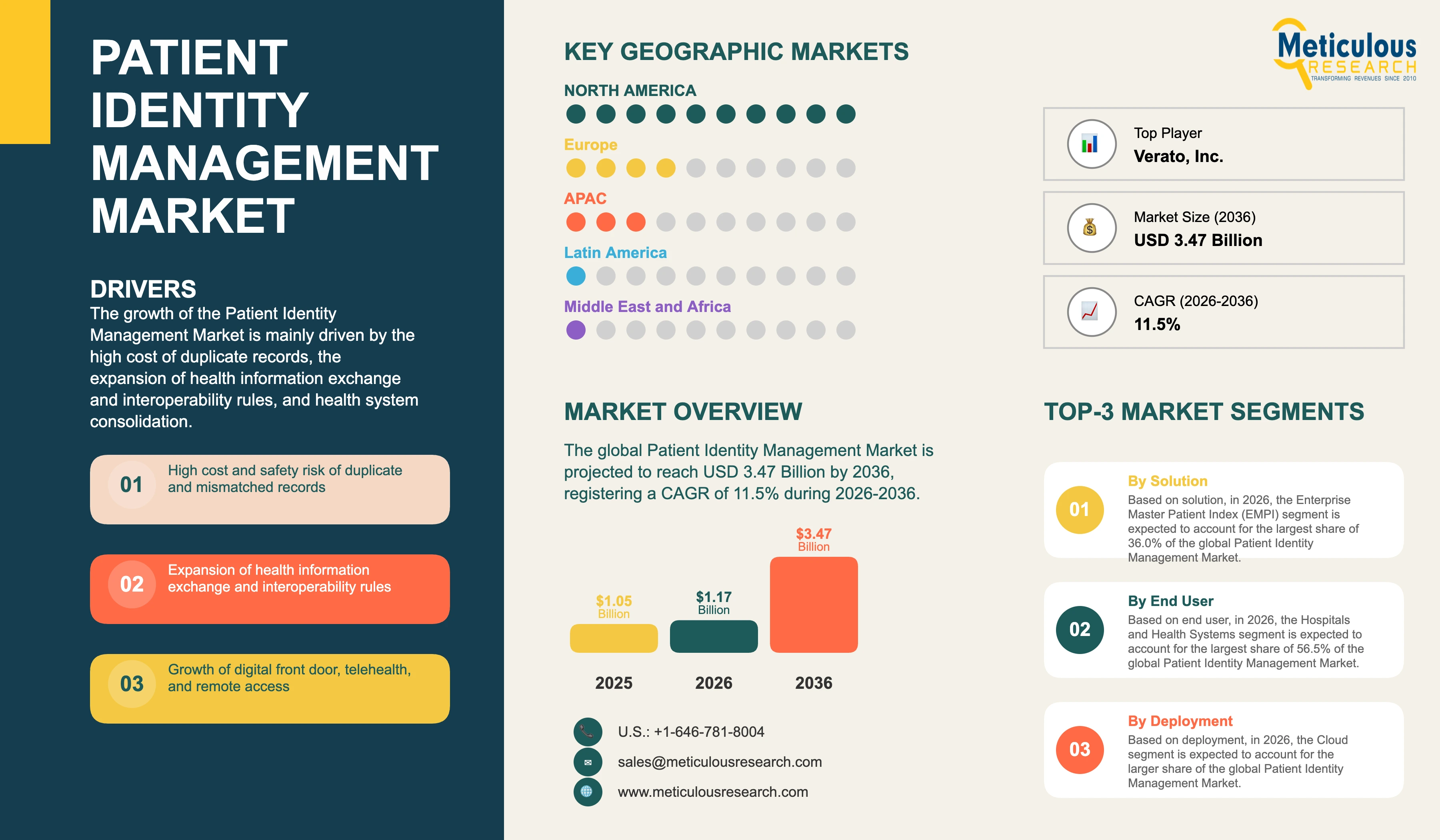
The global patient identity management market was valued at USD 1.05 billion in 2025. This market is expected to reach USD 3.47 billion by 2036 from an estimated USD 1.17 billion in 2026, registering a CAGR of 11.5% during the forecast period (2026-2036).
- Published
- Nov 2026
- Pages
- 268
- Format
- PDF + Excel
- Report ID
- MRHC - 1042568
- Base year
- 2025
- 2025 · BASELINE
- $1.05B
- 2036
- $3.47B
- CAGR 2026–2036
- 11.5%
2025 baseline · 2026–2036 forecast at 11.5% CAGR · hover a bar for the value
Key highlights
Accurate patient matching remains one of the largest unsolved problems in healthcare data exchange. Studies by The Pew Charitable Trusts and others have found that match rates between healthcare organizations can be far below what is needed for safe care, and duplicate records within a single hospital commonly affect a meaningful share of patient files, leading to repeated tests, delayed treatment, denied claims, and patient safety events.
Verato was named the number one vendor in Enterprise Patient Identity, EMPI, and Patient Matching for Revenue Cycle Management Risk in Black Book Research's 2026 State of Health and Hospital Systems Revenue Cycle Management Technology and Services survey, released in June 2026, reflecting the growing link between identity accuracy and claim integrity, revenue leakage, and patient access performance.
Verato was also recognized in the 2026 Gartner Magic Quadrant for Master Data Management, while Rhapsody (which acquired NextGate), 4medica, InterSystems, and Oracle Health continue to expand cloud-based EMPI and identity resolution offerings for health systems, health information exchanges, and payers.
Imprivata launched Imprivata Biometric Patient Identity in 2024, building on its long-standing PatientSecure palm-vein platform, and biometric patient identification using palm vein, facial recognition, and other methods is being adopted at registration desks to prevent duplicate records and medical identity fraud.
Rhapsody completed its acquisition of NextGate to combine enterprise EMPI with its interoperability platform, while identity verification providers such as ID.me, CLEAR, and Experian Health are expanding partnerships with health systems, payers, and digital health companies to verify patients remotely before granting access to records and services.
The U.S. Trusted Exchange Framework and Common Agreement requires strong identity proofing for individual access services, and the growth of nationwide exchange through Qualified Health Information Networks is increasing demand for identity verification and cross-organization matching capabilities.
By offering, software accounts for the larger share in 2026 and also registers the higher CAGR.
By solution, enterprise master patient index (EMPI) accounts for the largest share of 36.0% in 2026, while patient identity verification and proofing registers the highest CAGR.
By deployment, cloud accounts for the larger share in 2026 and also registers the higher CAGR.
By application, patient registration and access accounts for the largest share in 2026, while digital front door and patient portal access registers the highest CAGR.
By end user, hospitals and health systems account for the largest share of 56.5% in 2026, while health insurers and payers register the highest CAGR.
By geography, North America accounts for the largest share of 55.5% in 2026, while Asia-Pacific registers the highest CAGR of 15.0%.
Report summary
| Particulars | Details |
|---|---|
| Forecast Period | 2026-2036 |
| Base Year | 2025 |
| Estimated Year | 2026 |
| CAGR (Value) | 11.5% |
| Format | PDF, Excel & Cloud Portal · 268 pages |
| Market Size (Value) in 2025 | USD 1.05 billion |
| Market Size (Value) in 2026 | USD 1.17 billion |
| Market Size (Value) by 2036 | USD 3.47 billion |
| Largest Segment by Solution (2026) | Enterprise Master Patient Index (EMPI) (36.0%) |
| Largest Segment by End User (2026) | Hospitals and Health Systems (56.5%) |
| Largest Region (2026) | North America (55.5%) |
| Fastest-Growing Region | Asia-Pacific (CAGR 15.0%) |
| Key Companies | 15 companies and other companies |
| Segments Covered | Offering, Solution, Deployment, Application, End User, Geography |
| Countries Covered | U.S., Canada, U.K., Germany, France, Netherlands, Sweden, Norway, Denmark, Finland, Italy, Spain, Switzerland, Belgium, Austria, Ireland, Rest of Europe, Australia, Japan, China, India, South Korea, Singapore, New Zealand, Malaysia, Thailand, Indonesia, Philippines, Rest of Asia-Pacific, Brazil, Mexico, Colombia, Chile, Argentina, Rest of Latin America, Saudi Arabia, U.A.E., Qatar, Israel, South Africa, Rest of Middle East & Africa |
Report overview
Segments covered: offering, solution, deployment, application, end user.
The growth of this market is mainly driven by the high cost and patient safety risk of duplicate and mismatched medical records, the expansion of nationwide health information exchange under frameworks such as the Trusted Exchange Framework and Common Agreement (TEFCA) in the U.S., interoperability and patient access rules that require organizations to share records with patients and other providers through APIs, the consolidation of hospitals and health systems that must merge patient records from many sources, the growth of digital front door, telehealth, and patient portal services that require remote identity verification, rising medical identity theft and fraud, and the adoption of biometric and AI-based matching technologies. However, factors such as the absence of a national unique patient identifier in the U.S., inconsistent demographic data quality, the cost and complexity of large data cleanup projects, and privacy concerns about biometrics are expected to restrain the growth of this market to some extent.
Patient identity management refers to software and services that accurately identify patients and link their health records across systems and organizations. It includes enterprise master patient index (EMPI) software, which assigns each patient a unique identifier and links records from different systems, patient matching and identity resolution platforms that use probabilistic, referential, and AI-based algorithms, biometric patient identification at the point of care, digital identity verification and proofing for patient portals and telehealth, and data integrity services that find and resolve duplicate and overlaid records. This report covers the global revenue from patient identity management software and services sold to hospitals and health systems, health information exchanges and government agencies, health insurers and payers, ambulatory care providers, and laboratories, pharmacies, and life sciences companies.
Healthcare organizations hold patient information in many different systems, such as electronic health records, laboratory systems, imaging systems, billing systems, and patient portals. The same patient may be registered several times under slightly different names, addresses, or dates of birth, creating duplicate records. Records for two different patients may also be merged by mistake, creating overlays that can lead to dangerous clinical errors. When data is shared between organizations, these problems multiply, because each organization uses its own identifiers and data formats.
In many countries, national health identifiers help solve this problem, as the U.K. uses the NHS number, the Nordic countries use personal identity numbers, and India is building the Ayushman Bharat Health Account under its national digital health mission. In the U.S., however, federal law has long prevented funding for a national unique patient identifier, so healthcare organizations rely on matching algorithms that compare demographic data to link records. This makes the U.S. the largest market for patient identity management technology and services.
The importance of accurate identity has grown with the expansion of health information exchange and patient data access. In the U.S., the 21st Century Cures Act, information blocking rules, and CMS interoperability rules require providers and payers to share data with patients and with each other through standard APIs, while TEFCA connects health information networks across the country. Each of these exchanges depends on correctly matching patients across organizations. Health systems that grow through mergers must also combine patient records from many hospitals and clinics, which requires large-scale identity resolution and cleanup.
Patient identity management is also important for revenue cycle performance, because duplicate records and identity errors lead to claim denials, billing errors, and delays in payment, and they make it harder for hospitals to verify insurance and collect payments. Black Book Research's 2026 survey found that hospital finance leaders increasingly link identity accuracy to clean encounters, claim integrity, and revenue leakage prevention, which is broadening the buyer base for identity solutions beyond health information management departments.
Technology is evolving quickly, and referential matching, which compares patient data against large reference databases of verified identities, can significantly improve match rates over traditional probabilistic algorithms. Biometric identification, such as palm vein scanning and facial recognition, confirms patient identity at registration and prevents fraud. Digital identity proofing, using document verification and selfie matching, supports remote access to patient portals and telehealth services, while AI and machine learning help automate duplicate review and data quality management.
The market includes specialized identity vendors, EHR and health IT companies, interoperability platform providers, identity verification and data companies, and data integrity service providers. Leading companies include Verato, Inc., Rhapsody (NextGate), 4medica, Inc., InterSystems Corporation, Oracle Health, Imprivata, Inc., Experian Health, LexisNexis Risk Solutions, Harris Healthcare (QuadraMed), Just Associates, Inc., RightPatient, and ID.me, Inc.
Over the forecast period, the patient identity management market is expected to grow steadily, as nationwide data exchange expands, as health systems consolidate and move to cloud platforms, as digital front door and telehealth services require remote identity verification, and as payers and life sciences companies invest in identity resolution for analytics and real-world data. Growth will be strongest in identity verification, biometric identification, and cloud-based matching platforms.
Linking records across thousands of facilities is the foundation of our national program. We need matching that works with our national health ID and with records that were created before the ID existed.
Enterprise master patient index (EMPI) is expected to account for the largest share of 36.0% of the market in 2026, while patient identity verification and proofing is projected to register the highest CAGR.
Hospitals and health systems are expected to account for the largest share of 56.5% of the market in 2026, while health insurers and payers are projected to register the highest CAGR.
North America is expected to account for the largest share of 55.5% of the market in 2026, mainly due to the absence of a national patient identifier in the U.S., interoperability rules, TEFCA, and the presence of leading vendors.
Asia-Pacific is projected to register the highest CAGR of 15.0% during the forecast period, driven by national digital health programs in India and Australia and hospital digitalization across the region.
The report profiles 15 companies, including Verato, Rhapsody (NextGate), 4medica, InterSystems, Oracle Health, Imprivata, Experian Health, LexisNexis Risk Solutions, Harris Healthcare, Just Associates, RightPatient, ID.me, CLEAR, IBM, and Epic Systems.
Report infographic
Market dynamics
16 factors across 5 forcesHigh cost and safety risk of duplicate and mismatched records
Duplicate and mismatched patient records are a major source of cost and risk in healthcare. Industry studies and hospital reports have found that duplicate records commonly affect a meaningful share of patient files in many hospitals, and each duplicate can lead to repeated tests, delayed treatment, incomplete medical histories, and errors in medication and allergy information. Overlaid records, in which two patients share one record, can lead to serious clinical errors, such as giving a patient treatment intended for someone else.
Duplicate records also create large administrative costs, as health information management staff spend significant time reviewing and resolving potential duplicates, and errors lead to denied claims, rework in billing, and delays in payment. Regulators, accreditation bodies, and patient safety organizations have highlighted patient identification as a key safety goal, and The Joint Commission's National Patient Safety Goals require the use of at least two patient identifiers.
These costs give hospitals and health systems strong incentives to invest in EMPI software, matching technologies, and data cleanup services. Many organizations now treat identity management as part of their enterprise data strategy rather than as a back-office function, and they are investing in technologies that prevent duplicates at registration rather than only cleaning them up later. This shift supports demand for registration-level tools.
Expansion of health information exchange and interoperability rules
Health information exchange has expanded significantly in recent years, driven by regulation and by the need to coordinate care across providers. In the U.S., the 21st Century Cures Act and related information blocking rules require providers, health IT developers, and health information networks to share electronic health information, and CMS rules require payers to share data with patients and other payers through FHIR-based APIs. TEFCA, which began live exchange through Qualified Health Information Networks, connects networks across the country.
Every exchange of patient data depends on correctly identifying the patient in each system. As the volume of exchange increases, so does the need for accurate cross-organization matching, identity verification for individual access, and governance of identity data. Health information exchanges, government agencies, and networks are investing in EMPI and matching platforms, and identity requirements in TEFCA and similar frameworks are driving demand for higher-assurance identity proofing.
Similar trends are underway outside the U.S. The European Health Data Space regulation will require cross-border exchange of patient summaries and other data in the EU, while national digital health programs in India, Saudi Arabia, the U.A.E., Australia, and other countries are building identity and record-linkage systems as foundations for digital health.
Health system consolidation and enterprise data platforms
Hospital mergers and acquisitions, and the growth of large multi-hospital health systems, create the need to combine patient records from many facilities and systems. When health systems move to a single EHR platform, they must merge and clean millions of patient records, which requires EMPI technology, matching algorithms, and data integrity services. Even after consolidation, health systems often keep separate systems for laboratories, imaging, and specialty services that must be linked to a single patient identity.
Health systems are also building enterprise data platforms for analytics, population health, and AI, which depend on accurate patient identity to combine clinical, claims, and social data. Identity resolution is increasingly seen as the foundation of these platforms, and vendors are positioning their products as healthcare master data management solutions rather than standalone EMPI tools.
Growth of digital front door, telehealth, and remote access
Patients increasingly access healthcare digitally, through patient portals, mobile apps, telehealth visits, online scheduling, and remote check-in. Each of these services requires organizations to verify that the person accessing records or receiving care is who they claim to be, without seeing them in person. Weak identity verification can lead to unauthorized access to medical records, fraud, and privacy breaches.
Digital identity proofing solutions, such as document verification, selfie matching, and knowledge-based checks, allow organizations to verify patients remotely and grant appropriate access. The growth of patient data access rights and digital services is driving demand for these solutions, and vendors such as ID.me, CLEAR, Experian Health, LexisNexis Risk Solutions, and Imprivata are expanding their healthcare offerings. Health plans are also adopting remote identity verification for member portals and digital services.
Table of contents
13 chapters · 178 sections · 268 pages · click to expandSegmental analysis
| Segment | Largest share (2026) | Fastest growth (2026–2036) |
|---|---|---|
| By Offering | Patient registration and access | Digital front door and patient portal access |
By Offering
- The software segment is expected to account for the larger share of the patient identity management market, and it is also projected to register the higher CAGR during the forecast period.
- The cloud segment is expected to account for the larger share of the patient identity management market, and it is also projected to register the higher CAGR during the forecast period.
- The patient registration and access segment is expected to account for the largest share of the patient identity management market, while the digital front door and patient portal access segment is projected to register the highest CAGR during the forecast period.
Geographic analysis
North America
Largest shareIn 2026, North America is expected to account for the largest share of 55.5% of the global patient identity management market. The large share of this region is mainly due to the absence of a national patient identifier in the U.S., which makes organizations rely on matching technology, the large and fragmented U.S. healthcare system with many providers, payers, and health information exchanges, interoperability and information blocking rules, the launch of nationwide exchange through TEFCA, high rates of health system consolidation, and the presence of leading vendors such as Verato, 4medica, Rhapsody, Imprivata, Experian Health, LexisNexis Risk Solutions, Oracle Health, and ID.me. Canada is also an important market, where provincial health systems operate client registries and EMPI systems linked to provincial health card numbers.
Europe
Europe is the second-largest market, led by the U.K., Germany, France, the Netherlands, and the Nordic countries. Many European countries have national health or citizen identifiers, which reduce but do not eliminate the need for matching, since records must still be linked across systems and corrected when data is inconsistent. The European Health Data Space regulation will require cross-border exchange of health data, creating demand for identity and record-linkage capabilities. Sweden, Norway, Denmark, and Finland use personal identity numbers widely, while Italy, Spain, Switzerland, Belgium, Austria, and Ireland are investing in regional and national health information exchanges that require EMPI systems.
Asia-Pacific
Fastest growthAsia-Pacific is projected to register the highest CAGR of 15.0% during the forecast period. The rapid growth of this region is mainly driven by national digital health programs, such as India's Ayushman Bharat Digital Mission and Australia's My Health Record, hospital digitalization in China, Japan, and South Korea, the growth of private hospital groups in Southeast Asia, and government investment in health information exchange. Singapore, New Zealand, Malaysia, Thailand, Indonesia, and the Philippines are also building digital health infrastructure that requires patient identity and record-linkage solutions.
Latin America
Latin America and the Middle East & Africa account for smaller shares of the market but are expected to grow quickly. In Latin America, Brazil, Mexico, Colombia, Chile, and Argentina are developing national digital health strategies, and South Africa is investing in health information systems linked to its planned national health insurance program.
Middle East & Africa
Saudi Arabia, the U.A.E., and Qatar are building national health information exchanges and unified medical records as part of health transformation programs, while Israel has a highly digitalized health system.
Competitive landscape
The global patient identity management market is moderately fragmented, with the top five players estimated to account for about 40% of the market in 2025. The market includes specialized identity resolution and EMPI vendors, EHR and health IT companies, interoperability platform providers, identity verification and data companies, biometric identification providers, and data integrity service firms.
Verato is a leading provider of cloud-based identity resolution and healthcare master data management, using referential matching, and it was rated the top vendor for enterprise patient identity in Black Book Research's 2026 revenue cycle survey. Rhapsody, which acquired NextGate, offers enterprise EMPI and interoperability solutions used by health systems and health information exchanges, while 4medica provides cloud-based EMPI and data quality services for laboratories, health systems, and networks. InterSystems and Oracle Health offer EMPI capabilities as part of their health information exchange and EHR platforms, and Harris Healthcare's QuadraMed provides EMPI software and data integrity services.
Imprivata is a leader in biometric patient identification through its PatientSecure and Biometric Patient Identity solutions, and RightPatient offers facial recognition-based patient identification. Experian Health and LexisNexis Risk Solutions provide identity verification, referential matching, and data enrichment services, while ID.me and CLEAR offer digital identity verification for patient portals and healthcare services. Just Associates provides data integrity and duplicate remediation services.
Companies compete on match accuracy, speed, scalability, integration with EHR and exchange platforms, cloud capabilities, data stewardship tools, reference data quality, biometric and identity verification options, privacy and security, and price. Key strategies include partnerships with EHR, interoperability, and revenue cycle vendors, acquisitions to broaden identity and data management capabilities, expansion into payer and life sciences markets, and the addition of AI-based matching and data quality features.
We expect consolidation to continue, as interoperability and data platform companies acquire identity specialists and as identity verification companies expand into healthcare. Partnerships that combine identity verification, biometrics, and matching into end-to-end identity solutions are also expected to grow. EHR vendors are also strengthening their native identity capabilities, which increases competition for standalone EMPI vendors in single-EHR health systems, while specialists focus on cross-organization matching, referential data, and enterprise master data management, where EHR-native tools are less capable.
Some of the key players operating in the patient identity management market are Verato, Inc., Rhapsody (NextGate), 4medica, Inc., InterSystems Corporation, Oracle Health (Oracle Corporation), Imprivata, Inc., Experian Health, LexisNexis Risk Solutions, Harris Healthcare (QuadraMed), Just Associates, Inc., RightPatient, ID.me, Inc., CLEAR (Alclear, LLC), IBM Corporation, and Epic Systems Corporation, among others.
- —
Verato was rated the top vendor for enterprise patient identity in Black Book Research's 2026 revenue cycle survey and recognized in the 2026 Gartner Magic Quadrant for Master Data Management, Imprivata launched Imprivata Biometric Patient Identity, and the growth of TEFCA exchange increased demand for identity proofing and cross-organization matching.
- Verato, Inc.
- Rhapsody (NextGate)
- 4medica, Inc.
- InterSystems Corporation
- Oracle Health · Oracle Corporation
- Imprivata, Inc.
- Experian Health
- LexisNexis Risk Solutions
- Harris Healthcare (QuadraMed)
- Just Associates, Inc.
- RightPatient
- ID.me, Inc.
- CLEAR (Alclear, LLC)
- IBM Corporation
- Epic Systems Corporation
Expert perspectives
Patient identity management has become a foundation of digital healthcare, because as data exchange expands, patients access their records online, health systems consolidate, and organizations build analytics and AI platforms, the cost of identity errors rises and the value of accurate identity grows. We see identity management moving from a back-office health information management function to a strategic enterprise capability that affects patient safety, revenue, interoperability, and data strategy.
Over the forecast period, the market is expected to grow at a CAGR of 11.5%, from USD 1.17 billion in 2026 to USD 3.47 billion in 2036. Growth will be supported by the expansion of nationwide exchange, interoperability rules, digital front door services, health system consolidation, and investment by payers and life sciences companies in identity resolution.
Software remains the larger offering and also grows faster, while EMPI remains the largest solution, while patient identity verification and proofing grows fastest. Cloud deployment accounts for the larger share and grows faster than on-premise, and patient registration and access remains the largest application, while digital front door and patient portal access grows fastest. Hospitals and health systems remain the largest end user, while payers grow fastest. North America remains the largest region, and Asia-Pacific is the fastest-growing region at a CAGR of 15.0%.
For vendors, the key priorities are to improve match accuracy through referential matching and AI, to offer cloud-based platforms with strong security and privacy protections, to integrate deeply with EHR, exchange, and revenue cycle systems, and to provide clear metrics that show the value of identity investments. Vendors that combine identity verification, biometrics, matching, and data stewardship into end-to-end solutions are likely to gain share.
We also expect the U.S. policy environment to remain important, since any change in federal policy on a national patient identifier or national patient matching standards could significantly affect the market, either by improving data quality and reducing the need for some matching services or by creating new demand for identity infrastructure. In the meantime, TEFCA and interoperability rules will continue to drive investment in identity solutions.
Outside the U.S., national digital health programs in India, the Middle East, and Southeast Asia offer large opportunities, but they also favor vendors that can work with governments, adapt to national identifiers, and partner with local system integrators. International expansion will be an important growth strategy for leading vendors over the forecast period. Local partnerships and support for national identifiers will be essential to win these programs. Pricing will also need to suit public budgets.
Customer perspectives
Director of Health Information Management - multi-hospital health system, U.S.
Every merger brings in thousands of duplicate records, and my team spends hours every day reviewing potential matches. Our new identity platform catches most duplicates at registration and cuts our manual review work significantly.
Vice President of Digital Experience - regional health system, U.S.
Patients want to sign up for our portal and start a video visit in minutes, but we have to be sure we are giving records to the right person. Remote identity verification lets us do both.
Frequently asked questions
The global patient identity management market was valued at USD 1.05 billion in 2025, up from USD 940.0 million in 2024, and is estimated at USD 1.17 billion in 2026. The market includes EMPI software, patient matching platforms, biometric identification, identity verification, and data integrity services.
The global patient identity management market is expected to reach USD 3.47 billion by 2036, supported by the expansion of health information exchange, interoperability rules, digital front door services, and health system consolidation.
The market is expected to register a CAGR of 11.5% from 2026 to 2036, as identity management becomes a foundation for data exchange, revenue cycle performance, and healthcare AI.
Patient identity management refers to software and services that accurately identify patients and link their health records across systems and organizations, including EMPI software, patient matching, biometric identification, identity verification, and duplicate record remediation.
Market growth is mainly driven by the high cost and safety risk of duplicate and mismatched records, the expansion of health information exchange and interoperability rules, health system consolidation, and the growth of digital front door and telehealth services.
The absence of a national patient identifier in the U.S., poor demographic data quality, and the cost of data cleanup restrain growth, while privacy, consent, regulatory complexity, and difficulty measuring match accuracy are key challenges.
Key growth opportunities include referential matching and AI-based identity resolution, biometric patient identification, payer, life sciences, and real-world data applications, and national digital health programs in emerging markets.
In 2026, the software segment is expected to account for the larger share of the patient identity management market, and it is also projected to register the higher CAGR during the forecast period.
Enterprise master patient index (EMPI) is expected to account for the largest share of 36.0% of the market in 2026, while patient identity verification and proofing is projected to register the highest CAGR.
In 2026, the cloud segment is expected to account for the larger share of the patient identity management market, and it is also projected to register the higher CAGR during the forecast period.
In 2026, the patient registration and access segment is expected to account for the largest share of the patient identity management market, while the digital front door and patient portal access segment is projected to register the highest CAGR during the forecast period.
Hospitals and health systems are expected to account for the largest share of 56.5% of the market in 2026, while health insurers and payers are projected to register the highest CAGR.
North America is expected to account for the largest share of 55.5% of the market in 2026, mainly due to the absence of a national patient identifier in the U.S., interoperability rules, TEFCA, and the presence of leading vendors.
Asia-Pacific is projected to register the highest CAGR of 15.0% during the forecast period, driven by national digital health programs in India and Australia and hospital digitalization across the region.
The report profiles 15 companies, including Verato, Rhapsody (NextGate), 4medica, InterSystems, Oracle Health, Imprivata, Experian Health, LexisNexis Risk Solutions, Harris Healthcare, Just Associates, RightPatient, ID.me, CLEAR, IBM, and Epic Systems.
Verato was rated the top vendor for enterprise patient identity in Black Book Research's 2026 revenue cycle survey and recognized in the 2026 Gartner Magic Quadrant for Master Data Management, Imprivata launched Imprivata Biometric Patient Identity, and the growth of TEFCA exchange increased demand for identity proofing and cross-organization matching.
Cite this report
Meticulous Research. (2026). Patient Identity Management Market - Global Opportunity Analysis and Industry Forecast (2026-2036) (Report No. MRHC - 1042568). Meticulous Market Research Pvt. Ltd. https://www.meticulousresearch.com/product/patient-identity-management-market-7251