Cordierite Ceramics Market (2026-2036)
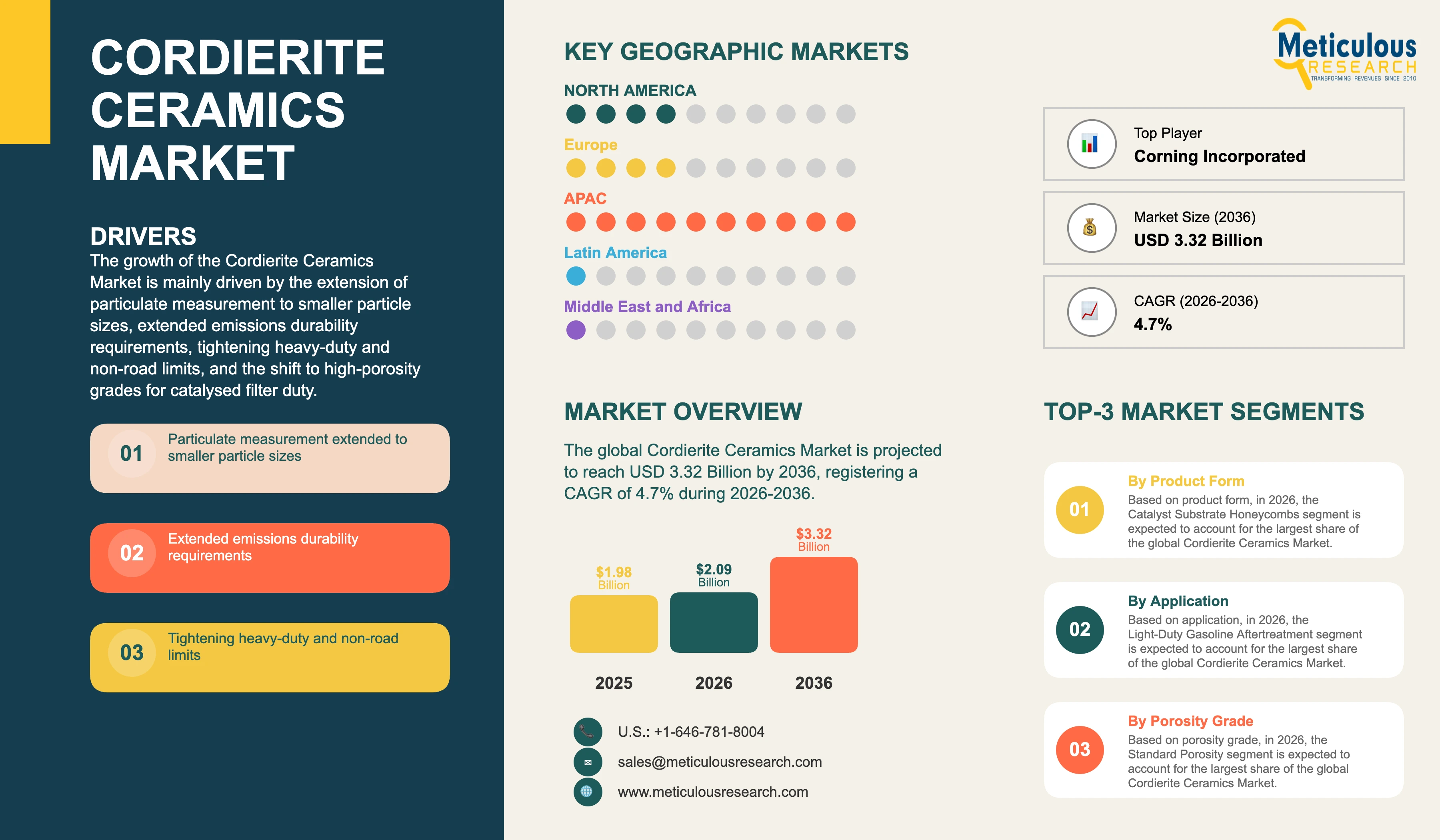
The cordierite ceramics market is valued at USD 2.09 billion in 2026 and is projected to reach USD 3.32 billion by 2036, at a CAGR of 4.7% during the forecast period. The market was valued at USD 1.98 billion in 2025 and at USD 1.89 billion in 2024.
- Published
- Nov 2026
- Pages
- 253
- Format
- PDF + Excel
- Report ID
- MRCHM - 1042770
- Base year
- 2025
- 2024 · HISTORICAL
- $1.89B
- 2036
- $3.32B
- CAGR 2026–2036
- 4.7%
2024–2025 baseline · 2026–2036 forecast at 4.7% CAGR · hover a bar for the value
Key highlights
This market measures cordierite ceramic articles on an as-fired basis, covering catalyst substrate honeycombs, particulate filter honeycombs, kiln furniture and other cordierite bodies.
Any applied washcoat or catalyst is excluded. The ceramic is measured bare, as it leaves the kiln and before it reaches a coater.
That basis dovetails with the three way catalyst washcoats title in this series, which measures washcoat as applied dry mass excluding the bare substrate. The two are complementary rather than overlapping, and not additive.
The canning, mat and shell are counted in exhaust system components, as is the catalyst in the selective catalytic reduction catalysts title where it sits on a cordierite body.
Silicon carbide and aluminium titanate filter bodies are different materials and are excluded, although both compete directly with cordierite for diesel particulate filter duty.
The raw batch of talc, kaolin, alumina and silica is a mineral input counted in those markets. Only the fired cordierite article is measured here.
Value growth at 4.7% runs at more than twice volume growth at 1.8%, because the specification of each part rises while the number of parts does not.
Cordierite is used for one property. Extrusion orients the crystallites so the fired body has a coefficient of thermal expansion close to zero, letting a thin-walled honeycomb survive a temperature swing of hundreds of degrees in seconds.
Kiln furniture, electrical insulators and heat-resistant cookware draw on the same property in slower duty, which is why they share this market with automotive aftertreatment.
Regulation (EU) 2024/1257, in force from 28 May 2024, applies to new car and van types from 29 November 2026 and to all new cars and vans from 29 November 2027, with buses, lorries and trailers following from 29 May 2028 and 29 May 2029.
For cars and vans that regulation maintains the existing Euro 6 exhaust emission limits. It is not a tightening of tailpipe chemistry for light vehicles, and it therefore places no new requirement on catalyst activity.
What it does change is that solid particles are counted from 10 nanometres rather than the previous threshold, and durability requirements are extended in mileage and lifetime.
Both of those are ceramic requirements rather than catalyst requirements. Counting smaller particles is a filtration problem solved in the pore structure of the filter body, and a longer durability period is a thermal and mechanical survival problem solved in the substrate.
The regulation most often described as weak on exhaust emissions is consequently the strongest demand event in this market, and the reason value compounds at more than twice the volume rate.
For buses and lorries the limits do tighten, adding nitrous oxide, which Euro VI did not regulate. Heavy-duty and non-road aftertreatment is the fastest application here at 7.4%, and those engines stay in production far longer than light-duty ones.
Corning Incorporated supplies cordierite gasoline particulate filters at 200 cells per square inch with an 8 mil web in medium porosity and at 300 cells per square inch with an 8 mil web in high porosity, for configurations from close-coupled to underfloor.
The uncatalysed variants are described as reaching the highest filtration efficiency targets for the most stringent regulations, while catalysed duty is served by a high-porosity variant supporting high washcoat loads, because the washcoat occupies pore volume that must be there before coating.
The one part of that regulation reaching battery electric vehicles sets brake particulate limits alongside tyre abrasion and battery durability rules. None creates aftertreatment demand, so electrification removes substrate volume without the regulation replacing it.
Report summary
| Particulars | Details |
|---|---|
| Base Year | 2025 |
| Actual Years | 2024-2025 |
| Forecast Period | 2026-2036 |
| Market Size in 2024 | USD 1.89 billion |
| Market Size in 2025 | USD 1.98 billion |
| Market Size in 2026 | USD 2.09 billion |
| Market Size in 2036 | USD 3.32 billion |
| Value CAGR (2026-2036) | 4.7% |
| Format | PDF, Excel & Cloud Portal · 253 pages |
| Volume in 2025 | 185.00 kilotons |
| Volume in 2026 | 190.00 kilotons |
| Volume in 2036 | 227.11 kilotons |
| Volume CAGR (2026-2036) | 1.8% |
| Average Selling Price, 2026 | USD 11.00 per kg |
| Average Selling Price, 2036 | USD 14.60 per kg |
| Units | Value in USD million; volume in kilotons of as-fired cordierite; price in USD per kg |
| Measurement Basis | Cordierite ceramic articles on an as-fired basis, bare, before any washcoat or catalyst is applied |
| Exclusions | Applied washcoat and catalyst; canning, mat and shell; silicon carbide and aluminium titanate filter bodies; the raw batch of talc, kaolin, alumina and silica |
| Segments: Product Form | Catalyst Substrate Honeycombs; Particulate Filter Honeycombs; Kiln Furniture and Refractory Supports; Other Cordierite Ceramic Articles |
| Segments: Application | Light-Duty Gasoline Aftertreatment; Heavy-Duty and Non-Road Aftertreatment; Light-Duty Diesel Aftertreatment; Industrial Kiln and Furnace; Electrical, Laboratory and Consumer |
| Segments: Porosity Grade | Standard Porosity; High Porosity for Catalysed Duty |
| Largest Segment by Product Form, 2026 | Catalyst Substrate Honeycombs |
| Fastest-Growing Segment by Product Form | Particulate Filter Honeycombs, at 8.0% |
| Largest Segment by Application, 2026 | Light-Duty Gasoline Aftertreatment |
| Fastest-Growing Segment by Application | Heavy-Duty and Non-Road Aftertreatment, at 7.4% |
| Largest Segment by Porosity Grade, 2026 | Standard Porosity |
| Fastest-Growing Segment by Porosity Grade | High Porosity for Catalysed Duty, at 7.5% |
| Largest Region, 2026 | Asia-Pacific |
| Fastest-Growing Region | Middle East & Africa, at 5.8% |
| Fastest-Growing Country | India, at 7.4% |
| Slowest-Growing Country | France, at 2.0% |
| Regions Covered | Asia-Pacific; Europe; North America; Latin America; Middle East & Africa |
| Countries Covered | China; India; Japan; South Korea; Germany; U.K.; France; U.S.; Mexico; Brazil; Saudi Arabia; South Africa |
| Key Players | Corning Incorporated; NGK Insulators, Ltd.; Ibiden Co., Ltd.; Denso Corporation; Saint-Gobain S.A.; Shandong Sinocera Functional Material Co., Ltd. |
| Top Five Share, 2026 | 72.4% |
| Profiled Companies Share, 2026 | 76.8% |
| Currency | USD |
Report overview
Market value is measured in in USD million; volume in kilotons of as-fired cordierite; price in USD per kg. Segments covered: product form, application, porosity grade.
In volume terms, the market is estimated at 190.00 kilotons of as-fired cordierite in 2026, rising to 227.11 kilotons by 2036, at a CAGR of 1.8%. The average selling price is estimated at USD 11.00 per kg in 2026 and USD 14.60 per kg in 2036, the increase reflecting a shift from plain catalyst substrates toward particulate filter bodies and high-porosity catalysed grades, each of which carries a higher price for the same mass of fired ceramic.
The growth of this market is mainly driven by the extension of particulate filtration to smaller particle sizes, the lengthening of emissions durability requirements that the ceramic rather than the catalyst must satisfy, and tightening heavy-duty and non-road limits on engines that remain in production. However, factors such as the decline of light-duty diesel aftertreatment, the removal of exhaust aftertreatment from battery electric vehicles, competition from silicon carbide and aluminium titanate in filter duty, and the maturity of kiln furniture demand are expected to restrain the growth of this market to some extent.
Among product forms, catalyst substrate honeycombs are expected to hold the largest share of this market in 2026, while particulate filter honeycombs are expected to record the highest CAGR during the forecast period. Geographically, Asia-Pacific is expected to account for the largest share of this market in 2026, while the Middle East & Africa is expected to register the highest CAGR during the forecast period.
Cordierite is a magnesium aluminium silicate, formed by firing a batch of talc, kaolin, alumina and silica to around 1,400 degrees Celsius. What makes it commercially distinct is not its composition but what extrusion does to it: forcing the plasticised batch through a honeycomb die aligns the platy clay particles, and the crystallites that grow from them during firing are oriented so that expansion along one axis is offset by contraction along another. The fired body ends up with a coefficient of thermal expansion close to zero.
That property is the whole basis of the market. A ceramic with near-zero thermal expansion can be taken from ambient to 1,000 degrees Celsius in seconds without cracking, which is exactly what happens to a catalytic converter at every cold start. No other inexpensive ceramic survives that duty in a thin-walled form, and the thinness matters because a thicker wall absorbs heat the catalyst needs and raises back pressure on the engine.
The same property, applied in slower duty, explains why kiln furniture is part of this market. Setters, batts, posts and saggars are heated and cooled through every firing cycle in a ceramic or sanitaryware plant, and a support that expanded would crack or would distort the ware it carries. Electrical insulators, resistor cores and heat-resistant cookware draw on the same characteristic.
Within automotive aftertreatment the material appears in two quite different articles. A catalyst substrate is a flow-through honeycomb whose channels are open at both ends, carrying a washcoat on the channel walls so that exhaust gas contacts the catalyst as it passes. A particulate filter is a wall-flow body whose channels are alternately plugged, forcing gas through the porous wall and trapping soot in it. The first is sized on geometric surface area, the second on pore structure, and they are priced differently because of it.
Corning Incorporated, which commercialised the cellular ceramic substrate for the first catalytic converters, supplies cordierite gasoline particulate filters at 200 cells per square inch with an 8 mil web in a medium-porosity grade and at 300 cells per square inch with an 8 mil web in a high-porosity grade, offered for configurations from close-coupled to underfloor and across catalysed and uncatalysed systems.
The distinction between those two porosity grades carries more commercial weight than the cell counts. An uncatalysed filter needs only enough porosity to pass gas while trapping particles, and the company describes its uncatalysed variants as reaching the highest filtration efficiency targets for the most stringent regulations. A catalysed filter must do the same job after a washcoat has filled part of the pore volume, which is why the catalysed duty is served by a high-porosity variant supporting high washcoat loads.
That is also the point at which this market meets the washcoat market measured separately in this series. The ceramic is sized and fired to a porosity that anticipates a coating it does not yet carry, and the coater then consumes part of that porosity. Measuring the bare body here and the applied coating there keeps the two from being double counted while preserving the engineering relationship between them.
The regulatory position for light vehicles changed with Regulation (EU) 2024/1257, which entered into force on 28 May 2024, amends Regulation (EU) 2018/858 and repeals the instruments that previously governed light and heavy duty separately, including Regulation (EC) No 715/2007, Regulation (EC) No 595/2009 and Commission Regulation (EU) 2017/1151. Consolidating both into a single instrument puts car and truck aftertreatment on one compliance calendar for the first time.
The calendar runs in stages. New car and van types must comply from 29 November 2026 and all new cars and vans from 29 November 2027. Buses, lorries and trailers follow at 29 May 2028 for new types and 29 May 2029 for new vehicles, and small-volume manufacturers are deferred to 1 July 2030 for cars and vans and 1 July 2031 for heavier categories.
For cars and vans the regulation maintains the existing Euro 6 exhaust emission limits. This is the feature most often cited as evidence that the regulation was diluted, and for catalyst chemistry it is: a converter that met Euro 6 meets Euro 7 on the same limits, so there is no new requirement for precious metal loading or washcoat activity in the light-duty fleet.
Two changes nonetheless land directly on the ceramic. Solid particles are counted from 10 nanometres rather than from the coarser threshold used previously, which extends measurement into a size range where filtration efficiency depends on pore size distribution rather than on filter area. And durability requirements are extended in both mileage and lifetime, which obliges the aftertreatment to survive substantially longer in service.
Neither of those is a chemistry problem. Capturing smaller particles is solved by engineering the pore structure of the filter wall, and surviving a longer durability period is solved by the thermal and mechanical strength of the substrate carrying the catalyst. The regulation therefore transfers its burden from the catalyst supplier to the ceramic supplier, and that transfer is what separates the value and volume trajectories in this market.
Heavy duty is treated quite differently. Limits for buses and lorries are tightened across several pollutants and extended to nitrous oxide, which was not regulated under Euro VI at all. Because a commercial vehicle engine has no near-term electric substitute at most duty cycles and remains in production for far longer than a passenger car engine, the heavy-duty and non-road application grows at 7.4% against 5.0% for light-duty gasoline.
Working against all of this is the electrification of the light fleet. A battery electric vehicle has no exhaust and takes no substrate or filter, and the only part of the regulation that reaches it sets brake particulate limits alongside tyre abrasion rules and battery durability thresholds. Those obligations create engineering work but no aftertreatment ceramic, so each electric vehicle sold in place of a combustion one removes volume from this market permanently.
Light-duty diesel compounds that loss. European diesel car share has fallen far enough that diesel particulate filter and oxidation catalyst substrate volume is contracting, and the application is forecast to decline at 1.0% a year through the forecast period, the only segment in this report with a negative rate.
The resulting market grows slowly in tonnage and considerably faster in value. Volume advances at only 1.8% as filters and heavy-duty bodies offset light-duty substrate losses, while value advances at 4.7% because average selling price rises from USD 11.00 per kg to USD 14.60 per kg on the shift toward filter bodies, higher cell densities and high-porosity catalysed grades.
Report infographic
Market dynamics
22 factors across 5 forcesParticulate Measurement Extended to Smaller Particle Sizes
Regulation (EU) 2024/1257 counts solid particles from 10 nanometres rather than from the coarser threshold used previously, which brings a size fraction into the measurement that was outside it before. Capturing particles in that range depends on the pore size distribution of the filter wall rather than on the frontal area of the filter.
Corning Incorporated describes the uncatalysed variants of its cordierite gasoline particulate filter range as reaching the highest filtration efficiency targets for the most stringent regulations, which is the specification level the extended measurement demands. A filter qualified against the earlier threshold is not automatically adequate against the new one.
Because the response is a higher-specification body rather than a larger one, this driver raises price without raising tonnage. Particulate filter honeycombs are forecast at 8.0%, the fastest product form in this report, and they are the principal reason value in this market compounds at more than twice the volume rate.
Extended Emissions Durability Requirements
The same regulation extends durability requirements in both mileage and lifetime, obliging the aftertreatment system to hold its performance substantially longer in service. For cars and vans that obligation arrives with new types from 29 November 2026 and all new vehicles from 29 November 2027.
A longer durability period is a materials requirement rather than a chemistry one. The substrate must survive more thermal cycles, more vibration and more exposure to ash and oil-derived contaminants without cracking or losing the coating it carries, and that is answered by wall thickness, microstructure and strength rather than by catalyst formulation.
Suppliers therefore quote a higher-specification ceramic into the same converter position. The driver lifts average selling price across the whole substrate base rather than in a single segment, and it applies to parts that would otherwise have been commodity items.
Tightening Heavy-Duty and Non-Road Limits
For buses and lorries the regulation tightens limits across several pollutants and extends control to nitrous oxide, which was not regulated under Euro VI. New types must comply from 29 May 2028 and new vehicles from 29 May 2029.
Commercial vehicle engines have no near-term electric substitute across most duty cycles and remain in production considerably longer than passenger car engines, so the volume base this driver acts on is stable rather than declining. Heavy-duty bodies are also physically larger, which multiplies the ceramic mass per vehicle.
Heavy-duty and non-road aftertreatment is consequently forecast at 7.4%, the fastest application in this report. It is the part of this market least exposed to light-vehicle electrification and the part where regulatory tightening is genuine rather than nominal.
High-Porosity Grades for Catalysed Filter Duty
A catalysed filter must trap particles after a washcoat has occupied part of its pore volume, which requires more porosity at the outset than an uncatalysed body of the same filtration performance. Corning Incorporated serves catalysed duty with a high-porosity variant that supports high washcoat loads, distinct from the medium-porosity grade used uncoated.
Combining substrate and filter functions in one body shortens the exhaust line and improves cold start performance, which is why vehicle makers specify it despite the higher ceramic cost. The high-porosity grade carries a premium because the microstructure is harder to control and the fired strength is lower.
High-porosity grades for catalysed duty are forecast at 7.5%, against 3.0% for standard porosity. The driver shifts the mix within the same tonnage, which is the clearest single mechanism behind the price path from USD 11.00 per kg to USD 14.60 per kg.
Consolidation of Light and Heavy Duty into One Instrument
Regulation (EU) 2024/1257 repeals the separate instruments that governed light and heavy duty, including Regulation (EC) No 715/2007, Regulation (EC) No 595/2009, Commission Regulation (EU) No 582/2011 and Commission Regulation (EU) 2017/1151, and amends Regulation (EU) 2018/858.
Putting both on a single compliance calendar lets a ceramic supplier develop one qualification programme across vehicle categories rather than two, and lets a vehicle maker specify common substrate families across its light and heavy ranges. That reduces qualification cost per part and accelerates the introduction of higher-specification bodies into both fleets.
Table of contents
11 chapters · 129 sections · 253 pages · click to expandSegmental analysis
| Segment | Largest share (2026) | Fastest growth (2026–2036) |
|---|---|---|
| By Product Form | Catalyst substrate honeycombs | Particulate filter honeycombs |
| By Application | Light-duty gasoline aftertreatment | Heavy-duty and non-road aftertreatment |
| By Porosity Grade | Standard porosity | — |
| By Geography | Asia-Pacific | Middle East & Africa |
By Product Form
- Cordierite Ceramics Analysis by Product Form
- This market is segmented by product form into catalyst substrate honeycombs, particulate filter honeycombs, kiln furniture and refractory supports, and other cordierite ceramic articles.
- Catalyst substrate honeycombs are expected to hold the largest share of this market in 2026.
- The form leads because every combustion vehicle built carries at least one, and most carry two in close-coupled and underfloor positions, so the installed demand base is as wide as vehicle production itself.
- Growth is nonetheless held to 2.6%, the slowest of the automotive forms, because the unit count falls with light-vehicle electrification even as the specification of each part rises under extended durability requirements.
- Particulate filter honeycombs are expected to record the highest CAGR of 8.0% during the forecast period.
- The form grows because Regulation (EU) 2024/1257 counts solid particles from 10 nanometres rather than the coarser threshold used before, which brings a size fraction into measurement that filters qualified against the earlier threshold were never tested on.
- Capturing particles at that scale depends on pore size distribution rather than on filter area, so the response is a higher-specification body at the same mass, and Corning Incorporated describes the uncatalysed variants of its range as reaching the highest filtration efficiency targets for the most stringent regulations.
- Kiln furniture and refractory supports grow at 3.0%.
- Setters, batts, posts and saggars are replaced on a wear cycle tied to installed firing capacity in the ceramic, sanitaryware and tableware industries rather than to production throughput, and that capacity is not expanding materially.
- The form carries substantial tonnage at a fraction of the price per kilogram of an automotive body, so it contributes stability rather than growth.
- Other cordierite ceramic articles grow at 6.6%, covering electrical insulators, resistor cores, heating element supports, laboratory ware, molten metal filters and heat-resistant cookware.
- These are supplied from the same extrusion and firing capability as honeycombs and are specified rather than tendered, which is why they carry better margins than kiln furniture.
By Application
- Cordierite Ceramics Analysis by Application
- This market is segmented into light-duty gasoline aftertreatment, heavy-duty and non-road aftertreatment, light-duty diesel aftertreatment, industrial kiln and furnace, and electrical, laboratory and consumer applications.
- Light-duty gasoline aftertreatment is expected to account for the largest share of this market in 2026, on the breadth of the gasoline vehicle base and on the spread of gasoline particulate filters to direct-injection engines that previously carried only a flow-through substrate.
- The application grows at 5.0%, with filter content and durability specification offsetting a declining combustion unit count.
- Heavy-duty and non-road aftertreatment is expected to register the highest CAGR of 7.4% during the forecast period.
- Limits for buses and lorries tighten across several pollutants and extend to nitrous oxide, which Euro VI did not regulate, with new types complying from 29 May 2028 and new vehicles from 29 May 2029.
- Commercial vehicle engines have no near-term electric substitute at most duty cycles, remain in production far longer than passenger car engines, and carry physically larger bodies, so the ceramic mass per unit is several times a light-duty equivalent.
- Light-duty diesel aftertreatment is forecast to contract at 1.0% a year, the only negative rate in this report.
- Diesel share of the European passenger car fleet has fallen far enough that filter and oxidation catalyst substrate volume is in decline, and because diesel bodies are larger and more heavily specified than gasoline equivalents, the tonnage lost per vehicle exceeds what the unit decline alone implies.
- Industrial kiln and furnace applications grow at 3.2% on replacement demand for kiln furniture and refractory supports.
- Electrical, laboratory and consumer applications grow at 7.0%, drawing on the same thermal shock resistance in duty where dimensional stability through repeated heating matters more than gas flow.
By Porosity Grade
- Cordierite Ceramics Analysis by Porosity Grade
- This market is segmented into standard porosity and high porosity for catalysed duty.
- Standard porosity is expected to hold the largest share of this market in 2026, covering flow-through catalyst substrates, uncatalysed filter bodies, kiln furniture and general technical articles.
- The grade leads on the breadth of its duty and is forecast at 3.0%, because it serves the parts whose unit count is falling.
- High porosity for catalysed duty is expected to record the higher CAGR of 7.5% during the forecast period.
- A catalysed filter must trap particles after a washcoat has occupied part of its pore volume, so more porosity is required at the outset than an uncatalysed body of equivalent filtration performance, and Corning Incorporated serves that duty with a high-porosity variant supporting high washcoat loads distinct from the medium-porosity grade used uncoated.
- Fired strength falls as porosity rises, which makes the microstructure harder to control and is why the grade commands a premium rather than competing on price.
By Geography
- Cordierite Ceramics Analysis by Geography
- Geographically, this market is segmented into Asia-Pacific, Europe, North America, Latin America, and the Middle East & Africa, with individual country sizing within each region.
- Asia-Pacific is expected to account for the largest share of this market in 2026, because vehicle assembly and ceramic extrusion capacity have both concentrated there and a substrate is made close to the assembly plant it serves.
- The Middle East & Africa is expected to register the highest CAGR of 5.8%, on vehicle fleet growth and industrial furnace construction from a small base.
- Europe is expected to record the lowest regional CAGR of 2.8%.
- The region sets the regulatory standard that drives specification in this market, but it is also where light-vehicle electrification and the decline of diesel are furthest advanced, so the value uplift arrives on a shrinking unit base.
Geographic analysis
Asia-Pacific
Largest shareAsia-Pacific is expected to account for the largest share of this market in 2026. A honeycomb body is bulky and fragile relative to its value, so extrusion and firing capacity sits close to the vehicle assembly it supplies, and both have concentrated in the region. Demand also draws on industrial kiln furniture for the ceramic and sanitaryware industries based there. India is expected to record the highest country CAGR in this report at 7.4%, on growth in passenger and commercial vehicle production that remains predominantly combustion-powered and on tightening domestic emissions limits. China follows at 5.0%, where the installed substrate capacity is largest but electrification of the light fleet is also most advanced, which tempers the rate below what vehicle output alone would give. Japan grows at 2.6% and South Korea at 3.4%. Both host substantial substrate and filter manufacturing capability serving export programmes rather than expanding domestic vehicle output, so growth comes from specification rather than from volume.
North America
North America is expected to grow at 4.4%, with the United States at the same rate. Light truck and commercial vehicle demand keeps the combustion base broader than in Europe, and heavy-duty aftertreatment carries a larger share of regional ceramic mass, which supports the rate despite slower regulatory tightening on light-duty tailpipe limits. Mexico grows on vehicle assembly serving North American programmes, which brings substrate and filter capacity with it, while Brazil draws on a combustion fleet that remains large and on flex-fuel engines requiring aftertreatment across both fuels.
Europe
Fastest growthEurope is expected to record the lowest regional CAGR at 2.8%, with Germany at 2.4%, the United Kingdom at 2.2% and France at 2.0%, the slowest country rate in this report. The region originates the specification changes that drive value in this market, yet it is also where the combustion unit base is contracting fastest through electrification and the collapse of diesel car share, so the price uplift lands on fewer parts each year.
Latin America
Latin America is expected to grow at 5.4%, with Mexico at 5.6% and Brazil at 5.2%.
Middle East & Africa
The Middle East & Africa is expected to register the highest regional CAGR at 5.8%, led by Saudi Arabia at 5.8% and South Africa at 5.4%. Vehicle fleet growth, local assembly and industrial furnace construction all contribute, from a base small enough that individual programmes move the regional rate.
Competitive landscape
The global cordierite ceramics market is highly concentrated in automotive honeycombs and fragmented in kiln furniture, because honeycomb extrusion requires precision dies, controlled drying of a wet thin-walled body and large continuous kilns, while refractory supports do not. Some of the key players operating in the cordierite ceramics market are Corning Incorporated (U.S.), NGK Insulators, Ltd. (Japan), Ibiden Co., Ltd. (Japan), Denso Corporation (Japan), Saint-Gobain S.A. (France), and Shandong Sinocera Functional Material Co., Ltd. (China), among others.
Corning Incorporated commercialised the cellular ceramic substrate for the first catalytic converters and retains the broadest position in both substrate and filter bodies. Its cordierite gasoline particulate filter range runs at 200 cells per square inch with an 8 mil web in medium porosity and at 300 cells per square inch with an 8 mil web in high porosity, offered across close-coupled and underfloor configurations and across catalysed and uncatalysed duty, with uncatalysed variants described as reaching the highest filtration efficiency targets for the most stringent regulations.
NGK Insulators, Ltd. holds a comparable position built on the same extrusion and firing capability, and competes principally on cell geometry, wall thickness and the dimensional control required at the thinnest webs. Because a substrate is qualified to a vehicle programme and held for the model cycle, the two largest participants compete at platform award rather than on recurring price, which is what keeps their positions stable between model generations.
Ibiden Co., Ltd. and Denso Corporation compete across substrate and filter duty, with Ibiden strongest where silicon carbide filter capability complements cordierite in heavy-duty diesel and Denso supplying into vehicle programmes as part of a broader aftertreatment and engine management position. Saint-Gobain S.A. and Shandong Sinocera Functional Material Co., Ltd. compete in kiln furniture, refractory supports and regional honeycomb supply, where the decisive variables are fired cost and delivery rather than qualification at the thinnest wall sections.
The five largest participants are estimated to hold 72.4% of this market in 2026, and the six companies profiled in this report 76.8%. The remainder is held by regional honeycomb producers in China and India and by refractory and kiln furniture specialists, whose individual positions are not separately quantified in this report. Competitive movement over the forecast period is expected to come from qualification of high-porosity catalysed filter bodies and from heavy-duty programme awards rather than from capacity, because capital committed to a vehicle platform cannot be redirected if that platform is electrified early.
- Corning Incorporated
- NGK Insulators, Ltd.
- Ibiden Co., Ltd.
- Denso Corporation
- Saint-Gobain S.A.
- Shandong Sinocera Functional Material Co., Ltd
Expert perspectives
The named driver for this market is filter and kiln furniture duty, and it is half right. Particulate filter honeycombs are indeed the fastest product form at 8.0%, but kiln furniture is 3.0% and amounts to ballast rather than growth: it tracks installed firing capacity that is not expanding, at a fraction of the price per kilogram of an automotive body. Pairing the two understates where this market is actually moving.
The larger omission is that the market is overwhelmingly an automotive aftertreatment market. Catalyst substrate honeycombs hold the largest share at 44.0% and filter bodies a further 30.0%, so nearly three quarters of it turns on vehicle emissions regulation rather than on industrial ceramics, and the slow rate on substrates at 2.6% is what holds total volume growth down to 1.8%.
What separates value from volume is Regulation (EU) 2024/1257, and the reason is not the one usually given. For cars and vans the regulation maintains the existing Euro 6 exhaust emission limits, which is the feature most often cited as evidence of dilution. On catalyst chemistry that criticism holds: a converter meeting Euro 6 meets Euro 7 on the same limits, and no new precious metal loading or washcoat activity is required in the light-duty fleet.
The two changes the regulation does make fall squarely on the ceramic. Solid particles are counted from 10 nanometres rather than the coarser threshold used before, which is a filtration problem solved in pore size distribution, and durability requirements are extended in mileage and lifetime, which is a thermal and mechanical survival problem solved in the substrate. Holding chemistry constant while tightening filtration and survival moves the compliance burden from the catalyst formulator to the ceramic supplier.
That reallocation is the whole explanation for a 4.7% value rate on a 1.8% volume rate, and it is why the regulation most often described as weak on exhaust emissions is the strongest demand event in this market. Corning Incorporated already positions its uncatalysed filter variants as reaching the highest filtration efficiency targets for the most stringent regulations, and its catalysed duty on a high-porosity grade supporting high washcoat loads.
Against this, the direction of the fleet is unambiguous. A battery electric vehicle takes no substrate and no filter, and the only part of the regulation that reaches it covers brake particulates, tyre abrasion and battery durability, none of which generates aftertreatment ceramic. The durable position in this market is therefore heavy-duty and non-road, at 7.4%, where limits genuinely tighten, nitrous oxide is regulated for the first time, engines stay in production far longer and the bodies are several times larger.
Customer perspectives
Vehicle makers specify a substrate on thermal mass and back pressure rather than on ceramic cost, because the part that reaches light-off fastest determines whether the vehicle passes the cycle.
The ceramic is a small part of the converter cost and the whole of its cold-start behaviour. We specify it on how quickly it lets the catalyst work.
Buyers report that the 10 nanometre counting threshold has reopened filter specification on programmes where the existing part was considered settled, and that requalification means retesting the vehicle rather than the component.
Extended durability requirements are treated as a warranty exposure rather than a compliance item, because a substrate that cracks late in life brings the vehicle back under emissions warranty.
Coaters specify porosity before they specify anything else, since a washcoat occupying pore volume must leave enough open structure for the filter to perform after coating.
Buyers of combined catalysed filter bodies report valuing the removal of a canning operation and an assembly step as highly as the packaging space saved, and price the part against the system it replaces rather than against the bare ceramic.
Substrate supply is qualified to a vehicle programme and held for the model cycle, so buyers report that competition occurs at platform award and that mid-cycle switching is not practical.
Commercial vehicle buyers report longer specification stability than light-duty buyers, because the engine family stays in production for many years and the aftertreatment is sized to it.
Buyers in diesel applications with severe thermal loading report selecting silicon carbide or aluminium titanate instead, and reserving cordierite for duty where thermal mass and cost dominate.
Kiln operators purchase furniture on cost per firing cycle, counting the number of cycles a setter survives before distortion rather than its purchase price.
Buyers report sourcing honeycombs close to the assembly plant, because the bodies are bulky and fragile relative to value and long-distance freight raises both cost and breakage.
Frequently asked questions
The cordierite ceramics market is valued at USD 2.09 billion in 2026 and is projected to reach USD 3.32 billion by 2036, at a CAGR of 4.7% during the forecast period. In volume terms the market is estimated at 190.00 kilotons of as-fired cordierite in 2026, rising to 227.11 kilotons by 2036 at a CAGR of 1.8%.
The extension of particulate measurement to 10 nanometres, extended emissions durability requirements that the ceramic rather than the catalyst must satisfy, tightening heavy-duty and non-road limits on engines that remain in production, the move to high-porosity grades for catalysed filter duty, and the consolidation of light and heavy duty into a single regulatory instrument.
The removal of aftertreatment from battery electric vehicles, the contraction of light-duty diesel aftertreatment, competition from silicon carbide and aluminium titanate in filter duty, and the maturity of kiln furniture demand. The principal challenges are controlling pore structure at high porosity, the capital intensity of honeycomb extrusion with model-cycle lock-in, and uncertain fleet composition against a fixed regulatory calendar.
Cordierite ceramic articles on an as-fired basis, bare, before any washcoat or catalyst is applied, covering catalyst substrate honeycombs, particulate filter honeycombs, kiln furniture and other cordierite bodies. The canning, mat and shell are counted in exhaust system components, and the raw batch of talc, kaolin, alumina and silica in those mineral markets.
The two are complementary and not additive. That title measures washcoat as applied dry mass excluding the bare substrate, and this one measures the bare as-fired substrate excluding any coating.
Because the specification of each part rises while the number of parts does not. Regulation (EU) 2024/1257 counts particles from 10 nanometres and extends durability, and the mix shifts toward filter bodies and high-porosity catalysed grades, raising average selling price from USD 11.00 per kg to USD 14.60 per kg.
Catalyst substrate honeycombs are expected to hold the largest share in 2026, because every combustion vehicle carries at least one and most carry two. Particulate filter honeycombs are projected to grow fastest at 8.0%.
Light-duty gasoline aftertreatment is expected to hold the largest share in 2026, on the breadth of the gasoline vehicle base. Heavy-duty and non-road aftertreatment is projected to grow fastest at 7.4%.
Standard porosity is expected to hold the largest share in 2026. High porosity for catalysed duty is projected to grow faster at 7.5%, because a catalysed filter needs more porosity at the outset to accommodate a washcoat.
It entered into force on 28 May 2024, amends Regulation (EU) 2018/858 and applies to new car and van types from 29 November 2026 and all new cars and vans from 29 November 2027, with buses, lorries and trailers following from 29 May 2028 and 29 May 2029. It repeals the instruments that previously governed light and heavy duty separately.
No. For cars and vans it maintains the existing Euro 6 exhaust emission limits, but solid particles are counted from 10 nanometres and durability requirements are extended in both mileage and lifetime.
Because both changes are ceramic requirements: capturing particles at 10 nanometres is solved in the pore size distribution of the filter wall, and a longer durability period is solved in the substrate. The compliance burden transfers from the catalyst formulator to the ceramic supplier.
Limits are more stringent across several pollutants and extend to nitrous oxide, which was not regulated under Euro VI. Compliance begins with new types from 29 May 2028 and new vehicles from 29 May 2029.
No aftertreatment demand. The provisions reaching battery electric vehicles set brake particulate limits, tyre abrasion rules and battery durability thresholds, so each electric vehicle sold in place of a combustion one removes volume from this market permanently.
Asia-Pacific is expected to account for the largest share in 2026, because honeycomb bodies are made close to the vehicle assembly they serve. The Middle East & Africa is expected to grow fastest at 5.8%, while India records the highest country CAGR at 7.4%.
Europe is expected to record the lowest regional CAGR at 2.8%, as electrification and the decline of diesel car share are furthest advanced there. Key players include Corning Incorporated (U.S.), NGK Insulators, Ltd. (Japan), Ibiden Co., Ltd. (Japan), Denso Corporation (Japan), Saint-Gobain S.A. (France), and Shandong Sinocera Functional Material Co., Ltd. (China).
Cite this report
Meticulous Research. (2026). Cordierite Ceramics Market - Global Opportunity Analysis and Industry Forecast (2026-2036) (Report No. MRCHM - 1042770). Meticulous Market Research Pvt. Ltd. https://www.meticulousresearch.com/product/cordierite-ceramics-market-7453