Methane-Reducing Feed Additives Market (2026-2036)
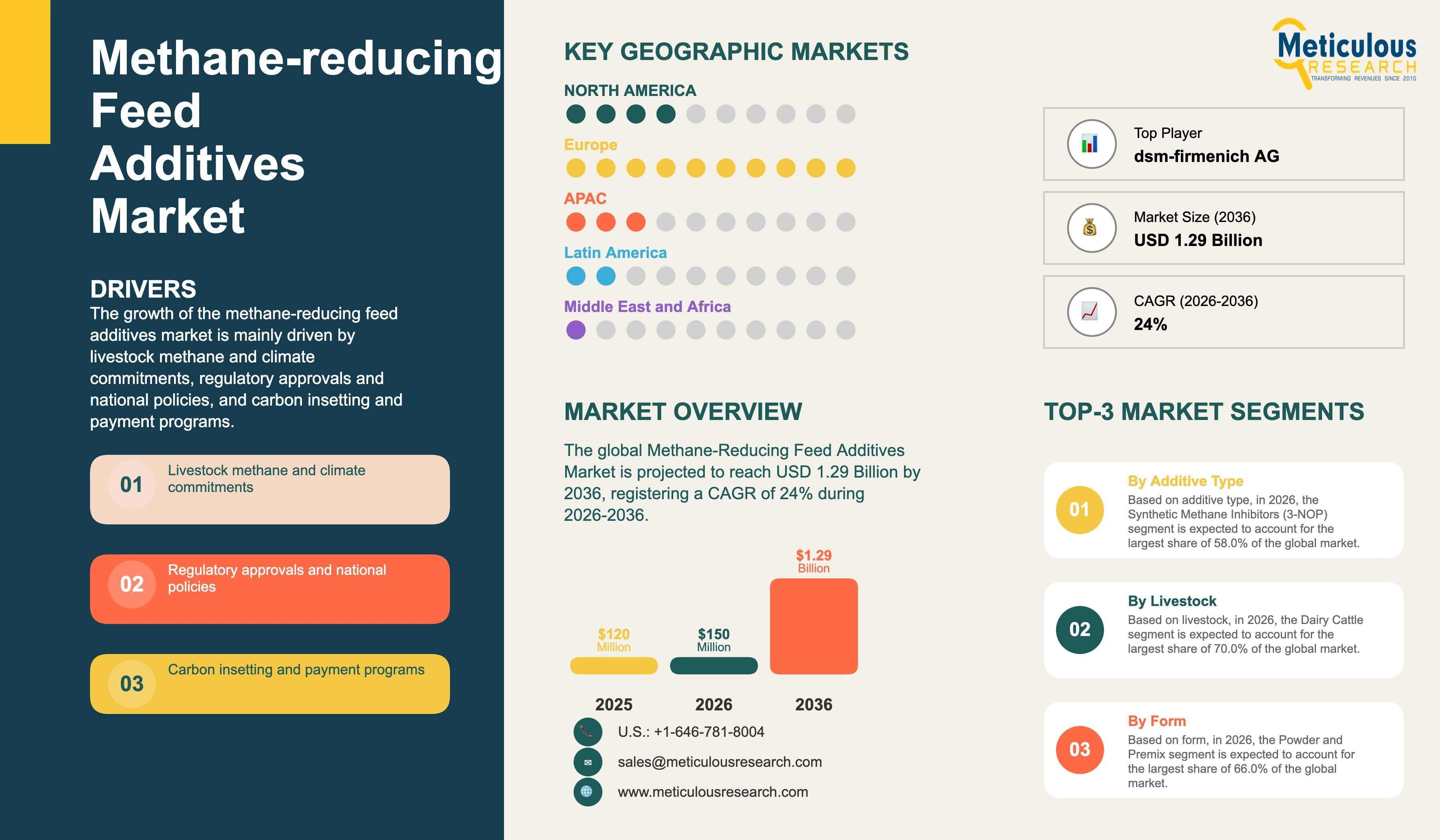
The global methane-reducing feed additives market was valued at USD 120.0 million in 2025. This market is expected to reach USD 1.29 billion by 2036 from an estimated USD 150.0 million in 2026, registering a CAGR of 24.0% during the forecast period (2026-2036).
- Published
- Nov 2026
- Pages
- 260
- Format
- PDF + Excel
- Report ID
- MRAGR - 1042535
- Base year
- 2025
- 2025 · BASELINE
- $120.0M
- 2036
- $1.29B
- CAGR 2026–2036
- 24.0%
2025 baseline · 2026–2036 forecast at 24.0% CAGR · hover a bar for the value
Key highlights
The United Nations Environment Programme and the Climate and Clean Air Coalition's Global Methane Assessment estimated that livestock account for about 32% of human-caused methane emissions, mainly from enteric fermentation in cattle and other ruminants, which makes feed additives one of the most direct tools for reducing agricultural methane.
The European Food Safety Authority concluded in 2021 that 3-nitrooxypropanol (3-NOP), sold by dsm-firmenich as Bovaer, reduces methane emissions from dairy cows by about 20% to 35% without affecting production, and EU member states approved the additive in February 2022, followed by approvals in the U.K., Canada, Japan, and other countries.
The U.S. Food and Drug Administration completed its review of Bovaer in May 2024, finding that it meets safety and efficacy requirements for lactating dairy cattle, and Elanco Animal Health markets the product in the U.S. through its strategic collaboration with dsm-firmenich.
Since 1 January 2025, conventional dairy farms in Denmark with more than 50 cows have been required to reduce methane emissions through feed, either by increasing dietary fat throughout the year or by feeding Bovaer for 80 days a year, the first national requirement of its kind. However, reports of animal health concerns from some Danish farmers in late 2025 led the authorities to investigate and EFSA to begin reviewing the latest scientific data on the additive.
CH4 Global made the first commercial deliveries of its Asparagopsis seaweed-based feed supplement, Methane Tamer, in Australia and opened the first phase of its commercial-scale EcoPark in South Australia in January 2025, while CSIRO research has shown that Asparagopsis can reduce cattle methane emissions by more than 80%.
Verra approved VM0041, a methodology for reducing enteric methane emissions from ruminants through the use of feed ingredients, which allows verified reductions from additives to be used in carbon credit and insetting programs, while dairy processors such as Arla and FrieslandCampina have introduced sustainability payment programs that reward farmers for using approved additives.
By additive type, synthetic methane inhibitors (3-NOP) account for the largest share of 58.0% in 2026, while seaweed-based additives register the highest CAGR.
By livestock, dairy cattle account for the largest share of 70.0% in 2026, while beef cattle register the highest CAGR.
By form, powder and premix account for the largest share in 2026, while liquid forms register the highest CAGR.
By geography, Europe accounts for the largest share of 52.0% in 2026, while Asia-Pacific registers the highest CAGR of 31.1%.
Report summary
| Particulars | Details |
|---|---|
| Base Year | 2025 |
| Estimated Year | 2026 |
| Forecast Period | 2026-2036 |
| Market Size in 2025 | USD 120.0 million |
| Market Size in 2026 | USD 150.0 million |
| Market Size by 2036 | USD 1.29 billion |
| CAGR (2026-2036) | 24.0% |
| Format | PDF, Excel & Cloud Portal · 260 pages |
| Largest Segment by Additive Type (2026) | Synthetic Methane Inhibitors (3-NOP) (58.0%) |
| Largest Segment by Livestock (2026) | Dairy Cattle (70.0%) |
| Largest Region (2026) | Europe (52.0%) |
| Fastest-Growing Region | Asia-Pacific (CAGR 31.1%) |
| Segments Covered | Additive Type, Livestock, Form, and Geography |
| Geographic Scope | Europe, North America, Asia-Pacific, Latin America, and Middle East and Africa |
| Key Companies Profiled | dsm-firmenich, Elanco, Agolin, Mootral, CH4 Global, Rumin8, Sea Forest, Symbrosia, Volta Greentech, FutureFeed, Cargill, Trouw Nutrition (Nutreco), and Royal Agrifirm Group |
Report overview
Segments covered: additive type, livestock, form.
The growth of this market is mainly driven by the large contribution of livestock to global methane emissions, regulatory approvals of methane-reducing additives in the EU, the U.S., the U.K., Canada, Brazil, Japan, and other countries, the first government requirements for methane-reducing feeding practices in Denmark, Scope 3 emission reduction commitments by dairy and meat companies, carbon insetting and payment programs that reward farmers for verified reductions, and the commercialization of new seaweed-based and natural additives. However, factors such as the cost of additives for farmers without a clear productivity benefit, concerns raised by some farmers and consumers about animal health and product safety, limited approvals and practical delivery options for grazing animals, and uncertainty about long-term efficacy are expected to restrain the growth of this market to some extent.
Methane-reducing feed additives are compounds, natural extracts, seaweeds, and microbial products added to the diets of cattle, sheep, goats, and other ruminants to reduce the methane produced during digestion. In the rumen, microbes called methanogens convert hydrogen and carbon dioxide into methane, which the animal releases mainly by belching. This process, known as enteric fermentation, is the largest source of methane in agriculture. Feed additives reduce methane by blocking the enzymes that methanogens use, by changing the rumen environment, or by shifting fermentation toward pathways that produce less hydrogen. Because methane also represents a loss of feed energy, some additives may improve feed efficiency, although results vary between products and farms.
This market covers the global revenue from the sale of methane-reducing feed additives, measured at the value of additives sold to feed manufacturers, premix producers, integrators, and farmers. It includes synthetic methane inhibitors such as 3-NOP, essential oils and plant extracts such as garlic, citrus, and other plant compounds, seaweed-based additives such as Asparagopsis, probiotics and direct-fed microbials, and other additives such as nitrates and specialized oils, where these are sold with a methane reduction claim. The market is segmented by additive type, livestock, form, and geography. General feed additives sold without a methane reduction claim, methane vaccines, breeding programs, and manure treatment products are not included.
Livestock are a major source of greenhouse gas emissions, and methane from cattle is the largest single part of this contribution. The Global Methane Assessment by UNEP and the Climate and Clean Air Coalition estimated that livestock produce about 32% of human-caused methane emissions, and methane is a powerful short-lived greenhouse gas that has a large effect on near-term warming. More than 150 countries have joined the Global Methane Pledge, which aims to cut global methane emissions by 30% from 2020 levels by 2030, and many countries are now looking at agriculture as an area where methane can be reduced. Feed additives are one of the few tools that can reduce enteric methane quickly without reducing herd sizes or production.
The market has developed rapidly since the first regulatory approvals in 2021 and 2022. Bovaer, the 3-NOP product developed by dsm-firmenich, was first approved in Brazil and Chile in 2021, followed by the EU in 2022, and the U.K., Canada, Australia, the U.S., Japan, and other countries in later years. EFSA found that it reduces methane from dairy cows by about 20% to 35%, and a meta-analysis by Pennsylvania State University found an average reduction of about 28% in lactating dairy cows. In the U.S., Elanco markets Bovaer and has worked with dairy processors and food companies to create payment programs that help farmers cover its cost.
Other types of additives are also entering the market and giving farmers more choice in cost, efficacy, and ingredient origin. Essential oils and plant extracts, such as Agolin Ruminant and Mootral's garlic and citrus-based product, provide smaller but steady reductions and are approved as feed materials or additives in many countries. Seaweed-based additives using Asparagopsis, which contains bromoform, can reduce methane by more than 80% in trials, according to CSIRO, and companies such as CH4 Global, Sea Forest, Symbrosia, and Volta Greentech are scaling up cultivation and processing. Rumin8 is developing synthetic versions of the active compounds in Asparagopsis and received its first regulatory approval in Brazil.
Policy and market incentives are shaping demand, since most farmers adopt additives only when regulation or payments make them worthwhile. Denmark became the first country to require methane-reducing feeding practices on larger dairy farms from January 2025, and it plans to introduce a tax on livestock emissions from 2030. Dairy companies such as Arla, FrieslandCampina, Danone, and Nestlé have Scope 3 climate targets and have started programs that reward farmers for using methane-reducing additives. Carbon insetting and credit programs, such as those based on Verra's methodology for methane-reducing feed ingredients, allow food companies and farmers to monetize verified reductions.
However, the market also faces important challenges related to animal health, consumer perception, and farmer confidence. In late 2025, some Danish farmers reported health problems in cows fed Bovaer, which led to a government investigation and a review by EFSA, and Arla's U.K. trial of the product ended amid consumer concerns. dsm-firmenich has stated that it expects the issues to be explained by other factors such as seasonality, feed quality, and disease. These events have increased attention on animal health, transparency, and farmer confidence, which will be important for the market's future growth.
Over the forecast period, the methane-reducing feed additives market is expected to grow rapidly from a small base, as approvals expand, new additives reach the market, payment programs grow, and more countries consider policies for agricultural methane. Europe is expected to remain the largest market, while Asia-Pacific is expected to grow fastest at a CAGR of 31.1%.
Accurate measurement and verification of methane reductions is essential for payment programs and carbon credits. Combining additives with digital tools, such as feed management software, methane measurement devices like breath analyzers, and herd-level modeling, creates opportunities for companies that can offer complete solutions. Additive suppliers that work with dairy processors, feed companies, and verification providers to deliver trusted data are well placed to benefit. Digital records of additive use, combined with animal-level methane measurement, can reduce verification costs and make it easier for small farms to join payment programs. Companies that build these data systems can also help food companies report Scope 3 reductions to investors and regulators. Feed companies are well placed to offer these services because they already supply farms regularly and hold detailed ration data, which can be linked with additive use and methane models.
Liquid and water-delivered forms, slow-release boluses, and combination products that pair methane reduction with productivity benefits, such as improved feed efficiency or milk components, can increase farmer adoption. Liquid forms are the fastest-growing form segment in this market. Products that combine methane reduction with clear productivity benefits are especially attractive because they can pay for themselves without external payments, and research into such combination products is increasing among feed companies and start-ups. Slow-release boluses that deliver additives over several months could open the grazing market, which is currently difficult to serve. Combination products may also reduce the need for external payments, which would make adoption more resilient to changes in government or company funding.
Based on the location of sales, Europe is expected to account for the largest share of 52.0% of the market in 2026, mainly due to early EU approval, Denmark's feeding requirement, and strong dairy processor commitments.
Among all regions, Asia-Pacific is projected to register the highest CAGR of 31.1% during the forecast period, driven by Australian seaweed products, approval in Japan, and potential approval in China.
The report profiles 13 companies, including dsm-firmenich, Elanco, Agolin, Mootral, CH4 Global, Rumin8, Sea Forest, Symbrosia, Volta Greentech, FutureFeed, Cargill, Trouw Nutrition, and Royal Agrifirm Group. The top five players account for an estimated 72.0% of the market in 2025.
Report infographic
Market dynamics
13 factors across 5 forcesLivestock methane and climate commitments
Livestock are one of the largest sources of human-caused methane, and the Global Methane Pledge has put methane reduction high on the climate agenda. Many countries, including Denmark, New Zealand, Ireland, and the Netherlands, have set targets to reduce agricultural emissions, and enteric methane from cattle is the largest source in most of these countries. Unlike many other agricultural measures, feed additives can reduce methane immediately and do not require changes in herd size or farm structure, which makes them attractive to governments and farmers. In countries with large livestock sectors, such as Ireland, Denmark, and New Zealand, agriculture accounts for a large share of national emissions, so governments cannot meet their climate targets without reducing enteric methane. Feed additives offer a measurable way to do so while maintaining food production and farm incomes.
Food and beverage companies have also made commitments that cover emissions in their supply chains. Dairy and meat companies, such as Arla, FrieslandCampina, Danone, Nestlé, and JBS, have set Scope 3 targets that require reductions on the farms that supply them, and many have started programs that encourage or pay farmers to use methane-reducing additives. Dairy cattle account for the largest share of the market by livestock, since dairy companies have the most direct relationship with farmers and the strongest climate commitments. Retailers are also starting to ask suppliers for lower-carbon dairy and beef products, which adds pressure across the value chain.
Regulatory approvals and national policies
Regulatory approvals are opening new markets for methane-reducing additives and giving farmers and food companies confidence that products are safe and effective. Bovaer has been approved in a large and growing number of countries, including the EU, the U.K., the U.S., Canada, Brazil, Australia, and Japan, and approvals for other products are increasing. The FDA's review of Bovaer in 2024 was an important milestone because the U.S. has a large dairy and beef sector and a long approval process for new feed additives. Rumin8 has received approval in Brazil, and Asparagopsis products are sold in Australia and other countries under feed regulations.
Denmark's requirement for methane-reducing feeding practices on large dairy farms from 2025 was the first national policy of its kind, and its planned livestock emissions tax from 2030 is expected to further increase demand for additives. Other countries, including New Zealand and Ireland, are considering how to encourage or require methane reduction on farms. These policies are expected to create stable demand and support the largest regional market, Europe. Regulators in several countries are also developing clearer pathways for approving additives with environmental claims, which should speed up approvals for new products over the forecast period.
Carbon insetting and payment programs
Programs that pay farmers for verified methane reductions are making additives more affordable. Dairy processors and food companies in Europe and North America have created programs that cover part or all of the cost of additives, and carbon credit methodologies, such as Verra's methodology for methane-reducing feed ingredients, allow reductions to be verified and traded. In the U.S., Elanco has developed a program that allows farmers to generate and sell insets from Bovaer use to food companies, creating an additional revenue stream.
These programs address the main barrier to adoption, which is that most additives add cost without a guaranteed increase in milk or meat production. As programs grow and verification methods improve, more farmers are expected to adopt additives. Several food companies have also started to pay premiums for low-methane milk and beef sold under sustainability brands, and some governments offer grants that cover part of the cost of additives. Together, these programs are turning methane reduction into a source of income for farmers rather than only a cost, which is expected to be a major driver of adoption over the forecast period.
Innovation in natural and seaweed-based additives
New additives are expanding the range of options for farmers, food companies, and feed manufacturers with different needs and budgets. Seaweed-based additives from Asparagopsis offer very high methane reductions in trials, and companies are building large cultivation facilities to lower costs. Essential oils and plant extracts offer natural options that may appeal to organic farmers and consumers. Probiotics and direct-fed microbials are being developed to change the rumen microbiome. These innovations are expected to increase competition, reduce costs, and expand the market, and seaweed-based additives form the fastest-growing additive type in this market. Investment from venture capital funds, climate funds, and large agribusiness and trading companies has supported these innovations, and several companies are scaling production to supply millions of cattle.
Table of contents
11 chapters · 108 sections · 260 pages · click to expandSegmental analysis
| Segment | Largest share (2026) | Fastest growth (2026–2036) |
|---|---|---|
| By Livestock Type | Dairy cattle | Beef cattle |
By Livestock Type
- Dairy cattle are expected to account for the largest share of 70.0% of the market in 2026, mainly due to daily mixed rations and dairy company programs, while beef cattle are projected to register the highest CAGR.
Geographic analysis
Asia-Pacific
Fastest growthAsia-Pacific and Latin America have large cattle herds and growing dairy sectors. Japan has approved Bovaer, Australia has supported research and commercialization through Meat and Livestock Australia and CSIRO, and companies such as Mitsubishi Corporation are partnering with CH4 Global to expand in Australia, Japan, and Southeast Asia. China and India have very large cattle populations, and approval of additives in China would create a major new market. Asia-Pacific is the fastest-growing region in this market. Asia-Pacific is projected to register the highest CAGR of 31.1% during the forecast period. The rapid growth of this region is mainly driven by the commercialization of Asparagopsis products in Australia, government and industry support for methane reduction in Australia and New Zealand, approval of Bovaer in Japan, partnerships such as CH4 Global's agreement with Mitsubishi Corporation, and the potential approval of additives in China, which has a large and growing dairy sector. Asia-Pacific and Latin America expansion
Latin America
Brazil, the world's largest beef exporter, has approved several methane-reducing additives, and meat companies such as JBS have partnered with additive developers. Latin America also offers strong potential because of its very large cattle herds, growing export markets that require lower-carbon products, and early regulatory approvals in Brazil, Chile, and other countries. Additive suppliers that partner with large meat processors, feed companies, and cooperatives in these regions can reach large numbers of animals quickly. Local production of seaweed and plant-based additives could also reduce costs and improve supply security in these markets. Latin America is growing because of approvals in Brazil, partnerships with meat processors such as JBS, and large cattle herds. In the U.S., adoption is supported by dairy processors and food companies that fund Bovaer use through insetting programs, while Canadian dairy and beef farmers gained access to the product after its approval in early 2024. Geographic Analysis
Europe
Largest shareIn 2026, Europe is expected to account for the largest share of 52.0% of the global methane-reducing feed additives market. The large share of this region is mainly due to the early EU approval of Bovaer in 2022, Denmark's requirement for methane-reducing feeding practices on large dairy farms, the strong climate commitments of European dairy processors such as Arla, FrieslandCampina, and Danone, and national targets to reduce agricultural emissions in countries such as the Netherlands, Ireland, and Germany. Denmark is one of the largest national markets because of its feeding requirement, and its planned livestock emissions tax from 2030 is expected to support continued demand from both dairy and beef farms. The Netherlands, Germany, Ireland, France, and the U.K. have large dairy sectors and growing payment programs. However, the concerns raised in Denmark in late 2025 and the EFSA review have created uncertainty, and the outcome of the review will influence growth in the region. Europe is expected to remain the largest region throughout the forecast period, supported by regulation and dairy company programs.
North America
North America is the second-largest region, supported by the FDA review of Bovaer, Elanco's marketing and insetting programs, and adoption in Canadian dairy and beef.
Middle East & Africa
The Middle East and Africa remains a small market today but has potential in countries with large dairy operations, such as Saudi Arabia, and growing interest in sustainable livestock production in South Africa and Kenya, where development programs are testing methane-reducing feeding practices.
Competitive landscape
The methane-reducing feed additives market is concentrated, with dsm-firmenich holding a leading position through Bovaer, and a growing number of companies offering plant-based, seaweed-based, and microbial products. Leading companies include dsm-firmenich and its U.S. partner Elanco Animal Health; plant extract companies such as Agolin and Mootral; seaweed companies such as CH4 Global, Sea Forest, Symbrosia, and Volta Greentech; Asparagopsis licensor FutureFeed; synthetic analog developer Rumin8; and feed companies such as Cargill, Trouw Nutrition (Nutreco), and Royal Agrifirm Group that distribute additives through their premixes.
Companies compete on methane reduction efficacy, safety data, regulatory approvals, cost, ease of use, supply capacity, and partnerships with dairy and meat companies. Access to feed company distribution networks and integration with insetting and verification programs are important competitive factors.
The top five players are estimated to account for 72.0% of the methane-reducing feed additives market in 2025. This high concentration reflects the strong position of 3-NOP, its wide regulatory approvals, and the early commercial stage of most competing products. However, concentration is expected to decline over the forecast period as seaweed-based, plant-based, and synthetic analog products receive more approvals and scale up production.
Players use several strategies to grow in this market, including expanding regulatory approvals, partnerships with dairy processors, meat companies, and feed manufacturers, distribution agreements, investment in production capacity, and the development of new forms for beef and grazing cattle. For example, CH4 Global has partnered with Mitsubishi Corporation and UPL to expand distribution, and Royal Agrifirm has partnered to distribute natural methane-reducing products.
Competition is expected to increase as seaweed-based and synthetic analog products receive more approvals, and prices are expected to fall as production scales up. Large feed and animal health companies are expected to play a growing role, either by developing their own products or by distributing and investing in start-ups. Partnerships between additive developers and dairy processors, meat companies, and retailers will remain important, since these partners often fund adoption and provide access to large numbers of farms through existing supply relationships. Companies that can show strong long-term safety data and cost-effective methane reductions are expected to gain market share.
Some of the key players operating in the methane-reducing feed additives market are dsm-firmenich AG, Elanco Animal Health Incorporated, Agolin SA, Mootral SA, CH4 Global, Inc., Rumin8 Pty Ltd, Sea Forest Ltd, Symbrosia, Inc., Volta Greentech AB, FutureFeed Pty Ltd, Cargill, Incorporated, Trouw Nutrition (Nutreco N.V.), and Royal Agrifirm Group.
- —
Denmark's feeding requirement took effect in January 2025, CH4 Global opened its first commercial EcoPark and began deliveries in Australia, Rumin8 received approval in Brazil, and EFSA began reviewing new data on 3-NOP after concerns raised by Danish farmers. CH4 Global also signed partnerships with Mitsubishi Corporation and UPL to expand distribution.
- Elanco
- Agolin
- Mootral
- CH4 Global
- Rumin8
- Sea Forest
- Symbrosia
- Volta Greentech
- FutureFeed
- Cargill
- Trouw Nutrition · Nutreco
- Royal Agrifirm Group
Expert perspectives
Methane-reducing feed additives are one of the most promising tools for reducing agricultural methane, and the market has moved from research to commercial sales in less than five years. The combination of regulatory approvals, dairy company commitments, payment programs, and the first government requirements in Denmark has created a real market, although it remains small compared with the overall feed additives industry.
Over the forecast period, the market is expected to grow at a CAGR of 24.0%, driven by expanding approvals, new products, growing payment and insetting programs, and policies in Europe and Asia-Pacific. The main risks are farmer and consumer confidence after the concerns raised in 2025, the outcome of the EFSA review, and the willingness of food companies and governments to cover the cost of additives.
3-NOP remains the largest additive type, while seaweed-based additives grow fastest as cultivation scales up. Dairy cattle remain the largest livestock segment, while beef cattle grow fastest as feedlot adoption increases and new delivery methods for grazing cattle are developed.
Europe remains the largest region because of regulation and dairy company programs, while Asia-Pacific is the fastest-growing region at a CAGR of 31.1%, supported by Australian seaweed products, Japanese approvals, and potential approval in China.
For additive suppliers, the key priorities are to build strong long-term safety and efficacy data, communicate transparently with farmers and consumers, secure approvals in new markets, and work with dairy processors and meat companies to fund adoption. For feed companies, the opportunity is to integrate methane-reducing additives into premixes and offer them as part of sustainability programs. For food companies, the priority is to design payment programs that make adoption profitable for farmers. We believe that the market will become more competitive and that the winners will be those that combine proven safety, low cost per tonne of methane reduced, and strong value chain partnerships.
We also expect government policy to become more important over the forecast period. Denmark's example shows that regulation can create rapid demand, and its planned livestock emissions tax from 2030 could be followed by similar measures in other countries. At the same time, the market's growth will depend on rebuilding confidence after the concerns raised in 2025. If the EFSA review confirms the safety of 3-NOP when used as directed and independent studies support animal health, adoption is expected to accelerate. If concerns persist, demand may shift toward natural and seaweed-based products, which would slow growth in the short term but increase competition and innovation over the longer term.
Customer perspectives
Dairy Farmer - 300-cow herd, Denmark
We started using a methane-reducing additive because of the national requirement, and it is easy to add to our mixed ration, but we watch our cows closely and want long-term safety data from independent studies. Payments from our dairy cooperative help cover the cost.
This explains why dairy cattle account for 70.0% of the market, why Europe accounts for 52.0% of the market, and why long-term safety evidence matters to farmers.
Sustainability Manager - dairy processor, Europe
Our Scope 3 targets depend heavily on reductions on our members' farms, so we pay farmers who use approved additives and verify the results through feed records, but we need clear safety evidence to keep consumers confident.
This comment explains why sustainability payment programs run by European dairy processors drive adoption and why transparency and independent safety data have become critical.
Feedlot Manager - beef operation, Australia
Seaweed-based products fit easily into our feedlot rations, and our processor pays for verified reductions. The cattle perform as well as before, and the extra income makes the program worthwhile for us.
This explains why seaweed-based additives and beef cattle are growing fastest in this market, and why Asia-Pacific, led by Australia, is the fastest-growing region.
Frequently asked questions
Based on sales of additives with a methane reduction claim, the market was valued at USD 120.0 million in 2025 and USD 95.0 million in 2024, and is estimated at USD 150.0 million in 2026. The market is still small compared with the overall feed additives industry but is growing quickly.
Cite this report
Meticulous Research. (2026). Methane-Reducing Feed Additives Market - Global Opportunity Analysis and Industry Forecast (2026-2036) (Report No. MRAGR - 1042535). Meticulous Market Research Pvt. Ltd. https://www.meticulousresearch.com/product/methane-reducing-feed-additives-market-7218