Medication Adherence Solutions Market (2026-2036)
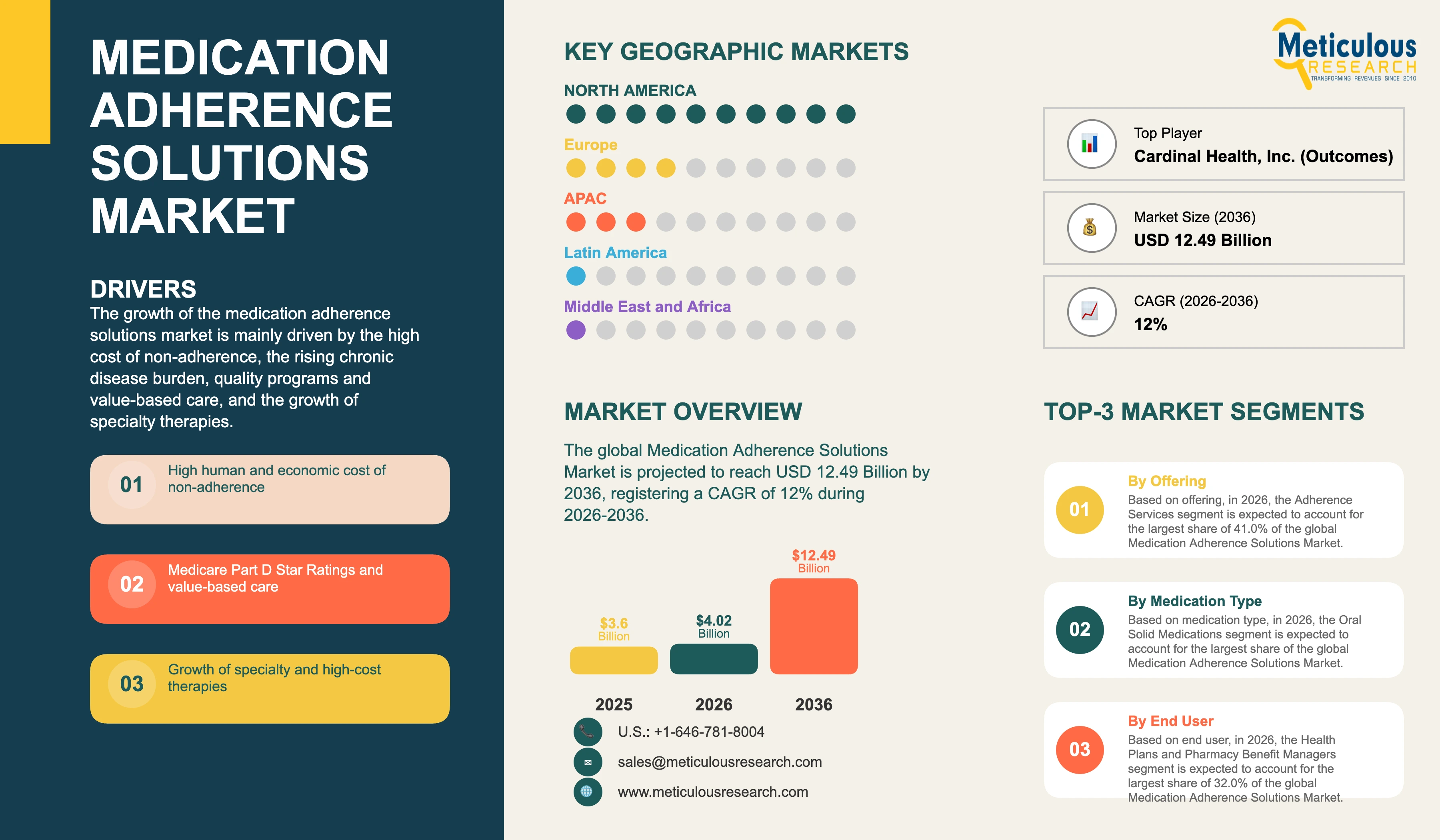
The global medication adherence solutions market was valued at USD 3.60 billion in 2025. This market is expected to reach USD 12.49 billion by 2036 from an estimated USD 4.02 billion in 2026, registering a CAGR of 12.0% during the forecast period (2026-2036).
- Published
- Nov 2026
- Pages
- 260
- Format
- PDF + Excel
- Report ID
- MRHC - 1042570
- Base year
- 2025
- 2025 · BASELINE
- $3.60B
- 2036
- $12.49B
- CAGR 2026–2036
- 12.0%
2025 baseline · 2026–2036 forecast at 12.0% CAGR · hover a bar for the value
Key highlights
The World Health Organization has reported that only about half of patients with chronic diseases in developed countries take their medications as prescribed, and estimates published in the Annals of Internal Medicine have put the avoidable healthcare cost of medication non-adherence in the U.S. at between USD 100 billion and USD 300 billion per year, mainly from avoidable hospital admissions and emergency visits.
In May 2026, Swoop, an AI-powered healthcare engagement company, acquired NimbleRx, a prescription management and pharmacy connectivity platform that serves patients across all 50 U.S. states and reports that its digital interventions improve long-term medication adherence by 26% to 40%, extending Swoop's business from patient engagement into prescription fulfillment and adherence.
In September 2026, Clarest Health launched Clarest Path, an intelligent medication management platform that combines an integrated data layer with a predictive intervention engine for health plans and at-risk providers, addressing all five medication-related Medicare Star Ratings measures, including adherence, comprehensive medication reviews, and statin use in people with diabetes.
In May 2026, CareTria, a therapy initiation partner to pharmaceutical companies backed by Frazier Healthcare, acquired digital pharmacy CaryHealth to combine electronic prescription handling, medication delivery, and adherence monitoring, reflecting pharmaceutical companies' interest in end-to-end therapy access and adherence services.
Custom Health, a TSX-listed medication management company, acquired adherence technology firm PatchRx and, in September 2026, completed the acquisition of Spencer Health Solutions, the developer of the spencer smart medication dispenser, building a vertically integrated model that combines pharmacy services, connected devices, and remote monitoring.
The growth of GLP-1 drugs for diabetes and obesity, which are expensive and have high discontinuation rates, has increased the interest of health plans, employers, and manufacturers in adherence and persistence programs that help patients stay on therapy and manage side effects.
By offering, adherence services account for the largest share of 41.0% in 2026, while software and digital platforms register the highest CAGR.
By medication type, oral solid medications account for the largest share in 2026, while inhaled medications register the highest CAGR.
By therapeutic area, cardiovascular diseases account for the largest share in 2026, while oncology registers the highest CAGR.
By end user, health plans and pharmacy benefit managers account for the largest share of 32.0% in 2026, while pharmaceutical and biotechnology companies register the highest CAGR.
By geography, North America accounts for the largest share of 57.5% in 2026, while Asia-Pacific registers the highest CAGR of 15.3%.
Report summary
| Particulars | Details |
|---|---|
| Forecast Period | 2026-2036 |
| Base Year | 2025 |
| Estimated Year | 2026 |
| CAGR (Value) | 12.0% |
| Format | PDF, Excel & Cloud Portal · 260 pages |
| Market Size (Value) in 2025 | USD 3.60 billion |
| Market Size (Value) in 2026 | USD 4.02 billion |
| Market Size (Value) by 2036 | USD 12.49 billion |
| Largest Segment by Offering (2026) | Adherence Services (41.0%) |
| Largest Segment by End User (2026) | Health Plans and Pharmacy Benefit Managers (32.0%) |
| Largest Region (2026) | North America (57.5%) |
| Fastest-Growing Region | Asia-Pacific (CAGR 15.3%) |
| Segments Covered | Offering, Medication Type, Therapeutic Area, End User, Geography |
| Countries Covered | U.S., Canada, U.K., Germany, France, Netherlands, Sweden, Norway, Denmark, Finland, Italy, Spain, Belgium, Switzerland, Ireland, Rest of Europe, China, Japan, India, Australia, South Korea, Taiwan, Singapore, New Zealand, Malaysia, Thailand, Rest of Asia-Pacific, Brazil, Mexico, Colombia, Chile, Argentina, Rest of Latin America, Saudi Arabia, U.A.E., Israel, South Africa, Rest of Middle East & Africa |
| Key Companies | 14 companies and other companies |
Report overview
Segments covered: offering, medication type, therapeutic area, end user.
The growth of this market is mainly driven by the large human and economic cost of medication non-adherence, the rising number of people living with chronic diseases and taking several medications, the role of medication adherence measures in Medicare Part D Star Ratings and other quality programs, the shift to value-based care models that reward lower hospital admissions, the growth of specialty and high-cost therapies such as GLP-1 drugs, oral oncology drugs, and biologics that require consistent use, investment by pharmaceutical companies in patient support programs, and the adoption of AI-based analytics, digital engagement platforms, and connected devices. However, factors such as limited reimbursement for adherence services in many countries, the difficulty of proving long-term outcomes, low patient engagement with digital tools, and data privacy and integration challenges are expected to restrain the growth of this market to some extent.
Medication adherence solutions are services, software platforms, and connected devices that help patients take their medications as prescribed and stay on therapy over time. They include pharmacist and nurse outreach services, medication therapy management, patient support programs, refill synchronization and reminder services, mobile apps and digital engagement platforms, AI-based adherence analytics and predictive platforms, connected devices such as smart pill dispensers, smart bottles and caps, connected inhalers and injection devices, smart blister packaging, and ingestible sensors. This report covers the global revenue from medication adherence services, software and digital platforms, and connected devices and smart packaging, sold to health plans and pharmacy benefit managers, pharmacies, pharmaceutical and biotechnology companies, healthcare providers and accountable care organizations, and patients and caregivers.
Medication non-adherence is one of the most persistent and costly problems in healthcare. Patients may never fill a new prescription, fill it late, skip doses, take the wrong dose, or stop taking a medication early. The reasons are varied and include forgetfulness, complex regimens, side effects, cost, lack of understanding of the condition or treatment, depression and cognitive decline, and difficulties with access to pharmacies. Non-adherence leads to worse health outcomes, disease progression, avoidable hospital admissions, and deaths, and it reduces the value of the large amounts spent on prescription drugs.
The market is shaped by the incentives of different healthcare stakeholders, since health plans and pharmacy benefit managers invest in adherence because it affects quality ratings and total medical costs. In the U.S., medication adherence for diabetes, hypertension, and cholesterol medications is part of the Medicare Part D Star Ratings, which affect plan payments and enrollment. Pharmacies invest in adherence because it improves prescription retention and allows them to earn fees for clinical services. Pharmaceutical companies fund patient support programs because patients who stay on therapy benefit more from treatment and generate more prescriptions over time. Providers in value-based care models invest because better adherence reduces hospital admissions and costs.
Services remain the largest part of the market, as pharmacists, nurses, and care coordinators contact patients by phone, text, and in person to identify barriers, provide education, and help patients refill prescriptions. Medication therapy management programs, which are required for certain Medicare Part D members, review patients' medications to identify problems and improve adherence. Patient support programs run by pharmaceutical companies and specialty pharmacies help patients start and stay on high-cost therapies, offering financial assistance, education, and nurse support.
Software and digital platforms are the fastest-growing part of the market, and adherence analytics platforms use pharmacy claims, prescription fill data, and clinical data to identify patients at risk of non-adherence and prioritize outreach. Mobile apps and text messaging platforms remind patients to take and refill their medications and track adherence, while pharmacy software automates refill synchronization, reminders, and adherence packaging. Artificial intelligence is increasingly used to predict which patients will become non-adherent and which interventions will work best for each patient.
Connected devices and smart packaging provide objective data on whether patients take their medications. Smart pill dispensers sort and dispense doses at the right time, smart bottles and caps record when they are opened, connected inhalers and injection devices record each use, and smart blister packs record when doses are removed. These devices are used mainly for high-risk patients, older adults with complex regimens, and clinical trials, and they are increasingly combined with pharmacist monitoring and remote therapeutic monitoring programs.
The market is fragmented and includes pharmacy benefit managers and health plans with internal programs, specialized adherence and medication management companies, pharmacy technology vendors, digital health companies, connected device makers, and patient support service providers. Leading companies include Cardinal Health (Outcomes), Clarest Health, Swoop (NimbleRx), OptimizeRx Corporation, Omnicell, Inc. (EnlivenHealth), Medisafe, Hero Health, MedMinder, Custom Health, AdhereTech, Jones Healthcare Group, Tabula Rasa HealthCare, and etectRx.
Over the forecast period, the medication adherence solutions market is expected to grow strongly, as chronic disease rates increase, as payers and providers adopt value-based care, as specialty and high-cost therapies expand, and as AI and digital tools make adherence programs more targeted and scalable. Growth will be strongest in software and digital platforms, oncology and specialty therapies, and programs funded by pharmaceutical companies and health plans.
Health plans and pharmacy benefit managers are expected to account for the largest share of 32.0% of the market in 2026, while pharmaceutical and biotechnology companies are projected to register the highest CAGR.
North America is expected to account for the largest share of 57.5% of the market in 2026, mainly due to Medicare Part D Star Ratings, value-based care, high specialty drug spending, and the presence of leading vendors.
Asia-Pacific is projected to register the highest CAGR of 15.3% during the forecast period, driven by rising chronic disease rates, aging populations, and the growth of pharmacy chains and digital health.
The report profiles 14 companies, including Cardinal Health (Outcomes), Clarest Health, Swoop (NimbleRx), OptimizeRx, Omnicell (EnlivenHealth), Tabula Rasa HealthCare, Medisafe, Hero Health, MedMinder, Custom Health, AdhereTech, Jones Healthcare Group, etectRx, and CareTria.
Report infographic
Market dynamics
16 factors across 5 forcesHigh human and economic cost of non-adherence
Medication non-adherence imposes a very large cost on patients, health systems, and payers. The World Health Organization's report on adherence to long-term therapies found that only about half of patients with chronic diseases in developed countries follow their prescribed treatment, and later research has confirmed that non-adherence remains common in conditions such as hypertension, diabetes, high cholesterol, heart failure, asthma, and depression. In the U.S., published estimates have put the avoidable healthcare costs of non-adherence at between USD 100 billion and USD 300 billion per year, mainly from hospital admissions and emergency department visits.
Non-adherence also reduces the effectiveness of prescription drugs, which account for a large and growing share of healthcare spending. When patients do not take their medications, the money spent on those drugs produces little health benefit, and their conditions may worsen, requiring more expensive care. For high-cost specialty drugs, poor adherence and early discontinuation can waste large amounts of money and lead to poor outcomes.
These costs give health plans, employers, providers, and pharmaceutical companies strong financial incentives to invest in adherence solutions. Studies of pharmacist interventions, refill synchronization, and targeted outreach have shown improvements in adherence rates, and some programs have shown reductions in hospital admissions and total costs, which supports continued investment. Employers that pay for health benefits are also paying closer attention to adherence, as non-adherence increases absenteeism and medical claims among their employees.
Rising chronic disease burden and polypharmacy
The number of people living with chronic diseases such as diabetes, cardiovascular disease, chronic respiratory disease, and mental health conditions is rising worldwide, driven by aging populations, obesity, and lifestyle factors. The International Diabetes Federation reports that hundreds of millions of adults are living with diabetes, and cardiovascular disease remains the leading cause of death worldwide. Most chronic diseases require long-term medication, often for life, which makes adherence critical to managing these conditions.
Older adults with several chronic conditions often take many medications every day, a situation known as polypharmacy, which makes adherence more difficult and increases the risk of errors and drug interactions. As populations age, the number of people with complex medication regimens is increasing, which drives demand for adherence services, medication reviews, adherence packaging, and connected devices. Patients discharged from hospital are a particularly high-risk group, since they often leave with new or changed medications, and transitional care programs that include pharmacist follow-up and medication reconciliation are expanding to reduce readmissions. Caregivers who manage medications for aging parents are also an important audience for adherence tools.
Quality programs and value-based care
Quality measurement and value-based payment models create direct financial incentives for adherence. In the U.S., the Medicare Part D Star Ratings include measures for adherence to diabetes medications, renin-angiotensin system antagonists, and statins, and Star Ratings affect quality bonus payments and rebates for Medicare Advantage plans. Health plans therefore invest heavily in adherence programs, often working with pharmacies, pharmacy benefit managers, and specialized vendors to improve their scores.
Accountable care organizations, Medicare Advantage provider groups, and other value-based care models also reward providers for reducing hospital admissions and total costs, which encourages them to invest in medication management and adherence. In Europe and other regions, pharmacy services such as new medicine services and medication reviews are increasingly funded by public health systems to improve outcomes and reduce waste. These quality and payment incentives turn adherence from a clinical goal into a measurable business priority for payers and providers.
Growth of specialty and high-cost therapies
Specialty therapies, including oral oncology drugs, biologics for autoimmune diseases, therapies for multiple sclerosis and HIV, and GLP-1 drugs for diabetes and obesity, account for a growing share of drug spending. These therapies are expensive, often have complex dosing or side effects, and require consistent use to be effective. Discontinuation rates for some of these therapies, such as GLP-1 drugs for weight loss, are high, which creates large costs and reduces benefits.
Pharmaceutical companies, specialty pharmacies, and health plans invest in patient support and adherence programs for these therapies, offering nurse support, side effect management, financial assistance, and digital engagement. The growth of specialty therapies is expected to be one of the most important drivers of the adherence solutions market over the forecast period. Specialty pharmacies also use adherence data to meet requirements in limited distribution agreements with manufacturers and in contracts with payers.
Table of contents
12 chapters · 179 sections · 260 pages · click to expandSegmental analysis
| Segment | Largest share (2026) | Fastest growth (2026–2036) |
|---|---|---|
| By Offering | Oral solid medications | Inhaled medications |
By Offering
- The oral solid medications segment is expected to account for the largest share of the medication adherence solutions market, while the inhaled medications segment is projected to register the highest CAGR during the forecast period.
- The cardiovascular diseases segment is expected to account for the largest share of the medication adherence solutions market, while the oncology segment is projected to register the highest CAGR during the forecast period.
Geographic analysis
North America
Largest shareIn 2026, North America is expected to account for the largest share of 57.5% of the global medication adherence solutions market. The large share of this region is mainly due to the high cost of non-adherence in the U.S., the role of medication adherence in Medicare Part D Star Ratings, the large Medicare Advantage market, the growth of value-based care, high spending on specialty and GLP-1 drugs, extensive pharmaceutical patient support programs, the availability of remote therapeutic monitoring reimbursement, and the presence of leading vendors such as Cardinal Health, Clarest Health, Swoop, OptimizeRx, Omnicell, Hero Health, MedMinder, and AdhereTech. Canada is also an important market, where pharmacies provide medication reviews and adherence packaging, and companies such as Custom Health and Jones Healthcare Group are based.
Europe
Europe is the second-largest market, led by the U.K., Germany, France, the Netherlands, and the Nordic countries. In the U.K., community pharmacies provide the New Medicine Service and other adherence-related services funded by the NHS, while pharmacies in the Netherlands, Germany, and the Nordic countries provide multi-dose packaging and medication reviews. Sweden, Norway, Denmark, and Finland use automated dispensing in municipal home care, while Italy, Spain, Belgium, Switzerland, and Ireland are expanding pharmacy-based adherence services and digital health programs.
Asia-Pacific
Fastest growthAsia-Pacific is projected to register the highest CAGR of 15.3% during the forecast period. The rapid growth of this region is mainly driven by rising rates of diabetes, hypertension, and other chronic diseases in China, India, and Southeast Asia, aging populations in Japan, South Korea, Taiwan, and Australia, the growth of pharmacy chains, private insurance, and digital health platforms, and government programs that promote chronic disease management. Mobile-first adherence apps and online pharmacy services are growing quickly in China and India, while Japan and Australia are expanding pharmacist-led medication management for older adults. Singapore, New Zealand, Malaysia, and Thailand are also growing markets.
Latin America
Latin America and the Middle East & Africa account for smaller shares of the market but are expected to grow steadily. Brazil, Mexico, Colombia, Chile, and Argentina have growing pharmacy chains and pharmaceutical patient support programs, while Saudi Arabia, the U.A.E., and Israel are investing in chronic disease management and digital health.
Middle East & Africa
In South Africa and other African countries, adherence programs for HIV and tuberculosis treatment are important and often supported by public health programs and international donors, including digital adherence technologies for tuberculosis recommended by the World Health Organization.
Competitive landscape
The global medication adherence solutions market is fragmented, with the top five players estimated to account for about 25% of the market in 2025. The market includes pharmacy benefit managers and health plans with internal programs, medication management and pharmacist services companies, pharmacy technology vendors, digital engagement and analytics companies, connected device and smart packaging makers, and patient support service providers.
Cardinal Health, through its Outcomes business, operates a large network of pharmacies that provide medication therapy management and adherence services for health plans. Clarest Health provides AI-powered medication management and adherence services for health plans and at-risk providers, and launched its Clarest Path platform in 2026. Swoop, which acquired NimbleRx in 2026, combines AI-based patient engagement with prescription fulfillment, while OptimizeRx provides digital health messaging for pharmaceutical companies through EHR and patient channels. Omnicell's EnlivenHealth offers pharmacy software for adherence programs, medication synchronization, and patient engagement, and Tabula Rasa HealthCare provides medication safety and adherence services.
Medisafe offers a widely used medication management app and digital patient support platform for pharmaceutical companies, while Hero Health, MedMinder, Custom Health, and AdhereTech provide connected dispensers, smart bottles, and monitoring services. Jones Healthcare Group offers smart blister packaging, and etectRx develops ingestible sensor technology for adherence monitoring. Many pharmacy chains, pharmacy benefit managers, and specialty pharmacies also run their own adherence programs.
Companies compete on clinical outcomes and evidence, ability to improve Star Ratings and adherence metrics, data and analytics capabilities, integration with pharmacy, health plan, and EHR systems, patient engagement, scale of pharmacist and nurse networks, technology, and price. Key strategies include acquisitions to combine engagement, pharmacy, and devices, partnerships with health plans, pharmacy benefit managers, and pharmaceutical companies, the launch of AI-based platforms, and expansion into specialty and GLP-1 adherence programs.
We expect consolidation to continue, as companies seek to offer end-to-end medication management that combines analytics, outreach, pharmacy fulfillment, and connected devices. Larger healthcare technology, pharmacy, and services companies are likely to acquire specialized adherence vendors to strengthen their offerings to health plans and pharmaceutical companies. Outcome-based pricing, in which vendors are paid for measured adherence gains, is also expected to become more common.
Some of the key players operating in the medication adherence solutions market are Cardinal Health, Inc. (Outcomes), Clarest Health, Swoop (NimbleRx), OptimizeRx Corporation, Omnicell, Inc. (EnlivenHealth), Tabula Rasa HealthCare, Inc., Medisafe, Hero Health, Inc., MedMinder Systems, Inc., Custom Health Holdings Inc., AdhereTech, Inc., Jones Healthcare Group, etectRx, Inc., and CareTria, among others.
- —
Swoop acquired NimbleRx in May 2026, CareTria acquired digital pharmacy CaryHealth in May 2026, Clarest Health launched its Clarest Path medication management platform in September 2026, and Custom Health completed its acquisition of Spencer Health Solutions in September 2026.
- Cardinal Health, Inc. · Outcomes
- Clarest Health
- Swoop (NimbleRx)
- OptimizeRx Corporation
- Omnicell, Inc. (EnlivenHealth)
- Tabula Rasa HealthCare, Inc.
- Medisafe
- Hero Health, Inc.
- MedMinder Systems, Inc.
- Custom Health Holdings Inc.
- AdhereTech, Inc.
- Jones Healthcare Group
- CareTria
Expert perspectives
Medication non-adherence is one of the largest sources of avoidable cost and poor outcomes in healthcare, and the medication adherence solutions market is benefiting from stronger financial incentives to address it. Medicare Star Ratings, value-based care, the growth of specialty and GLP-1 drugs, and pharmaceutical investment in patient support are directing more money toward adherence, while AI and digital tools are making programs more targeted and scalable. We see the market moving from simple reminders and outreach toward integrated, data-driven medication management.
Over the forecast period, the market is expected to grow at a CAGR of 12.0%, from USD 4.02 billion in 2026 to USD 12.49 billion in 2036. Growth will be supported by AI-driven predictive platforms, pharmaceutical patient support programs, connected devices and remote monitoring, and expansion in Asia-Pacific.
Adherence services remain the largest offering, while software and digital platforms grow fastest. Oral solid medications remain the largest medication type, while inhaled medications grow fastest. Cardiovascular diseases remain the largest therapeutic area, while oncology grows fastest. Health plans and pharmacy benefit managers remain the largest end user, while pharmaceutical and biotechnology companies grow fastest. North America remains the largest region, and Asia-Pacific is the fastest-growing region at a CAGR of 15.3%.
For vendors, the key priorities are to demonstrate measurable improvements in adherence, outcomes, and costs, to use AI to target the right patients with the right interventions, to integrate with pharmacy, health plan, and provider systems, and to address underlying barriers such as cost and side effects rather than relying on reminders alone. Vendors that can close the loop from identifying non-adherence to resolving it, for example through pharmacy fulfillment and home delivery, are likely to gain share.
We expect the role of pharmaceutical companies to grow significantly, as more high-cost therapies require strong adherence and persistence support and as competition among drugs increases. At the same time, health plans will continue to focus on Star Ratings and total cost of care, and they will look for platforms that combine several medication management services. Vendors that serve both pharmaceutical companies and health plans, while maintaining appropriate data separation and compliance, will have strong growth opportunities.
Finally, policy changes such as the Medicare Part D out-of-pocket cap and changes to Star Ratings methodology will influence where adherence spending goes. Vendors should monitor these changes closely and adapt their offerings to address the measures and populations that matter most to their customers. In our view, flexibility in program design will be a key competitive advantage.
Customer perspectives
Vice President of Pharmacy Quality - Medicare Advantage health plan, U.S.
Our Star Ratings depend heavily on medication adherence, so we use predictive analytics to find members who are likely to stop taking their statins or diabetes drugs and send them to pharmacists who can solve the problem. The programs that combine data, outreach, and home delivery work best.
Head of Patient Services - specialty pharmaceutical company, U.S.
Patients who stop our oral cancer drug early do not get the full benefit of treatment. Our support program combines nurse calls, side effect management, and digital reminders, and we track persistence closely.
Community Pharmacy Owner - U.K.
The New Medicine Service and our adherence packaging help patients start and stay on their medicines. We are now using an app to remind patients and track refills, which saves our staff time.
Frequently asked questions
The global medication adherence solutions market was valued at USD 3.60 billion in 2025, up from USD 3.22 billion in 2024, and is estimated at USD 4.02 billion in 2026. The market includes adherence services, software and digital platforms, and connected devices and smart packaging.
Cite this report
Meticulous Research. (2026). Medication Adherence Solutions Market - Global Opportunity Analysis and Industry Forecast (2026-2036) (Report No. MRHC - 1042570). Meticulous Market Research Pvt. Ltd. https://www.meticulousresearch.com/product/medication-adherence-solutions-market-7253