Hospital Indoor Positioning Market (2026-2036)
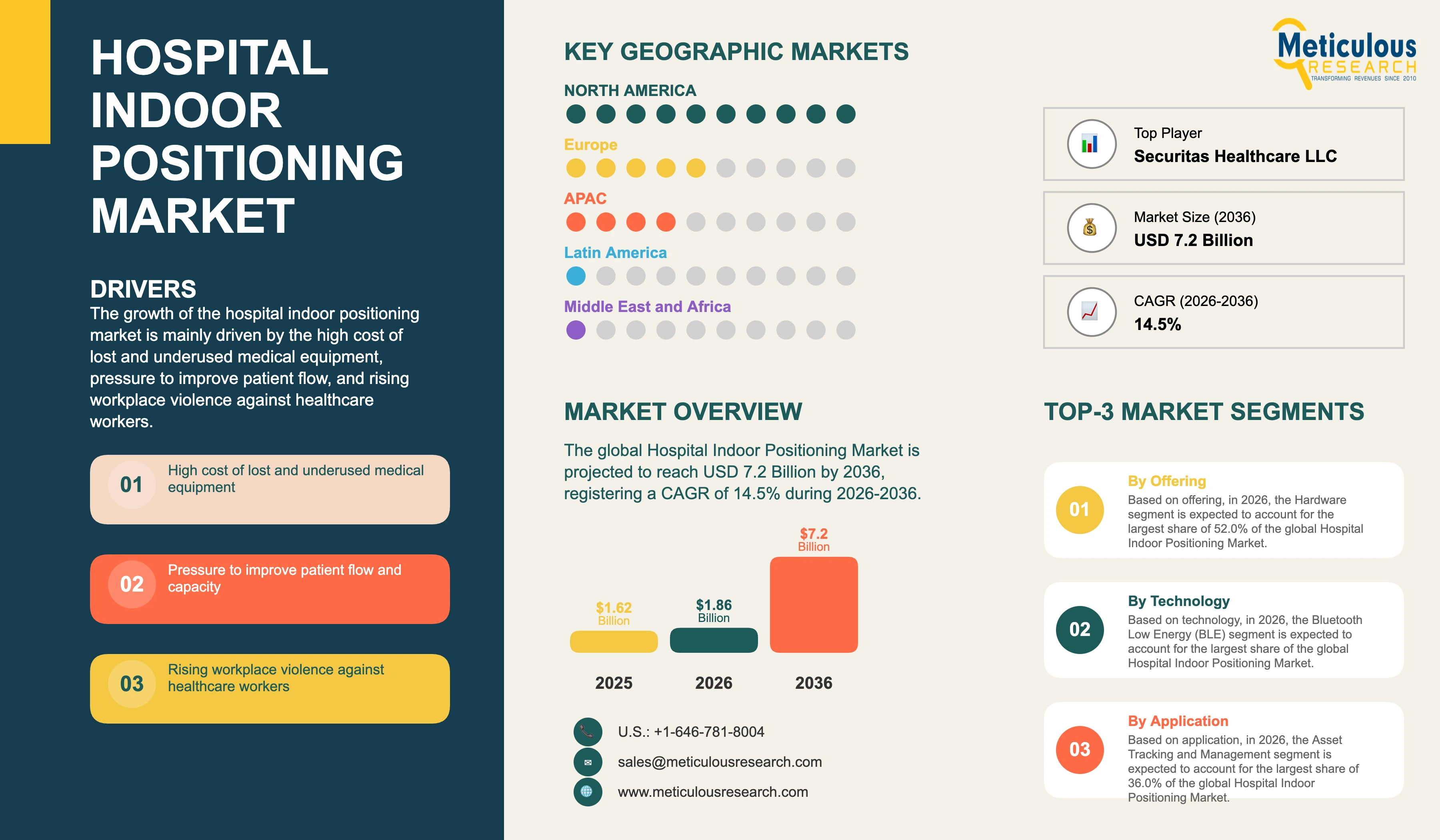
The global hospital indoor positioning market was valued at USD 1.62 billion in 2025. This market is expected to reach USD 7.20 billion by 2036 from an estimated USD 1.86 billion in 2026, registering a CAGR of 14.5% during the forecast period (2026-2036).
- Published
- Nov 2026
- Pages
- 261
- Format
- PDF + Excel
- Report ID
- MRHC - 1042578
- Base year
- 2025
- 2025 · BASELINE
- $1.62B
- 2036
- $7.20B
- CAGR 2026–2036
- 14.5%
2025 baseline · 2026–2036 forecast at 14.5% CAGR · hover a bar for the value
Key highlights
In May 2026, Securitas Healthcare, the healthcare business of Securitas AB that was formerly known as STANLEY Healthcare, acquired ZulaFly, a healthcare-focused cloud-native real-time location system (RTLS) and staff safety technology company, to expand its cloud-based RTLS capabilities alongside its on-premise platforms. Securitas Healthcare was also named Best in KLAS for Real-Time Location Systems in 2025.
In March 2026, CenTrak, a Halma company and one of the largest hospital RTLS providers in the U.S., received Epic Toolbox designation for its location solutions and validation with Rauland's nurse call platform, and it launched a new wearable for high-risk and wandering patients, reflecting the growing integration of location data into clinical workflows.
Zebra Technologies introduced its Orchestrated Care framework for hospitals in March 2026, combining RFID, real-time location, software, and mobile computing to improve asset visibility, patient safety, and hospital operations, while Qorvo announced the integration of ultra-wideband RTLS directly into enterprise Wi-Fi access points in May 2026.
Sonitor, a provider of ultrasound-based RTLS, merged with Tagnos, a provider of workflow and patient flow software, to combine high-accuracy room-level location with operational analytics for hospitals, and Zebra Ventures became a shareholder in the combined company.
HPE Aruba Networking and Cisco Systems now ship most enterprise Wi-Fi access points with built-in BLE radios, which allows hospitals to add location services to their existing networks at lower cost, and many health systems are evaluating location capabilities as part of their Wi-Fi refresh cycles.
Workplace violence against healthcare workers has become a major driver of the market, as hospitals deploy badge-based staff duress systems that send a precise location when a nurse presses an alert button, and several U.S. states now require hospitals to have workplace violence prevention plans.
By offering, hardware accounts for the largest share of 52.0% in 2026, while software registers the highest CAGR.
By technology, bluetooth low energy (BLE) accounts for the largest share in 2026, while ultra-wideband (UWB) registers the highest CAGR.
By application, asset tracking and management accounts for the largest share in 2026, while staff safety and duress alerting registers the highest CAGR.
By deployment, on-premise accounts for the larger share in 2026, while cloud registers the higher CAGR.
By end user, large hospitals and health systems account for the largest share of 58.5% in 2026, while medium and small hospitals register the highest CAGR.
By geography, North America accounts for the largest share of 48.0% in 2026, while Asia-Pacific registers the highest CAGR of 18.6%.
Report summary
| Particulars | Details |
|---|---|
| Base Year | 2025 |
| Estimated Year | 2026 |
| Forecast Period | 2026-2036 |
| Market Size in 2025 | USD 1.62 billion |
| Market Size in 2026 | USD 1.86 billion |
| Market Size by 2036 | USD 7.20 billion |
| CAGR (2026-2036) | 14.5% |
| Format | PDF, Excel & Cloud Portal · 261 pages |
| Largest Segment by Offering (2026) | Hardware (52.0%) |
| Largest Segment by Application (2026) | Asset Tracking and Management (36.0%) |
| Largest Segment by End User (2026) | Large Hospitals and Health Systems (58.5%) |
| Largest Region (2026) | North America (48.0%) |
| Fastest-Growing Region | Asia-Pacific (CAGR 18.6%) |
| Companies Profiled | 15 companies and other companies |
| Segments Covered | Offering, Technology, Application, Deployment, End User, Geography |
| Countries Covered | U.S., Canada, U.K., Germany, France, Netherlands, Sweden, Norway, Denmark, Finland, Italy, Spain, Belgium, Switzerland, Austria, Ireland, Rest of Europe, China, Japan, India, Australia, South Korea, Singapore, Taiwan, Malaysia, Thailand, Indonesia, New Zealand, Rest of Asia-Pacific, Brazil, Mexico, Colombia, Chile, Argentina, Rest of Latin America, Saudi Arabia, U.A.E., Qatar, Israel, South Africa, Rest of Middle East & Africa |
Report overview
Segments covered: offering, technology, application, deployment, end user.
The growth of this market is mainly driven by the high cost of lost and underused medical equipment, pressure on hospitals to improve patient flow and reduce emergency department boarding, the rising number of violent incidents against nurses and other staff that is driving the adoption of staff duress systems, infection prevention requirements that support automated hand hygiene and contact tracing, the integration of real-time location data into electronic health records and nurse call systems, the shift to cloud-based and software-led location platforms, and the falling cost of Bluetooth Low Energy and ultra-wideband tags and sensors. However, factors such as high upfront installation costs, long and complex deployments in older hospital buildings, difficulties in proving return on investment, and concerns about staff privacy and cybersecurity are expected to restrain the growth of this market to some extent.
Hospital indoor positioning refers to technologies and solutions that locate and track medical equipment, patients, staff, and visitors inside hospital buildings in real time. These systems are commonly called real-time location systems (RTLS) or indoor location systems. They use small tags or badges attached to equipment or worn by people, sensors or readers installed in ceilings and walls, network infrastructure, and software that turns location data into useful information for clinical, operational, and security teams. This report covers the global revenue from hardware, software, and services used for indoor positioning in hospitals, across Bluetooth Low Energy (BLE), infrared (IR), ultra-wideband (UWB), Wi-Fi, ultrasound, and RFID technologies.
Hospitals are large, complex buildings where thousands of mobile medical devices, such as infusion pumps, wheelchairs, beds, monitors, and ventilators, move between departments every day. Nurses and technicians often spend a significant part of each shift searching for equipment, and hospitals buy more equipment than they need because they cannot find what they already own. RTLS solves this problem by showing the exact location of each device on a map, tracking its status, such as clean, dirty, or in use, and alerting staff when par levels fall too low or when equipment is due for maintenance.
Beyond asset tracking, hospital indoor positioning is now used for a wide range of applications. Patient flow solutions track patients through admission, procedures, and discharge, helping hospitals reduce waiting times and emergency department boarding. Staff duress solutions allow nurses to call for help with a button on their badge, sending their precise location to security staff. Infant protection systems prevent abductions from maternity units, while elopement prevention systems alert staff when patients at risk of wandering leave safe areas. Hand hygiene monitoring, temperature monitoring for refrigerators and freezers, contact tracing, and indoor wayfinding for patients and visitors are other important uses.
Different technologies offer different levels of accuracy and cost, and infrared and ultrasound systems provide reliable room-level and bay-level accuracy, which is important for clinical workflows such as knowing which patient room a nurse is in, and they have been widely used in U.S. hospitals by vendors such as CenTrak and Sonitor. BLE has become the most widely used technology because tags are inexpensive, have long battery lives, and can use existing Wi-Fi access points with built-in BLE radios. UWB offers very high accuracy, down to tens of centimeters, and is growing quickly, while Wi-Fi-based location and RFID are used for lower-accuracy tracking and supply chain applications.
The market has moved from standalone asset tracking projects toward enterprise-wide location platforms that support many applications on a single infrastructure. Hospitals increasingly want a single location layer that can feed data into their electronic health record, nurse call, building management, and security systems, as well as into analytics platforms that show how equipment, patients, and staff move through the hospital. Integrations with Epic, Oracle Health, nurse call systems from Rauland, Hillrom, and Ascom, and Wi-Fi networks from Cisco and HPE Aruba are now important selection factors.
Deployment models are also changing, as traditional RTLS deployments run on servers inside the hospital, but cloud-based platforms are growing quickly because they reduce IT burden, allow faster updates, and support multi-hospital health systems. Some vendors offer RTLS as a subscription service, including hardware, software, and support, which lowers upfront costs. Location data is also being combined with artificial intelligence to predict equipment needs, optimize cleaning and maintenance, and forecast patient flow.
The market includes specialized healthcare RTLS vendors, large technology and networking companies, nurse call and patient safety companies, and newer BLE and UWB specialists. Leading companies include Securitas Healthcare, CenTrak (Halma plc), Zebra Technologies, HPE Aruba Networking, Cisco Systems, TeleTracking Technologies, Midmark Corporation, Sonitor, GE HealthCare, HID Global, Kontakt.io, Cognosos, AiRISTA, and Ascom.
Over the forecast period, the hospital indoor positioning market is expected to grow strongly, as hospitals expand from asset tracking into patient flow, staff safety, and clinical workflow applications, as BLE and UWB reduce costs and improve accuracy, as cloud platforms make RTLS easier to deploy across health systems, and as hospitals in Asia-Pacific, the Middle East, and Latin America build new digital hospitals with location infrastructure included from the start.
We are including location infrastructure in our new hospitals from the design stage, so that asset tracking, patient flow, and wayfinding are available from the first day. Ultra-wideband accuracy is important for our operating theaters.
North America is expected to account for the largest share of 48.0% of the market in 2026, mainly due to the large number of U.S. hospitals, strong pressure to improve patient flow, workplace violence prevention laws, and the presence of leading vendors.
Asia-Pacific is projected to register the highest CAGR of 18.6% during the forecast period, driven by smart hospital construction in China, private hospital growth in India, and aging populations in Japan, South Korea, and Australia.
The report profiles 15 companies, including Securitas Healthcare, CenTrak, Zebra Technologies, HPE Aruba Networking, Cisco Systems, TeleTracking Technologies, Midmark, Sonitor, GE HealthCare, HID Global, Kontakt.io, Cognosos, AiRISTA, Ascom, and BlueIOT.
Report infographic
Market dynamics
16 factors across 5 forcesHigh cost of lost and underused medical equipment
Medical equipment is one of the largest capital expenses for hospitals, and much of it is mobile. Infusion pumps, telemetry monitors, wheelchairs, beds, and other devices move between departments constantly, and studies by hospitals and RTLS vendors have long reported that a significant share of this equipment is hard to find or used only a small part of the time. Hospitals often respond by buying or renting more equipment, which raises costs, while nurses lose time searching for devices instead of caring for patients.
RTLS-based asset tracking addresses these problems directly, because by showing the real-time location and status of every tagged device, hospitals can reduce equipment searches, lower rental costs, avoid unnecessary purchases, improve preventive maintenance compliance, and prevent losses and theft. Many hospitals report that asset tracking projects pay back their investment within a few years, which makes asset tracking the most common entry point for RTLS adoption and a foundation for later applications.
Regulatory and accreditation requirements also support asset tracking, since hospitals must keep accurate records of equipment maintenance, recalls, and cleaning, and RTLS data can automate much of this work, helping hospitals pass inspections by The Joint Commission and other bodies and respond quickly to device recalls. Accurate location data also helps hospitals find recalled devices within hours rather than days.
Pressure to improve patient flow and capacity
Hospitals in the U.S., Europe, and many other regions face serious capacity pressures, with crowded emergency departments, long waits for inpatient beds, and delays in discharges and transfers. Emergency department boarding, in which admitted patients wait in the emergency department for an inpatient bed, has reached high levels in many U.S. hospitals, and it is linked to worse patient outcomes and staff burnout. Improving patient flow without adding beds is a top priority for hospital leaders.
Indoor positioning helps hospitals track patients through each step of their care, measure waiting times and bottlenecks, see when rooms are ready for the next patient, and coordinate transport, cleaning, and discharge teams. Patient flow software from vendors such as TeleTracking, Sonitor-Tagnos, CenTrak, and Securitas Healthcare uses location data to automate status updates in the electronic health record, trigger room cleaning when a patient leaves, and provide command centers with real-time views of hospital capacity. Faster room turnover alone can add meaningful capacity without new beds.
Rising workplace violence against healthcare workers
Violence against nurses and other healthcare workers has increased significantly in recent years, and healthcare workers face much higher rates of workplace violence than workers in most other industries, according to the U.S. Bureau of Labor Statistics. Nurses' unions and professional associations have called for stronger protection, and several U.S. states have passed laws requiring hospitals to adopt workplace violence prevention programs. Federal legislation on workplace violence prevention in healthcare has also been proposed.
Staff duress systems based on indoor positioning give nurses and other staff wearable badges with alert buttons. When pressed, the badge sends the staff member's exact location to security and nearby colleagues, allowing a faster response. These systems are among the fastest-growing applications of hospital RTLS, and vendors such as Securitas Healthcare, CenTrak, Midmark, Kontakt.io, and ZulaFly have expanded their staff safety offerings. Because staff duress systems require room-level accuracy and coverage across the whole hospital, they also encourage hospitals to install enterprise-wide location infrastructure that can support other applications.
Integration with EHR, nurse call, and clinical workflows
The value of indoor positioning increases significantly when location data is integrated into the systems clinicians use every day. Integration with electronic health records allows location data to automatically update patient status and document nurse visits, while integration with nurse call systems allows calls to be cancelled automatically when a nurse enters a room and allows alerts to be routed to the nearest available staff member. Integration with Wi-Fi and building systems reduces infrastructure costs and enables new uses.
Major EHR and nurse call vendors now offer standard integrations with leading RTLS platforms, and RTLS vendors have achieved certifications such as Epic Toolbox designation, which makes integration easier and more reliable. These integrations turn RTLS from a standalone tool into a core part of hospital clinical operations, which increases adoption and supports expansion to new applications.
Table of contents
13 chapters · 187 sections · 261 pages · click to expandSegmental analysis
| Segment | Largest share (2026) | Fastest growth (2026–2036) |
|---|---|---|
| By Offering | Hardware | Software |
By Offering
- The on-premise segment is expected to account for the larger share of the hospital indoor positioning market, while the cloud segment is projected to register the higher CAGR during the forecast period.
Geographic analysis
North America
Largest shareIn 2026, North America is expected to account for the largest share of 48.0% of the global hospital indoor positioning market. The large share of this region is mainly due to the large number of hospitals and health systems in the U.S., their high spending on medical equipment and technology, strong pressure to improve patient flow and reduce costs, rising workplace violence and new state laws requiring prevention programs, and the presence of leading RTLS vendors such as Securitas Healthcare, CenTrak, Zebra Technologies, TeleTracking, Midmark, HPE Aruba, Cisco, and Kontakt.io. KLAS Research rankings and integration with Epic and Oracle Health also play an important role in U.S. purchasing decisions. Canada is a smaller but active market, where provincial health systems use RTLS for asset tracking, infection control, and patient flow.
Europe
Europe is the second-largest market, led by the U.K., Germany, France, the Netherlands, and the Nordic countries. NHS trusts in the U.K. use RTLS for asset tracking, patient flow, and staff safety, while hospitals in Germany and France are modernizing their infrastructure through national hospital investment programs such as Germany's Hospital Future Act. Sweden, Norway, Denmark, and Finland have highly digitalized hospitals, and new hospital projects in these countries often include location infrastructure. Italy, Spain, Belgium, Switzerland, Austria, and Ireland are growing markets, although data protection rules on staff monitoring require careful system design across Europe.
Asia-Pacific
Fastest growthAsia-Pacific is projected to register the highest CAGR of 18.6% during the forecast period. The rapid growth of this region is mainly driven by large hospital construction and smart hospital programs in China, rapid growth of private hospital groups in India, aging populations and staff shortages in Japan, South Korea, Singapore, and Australia, and strong local supply of BLE and UWB hardware from companies such as BlueIOT and Tsingoal. Australia and Singapore are early adopters of hospital RTLS, while Malaysia, Thailand, Indonesia, Taiwan, and New Zealand are growing markets as hospitals invest in digital infrastructure.
Latin America
Latin America and the Middle East & Africa account for smaller shares of the market, but they are expected to grow quickly. In Latin America, private hospital groups in Brazil, Mexico, Colombia, Chile, and Argentina are adopting asset tracking and patient flow solutions, while Israel and South Africa are also important markets in the Middle East & Africa.
Middle East & Africa
Saudi Arabia, the U.A.E., and Qatar are building large numbers of new hospitals as part of national health transformation programs, and many of these projects include RTLS and smart hospital infrastructure.
Competitive landscape
The global hospital indoor positioning market is moderately concentrated, with the top five players estimated to account for about 45% of the market in 2025. The market includes specialized healthcare RTLS vendors, large technology and networking companies, nurse call and patient safety companies, patient flow software vendors, and BLE and UWB specialists.
Securitas Healthcare is one of the leading vendors, with a broad portfolio that includes the AeroScout and MobileView RTLS platforms, Hugs infant protection, staff safety solutions, and environmental monitoring, and it strengthened its cloud capabilities with the acquisition of ZulaFly in 2026. CenTrak, part of Halma plc, is a leading provider of clinical-grade locating based on infrared and RF technologies, with strong integrations with EHR and nurse call systems. Zebra Technologies offers RFID, RTLS, and mobile computing solutions through its Orchestrated Care framework, while HPE Aruba Networking and Cisco Systems provide BLE and Wi-Fi-based location services through their network infrastructure.
TeleTracking Technologies is a leader in patient flow and capacity management software that uses RTLS data, while Midmark Corporation, Sonitor (now merged with Tagnos), GE HealthCare, HID Global, Kontakt.io, Cognosos, AiRISTA, and Ascom offer location hardware, software, or integrated workflow solutions. Chinese and Asian vendors such as BlueIOT and Tsingoal are expanding with UWB solutions in Asia-Pacific.
Companies compete on location accuracy, reliability, breadth of applications, integration with EHR, nurse call, and network systems, total cost of ownership, ease of deployment, cloud capabilities, cybersecurity, analytics, and services. Key strategies include acquisitions to add cloud platforms and workflow software, partnerships with EHR, nurse call, and networking vendors, new product launches such as staff safety badges and patient wearables, and expansion into international markets.
We expect competition to increase as networking vendors embed BLE and UWB location into standard Wi-Fi infrastructure, which could reduce the cost of entry and put pressure on traditional RTLS hardware vendors. Specialized vendors are likely to respond by focusing on software, analytics, workflow integration, and clinical-grade accuracy, where they can differentiate their offerings. Service quality, including the ability to support hospitals through long deployments and workflow change, is also becoming an important factor in vendor selection.
Some of the key players operating in the hospital indoor positioning market are Securitas Healthcare LLC, CenTrak, Inc. (Halma plc), Zebra Technologies Corporation, HPE Aruba Networking, Cisco Systems, Inc., TeleTracking Technologies, Inc., Midmark Corporation, Sonitor Technologies, GE HealthCare Technologies Inc., HID Global Corporation, Kontakt.io, Cognosos, Inc., AiRISTA Flow, Inc., Ascom Holding AG, and BlueIOT (Beijing) Technology Co., Ltd., among others.
- —
Securitas Healthcare acquired cloud-native RTLS provider ZulaFly in May 2026, CenTrak received Epic Toolbox designation and launched a new high-risk patient wearable in March 2026, Zebra Technologies introduced its Orchestrated Care framework, Qorvo announced UWB integration into Wi-Fi access points, and Sonitor merged with Tagnos.
- Securitas Healthcare LLC
- CenTrak, Inc. (Halma plc)
- Zebra Technologies Corporation
- HPE Aruba Networking
- Cisco Systems, Inc.
- TeleTracking Technologies, Inc.
- Midmark Corporation
- Sonitor Technologies
- GE HealthCare Technologies Inc.
- HID Global Corporation
- Kontakt.io
- Cognosos, Inc.
- AiRISTA Flow, Inc.
- Ascom Holding AG
- BlueIOT (Beijing) Technology Co., Ltd.
Expert perspectives
The hospital indoor positioning market is moving from a niche asset tracking technology to a core part of hospital operations. Capacity pressures, staff shortages, and rising workplace violence have made real-time visibility of equipment, patients, and staff a strategic priority for hospital leaders, and integration with EHR and nurse call systems has made location data part of everyday clinical workflows. We see this shift as the main reason the market is expected to grow strongly over the next decade.
Over the forecast period, the market is expected to grow at a CAGR of 14.5%, from USD 1.86 billion in 2026 to USD 7.20 billion in 2036. Growth will be supported by the expansion from asset tracking to staff safety, patient flow, and other applications, the adoption of low-cost BLE and high-accuracy UWB, the growth of cloud-based platforms and subscription models, and new hospital construction in emerging markets.
Hardware remains the largest offering, while software grows fastest, and BLE remains the largest technology, while UWB grows fastest. Asset tracking remains the largest application, while staff safety and duress alerting grows fastest. On-premise deployment still accounts for the larger share, but cloud grows much faster. Large hospitals and health systems remain the largest end user, while medium and small hospitals grow fastest. North America remains the largest region, and Asia-Pacific is the fastest-growing region at a CAGR of 18.6%.
For vendors, the key priorities are to offer enterprise platforms that support many applications on shared infrastructure, to integrate deeply with EHR, nurse call, and network systems, to provide cloud options and subscription pricing, and to help hospitals change workflows so that they can achieve measurable results. We believe that services and analytics will become increasingly important differentiators, as hospitals focus less on the technology itself and more on the outcomes it delivers.
We also expect the convergence of location and networking to reshape the market. As BLE and UWB become standard features of Wi-Fi access points, the cost of location infrastructure will fall, and the value will shift toward software, applications, and integration. Vendors that partner closely with networking companies, or that build strong software platforms that work across different hardware, are likely to gain share.
Staff privacy and cybersecurity will also remain important issues, and hospitals and vendors that address these concerns openly, involve staff in deployment decisions, and design systems with strong security and data protection will be better positioned to expand location-based applications across their organizations. In our view, these factors will separate successful long-term programs from projects that stall after the first phase.
Customer perspectives
Director of Clinical Engineering - multi-hospital health system, U.S.
We used to rent infusion pumps every winter because we could not find our own. Since we tagged our equipment, our nurses find devices in minutes, our rentals have dropped, and we can show exactly how often each device is used before we buy more.
Chief Nursing Officer - community hospital, U.S.
Our nurses asked for a way to call for help without searching for a phone. The duress badges show security exactly where the nurse is, and we chose a cloud system because we do not have a large IT team to manage servers.
Frequently asked questions
The global hospital indoor positioning market was valued at USD 1.62 billion in 2025, up from USD 1.42 billion in 2024, and is estimated at USD 1.86 billion in 2026. The market includes hardware, software, and services used to locate and track equipment, patients, staff, and visitors inside hospitals.
Cite this report
Meticulous Research. (2026). Hospital Indoor Positioning Market - Global Opportunity Analysis and Industry Forecast (2026-2036) (Report No. MRHC - 1042578). Meticulous Market Research Pvt. Ltd. https://www.meticulousresearch.com/product/hospital-indoor-positioning-market-7261