Infectious Disease Point-of-Care Testing Market (2026-2036)
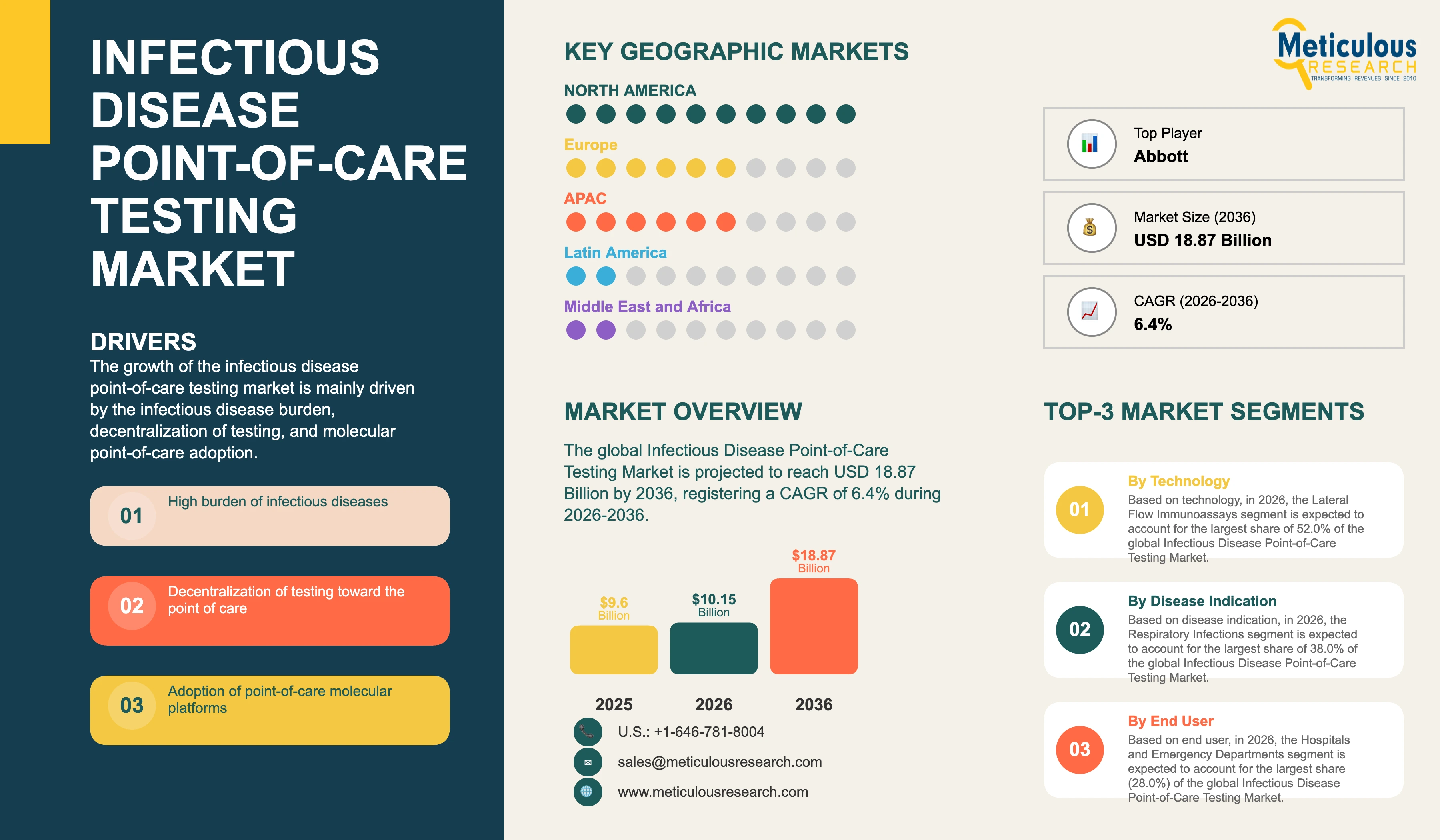
The global infectious disease point-of-care testing market was valued at USD 9.60 billion in 2025. This market is expected to reach USD 18.87 billion by 2036 from an estimated USD 10.15 billion in 2026, registering a CAGR of 6.4% during the forecast period (2026-2036).
- Published
- Nov 2026
- Pages
- 245
- Format
- PDF + Excel
- Report ID
- MRHC - 1042572
- Base year
- 2025
- 2025 · BASELINE
- $9.60B
- 2036
- $18.87B
- CAGR 2026–2036
- 6.4%
2025 baseline · 2026–2036 forecast at 6.4% CAGR · hover a bar for the value
Key highlights
bioMérieux reported sales of EUR 79 million for its BIOFIRE SPOTFIRE point-of-care molecular system in the first half of 2025, an organic increase of 143% year-over-year, and the installed base of SPOTFIRE instruments reached more than 4,600 by mid-2025 compared with about 1,450 a year earlier, after the U.S. FDA expanded the CLIA waiver for its Respiratory/Sore Throat Panel Mini to include anterior nasal swab samples.
Baebies received U.S. FDA 510(k) clearance and a CLIA waiver in 2026 for its FINDER Flu A/B and SARS-CoV-2 test, making FINDER the first point-of-care platform with cleared tests across molecular and other testing modalities, while Autonomous Medical Devices Incorporated received 510(k) clearance and a CLIA waiver in June 2026 for its Fast PCR instrument and Mini Respiratory Panel.
Co-Diagnostics submitted a dual 510(k) and CLIA waiver application to the U.S. FDA in August 2026 for its Co-Dx PCR Flu A/B and RSV multiplex test on the Co-Dx PCR Pro instrument, after completing 27 analytical studies and more than 10,000 test runs, reflecting the growing number of companies developing low-cost point-of-care PCR platforms.
Visby Medical received U.S. FDA clearance and a CLIA waiver in February 2025 for its point-of-care PCR Respiratory Health Test, and it previously secured FDA De Novo authorization for the first over-the-counter PCR sexual health test for women, illustrating the movement of molecular infectious disease testing into clinics and homes.
bioMérieux acquired SpinChip Diagnostics, a developer of point-of-care immunoassay technology, in 2025 to strengthen its future presence in point-of-care testing, while major diagnostics companies, including Abbott, Roche, Danaher's Cepheid, and QuidelOrtho, continue to expand their rapid antigen and point-of-care molecular test menus. Several of these companies are also adding connectivity and data management features to their point-of-care platforms to support quality control and public health reporting.
By product, assays, kits, and reagents account for the largest share in 2026, while software and services register the highest CAGR.
By technology, lateral flow immunoassays account for the largest share of 52.0% in 2026, while molecular diagnostics register the highest CAGR.
By disease indication, respiratory infections account for the largest share of 38.0% in 2026, while sexually transmitted infections register the highest CAGR.
By end user, hospitals and emergency departments account for the largest share in 2026, while retail pharmacies and home care registers the highest CAGR.
By geography, North America accounts for the largest share of 40.0% in 2026, while Asia-Pacific registers the highest CAGR of 8.4%.
Report summary
| Particulars | Details |
|---|---|
| Base Year | 2025 |
| Estimated Year | 2026 |
| Forecast Period | 2026-2036 |
| Market Size in 2025 | USD 9.60 billion |
| Market Size in 2026 | USD 10.15 billion |
| Market Size by 2036 | USD 18.87 billion |
| CAGR (2026-2036) | 6.4% |
| Format | PDF, Excel & Cloud Portal · 245 pages |
| Largest Segment by Technology (2026) | Lateral Flow Immunoassays (52.0%) |
| Largest Segment by Disease Indication (2026) | Respiratory Infections (38.0%) |
| Largest Region (2026) | North America (40.0%) |
| Fastest-Growing Region | Asia-Pacific (CAGR 8.4%) |
| Companies Profiled | 15 companies and other companies |
| Segments Covered | Product, Technology, Disease Indication, End User, Geography |
| Countries Covered | U.S., Canada, Germany, U.K., France, Italy, Spain, Netherlands, Sweden, Switzerland, Poland, Rest of Europe, China, Japan, India, South Korea, Australia, Indonesia, Thailand, Vietnam, Philippines, Malaysia, Rest of Asia-Pacific, Brazil, Mexico, Argentina, Colombia, Chile, Rest of Latin America, South Africa, Nigeria, Kenya, Saudi Arabia, U.A.E., Rest of Middle East & Africa |
Report overview
Segments covered: product, technology, disease indication, end user.
The growth of this market is mainly driven by the high and recurring burden of respiratory infections, HIV, hepatitis, sexually transmitted infections, malaria, tuberculosis, and other infectious diseases, the shift of testing from central laboratories to physician offices, urgent care clinics, pharmacies, and homes, the rapid adoption of point-of-care molecular platforms with laboratory-quality accuracy, growing efforts to combat antimicrobial resistance through faster diagnosis, and global health programs that rely on rapid tests to reach patients in low-resource settings. However, factors such as the lower sensitivity of some rapid antigen tests, reimbursement and pricing pressures, regulatory requirements for CLIA waiver and EU IVDR certification, and the post-pandemic decline in COVID-19 testing are expected to restrain the growth of this market to some extent.
Infectious disease point-of-care testing refers to diagnostic tests for infectious diseases that are performed at or near the site of patient care, rather than in a central laboratory, and that provide results quickly enough to guide treatment decisions during the same patient visit. It includes rapid lateral flow immunoassays, point-of-care molecular tests based on PCR and isothermal amplification, other immunoassays such as agglutination and flow-through tests, and other technologies, together with the instruments, readers, software, and services used to run and manage these tests. This report covers point-of-care testing for respiratory infections, HIV, hepatitis, sexually transmitted infections, malaria and tropical diseases, tuberculosis, and healthcare-associated and other infections, performed in hospitals and emergency departments, physician offices and urgent care clinics, retail pharmacies and home settings, public health and community settings, and other locations. Centralized laboratory infectious disease testing and point-of-care tests for non-infectious conditions, such as glucose and cardiac markers, are analyzed in separate reports. The market is measured on a revenue basis.
Point-of-care testing is important for infectious diseases because rapid diagnosis allows clinicians to start the right treatment immediately, avoid unnecessary antibiotics, isolate infectious patients, and link patients to care before they are lost to follow-up. In outpatient settings, a rapid result can determine whether a patient with respiratory symptoms receives an antiviral, an antibiotic, or neither. In low-resource settings, rapid tests for HIV, malaria, syphilis, and hepatitis allow community health workers and clinics to test and treat patients in a single visit without laboratory infrastructure.
The market changed dramatically during the COVID-19 pandemic, when demand for rapid antigen and point-of-care molecular tests increased sharply and many new tests, platforms, and manufacturers entered the market. After the pandemic, COVID-19 testing volumes fell sharply, which reduced market revenues in 2022 and 2023. However, the pandemic left a lasting legacy: a much larger installed base of point-of-care instruments, greater awareness of rapid testing among clinicians and consumers, regulatory pathways for over-the-counter tests, and multiplex tests that detect COVID-19, influenza, and RSV together. The market has since returned to growth, driven by respiratory panels, molecular platforms, and expansion beyond respiratory testing.
Lateral flow immunoassays account for the largest share of the market by technology, since they are inexpensive, simple to use, and widely used for influenza, COVID-19, strep A, HIV, malaria, syphilis, and hepatitis testing. Point-of-care molecular diagnostics are the fastest-growing technology, supported by platforms such as Abbott ID NOW, Cepheid GeneXpert Xpress, Roche cobas liat, bioMérieux BIOFIRE SPOTFIRE, Visby Medical, and new entrants such as Baebies, Autonomous Medical Devices, and Co-Diagnostics, which provide laboratory-quality PCR results in minutes.
Respiratory infections account for the largest share of the market by disease indication, reflecting the very large number of patients with influenza, COVID-19, RSV, and strep throat seen in outpatient care each year, and the growing use of multiplex respiratory panels. HIV, hepatitis, malaria, and tuberculosis testing are supported by global health programs, while sexually transmitted infection testing is the fastest-growing indication, driven by rising syphilis, gonorrhea, and chlamydia rates and new point-of-care and home tests.
Hospitals and emergency departments are the largest end users, followed by physician offices and urgent care clinics, public health and community settings, and retail pharmacies and home care, which is the fastest-growing end user. North America is the largest regional market, supported by high testing volumes, reimbursement for CLIA-waived tests, and the presence of leading companies, while Asia-Pacific is the fastest-growing region.
The market is served by large diagnostics companies, including Abbott, Roche, Danaher's Cepheid, bioMérieux, QuidelOrtho, and BD, as well as specialized rapid test manufacturers such as SD Biosensor, Wondfo, Biosynex, OraSure Technologies, Trinity Biotech, Sekisui Diagnostics, and Meridian Bioscience, and newer point-of-care molecular companies such as Visby Medical and Baebies. Asian manufacturers, particularly in South Korea and China, supply large volumes of low-cost rapid tests worldwide.
Over the forecast period, the infectious disease point-of-care testing market is expected to grow steadily, supported by the infectious disease burden, decentralization of testing, molecular point-of-care adoption, antimicrobial stewardship, and global health programs. At the same time, pricing pressure, reimbursement, regulatory requirements, and competition will shape the market.
North America is expected to account for the largest share of 40.0% of the market in 2026, mainly due to high testing volumes, many urgent care and retail clinics, reimbursement for CLIA-waived tests, rapid adoption of molecular point-of-care platforms, and the presence of leading companies.
Asia-Pacific is projected to register the highest CAGR of 8.4% during the forecast period, driven by a high infectious disease burden, expanding primary care and pharmacy networks, government health programs, and large local rapid test manufacturing industries.
The report profiles 15 companies, including Abbott, Roche, Danaher (Cepheid), bioMérieux, QuidelOrtho, BD, SD Biosensor, Wondfo, Biosynex, OraSure Technologies, Trinity Biotech, Sekisui Diagnostics, Meridian Bioscience, Visby Medical, and Baebies.
In the U.S., a CLIA waiver allows a test to be performed in settings without a certified laboratory, such as physician offices, urgent care clinics, and pharmacies, which greatly expands the number of sites where the test can be used.
Report infographic
Market dynamics
18 factors across 5 forcesHigh burden of infectious diseases
Infectious diseases remain a major cause of illness, hospitalization, and death in both developed and developing countries. Seasonal influenza, COVID-19, and RSV cause hundreds of millions of infections and millions of hospitalizations each year, and strep throat and other bacterial respiratory infections are among the most common reasons for outpatient visits. HIV, viral hepatitis, malaria, and tuberculosis continue to affect tens of millions of people, mainly in low- and middle-income countries, and sexually transmitted infections such as syphilis, gonorrhea, and chlamydia have increased in many countries. Each of these diseases requires accurate diagnosis to guide treatment and prevent transmission, creating large and recurring demand for testing.
New and re-emerging infections, such as mpox, avian influenza, dengue, and other outbreaks, also periodically create demand for rapid tests and encourage governments to build point-of-care testing capacity for outbreak preparedness.
The ageing of populations in developed countries also increases the number of people at high risk of severe respiratory infections, which supports testing to guide antiviral treatment and infection control in older adults.
Decentralization of testing toward the point of care
Healthcare systems are increasingly moving testing from central laboratories to settings closer to patients, including physician offices, urgent care clinics, retail clinics, pharmacies, nursing homes, and homes. Point-of-care testing reduces the time to diagnosis from days to minutes, avoids repeat visits, and improves patient satisfaction. The growth of urgent care clinics, retail health clinics, and telehealth in the U.S. and other countries has increased demand for CLIA-waived tests that can be performed by non-laboratory staff, and pharmacies in many countries are expanding test-and-treat services for influenza, COVID-19, and strep throat.
The COVID-19 pandemic accelerated this trend by establishing regulatory pathways for home and over-the-counter tests and familiarizing consumers with self-testing, and companies are now developing home tests for other infections, including sexually transmitted infections.
Shortages of laboratory staff in many countries further encourage healthcare providers to adopt simple point-of-care tests that can be performed by nurses, pharmacists, and other non-laboratory personnel.
Adoption of point-of-care molecular platforms
Point-of-care molecular platforms provide PCR-level accuracy in 15 to 30 minutes and can be used in CLIA-waived settings, which overcomes the main limitation of rapid antigen tests, their lower sensitivity. Multiplex molecular panels can detect several respiratory pathogens, such as influenza A and B, SARS-CoV-2, RSV, and strep A, from a single sample, which helps clinicians distinguish between infections with similar symptoms. The commercial momentum of these platforms is strong: bioMérieux reported first-half 2025 SPOTFIRE sales of EUR 79 million, up 143% organically, with an installed base of more than 4,600 instruments, and Baebies, Autonomous Medical Devices, and others received FDA clearances and CLIA waivers for new point-of-care PCR systems in 2026.
The falling cost of molecular instruments and cartridges, the expansion of test menus beyond respiratory infections, and growing evidence that molecular point-of-care testing improves clinical decisions are expected to drive continued adoption.
Antimicrobial resistance and stewardship efforts
Antimicrobial resistance is a major global health threat, and inappropriate use of antibiotics for viral infections is a key contributor. Rapid point-of-care tests that identify the cause of infection allow clinicians to prescribe antibiotics only when needed, and they support antimicrobial stewardship programs in hospitals and outpatient settings. Governments, health systems, and payers are encouraging the use of rapid diagnostics to reduce unnecessary antibiotic prescribing, and new tests that distinguish bacterial from viral infections are being developed and cleared.
Rapid diagnosis of healthcare-associated infections and resistant organisms, such as MRSA and carbapenem-resistant bacteria, also helps hospitals isolate patients quickly and prevent outbreaks.
Global health programs and test-and-treat strategies
International organizations and programs, such as the World Health Organization, the Global Fund, UNITAID, PEPFAR, and national health ministries, rely heavily on rapid tests to diagnose HIV, malaria, syphilis, hepatitis, and tuberculosis in low- and middle-income countries. Rapid diagnostic tests allow community health workers and primary care clinics to test and treat patients in a single visit, which is essential in areas without laboratory infrastructure. WHO prequalification and procurement by global health agencies support large volumes of rapid tests, and new targets for hepatitis elimination, HIV control, and malaria elimination require expanded testing.
Point-of-care molecular tests for tuberculosis and HIV viral load are also being deployed more widely in high-burden countries, supported by global health funding and price agreements.
Table of contents
12 chapters · 168 sections · 245 pages · click to expandSegmental analysis
| Segment | Largest share (2026) | Fastest growth (2026–2036) |
|---|---|---|
| By Product | Assays, kits, and reagents | Software and services |
By Product
- The assays, kits, and reagents segment is expected to account for the largest share of the infectious disease point-of-care testing market, while the software and services segment is projected to register the highest CAGR during the forecast period.
- The hospitals and emergency departments segment is expected to account for the largest share of the infectious disease point-of-care testing market, while the retail pharmacies and home care segment is projected to register the highest CAGR during the forecast period.
Geographic analysis
North America
Largest shareIn 2026, North America is expected to account for the largest share of 40.0% of the global infectious disease point-of-care testing market. The large share of this region is mainly due to high testing volumes for respiratory and sexually transmitted infections, the large number of urgent care and retail clinics, reimbursement for CLIA-waived point-of-care tests, the rapid adoption of point-of-care molecular platforms, the availability of over-the-counter home tests, and the presence of leading companies such as Abbott, Danaher's Cepheid, QuidelOrtho, BD, OraSure Technologies, Visby Medical, Baebies, and Meridian Bioscience. The U.S. is the largest market in the region, followed by Canada. The U.S. FDA's CLIA waiver pathway has enabled a large market for point-of-care tests in non-laboratory settings.
Asia-Pacific
Fastest growthAsia-Pacific is projected to register the highest CAGR of 8.4% during the forecast period. The rapid growth of this region is mainly driven by the high burden of respiratory infections, tuberculosis, hepatitis, dengue, and malaria, expanding primary care and pharmacy networks, government health programs, rising healthcare spending, and large local manufacturing industries in South Korea, China, and India. China, Japan, India, South Korea, Australia, Indonesia, Thailand, Vietnam, the Philippines, and Malaysia are important markets, and South Korean and Chinese manufacturers such as SD Biosensor and Wondfo supply rapid tests worldwide. Japan has a long tradition of rapid influenza testing in clinics, and India's large private healthcare sector and government tuberculosis programs support strong demand for rapid and molecular tests.
Europe
Europe accounts for a significant share of the global market, supported by widespread use of rapid respiratory tests in primary care and hospitals, antimicrobial stewardship policies that encourage point-of-care testing, and leading companies such as Roche, bioMérieux, Biosynex, and Trinity Biotech. The EU In Vitro Diagnostic Regulation has increased regulatory requirements for tests sold in Europe. Germany, the U.K., France, Italy, Spain, the Netherlands, Sweden, Switzerland, and Poland are important markets.
Latin America
Latin America and the Middle East & Africa account for smaller shares of the market but are growing steadily, supported by high burdens of HIV, malaria, tuberculosis, dengue, and other infectious diseases, global health programs, and expanding healthcare access. Sub-Saharan Africa is the largest market for HIV and malaria rapid tests, supported by the Global Fund, PEPFAR, and national programs, while Brazil and Mexico are the largest markets in Latin America. Gulf countries are also investing in point-of-care testing as part of healthcare modernization programs.
Competitive landscape
The global infectious disease point-of-care testing market is moderately consolidated, with the top five players estimated to account for about 45% of the market in 2025. The market includes large diagnostics companies with broad point-of-care portfolios, specialized rapid test manufacturers, point-of-care molecular platform developers, and many regional manufacturers of rapid tests.
Abbott is a leading player, with rapid antigen tests such as BinaxNOW and Panbio, the ID NOW molecular platform, and a large portfolio of HIV, malaria, and other rapid tests for global health. Roche offers the cobas liat molecular platform and rapid antigen tests, Danaher's Cepheid offers the GeneXpert system, which is widely used for tuberculosis, HIV, and respiratory testing, and bioMérieux offers the BIOFIRE SPOTFIRE point-of-care molecular system. QuidelOrtho and BD offer rapid antigen and point-of-care tests for respiratory and other infections. SD Biosensor, Wondfo, Biosynex, OraSure Technologies, Trinity Biotech, Sekisui Diagnostics, and Meridian Bioscience are important rapid test manufacturers, while Visby Medical and Baebies are newer point-of-care molecular companies.
Companies in this market compete on test accuracy, speed, ease of use, test menu breadth, instrument cost and footprint, price per test, regulatory approvals such as CLIA waivers and WHO prequalification, distribution reach, and connectivity. Key strategies include launches of new tests and platforms, expansion of molecular test menus, acquisitions of point-of-care technology companies, partnerships with pharmacies and telehealth providers, and expansion in emerging markets.
Competition is particularly intense in rapid antigen tests, where many manufacturers offer similar products at low prices, while competition in point-of-care molecular testing is increasing as new low-cost platforms enter the market. Large companies benefit from installed bases, broad menus, and established distribution, while smaller companies compete through innovation in cost, speed, and new testing settings such as homes. Distribution partnerships with medical supply companies are also important for reaching physician offices and clinics.
We expect continued consolidation, as large diagnostics companies acquire point-of-care technology developers, as shown by bioMérieux's acquisition of SpinChip, and as smaller companies that grew during the pandemic restructure or exit. Partnerships between test developers and pharmacy chains are also likely to increase.
Some of the key players operating in the infectious disease point-of-care testing market are Abbott Laboratories, F. Hoffmann-La Roche Ltd., Danaher Corporation (Cepheid), bioMérieux S.A., QuidelOrtho Corporation, Becton, Dickinson and Company, SD Biosensor, Inc., Guangzhou Wondfo Biotech Co., Ltd., Biosynex SA, OraSure Technologies, Inc., Trinity Biotech plc, Sekisui Diagnostics, LLC, Meridian Bioscience, Inc., Visby Medical, Inc., and Baebies, Inc., among others.
- —
bioMérieux reported first-half 2025 SPOTFIRE sales of EUR 79 million, up 143% organically, Baebies and Autonomous Medical Devices received FDA clearances and CLIA waivers for point-of-care PCR systems in 2026, and Co-Diagnostics submitted a dual 510(k) and CLIA waiver application for its point-of-care PCR respiratory test in August 2026.
- Abbott Laboratories
- F. Hoffmann-La Roche Ltd.
- Danaher Corporation · Cepheid
- QuidelOrtho Corporation
- Becton
- Dickinson and Company
- SD Biosensor, Inc.
- Guangzhou Wondfo Biotech Co., Ltd.
- Biosynex SA
- OraSure Technologies, Inc.
- Trinity Biotech plc
- Sekisui Diagnostics, LLC
- Meridian Bioscience, Inc.
- Visby Medical, Inc.
- Baebies, Inc.
Expert perspectives
The infectious disease point-of-care testing market has moved beyond the COVID-19 pandemic boom and decline and is entering a phase of steadier, more diversified growth. The pandemic expanded the installed base of point-of-care platforms, normalized rapid and home testing, and accelerated the development of molecular point-of-care technologies, and these changes are now supporting growth in respiratory, sexually transmitted, and other infectious disease testing.
Over the forecast period, the market is expected to grow at a CAGR of 6.4%, from USD 10.15 billion in 2026 to USD 18.87 billion in 2036. Growth will be supported by the infectious disease burden, decentralization of testing, molecular point-of-care adoption, antimicrobial stewardship, and global health programs.
Among the market segments, assays, kits, and reagents are the largest product, while software and services grow fastest. Lateral flow immunoassays are the largest technology, while molecular diagnostics grow fastest, respiratory infections are the largest disease indication, while sexually transmitted infections grow fastest, and hospitals and emergency departments are the largest end users, while retail pharmacies and home care grow fastest. North America is the largest region, and Asia-Pacific is the fastest-growing region at a CAGR of 8.4%.
In our view, the most important change over the forecast period will be the shift from antigen to molecular testing at the point of care. As new platforms reduce instrument and cartridge costs, molecular testing will become standard in physician offices, urgent care clinics, and pharmacies, and eventually in homes. Companies with broad, affordable molecular menus and large installed bases will gain share.
We also expect testing to move further into pharmacies and homes, supported by test-and-treat services, over-the-counter authorizations, and telehealth. This will create new channels and business models, but it will also require simple, reliable tests and digital tools to support users.
Sexually transmitted infections, antimicrobial resistance, and host-response testing are likely to be important growth areas beyond respiratory testing. In low- and middle-income countries, global health programs will continue to drive large volumes of rapid tests, although funding pressures may affect procurement in some years.
Pricing pressure and regulatory requirements will remain challenges, and companies will need to manage costs, diversify their menus, and invest in evidence and approvals to remain competitive. Companies that combine accurate tests, affordable instruments, strong distribution, and digital connectivity are likely to lead the market, while those relying mainly on low-cost antigen tests may face continued margin pressure.
Overall, we believe infectious disease point-of-care testing will become a central part of infectious disease management across healthcare settings, and the market will grow steadily over the forecast period.
Customer perspectives
Medical Director - Urgent care network, U.S.
During the respiratory season our clinics test thousands of patients every single week. We are moving from antigen tests to rapid PCR panels because they give us confidence to prescribe antivirals or avoid antibiotics at the same visit.
“Rapid tests allow our community health workers to test and treat patients in villages without laboratories. Price and reliable supply are our main concerns.”
“Customers increasingly want to be tested and treated for common infections at the pharmacy, so we are expanding testing services and selling more home tests.”
Frequently asked questions
The global infectious disease point-of-care testing market was valued at USD 9.60 billion in 2025, up from USD 9.15 billion in 2024, and is estimated at USD 10.15 billion in 2026. The market includes assays, kits, and reagents, instruments and analyzers, and software and services.
Cite this report
Meticulous Research. (2026). Infectious Disease Point-of-Care Testing Market - Global Opportunity Analysis and Industry Forecast (2026-2036) (Report No. MRHC - 1042572). Meticulous Market Research Pvt. Ltd. https://www.meticulousresearch.com/product/infectious-disease-point-of-care-testing-market-7255