Healthcare Workforce Management Market (2026-2036)
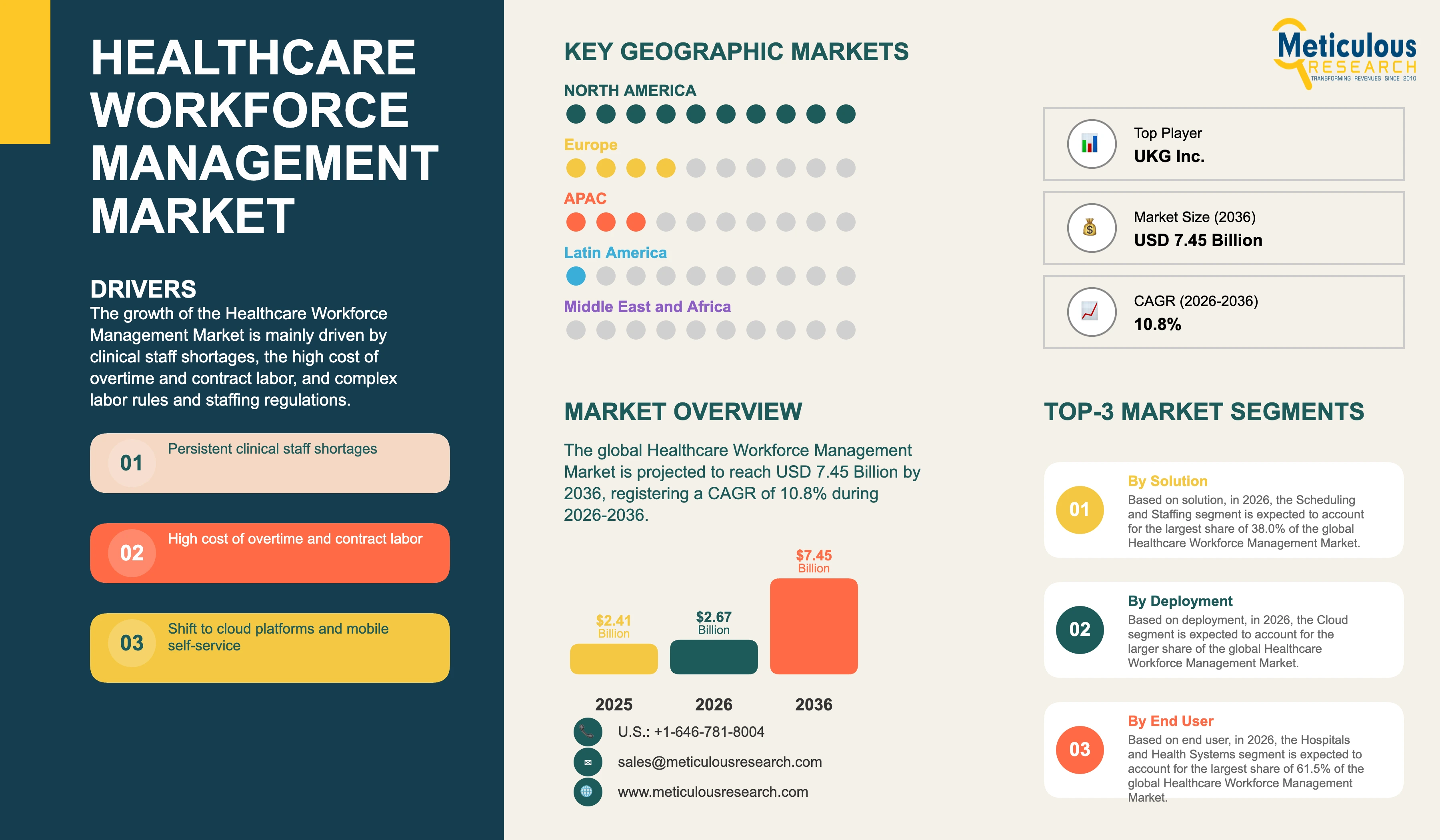
The global healthcare workforce management market was valued at USD 2.41 billion in 2025. This market is expected to reach USD 7.45 billion by 2036 from an estimated USD 2.67 billion in 2026, registering a CAGR of 10.8% during the forecast period (2026-2036).
- Published
- Nov 2026
- Pages
- 280
- Format
- PDF + Excel
- Report ID
- MRHC - 1042580
- Base year
- 2025
- 2025 · BASELINE
- $2.41B
- 2036
- $7.45B
- CAGR 2026–2036
- 10.8%
2025 baseline · 2026–2036 forecast at 10.8% CAGR · hover a bar for the value
Key highlights
Healthcare organizations continue to struggle with staff shortages and high labor costs, and a 2026 survey cited by symplr found that 41% of respondents still manage physician and nurse scheduling fully manually and another 35% describe it as only minimally automated, while only 4% report full automation, which shows the large room for adoption of workforce management technology.
In July 2025, symplr acquired the Smart Square nurse and staff scheduling software from AMN Healthcare for about USD 75 million, combining two Best in KLAS solutions for scheduling and timekeeping. In October 2026, symplr launched symplr Time and Scheduling, an integrated platform that combines AI-driven predictive scheduling with healthcare-specific timekeeping.
UKG reported in February 2026 that nearly 90% of the largest U.S. healthcare systems use its platform for staffing and scheduling and that it serves more than 3,500 hospitals and 10,000 post-acute care facilities, reflecting the strong position of large human capital management vendors in healthcare.
Hospitals and health systems are expanding internal float pools and internal staffing marketplaces to reduce their reliance on expensive travel nurses and agency staff, and vendors such as ShiftWise (AMN), Aya Healthcare, Trusted Health, ShiftMed, and Medely offer platforms that let organizations fill open shifts with their own staff, per diem workers, and contract clinicians.
In the U.K., NHS trusts use e-rostering and staff bank platforms such as RLDatix HealthRoster, Allocate, and Patchwork Health to manage nurse and doctor rotas and to fill shifts internally, as NHS England has pushed trusts to reduce agency spending and make better use of bank staff.
Artificial intelligence is becoming central to the market, as vendors add demand forecasting based on patient census and acuity data, automated schedule creation, shift recommendations, and predictive analytics that identify staffing gaps weeks or months in advance.
By solution, scheduling and staffing accounts for the largest share of 38.0% in 2026, while workforce analytics and predictive staffing registers the highest CAGR.
By component, software accounts for the larger share in 2026 and also registers the higher CAGR.
By deployment, cloud accounts for the larger share in 2026 and also registers the higher CAGR.
By end user, hospitals and health systems account for the largest share of 61.5% in 2026, while home health and hospice providers register the highest CAGR.
By geography, North America accounts for the largest share of 54.5% in 2026, while Asia-Pacific registers the highest CAGR of 14.3%.
Report summary
| Particulars | Details |
|---|---|
| Base Year | 2025 |
| Estimated Year | 2026 |
| Forecast Period | 2026-2036 |
| Market Size in 2025 | USD 2.41 billion |
| Market Size in 2026 | USD 2.67 billion |
| Market Size by 2036 | USD 7.45 billion |
| CAGR (2026-2036) | 10.8% |
| Format | PDF, Excel & Cloud Portal · 280 pages |
| Largest Segment by Solution (2026) | Scheduling and Staffing (38.0%) |
| Largest Segment by End User (2026) | Hospitals and Health Systems (61.5%) |
| Largest Region (2026) | North America (54.5%) |
| Fastest-Growing Region | Asia-Pacific (CAGR 14.3%) |
| Companies Profiled | 17 companies and other companies |
| Segments Covered | Solution, Component, Deployment, End User, Geography |
| Countries Covered | U.S., Canada, U.K., Germany, France, Netherlands, Sweden, Norway, Denmark, Finland, Italy, Spain, Switzerland, Belgium, Ireland, Austria, Rest of Europe, Australia, Japan, China, India, Singapore, South Korea, New Zealand, Malaysia, Thailand, Indonesia, Philippines, Rest of Asia-Pacific, Brazil, Mexico, Colombia, Chile, Argentina, Rest of Latin America, Saudi Arabia, U.A.E., Qatar, Israel, South Africa, Rest of Middle East & Africa |
Report overview
Segments covered: solution, component, deployment, end user.
The growth of this market is mainly driven by persistent shortages of nurses and other clinical staff, the high cost of overtime and contract labor for hospitals and health systems, the need to comply with complex labor rules, union agreements, and nurse staffing regulations, the shift from manual and spreadsheet-based scheduling to cloud-based platforms, the use of artificial intelligence for demand forecasting and predictive staffing, the growth of internal float pools and gig-style staffing marketplaces, and the focus on reducing clinician burnout through flexible and self-service scheduling. However, factors such as tight hospital IT budgets, the complexity of implementing and integrating workforce systems with electronic health records, human resources, and payroll platforms, and resistance to change among managers and staff are expected to restrain the growth of this market to some extent.
Healthcare workforce management refers to software and services that help healthcare organizations plan, schedule, deploy, track, and pay their clinical and non-clinical staff. It includes nurse and staff scheduling, physician scheduling, time and attendance, absence and leave management, credentialing and compliance management, internal float pools and staffing marketplaces, labor productivity analytics, and predictive staffing tools. This report covers the global revenue from healthcare-specific workforce management software and related implementation, integration, and support services sold to hospitals and health systems, ambulatory care centers and physician groups, long-term and post-acute care facilities, and home health and hospice providers.
Labor is the largest cost for most healthcare providers, often accounting for half or more of total operating expenses in hospitals. At the same time, healthcare faces serious and lasting staff shortages. Nurses, nursing assistants, and other clinicians have left the workforce or reduced their hours since the COVID-19 pandemic, and aging populations are increasing demand for care. The World Health Organization projects a global shortfall of millions of health workers by 2030, and the U.S. Health Resources and Services Administration projects continued shortages of registered nurses and other clinicians over the next decade.
These pressures make workforce management a strategic priority for healthcare leaders, because hospitals need to match staffing to patient demand, which changes by hour, day, and season, while meeting nurse-to-patient ratio requirements, union agreements, overtime limits, and staff preferences. Poor scheduling leads to understaffing, which affects patient safety and staff burnout, or overstaffing, which raises costs. During the pandemic, many hospitals relied heavily on travel nurses and agency staff, whose rates rose sharply, and many are now working to reduce these costs by improving internal scheduling and building internal staffing pools.
Healthcare workforce management differs from general workforce management in other industries because of complex 24/7 shift patterns, many different roles and skill levels, clinical competency and license requirements, on-call and premium pay rules, union contracts, and regulations on staffing ratios and working hours. Specialized healthcare vendors such as symplr, QGenda, RLDatix, HealthStream, and Kronos's successor UKG with its healthcare solutions have built products designed for these needs, while large enterprise software vendors such as Workday, Oracle, Infor, and SAP offer workforce management as part of broader human capital management suites.
Cloud-based software has become the standard for new deployments, since cloud platforms allow staff to view schedules, swap shifts, and pick up open shifts on their phones, give managers real-time visibility of staffing across units and facilities, and make it easier to update the system as rules and regulations change. Many health systems are replacing older on-premise systems with cloud platforms, often as part of broader human resources and enterprise resource planning modernization projects. Cloud delivery also makes it easier for vendors to add new features, such as AI scheduling assistants, without lengthy upgrade projects.
Artificial intelligence and analytics are now a major focus, and vendors use data from electronic health records on patient census, admissions, discharges, and acuity to forecast staffing needs, recommend schedules, and identify gaps before they occur. Predictive analytics can also identify staff at risk of burnout or turnover, while labor productivity dashboards help executives compare staffing and costs across units and facilities. These tools are moving workforce management from a back-office scheduling function to a strategic planning capability that links staffing decisions with patient demand, quality outcomes, and financial performance.
The market includes specialized healthcare workforce vendors, large human capital management vendors, healthcare staffing companies with technology platforms, and newer staffing marketplace startups. Leading companies include UKG Inc., symplr, QGenda, RLDatix, Workday, Oracle, Infor, HealthStream, AMN Healthcare, Aya Healthcare, ShiftMed, Trusted Health, and Medely.
Over the forecast period, the healthcare workforce management market is expected to grow steadily as healthcare organizations replace manual and legacy systems, adopt AI-driven scheduling and predictive staffing, expand internal float pools and marketplaces, and integrate workforce data with clinical and financial systems. Growth will be strongest in analytics, predictive staffing, and internal staffing marketplaces, and in emerging markets where hospitals are modernizing their operations.
Report infographic
Market dynamics
16 factors across 5 forcesPersistent clinical staff shortages
The most important driver of the healthcare workforce management market is the ongoing shortage of nurses and other clinical staff. Many nurses left hospital work during and after the COVID-19 pandemic because of burnout, stress, and better opportunities elsewhere, and turnover among registered nurses and nursing assistants remains high in many countries. At the same time, aging populations are increasing the number of patients and the complexity of care, especially in hospitals, long-term care, and home health.
With limited staff available, healthcare organizations must make the best possible use of every nurse and clinician. Workforce management systems help them match staff to patient demand, fill gaps quickly, avoid unnecessary overtime, and deploy staff with the right skills and credentials to the units that need them most. They also help managers identify patterns of understaffing and plan recruitment and training.
Staff shortages also affect patient safety and quality of care, since studies have linked low nurse staffing levels to higher rates of patient complications and mortality. Regulators, accreditation bodies, and patients increasingly expect hospitals to show that they are staffing safely, which makes accurate scheduling and staffing data more important. Accurate staffing records are also needed to report to regulators and to support quality improvement programs.
High cost of overtime and contract labor
Labor costs have risen sharply for healthcare providers, driven by higher wages, overtime, incentive pay for extra shifts, and heavy use of travel nurses and agency staff during and after the pandemic. Although contract labor rates have fallen from their peak, many hospitals still spend large amounts on premium labor, and controlling labor costs is a top priority for hospital finance leaders as margins remain under pressure.
Workforce management systems help organizations reduce these costs by giving managers real-time visibility of overtime, premium pay, and contract labor use, by filling shifts first with internal staff, and by forecasting demand so that schedules can be built in advance rather than filled at the last minute. Internal float pools and staffing marketplaces allow hospitals to fill open shifts with their own staff or per diem workers at lower cost than agency staff. Many health systems report significant savings from reducing contract labor through better workforce management. Reducing reliance on contract labor also improves continuity of care, since permanent and internal float staff know the hospital, its systems, and its patients better than temporary workers.
Complex labor rules, union agreements, and staffing regulations
Healthcare organizations must comply with complex rules on pay, working hours, breaks, overtime, on-call duties, and staffing levels. In the U.S., several states, including California and Oregon, have laws that set minimum nurse-to-patient ratios or require hospital staffing committees and staffing plans, and more states are considering similar laws. Union agreements often add further rules on scheduling, seniority, and premium pay. In Europe, the Working Time Directive limits working hours, and national rules and collective agreements govern shift patterns and pay.
Manual scheduling makes it very difficult to comply with these rules consistently, and errors can lead to pay disputes, grievances, fines, and legal action. Workforce management systems embed compliance rules into scheduling and timekeeping, check schedules against staffing requirements, calculate pay accurately, and keep records for audits. Vendors that offer healthcare-specific compliance capabilities, such as symplr's integrated Time and Scheduling platform, are well placed in this environment. The CMS minimum staffing standards for nursing homes, and similar rules in other countries, are adding further compliance requirements for long-term care providers.
Shift to cloud platforms and mobile self-service
Healthcare organizations are moving from on-premise and spreadsheet-based workforce systems to cloud platforms. Cloud systems are easier to update, can scale across multi-hospital health systems, and support mobile apps that allow staff to view schedules, request time off, swap shifts, and pick up open shifts from their phones. Mobile self-service is especially important for younger nurses and clinicians, who expect flexible and convenient scheduling, and it reduces the administrative workload for managers.
Large health systems are also consolidating their workforce systems as part of broader human resources and enterprise resource planning projects with vendors such as Workday, Oracle, UKG, and Infor. These projects often replace several older systems at once and create demand for new scheduling, timekeeping, and analytics capabilities.
Table of contents
12 chapters · 175 sections · 280 pages · click to expandSegmental analysis
| Segment | Largest share (2026) | Fastest growth (2026–2036) |
|---|---|---|
| By Solution | Scheduling and staffing | Workforce analytics and predictive staffing |
By Solution
- The software segment is expected to account for the larger share of the healthcare workforce management market, and it is also projected to register the higher CAGR during the forecast period.
Geographic analysis
North America
Largest shareIn 2026, North America is expected to account for the largest share of 54.5% of the global healthcare workforce management market. The large share of this region is mainly due to the large size and high labor costs of the U.S. healthcare system, severe nurse shortages and heavy use of contract labor, complex state nurse staffing laws and union agreements, high adoption of cloud-based human capital management systems among U.S. health systems, and the presence of leading vendors such as UKG, symplr, QGenda, Workday, Oracle, Infor, HealthStream, and AMN Healthcare. Canada is also an important market, with provincial health systems investing in scheduling and staffing tools to address nurse shortages.
Europe
Europe is the second-largest market, led by the U.K., Germany, France, the Netherlands, and the Nordic countries. In the U.K., NHS trusts widely use e-rostering systems, such as RLDatix HealthRoster, and staff bank platforms, such as Patchwork Health and Allocate, and NHS England has encouraged trusts to adopt e-rostering and e-job planning for all clinical staff and to reduce agency spending. In continental Europe, hospitals are modernizing workforce systems to comply with working time rules and address nursing shortages, with vendors such as SAP, ATOSS, Dedalus, and local specialists playing important roles. Sweden, Norway, Denmark, and Finland have highly digitalized public hospital systems, while Italy, Spain, Switzerland, Belgium, Ireland, and Austria are modernizing hospital rostering and timekeeping to address nurse shortages and comply with working time rules.
Asia-Pacific
Fastest growthAsia-Pacific is projected to register the highest CAGR of 14.3% during the forecast period. The rapid growth of this region is mainly driven by the rapid expansion of hospital capacity in China, India, and Southeast Asia, growing investment in hospital digitalization and human resources systems by large private hospital groups, aging populations and nursing shortages in Japan, South Korea, Singapore, and Australia, and government programs that promote digital health. Australia and New Zealand already have well-developed workforce management markets, while India and Southeast Asia offer strong growth potential as private hospital chains expand. New Zealand, Malaysia, Thailand, Indonesia, and the Philippines are also investing in hospital digitalization, with large private hospital groups such as IHH Healthcare and Bangkok Dusit Medical Services adopting cloud-based workforce tools.
Latin America
Latin America and the Middle East & Africa account for smaller shares of the market, but they are expected to grow steadily. In Latin America, private hospital groups in Brazil, Mexico, Colombia, and Chile are adopting cloud-based scheduling and timekeeping tools to manage growing workforces. Local partners and system integrators play a key role in these markets.
Middle East & Africa
In the Middle East, Saudi Arabia, the U.A.E., and Qatar are investing heavily in new hospitals and digital health systems, and large hospital groups are adopting workforce management platforms as part of broader transformation programs. Qatar, Israel, South Africa, and Argentina are also expected to contribute to growth as hospital groups modernize their human resources systems.
Competitive landscape
The global healthcare workforce management market is moderately fragmented, with the top five players estimated to account for about 40% of the market in 2025. The market includes large human capital management and enterprise software vendors, specialized healthcare workforce and operations software vendors, healthcare staffing companies with technology platforms, and staffing marketplace startups.
UKG is a leading vendor of time and attendance, scheduling, and human capital management software for hospitals, with a very large installed base among U.S. health systems. symplr has built a broad healthcare operations platform, including nurse and staff scheduling, physician scheduling, timekeeping, credentialing, and provider data management, and strengthened its position with the acquisition of Smart Square from AMN Healthcare in 2025. QGenda is a leader in physician and provider scheduling, while Workday, Oracle, and Infor offer workforce management as part of human capital management and enterprise resource planning suites used by many large health systems.
RLDatix, through HealthRoster and Allocate, is a leading vendor in the U.K. and other markets, while HealthStream offers scheduling and credentialing solutions for U.S. hospitals. Healthcare staffing companies such as AMN Healthcare (ShiftWise and WorkWise) and Aya Healthcare offer vendor management systems and internal staffing marketplace technology, while startups such as ShiftMed, Trusted Health, Medely, Nomad Health, and Patchwork Health provide on-demand staffing platforms. These marketplace companies compete with and also partner with traditional scheduling vendors, since health systems want open shifts to flow smoothly from scheduling systems into marketplaces.
Companies compete on healthcare-specific functionality, ease of use for managers and staff, AI and analytics capabilities, compliance with labor rules and staffing regulations, integration with EHR, human resources, and payroll systems, implementation speed, customer support, and price. Recognition in KLAS Research rankings is an important factor in vendor selection among U.S. hospitals. Key strategies include product innovation in AI-driven scheduling and analytics, platform consolidation through acquisitions, partnerships with EHR and human resources vendors, expansion into post-acute and home care, and international expansion.
Competition is expected to increase as large human capital management vendors add healthcare-specific capabilities and as specialized vendors broaden their platforms. We expect further consolidation, with private equity-backed vendors acquiring point solutions in credentialing, analytics, and staffing marketplaces to build end-to-end healthcare workforce platforms.
Some of the key players operating in the healthcare workforce management market are UKG Inc., symplr, QGenda, LLC, RLDatix, Workday, Inc., Oracle Corporation, Infor, Inc., HealthStream, Inc., AMN Healthcare Services, Inc., Aya Healthcare, Inc., ShiftMed, LLC, Trusted Health, Inc., Medely, Inc., and Patchwork Health Ltd., among others.
- —
symplr acquired the Smart Square scheduling software from AMN Healthcare for about USD 75 million in 2025 and launched symplr Time and Scheduling in October 2026, UKG reported in 2026 that nearly 90% of the largest U.S. health systems use its platform, and vendors across the market are adding AI-driven forecasting and scheduling capabilities.
- UKG Inc.
- QGenda, LLC
- RLDatix
- Workday, Inc.
- Oracle Corporation
- Infor, Inc.
- HealthStream, Inc.
- AMN Healthcare Services, Inc.
- Aya Healthcare, Inc.
- ShiftMed, LLC
- Trusted Health, Inc.
- Medely, Inc.
- Patchwork Health Ltd.
Expert perspectives
The healthcare workforce management market is benefiting from a lasting shift in how healthcare organizations view labor. Staff shortages and high labor costs after the pandemic have made workforce management a board-level priority, and hospitals that once relied on manual scheduling and agency staff are now investing in platforms that help them forecast demand, fill shifts internally, and comply with complex rules. We expect this to remain one of the most important areas of healthcare operations technology over the next decade.
Over the forecast period, the market is expected to grow at a CAGR of 10.8%, from USD 2.67 billion in 2026 to USD 7.45 billion in 2036. Growth will be supported by the replacement of manual and legacy systems, the adoption of AI-driven predictive staffing, the expansion of internal float pools and marketplaces, and growing adoption in post-acute care, home health, and emerging markets.
Scheduling and staffing remains the largest solution, while workforce analytics and predictive staffing grows fastest. Cloud deployment dominates and grows faster than on-premise, and hospitals and health systems remain the largest end user, while home health and hospice providers grow fastest. North America remains the largest region, and Asia-Pacific is the fastest-growing region at a CAGR of 14.3%.
For vendors, the key priorities are to deliver reliable AI forecasting and scheduling that staff trust, to integrate scheduling, timekeeping, credentialing, and analytics into unified platforms, to offer strong integrations with EHR and human resources systems, and to provide clear evidence of savings in overtime, contract labor, and administrative time. Vendors should also design tools that support flexible work and staff wellbeing, since retention is as important as cost control for healthcare employers.
We expect the competitive landscape to be shaped by consolidation and by competition between large human capital management suites and specialized healthcare vendors. Health systems that have standardized on enterprise suites may prefer workforce modules from the same vendor, while those with complex scheduling needs may continue to choose specialized healthcare products. Vendors that combine deep healthcare expertise with modern cloud and AI capabilities are likely to gain share. Pricing models are also likely to change, with more vendors linking fees to outcomes such as reductions in contract labor spending.
In our view, the most important long-term change will be the use of workforce data in clinical and financial decision-making. Health systems that connect staffing data with patient outcomes, quality metrics, and financial performance will be able to manage labor more strategically, and workforce management platforms will become a core part of healthcare enterprise systems.
Customer perspectives
Buyers of healthcare workforce management solutions include chief nursing officers, chief human resources officers, chief financial officers, staffing office directors, nurse managers, and IT leaders at hospitals, health systems, physician groups, long-term care facilities, and home health agencies. Their purchase decisions depend mainly on healthcare-specific functionality, ease of use, integration, compliance, AI capabilities, and proven cost savings.
Chief Nursing Officer - multi-hospital health system, U.S.
Our biggest goal is to reduce our reliance on travel nurses while keeping safe staffing on every unit. We need to see staffing gaps weeks ahead, fill them with our own float pool, and give nurses flexibility to pick up shifts from their phones.
This comment explains why scheduling and staffing accounts for 38.0% of the market, why hospitals and health systems account for 61.5% of the market, and why North America accounts for 54.5% of the market. It also shows why predictive staffing and internal staffing marketplaces are growing quickly.
Director of Workforce Planning - NHS acute trust, U.K.
E-rostering and our staff bank platform have helped us move shifts from agencies to our own bank staff. The next step is to use our activity and acuity data to plan staffing more accurately across the year.
This comment explains why Europe is the second-largest market and why workforce analytics and predictive staffing is the fastest-growing solution.
Chief Operating Officer - home health and hospice agency, U.S.
We schedule hundreds of caregivers across thousands of patient homes every week, and we still rely too much on phone calls and spreadsheets. We need a system that handles scheduling, visit verification, and payroll together.
This comment explains why home health and hospice providers are the fastest-growing end user and why cloud-based platforms are preferred.
Frequently asked questions
The global healthcare workforce management market was valued at USD 2.41 billion in 2025, up from USD 2.18 billion in 2024, and is estimated at USD 2.67 billion in 2026. The market includes healthcare-specific scheduling, timekeeping, analytics, staffing marketplace, credentialing, and absence management software and related services.
Cite this report
Meticulous Research. (2026). Healthcare Workforce Management Market - Global Opportunity Analysis and Industry Forecast (2026-2036) (Report No. MRHC - 1042580). Meticulous Market Research Pvt. Ltd. https://www.meticulousresearch.com/product/healthcare-workforce-management-market-7263