Healthcare Revenue Cycle Management Market (2026-2036)
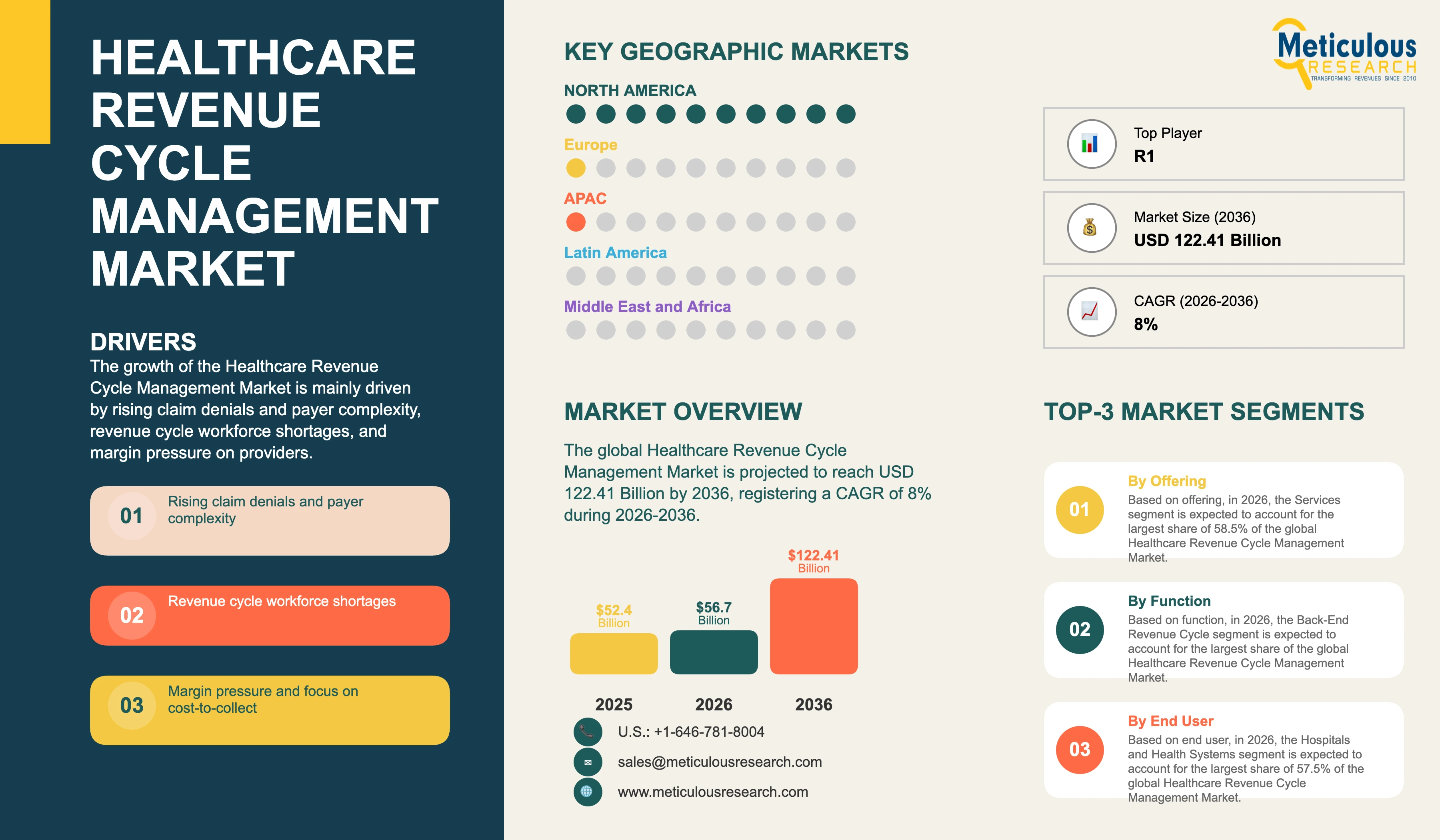
The global healthcare revenue cycle management market was valued at USD 52.40 billion in 2025. This market is expected to reach USD 122.41 billion by 2036 from an estimated USD 56.70 billion in 2026, registering a CAGR of 8.0% during the forecast period (2026-2036).
- Published
- Nov 2026
- Pages
- 255
- Format
- PDF + Excel
- Report ID
- MRHC - 1042581
- Base year
- 2025
- 2025 · BASELINE
- $52.40B
- 2036
- $122.4B
- CAGR 2026–2036
- 8.0%
2025 baseline · 2026–2036 forecast at 8.0% CAGR · hover a bar for the value
Key highlights
Waystar, a leading healthcare payment software company, reported first-quarter 2026 revenue of USD 313.9 million, up 22% year-on-year, and said it serves about 30,000 clients representing more than 1 million providers while processing more than 7.5 billion healthcare payment transactions each year. Waystar also completed its USD 1.25 billion acquisition of AI-driven revenue cycle company Iodine Software to extend into the mid-revenue cycle.
Waystar's leadership has described the revenue cycle labor pool in the U.S. as about USD 100 billion and has said that new AI capabilities for denials, prior authorization, and payment recoupment can automate a meaningful share of this work, which shows how AI is expanding the addressable market for revenue cycle software.
R1, which was taken private in November 2024 in an USD 8.9 billion deal by TowerBrook Capital Partners and Clayton, Dubilier and Rice, has built its Phare Operating System platform and agreed in 2026 to acquire Humata Health, a provider of AI-powered touchless prior authorization, to automate more of the revenue cycle.
KLAS Research's Revenue Cycle Management Suites 2026 report rated Waystar the top suite vendor among organizations using three or more modules from a single vendor, while Black Book Research's first-quarter 2026 Agentic and Generative AI Revenue Cycle Management Benchmark also ranked Waystar first overall.
PitchBook reported in 2026 that private equity investors have made about USD 42.9 billion of revenue cycle management deals since 2017, including a recently announced USD 12 billion acquisition of Ensemble Health Partners, while warning that agentic AI could compress outsourcing fees and cost-to-collect over time.
Health systems continue to sign large outsourcing and co-sourcing agreements in 2026, including IU Health's strategic collaboration with Ensemble Health Partners and Stamford Health's agreement with Ensemble, as rising denials, reimbursement pressure, and staffing challenges push providers to seek external expertise.
By offering, services account for the larger share of 58.5% in 2026, while software registers the higher CAGR.
By function, back-end revenue cycle accounts for the largest share in 2026, while mid-revenue cycle registers the highest CAGR.
By deployment, cloud accounts for the larger share in 2026 and also registers the higher CAGR.
By end user, hospitals and health systems account for the largest share of 57.5% in 2026, while post-acute, home health, and behavioral health providers register the highest CAGR.
By geography, North America accounts for the largest share of 78.5% in 2026, while Asia-Pacific registers the highest CAGR of 11.8%.
Report summary
| Particulars | Details |
|---|---|
| Forecast Period | 2026-2036 |
| Base Year | 2025 |
| Estimated Year | 2026 |
| CAGR (Value) | 8.0% |
| Format | PDF, Excel & Cloud Portal · 255 pages |
| Market Size (Value) in 2025 | USD 52.40 billion |
| Market Size (Value) in 2026 | USD 56.70 billion |
| Market Size (Value) by 2036 | USD 122.41 billion |
| Largest Segment by Offering (2026) | Services (58.5%) |
| Largest Segment by End User (2026) | Hospitals and Health Systems (57.5%) |
| Largest Region (2026) | North America (78.5%) |
| Fastest-Growing Region | Asia-Pacific (CAGR 11.8%) |
| Segments Covered | Offering, Function, Deployment, End User, Geography |
| Countries Covered | U.S., Canada, U.K., Germany, France, Netherlands, Italy, Spain, Switzerland, Ireland, Sweden, Norway, Denmark, Finland, Belgium, Rest of Europe, India, China, Japan, Australia, South Korea, Singapore, Philippines, Malaysia, Thailand, Indonesia, New Zealand, Rest of Asia-Pacific, Brazil, Mexico, Colombia, Chile, Argentina, Rest of Latin America, Saudi Arabia, U.A.E., Qatar, Israel, South Africa, Rest of Middle East & Africa |
| Key Companies | 15 companies and other companies |
Report overview
Segments covered: offering, function, deployment, end user.
The growth of this market is mainly driven by rising claim denials and growing complexity in payer rules and prior authorization, persistent shortages of revenue cycle staff such as coders, billers, and patient access representatives, pressure on hospital and physician practice margins that makes cash collection and cost-to-collect critical, the growth of patient financial responsibility through high-deductible health plans, the shift to value-based and risk-based payment models, and the rapid adoption of artificial intelligence, automation, and agentic AI across front-end, mid-cycle, and back-end revenue cycle processes. However, factors such as the high cost and complexity of replacing legacy systems, data security risks highlighted by large cyberattacks on healthcare clearinghouses, concerns about the quality of offshore outsourcing, and pricing pressure as automation reduces the labor content of revenue cycle work are expected to restrain the growth of this market to some extent.
Healthcare revenue cycle management refers to the administrative and financial processes that healthcare providers use to capture, manage, and collect payment for the services they deliver. The revenue cycle begins when a patient schedules an appointment and continues through registration, insurance eligibility and benefits verification, prior authorization, clinical documentation, medical coding, charge capture, claim submission, payment posting, denial management, patient billing, and collections. This report covers the global revenue from revenue cycle management software and outsourced revenue cycle services sold to hospitals and health systems, physician practices and medical groups, ambulatory surgical centers and diagnostic laboratories, and post-acute, home health, and behavioral health providers.
Revenue cycle management is particularly complex in the U.S., where providers bill hundreds of commercial health plans, Medicare, Medicaid, and Medicare Advantage plans, each with its own coverage rules, prior authorization requirements, and payment policies. Claim denials have risen in recent years, and providers report that external payer dynamics, particularly denials and reimbursement pressure, have become the leading threat to revenue performance. At the same time, patients pay a growing share of their healthcare costs through deductibles and coinsurance, which makes patient collections and price estimates more important.
Providers manage the revenue cycle using a mix of in-house staff, software, and outsourcing. Large health systems often use the revenue cycle modules of their electronic health record, such as Epic or Oracle Health, together with specialized software for eligibility, claims, denials, coding, and patient payments from vendors such as Waystar, Experian Health, FinThrive, and Optum. Many providers also outsource parts or all of their revenue cycle to firms such as R1, Ensemble Health Partners, Optum, Conifer Health Solutions, and AGS Health, either to reduce costs, improve performance, or address staff shortages. Physician practices often use integrated practice management and billing services from vendors such as athenahealth and Ventra Health.
Artificial intelligence is transforming the market, as vendors are using machine learning to predict denials before claims are submitted, automate eligibility checks and prior authorizations, suggest codes from clinical documentation, prioritize accounts for follow-up, generate appeal letters, and estimate patient payments. Agentic AI, in which software agents complete multi-step tasks such as checking a claim status on a payer portal or drafting and submitting an appeal, is now being deployed across the revenue cycle. Large vendors are making major investments and acquisitions to build these capabilities, such as Waystar's acquisition of Iodine Software and R1's acquisition of Humata Health.
The market is also consolidating, as private equity firms have invested heavily in revenue cycle companies, and large software and services vendors are acquiring point solutions to build complete platforms. At the same time, the cyberattack on Change Healthcare in 2024, which disrupted claims processing and payments for many U.S. providers for weeks, highlighted the risks of concentration in clearinghouse and payment infrastructure and led many providers to diversify their vendors and strengthen their contingency plans.
Outside the U.S., revenue cycle management is growing as healthcare systems adopt activity-based funding, private health insurance expands, and hospitals digitalize their billing and claims processes. In the Middle East, mandatory health insurance programs in Saudi Arabia and the U.A.E. have created demand for claims management and coding services, while India and the Philippines are major centers for offshore revenue cycle services that support U.S. providers. In Europe and Asia-Pacific, hospitals are adopting coding, billing, and claims software to manage diagnosis-related group payments and insurance claims.
The market includes revenue cycle software vendors, EHR vendors with revenue cycle modules, outsourcing firms, clearinghouses and payment networks, and specialized AI companies. Leading companies include R1, Optum (UnitedHealth Group), Waystar Holding Corp., Ensemble Health Partners, Oracle Health, Epic Systems Corporation, athenahealth, Inc., Experian Health, FinThrive, Conifer Health Solutions, AGS Health, Availity, Veradigm, and Ventra Health.
Over the forecast period, the healthcare revenue cycle management market is expected to grow steadily, as providers invest in automation and AI to address rising denials and staff shortages, as outsourcing expands among hospitals and medical groups, and as revenue cycle practices spread in international markets. However, automation is also expected to reduce the labor content of revenue cycle work, which could lower prices for some outsourced services and shift spending from services toward software.
Hospitals and health systems are expected to account for the largest share of 57.5% of the market in 2026, while post-acute, home health, and behavioral health providers are projected to register the highest CAGR.
North America is expected to account for the largest share of 78.5% of the market in 2026, mainly due to the complexity of the U.S. healthcare payment system and the presence of nearly all leading vendors.
Asia-Pacific is projected to register the highest CAGR of 11.8% during the forecast period, driven by private hospital and insurance growth, national insurance programs, and offshore revenue cycle services in India and the Philippines.
The report profiles 15 companies, including R1, Optum, Waystar, Ensemble Health Partners, Epic Systems, Oracle Health, athenahealth, Experian Health, FinThrive, Conifer Health Solutions, AGS Health, Availity, Veradigm, Ventra Health, and Infinx.
Report infographic
Market dynamics
16 factors across 5 forcesRising claim denials and payer complexity
Claim denials and payer requirements have become a major source of lost revenue and administrative cost for healthcare providers. Providers report that denial rates have risen in recent years, driven by stricter payer policies, more frequent use of prior authorization, documentation requirements, and automated claim review by payers. Each denied claim requires staff time to investigate, correct, and appeal, and many denials are never recovered, which directly reduces provider revenue.
Prior authorization requirements are a particular burden, as payers require approval before many procedures, imaging studies, and medications. Although CMS has issued rules requiring certain payers to adopt electronic prior authorization interfaces and shorten response times, providers still spend large amounts of staff time on authorizations. Medicare Advantage plans, which now cover more than half of Medicare beneficiaries, are associated with higher denial and authorization burdens for many providers.
These pressures drive demand for denial prediction and prevention tools, prior authorization automation, eligibility and benefits verification, coding and documentation improvement, and appeals management software and services. Vendors that can show measurable reductions in denials and faster recovery of denied claims are in strong demand. Providers are also building payer intelligence capabilities, using data on denial patterns by payer, service, and reason to negotiate contracts and challenge inappropriate denials, which further supports investment in analytics and denial management tools. The growing administrative burden is also a concern for clinicians, since prior authorization delays can postpone care, which adds pressure on providers to automate these processes.
Revenue cycle workforce shortages
Healthcare providers face persistent shortages of revenue cycle staff, including medical coders, billers, patient access representatives, and accounts receivable follow-up specialists. Turnover in these roles is high, and recruiting and training replacements is costly. The work is also becoming more complex, as payer rules change frequently and coding requirements become more detailed.
Staff shortages push providers to adopt automation and AI that can complete routine tasks without human intervention, and to outsource work to firms with large trained workforces in the U.S. and offshore locations such as India and the Philippines. Many outsourcing agreements involve the transfer of provider revenue cycle staff to the outsourcing firm, which then uses technology and process improvements to increase productivity.
Automation also helps providers retain staff by removing repetitive work and allowing employees to focus on complex cases, which improves job satisfaction. This combination of labor savings and better use of skilled staff is a key reason providers are investing in AI-enabled revenue cycle tools.
Margin pressure and focus on cost-to-collect
Hospitals and physician practices face tight operating margins, driven by rising labor and supply costs, slower growth in reimbursement rates, and changes in payer mix. Improving cash collection and reducing the cost of collecting revenue are among the most effective ways for providers to improve their finances, and revenue cycle performance is closely monitored by chief financial officers and boards.
Providers measure revenue cycle performance using metrics such as days in accounts receivable, clean claim rate, denial rate, net collection rate, and cost-to-collect. Software and outsourcing vendors that can improve these metrics, often with performance guarantees or contracts tied to cash collections, are well positioned. This focus on financial outcomes supports continued investment in revenue cycle solutions even when overall IT budgets are constrained. Many outsourcing contracts include guarantees on cash collections or cost-to-collect, which shifts risk to vendors and makes outsourcing more attractive to financially stressed providers.
Growth of patient financial responsibility and price transparency
Patients pay a growing share of healthcare costs through high-deductible health plans, coinsurance, and copayments, which makes patient collections an increasingly important part of provider revenue. Patient balances are harder and more expensive to collect than insurance payments, and confusing bills can damage patient satisfaction and lead to bad debt.
Providers are adopting patient financial engagement tools, including cost estimates, online and mobile payments, payment plans, and financing options, as well as propensity-to-pay analytics. Federal price transparency rules and the No Surprises Act requirement for good faith estimates for uninsured and self-pay patients have also increased demand for accurate patient estimate tools, which are part of the front-end revenue cycle. Providers that offer clear estimates and flexible payment options before care is delivered collect more of what patients owe and reduce bad debt.
Table of contents
12 chapters · 172 sections · 255 pages · click to expandSegmental analysis
By Offering
- The cloud segment is expected to account for the larger share of the healthcare revenue cycle management market, and it is also projected to register the higher CAGR during the forecast period.
Geographic analysis
North America
Largest shareIn 2026, North America is expected to account for the largest share of 78.5% of the global healthcare revenue cycle management market. The large share of this region is mainly due to the size and complexity of the U.S. healthcare system, with its many payers, complex billing and coding rules, high claim denial rates, prior authorization requirements, and growing patient financial responsibility, the widespread use of revenue cycle outsourcing and specialized software by U.S. providers, and the presence of nearly all leading vendors, including R1, Optum, Waystar, Ensemble Health Partners, Epic, Oracle Health, athenahealth, Experian Health, FinThrive, Conifer Health Solutions, and Availity. Canada is a smaller market, where hospitals manage revenue mainly from provincial funding, private insurance, and out-of-province billing.
Europe
Europe is the second-largest market, led by the U.K., Germany, France, the Netherlands, Italy, and Spain. Hospitals in these countries use coding and billing systems to manage diagnosis-related group payments and activity-based funding, and private hospital groups and insurers are adopting claims management and revenue integrity software. Germany's hospital reform and its changes to hospital financing, and the growth of private healthcare in the U.K., Ireland, Switzerland, and the Nordic countries, including Sweden, Norway, Denmark, and Finland, support demand for revenue cycle solutions.
Asia-Pacific
Fastest growthAsia-Pacific is projected to register the highest CAGR of 11.8% during the forecast period. The rapid growth of this region is mainly driven by the expansion of private hospitals and health insurance in India, China, and Southeast Asia, national health insurance programs such as India's Ayushman Bharat, the adoption of diagnosis-related group payment systems in China and other countries, and the role of India and the Philippines as major centers for offshore revenue cycle services. Australia, Japan, South Korea, Singapore, Malaysia, Thailand, Indonesia, and New Zealand are also adopting revenue cycle software to manage insurance claims and hospital billing.
Latin America
Latin America and the Middle East & Africa account for smaller shares of the market but are expected to grow quickly. In Latin America, private hospital groups and insurers in Brazil, Mexico, Colombia, Chile, and Argentina are adopting revenue cycle software and services.
Middle East & Africa
Saudi Arabia, the U.A.E., and Qatar have introduced mandatory health insurance and electronic claims platforms, such as Saudi Arabia's NPHIES platform, creating strong demand for coding, claims management, and denial management solutions, while Israel and South Africa have well-developed private healthcare sectors.
Competitive landscape
The global healthcare revenue cycle management market is fragmented, with the top five players estimated to account for about 25% of the market in 2025. The market includes revenue cycle outsourcing firms, revenue cycle software vendors, EHR vendors with integrated revenue cycle modules, clearinghouses and payment networks, specialty billing companies, and AI-native startups.
R1 is one of the largest revenue cycle outsourcing and technology companies, serving large health systems with end-to-end services and its Phare Operating System, and it is expanding into AI-powered prior authorization with the acquisition of Humata Health. Optum, part of UnitedHealth Group, offers revenue cycle software, clearinghouse services through Change Healthcare, and outsourcing services. Ensemble Health Partners is a fast-growing outsourcing firm with high client satisfaction according to KLAS Research, and it is the subject of a large announced acquisition. Conifer Health Solutions and AGS Health are other important outsourcing and services providers.
Waystar is a leading revenue cycle software and payments company, serving about 30,000 clients, and it has expanded into the mid-revenue cycle through its acquisition of Iodine Software. Experian Health, FinThrive, and Availity offer revenue cycle software across patient access, claims, and payer connectivity. Epic and Oracle Health provide integrated revenue cycle modules within their EHR platforms, while athenahealth, Veradigm, and Ventra Health serve physician practices and specialty groups.
Companies compete on financial outcomes such as cash collections, denial rates, and cost-to-collect, the breadth and integration of their platforms, AI and automation capabilities, payer connectivity, data security, client service, and price. Key strategies include acquisitions of AI and point solution companies, investment in agentic AI, partnerships with health systems, long-term outsourcing agreements, offshore expansion, and outcome-based pricing.
We expect consolidation to continue, as private equity-backed firms and large software vendors acquire specialized companies, and as providers prefer fewer, broader partners. At the same time, AI-native companies are entering the market with automation-focused offerings, which is likely to increase competition and pressure prices for traditional outsourcing services. EHR vendors are also expanding their native revenue cycle automation, which could reduce demand for some third-party point solutions within large health systems.
Some of the key players operating in the healthcare revenue cycle management market are R1, Optum, Inc. (UnitedHealth Group Incorporated), Waystar Holding Corp., Ensemble Health Partners, Epic Systems Corporation, Oracle Health (Oracle Corporation), athenahealth, Inc., Experian Health, FinThrive, Conifer Health Solutions, LLC, AGS Health, Availity, LLC, Veradigm Inc., Ventra Health, and Infinx, Inc., among others.
- —
Waystar reported 22% revenue growth in the first quarter of 2026 and completed its USD 1.25 billion acquisition of Iodine Software, R1 agreed to acquire prior authorization AI company Humata Health, KLAS Research rated Waystar the top revenue cycle suite vendor in 2026, and a USD 12 billion acquisition of Ensemble Health Partners was announced.
- R1
- Optum, Inc. (UnitedHealth Group Incorporated)
- Waystar Holding Corp.
- Ensemble Health Partners
- Epic Systems Corporation
- Oracle Health · Oracle Corporation
- Experian Health
- FinThrive
- Conifer Health Solutions, LLC
- AGS Health
- Availity, LLC
- Veradigm Inc.
- Ventra Health
- Infinx, Inc.
Expert perspectives
The healthcare revenue cycle management market is at the center of one of the most important applications of artificial intelligence in healthcare. Rising denials, staff shortages, and margin pressure have made revenue cycle performance a top priority for provider executives, while AI and automation are changing how revenue cycle work is done. We see the market moving from labor-intensive processes toward AI-native operating models in which software performs most routine tasks and skilled staff focus on complex cases.
Over the forecast period, the market is expected to grow at a CAGR of 8.0%, from USD 56.70 billion in 2026 to USD 122.41 billion in 2036. Growth will be supported by AI-driven automation, the expansion of outsourcing and co-sourcing, the growth of patient financial responsibility, and the modernization of revenue cycle processes in international markets. However, automation is also expected to reduce prices for some services, which will moderate growth in market value compared with the volume of work.
Services remain the larger offering, while software grows faster, and the back-end revenue cycle remains the largest function, while the mid-revenue cycle grows fastest. Cloud deployment accounts for the larger share and grows faster than on-premise. Hospitals and health systems remain the largest end user, while post-acute, home health, and behavioral health providers grow fastest. North America remains by far the largest region, and Asia-Pacific is the fastest-growing region at a CAGR of 11.8%.
For vendors, the key priorities are to deliver measurable financial outcomes, to build or acquire AI capabilities across the revenue cycle, to integrate their platforms and simplify the technology stack for providers, and to strengthen data security. Outsourcing firms will need to adapt their pricing models as automation reduces labor costs, and software vendors will need to show that their AI tools deliver results in real-world conditions.
We expect the balance of power between payers and providers to remain a central issue. As payers use AI to review and deny claims, providers will invest in AI to prevent and overturn denials, and regulators may step in to set rules for automated decisions. Vendors that help providers navigate this environment, and that support both fee-for-service and value-based payment, will be best positioned.
Finally, cybersecurity and resilience will remain critical after the Change Healthcare attack. Providers will continue to diversify their clearinghouse and payment relationships and require stronger security from vendors, which favors companies with robust security, redundancy, and transparent incident response. In our view, resilience will become a standard selection criterion. This will shape vendor choices.
Customer perspectives
Vice President of Revenue Cycle - Multi-hospital health system, U.S.
Denials are now our biggest revenue problem, and we cannot hire enough coders and follow-up staff. We partnered with an outsourcing firm that uses AI to predict denials and automate appeals, and our cash collections have improved.
Director of Health Information Management - Academic medical center, U.S.
Autonomous coding and AI-assisted documentation review are helping us capture the right codes before claims go out, which prevents many denials. The mid-cycle is where we see the biggest gains from AI right now.
“With mandatory insurance and electronic claims, our rejection rates became a serious issue. We are investing in coding, claims scrubbing, and denial management tools adapted to local payer rules.”
Frequently asked questions
The global healthcare revenue cycle management market was valued at USD 52.40 billion in 2025, up from USD 48.60 billion in 2024, and is estimated at USD 56.70 billion in 2026. The market includes revenue cycle management software and outsourced revenue cycle services.
Cite this report
Meticulous Research. (2026). Healthcare Revenue Cycle Management Market - Global Opportunity Analysis and Industry Forecast (2026-2036) (Report No. MRHC - 1042581). Meticulous Market Research Pvt. Ltd. https://www.meticulousresearch.com/product/healthcare-revenue-cycle-management-market-7264